Private Label, White Label, Wholesale partnerships available - EU, USA and UK - Free shipping from €75
What Is Contamination Control in Lab Settings
A researcher receives a high-purity peptide, opens a fresh vial, and starts reconstitution at a bench that looks spotless. The batch later produces an unexpected assay result. The cause might be microbial introduction, a particle from packaging, a residue from a previous process, or a handling mistake that nobody recorded. Visual cleanliness alone can't identify the problem.
That's why laboratory teams need a practical answer to what is contamination control. It's a coordinated system for preventing, detecting, and managing unwanted biological, chemical, and particulate contaminants across facility design, personnel behavior, equipment, materials, storage, and workflows. For procurement teams, the system also extends to supplier qualification, packaging integrity, Certificates of Analysis, and transport conditions.
Table of Contents
- Defining Contamination Control in Modern Laboratories
- Identifying Primary Contamination Sources and Types
- Implementing Engineering and Administrative Controls
- Mastering Material Handling and Reagent Reconstitution
- Establishing Monitoring and Validation Protocols
- Evaluating Suppliers with a Contamination Control Checklist
Defining Contamination Control in Modern Laboratories
Contamination control is best understood as a measurable engineering and quality discipline, not a cleaning checklist. The program begins by identifying what could compromise a reagent, research material, surface, assay, or controlled environment. It then assigns controls to each risk and produces evidence that those controls continue to work.
The ISO 14644 framework gives cleanroom teams a useful foundation. ISO 14644-1 classifies air cleanliness by airborne particle concentration, while ISO 14644-2 provides a monitoring framework for demonstrating ongoing performance. The classification system is deliberately precise. ISO 5 permits 3,520 particles per cubic meter at 0.5 µm and 29 particles per cubic meter at 5.0 µm, whereas ISO 8 permits 3,520,000 particles per cubic meter at 0.5 µm and 29,300 particles per cubic meter at 5.0 µm, as described by the International Organization for Standardization's cleanroom overview. That 1,000-fold difference shows why “the room looks clean” isn't an adequate release criterion.
The control system has a lifecycle
A functional program covers more than the room where a researcher performs an operation. It starts with facility and process design, continues through purchasing and receipt, and reaches the final handling step. The same risk-based logic applies to a production suite, a university laboratory, a peptide research workspace, and a warehouse storing sterile diluents.
A practical system connects:
- Process design: Define which materials and operations are vulnerable, then limit unnecessary exposure.
- People and workflow: Control entry, movement, gowning, talking, handling, and traffic patterns.
- Equipment suitability: Use surfaces and tools that can be cleaned, disinfected, inspected, and maintained.
- Material control: Assess packaging, labels, containers, storage conditions, and transfer routes.
- Verification: Use particle counts, microbial sampling, surface checks, records, and investigation procedures.
The consequences of weak control reach beyond a failed inspection. Contamination can invalidate research data, compromise a batch, delay a study, and make the root cause difficult to reconstruct. A well-designed system reduces those risks by treating every transfer and exposure point as a decision that needs a defined control.
Practical rule: If a team can't state the contaminant, the entry route, the preventive control, and the evidence of effectiveness, the control program is incomplete.
EU GMP Annex 1 reinforces this whole-process approach for sterile manufacturing. It defines bioburden as the total number of microorganisms associated with personnel, air, surfaces, equipment, packaging, raw materials, water, in-process materials, or finished products, according to the European Commission's Annex 1 document. That definition is particularly relevant to laboratories and suppliers because it places incoming materials and handling practices inside the contamination control strategy, rather than treating the cleanroom as an isolated solution.
Identifying Primary Contamination Sources and Types
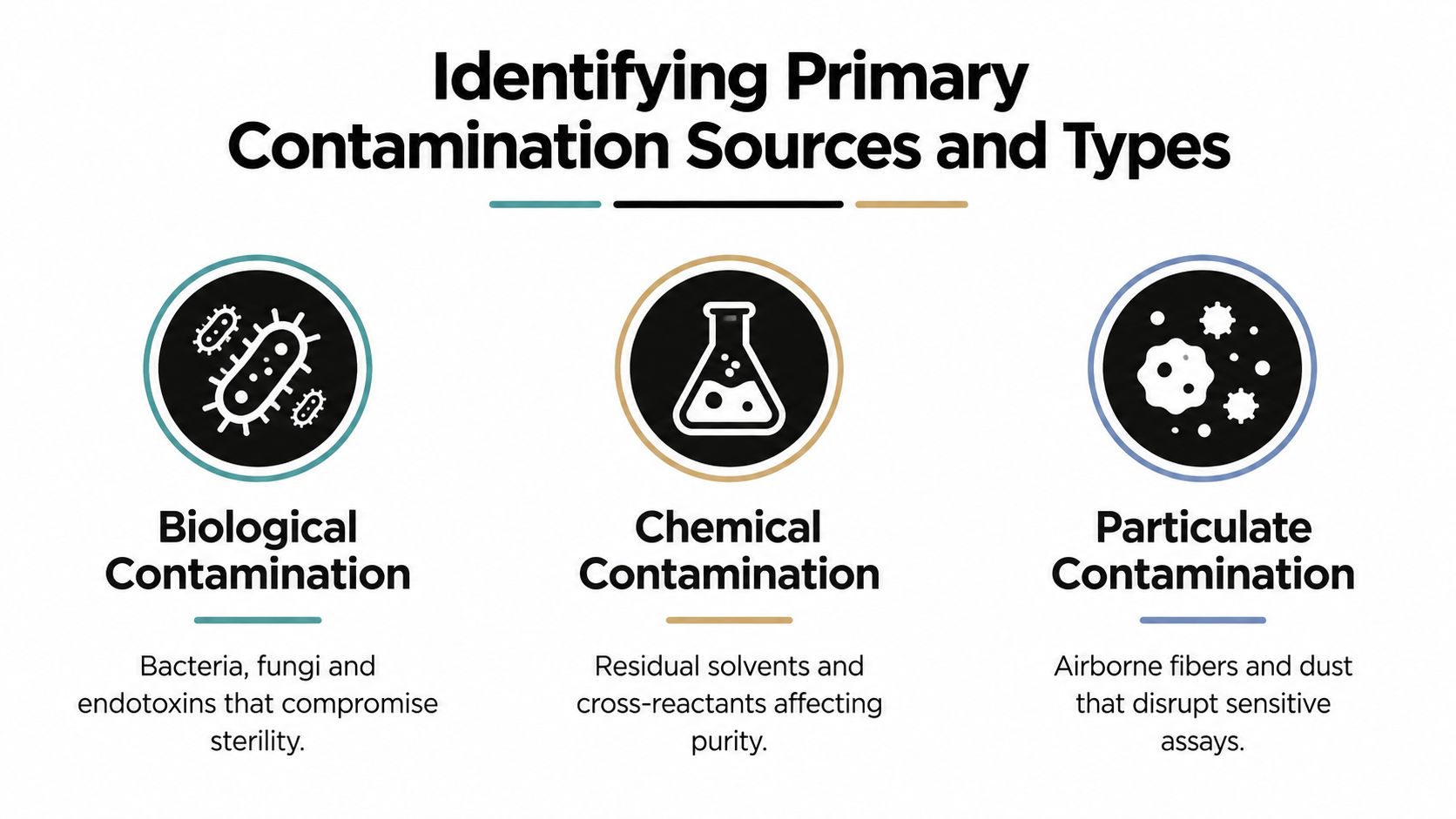
A laboratory can't choose sensible controls until it distinguishes the contaminant from its source. The main categories are biological, chemical, and particulate contamination, and each behaves differently during storage, transfer, preparation, and use.
Biological contamination
Bacteria, fungi, and other microorganisms can enter through personnel, air, surfaces, water, equipment, packaging, or exposed materials. Endotoxins create a related concern because a process may remove viable organisms without removing every harmful residue. A laboratory therefore needs to consider both microbial presence and the conditions that permit microbial growth or transfer.
For peptide researchers and reagent handlers, the vulnerable moment is often not manufacture. It's the transition from sealed container to working solution. A disinfected vial stopper, clean transfer device, controlled workspace, and documented handling sequence each address a different route of introduction. The microbial contamination guidance from Herbilabs provides additional context for recognizing and managing these risks.
Chemical contamination
Chemical contamination includes residual solvents, cleaning agents, lubricants, leachables, and cross-reactants. It may not be visible, and it can alter purity, stability, or assay behavior without producing an obvious change in appearance. Volatile organic compounds deserve separate attention in laboratories with solvents, adhesives, coatings, or nearby industrial processes. The Covenant Aire Solutions VOC guide is a useful resource for understanding why airborne chemical contaminants need a different control strategy from particles.
Particulate contamination
Particles include dust, fibers, skin fragments, packaging debris, and equipment-generated material. ISO 14644-1 classifies air cleanliness through airborne particle counts across the 0.1 µm to 5 µm range, measured with light-scattering particle counters at defined sampling locations, according to the ISO 14644-1 standard page. A target class therefore needs a specified particle-size range and a sampling plan, otherwise two monitoring results may not be comparable.
The largest source is often the person inside the controlled space. Contamination-control literature cited by Precise Group attributes about 70% of total particulate contamination to personnel, compared with equipment at 15%, workstations at 10%, and materials at 5%; other technical summaries estimate personnel at 75–80% (Precise Group's personnel contamination overview). A motionless, fully gowned person can generate roughly 100,000 particles per minute, walking can raise that to about 1,000,000 particles per minute, and active work can reach 5,000,000 particles per minute, from the same source.
That scale explains why a well-engineered HVAC system can't compensate for poor behavior. Fast movements, unnecessary traffic, exposed hair or skin, incorrect gowning, and poorly planned material transfers can defeat a well-qualified room. The strongest response combines engineering barriers with controlled movement, training, and observation.
Implementing Engineering and Administrative Controls
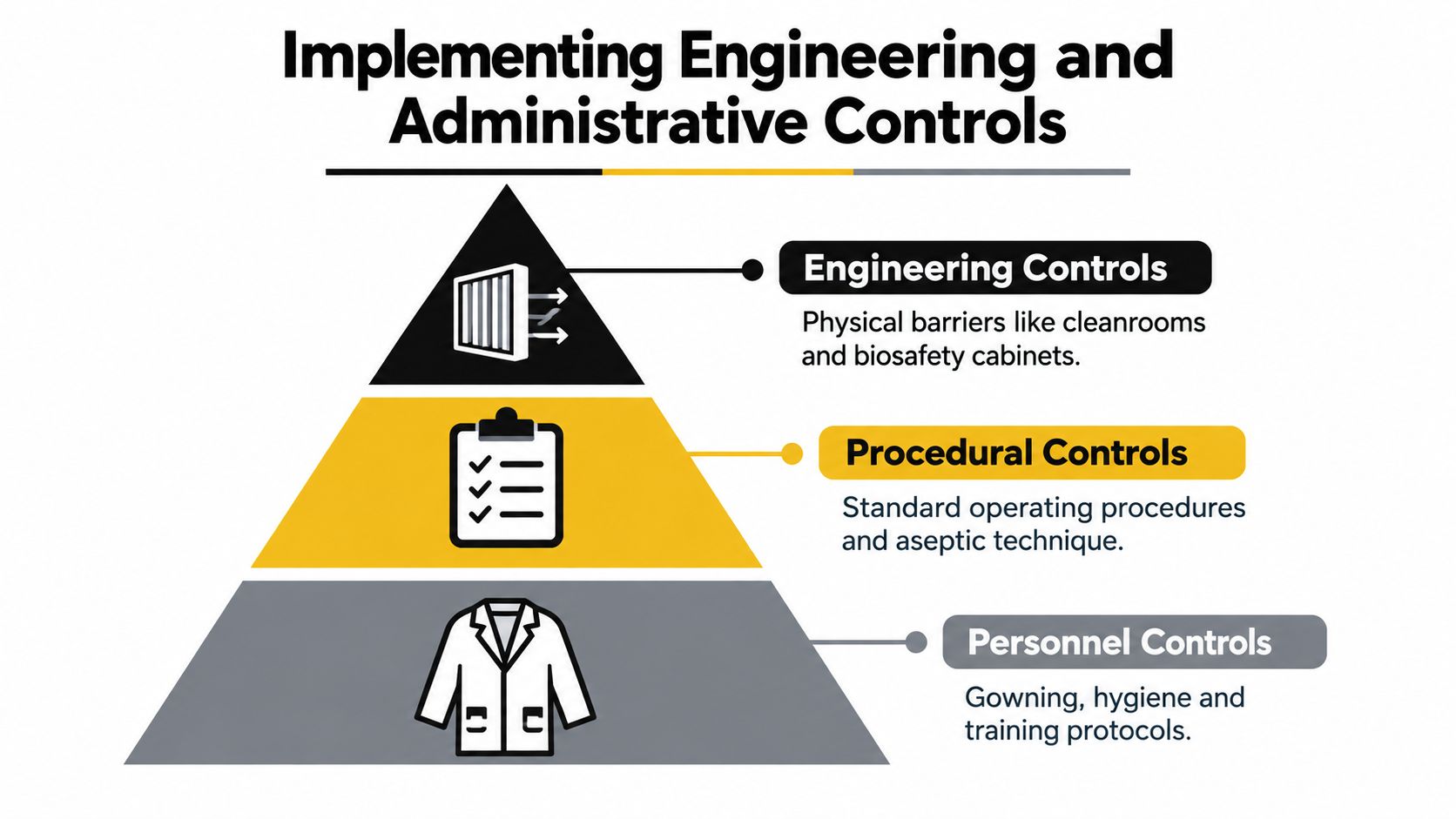
Effective contamination control uses defense in depth. Engineering controls reduce the opportunity for contaminants to enter or move through a workspace. Administrative and personnel controls govern what people do when the physical system can't eliminate exposure entirely.
Start with the physical environment
Facility design should separate cleaner and less-clean activities, define personnel and material routes, and minimize unnecessary door openings. Airflow design, pressure relationships, HEPA filtration, cleanable finishes, and suitable workstations establish the baseline. A biosafety cabinet or other localized barrier can protect an exposed operation when the wider room doesn't provide sufficient control.
EU GMP Annex 1 states that exposed cleanroom surfaces should be smooth, impervious, and unbroken. That specification matters because cracks, joints, rough finishes, and damaged coatings can trap particles or microorganisms and make repeated cleaning less reliable. Equipment selection should therefore include cleanability and maintenance access, not just purchase price or throughput.
Build procedures around actual failure points
A standard operating procedure should describe the sequence that prevents contamination, not merely require staff to “work aseptically.” Useful procedures define:
- Entry and gowning: Specify hand hygiene, garment order, glove changes, and checks before entry.
- Material transfer: Identify what must be wiped, wrapped, staged, or held before entering a controlled area.
- Workstation setup: Limit exposed items and place sterile tools so personnel don't reach over critical surfaces.
- Waste and exit: Prevent used materials, packaging, and waste from crossing clean routes.
- Deviation response: State what happens after a dropped item, damaged package, opened door, or monitoring excursion.
Training must include observation, not just a signed reading record. Supervisors should watch gowning, movement, glove handling, and transfer practices under realistic conditions. A state-of-the-art room still depends on the decisions made inside it.
Match controls to the consequence
Not every laboratory needs the same facility controls. A low-risk analytical preparation may need a different combination of segregation, cleaning, and monitoring from an aseptic operation. The right choice depends on the material, exposure, process sensitivity, and consequence of failure.
The advantages of contamination elimination can help procurement and operations teams frame the business case for prevention, but purchasing a physical barrier alone won't create control. Teams need compatible procedures, maintenance, cleaning records, and evidence that the complete system performs as intended.
The following video can support training discussions about contamination-control principles and workplace behavior:
Operational insight: Engineering controls reduce dependence on perfect behavior. They don't remove the need for training, supervision, or documented response.
Mastering Material Handling and Reagent Reconstitution
Contamination often enters after a material has passed incoming inspection. A sealed vial may be suitable for research use, yet the reconstitution step can introduce particles or microorganisms through a stopper, needle, pipette, glove, work surface, or diluent.

Control the setup before opening anything
The workspace should be cleared of unrelated materials, cleaned using the approved agent, and allowed to reach the required condition before the vial and diluent are opened. Labels, calculations, transfer devices, and waste containers should be ready beforehand. Reaching for supplies after opening a container creates unnecessary movement and increases the time that critical surfaces remain exposed.
Personnel should inspect the vial, stopper, seal, and diluent container before use. Damaged packaging, unclear identification, visible residue, or an unexpected change in appearance should trigger a hold and investigation rather than an attempt to continue.
Treat the stopper as a critical surface
The vial stopper is a common breach point because it sits between a protected interior and repeated external handling. The operator should disinfect it with the approved method, respect the required contact and drying conditions in the applicable procedure, and avoid touching it after disinfection. Gloves that contact a non-clean surface should be changed or disinfected according to the local SOP before the next critical action.
A sterile diluent, including bacteriostatic water where appropriate for the intended research protocol, should be selected for compatibility with the material and the documented use. The container, closure, and transfer device should remain within their stated conditions. A diluent isn't interchangeable with another solution just because both appear clear.
Reconstitute with controlled motion
The transfer device should be sterile and suitable for the volume and container. The operator should avoid touching the needle, pipette tip, or connection points, keep the device from contacting the bench, and introduce liquid in a manner that limits splashing and foaming. Lyophilized materials may be sensitive to vigorous agitation, so the applicable product or research procedure should define whether gentle swirling, controlled inversion, or another technique is appropriate.
Premium glass vials can support inspection and closure integrity, but glass quality doesn't compensate for poor handling. Storage conditions, light exposure, labeling, and post-reconstitution handling must also match the material's documented requirements. A practical guide to reagent reconstitution for experimental success can help researchers standardize the sequence and identify avoidable handling errors.
For multi-dose containers, the risk increases with every access event. The research protocol should define dating, storage, access limits, and disposal criteria. If those criteria aren't established, the operator can't reliably distinguish a valid working solution from one whose integrity has become uncertain.
Establishing Monitoring and Validation Protocols
A contamination control program needs evidence, not assumptions. Monitoring shows whether the environment remains within its intended state, while validation demonstrates that equipment, procedures, and processes can achieve the required result under defined conditions.
Define what must be measured
The monitoring plan should begin with the target environment and the operation's critical risks. For airborne particles, the plan should state the ISO class, particle-size bins, locations, operating state, instrument requirements, sampling frequency, alert limits, action limits, and response process. ISO 14644-2 provides the monitoring framework for demonstrating continuing performance, while ISO 14644-1 supplies the classification basis.
Microbial and surface controls add information that particle counting can't provide. EU GMP Annex 1 treats bioburden as a whole-process concern involving personnel, air, surfaces, equipment, packaging, raw materials, water, in-process materials, and finished products. Monitoring should therefore include the surfaces and materials that can affect the operation, not just room air.
Records should make trends visible. A single result can support an immediate decision, but repeated results help identify recurring locations, shifts, equipment, materials, or behaviors that need corrective action.
Connect incoming material data to environmental data
Supplier documentation is part of the evidence chain. A batch-specific Certificate of Analysis should identify the material, batch, test results, specifications, and approval status in a form that procurement and quality staff can review. The document doesn't replace internal receipt checks, storage controls, or use-specific testing, but it gives the laboratory a defined starting point.
Batch-level bioburden testing is especially relevant for sterile and low-bioburden workflows before sterilizing filtration or final release. Lower upstream bioburden reduces the challenge presented to downstream sterilization or filtration, which supports more consistent processing. The contamination detection resource from Herbilabs offers practical context for recognizing contamination signals and selecting appropriate checks.
Validate, investigate, and improve
Validation should cover installation, operation, and performance under realistic conditions. The team needs to show that the control works when personnel enter, materials move, equipment operates, and the process runs as intended. A cleanroom that passes an initial qualification but lacks routine review isn't a controlled system.
When a result exceeds an alert or action limit, the response should protect affected materials first. Quality staff should assess the event, review recent activity and material movements, identify potential scope, document the investigation, and determine whether corrective action or requalification is necessary. Change control matters as well. A new supplier, altered packaging, revised cleaning agent, moved workstation, or changed traffic route can affect contamination risk even when the room itself hasn't changed.
Evaluating Suppliers with a Contamination Control Checklist
Procurement teams should assess suppliers as part of the laboratory's contamination control system. A low price or attractive lead time doesn't compensate for unclear batch identity, weak packaging, poor storage, or missing quality records.
Compare the supplier evidence
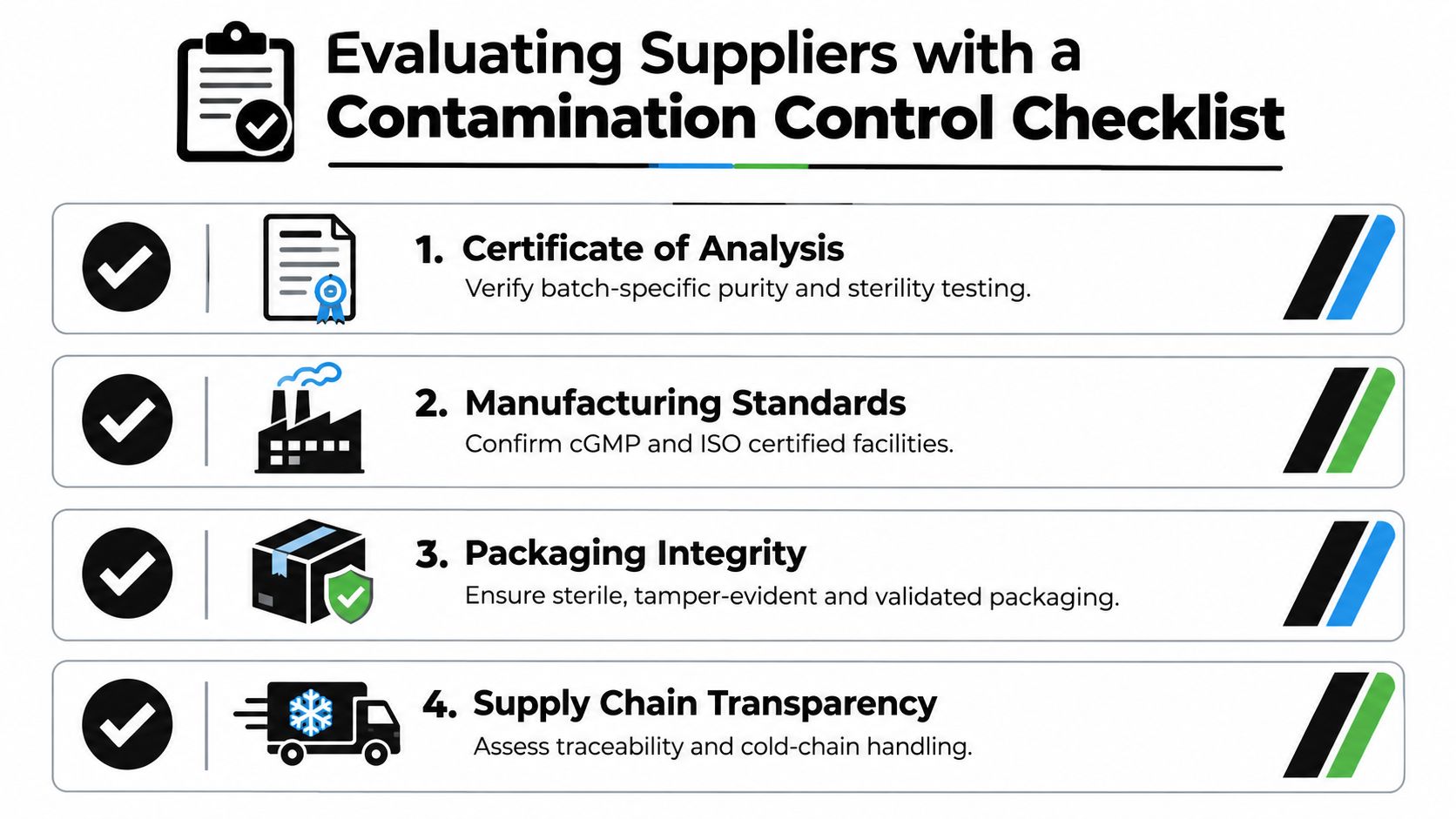
| Evaluation area | Questions for procurement | Why it matters |
|---|---|---|
| Certificate of Analysis | Is the document batch-specific, current, and traceable to the supplied container? Does it identify relevant purity, identity, sterility, or bioburden testing? | A generic specification sheet can't prove what happened to the received batch. |
| Manufacturing standards | Does the supplier explain its manufacturing controls, testing process, and facility qualifications? Are claims about ISO or cGMP status documented? | Clear evidence supports supplier qualification and audit readiness. |
| Packaging integrity | Are vials, closures, seals, labels, and external packaging suitable for the intended handling and transport? | Packaging is a contamination barrier, not a cosmetic feature. |
| Supply chain transparency | Can the supplier describe storage, temperature control, dispatch, traceability, and deviation handling? | A compliant manufacturing step can be undermined by uncontrolled storage or transport. |
Inspect what arrives
Receiving staff should verify the shipment against the purchase order and accompanying documentation. They should check container condition, seals, labels, lot or batch identification, visible damage, and any storage indicators or instructions. Materials with damaged packaging or unexplained discrepancies should be segregated until quality personnel decide whether they can be accepted.
Storage procedures should preserve the material's specified conditions and separate approved, quarantined, rejected, and returned stock. A supplier that communicates quickly after a temperature excursion or packaging issue is easier to manage than one that provides only a generic customer-service response.
For laboratories sourcing sterile diluents and high-purity research reagents, Herbilabs offers batch documentation, premium glass-vial formats, temperature-controlled storage, and Research Use Only supply under its stated terms. That makes the company one supplier option for teams comparing documentation and handling requirements, rather than a substitute for the buyer's own qualification process.
Ask questions before placing a recurring order
A serious supplier review should ask how the company handles out-of-specification results, complaints, recalls, retained samples, label reconciliation, and changes to materials or packaging. Procurement should also confirm whether wholesale or distribution arrangements preserve batch traceability through the final customer.
The strongest supplier relationship produces usable evidence at every handoff. That evidence lets researchers connect a result to a specific material, storage condition, handling record, and corrective action when something goes wrong.
Herbilabs supplies high-purity research reagents and sterile diluents, including bacteriostatic water and reconstitution solutions in premium glass vials, with batch documentation and Research Use Only terms. Visit Herbilabs to review available laboratory supplies and discuss individual, multi-pack, or wholesale requirements with the team.