Private Label, White Label, Wholesale partnerships available - EU, USA and UK - Free shipping from €75
Contamination Detection in the Lab: A Practical Guide
A flask looks clear, the assay controls are within range, and the next sample is already waiting on the bench. Then a routine check raises a question: was the signal produced by the sample, or did contamination enter through a reagent, a surface, an operator, or the equipment used before collection?
That question sits at the center of contamination detection. Reliable work depends on more than a sensitive instrument. It depends on understanding where contaminants originate, selecting a method that measures the right risk, and controlling upstream materials so the cleanest possible result exists before testing begins.
Table of Contents
- Why Contamination Detection Matters More Than Ever
- Where Contamination Actually Comes From
- The Four Main Detection Methods Compared
- Designing a Sampling Strategy You Can Trust
- How Reagent and Diluent Quality Shape Every Result
- Reading Results Without Fooling Yourself
- Why Detection Alone Is Not Enough
- Building a Contamination-Resistant Workflow
Why Contamination Detection Matters More Than Ever
A cell-culture line can look healthy while a hidden contaminant changes the experiment around it. Mycoplasma is a familiar example. It may not create obvious turbidity or rapidly destroy the culture, yet it can alter growth behavior, metabolism, and gene-expression results. A screening PCR may eventually reveal the problem, but by then the line may have supported weeks of work and influenced conclusions that appeared technically sound.
Contamination rarely announces itself. It often appears first as a small shift, an unexplained control result, an unusual culture response, or a result that cannot be reproduced. The laboratory's task is to separate a genuine biological signal from an artifact introduced somewhere along the workflow.
Practical rule: A result is only as trustworthy as the chain of controls protecting the sample before, during, and after collection.
The scale of environmental surveillance shows why this discipline matters beyond one flask. The European Environment Agency reported 1.38 million potentially contaminated sites registered in 2016 across 23 Member States, with 69% confirmed through on-site investigations. Its indicator also projects 2.8 million potentially contaminated sites across the EU-27, based on a dataset spanning collection campaigns from 2001–2006, 2011, and 2016. These figures place contamination screening within a large, continuing monitoring effort, not a niche laboratory activity. The published environmental contamination indicator provides useful context for laboratories and businesses that manage documentation, traceability, and screening workflows.
The same logic applies to food, water, pharmaceutical manufacturing, clinical testing, and research. A Europe-wide food-safety analysis covering 2000–2024 recorded 392,269,911 analytical results from 15,176,473 samples, while 97,254 results were non-compliant, or 0.025% of all results. That pattern illustrates the challenge: detection systems must identify rare failures within very large volumes of apparently acceptable material. The U.S. Environmental Protection Agency's Superfund data resources also reflect the importance of organized contamination surveillance and recordkeeping.
Indoor conditions can influence laboratory risk as well. Teams reviewing airflow, dust, ventilation, or building hygiene may benefit from this practical guide to improving indoor air quality, especially when environmental observations point beyond the immediate bench.
Where Contamination Actually Comes From
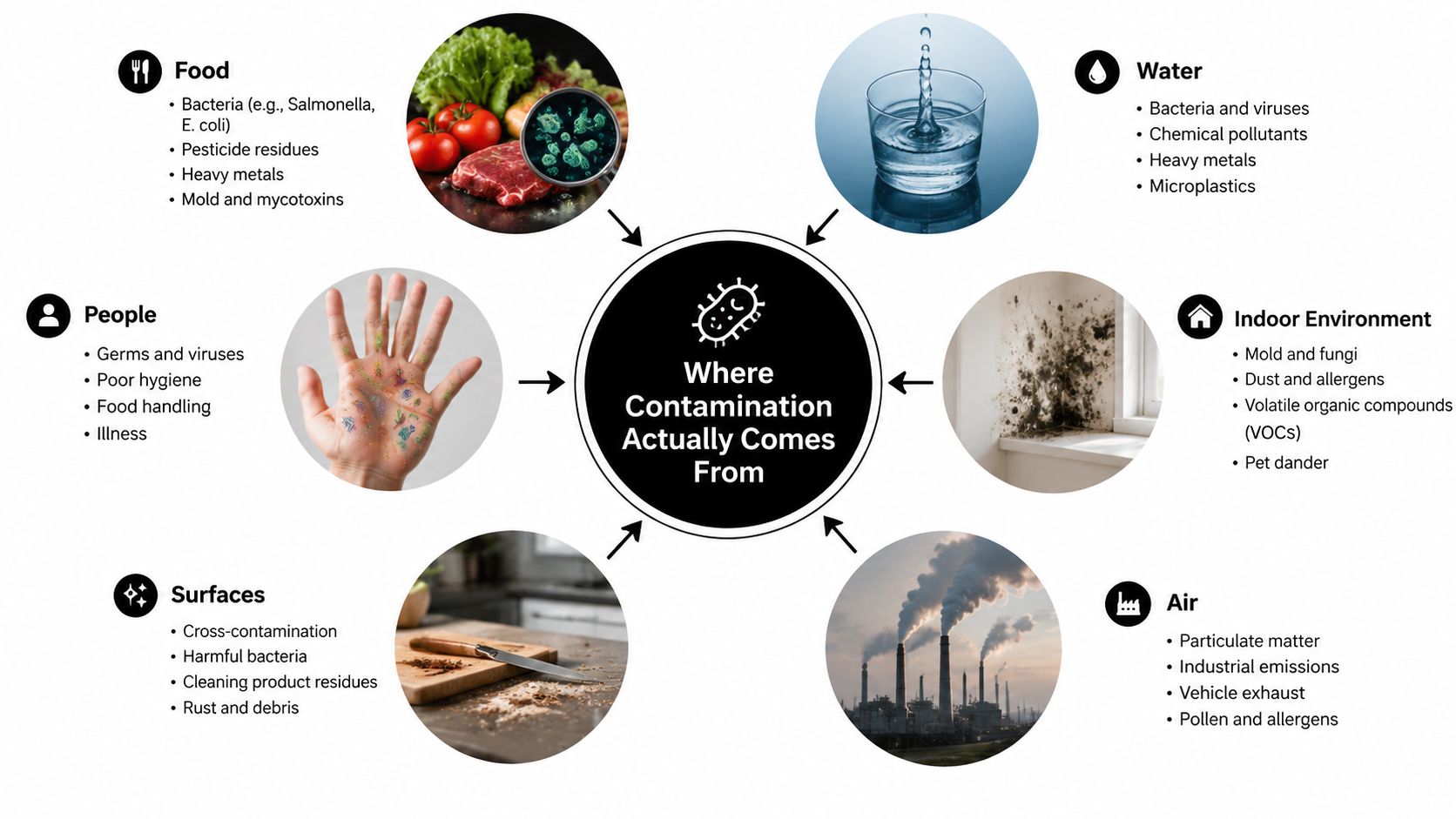
Most contamination events have ordinary beginnings. A researcher adjusts a plate lid with an ungloved hand. A sleeve brushes the edge of an open vessel. A shared keyboard receives a touch between two tasks. None of these actions looks dramatic, but each can move biological material into a workflow that depends on controlled handling.
People are one source. Skin particles, hair, breath aerosols, and ungloved contact can reach open cultures or prepared media. A fingerprint on a plate lid is a useful visual reminder that the lid has contacted something outside the sterile process, even if the culture remains clear at first.
Surfaces create a second route. Bench tops, incubator handles, cold-room doors, keyboards, and trolley surfaces collect repeated contact. Water pans inside incubators deserve special attention because standing moisture can support persistent microbial growth. A swab from a dry-looking surface may tell only part of the story if it misses seams, corners, or areas touched during normal work.
Reagents can carry the problem forward
A buffer prepared with non-sterile water can introduce colonies that later look like sample contamination. Dehydrated media may be rehydrated in a container that wasn't adequately cleaned. A diluent intended to be sterile may carry residual bioburden into every dilution, blank, or control prepared from it.
Water quality needs its own decision path. Laboratories reviewing source water, purified water, or process water can use Praz Pure Water's testing expertise as a reference point when defining an appropriate testing program.
Equipment adds another layer. A clogged pipette barrel can retain droplets. An ultrasonic bath can become a reservoir if cleaning is neglected. An autoclave load that is packed too tightly may not receive uniform exposure. Even a filtered tip box used past its validated handling period can undermine an otherwise careful technique.
A practical investigation therefore asks four questions:
- Who handled the material? Review gloves, gowning, transfers, and shift handoffs.
- What did the sample touch? Include benches, racks, lids, doors, and shared tools.
- Which reagent entered the process? Check water, media, buffers, diluents, and lot records.
- Which equipment supported the step? Inspect pipettes, incubators, baths, sterilizers, and storage areas.
The Four Main Detection Methods Compared
No single method answers every contamination question. Each technique sees a different part of the problem, so the strongest workflow combines methods according to the sample, the decision, and the required response.
Microbiological culture measures organisms that remain viable and can grow under the selected conditions. It supports colony-forming unit estimation and can reveal an unexpected organism through colony appearance and follow-up identification. Culture is relatively accessible and useful when a laboratory needs evidence of recoverable living contamination. Its weakness is time, and it can miss organisms that don't grow on the chosen medium or under the chosen incubation conditions.
PCR and qPCR detect genetic material. These methods are fast and sensitive, making them useful for targeted screening such as mycoplasma or a known pathogen. They don't automatically establish viability. DNA from dead cells may still produce a signal, while inhibitors in a complex matrix can suppress amplification and create a misleading negative.
Endotoxin testing with LAL measures endotoxin activity associated with Gram-negative bacterial cell-wall material. It provides a quantitative pyrogen-related result and is especially important for injectable-related workflows. It doesn't identify living organisms, and it doesn't detect every microbial or chemical hazard. A low endotoxin result therefore cannot stand in for sterility testing.
Particle counts and surface swabs help map environmental change. Particle monitoring can flag an airflow or activity trend, while swabs can identify recovery from selected contact points. Neither approach identifies species on its own, and both depend heavily on location, technique, recovery, and timing.
A methods overview can help buyers compare analytical options, including the peptide testing methods and resources from Bulk Aussie Peptides. Laboratories developing a broader sterility program can also consult these sterility testing procedures as part of method planning.
| Method | What It Detects | Typical Turnaround | Strengths | Key Limitations |
|---|---|---|---|---|
| Culture | Viable organisms able to grow under selected conditions | Slow to moderate | Supports viable counts and organism recovery | Misses non-culturable or unsuitable organisms |
| PCR or qPCR | Target genetic material | Rapid | Sensitive and useful for targeted screening | Doesn't prove viability and can be affected by inhibitors |
| LAL endotoxin testing | Endotoxin activity from Gram-negative bacterial material | Rapid to moderate | Quantitative and relevant to injectable workflows | Doesn't measure living microbes or all contaminants |
| Particle counts and surface swabs | Airborne particles or recoverable material at selected points | Rapid | Maps trends and possible hotspots | Doesn't identify species and depends on sampling quality |
The following video provides a visual introduction to contamination detection concepts before a laboratory selects a layered panel.
Designing a Sampling Strategy You Can Trust
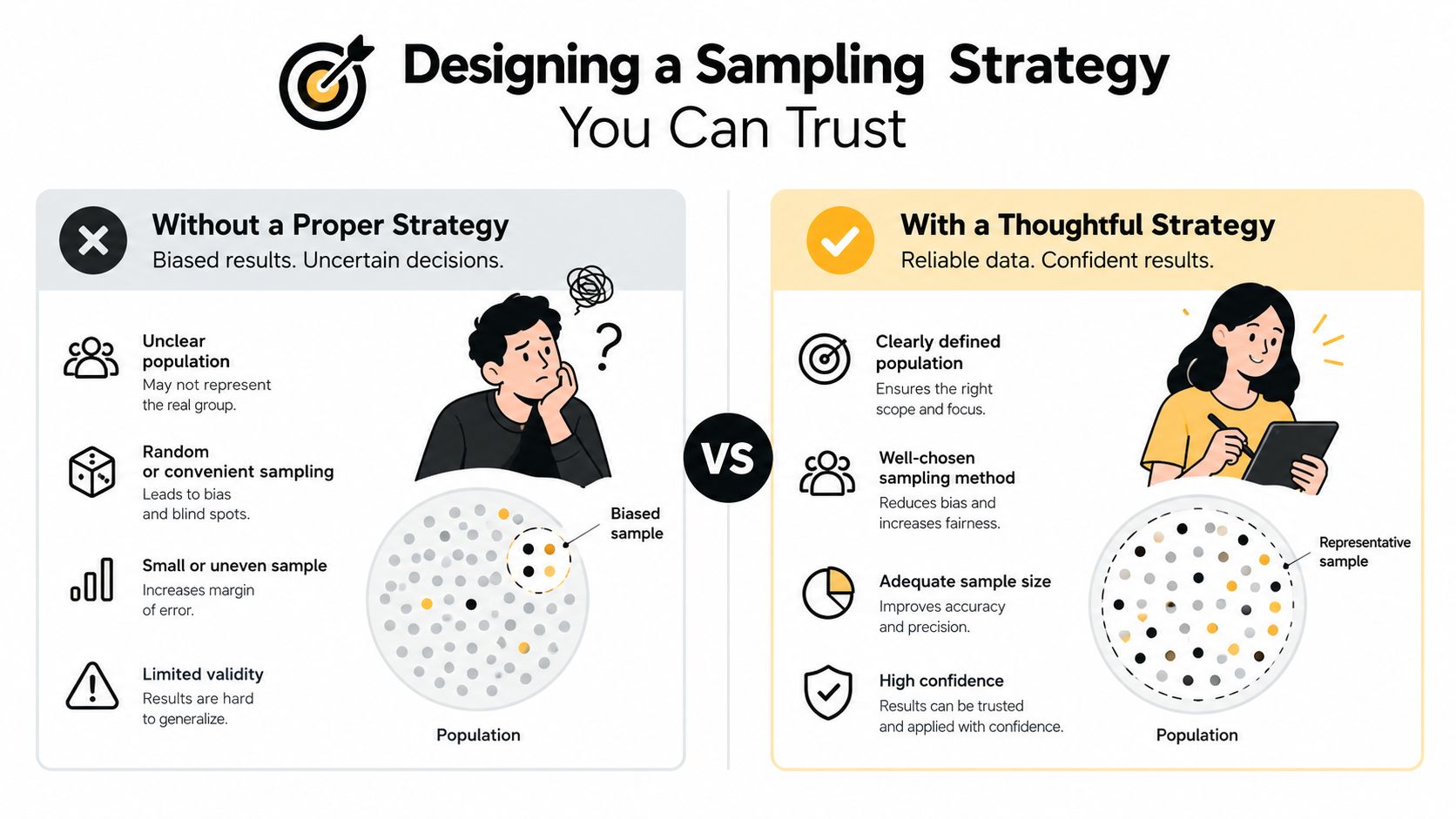
A researcher who suspects contamination often swabs the most obvious location first. That grab sample can be useful for incident triage, but it isn't automatically representative. A positive result may describe a localized hotspot, while a negative result may show that the swab missed the route by which contamination moved.
Start with the decision, not the swab
Point-of-use sampling works well when a team needs a quick answer about a particular vessel, filling point, surface, or contact event. The location should be documented precisely, and the timing should relate to the operation being investigated. Sampling before cleaning and after cleaning answers different questions, so the record must distinguish them.
Environmental mapping serves a different purpose. A laboratory selects representative air and surface locations across the working area, then repeats the process consistently enough to identify trends. The framework may draw on expectations associated with ISO 14698 or USP <1116>, but the written plan should define the actual locations, methods, frequency, and response rules rather than relying on a standard name alone.
Make recovery comparable
Contact plates can suit flat, accessible surfaces. Swabs are more flexible for seams, corners, equipment joints, and irregular areas, but recovery varies with pressure, angle, wetting solution, and operator technique. Sample volume also matters for liquids. A small volume may miss a low-level event, while a larger volume may complicate filtration, neutralization, or matrix handling.
Consistency turns individual samples into evidence. If operators change the area, pressure, timing, or recovery method each time, trend analysis becomes much weaker.
Mapping is justified during qualification, after facility changes, or when a laboratory needs a stable environmental baseline. Grab samples are appropriate during an investigation or when a specific point requires immediate attention. Both approaches become more useful when the laboratory records operator, location, activity, cleaning status, sample volume, method, and result together.
How Reagent and Diluent Quality Shape Every Result
A diluent isn't an invisible vehicle. It enters the test system, contacts the sample, affects recovery, and may contribute its own background signal. A laboratory can perform a careful swab, plate the correct volume, and incubate under controlled conditions, yet still misinterpret the outcome if the diluent introduced organisms or altered the assay environment.
A non-sterile buffer can add CFUs that resemble a positive sample. Residual bioburden can shift the baseline across repeated preparations. In endotoxin testing, water and container-related leachates can create a signal that requires investigation before the sample itself is blamed. The upstream material therefore belongs inside the contamination detection plan, not outside it.
Different product formats solve different problems and carry different trade-offs. Sterile-filtered material may suit routine liquid handling when the formulation and packaging support filtration. Gamma-irradiated components can provide a useful barrier for selected single-use materials, although the process and product compatibility still require review. Bacteriostatic formulations may limit microbial multiplication in intended applications, but they aren't a universal substitute for aseptic technique, validated compatibility, or a proper sterility control.
Herbilabs supplies sterile and bacteriostatic diluent options, including research-use reconstitution solutions, so a buyer can compare the intended formulation, packaging, certificate of analysis, and stated use against the assay's sensitivity requirements. The important decision isn't whether a vial is labeled sterile. It is whether the material is appropriate for the matrix, detection method, storage conditions, and downstream interpretation.
| Diluent Type | Sterility Level | Endotoxin Load | Best Use Case | Detection Risk |
|---|---|---|---|---|
| Sterile-filtered | Depends on validated filtration and packaging | Must be verified for the application | Routine liquid preparation and dilution | Filter or container failure can add background |
| Gamma-irradiated | Processed as a single-use material where compatible | Requires product-specific evidence | Selected disposable components | Material changes may affect compatibility |
| Bacteriostatic | Formulated to inhibit multiplication in intended use | Must be assessed separately | Applications requiring a bacteriostatic formulation | Inhibitor effects may alter culture recovery or assay behavior |
The cleanest downstream result depends on decisions made before the sample is collected.
Reading Results Without Fooling Yourself
A result needs context before it becomes a conclusion. Culture, PCR, and endotoxin assays each produce signals that can be technically correct while still answering a narrower question than the operator assumes.
Culture results need a defined frame
A plate with too many colonies to count, often recorded as TNTC, doesn't provide the same information as a plate with well-separated colonies. A countable plate supports estimation, but the interpretation still depends on sample type, dilution, volume, incubation conditions, and recovery method. Air, surface, and liquid samples shouldn't be treated as interchangeable because each represents a different exposure and collection process.
For pharmaceutical water systems, published expert summaries commonly describe system-specific alert and action limits, with purified water generally not routinely exceeding 100 CFU/mL and water for injection generally not exceeding 10 CFU/100 mL, unless specifically justified. These values are not universal release rules. They are practical reference points that must sit inside a validated, system-specific program. The pharmaceutical water testing discussion explains why an excursion should lead to investigation of biofilm, sanitization, stagnation, and point-of-use behavior.
PCR and endotoxin signals need controls
A low Cq generally indicates more target nucleic acid entered the amplification reaction than a late Cq signal, but it doesn't prove clinical significance or viability. A late signal may reflect trace DNA, dead cells, contamination introduced during setup, or a result near the method's detection boundary. Positive and negative controls, inhibition controls, extraction records, and repeat testing help distinguish these possibilities.
LAL results can also be affected by matrix interference and plate-reader behavior. A suspected pyrogen signal requires suitability checks, controls, and an understanding of the product matrix rather than an automatic assumption that the sample contains biologically meaningful endotoxin.
The certificate of analysis guidance from Herbilabs can help buyers and laboratory staff read lot-specific documentation without treating a certificate as a replacement for in-process controls.
Why Detection Alone Is Not Enough
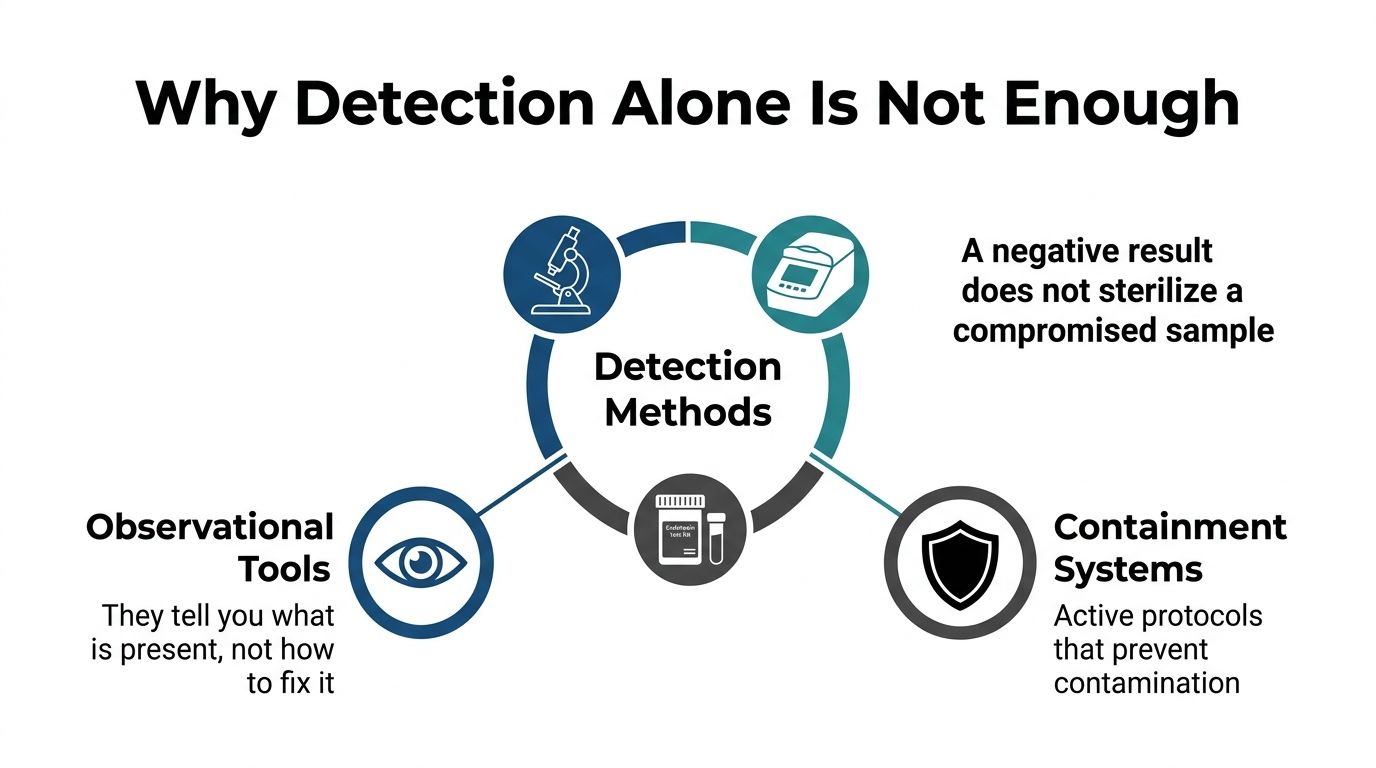
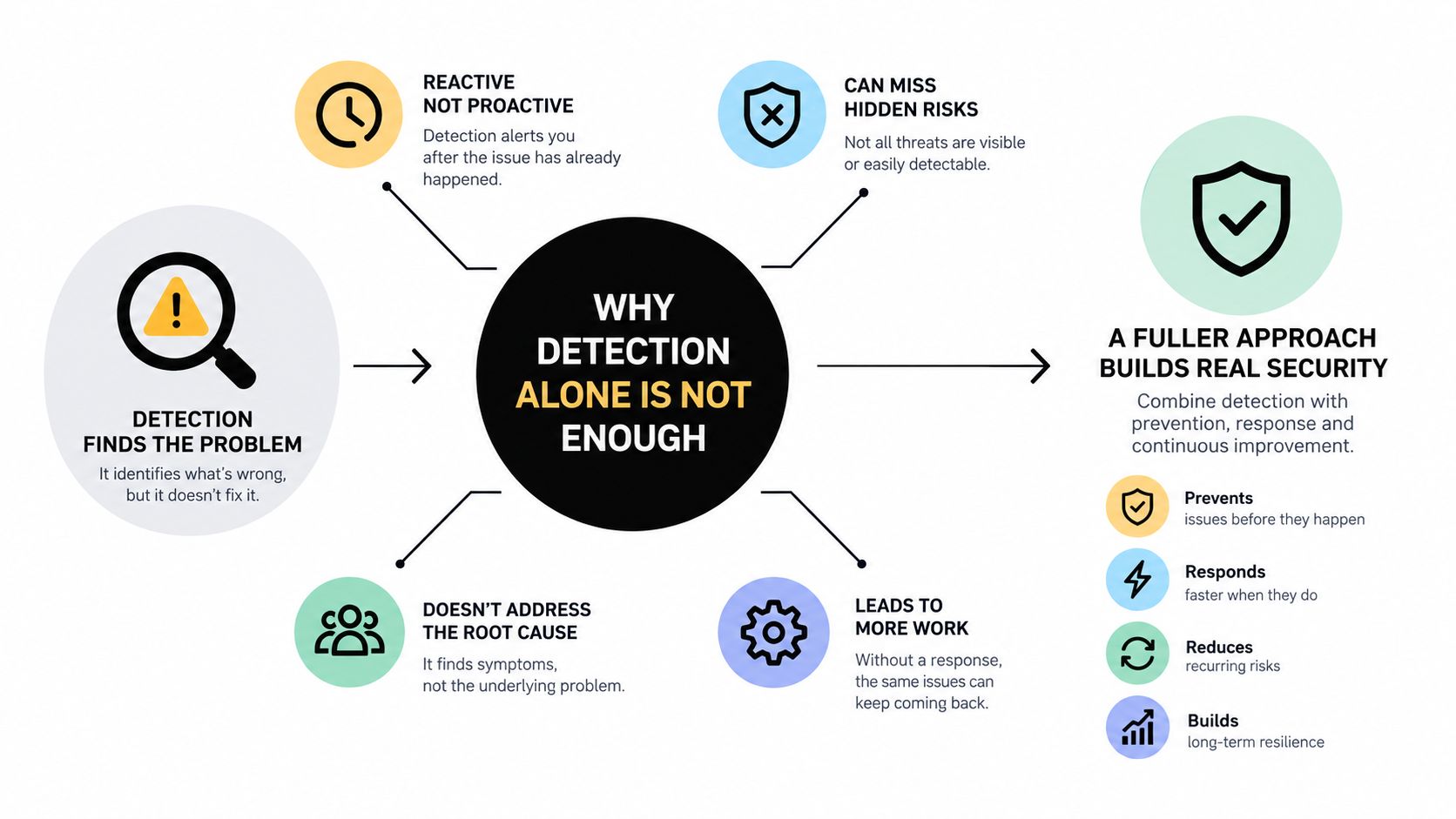
Detection is an observational tool. It reports what a method recovered, amplified, or measured from a particular sample at a particular time. It doesn't repair a compromised sample, decontaminate a biosafety cabinet, or sterilize a reagent reservoir after the fact.
A negative media blank can look reassuring while still failing to answer the right question. For example, the blank may be prepared from a contaminated diluent that was also used elsewhere, or the sampled location may not include the surface where contamination entered. A PCR-negative result can also occur when inhibitors suppress amplification or when the target sits below the method's effective detection capability.
Negative doesn't mean clean forever
Surface sampling is limited by reach and recovery. The swab may pass over a clean patch while missing a seam, underside, or wet area. Similarly, a clean result from a closed container doesn't establish that every transfer step, accessory, or upstream component remained controlled.
The 2025 review of 50 papers on LLM data-contamination detection found eight categories of assumptions, while only three were tested as case studies. Although that literature concerns benchmark contamination rather than laboratory microbiology, the lesson transfers directly: a detection method can appear advanced while relying on assumptions that haven't been validated across real conditions. The review of contamination-detection assumptions provides a useful caution against confusing more detection with more reliable detection.
Controls must surround the test
Engineering controls include suitable airflow, HEPA filtration where required, segregated work areas, and equipment designed to limit transfer. Administrative controls include SOPs, training, cleaning records, lot segregation, and clear handoff procedures. PPE reduces personal transfer risk, but it can't compensate for a poor workflow or contaminated reagent.
The weak points often appear during shift changes, new-operator training, reagent-lot transitions, rushed cleaning, or work performed outside the usual sequence. Detection should expose those weaknesses and guide correction. It can't serve as the only safety net.
Building a Contamination-Resistant Workflow
Resistance comes from several modest controls working together. Facility layout limits movement between incompatible tasks. Procedures make good handling repeatable. Reagents reduce background risk. Sampling detects drift, and predefined responses stop a small signal from becoming a larger investigation.
Separate pre-PCR and post-PCR areas where molecular workflows require them. Keep movement unidirectional, assign dedicated pipettes to each zone, and verify HEPA performance according to the facility's planned maintenance schedule. Single-use consumables may be appropriate when cleaning and verification would create more uncertainty than controlled replacement.
Reagent control belongs at the center of the system. Specify sterile and endotoxin-suitable diluents according to the assay's sensitivity floor, review certificates of analysis, and keep incoming lots identifiable. If one lot fails, quarantine that lot without losing traceability across the whole bench.
Sampling frequency should follow risk. Open-system operations and frequently handled points generally deserve closer attention than closed, validated processes. A CFU excursion, a Cq shift, or a cluster of positive swabs should already have a documented response before the signal appears.
A practical working checklist
- Control people: Define gowning, glove changes, hand hygiene, and clean-to-dirty movement.
- Control surfaces: Assign cleaning responsibility to specific areas and record completion.
- Control reagents: Verify sterility evidence, endotoxin suitability, storage, lot identity, and expiry.
- Control equipment: Inspect pipettes, incubators, baths, sterilizers, and water systems.
- Control sampling: Use targeted grabs for investigations and consistent mapping for baseline trends.
- Control methods: Pair viable culture, molecular screening, endotoxin testing, or environmental tools according to the question.
- Control interpretation: Set alert, action, repeat, and escalation rules in advance.
- Control records: Link each result to operator, location, lot, instrument, method, and sample provenance.
- Control suppliers: Ask how each lot is tested, documented, packaged, stored, and transported.
- Control changes: Reassess contamination risk after facility, equipment, reagent, or process changes.
- Control training: Reinforce technique through documented contamination control training.
- Control remediation: Investigate the route, contain affected material, correct the cause, and verify recovery before routine work resumes.
A laboratory that follows these habits doesn't eliminate every risk. It makes contamination easier to detect early, easier to trace, and less likely to distort the work that follows.
Herbilabs offers sterile and bacteriostatic research-use diluents, reconstitution solutions, lot documentation, and contamination-focused laboratory supplies for teams building stronger upstream controls. Visit Herbilabs to review options for your workflow, check product documentation, and discuss supply requirements for laboratory or distribution use.


