Private Label, White Label, Wholesale partnerships available - EU, USA and UK - Free shipping from €75

Sterility Testing Procedures: A Practical Guide for Labs
A batch of sterile product is ready for release, but the quality decision still depends on what happens inside the microbiology laboratory. The test vessels have been inoculated, controls are in place, and the incubation period has begun. A single unexpected signal can trigger an investigation, delay distribution, and force the QA team to explain whether the result reflects the product, the test method, or the laboratory environment.
That's why sterility testing procedures aren't merely routine bench work. The selected method determines how the sample is prepared, which sterile reagents and consumables are required, how controls are interpreted, and how confidently the final result can support a release decision. The sections below connect the main regulatory frameworks with the practical purchasing and workflow choices that laboratories must make.
Table of Contents
- The Moment a Batch Sits in Incubation
- What Sterility Testing Actually Measures
- Direct Inoculation vs Membrane Filtration Compared
- Regulatory Framework Across USP, EP, ISO and Annex 1
- Sampling, Replicates and Contamination Control
- Rapid and Alternative Methods Worth Considering
- Choosing Compatible Sterile Reagents and Consumables
- Troubleshooting Failed Runs and Next Steps
The Moment a Batch Sits in Incubation
A senior QC microbiologist reviews the release file for a parenteral lot scheduled for shipment to several distribution hubs. Two incubation cabinets are running in parallel. One holds vessels at a lower temperature range, while the other supports a higher range. Each vessel carries the batch identifier, inoculation date, and analyst initials.
The 14-day incubation clock has started. Nothing dramatic is visible yet, but the release decision is already tied to the integrity of the work completed before incubation. The laboratory must know that the sampled units represent the lot, that the selected medium can support recovery, and that the product itself hasn't inhibited microbial growth.
Why the method choice matters
A direct-inoculation procedure places a defined quantity of product into culture medium. A membrane-filtration procedure handles the product differently, allowing the laboratory to collect microorganisms on a membrane and rinse away residues that might suppress recovery. Both procedures ultimately ask whether visible microbial growth appears under controlled conditions, but they create different risks and require different consumables.
The distinction matters during an investigation. If a negative control becomes turbid, the laboratory may need to examine aseptic handling, room conditions, transfers, and media preparation. If a product sample remains clear while a suitability control fails, the result may say more about toxicity or inadequate recovery than about the product's sterility.
Practical rule: A passing result is defensible only when the sample, method, controls, media, incubation conditions, and records all support the interpretation.
This article treats the test as one part of a larger contamination-control system. A sterility result cannot repair weak aseptic processing, poor environmental monitoring, or an unsuitable sampling plan. It can provide controlled evidence, but only within the validated scope of the procedure.
What Sterility Testing Actually Measures
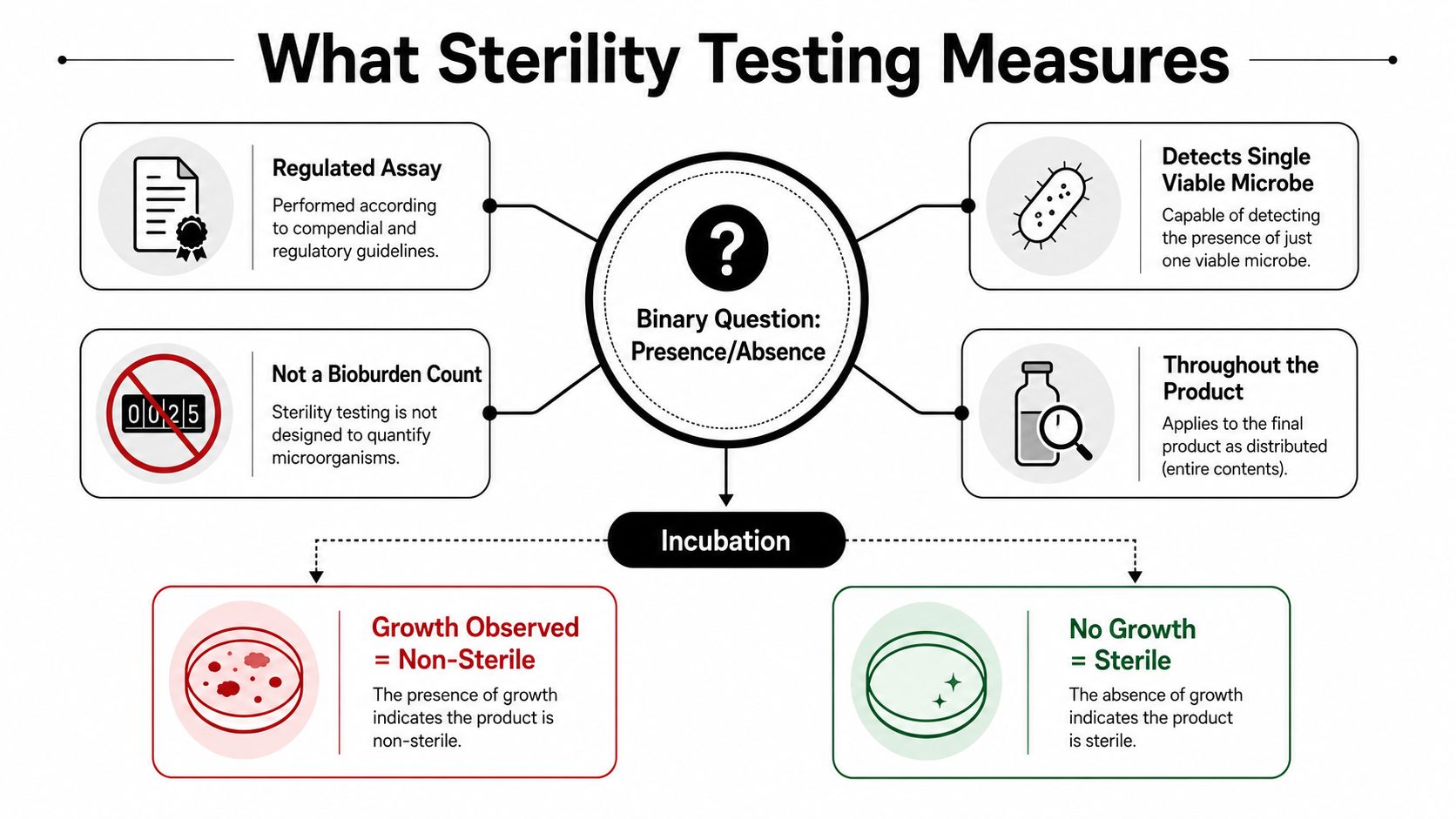
Sterility testing is a regulated presence-or-absence assay. It isn't designed to calculate the precise number of microorganisms in the original batch. Instead, it asks whether viable contamination in the tested article can grow into detectable evidence under defined culture conditions.
A useful analogy is a smoke detector. The detector can indicate that smoke is present, but it doesn't measure every smoke particle in the building or prove that no smoke exists elsewhere. Sterility testing works similarly. Visible growth means that the test conditions supported recovery of viable contamination. No visible growth means that the tested sample remained negative within the method's validated capability.
Why incubation takes 14 days
The modern global baseline is built around a 14-day incubation period. USP <71> notes harmonization with the European Pharmacopoeia and Japanese Pharmacopoeia, while historical industry summaries describe a change from an earlier seven-day USP incubation allowance for membrane-filtration tests to the harmonized 14-day approach after available data were evaluated. The USP chapter provides the current compendial reference point in its sterility testing chapter.
The long window protects against a simple mistake: assuming that every contaminating organism grows quickly. Injured cells, environmental isolates, and slow-growing organisms may need time to recover in a supportive medium before growth becomes visible. Analysts therefore examine vessels at defined intervals rather than treating incubation as passive storage.
The two-temperature design supports recovery across organisms with different growth preferences. A lower range is commonly associated with recovery of fungi and other organisms suited to cooler incubation, while a higher range supports many aerobic and anaerobic bacteria. Exact conditions must follow the applicable compendial method and approved procedure.
For readers working with peptide products or related research materials, a separate overview of microbial testing for peptides can help distinguish sterility checks from broader microbial quality testing. That distinction prevents a release assay from being mistaken for a complete contamination or bioburden characterization program.
Direct Inoculation vs Membrane Filtration Compared
The two traditional approaches answer the same broad question, but they prepare the product differently.
Direct inoculation transfers a measured amount of the product directly into sterile culture broth. It's straightforward and can suit small-volume aqueous products, oils, and ointments when the matrix doesn't interfere with growth or prevent suitable mixing. The drawback is that preservatives, solvents, or antimicrobial ingredients enter the broth with the sample.
Membrane filtration passes a suitable product volume through a membrane, commonly a 0.45 micrometre membrane for culture-based recovery. The membrane retains microorganisms, can be rinsed to remove inhibitory residues, and is then placed into the selected culture medium. The approach often suits filterable liquids, large-volume products, or formulations where concentrating the microbial burden improves the practical chance of detection.
| Criterion | Direct Inoculation | Membrane Filtration |
|---|---|---|
| Product fit | Useful for small-volume aqueous products, oils, and ointments when suitable | Useful for filterable liquids, larger volumes, and products with inhibitory residues |
| Main strength | Simple sample transfer with fewer handling stages | Concentration and rinsing can reduce matrix interference |
| Main limitation | Preservatives or antimicrobial ingredients enter the broth | Adds membrane, rinsing, assembly, and filtration controls |
| Key suitability question | Can the product coexist with the medium without suppressing recovery? | Can the product pass through the membrane and be rinsed effectively? |
| Buyer priorities | Sterile vessels, suitable media, pipette tips, and transfer tools | Qualified membranes, sterile assemblies, rinse fluid, canisters, and integrity controls |
Matching the procedure to the matrix
The buyer should start with the product, not with the equipment catalogue. A viscous ointment may require a different handling strategy from a clear aqueous solution. A preservative-containing formulation may need a neutralization or rinsing approach that direct inoculation cannot provide. A filterable formulation may benefit from membrane filtration, but only after the laboratory demonstrates recovery under actual product conditions.
Membrane choice also needs documented control. A laboratory should track membrane material, pore size, lot number, extractables or compatibility information where relevant, and the performance of the complete assembly. Procedures for filter integrity testing can help laboratories build that control into qualification and routine review.
Neither method is automatically more sensitive. The effective detection capability depends on sample volume, product interference, recovery conditions, rinsing, media performance, and operator execution. A simpler method can be stronger when it fits the matrix, while a more elaborate method can fail if its suitability controls are weak.
Regulatory Framework Across USP, EP, ISO and Annex 1
A laboratory shipping sterile products across regions must treat the regulatory environment as a connected system, not as a list of interchangeable labels.
USP <71> and European Pharmacopoeia 2.6.1 establish compendial expectations for sterility testing, including suitable media, incubation, controls, and method suitability. Their approaches are broadly aligned, but the laboratory still needs to identify the applicable edition, market requirement, product category, and approved specification. A procedure copied from one jurisdiction may not satisfy another without a documented assessment.
ISO 11737 addresses a different part of the microbiological picture. ISO 11737-1:2018 covers enumeration and characterization of viable microorganisms on or in healthcare products. ISO 11737-2:2019 covers sterility tests for products exposed to sterilizing treatment, including testing during definition, validation, and maintenance of the sterilization process. FDA recognition records identify ISO 11737-2:2019 as a recognized standard, with recognition records updated in later entries. The FDA-recognized standard record should be checked directly for current regulatory status.
| Framework | Primary role | What laboratories should document |
|---|---|---|
| USP <71> | Compendial sterility test expectations | Media, incubation, controls, sample handling, suitability, observations, and deviations |
| EP 2.6.1 | European compendial sterility test expectations | Applicable text, product category, method suitability, media performance, and observations |
| ISO 11737-1 | Enumeration and characterization of viable microorganisms | Sampling, recovery method, microbial characterization, and validation rationale |
| ISO 11737-2 | Sterility testing associated with sterilizing treatment | Test design, process stage, method controls, and interpretation |
| EU GMP Annex 1 | Contamination-control expectations for sterile manufacture | Facility, personnel, environmental monitoring, aseptic processing, transfers, and contamination-control strategy |
Where Annex 1 fits
Annex 1 isn't a replacement for a compendial sterility test. It establishes manufacturing expectations around facility design, personnel qualification, environmental monitoring, aseptic operations, material transfer, and contamination-control strategy. A passing final test cannot compensate for weak upstream controls.
A laboratory's controlled procedure should connect each framework to the responsible authority, product type, release specification, and record set. Guidance on CGMP compliance requirements can support that mapping, but the QA unit must still approve the final interpretation against the governing regulations and internal procedures.
Regulatory perspective: Harmonization reduces unnecessary differences, but it doesn't eliminate the need to verify the exact requirement governing a product and market.
Sampling, Replicates and Contamination Control
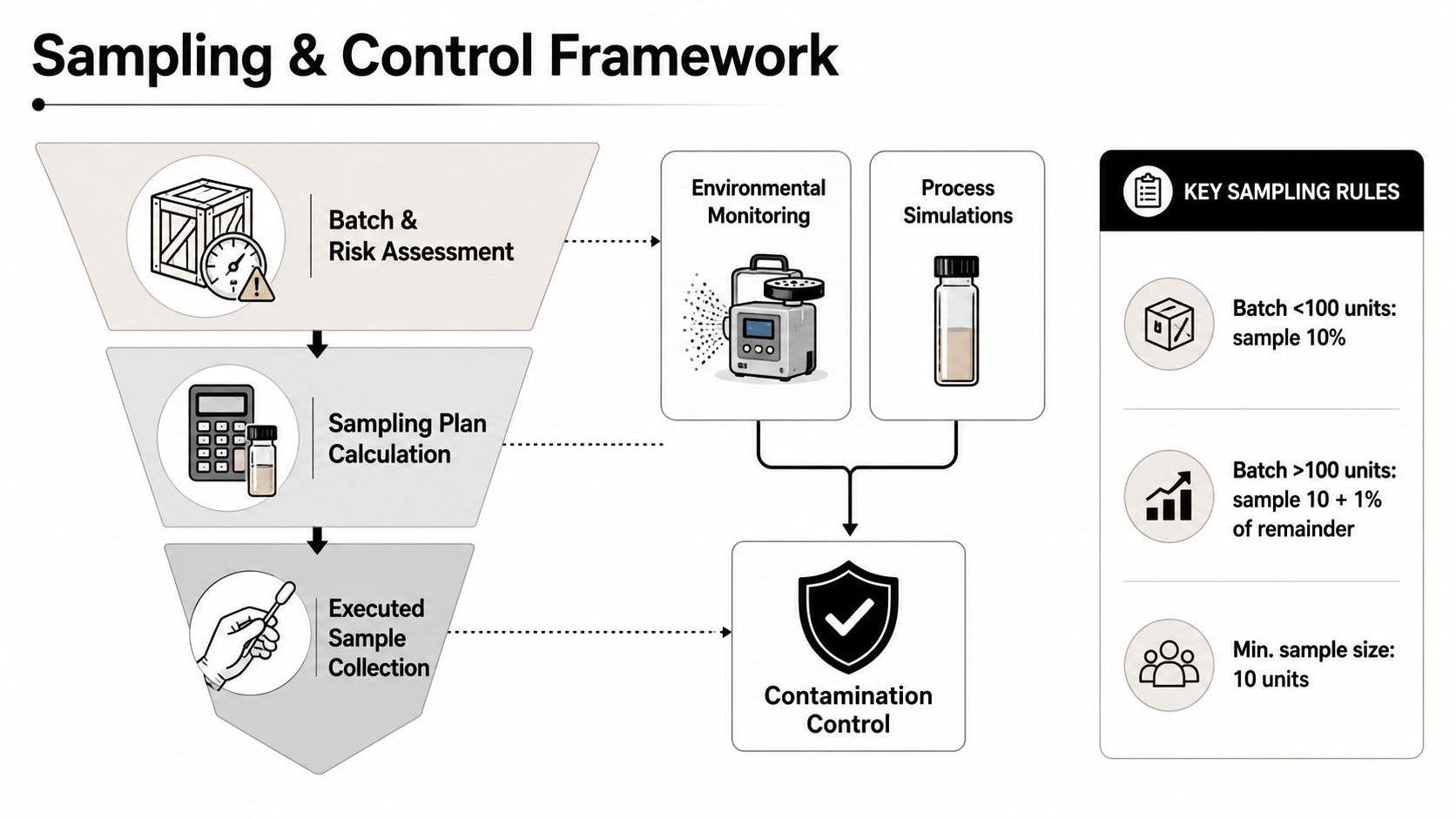
A sterility result is only as representative as the units selected for testing. The sampling plan should reflect the batch configuration, container format, fill volume, product risk, and the quantity required by the applicable compendial procedure. A larger sample cannot rescue a method that hasn't demonstrated recovery from the actual matrix.
For medical-device sterility testing, an industry summary describes at least three replicate samples as generally needed for reliability and identifies direct inoculation, rinsing followed by membrane filtration, and other product-appropriate options within ISO 11737-2 practice. The summary also describes soybean-casein digest medium incubated at 28 to 32 degrees Celsius for 14 days as a modern baseline for the cited medical-device context. The FDA standard information should remain the controlling reference for the applicable device program.
Controls that make the result credible
Controls aren't decorative additions to a worksheet. They show whether contamination entered through the environment, whether the medium remained capable of supporting growth, and whether the analyst followed the approved technique.
- Environmental monitoring: Use the monitoring program appropriate to the classified area, including active air, viable particles, settle plates, contact plates, and personnel monitoring where required.
- Negative controls: A contaminated negative control can indicate a laboratory or handling breach and may invalidate the run.
- Growth controls: The laboratory must verify that the medium and test conditions can recover the challenge organism or organisms specified by the approved suitability study.
- Traceable execution: Record operators, consumable lots, incubation positions, transfers, observations, and any intervention that could affect interpretation.
Before testing begins, the team should disinfect approved surfaces, verify required airflow conditions, inspect containers, and reduce unnecessary movement or congestion. Sterile single-use consumables and validated transfer techniques can reduce avoidable handling variation. A practical contamination control training resource can help align analyst behavior with the broader contamination-control strategy.
For basic sterile-handling principles, a prevent mushroom contamination guide can also serve as accessible background reading. Any suspected contamination requires a traceable investigation that distinguishes product failure from a laboratory event without assigning blame before the evidence is reviewed.
Rapid and Alternative Methods Worth Considering
A negative sterility test doesn't prove that every unit in a batch is sterile. It shows that the tested sample produced no detectable growth under the validated conditions used by the laboratory. The result is therefore evidence within a defined scope, not a replacement for sterilization validation, aseptic processing controls, bioburden information where applicable, or environmental monitoring.
The traditional culture method behaves like a smoke detector. It waits for viable organisms to recover and multiply until the laboratory can observe a signal. It doesn't report the original microbial quantity, reveal exactly when contamination occurred, or identify every organism that might be present but unable to grow under the selected conditions.
What an alternative method must prove
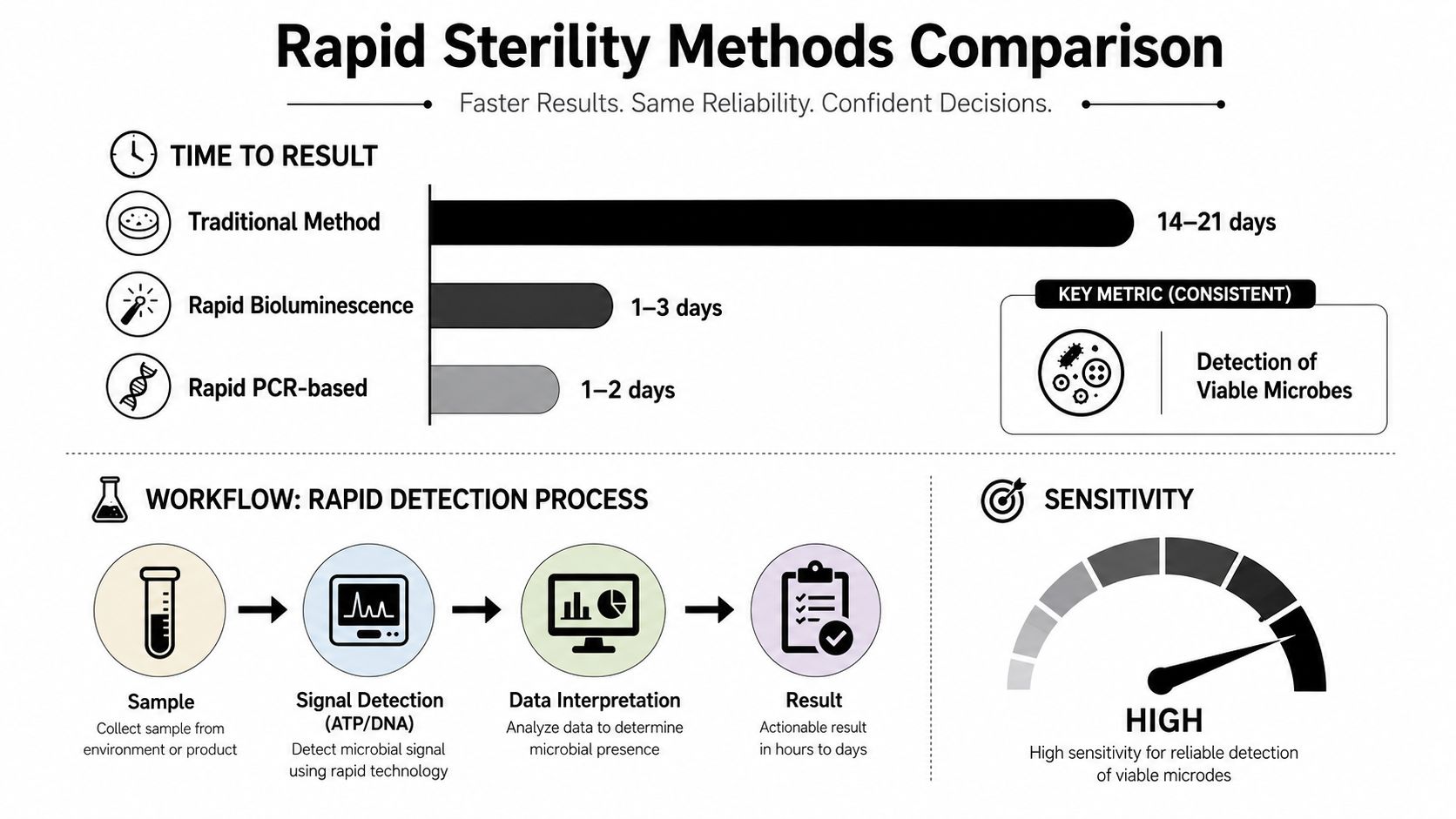
Rapid methods may use growth-based signals, ATP or respiration measurements, nucleic-acid detection, solid-phase cytometry, or other technologies. The technology name matters less than the validation package behind it.
A defensible alternative method should address:
- Comparability: Results should be shown equivalent to, or better than, the traditional method for the intended product and use.
- Matrix interference: The product must not suppress, distort, or mask the detection signal.
- Challenge recovery: The method should reproducibly recover relevant organisms under realistic test conditions.
- False-negative controls: The validation design must demonstrate that inhibition, extraction failure, or signal loss won't produce a negative result.
- Regional acceptability: The package should map to the expectations of the applicable authority, compendial chapter, and quality system.
FDA guidance on alternative microbiological methods frames equivalence and validation as structured evidence rather than a simple technology substitution. Complex matrices deserve particular attention because a method that works in a clear solution may not transfer directly to a viscous, protein-rich, cellular, or otherwise inhibitory product.
Rapid testing can shorten decision cycles, but it can also introduce new controls, software, data-integrity requirements, and training needs. The right question isn't whether a rapid method sounds faster. It's whether the laboratory can defend its sensitivity, specificity, recovery, controls, and interpretation for the product being released.
Choosing Compatible Sterile Reagents and Consumables
The purchasing file should support the same conclusion as the laboratory record. For each sterile reagent or consumable, the buyer should be able to connect the item to the procedure, product matrix, acceptance criteria, and supplier documentation.
A practical buying checklist
Sterile diluents and rinse fluids should have a clear identity, lot traceability, expiry information, storage conditions, and a certificate of analysis. The laboratory should confirm that the fluid is appropriate for the approved method and doesn't introduce antimicrobial activity or other interference.
Membranes and filtration assemblies require more than a pore-size check. The laboratory should review membrane material, compatibility with the product, sterile packaging, lot consistency, assembly configuration, and any required integrity or performance qualification. A 0.45 micrometre membrane may be specified for a culture-based filtration procedure, while a 0.22 micrometre component may belong to a different filtration or sterilizing-grade application. The buyer shouldn't substitute one for the other without technical and regulatory assessment.
Canisters, funnels, tubing, and transfer tools should arrive in packaging that supports cleanroom transfer, such as double-bagged presentation where required by the site procedure. Packaging defects, inconsistent labeling, or undocumented changes can create a validation and deviation burden even when the product itself appears usable.
Certificates and supplier controls should address sterility status and any additional attributes relevant to the application, such as endotoxin or mycoplasma claims. A claim only helps when its test basis, lot association, and scope are transparent. Supplier audits and continuity planning matter because a replacement item may require comparability work.
Purchasing insight: The cheapest consumable can become expensive if its documentation, packaging, or supply history forces a deviation or repeat qualification.
| Consumable | USP <71> requirement | EP 2.6.1 requirement | Rapid method fit |
|---|---|---|---|
| Sterile culture media | Must support the approved culture-based procedure and pass growth-promotion controls | Must support the applicable European compendial procedure and controls | May serve as a comparison or enrichment component, depending on the validated method |
| Sterile diluent | Must be suitable for product preparation and not inhibit recovery | Must be suitable for the product and approved preparation method | Depends on extraction, dilution, and signal chemistry |
| Membrane filter | Must match the validated filtration procedure and product compatibility assessment | Must match the applicable filtration procedure and suitability evidence | May be used for sample preparation if validated for the platform |
| Rinse fluid | Must remove inhibitory residues without damaging recovery | Must meet the approved method's suitability requirements | Requires validation against the rapid detection signal |
| Single-use filtration assembly | Must support aseptic manipulation and traceability | Must support the approved procedure and documented controls | Must be compatible with instrument, extraction, and data workflow |
In-house preparation can give a laboratory control over formulation, but it also creates responsibilities for compounding records, sterilization, testing, storage, and change control. Commercially prepared reagents may simplify documentation and consistency, provided the supplier's records are complete and the item is qualified for the intended use. Herbilabs is one supplier option for sterile diluents and related laboratory materials, with product documentation that can include batch certificates and sterility-related quality information. The QA unit should evaluate any supplier against its own approved criteria rather than relying on product descriptions alone.
Troubleshooting Failed Runs and Next Steps
A failed run needs a structured response, not an automatic retest. The first question is whether the controls support a valid interpretation.
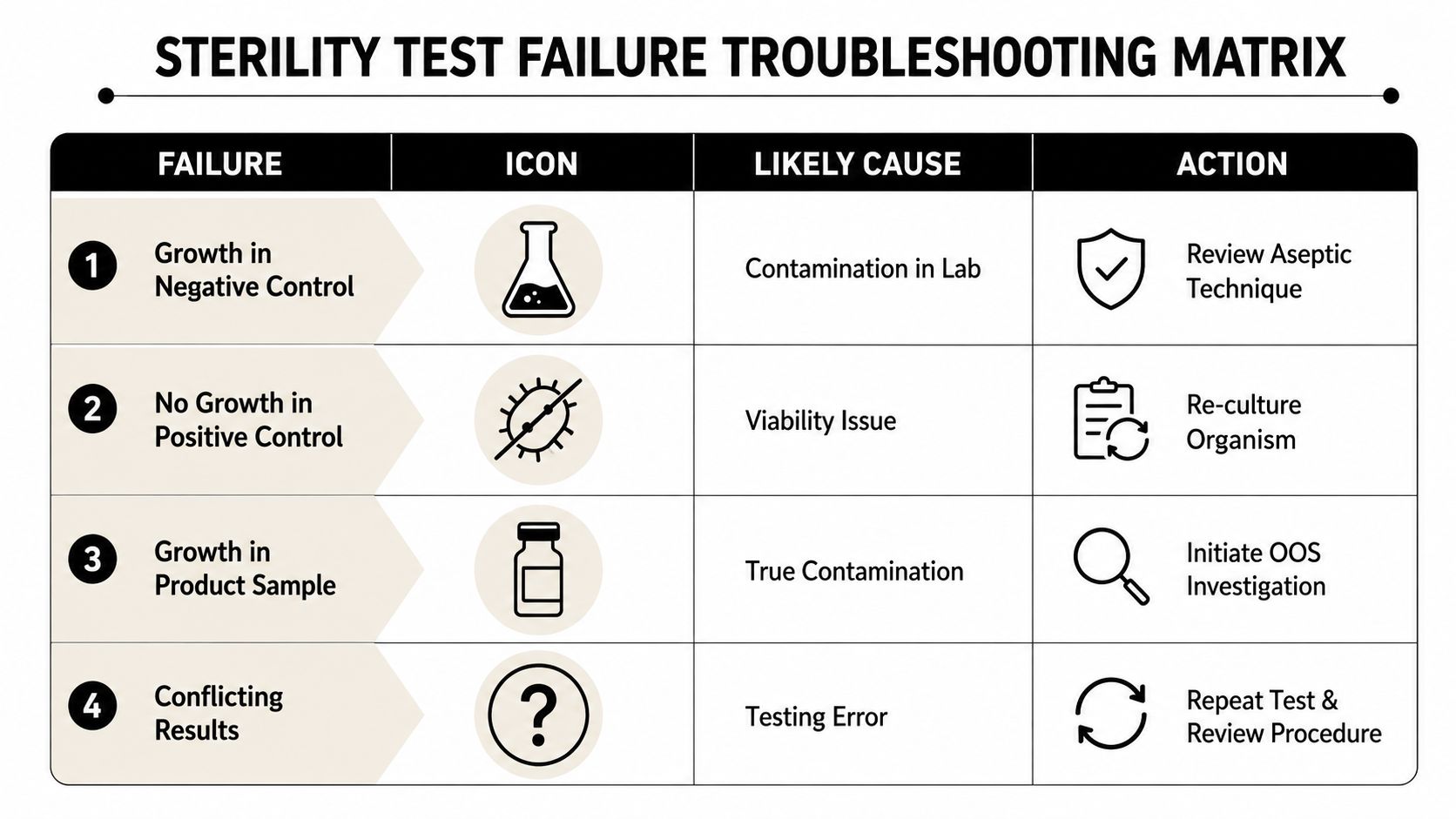
| Failure | Likely cause | Laboratory action |
|---|---|---|
| Growth in a negative control | Environmental or handling contamination | Review aseptic technique, room data, transfers, media, and consumable lots |
| No growth in a positive or suitability control | Organism viability, medium failure, toxicity, or incubation problem | Review culture preparation, reculture the organism as required, and assess method suitability |
| Growth in a product sample | Possible product contamination or test-related introduction | Initiate the approved OOS investigation and preserve evidence |
| Conflicting observations | Recording, handling, incubation, or procedural error | Reconcile records, review the procedure, and follow approved retest criteria |
The laboratory should follow the OOS procedure, examine environmental and analyst records, check media growth promotion, review product preparation, and assess whether the run meets the criteria for invalidation. Retesting must follow the applicable compendial requirements and approved protocol. It shouldn't be used to erase an inconvenient result.
Automation, electronic records, and real-time environmental monitoring can strengthen traceability, but they don't remove the need for method suitability or trained operators. Annex 1 expectations also keep the focus on the full contamination-control strategy, not only on the final vessel.
A QA manager can improve the next run by checking four items before purchase orders are released: the approved method, product compatibility, complete lot documentation, and supplier continuity. The laboratory should then tie every consumable and reagent to the controlled procedure, verify controls during execution, and investigate deviations through evidence rather than assumption.
Herbilabs supplies sterile diluents and related laboratory materials with batch documentation that can support reagent qualification and sterility-focused quality workflows. Visit Herbilabs to review available materials and documentation options for a controlled sterility testing program.


