Private Label, White Label, Wholesale partnerships available - EU, USA and UK - Free shipping from €75
Filter Integrity Testing: Methods, Workflows, and Compliance
A sterile filtration batch can look routine until a post-use result raises a question no one wants to answer: did the filter protect the product throughout processing, or did a defect escape detection? The answer depends on more than selecting bubble point, diffusion, or pressure-hold testing. It depends on connecting the physical result to bacterial-retention validation, the actual fluid, the installed housing, sterilization conditions, and a complete audit trail.
For procurement teams, distributors, operators, and quality units, filter integrity testing is therefore a validation and documentation problem as much as a pass-or-fail test. A filter supplier should provide evidence that allows the downstream user to defend the result under inspection, not just a device and a generic test limit.
Table of Contents
- The High Cost of an Undetected Filter Breach
- Core Principles of Wetted Membrane Testing
- Comparing Bubble Point, Diffusion, and Pressure-Hold Methods
- Step-by-Step Workflow and Acceptance Criteria
- Regulatory Expectations and Audit Defense
- The Shift Toward Automated and Cloud-Connected Testers
- Strategic Purchasing and Quality Assurance Considerations
The High Cost of an Undetected Filter Breach
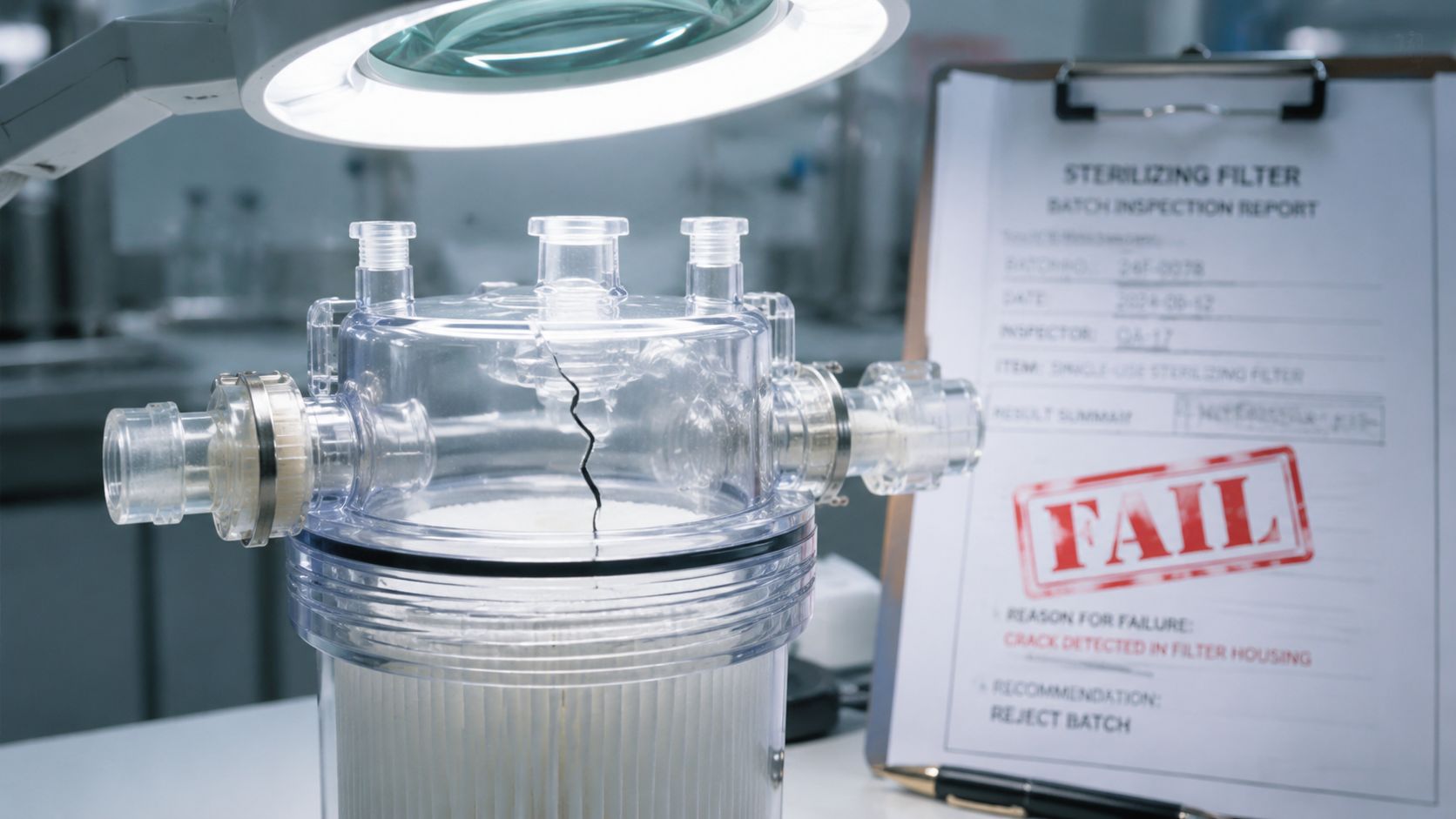
A batch fails sterility testing weeks after production. The investigation team reviews the batch record, confirms that the sterilizing filter was installed according to the procedure, and finds a recorded integrity check marked as passing. The apparent reassurance disappears when the team discovers that the operator used an unsuitable test setup, the membrane wasn't fully wetted, or the result wasn't tied to the filter manufacturer's validated limit.
That kind of investigation quickly expands beyond the filter itself. Quality personnel may need to reconstruct installation, sterilization, filtration, sampling, equipment status, operator actions, and environmental records. Production schedules can be disrupted, release decisions can be delayed, and regulators may scrutinize whether the site treated the filter as a critical sterile barrier or as a routine consumable.
The risk is especially serious because sterile filtration often sits immediately before aseptic handling. A compromised membrane, damaged seal, or leaking housing can undermine the control strategy even when upstream process records appear acceptable. The connection between filtration and microbial contamination is operational, not theoretical. A physical integrity result is one of the controls used to show that the barrier remained capable of its validated function.
Why a superficial pass can fail quality review
A test can be recorded correctly and still be scientifically weak. Common problems include:
- Incomplete wetting: Dry or poorly wetted pore structures can distort diffusion and bubble-point behavior.
- Wrong acceptance limit: A limit copied from another membrane, housing, or wetting fluid may have no demonstrated relationship to the current setup.
- Unresolved external leakage: A fitting, valve, O-ring, or test connection can create pressure loss that resembles membrane damage.
- Missing validation bridge: A physical pass has limited meaning if the supplier hasn't shown how the test value correlates with bacterial retention for the specific filter configuration.
Practical rule: A passing number is only as defensible as the validated method, setup, and documentation behind it.
The historical value of integrity testing is that it replaced destructive challenge checks for routine verification with quantitative, repeatable assessments that can be performed before and after filtration without sacrificing the filter. That makes the method a critical control point in the sterile barrier system, not a checkbox added after the work is complete.
Core Principles of Wetted Membrane Testing
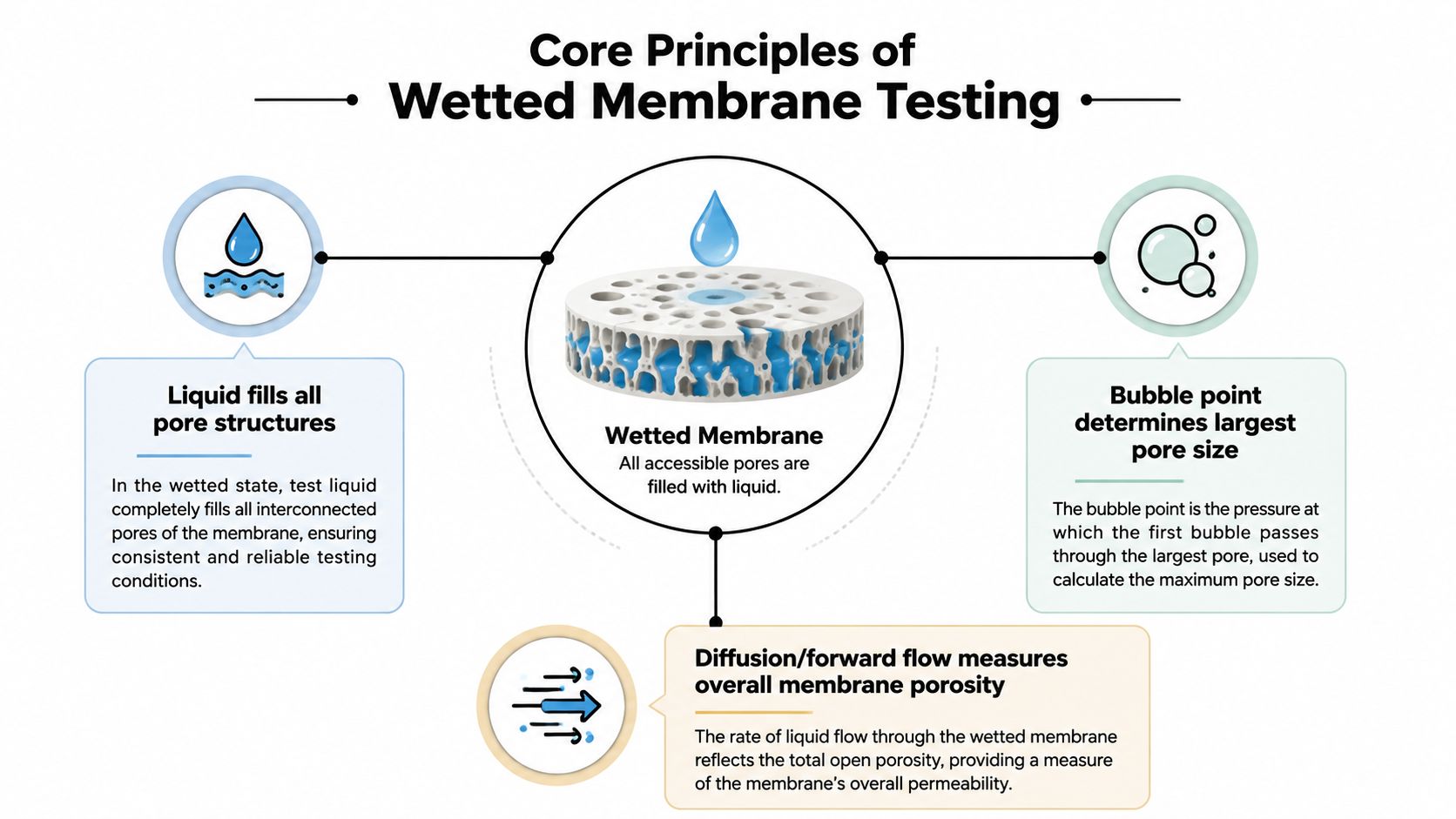
A membrane filter's pores must be filled with a compatible liquid before most physical integrity tests can provide meaningful results. The liquid acts like a seal inside the pore network. Gas applied to one side cannot pass through as free airflow while the pores remain filled. Instead, it either dissolves and moves through the liquid by diffusion, or reaches a pressure at which it displaces the liquid from the largest pore.
A simple analogy is a drinking straw filled with water. Gentle pressure may move dissolved gas through the liquid, but a stronger pressure can push the liquid out of the straw's widest opening. A wetted membrane behaves in a more complex way because it contains many interconnected pores, yet the logic is similar. Bubble point identifies the pressure transition associated with the largest wetted pores, while diffusion or forward flow evaluates gas movement below that transition.
From destructive challenges to routine verification
The bubble point method traces back to 1894, while gas-liquid diffusion testing was conceptualized around 1973, according to the historical discussion indexed by PubMed. These methods became foundational because they provide non-destructive evidence that a sterilizing filter has no oversized pores or defects that could compromise retention.
Modern instruments typically apply controlled gas pressure to a wetted membrane, then measure pressure, gas flow, or pressure decay. The test doesn't directly count microorganisms. Instead, the manufacturer establishes a relationship between physical behavior and microbial retention during validation, then publishes acceptance limits for production use.
This distinction matters for non-engineering buyers. The instrument isn't proving sterility by itself. It's checking whether the filter still resembles the physically intact filter that passed the manufacturer's retention validation.
Why wetting fluid and setup matter
Surface tension, viscosity, temperature, membrane chemistry, and product residue can all influence the measured result. A test developed with one wetting liquid can't automatically be transferred to another fluid without supporting evidence. Hydrophilic membranes and hydrophobic membranes also require different preparation approaches, and the test procedure must follow the manufacturer's validated instructions.
Personnel who regularly compare membrane systems can use broader educational material, such as this advice on choosing water filters, to understand how filtration choices depend on application and system conditions. Pharmaceutical procurement still needs a much stricter filter-specific package, including integrity limits, compatibility data, and retention evidence.
The practical connection is straightforward. A result becomes trustworthy when the liquid fully occupies the intended pore structure, the test pressure is appropriate, the system is leak-tight, and the acceptance limit belongs to that membrane and configuration.
Comparing Bubble Point, Diffusion, and Pressure-Hold Methods
The three principal methods measure different physical signals. Bubble point ramps pressure until gas displaces liquid from the largest wetted pores. Diffusion or forward flow measures gas passing through the liquid-filled pore structure below bubble point. Pressure hold pressurizes a sealed volume and monitors pressure decay after the gas source is isolated.
No method should be selected solely because an instrument can run it. The decision should reflect filter area, housing design, downstream access, fluid compatibility, process risk, and the evidence contained in the manufacturer's validation package.
| Method | Best For | Key Limitation |
|---|---|---|
| Bubble Point | Smaller filters and confirmation of the largest pore behavior | Can be less informative for isolated defects in large-area assemblies |
| Diffusion or Forward Flow | Larger surface areas and routine measurement of gas flow below bubble point | Sensitive to wetting, temperature, and setup conditions |
| Pressure Hold | Systems where downstream flow measurement is impractical | Pressure decay can reflect upstream volume and external leaks |
Bubble point
Bubble point is intuitive and widely recognized. The tester increases pressure until continuous gas breakthrough begins, identifying the pressure associated with the largest wetted pore structure. A result below the manufacturer's minimum can indicate an oversized pore, membrane damage, incomplete wetting, or a setup problem.
The method is often practical for smaller filters because the measured transition is comparatively easy to interpret. It becomes more demanding as effective filter area increases, because a localized defect can produce a smaller signal relative to the whole assembly. The test also requires careful pressure control and a fully wetted membrane.
Diffusion and forward flow
For sterilizing-grade membrane filters, diffusion testing commonly operates at about 80% of the manufacturer's minimum bubble-point pressure after complete wetting, as described in 3M's technical brief. At that sub-bubble-point pressure, gas should remain limited to diffusion through the wetted pores. A measured flow above the manufacturer's limit can indicate a membrane defect, incomplete wetting, or an incomplete seal.
This method is attractive for larger filter surfaces because it measures a controlled flow signal rather than requiring a full pressure ramp to gas breakthrough. It still needs stable temperature, correct wetting, calibrated measurement, and a validated limit.
Pressure hold
Pressure-hold testing isolates the pressurized side and monitors pressure decay. It can be convenient where a downstream flow sensor cannot be connected, but the result reflects the complete test volume. A large upstream volume can reduce the apparent pressure change, while a leaking valve or fitting can create a failure unrelated to the membrane.
Packaging engineers face a similar principle when they distinguish a package material's performance from the performance of its complete assembly. Teams evaluating compression testing for e-commerce packaging will recognize the broader lesson: the test result depends on the tested configuration, not merely the material name.
Step-by-Step Workflow and Acceptance Criteria
A reliable integrity test begins before the instrument applies pressure. Confirm the filter identity, membrane type, housing configuration, wetting fluid, test method, and approved acceptance limit. The procedure must also define what happens after sterilization and product filtration, including how the assembly remains closed and sterile during testing.
Use the sequence below to apply the core controls. It does not replace the filter manufacturer's instructions or the site's approved procedure.
1. Prepare and wet the membrane
Flush or wet the membrane with the specified compatible liquid until the procedure supports complete pore filling. Incomplete wetting commonly produces unreliable results, especially when product composition, membrane chemistry, or sterilization changes wetting behavior.
Check for trapped air, blocked vents, unusual flow resistance, and residues that could affect the reading. A failed result may reflect poor preparation rather than membrane damage, so the investigation must examine both possibilities.
2. Connect the test unit
Connect the integrity tester to the approved port without disturbing the sterile housing arrangement. Confirm the position of fittings, valves, seals, and drain paths. A leak at the test connection can appear as excessive diffusion or pressure decay.
Verify instrument status and calibration before starting. The record should identify the filter, housing, test instrument, wetting fluid, operator, and applicable procedure. These details connect the printed result to the actual tested assembly during an audit.
3. Apply the validated pressure
For diffusion or forward-flow testing, many validated methods use pressure at about 80% of the manufacturer's specified bubble point. Pressure-hold procedures may pressurize the nonsterile side to roughly 85% of the bubble point before monitoring pressure decay, depending on the approved method.
Treat these values as method parameters, not universal settings. The filter's approved procedure controls the exact pressure, stabilization time, flow limit, and test volume. Operators should not substitute a remembered value from another membrane or supplier.
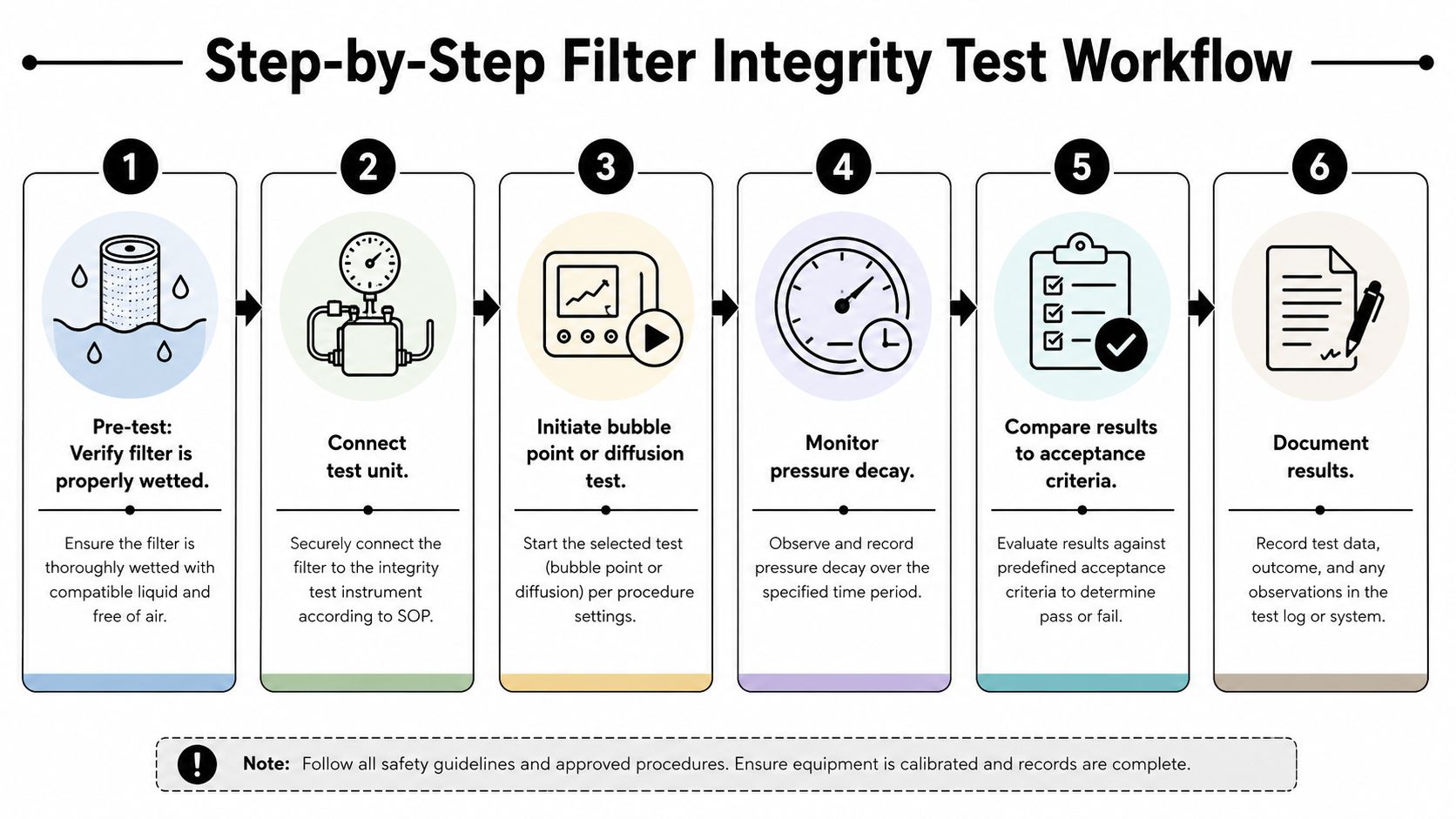
4. Stabilize and measure
Allow the system to stabilize before interpreting flow or pressure behavior. Temperature changes affect gas behavior and can shift diffusion measurements. Watch for unstable supply pressure, trapped air, vibration, or a drifting reading.
A short instructional demonstration can help new personnel visualize the connection sequence and instrument behavior:
5. Compare against the correct limit
The result passes only when it meets the manufacturer's validated criterion for the specific filter, membrane, area, wetting condition, and test method. Do not round a borderline value casually or compare it with an unofficial tolerance.
If the result fails, pause disposition. Check wetting, temperature, instrument status, fittings, seals, and valve position under the deviation procedure. Any re-test must be controlled and justified, never used only to obtain a pass.
6. Document the decision
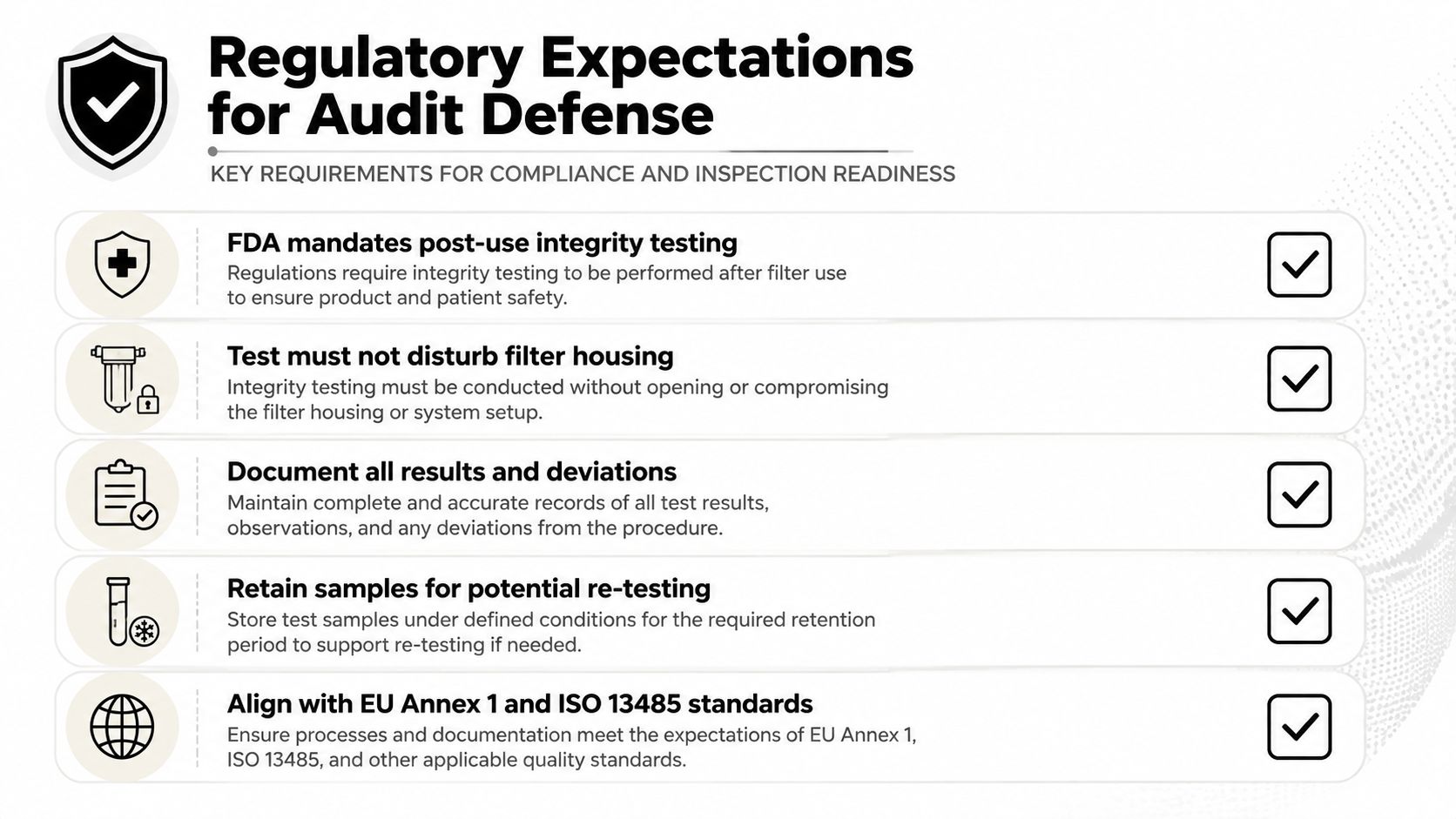
A defensible record captures raw values, units, test conditions, acceptance criteria, instrument identification, filter lot, housing or assembly identity, operator, date, and deviations. It should also state whether testing occurred pre-use, post-sterilization, post-use, or during qualification.
That documentation preserves the link between the manufacturer's bacterial-challenge validation and the site's actual process conditions. During an audit, the instrument's PASS result is only the starting point. The approved method, filter-specific limit, configuration, and investigation history explain why the result supports the intended integrity decision.
Regulatory Expectations and Audit Defense
Regulators expect sterile-drug manufacturers to use validated physical integrity testing within the sterile filtration control strategy. The FDA sterile drug products material describes post-use physical integrity testing as a validated check performed without disturbing the filter housing. Pre-use testing is recommended when process conditions allow it, with diffusion, pressure-hold, and bubble-point methods recognized as accepted approaches.
The timing addresses different failure modes. Pre-use testing can detect damage from shipping, installation, assembly, or sterilization before product exposure. Post-use testing can identify damage introduced during processing. A site that performs only one check may leave part of the risk uncontrolled, depending on process design and the documented justification.
The bacterial-retention bridge
The audit question is rarely limited to whether the instrument printed PASS. Inspectors will ask why that result demonstrates the required microbial retention for the selected filter under the actual process conditions.
The sterilizing-filtration benchmark requires a sterilizing filter to retain at least 10 colony-forming units of P. diminuta per square centimeter of filter surface. This benchmark is associated with the bacterial-retention principles described in applicable compendial guidance, including Ph. Eur. 2.6.27 and USP <1229>. The physical test limit must connect to the manufacturer's bacterial-challenge validation package. Site qualification must then show that installation, sterilization, fluid exposure, temperature, pressure, and operating conditions do not invalidate that relationship.
That connection is the often-missed bridge between supplier validation and process evidence. A manufacturer may establish a correlation under defined challenge conditions, but the customer must demonstrate that the installed filter and process remain within those conditions, or document a justified assessment of the differences.
A supplier's package should make this bridge visible rather than forcing the customer to assemble it from scattered certificates.
Documentation that supports an audit
A distributor or wholesaler should provide, or identify how the customer can obtain:
- Filter identity: Product code, membrane material, pore designation, effective area, assembly type, and lot traceability.
- Integrity limits: Approved bubble-point, diffusion, or pressure-hold limits, including wetting fluid and test pressure.
- Bacterial challenge evidence: Validation data showing how the physical limits relate to microbial retention for the relevant filter design.
- Process compatibility: Evidence covering the customer's fluid, temperature, pressure, sterilization cycle, and contact conditions.
- Installation controls: Instructions for housing fit, seals, orientation, venting, drainage, and test connections.
- Sterilization impact: Information showing that the approved sterilization approach does not damage or alter the validated test response.
- Records and deviations: A controlled form or electronic record structure that captures raw results, instrument status, calculations, and investigations.
A certificate of conformance proves what was supplied. It does not, by itself, prove that the customer's process was validated.
Qualification covers more than retention. Guidance on sterilizing filter validation emphasizes installation, sterilization, and integrity testing, alongside chemical compatibility, adsorption or binding, and extractables considerations. A cGMP compliance requirements framework can help quality teams place these records within the wider quality system. The filter-specific evidence must still stand on its own.
The Shift Toward Automated and Cloud-Connected Testers
Manual testing can be appropriate when the procedure is simple, the testing frequency is manageable, and trained operators can create complete contemporaneous records. The problem starts when a manual workflow depends on memory, handwritten transcription, informal corrections, or uncontrolled calculations. In that environment, a technically correct test can still produce weak data-integrity evidence.
Automated integrity testers reduce some operator decisions by controlling pressure ramps, stabilization, flow measurement, and result classification. They can also associate the result with an instrument identity, user login, method version, and electronic record. Those controls don't replace validation, but they can reduce opportunities for transcription errors and unexplained changes.
What automation actually improves
The strongest case for automation isn't speed alone. It's consistency and traceability across repeated tests.
- Method control: The instrument can restrict users to approved test methods and limits.
- Electronic records: Raw readings and final decisions can remain connected in one record.
- Audit trails: Changes to methods, users, and results can become reviewable events.
- Operator guidance: Prompts can expose missing steps, incorrect connections, or unstable conditions.
- Trend review: Repeated borderline results may become visible before a clear failure occurs.
Cloud-connected platforms add another layer. They may allow authorized quality personnel to review records across locations, standardize methods across laboratories, and monitor equipment status. They also introduce governance questions around access, data ownership, cybersecurity, backup, system validation, and electronic-signature controls.
When manual remains reasonable
Automation isn't automatically justified for every laboratory. A lower-throughput site with a stable, well-understood process may gain little from a complex connected architecture if the manual procedure already produces controlled records and trained staff follow it consistently.
The decision should compare the complete quality burden:
- How often are filters tested?
- How many sites or instruments need harmonized methods?
- How much review time does manual transcription require?
- Can the current records support an inspection without reconstruction?
- What happens operationally when an instrument, network, or software platform is unavailable?
- Does the proposed system have a credible validation and support package?
Market analysis places the sector's 2025 to 2033 growth forecasts commonly around mid-single-digit CAGR, while market-size estimates range from about USD 90 million to USD 150 million, depending on scope, as reported by Research and Markets. Those estimates describe a developing market, not a universal business case for every buyer.
For smaller labs and regional distributors, the better question is whether automation reduces a specific audit or execution risk enough to justify the added cost and maintenance. A portable tester with controlled methods may solve the core problem more effectively than an oversized cloud platform.
Strategic Purchasing and Quality Assurance Considerations
Procurement should treat a sterilizing filter as part of a validated system, not as an interchangeable membrane purchased by pore designation alone. The supplier's technical file, test limits, compatibility evidence, sterilization information, and traceability support can matter as much as the cartridge or capsule itself.
A useful supplier review starts with the audit question: could a downstream customer explain exactly why a passing result supports bacterial retention under the intended conditions? If the answer depends on undocumented assumptions, the purchase carries avoidable quality risk.
What the supplier should support
The purchasing file should address:
- Validated test limits: The supplier should identify the method, pressure, wetting fluid, temperature conditions, and configuration behind each limit.
- Retention correlation: The bacterial-challenge package should explain how the physical acceptance criteria relate to the claimed sterilizing performance.
- Compatibility: Chemical exposure, adsorption or binding, extractables, and product-contact risks should be evaluated for the intended process.
- Sterilization: The approved cycle and any restrictions should be clear, especially where steam or other sterilization steps could affect membrane behavior.
- Installation: Housing dimensions, seal requirements, flow orientation, venting, and drain arrangements should be controlled in the customer's procedure.
- Change notification: Material, manufacturing, packaging, and test-method changes should be managed through supplier quality agreements.
Troubleshooting before rejecting the filter
A failed result deserves a structured investigation. Operators should first examine incomplete wetting, trapped air, temperature instability, incorrect pressure, external leakage, valve position, instrument calibration, and residue from the product or sterilization process. If the housing or test line leaks, replacing the membrane won't solve the underlying problem.
The investigation should preserve the original record and document any authorized re-test. A second pass doesn't erase the first failure. Quality personnel need to know why the initial result occurred, what evidence supports the corrective action, and whether product disposition requires escalation.
For wholesalers, the most valuable offering is not merely reliable delivery. It's a documentation package that helps customers connect the supplied filter to their procedures, validation studies, and batch records. For laboratory managers, the best purchase is the one that aligns hardware, method, training, records, and supplier support into one defensible control strategy.
Herbilabs supplies laboratory materials, sterile diluents, clear COAs, and wholesale or distribution support for research workflows across the EU, UK, and USA. Visit Herbilabs to review its laboratory supply and partnership options, then contact the team about documentation and fulfillment requirements for your operation.