Private Label, White Label, Wholesale partnerships available - EU, USA and UK - Free shipping from €75

Sodium Chloride for Nebulizer: A Practical Guide
The most popular advice about sodium chloride for nebulizer use is also the source of many avoidable errors: “saline is saline.” A graduate student once reached for a 3% ampoule when a routine dilution required 0.9% sodium chloride. The mistake was caught before exposure, but the prepared vial had to be discarded and the run restarted.
That small failure captures the central problem. 0.9%, 3%, and 7% sodium chloride are not interchangeable, even though each may be called saline. Concentration changes the airway effect, the tolerance profile, the appropriate protocol, and sometimes the suitable nebulizer presentation. Buyers also need to distinguish sterile single-use packaging, multi-dose formats, bacteriostatic products, and research-use-only labeling.
The practical rule is simple: identify the intended airway effect first, then verify concentration, sterility, container format, device compatibility, and documentation.
Table of Contents
- Why the Right Sodium Chloride Matters in a Nebulizer
- 0.9% vs 3% vs 7% Sodium Chloride Explained
- Sterile, Multi-Dose, and Bacteriostatic Formats
- Matching Sodium Chloride to Your Nebulizer Type
- Safety, Bronchospasm, and Pre-Treatment Protocol
- Handling, Storage, and Shelf-Life Best Practices
- COA, Batch Testing, and Quality Signals for Buyers
- Ordering, Packaging, and Wholesale Partnership Notes
Why the Right Sodium Chloride Matters in a Nebulizer
A nebulizer produces an aerosol, but it cannot correct a wrong product choice. Before ordering or opening a container, identify the protocol, intended airway role, and documentation required for the work.
The purchasing question is often more specific than “Do you have saline?” A buyer may need a defined concentration, sterile presentation, stated fill volume, compatible container, and a label that supports the intended use. The product name alone does not confirm those details. A research-use-only item, for example, may not meet a clinical requirement even when its chemistry appears suitable.
Four checks before the chamber is filled
A new researcher or purchasing coordinator can reduce mix-ups by checking these points in sequence:
- Concentration: Does the written protocol specify the required formulation?
- Purpose: Is the solution being used to dilute medication, support airway moisture, or produce a secretion-clearance response?
- Device: Does the nebulizer accept the container, preservatives, and specified fill volume?
- Documentation: Does the label or certificate identify sterility, volume, lot, expiry, storage, and regulatory status?
Concentration and airway role should be confirmed from the protocol rather than inferred from the carton. The product may be chemically accurate yet still unsuitable because its packaging, sterility status, or labeling does not match the procedure.
For buyers, request the certificate of analysis, batch or lot information, packaging description, and storage requirements before placing a larger order. Check whether the supplier identifies the material as clinical-use, laboratory-use, or RUO. That classification affects how the product can be supplied and used.
Practical rule: Treat “saline” as a product category, not a complete specification.
For clinical use, the prescriber or respiratory professional selects the formulation. For laboratory work, the protocol owner should record the required concentration, exposure purpose, device, and acceptance documents before anyone opens a container. This paperwork protects the receiving person or model and prevents an otherwise avoidable run failure.
0.9% vs 3% vs 7% Sodium Chloride Explained
“Saline” does not describe one airway effect. The concentration changes how the solution behaves, so 0.9% sodium chloride, 3% sodium chloride, and 7% sodium chloride should be treated as different tools rather than interchangeable products.
0.9% sodium chloride is isotonic. Its osmotic behavior is close to airway fluid, so it mainly acts as a carrier and moisture-supporting solution. It can help create liquid for aerosol generation without deliberately drawing substantial water into the airway surface.
3% and 7% sodium chloride are hypertonic. Their higher salt concentration creates a stronger osmotic pull. As described in clinical information about sodium chloride nebulizer solutions, higher-concentration solutions may be selected for condition-specific secretion-clearance purposes, while 0.9% is commonly used as general saline.
The mechanism determines the use
With 0.9% sodium chloride, the main function is delivery. It can dilute an inhaled medication or provide a suitable fluid base for the nebulizer. The concentration itself is not intended to produce a strong mucus-mobilizing response.
With 3% sodium chloride, the solution contributes more directly to airway treatment. Its osmotic effect can draw water toward airway secretions, helping loosen mucus and making coughing more productive in protocols that call for this response.
7% sodium chloride produces a stronger hypertonic effect than 3%. That may support more intensive mucus mobilization or sputum-induction protocols, but the same mechanism can increase throat irritation, coughing, or bronchospasm. Tolerance varies, so the selected concentration must come from the documented clinical or laboratory procedure.
A useful analogy is carrier fluid versus active osmotic tool. The 0.9% solution primarily transports or moistens. The 3% and 7% solutions are chosen when the salt gradient itself is part of the intended airway response.
Concentration does not determine the required device setting, container amount, or workflow by itself. Those details belong to the approved protocol and nebulizer instructions. Buyers comparing products should also use this saline versus sterile water guide to separate carrier fluids from therapeutic saline concepts. A chemically accurate product can still be unsuitable if its concentration does not match the intended airway effect, or if its sterility and RUO labeling do not fit the application.
Sterile, Multi-Dose, and Bacteriostatic Formats
Concentration answers one question, but packaging answers another: how will contamination be controlled after the product reaches the user? A sterile solution can still become unsuitable after opening if the container, withdrawal method, and in-use procedure don't match the workflow.
Single-use ampoules
Sterile single-use ampoules are generally the clearest choice for routine nebulization. Each container is opened immediately before treatment, and unused contents are discarded. That design limits the time available for contamination and avoids adding a preservative to an inhaled solution.
A buyer should confirm that the label states the concentration, intended route or use, fill volume, sterility status, and single-use instruction. A twist-off plastic vial or snap-open ampoule may be convenient, but convenience doesn't replace checking whether the product is labeled for inhalation, injection, or research use only.
Sterile multi-dose containers
Sterile multi-dose vials can suit a laboratory workflow that requires repeated withdrawals of the same solution during a controlled session. They demand an aseptic process, a sterile needle and syringe for every withdrawal, clear opening records, and a defined discard policy.
This format may reduce packaging waste, but it also increases the number of handling decisions. A distributor should never assume that “sterile” means “safe indefinitely after first puncture.” The supplier's in-use instructions and the receiving site's validated procedure govern the practical shelf life.
Bacteriostatic preparations
Bacteriostatic saline contains a preservative intended to limit microbial growth after repeated entry into the container. That feature may suit some bench workflows, but a preservative that is acceptable for one route may irritate the airways when aerosolized. Independent safety summaries have also associated benzyl alcohol-containing bacteriostatic saline with airway concerns, including bronchitis, as discussed in this bacteriostatic saline safety overview.
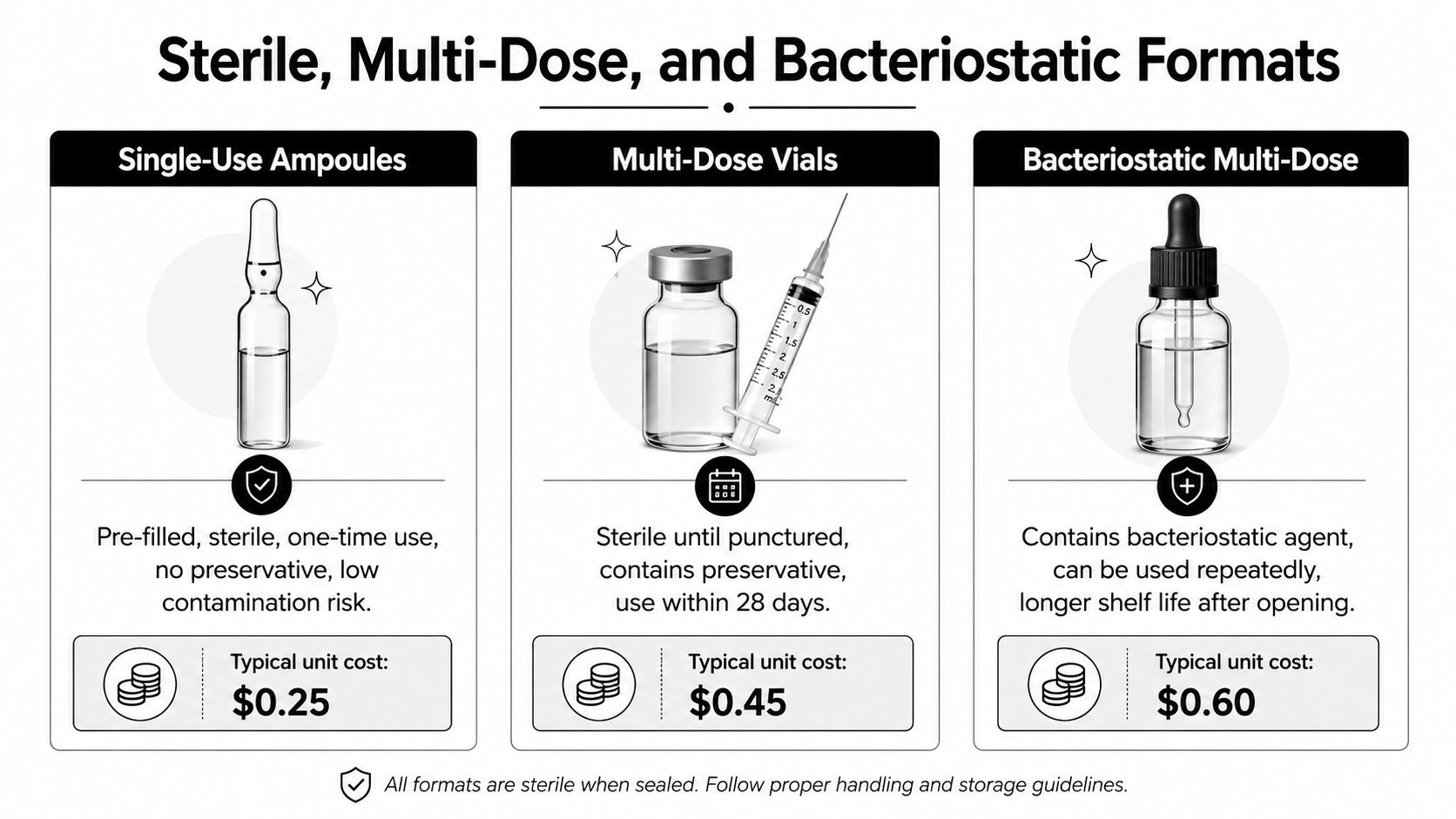
For respiratory applications, buyers should treat bacteriostatic labeling as a signal to stop and verify compatibility rather than as a quality upgrade. More detail on the distinction between preserved and non-preserved products appears in this bacteriostatic saline reference.
Matching Sodium Chloride to Your Nebulizer Type
The nebulizer isn't a passive container. Its chamber geometry, aerosol mechanism, residual volume, and material tolerance all influence whether a sodium chloride presentation works as intended.
Jet nebulizers
Jet devices use compressed air to break liquid into droplets. They commonly accommodate sterile 0.9% sodium chloride presentations, but a portion of the liquid can remain in the chamber after aerosol production stops. Because adequate chamber volume supports consistent aerosol generation, the written protocol should specify the fill rather than relying on an operator's estimate.
A practical example is a routine medication dilution. The protocol may call for 0.9% sodium chloride to bring the chamber to an appropriate volume, while a hypertonic treatment may arrive as a dedicated ampoule that is used according to its own instructions. The two products should not be substituted because both fit physically.
Vibrating mesh devices
Mesh nebulizers push liquid through fine apertures. They can be more sensitive to viscosity, particles, residues, and formulation additives than a basic jet device. Preservative-free sterile solutions are the safer starting point for compatibility review, particularly when the supplier has documented the product for inhalation equipment.
A multi-dose product containing a bacteriostatic agent may create a formulation and maintenance question, even if it appears clear. The device manufacturer's instructions should be checked alongside the solution label. A useful overview of mask selection and device setup is this face mask nebulizer guide.
Ultrasonic devices
Ultrasonic nebulizers use vibration and can produce a dense aerosol while transferring some energy into the liquid. Simple isotonic saline is often the less complicated choice unless the protocol specifically requires hypertonic induction. The operator should verify that the device is approved for the intended solution and concentration.
| Nebulizer Type | Best Sodium Chloride | Typical Fill Volume | Residual Volume | Compatibility Notes |
|---|---|---|---|---|
| Jet | Sterile 0.9% ampoules for routine dilution, protocol-specific hypertonic products when required | Follow device and protocol instructions | Often leaves liquid in the chamber | Confirm chamber minimum, aerosol time, and cleaning procedure |
| Vibrating mesh | Preservative-free sterile solution with documented device compatibility | Follow manufacturer instructions | Device-dependent | Check for particles, additives, and formulation restrictions |
| Ultrasonic | Simple isotonic saline unless hypertonic use is specifically documented | Follow manufacturer instructions | Device-dependent | Confirm heat and formulation compatibility before use |
The safest pairing is not the cheapest container with the most familiar device. It is the combination whose concentration, excipients, fill, and aerosol mechanism have been checked together.
Safety, Bronchospasm, and Pre-Treatment Protocol
Hypertonic saline can be useful for mucus mobilization, but it isn't a neutral carrier. Cough, throat irritation, chest tightness, dyspnea, and bronchospasm can occur, particularly in people with reactive airways. Guidance from King's College Hospital recommends bronchodilator pretreatment and places hypertonic saline within a broader airway-clearance sequence, as described in this hypertonic saline protocol.
Why pretreatment matters
A short-acting bronchodilator such as salbutamol or terbutaline may be given before hypertonic saline when the clinical protocol calls for it. This step directly addresses the known bronchoconstrictive potential of concentrated saline. It isn't merely a comfort measure, and it shouldn't be removed from the workflow because the solution is labeled sterile.
A first dose also deserves a higher level of observation in susceptible patients. The supervising professional can establish a baseline, administer the prescribed bronchodilator, introduce the saline according to the protocol, and watch for cough, wheeze, breathlessness, or chest tightness.
Safety principle: Hypertonic saline should be treated as an active airway intervention, not as ordinary dilution water.
For a laboratory model, the same logic applies even when the container carries RUO labeling. Research status does not eliminate the need for documented exposure limits, equipment checks, stop criteria, and trained supervision. Human use requires direction from a qualified healthcare professional, and a research protocol should specify who can stop the exposure and what happens if the model shows intolerance.
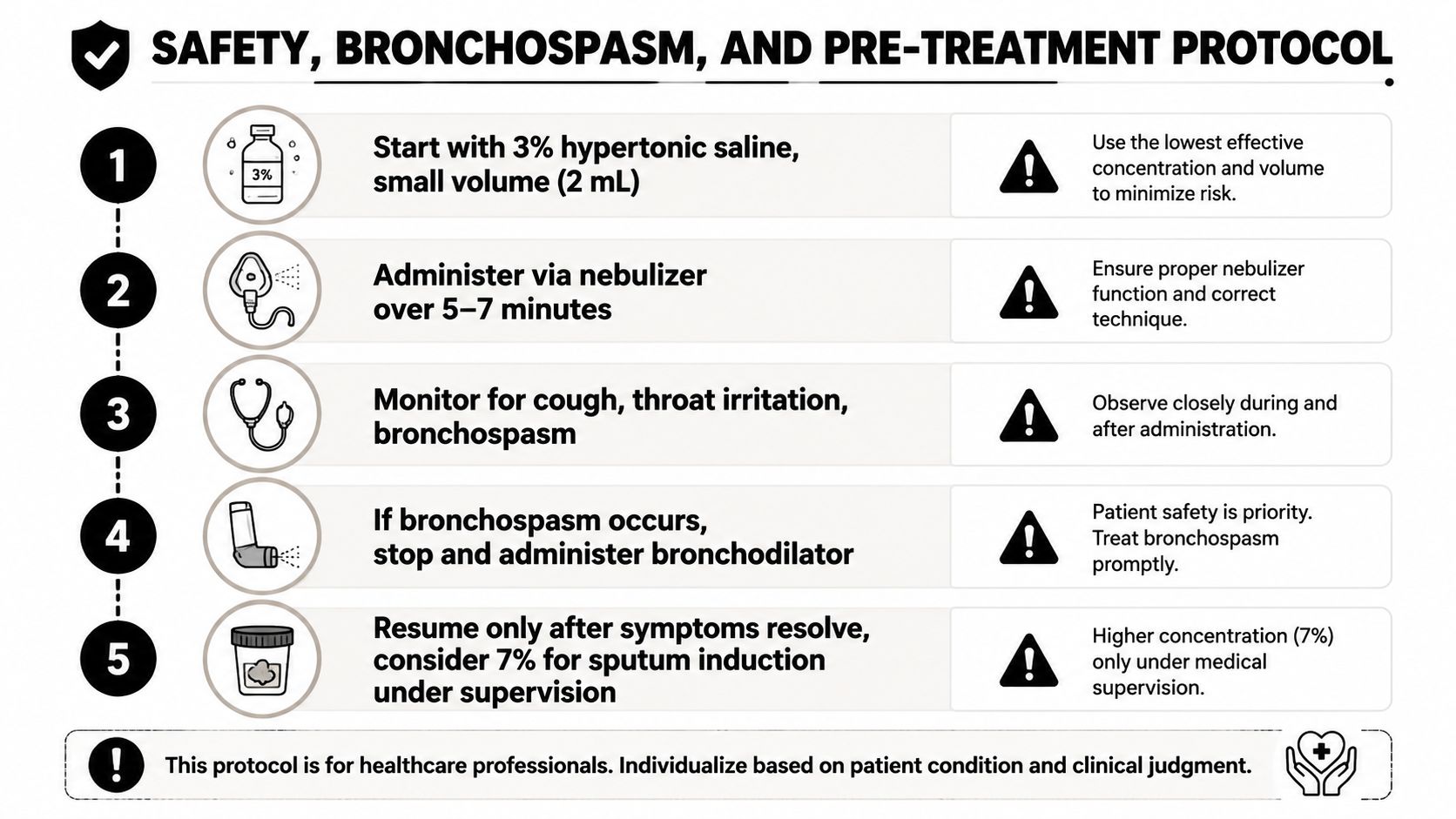
A practical educational video can help staff visualize mask placement and treatment sequencing:
If symptoms begin, the operator should follow the approved protocol, stop the exposure when instructed, and seek clinical assistance where appropriate. A lower concentration may be better tolerated for some patients, but the decision belongs to the prescriber or supervising professional.
Handling, Storage, and Shelf-Life Best Practices
A printed expiry date describes the unopened product under its labeled storage conditions. It doesn't guarantee that a container remains suitable after careless opening, repeated handling, or uncertain storage. The handling plan should begin before the ampoule or vial reaches the nebulizer.
At the point of opening
Single-use containers should be opened immediately before use. The operator should inspect the package, confirm the concentration and expiry, keep the opening area clean, and discard unused contents rather than returning them to stock.
A clear solution isn't automatically acceptable. Cloudiness, visible particles, damaged packaging, a compromised seal, or an unclear label should trigger quarantine and review. The same inspection applies to products moved between storage locations.
During multi-dose work
Repeated withdrawals require a written aseptic procedure. Each entry should use a sterile needle and syringe, and the vial should carry an opening date and responsible operator identifier. The discard period must come from the product documentation or an approved site procedure, not from an informal assumption.
Wholesalers should communicate storage and expiry information on every pack or accompanying document. A receiving team needs to connect the container to its lot, certificate of analysis, and shipment record without searching through unrelated paperwork.
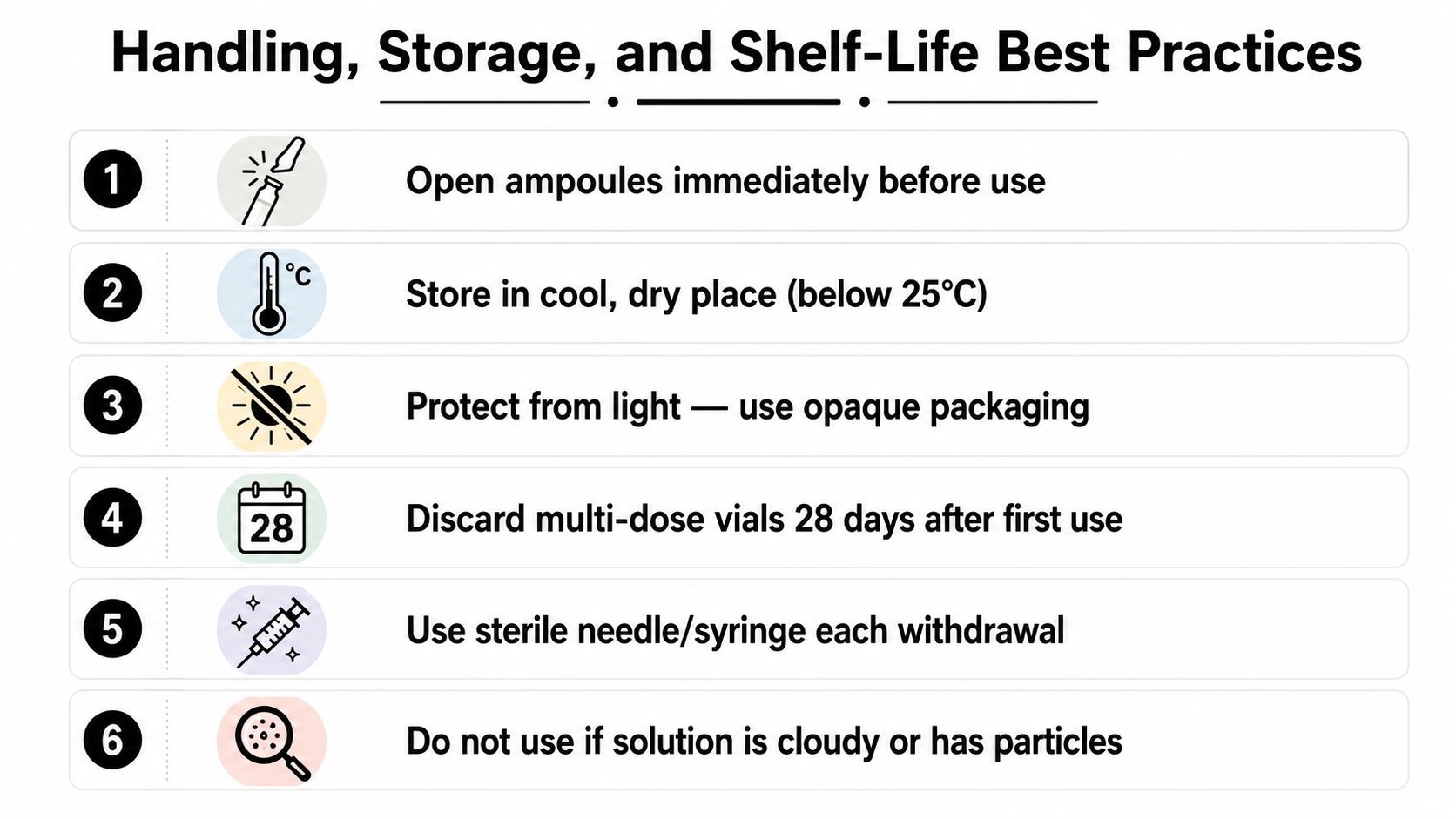
A concise receiving checklist can include:
- Inspect the container: Reject damaged, leaking, cloudy, or particulate-filled units.
- Verify the label: Match concentration, volume, sterility, intended use, lot, and expiry to the purchase order.
- Control the environment: Follow the supplier's stated temperature and light requirements rather than transferring stock casually.
- Record opening: Date multi-dose containers and apply the documented discard rule.
- Separate formats: Keep bacteriostatic and preservative-free products physically and visually distinct.
- Retain traceability: Store the lot number and COA with the receiving record.
Storage instructions vary by product. Some unopened solutions are held at ambient conditions, while some opened multi-dose workflows require controlled refrigeration. The label and validated supplier instructions should always take priority over a generic temperature rule.
COA, Batch Testing, and Quality Signals for Buyers
A Certificate of Analysis is useful only when it identifies the actual batch being purchased. A generic specification sheet may describe a product family, but it cannot replace a batch-specific document that connects the material to its test results, lot number, release decision, and stated storage conditions.
What a buyer should look for
For sodium chloride solutions used around aerosol equipment, the COA should make the quality system visible. Relevant fields commonly include:
- Identity and assay: Confirms that the material is sodium chloride at the labeled concentration.
- pH: Helps identify whether the solution falls within the supplier's approved range.
- Sterility: Shows whether the batch passed the stated sterility method.
- Endotoxin: Matters because aerosolized contaminants can reach the lower respiratory tract without relying on ordinary upper-airway filtering.
- Particulates: Supports assessment of visible and subvisible contamination risks.
- Appearance: Provides a basic check for clarity, color, and foreign matter.
- Packaging and seal: Connects the test result to the container system supplied.
A buyer should also check whether the test method is named, whether the result is a pass or a measured value, and whether the document carries an authorized release signature or equivalent approval. The sodium chloride injection USP product reference offers an example of the type of product documentation buyers may compare during supplier qualification, but the receiving organization still needs the batch-specific COA for the shipment in hand.
| COA Field | Typical Specification | Why It Matters for Nebulizer Use |
|---|---|---|
| Concentration or assay | Must match the labeled formulation and approved product specification | Prevents substitution between isotonic and hypertonic protocols |
| pH | Supplier-defined acceptance range | Supports formulation consistency and tolerability review |
| Sterility | Pass or fail against the stated method | Confirms the batch met its release requirement |
| Endotoxin | Supplier-defined limit or applicable specification | Helps assess contamination risk for aerosol exposure |
| Particulates | Within the stated acceptance criteria | Reduces concern about material entering the aerosol pathway |
| Appearance | Clear and free from visible foreign matter where specified | Provides a basic incoming inspection signal |
| Lot and expiry | Batch-specific identifiers | Preserves traceability during complaints, recalls, or investigations |
Red flags during qualification
A supplier should be asked to clarify any COA that omits endotoxin information, provides no sterility method, uses a lot number that doesn't match the label, or makes a broad “tested for nebulization” statement without explaining the test setup. Reformulation also matters. A document generated before a composition, container, or manufacturing change may no longer describe the current product.
The strongest purchasing decision combines three records: the product label, the batch COA, and the supplier's change-control history. If any one of those is missing, the buyer has less evidence that the delivered solution matches the intended workflow.
Ordering, Packaging, and Wholesale Partnership Notes
Wholesale buyers should order sodium chloride by a complete specification, not by a short product nickname. The purchase description should identify concentration, fill volume, container type, sterile or bacteriostatic status, intended use, storage conditions, and regulatory labeling.
Match packaging to the workflow
Unit-of-use ampoules suit routine respiratory care because they reduce repeated access and simplify inventory counting. Multi-dose sterile vials may fit controlled bench procedures where repeated withdrawals are justified, while larger bottles may serve laboratory dilution or preparation workflows that don't place the container directly into a nebulizer chamber.
The correct choice depends on turnover, operator training, device requirements, and contamination controls. A lower unit price can lose its advantage if the format creates waste, complicates cold storage, or fails a customer's inhalation-use requirements.
Build the purchase order around evidence
A distributor can request the following before approving a supplier:
- Product identity: Concentration, sodium chloride grade, volume, and presentation.
- Use status: Clinical labeling, inhalation labeling, or clear Research Use Only status where applicable.
- Batch records: Lot number, manufacture date, expiry date, and batch-specific COA.
- Quality data: Assay, pH, sterility, endotoxin, particulates, and appearance results where specified.
- Packaging information: Container material, closure, tamper evidence, and case configuration.
- Change control: Advance notification of formulation, manufacturing site, packaging, or labeling changes.
- Supply continuity: Lead-time expectations, replacement policy, and complaint-response process.
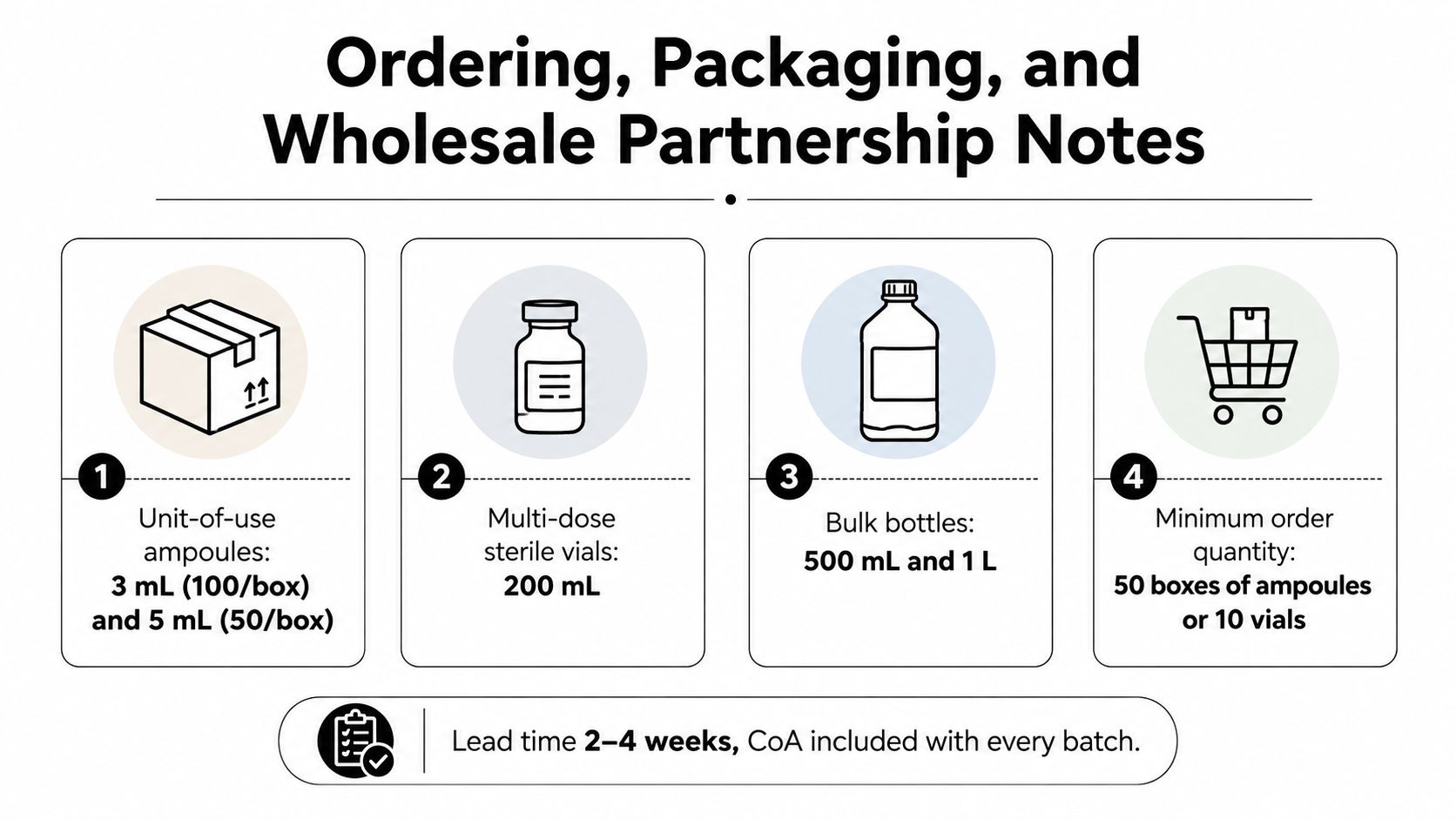
RUO labeling needs careful handling
An RUO product is not automatically interchangeable with a clinically labeled inhalation product. Resellers and distributors should preserve the manufacturer's intended-use language, avoid converting research documentation into treatment claims, and ensure downstream customers understand the product's status.
A durable supplier relationship depends on transparency more than attractive packaging. Batch retention samples, responsive COA support, clear deviations handling, and early reformulation notices help buyers protect their own customers and maintain traceability across the distribution chain.
The final receiving check should ask one direct question: does the product in the carton match the use case in the customer's protocol? If concentration, formulation, device compatibility, and documentation all align, the order is much less likely to create a bench-side surprise.
Herbilabs supplies high-purity sterile diluents and research-use-only laboratory products with batch documentation, clear COAs, and wholesale options for distributors in the EU, UK, USA, and other markets. Buyers evaluating sodium chloride for nebulizer workflows can visit Herbilabs to review available formats and discuss a specification that matches their packaging, documentation, and supply requirements.