Private Label, White Label, Wholesale partnerships available - EU, USA and UK - Free shipping from €75

Saline vs. Sterile Water: Choose Right for Your Lab
A lyophilized peptide is on the bench. The protocol says “reconstitute under sterile conditions,” but says nothing useful about ionic environment, downstream exposure to cells, storage duration, or whether the vial will be split across multiple runs. That's where avoidable variability starts.
For lab professionals and distributors, saline vs. sterile water isn't a beginner question. It's a control point. The wrong diluent can distort a cell-facing assay, destabilize a sensitive reagent, complicate RUO handling, or create needless procurement risk when supply tightens. The simple classroom rule, isotonic versus hypotonic, is correct but incomplete.
What matters in practice is context. Direct tissue contact, peptide conformation, ionic strength, packaging, sterility claims, certificate review, and supplier consistency all affect whether the “purest” option is the right one.
Table of Contents
- The Critical Choice at the Laboratory Bench
- Foundational Definitions Saline and Sterile Water
- The Core Scientific Difference Osmolarity and Ionic Strength
- Clinical and Laboratory Use Cases Compared
- Optimizing Peptide and Reagent Reconstitution
- Navigating Quality Purity and Supply Chain Realities
- A Decision Framework for Choosing Your Diluent
The Critical Choice at the Laboratory Bench
Most bench errors don't announce themselves as errors. They look routine. A vial is opened, a sterile syringe is used, the powder dissolves, and the preparation appears visually acceptable. The problem only shows up later, when a bioassay becomes noisy, a peptide loses activity, or a cell-facing application behaves inconsistently across runs.
That's why diluent choice deserves more respect than it usually gets. In a live workflow, the choice isn't “salt water or pure water.” It's whether the solution supports the biology, chemistry, and handling conditions of the specific task. A reconstitution step for a peptide stock isn't judged only by whether the powder disappears. It's judged by whether the molecule remains usable in the system that follows.
Practical rule: If a diluent will contact living cells or tissue directly, compatibility with that environment matters as much as sterility.
Distributors see the same issue from another angle. Customers often ask for “sterile water” or “saline” as if those labels alone settle fitness for purpose. They don't. The correct recommendation depends on whether the buyer is preparing a transient stock for later buffered dilution, maintaining structural integrity in a biologically exposed system, or managing RUO inventory under supply constraints.
A useful decision starts by separating three questions:
- What touches the final system: A temporary stock solution can tolerate choices that direct exposure to cells cannot.
- What the molecule needs: Some reagents only need clean dissolution. Others need ionic support to avoid aggregation or conformational drift.
- What the supply chain can guarantee: A theoretically correct diluent is still a bad choice if batch documentation, packaging integrity, or sourcing consistency is weak.
That framework turns a routine bench step into a controlled choice instead of a habit.
Foundational Definitions Saline and Sterile Water
Normal saline and sterile water are often discussed casually, but they serve different roles because they're built differently.
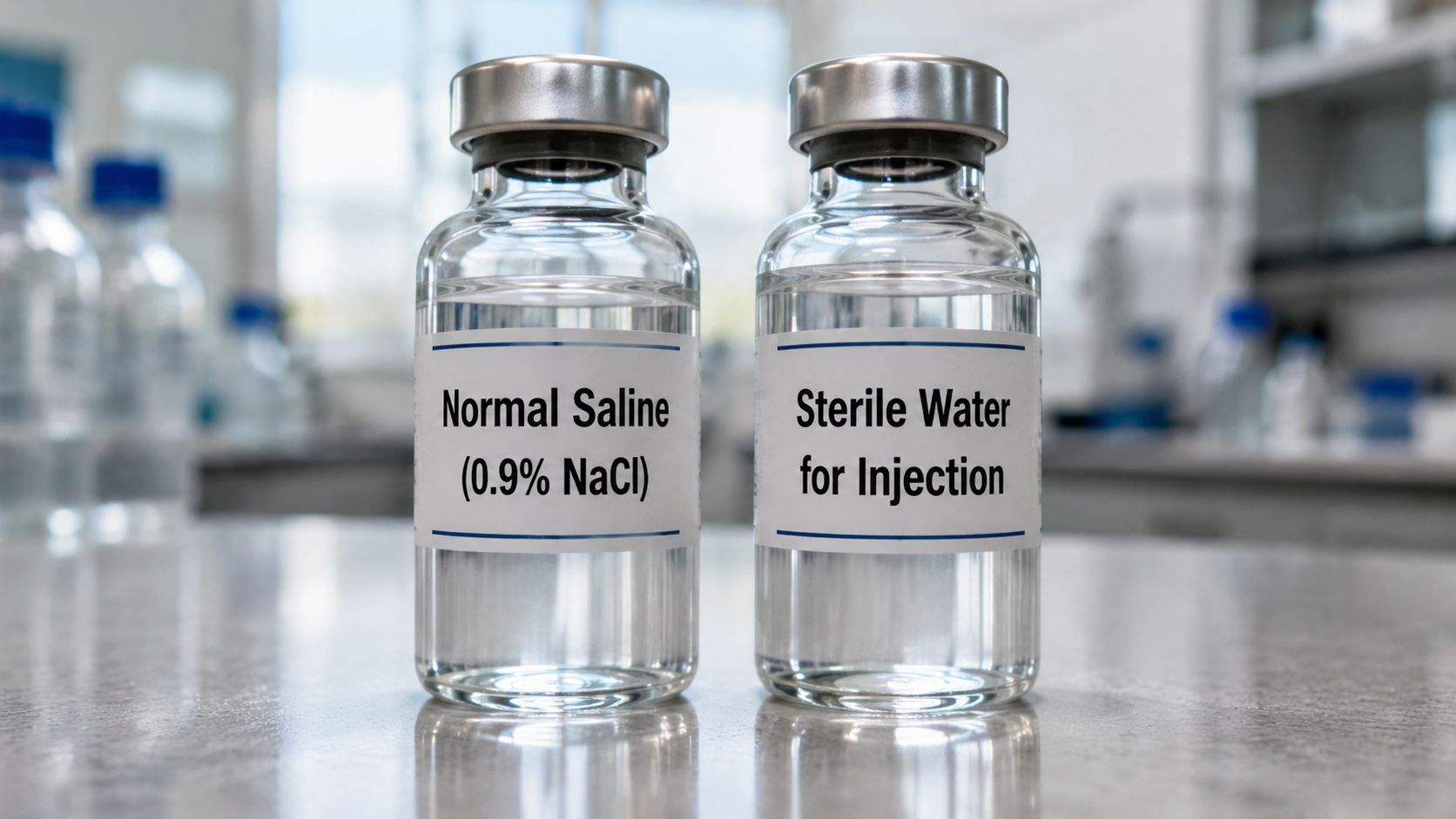
Normal saline is 0.9% sodium chloride in water. In practical terms, it's a sterile aqueous solution that supplies sodium and chloride ions in a concentration intended to be isotonic with human blood. That isotonicity is what makes it suitable when direct physiological contact matters.
Sterile water is sterile water without dissolved ions. It's valued for purity and flexibility, but “more pure” doesn't mean “safer everywhere.” In biological settings, the absence of solute is itself an active property with consequences.
What the labels really imply
For lab buyers, the first distinction is compositional.
- Saline contains ions. Those ions affect osmotic behavior, conductivity, and biomolecular interactions.
- Sterile water contains no dissolved ions. That makes it useful where the operator wants a blank starting point before adding a defined buffer or reagent system.
- Sterility is not the whole story. Two sterile liquids can behave very differently once they touch proteins, peptides, cells, or tissue.
The second distinction is use category. Product naming matters. Sterile water intended for injection or irrigation is manufactured for specific sterile-use contexts, while RUO products are purchased and handled under research restrictions. Teams that skip that distinction can create compliance issues even when the chemistry seems appropriate.
A clean way to think about product selection is to treat sterile water as a neutral base material and saline as a biologically matched working environment. Those aren't interchangeable categories.
Why procurement language should stay precise
In purchasing conversations, “sterile,” “pyrogen-free,” “for injection,” “for irrigation,” and “RUO” are often blurred together. That leads to preventable mistakes in substitution.
A distributor or lab manager reviewing USP sterile water for injection options should read beyond the front label and confirm intended use, packaging configuration, batch documentation, and whether the product is being purchased for a research workflow or a regulated clinical pathway.
Sterility answers one question. Composition, designation, and documentation answer the rest.
The Core Scientific Difference Osmolarity and Ionic Strength
A common bench failure looks harmless at first. A material dissolves cleanly in sterile water, the vial stays clear, and the prep moves forward. An hour later, the peptide has drifted, the cell assay is noisy, or the receiving lab asks why the reconstitution medium does not match the product file. The difference was not sterility. It was osmolarity and ionic strength.
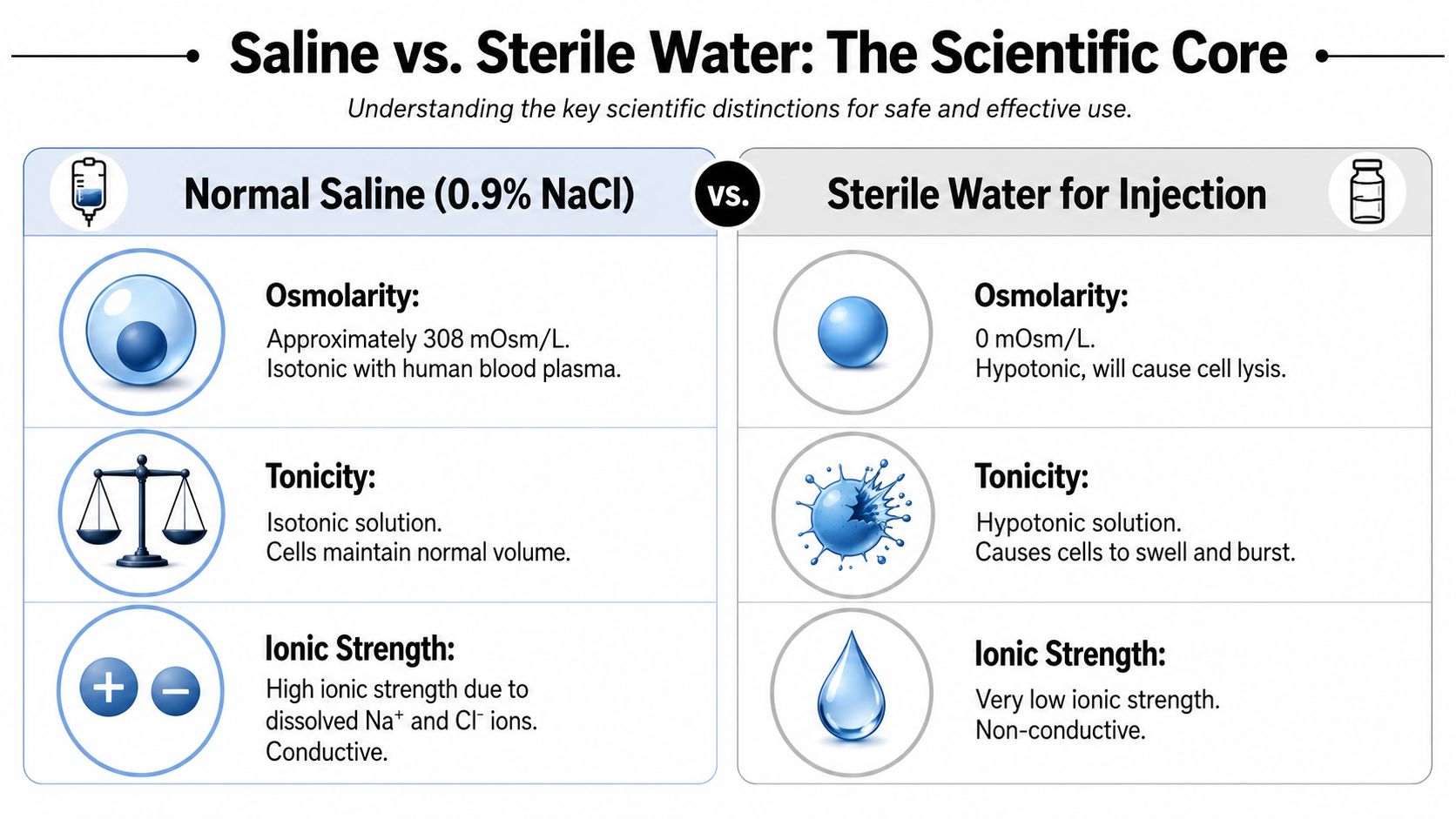
Sterile water presents cells and biomolecules with a zero-ion environment. Normal saline presents sodium and chloride at a concentration intended to approximate physiological tonicity. Those conditions produce different behavior immediately, even before pH adjustment, buffering, or storage enters the picture.
What changes at the point of contact
Cells respond to gradients, not labels.
If sterile water contacts cells or tissue directly, water moves inward because the external phase has lower solute concentration than the intracellular space. Cell swelling follows. In a strong enough gradient, membranes rupture. For any workflow involving direct exposure, that is a sample integrity problem, not a theoretical one.
Saline limits that osmotic shock because its tonicity is closer to the biological environment. Cell volume remains more stable, and the diluent is less likely to distort the system before the intended treatment, stain, or assay begins.
A practical comparison is below:
| Property | Normal Saline | Sterile Water | Practical consequence |
|---|---|---|---|
| Solute content | Contains Na+ and Cl− | No dissolved ions | Different osmotic and electrostatic behavior |
| Tonicity relative to blood | Near isotonic | Hypotonic | Saline is generally safer for direct biological contact |
| Conductivity | Conductive | Very low conductivity | Can affect instrument behavior and some assay setups |
| Best fit | Direct biological contact or physiologic dilution | Controlled base for later formulation | Choice depends on the next processing step |
A short visual summary helps when training new staff.
Why ionic strength matters after dissolution
The harder decisions start once the material is in solution.
For proteins, peptides, and other charged biomolecules, ionic strength influences electrostatic screening, solvation, adsorption to surfaces, and aggregation risk. A zero-ion diluent can be appropriate when the next step is immediate transfer into a defined formulation. It can also create instability if the molecule depends on some ionic screening to remain dispersed or structurally consistent during hold time, transport, or repeated sampling.
That is why the simple isotonic versus hypotonic rule is incomplete for research use. A peptide may dissolve in sterile water and still perform poorly because the initial medium promotes aggregation, shifts apparent recovery, or changes how much material sticks to plastic. The reverse problem also occurs. Saline can introduce ionic conditions that are incompatible with a downstream assay, analytical method, or final formulation target.
For cell-facing systems, sodium chloride injection USP is often the more coherent starting point when direct exposure is expected. For intermediate stocks that will be reformulated into a validated buffer, sterile water may be the cleaner choice, provided the hold time is short and compatibility has been checked.
Distributors and lab leads should treat this as a documentation issue as well as a formulation issue. The right question is not only “will it dissolve?” It is “what ionic environment does this create, how long will the material remain in it, and does the COA support that use under the product's RUO designation?”
A clear solution can still be the wrong solution.
Clinical and Laboratory Use Cases Compared
A bench scientist reconstitutes a peptide in sterile water because the assay buffer comes later. A clinical team reaches for saline because the solution will contact tissue immediately. Both choices can be correct. The mistake is treating either diluent as a universal default.
Use case determines the right answer, but so do hold time, downstream exposure, documentation, and purchasing constraints. For lab managers and distributors, this section is less about textbook tonicity and more about reducing avoidable variability.
A quick comparison matrix
| Application | Better default choice | Why |
|---|---|---|
| Direct tissue or cell contact | Saline | Better aligned with physiological exposure and less likely to cause osmotic injury during direct contact |
| Interim stock for later buffered formulation | Sterile water, if compatible | Low-ion starting point when final composition will be defined in a validated formulation step |
| Wound irrigation | Context-dependent | Tissue comfort, protocol, and setting matter more than a blanket assumption that saline always improves outcomes |
| General cleaning or dilution not involving direct cell exposure | Depends on protocol | Material compatibility and validated procedure usually matter more than tonicity |
| Sensitive peptide preparation | Case-dependent | Ionic strength may improve recovery for some molecules and worsen solubility or assay compatibility for others |
Where common assumptions fail
Wound care is a useful example because it exposes the limit of the simple isotonic rule. A review in Athenaeum found that published comparisons between normal saline and tap water did not show a consistent advantage for saline in infection or healing outcomes, while still recognizing saline's value for tissue compatibility in many settings, as discussed in this wound irrigation review for low-resource and street medicine settings.
That distinction matters in procurement. Saline may be preferred for direct tissue handling, but that does not make it categorically better for every cleaning or irrigation workflow. Clinical comfort, protocol requirements, and supply availability all affect the decision.
A multicenter wound irrigation trial with 715 subjects found similar infection outcomes between saline and tap water. In practice, clinicians still often favor saline where tolerability and predictable composition matter. Sterile water can be less comfortable on exposed tissue because of its hypotonicity. That point carries over to translational work, where user handling and biological response may matter as much as microbial endpoints.
For laboratory operations, the decision matrix is narrower and more technical. If the liquid will contact live cells directly, saline is usually the safer starting point unless a validated buffer replaces it immediately. If the liquid is only an intermediate vehicle before controlled reformulation, sterile water may be cleaner because it avoids adding sodium and chloride ions too early.
The trade-off shows up in QC and distribution as well. Saline introduces a defined ionic background that may be appropriate for one workflow and disqualifying for another, especially for conductivity-sensitive assays or products sold for research use only. Sterile water removes that ionic variable, but it puts more pressure on fast use, validated reformulation, and clear instructions in the COA and product insert.
Teams writing SOPs should specify more than the product name. They should specify exposure context, allowable hold time, packaging, and the release documents required to verify fitness for use. Labs that need a refresher on diluent selection can review this guide to reconstitution solutions for laboratory and peptide workflows.
The practical rule is straightforward. Choose the diluent that matches the full workflow, not the one that sounds safest in isolation.
Optimizing Peptide and Reagent Reconstitution
Peptide users often ask the wrong first question. They ask what dissolves the powder fastest. The better question is what keeps the molecule usable after it dissolves.
Reconstitution is a stability decision
A peptide can go into solution and still move toward aggregation, adsorption, or conformational drift within minutes or hours. That's why reconstitution should be treated as a formulation event, not a clerical step.
Sterile water has an obvious appeal here. It starts as a low-complexity system and doesn't introduce sodium chloride that might interfere with the intended final formulation. For some reagents, that's exactly right. It gives the operator a clean point of control before adding a defined buffer, acidifier, base, or carrier system.
Saline can be the better choice when the molecule benefits from ionic support and the preparation is meant for near-physiological handling conditions. The trade-off is that the same ions that stabilize one peptide can reduce the apparent solubility of another or shift the behavior of a borderline formulation. This is why teams should stop treating “water versus saline” as a universal recipe decision.
A strong reconstitution workflow usually checks four variables together:
- Exposure context: Will the stock touch cells or tissue directly, or will it only be diluted further?
- Time in solution: Immediate use tolerates more than long hold times.
- Sensitivity to ionic strength: Some molecules behave better with ionic screening, others don't.
- Packaging and sterility controls: A good diluent in poor packaging still creates avoidable risk.
A practical reading of the datasheet
Most peptide datasheets don't hand over a complete formulation strategy, but they usually give enough clues to avoid the worst choices. Charge-related behavior, recommended solvent sequence, and storage guidance often indicate whether the peptide wants an ionic environment or a minimal one at first contact.
A practical approach is:
- Check whether the supplier specifies a solvent sequence. If the datasheet suggests an initial aqueous step followed by buffered dilution, sterile water may be intended as a temporary vehicle rather than a final environment.
- Look for charge sensitivity. Highly charged peptides often respond strongly to ionic conditions.
- Separate dissolution from storage. A stock that dissolves in sterile water may still store better after transfer into a more stabilizing formulation.
- Document the exact diluent lot and workflow. Reconstitution variability is easy to mislabel as peptide variability.
For teams standardizing procedures, a technical guide on what reconstitution solution means in practice can help align terminology across purchasing, bench staff, and resellers.
The first successful dissolution is not the endpoint. The endpoint is reproducible molecular behavior in the downstream assay.
Navigating Quality Purity and Supply Chain Realities
A bench scientist opens a replacement case of sterile diluent during a backorder and assumes the swap is harmless. That is often where variability enters the workflow. Composition matters, but batch proof, labeling discipline, and packaging integrity decide whether the vial in hand is fit for peptide work, cell-facing applications, or RUO distribution.
What to check in a COA
A certificate of analysis is not clerical paperwork. It is the minimum evidence set for deciding whether a lot belongs in a controlled research workflow or should be quarantined before it reaches inventory.
The review should answer a few specific questions. First, does the batch designation match the exact SKU and container format ordered? Similar product names still cause substitution errors, especially when sterile water, saline, bacteriostatic formulations, and different fill volumes sit in the same purchasing queue. Second, are sterility, endotoxin, conductivity, or microbial control statements written as actual test results rather than marketing language? Third, is the RUO designation explicit and consistent across the COA, label, and sales documentation? If those documents drift apart, downstream compliance problems usually follow.
Packaging deserves the same scrutiny. A chemically acceptable diluent can still become a poor choice if the closure system does not support the access pattern, hold time, or contamination controls used at the bench. Single-use units reduce one risk profile. Multi-access packaging creates another.
Handling controls matter too. Teams auditing sterile workflow often pair COA review with a check of cleaning and sterilization practices around support equipment. For staff training, a short reference on the role of an autoclave for laboratory work can help procurement, operations, and lab personnel use the same standard.
Why shortages change procurement decisions
According to the ASHP shortage FAQ on sterile water for injection, the 2024 to 2025 shortage of Sterile Water for Injection vials led institutions to reserve supply for critical medication reconstitution. That pressure does not stay inside hospital channels. It affects distributor allocations, substitution frequency, and how aggressively buyers accept "equivalent" stock in research settings.
The same ASHP summary notes that shortages drive conservation measures and product restrictions. For RUO buyers and distributors, the practical implication is straightforward. Verification work has to increase when availability drops. This is the point where weak supplier files show up fast.
Common failure points are easy to recognize:
- Substituting brands without checking lot-specific documents
- Treating all sterile diluents as functionally identical
- Blurring RUO products with clinically designated stock in listings or customer communication
- Accepting packaging changes without reassessing contamination and stability risk
- Skipping COA review because the base chemistry appears familiar
Those shortcuts have direct consequences. Peptide reconstitution can shift lot to lot. Complaint rates rise because the customer sees inconsistent performance, not the procurement decision behind it. Product managers then spend time tracing preventable variability through supplier records, container configurations, and incomplete release documents.
In a stable supply situation, poor vetting may only slow receiving. Under shortage pressure, it affects research integrity, inventory confidence, and the credibility of every result generated from the lot.
A Decision Framework for Choosing Your Diluent
The most reliable way to handle saline vs. sterile water is to decide from the endpoint backward. Start with what the solution will contact, how long it will remain in that state, and what the molecule needs from its environment.
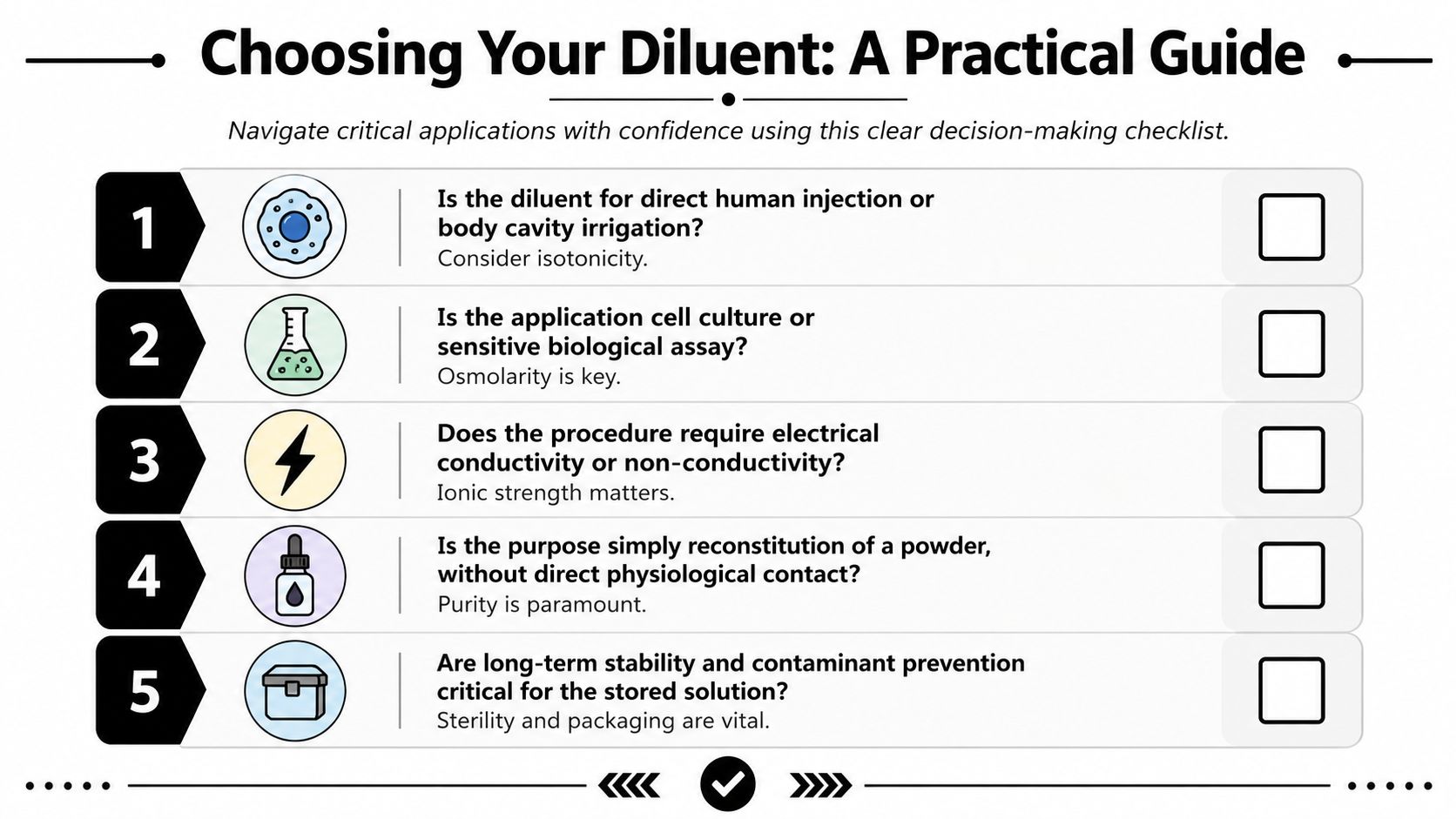
Five questions before opening the vial
Will this contact living cells or tissue directly?
If yes, saline is usually the safer starting point because physiological compatibility matters immediately.Is this only an intermediate stock?
If the solution will be promptly moved into a defined buffer and won't contact cells in its initial state, sterile water may be appropriate.Does the reagent depend on ionic support?
If the molecule is prone to instability in low-ion conditions, a completely ion-free environment may be a poor choice.Could added salt create a solubility problem?
If the reagent has marginal solubility or known sensitivity to ionic strength, sterile water may offer a cleaner initial dissolution path.Can the supplier prove consistency?
If documentation, packaging, or designation are unclear, neither diluent is a good choice until the batch can be verified.
A short operational checklist works well in SOP form:
- For direct biological exposure: Choose isotonic conditions unless the protocol explicitly requires otherwise.
- For sensitive peptide work: Separate “dissolves now” from “remains stable later.”
- For RUO procurement: Verify COA, packaging, and designation before approving substitutions.
- For shortage conditions: Lock approved alternates before inventory pressure forces a rushed decision.
The right diluent is the one that preserves the sample, fits the downstream system, and arrives with documentation strong enough to defend the result.
For labs, wholesalers, and peptide resellers that need high-purity sterile diluents with clear batch documentation and RUO-focused supply support, Herbilabs is a practical partner to evaluate. Their catalog is built around research workflows where consistency, contaminant control, and transparent COAs matter as much as the label on the vial.