Private Label, White Label, Wholesale partnerships available - EU, USA and UK - Free shipping from €75

5 Ml Sterile Vials: A Practical Buyer’s Guide
A researcher preparing the week's work may need separate aliquots for peptide material, microbial stocks, buffer blanks, or reconstitution trials. The problem isn't finding a container that holds liquid. It's finding a sterile container closure system that fits the working volume, protects the contents, supports reliable withdrawals, and comes with documentation a quality team can defend.
That's why 5 ml sterile vials remain so useful. The format sits between small-volume convenience and practical handling space, while its standardized geometry supports familiar stoppers, seals, trays, labels, and filling equipment. Buyers who treat the vial as a commodity often focus on unit price and miss the factors that create risk later, including glass chemistry, stopper compatibility, particulate control, closure integrity, and lot traceability.
Table of Contents
- Why 5 Ml Became the Default Vial for Sterile Work
- Anatomy of a 5 Ml Sterile Vial
- Glass Types and Closures Compared
- Compatibility With Reconstitution Workflows
- Handling and Storage From Receipt to Disposal
- Quality Documentation Buyers Should Require
- Choosing a 5 Ml Sterile Vial Supplier
Why 5 Ml Became the Default Vial for Sterile Work
A researcher planning several days of experiments may divide material into multiple small portions rather than repeatedly opening one larger container. A 5 ml vial accommodates that routine without forcing the lab to expose a larger stock for every withdrawal. It also gives technicians enough room to inspect the contents, insert a needle cleanly, and work with a stopper and seal that are familiar across pharmaceutical and research workflows.
The size works because it avoids two opposing problems. Very small containers can make reconstitution and withdrawal awkward, particularly when a powder needs room to dissolve or a syringe must reach the liquid without scraping the base. Larger formats can leave more material committed to a single container when the protocol only requires a small working quantity. The right choice still depends on fill volume, access frequency, storage conditions, and whether the material is single-use or repeatedly accessed.
Standardization reduces procurement friction
The 5 ml nominal capacity belongs to an established ISO 8362 glass vial family, rather than an isolated laboratory format. A packaging reference lists 5 ml alongside common pharmaceutical capacities including 7, 8, 10, 15, 20, 25, 30, 50, and 100 ml, and gives the 5 ml geometry as approximately 46.5 mm body height, 41.0 mm body height to the center of constriction, and 14.75 mm body diameter. These dimensional details help explain why the format fits established handling, labeling, and closure systems. The 5 ml sterile vial format and ISO 8362 dimensions provide useful context for buyers comparing nominal capacity with physical fit.
That standardization matters to wholesalers and distributors. A vial that matches common pharmaceutical tooling is easier to evaluate alongside compatible closures, trays, filling equipment, and secondary packaging. It also reduces the likelihood that a buyer will build an otherwise suitable product around an unusual neck finish or incompatible seal.
The format has a long regulated history
The commercial history of 5 ml sterile packaging extends beyond research benches. A documented FDA DailyMed product record for Sterile Water for Injection identifies a 5 ml single-dose vial, packaged 25 vials per tray, with a marketing start date of 09/30/1990. The same product information gives a labeled pH range of 5.0 to 7.0, illustrating that container size, tray configuration, labeling, and quality attributes operate together inside a regulated drug-product system. The SGD Pharma range overview provides background on this established packaging context.
For research buyers, the practical lesson is straightforward. A 5 ml vial isn't automatically suitable because the label says sterile. The selected format must match the material, access pattern, closure, and evidence package required by the workflow. Guidance on matching vial volume to the research application can help teams make that decision before purchasing by capacity alone.
Anatomy of a 5 Ml Sterile Vial
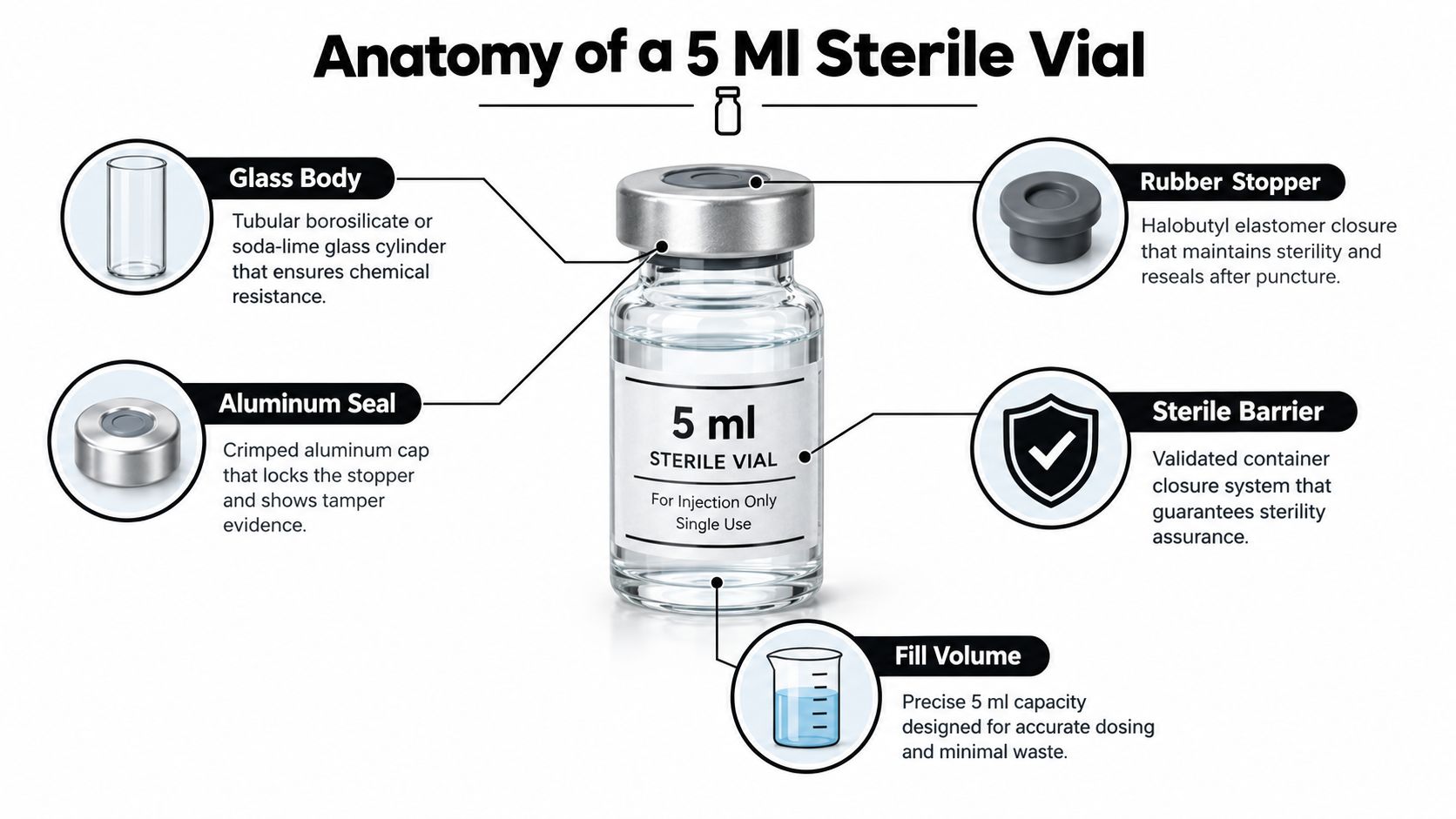
A 5 ml sterile vial consists of several parts that function together. The glass body contains the material, the neck defines the closure interface, the elastomer stopper provides the resealable barrier, and the aluminum seal locks the assembly in place. A purchasing specification should describe the complete combination, because changing one component can alter extractables, puncture behavior, sterilization performance, or container closure integrity.
Start with the glass body
The body is typically a tubular pharmaceutical glass cylinder, often made from Type I borosilicate or soda-lime glass depending on the formulation and risk profile. Its shoulder, wall, base, and internal surface affect filling, visual inspection, thermal exposure, and resistance to chemical interaction. A buyer should ask whether the vial is molded or tubing-derived, whether it is intended for terminal sterilization or aseptic processing, and whether the supplier can provide the relevant dimensional and material information.
The base also deserves attention. It must remain stable during handling and filling, while the overall vessel needs to tolerate the process conditions defined for the product. Lyophilization adds further requirements because the vial can experience vacuum and must work with a stopper designed for controlled drying and later sealing.
Specify the neck finish before ordering
The neck finish determines the stopper diameter, aluminum seal, crimping tool, and filling-line compatibility. Common pharmaceutical systems use 13 mm or 20 mm crimp finishes, but the buyer shouldn't assume that every 5 ml vial uses the same interface. The finish needs to appear clearly on the quotation, drawing, sample label, and certificate documentation.
The stopper normally uses a halobutyl elastomer such as bromobutyl or chlorobutyl rubber. These materials are selected for barrier performance, puncture behavior, and controlled interaction with the product. A fluoropolymer-laminated surface can reduce contact between the formulation and the elastomer, although it may increase cost and require a specific needle and puncture assessment.
Treat the seal as part of the system
The aluminum crimp seal holds the stopper against the vial finish. A flip-off button exposes the stopper while preserving a clear tamper-evident presentation, whereas a plain tear-off seal may suit a different terminal processing or access routine. Neither option replaces aseptic technique or a validated integrity assessment.
Practical rule: A vial, stopper, and seal should be qualified as an assembly, not selected as unrelated line items.
The supplier should be able to explain how the components are matched and what tests apply to the finished system. Product teams looking for broader specifications can also review sterile glass vial options and closure considerations before requesting samples.
Glass Types and Closures Compared
Glass selection should follow the chemistry and handling history of the contents. Type I borosilicate is generally chosen when low chemical interaction, thermal resistance, and a stronger assurance profile matter more than the lowest purchase price. Type III soda-lime may be appropriate for less sensitive aqueous materials, but it shouldn't be treated as interchangeable with Type I for every formulation.
Type II soda-lime glass occupies an intermediate position. Its inner surface is treated to reduce alkalinity and ion release, but availability in sterile 5 ml configurations can be less predictable than standard Type I or Type III offerings. Coated and ready-to-use formats may add process convenience and inspection support, yet they require the buyer to examine the coating, washing, sterilization, packaging, and shelf-life documentation.
Compare the common configurations
| Configuration | Leachables | Cost | Best Fit |
|---|---|---|---|
| Type I borosilicate with bromobutyl stopper | Low chemical interaction is generally the reason buyers select this combination | Usually higher than basic soda-lime options | Peptides, biologics, sensitive analytes, and workflows involving demanding storage or temperature changes |
| Type I borosilicate with fluoropolymer-laminated stopper | Reduced stopper-derived interaction compared with an unlaminated elastomer surface | Higher component and qualification cost | Formulations where elastomer contact and extractables require closer control |
| Type III soda-lime with standard butyl closure | Greater concern about ion release for sensitive formulations | Often the economical choice | Buffers, microbial media, and less sensitive aqueous research materials |
| Type II treated soda-lime with compatible elastomer | Reduced surface alkalinity compared with untreated soda-lime | Availability and pricing vary by supplier | Formulations needing an intermediate material position when the format is stocked |
| Ready-to-use or coated vial system | Processing and surface control can support a higher-assurance workflow, subject to supplier evidence | Generally higher landed cost | Buyers seeking pre-washed, packaged, or specially treated components with documented handling |
Market context supports the importance of this comparison. Type I borosilicate remains the dominant pharmaceutical glass material because of its chemical resistance, while vials represented roughly 40.53% of pharmaceutical glass packaging revenue in 2025 according to Mordor Intelligence's market analysis. The same source identifies formats up to 10 ml as the largest capacity band, at about 49.4% share in 2026, making the 5 ml format part of a commercially important small-volume segment. The pharmaceutical glass packaging market analysis gives that market context.
Match the stopper to the access pattern
Bromobutyl and chlorobutyl stoppers can both be suitable, but the choice should reflect the product and process. A buyer should ask about puncture force, coring behavior, resealability, sterilization exposure, and extractables rather than accepting “rubber stopper” as a complete specification. Chlorobutyl may be preferred for some freeze-drying applications, while a fluoropolymer-laminated bromobutyl design can make sense when stopper-derived substances are a particular concern.
Flip-off seals improve visual access and routine aseptic handling, but they add component and assembly cost. For a distributor, the sensible comparison is not just price per vial. It is the total cost of the closure system, qualification work, rejected units, and documentation gaps that can appear after the product reaches a regulated customer.
Compatibility With Reconstitution Workflows
Reconstitution starts as soon as a diluent contacts the material inside the vial. The container must tolerate the liquid phase, protect the formulation during storage, and support withdrawals without creating avoidable particles or compromising the septum. A vial that looks suitable on the shelf may still be wrong for a workflow involving repeated puncture, low-temperature storage, or an aggressive solvent.
A common peptide workflow illustrates the decision. The operator disinfects the stopper, introduces the selected diluent slowly, allows the material to dissolve under the applicable procedure, and inspects the resulting solution. Type I glass can be a sensible starting point for acidic or basic aqueous diluents, but the supplier still needs to confirm compatibility for the specific formulation and closure combination.
Evaluate the diluent and closure together
Bacteriostatic water and sterile water are not identical workflow inputs. Bacteriostatic water contains a preservative system, while sterile water does not provide the same formulation context. Alcohol-based and oil-based solvents create different compatibility questions, particularly for elastomer closures and any surface treatment applied to the stopper.
| Diluent Type | Glass Compatibility | Stopper Compatibility | Workflow Use Case |
|---|---|---|---|
| Sterile water | Type I glass is a strong general starting point for sensitive aqueous formulations | Confirm puncture, resealing, and extractables data for the selected elastomer | Reconstitution where the formulation does not require a preservative system |
| Bacteriostatic water | Type I glass is generally suited to aqueous contact, subject to product-specific validation | Confirm compatibility with the preservative and repeated access routine | Research workflows requiring the specified bacteriostatic diluent |
| Alcohol-based solvent | Glass may be suitable, but the formulation and exposure conditions require review | Request solvent-specific elastomer compatibility and extractables information | Specialized research preparations where alcohol is part of the solvent system |
| Oil-based solvent | Glass compatibility must be assessed against the oil and formulation | Stopper swelling, permeation, and resealing require explicit supplier confirmation | Non-aqueous preparations with a defined oil vehicle |
The operator should also consider residual volume and visual inspection. A deep shoulder or unsuitable base can leave material difficult to recover, while an opaque label or poor lighting can hide undissolved particles. The stopper must puncture cleanly, and the needle should not scrape the glass or repeatedly strike the same area of the septum.
Use a decision matrix before committing
For peptides, buyers often prioritize Type I glass, a low-extractables halobutyl closure, clear inspection, and compatibility with the selected reconstitution solvent. Small molecules may require a different assessment based on pH, solvent polarity, adsorption, and storage duration. Biologics demand closer attention to silicone, particles, protein interaction, agitation, and container closure integrity.
A compatibility claim is only useful when it identifies the formulation, exposure conditions, stopper, and intended access pattern.
Procurement teams should request formulation-specific evidence instead of relying on a generic statement that the vial is “chemical resistant.” A practical guide to reconstitution for experimental success can help teams formalize the workflow, but it doesn't replace validation for a particular product.
Handling and Storage From Receipt to Disposal
A 5 ml sterile vial can arrive in perfect condition and still become unsuitable through poor receiving or handling. The procedure should begin at the loading dock, not at the moment a technician reaches for a vial. Lot identity, package condition, storage requirements, and documentation all need to remain connected.
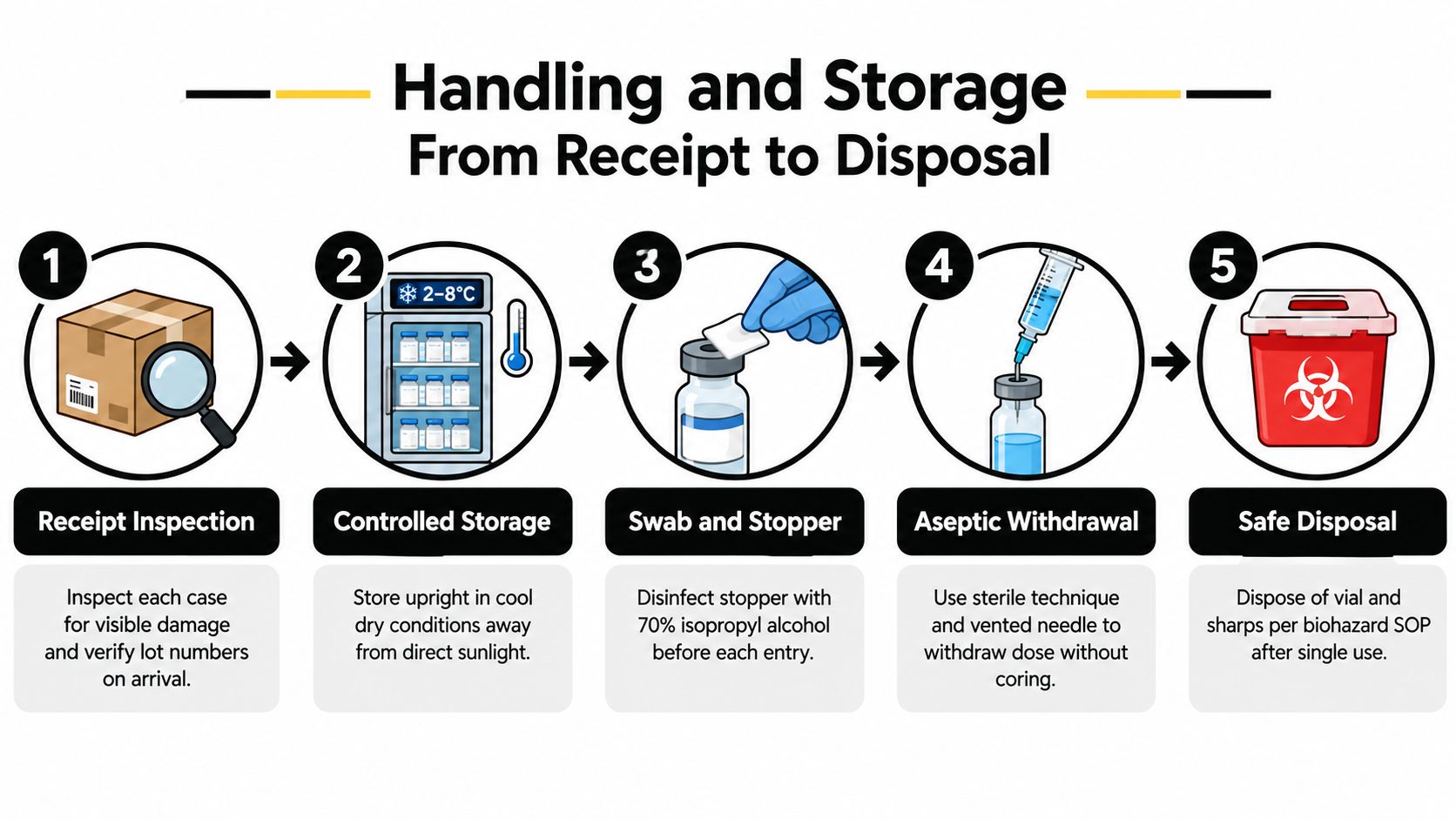
A receiving technician should inspect the case for crushed packaging, cracked shoulders, displaced seals, wet cartons, or signs of temperature excursion. The lot should remain in quarantine until the buyer reviews the certificate of analysis, sterility information, and any required transport or cold-chain records.
Follow a controlled sequence
Unopened vials belong in the storage conditions specified by the supplier. If the product doesn't require refrigeration or light protection, a controlled, dry, access-managed cabinet may be appropriate. Staff should avoid moving sterile units between unsuitable environments, and outer packaging should remain intact until the vial enters the controlled work area.
Before access, the technician checks the vial identity, expiry information, visible particles, cracks, and seal condition. The septum is disinfected with sterile alcohol and allowed to dry fully. A needle introduced at a controlled angle can reduce coring risk, but the exact technique should follow the laboratory SOP and the closure manufacturer's instructions.
Withdrawal should be slow enough to avoid sudden pressure changes and unnecessary foaming. If the vial is accessed repeatedly, each entry should be documented according to the product's use policy, including operator, date, material identity, and any observations. A vial showing cloudiness, unexpected color, particles, a damaged seal, or compromised packaging should be isolated rather than returned to routine stock.
The handling sequence can be summarized as follows:
- Receive and quarantine: Match lot numbers, inspect packaging, and hold the shipment pending document review.
- Store under control: Keep units in the specified environment and protect them from unnecessary handling.
- Disinfect the access point: Swab the stopper and allow the surface to dry before needle entry.
- Withdraw aseptically: Use the approved needle and technique, avoiding repeated puncture in one location.
- Dispose safely: Place used vials and sharps into the approved biomedical waste stream.
A logistics group that needs a repeatable format can use this process documentation for logistics teams as a reference when building receiving, quarantine, and release procedures.
The following video can supplement a written SOP with a visual handling reference:
Disposal requirements depend on the material, jurisdiction, and site classification. The final container and any associated needles should go into the designated sharps or biohazard container, rather than ordinary waste, when the local procedure requires that classification.
Quality Documentation Buyers Should Require
A sterile vial purchase is only as strong as the evidence attached to the lot. Product photos and a general statement of sterility don't establish whether the delivered units match the quoted specification. A buyer needs lot-specific records that connect material, dimensions, sterilization, packaging, and closure performance.
The Certificate of Analysis should identify the exact lot and describe the applicable material and dimensional requirements. For glass, buyers commonly look for a reference to USP <660> or an equivalent recognized specification. The COA should be reviewed against the purchase order, because a document that describes a different neck finish or glass type doesn't support the actual shipment.
Separate release evidence from marketing language
Sterility and endotoxin information answer different questions. Sterility testing addresses the presence of viable microorganisms under the specified test method, while endotoxin testing addresses pyrogenic bacterial residue. Buyers should ask for the method, acceptance criteria, lot identity, and release status rather than accepting an undated certificate covering an unspecified production run.
Dimensional data also predicts practical performance. Neck finish, wall thickness, body diameter, and base flatness affect stopper fit, crimping, filling-line movement, tray stability, and visual inspection. A supplier that can provide drawings and lot-specific dimensional control gives the customer more confidence than a catalog page listing capacity alone.
| Document | Standard Reference | What It Confirms |
|---|---|---|
| Lot-specific Certificate of Analysis | USP <660> or the supplier's declared glass specification | Glass identity, tested attributes, and release status for the delivered lot |
| Sterility report | USP <71> or the declared validated sterility method | The reported sterility result for the identified lot |
| Bacterial endotoxin report | USP <85> or the declared endotoxin method | The reported endotoxin result and applicable acceptance criteria |
| Dimensional drawing or inspection report | ISO 8362 dimensions where applicable, plus supplier tolerances | Neck finish, body dimensions, wall characteristics, and base geometry |
| Sterilization validation summary | Supplier's validated sterilization process | Evidence that the stated sterilization cycle is controlled and repeatable |
| Extractables summary | Supplier study or formulation-specific assessment | Potential substances originating from glass, stopper, coating, or packaging |
| Change-control history | Supplier quality-system procedure | How material, equipment, process, and packaging changes are assessed and communicated |
Ask questions before the order is released
The most useful supplier conversation is specific. Buyers should ask whether the samples represent production stock, whether the COA can be shared before shipment, how sterilization is released, and how the vendor notifies customers of changes. A distributor should also confirm that the outer packaging protects the sterile barrier through the intended transport route.
Documentation won't eliminate every risk. It does, however, distinguish a traceable container closure system from a commodity vessel whose suitability depends on assumptions.
Choosing a 5 Ml Sterile Vial Supplier
A supplier decision should combine technical fit with operational reliability. The lowest unit quotation can become expensive if the vendor can't provide lot records, changes the stopper without notice, or packages the units in a way that creates breakage during distribution. Procurement should score the supplier's evidence and delivery behavior alongside glass and closure specifications.
Build the procurement screen around evidence
Start with the supplier's quality system and downstream support. Buyers serving regulated pharmaceutical customers may request evidence of relevant primary-packaging quality certification, facility registration where applicable, audit history, and documented change control. Those records don't prove that every vial is suitable for every formulation, but they show whether the vendor has a system for controlling and communicating production decisions.
Material transparency comes next. The quotation should state the glass type, vial manufacturing method, neck finish, stopper material, seal design, sterilization method, packaging configuration, and shelf-life conditions. If a sensitive assay may be affected by silicone or stopper-derived substances, the supplier should explain whether a silicone-free or fluoropolymer-laminated option is available and provide supporting evidence.
The checklist below gives procurement a practical starting point:
- Confirm the container system: Match the vial body, neck finish, stopper, seal, and intended access pattern.
- Review lot documentation: Require a lot-specific COA, sterility result, endotoxin result where relevant, dimensional evidence, and sterilization information.
- Test packaging resilience: Examine sterile barrier packaging, case protection, pallet stability, and the supplier's response to transport damage.
- Check supply behavior: Review lead-time consistency, minimum order flexibility, allocation practices, and communication during shortages.
- Protect downstream compliance: Confirm that labels, shipment records, and product classifications support the customer's intended research or pharmaceutical use.
Procurement test: If the supplier can't explain what changes trigger customer notification, the quoted price doesn't represent the full supply risk.
Distribution teams also need to account for shipment restrictions, destination rules, labeling, and documentation. A resource covering eCommerce compliance for drug shipments can help teams review those operational issues before listing or dispatching products across different markets.
Herbilabs offers sterile diluents and reconstitution solutions in glass vial formats for research-use workflows, with product documentation focused on compatibility and handling. That makes the company one possible source to evaluate alongside other vendors when the buyer needs a matched diluent and vial workflow rather than an empty container alone.
The final supplier score should reflect total landed risk. A slightly higher-priced vial with dependable packaging, clear records, stable specifications, and responsive quality support may be more practical than a cheaper unit that creates quarantine delays or forces a distributor to answer unanswered customer questions.
For sterile diluents and reconstitution solutions suited to research-use workflows, review the glass vial formats, compatibility information, and documentation available from Herbilabs. Contact the team with the target fill volume, formulation type, closure preference, and distribution requirements so the supplier comparison starts with a concrete specification.