Private Label, White Label, Wholesale partnerships available - EU, USA and UK - Free shipping from €75

30 Ml Vials Explained: Specs, Uses, and Lab Workflow Tips
A new researcher can spend more time choosing a vial than preparing the material that goes inside it. A 10 ml vial may look too small, while a 50 ml bottle may seem wasteful, and a 30 ml vial appears to be the compromise. The decision becomes more consequential once repeated withdrawals, sterile access, headspace, transport, and documentation enter the workflow.
The label “30 ml” also creates a common misunderstanding. It usually identifies a nominal container class, not the exact physical amount the glass can hold. Supplier specifications for the DIN/ISO 30R format place the container at about 30 mm in diameter and 75 mm in height, with a brimful capacity of roughly 37.5 ml, as documented by published 30R injection-vial specifications. That difference affects filling plans, closure selection, storage, and purchasing decisions.
Table of Contents
- Why 30 ml Vials Deserve a Closer Look
- Understanding 30 ml Vial Specs and Materials
- Sterilization and Closure Integrity in Practice
- How 30 ml Vials Compare to Other Vial Sizes
- Handling, Storage, and Workflow Integration
- Dose and Volume Calculations for Real Use
- Sourcing 30 ml Vials for Lab and Distribution Needs
- Common Questions About 30 ml Vials
- Is a 30 ml vial automatically multi-dose?
- How much headspace should the vial have?
- Does Type I borosilicate differ from soda-lime glass?
- Do stoppers need pre-rinsing?
- What does closure integrity prove?
- How often should CCI testing be performed?
- What should a buyer retain for each lot?
- Can a 30 ml vial be frozen?
- What should be checked before purchase?
Why 30 ml Vials Deserve a Closer Look
At the bench, three empty containers often present three different problems. The smaller vial may force a transfer or a second container, while the larger bottle occupies more space and can leave a greater residual volume after the working solution has been used. A 30 ml vial sits between those options, but its value isn't just that it is “in the middle.” Its geometry and closure options often align with the way laboratories prepare, store, and withdraw materials.
A researcher handling a lyophilized peptide, protein, antibody, or reagent needs to answer several questions before ordering:
- Will the final liquid fit without crowding the stopper?
- Will the material need one withdrawal or repeated access?
- Does the workflow require a sterile crimp seal?
- Will the container move through cold storage, shipping, and clinical or research receiving?
- Can the supplier provide documentation that matches the intended use?
The nominal volume addresses only the first question, and even there it must be interpreted carefully. A 30R vial can have a brimful capacity above its nominal class, because the glass needs room for headspace, stopper displacement, and safe handling. Independent packaging references also list measured or usable capacities around 29.9 to 30.4 ml, with tolerance bands near ±0.6 ml, reinforcing that the designation describes a class rather than one immutable physical volume. These figures are included in the supplier's 30R product data.
Practical rule: Treat “30 ml” as a procurement starting point. Confirm the actual fill range, internal geometry, closure finish, and intended use before approving a purchase order.
The format also carries regulatory significance. U.S. FDA multiple-dose container guidance generally places such containers at 30 ml or less, unless a larger size has a specific justification, as summarized in the FDA multiple-dose container guidance discussion. The same guidance is commonly associated with a 28-day beyond-use period after first entry when the label doesn't specify another period. That doesn't make every 30 ml vial automatically suitable for every multi-dose application. It means the format sits close to a practical threshold where labeling, preservative strategy, aseptic technique, and usage records become central.
For wholesalers and laboratory managers, this threshold affects more than bench convenience. A standardized 30R format can simplify trays, racks, closures, and inventory planning. For researchers, it provides a clear reminder that container size is part of the process design, not an afterthought.
Understanding 30 ml Vial Specs and Materials
A new researcher selecting a 30 ml vial may first check the volume, then discover that the vial does not fit the existing rack, label, stopper, or filling equipment. The specification works as a system. Diameter affects rack fit and closure tooling. Height affects trays, packaging, and label placement. Glass composition affects chemical durability, while the stopper and seal determine how the container performs after filling.
A widely used pharmaceutical format is the DIN/ISO 30R vial, commonly produced from Type I borosilicate glass and associated with ISO 8362-1 compliance. A commercial specification describes this format with a polypropylene-tray packing configuration, as shown in a commercial 30R Type I borosilicate specification. Its wall thickness also matters during sourcing. A thicker wall can provide greater mechanical margin and influence how quickly the glass responds to temperature changes, but it does not replace validation for thermal cycling or transport shock.
Type I borosilicate is used for demanding injectable and reconstitution workflows because it provides high hydrolytic resistance and low ion release. Those properties can help limit pH drift and extractables-related instability in sensitive materials. Soda-lime glass may suit less demanding diagnostic or non-sterile uses, but a lower purchase price still requires checks for extractables, chemical compatibility, and temperature exposure.
The geometry behind the label
A vial's outside dimensions reveal only part of its working behavior. Shoulder shape, body height, neck width, and finish all affect internal volume and equipment compatibility. Nominal volume also differs from brimful capacity, the amount the container holds when filled to the rim. A fill plan normally leaves headspace above a liquid or powder, so the usable working volume is lower than the total glass capacity.
| Parameter | Typical value | Notes |
|---|---|---|
| Nominal format | 30 ml, commonly 30R | A nominal class, not a brimful volume |
| Outer diameter | About 30 mm | Confirm rack, tray, and label compatibility |
| Total height | About 75 mm | May vary with supplier and finish |
| Brimful capacity | Roughly 37.5 ml | Extra capacity supports headspace and handling margin |
| Glass type | Type I borosilicate | Used when chemical durability is important |
| Standard reference | ISO 8362-1 | Verify the supplier's exact compliance documents |
Closure selection should match the access pattern. A 20 mm crimp finish with a butyl or bromobutyl stopper suits many sterile applications. Screw-neck versions with PTFE-lined caps can suit repeated laboratory access when resealing and chemical compatibility matter. Aluminum crimp seals with plastic flip-off caps provide a visible closure format for sterile products, while still requiring controlled assembly and inspection.
For more formats, laboratory buyers can review sterile glass vials for research and compounding workflows. Compare the complete contact system: glass, stopper, seal, temperature, formulation, and the number of times the container will be entered. That comparison turns 30 ml from a catalog label into a workable specification for procurement and routine handling.
Sterilization and Closure Integrity in Practice
A researcher receives a sterilized 30 ml vial, then discovers its stopper and crimp were never qualified for the same process. The glass may be suitable, yet the assembled package can still fail. Sterility depends on the combined performance of the glass, stopper, seal, filling process, and handling environment. The closure must resist microbial ingress during transport, storage, manipulation, and puncture.
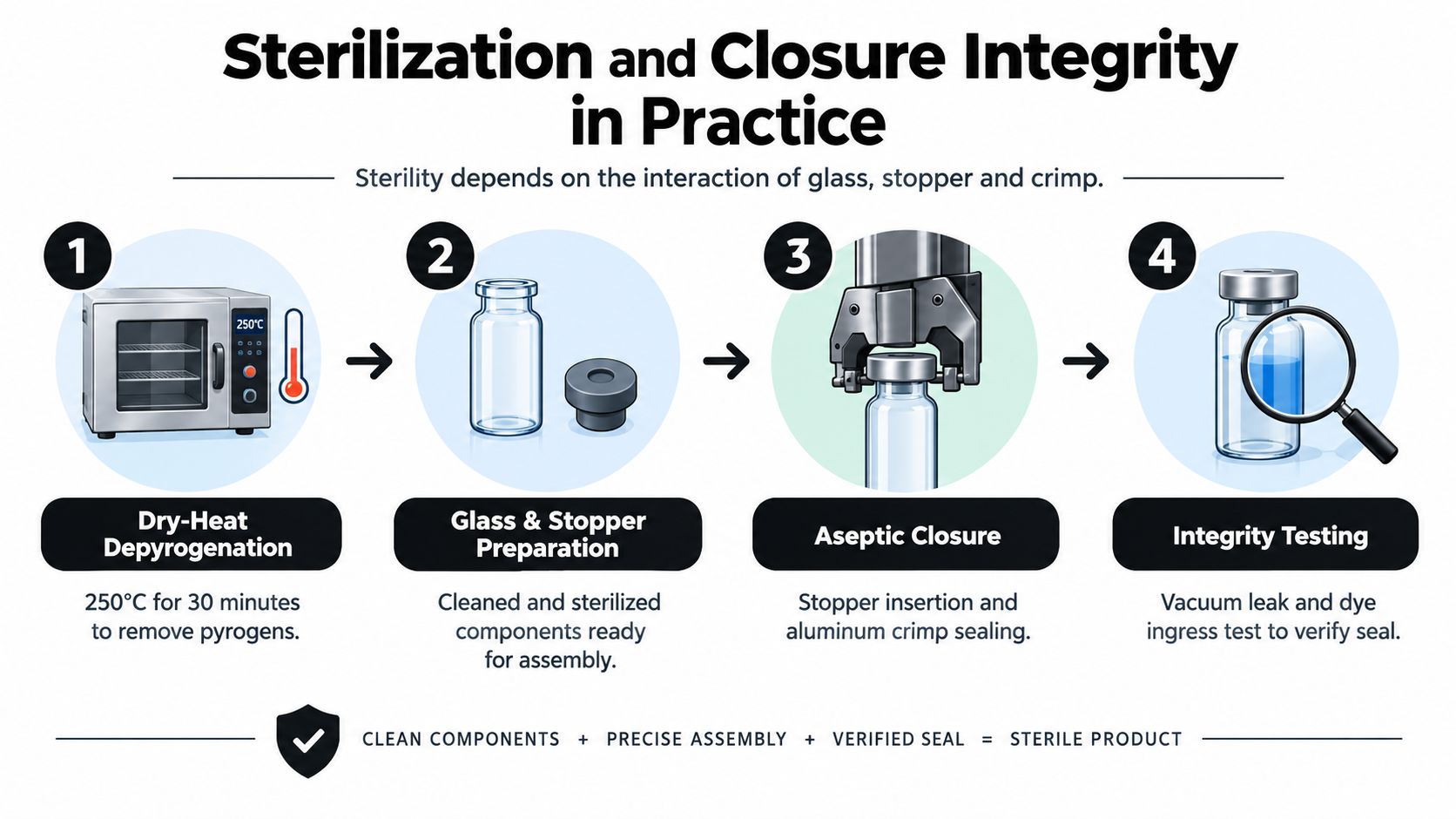
Type I borosilicate glass may tolerate high-temperature processing, but stoppers and assembled closures have different limits. Validate the selected cycle for every component and for the final configuration. Individual compatibility does not prove that the vial, stopper, and crimp can safely undergo sterilization together.
Container-closure integrity, or CCI, asks whether the completed package continues to control ingress and leakage. Peer-reviewed packaging research describes CCI as a fundamental requirement for sterile drug packages and discusses helium leak testing alongside residual seal force measurements in the peer-reviewed vial container-closure integrity study. For procurement, that makes CCI a system qualification issue, not merely a glass specification.
What the operator should verify
A practical integrity program links validation with routine checks:
- Component qualification: Confirm that the glass, stopper, seal, and finish suit the formulation and process.
- Assembly control: Check stopper placement and consistent crimp compression. Distortion at the finish can compromise the seal.
- Inspection: Look for tilted stoppers, incomplete crimps, damaged aluminum, cracks, and visible contamination.
- Integrity testing: Select a validated method for the package, such as helium leak, dye ingress, pressure decay, or another accepted approach.
- Documentation: Retain the method, acceptance criteria, lot information, and deviations.
The vial integrity testing resource helps procurement and quality teams organize supplier documentation questions. Approve a 30 ml vial as a complete container-closure system, with the glass, stopper, seal, assembly process, and test records considered together.
How 30 ml Vials Compare to Other Vial Sizes
Size selection should begin with the material's actual working volume, not the largest number printed on the label. A 10 ml container may suit a low-volume liquid or a single preparation, while a 50 ml or 100 ml format may make sense for a bulk reagent. A 30 ml vial becomes attractive when the workflow needs moderate capacity without the footprint and residual volume of a larger container.
The comparison below is deliberately qualitative where the product and formulation determine the final result. “Headspace percentage” cannot be assigned responsibly without knowing the fill volume, powder behavior, liquid expansion, stopper geometry, and process requirements.
| Size | Typical fill | Headspace | Multi-dose use | Common closure |
|---|---|---|---|---|
| 10 ml | Small preparations | Often limited when repeated access is needed | Low to moderate | Small crimp or screw closure |
| 20 ml | Moderate preparations | Depends on formulation and fill plan | Moderate | Crimp or screw closure |
| 30 ml | Mid-range preparations | Usually planned around the formulation | Suitable for workflows requiring repeated access, when validated | Commonly 20 mm crimp or compatible screw finish |
| 50 ml | Larger preparations | More room, but potentially more residual material | Useful for higher-volume work | Larger crimp or screw closure |
| 100 ml | Bulk or high-volume preparations | Substantial capacity | Appropriate only when demand supports it | Larger closure system |
A 20 ml vial can force a second container when the total preparation volume, required headspace, or withdrawal plan exceeds its practical capacity. A 50 ml vial can create unnecessary residual material when the process uses only a moderate amount. The 30 ml format often avoids both problems, but it shouldn't be selected solely because it appears convenient.
Closure hardware also matters. The finish must match available crimp heads, capping tools, adapters, and inspection procedures. A change from one nominal vial size to another can affect stopper flange dimensions, decapping force, label position, and tray design. The switch is easier when the 30 ml format already matches the lab's existing racks and cryoboxes.
Before ordering, teams can use a vial-volume guide for matching container size to research applications. The correct choice is the smallest validated format that accommodates the material, access method, headspace, and handling sequence.
Handling, Storage, and Workflow Integration
The vial's work begins when the shipment reaches the receiving area. A disciplined intake process catches defects before a container enters a sterile or temperature-controlled workflow. Staff should inspect the glass under good lighting, verify labels and lot information, and check for cracks, chips, visible particles, damaged stoppers, or irregular crimps.
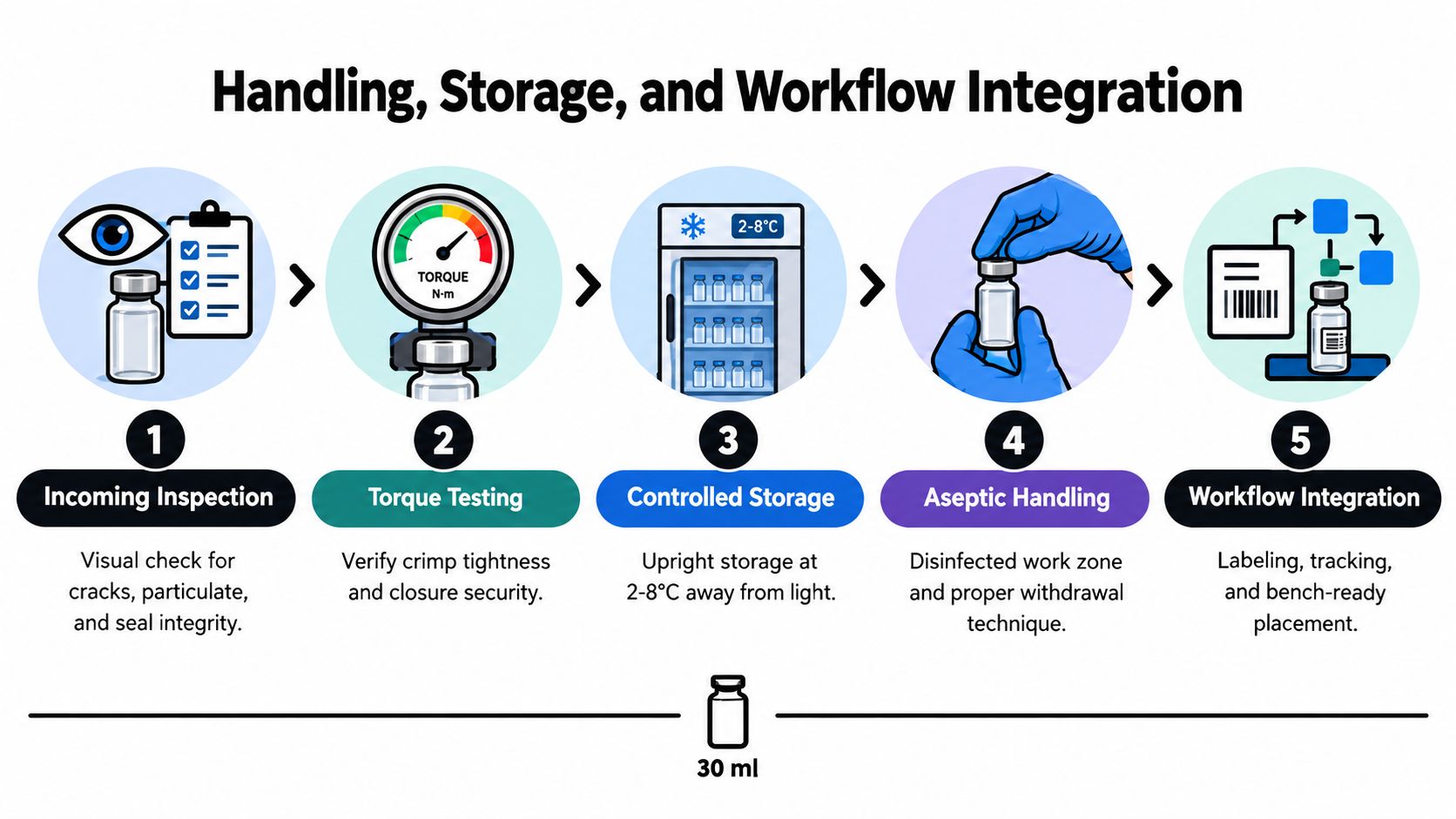
A lyophilized product adds another visual checkpoint. A collapsed or fractured cake may indicate that the material experienced an unsuitable drying or storage condition, although interpretation depends on the formulation and validated product appearance. The operator should record the observation rather than trying to correct the vial by shaking, warming, or opening it outside the approved procedure.
From receiving to controlled access
A practical workflow can be organized around five decisions:
- Receiving: Quarantine questionable units and reconcile lot, quantity, and documentation against the purchase order.
- Storage: Use upright racks that prevent tipping and keep containers protected from light when the material requires it.
- Temperature control: Follow the product-specific storage instruction. Refrigerated storage may suit some materials, while frozen storage requires validated containers and thawing procedures.
- Aseptic withdrawal: Disinfect the work area and stopper, use suitable sterile equipment, and minimize unnecessary punctures.
- Tracking: Record first entry, operator, material identity, storage location, and any required beyond-use or discard date.
Handling principle: The vial should have one documented home at every stage, receiving, quarantine, storage, preparation, active use, and disposal.
Borosilicate glass can be durable, but abrupt temperature changes still deserve attention. A frozen vial shouldn't be moved directly into a hot environment or exposed to sudden warming. The laboratory's validated thaw procedure should control the transition and include inspection for cracks, leaks, cloudiness, or particulate matter.
Small-format organization can also improve safety in specialized laboratories. A vials holder for cell therapy labs may help teams keep containers upright and identifiable during storage or transport, provided the holder is compatible with the vial dimensions and the required temperature range.
For dispatch to clinics or partner laboratories, packaging must protect the vial from impact, temperature excursions, label abrasion, and unauthorized access. The receiving site should get clear instructions on storage, inspection, aseptic handling, and documentation rather than receiving a container with no workflow context.
Dose and Volume Calculations for Real Use
A 30 ml vial's nominal capacity doesn't tell a researcher how much material will be recovered. Working volume depends on the liquid added, the concentration achieved, the amount retained in the vial and equipment, and the access method.
A useful planning approach starts with the intended fill rather than the brimful capacity. Many teams leave substantial headspace for thermal expansion, stopper displacement, powder handling, or nitrogen overlay. The exact fill limit must come from the formulation and validated process. A supplier's brimful figure should never be mistaken for an approved operating fill.
Consider a simple laboratory calculation. A lyophilized vial contains 50 mg of material and receives 2 ml of diluent. The resulting concentration is 25 mg/ml. A 5 mg working amount would occupy 0.2 ml, so the theoretical dose count before accounting for retained material is 10 withdrawals.
The calculation is:
Concentration = total material ÷ reconstitution volume
Dose volume = required dose ÷ concentration
Usable doses = recoverable material ÷ single-dose amount
The word “recoverable” matters. Syringe dead space, the needle hub, stopper retention, transfer losses, and liquid left on the vial wall can reduce the amount delivered. A calculation that ignores those losses may overstate the number of usable withdrawals. In a regulated or clinical workflow, the approved formulation record and dosing instructions control. Researchers should not improvise dose changes from container capacity alone.
A procurement calculation
A buyer can compare formats by asking four questions:
- What total liquid volume will the process add?
- What headspace does the formulation require?
- How many withdrawals will occur before the vial is discarded?
- How much material can the process tolerate losing during access?
For researchers reviewing how to reconstitute peptide vials, the container decision should remain separate from clinical dosing decisions. A 30 ml vial may accommodate the workflow, but it doesn't determine the correct diluent volume, concentration, dose, or beyond-use period.
This distinction protects both the researcher and the purchasing team. The vial supplies physical capacity. The formulation protocol supplies the permitted preparation and use conditions.
Sourcing 30 ml Vials for Lab and Distribution Needs
Procurement teams should evaluate 30 ml vials as quality-controlled packaging components rather than low-cost consumables. The right supplier can provide dimensional consistency, material traceability, closure information, lot records, and packaging details that support receiving and production controls.
A request for quotation should ask for documents that match the intended use:
- Material identity: Confirm Type I borosilicate glass where the formulation requires chemical durability.
- Dimensional data: Request drawings, tolerances, finish details, and inspection criteria.
- Closure information: Match stopper composition, seal material, and finish to the formulation and access pattern.
- Lot traceability: Ensure the supplier can identify the glass, stopper, seal, and packaging lot.
- Sterility evidence: For sterile products, request the relevant validation and release documentation.
- Change control: Ask how the supplier communicates changes to materials, tooling, manufacturing location, or packaging.
Automated filling lines make dimensional control especially important. Small differences in neck finish, height, or base geometry can affect feeding, gripper alignment, stopper placement, crimping, labeling, and reject rates. A vial that works on a manual bench may not perform identically on a filling line.
Packaging format also changes the risk profile. Bulk-packed containers may reduce handling cost but require stronger incoming inspection and controlled transfer. Trays can simplify organization, while nest-and-tub systems may suit higher-control environments. The supplier should explain how each format protects the glass and how the packaging will be opened in the buyer's facility.
The market context supports careful segmentation rather than a one-size-fits-all assumption. A market report projects the global vials packaging market at about US$9.7 billion in 2026 and up to US$13.1 billion by 2033, while identifying the 11 to 50 ml capacity band as a commercial segment, according to the cited vials packaging market report. Those projections don't establish that one supplier or material is suitable. They show why buyers should compare quality systems, regional compliance, packaging waste obligations, and supply continuity alongside unit price.
Common Questions About 30 ml Vials
Is a 30 ml vial automatically multi-dose?
No. Nominal capacity alone does not establish that classification. The label, intended use, formulation, closure system, sterile processing, and applicable guidance must all align. A 30 ml container can therefore be single-dose or multi-dose, depending on the validated product configuration. For multi-dose use, follow the product label and applicable guidance for entry limits, storage, and post-entry handling. The practical boundary and commonly applied post-entry period are discussed in the multiple-dose vial guidance reference.
How much headspace should the vial have?
There is no universal percentage. A lyophilized product needs room for cake formation, drying, pressure conditions, and reconstitution. A liquid may need space for expansion, mixing, and routine handling. Set the fill volume through formulation development and process validation, then confirm that the selected vial's brimful capacity and dimensions support it.
Does Type I borosilicate differ from soda-lime glass?
Yes. Type I borosilicate is commonly chosen for higher chemical durability and lower ion release. Soda-lime glass may suit less demanding formulations. Review pH sensitivity, storage temperature, extractables, and regulatory requirements before selecting the material.
Do stoppers need pre-rinsing?
Do not rinse a stopper casually. Washing can introduce particles, change the surface, or disturb a validated sterilization condition. The approved process and manufacturer instructions should specify whether washing, sterilization, siliconization, or another preparation step is required.
What does closure integrity prove?
Closure integrity supports the conclusion that the assembled vial maintains its barrier during the defined test conditions. It does not, by itself, prove sterility throughout every later handling step. Use the acceptance criteria and validation approach established for the specific vial, stopper, and seal, as explained in the dedicated sterilization and closure integrity section.
How often should CCI testing be performed?
The testing schedule should match the quality system and the package's risk. Include appropriate evaluation during development and validation, then repeat it when materials, components, equipment, processes, packaging, or storage conditions change. Routine lot-based testing may also be required by the approved specification. The supplier should state the sampling plan, acceptance criteria, and records supplied with each lot.
What should a buyer retain for each lot?
Keep records linking the received lot to the supplier, material specification, dimensions, closure components, inspection results, storage conditions, and applicable sterility or integrity documents. Record the receiving decision, deviations, and release status as well.
Can a 30 ml vial be frozen?
Only after validating the product, vial, closure, and storage system for freezing. Cold temperatures and rapid transitions can place mechanical stress on the glass and closure. Follow material-specific storage instructions and use controlled thawing.
What should be checked before purchase?
Use a checklist that connects the vial specification to the workflow:
- Format: Confirm nominal and brimful capacity, dimensions, finish, and rack compatibility.
- Material: Verify glass type and chemical compatibility.
- Closure: Match stopper, seal, cap, and puncture requirements.
- Sterility: Review sterilization and release evidence when sterile use is intended.
- Integrity: Confirm the supplier's CCI method and acceptance criteria.
- Workflow: Map filling, storage, withdrawal, labeling, dispatch, and disposal.
- Compliance: Review regional packaging, labeling, waste, and classification obligations.
- Supply: Assess lot consistency, packaging format, change control, and delivery continuity.
For laboratories and distribution partners comparing 30 ml vials, Herbilabs offers Research Use Only reconstitution solutions in glass multi-dose formats, with batch documentation and individual or wholesale ordering options. Visit Herbilabs to compare container format, documentation, and workflow requirements before ordering.