Private Label, White Label, Wholesale partnerships available - EU, USA and UK - Free shipping from €75

Vial Integrity Testing: A Practical Guide
A stability pull can expose what release testing missed. A lyophilized drug product may leave the fill-finish line with an intact crimp and a passing sterility result, then show moisture ingress months later. The stopper looked seated, the glass looked clean, and the cap showed no obvious damage. Yet the vial closure system had failed to protect the product.
That situation is why vial integrity testing deserves more attention than a final visual check. Container closure integrity, or CCI, depends on the interaction of the glass vial, elastomeric stopper, and mechanical seal. A reliable program asks whether the complete system can keep the product inside and contaminants outside through handling, storage, transport, and use.
Table of Contents
- When a Sealed Vial Is Not Really Sealed
- What Container Closure Integrity Actually Means
- The Main Vial Integrity Testing Methods Explained
- How to Choose the Right Method for Your Vial
- Regulatory Standards That Shape Every CCI Program
- Integrity Testing for Frozen and Ultra-Cold Storage
- Common Failures and How to Troubleshoot Them
- Building a Vial Integrity Program That Lasts
When a Sealed Vial Is Not Really Sealed
A lab manager reviewing a stability failure usually starts with the formulation. Moisture mapping, assay results, degradation products, and particulate findings all matter, but the packaging may be the actual source of the problem. A vial can appear sealed while a microscopic path allows water vapor, air, or microorganisms to move through the closure system.
The distinction is practical. A clean crimp confirms that the cap was applied. It doesn't prove that the stopper compressed evenly against the vial finish, that the glass has no critical flaw, or that the seal will remain effective after temperature cycling. Visual inspection can support a CCI investigation, but it cannot replace an integrity test.
Practical rule: Treat the vial, stopper, and crimp as one engineered system. Testing only one component leaves the most important interface unexamined.
The three parts of the barrier
The glass vial provides the rigid container body and finish. Its performance depends on the quality of the glass, forming process, handling history, and resistance to damage during filling and transport. A surface defect or micro-crack can create a leak path even when the vial looks acceptable under routine lighting.
The elastomeric stopper provides the primary seal and the access point for later needle penetration. Its dimensions, compression, material properties, and compatibility with the product all affect closure performance. The aluminum crimp then holds the stopper in position and applies the mechanical force needed to maintain contact with the vial finish.
The seal between these parts is the critical location. A stopper can be correctly specified yet poorly seated. A crimp can be visually uniform yet apply uneven force. A vial can pass an early check and fail after storage because the materials respond differently to time, pressure, or temperature.
Why the failure matters
A compromised vial can lose sterility assurance, change product moisture content, alter headspace composition, or permit particulate ingress. The consequences may include a rejected batch, an extended investigation, an audit observation, or a recall decision. For clinical supplies, the failure can also disrupt a study and make affected material unsuitable for administration.
Deterministic methods provide controlled, measurable, and repeatable evidence of package performance. Probabilistic and biological methods can still have a role, particularly in legacy comparisons or specific studies, but a sound program chooses the test according to the defect risk rather than the convenience of the instrument.
What Container Closure Integrity Actually Means
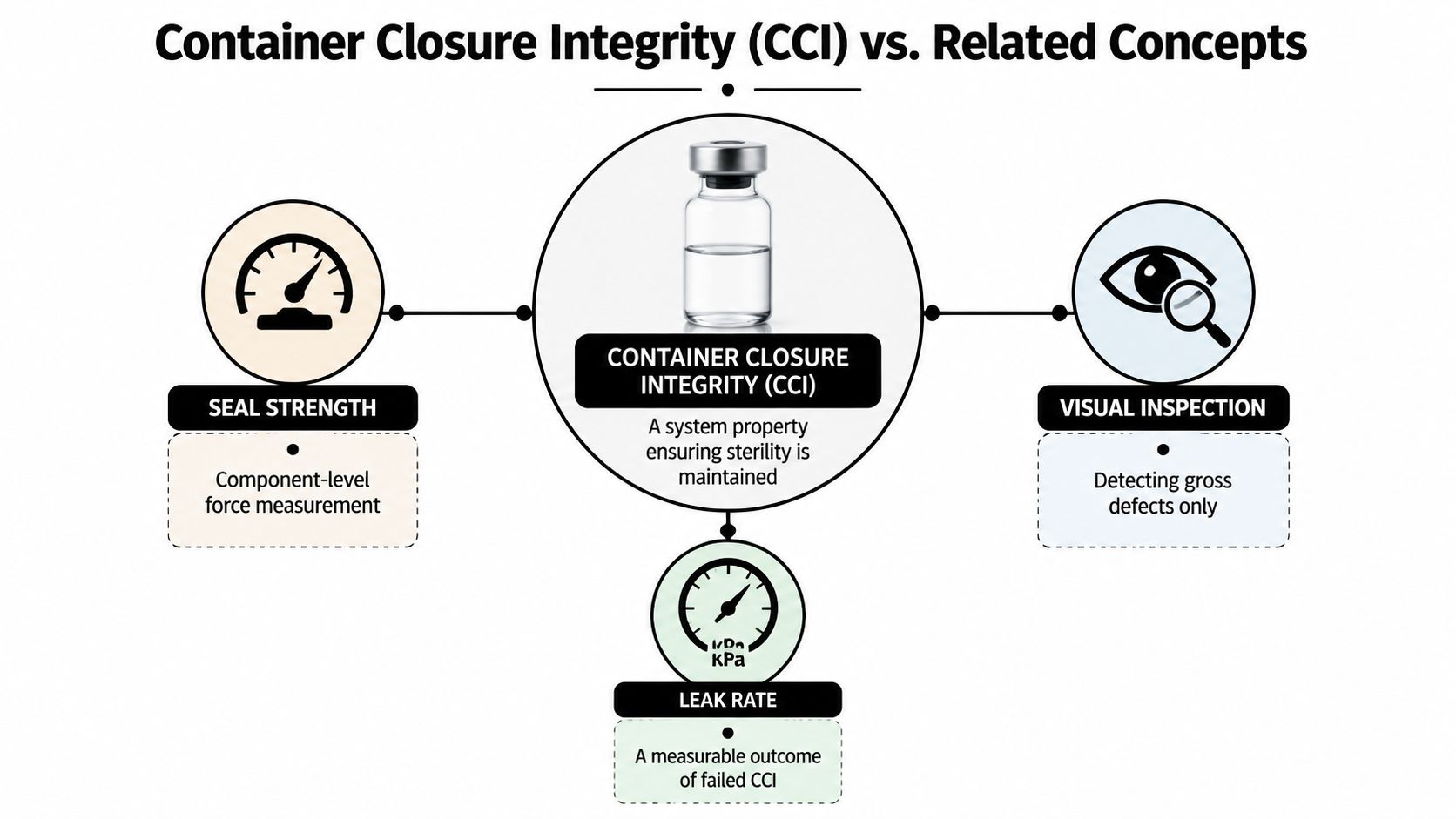
Container closure integrity is the ability of a complete package system to prevent unwanted movement across its boundary during the intended product lifecycle. In a sterile vial, that means retaining the formulation while limiting the entry of microorganisms, gases, moisture, and other contaminants.
The definition is broader than seal strength. Seal strength measures the force required to separate or disrupt a component interface. A strong seal can still contain a pathway that permits gas movement. Likewise, a vial can have a visually acceptable crimp while the actual closure interface performs inadequately under storage conditions.
Leak rate is an outcome used to characterize package performance. Visual inspection looks for observable defects such as cracks, damaged caps, displaced stoppers, or visible particles. It can detect gross problems, but it won't establish that a package remains an effective sterile barrier against defects too small to see.
Why vial systems need a lifecycle view
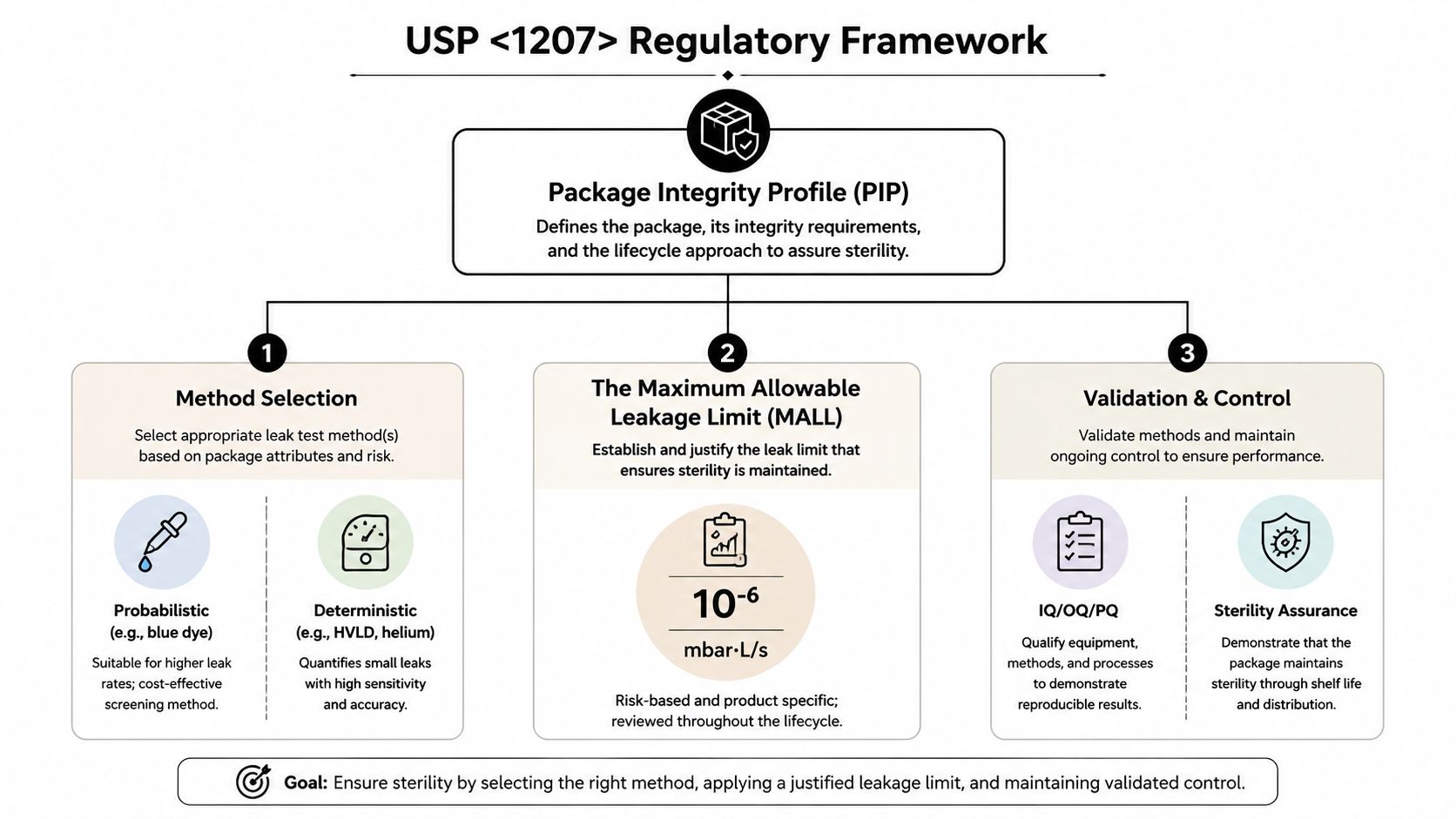
USP <1207>, Package Integrity Evaluation, Sterile Products, provides guidance for nonporous packages intended for sterile pharmaceutical products. The chapter was published in a more detailed form in 2016, and it helped formalize the move toward deterministic methods that can be controlled, calibrated, quantified, and repeated. The USP <1207> package integrity chapter is therefore a foundational reference for manufacturers working under United States and globally aligned quality systems.
The package must be considered across filling, stoppering, crimping, sterilization, shipping, storage, sampling, and administration. A method that works on an empty vial during development may not be suitable for a filled lyophilized product or a vial held at a deep-freeze temperature.
The leakage limit is a risk decision
A maximum allowable leakage limit, or MALL, isn't a universal value that can be copied from one product to another. The appropriate limit depends on the product's criticality, headspace, closure design, storage environment, and the consequences of microbial or moisture ingress.
That logic changes the question from “Which instrument is most sensitive?” to “Which validated method can detect the failure that matters for this package?” A test can be highly sensitive yet poorly suited to the product state, sample-preservation requirement, or lifecycle stage.
The Main Vial Integrity Testing Methods Explained
A vial leaves the filling line with a small crack near the heel. During transport qualification, that defect becomes a leak path. The right test is the one that creates a measurable signal for that failure while fitting the product state and the stage of the lifecycle. The methods below are therefore best read as a defect-method matching guide, not a list of interchangeable instruments.
| Method | Category | Typical Sensitivity | Best Fit |
|---|---|---|---|
| Vacuum decay | Deterministic | Method- and package-dependent | Routine screening for pressure response and gross to fine leaks |
| Pressure decay | Deterministic | Method- and package-dependent | Quantitative package testing where controlled pressurization is suitable |
| HVLD | Deterministic | Method- and formulation-dependent | Non-destructive screening of conductive liquid or suitable filled systems |
| Helium mass spectrometry | Deterministic | Highly sensitive, method-dependent | Development, validation, defect characterization, and reference testing |
| Dye ingress | Probabilistic | Defect visibility depends on conditions | Legacy comparisons and selected destructive studies |
| Microbial challenge or immersion ingress | Probabilistic or biological | Depends on organism, exposure, and method design | Biological confirmation and specialized validation work |
Vacuum and pressure decay
Vacuum decay suits a sealed vial whose leak changes the chamber pressure in a repeatable way. For example, it can screen liquid-filled vials after stoppering and crimping, when routine testing must preserve the sample and compare many units under consistent conditions. Pressure decay applies the opposite stimulus. It can help quantify leakage where controlled pressurization is appropriate, such as a package study comparing closure settings or confirming a process adjustment.
Both methods depend on the test setup as much as the instrument. Chamber volume, vial placement, temperature, package geometry, and acceptance criteria can shift the result. A method that detects a pressure response in an empty vial may need new development for a filled or lyophilized package.
High-voltage leak detection
High-voltage leak detection, or HVLD, is suited to a conductive liquid-filled vial when the formulation and container create a stable electrical signal. A production team might use it for non-destructive screening after filling, provided a known leak produces a distinguishable response from normal formulation and package variation.
HVLD is a poor default for a dry lyophilized cake or powder. Limited moisture, glass properties, stopper condition, vial wall thickness, and test configuration can all affect conductivity. The practical question is whether the suspected defect creates a reliable electrical path, not whether the instrument can apply voltage.
Helium leak detection
Helium mass spectrometry is most useful when development work needs a sensitive tracer-gas measurement. It can characterize a suspected microleak in a vial, compare deliberately prepared defect sizes, or provide a reference while a faster routine method is qualified. That role is especially valuable when the team must understand the leak path before setting a production acceptance criterion.
Special charging, fixturing, or destructive preparation may be required. The method therefore fits development, validation, and investigation better than every routine sample.
Dye and microbial ingress
Dye ingress can support a legacy comparison or a destructive study in which visual evidence of liquid entry is useful. Its result depends on exposure time, dye and defect interaction, observation conditions, and operator interpretation. A visible result can show entry, but it does not automatically quantify the leak path.
Microbial challenge or immersion ingress is appropriate when the study needs a biological demonstration, such as investigating whether a defined closure defect permits contamination under specified exposure conditions. These tests consume samples and add variability from the organism, handling, and challenge design. They should answer a specific biological question rather than replace deterministic testing by default.
How to Choose the Right Method for Your Vial
Method selection begins with the failure mode, not the vendor brochure. A useful program considers the defect class, product state, sample-preservation need, and lifecycle stage before selecting equipment or writing a protocol.
Start with the defect
A gross crack, an imperfect stopper interface, a gas leak, and microbial ingress aren't identical problems. The method must create a physical signal that responds to the defect of concern. A test designed for gas movement may not predict liquid ingress in the same way, and a biological challenge may not quantify the leak path.
Product state narrows the choice further:
- Liquid fill: Vacuum decay, pressure decay, and suitable HVLD configurations may provide useful non-destructive evidence.
- Lyophilized powder: Headspace-based or tracer-gas approaches may be more informative than methods that depend on liquid conductivity.
- Gas-sensitive product: Headspace composition analysis can address changes that a simple visual check cannot reveal.
- Microbial risk: A biological challenge may be relevant, but its role should be justified against deterministic alternatives.
A PDA presentation on test method selection and application emphasizes that method choice depends on package contents, materials, required outcome, detection capability, sample preservation, speed, and lifecycle phase. The same presentation notes that available methods can address defects ranging from less than 0.01 microns to several millimeters, depending on the technique and application.
Then decide whether the sample must survive
A release test may need to preserve the vial for stability, retain the product for further analysis, or avoid exposing a clinical sample to a tracer. Development work can tolerate destructive preparation when it produces better information about a suspected defect.
| Method | Defect Size Detected | Sample Preserved? | Best Lifecycle Stage |
|---|---|---|---|
| Vacuum decay | Gross to fine leaks, method-dependent | Often yes | Routine monitoring and release support |
| Pressure decay | Gross to fine leaks, method-dependent | Often yes | Process qualification and routine testing |
| HVLD | Method-dependent conductive pathways | Often yes | Non-destructive screening |
| Helium mass spectrometry | Very small tracer-gas pathways | Often no or limited | Development and validation |
| Dye ingress | Visible liquid pathways under test conditions | No | Legacy comparison and destructive studies |
| Microbial ingress | Biological entry under challenge conditions | No | Specialized validation and biological studies |
A 10 mL sterile glass vial, for example, should be assessed as a specific package geometry rather than as a generic vial. Its neck finish, stopper design, fill state, and intended storage profile all influence the method decision. The relevant sterile vial format can be reviewed alongside the planned closure and test fixture.
Regulatory Standards That Shape Every CCI Program
A compliant CCI program needs a defensible chain of reasoning. The protocol should show what can fail, how the selected method detects that failure, why the acceptance limit protects the product, and how the team verifies performance over time.
USP <1207> helped establish this framework by encouraging deterministic methods that can be calibrated, controlled, quantified, and repeated. It also separates method suitability from mere instrument operation. A laboratory must demonstrate that the method works for its vial, closure, product state, defect model, and intended use.
Turning guidance into documentation
The package integrity profile should connect package design, materials, manufacturing steps, storage conditions, and failure modes. The method report should then document:
- Method suitability: The test responds to relevant defects in the actual container closure system.
- System control: Instruments, fixtures, calibration, environmental conditions, and operators remain controlled.
- Acceptance criteria: Pass or fail limits relate to the package risk and validated method capability.
- Sampling rationale: The number and selection of samples follow a scientifically justified plan.
- Lifecycle coverage: Development, qualification, stability, transport, and routine monitoring are considered together.
A laboratory shouldn't insert an arbitrary sample count or threshold into a protocol because another product used it. Instead, the team should justify the plan through risk assessment, process knowledge, defect history, method capability, and regulatory expectations.
The EU GMP Annex 1 revision adds an important distinction. Containers closed by fusion, including glass or plastic ampoules and BFS units, should undergo 100% integrity testing, while other closure systems should use validated methods and scientifically valid sampling plans. Annex 1 also states that visual inspection alone isn't an acceptable integrity test method, and vacuum-sealed containers must be tested for maintenance of vacuum during shelf life. The EU GMP Annex 1 document provides the governing reference.
Linking CCI to contamination control
CCI doesn't stand alone from the contamination control strategy. Supplier qualification, component handling, crimping controls, environmental controls, and investigation procedures must align with the integrity method. A facility manager reviewing the wider hygiene program may also find disinfection for facility managers useful when connecting surface-control practices with sterile packaging protection.
For sterility assurance planning, teams can also use the sterility assurance levels reference as a related resource. The key expectation remains traceability. An inspector should be able to follow the path from package risk to defect model, from defect model to test method, and from test result to disposition without relying on an undocumented explanation from one subject-matter expert.
Integrity Testing for Frozen and Ultra-Cold Storage
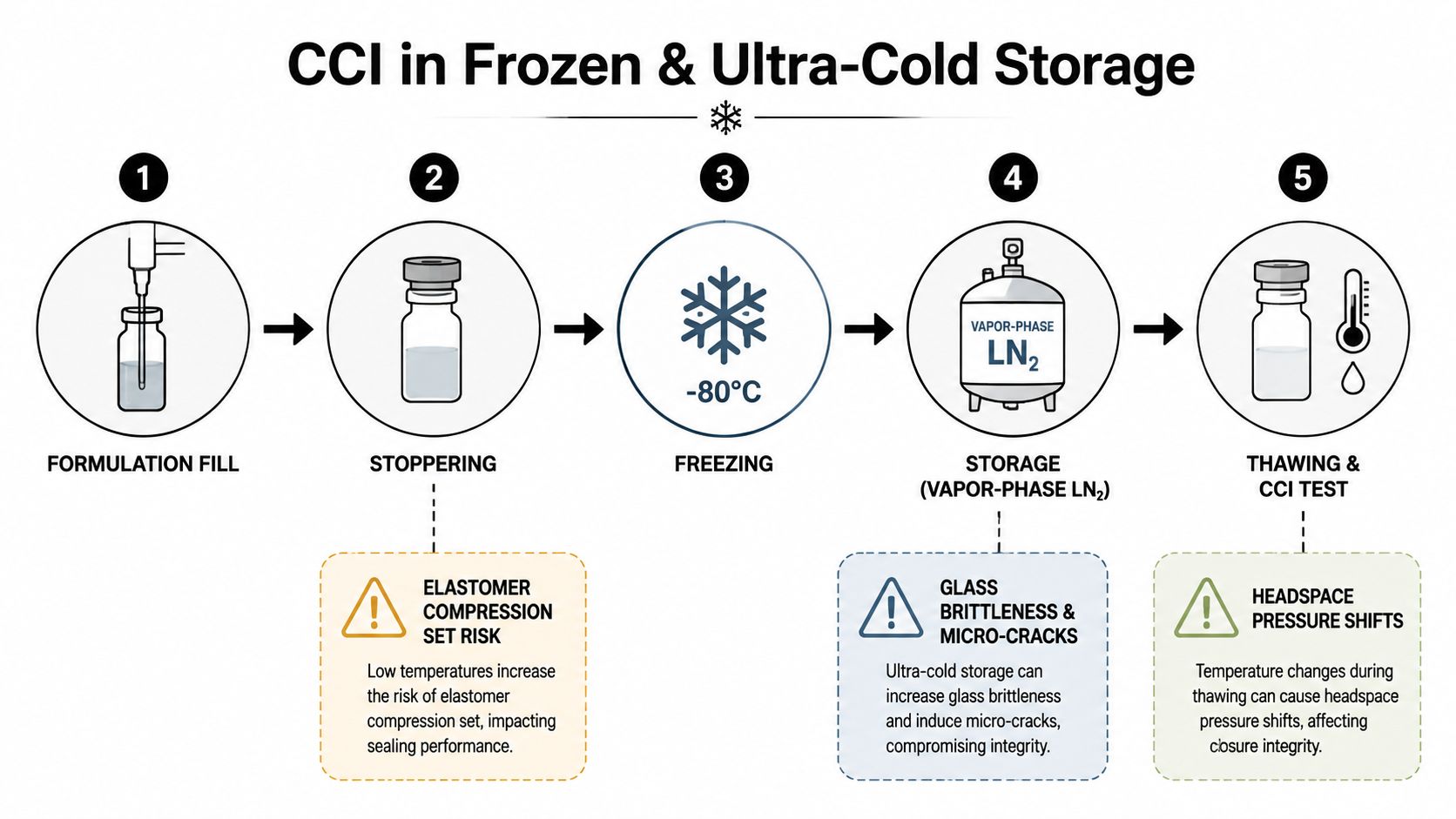
A vial stored at -80°C doesn't experience the same package conditions as a vial held at ambient or refrigerated temperature. Elastomeric materials can change compression behavior, glass can become more vulnerable to handling damage, and headspace pressure can shift as the vial freezes, remains cold, and later warms.
Those changes can create a leak path that isn't present during an initial room-temperature test. For cell and gene therapy workflows, reconstitutable products, and other temperature-sensitive materials, the CCI protocol should reproduce the actual thermal profile instead of treating cold storage as a simple storage note.
A cold-chain test begins before the instrument
The 2024 vial method-development work reported that headspace gas ingress testing can evaluate CCI in product-filled vials stored at -80°C. It also described carbon dioxide as a tracer gas by using dry ice to create a carbon dioxide-rich freezer environment and then measuring headspace CO2 after storage. The published frozen-vial method paper explains why this approach can assess integrity without relying only on a conventional warm test.
The laboratory should define the preconditioning process, fixture temperature, equilibration time, handling limits, and acceptance criteria before testing begins. A sample warmed during transfer may show a different headspace response from one tested under conditions that reflect the storage environment.
A cold-chain protocol should address:
- Freeze profile: The rate and duration of freezing can affect the product, stopper, and headspace.
- Storage exposure: The test should represent the intended freezer or vapor-phase environment.
- Thermal transitions: Freeze-thaw cycles may reveal defects that static storage doesn't expose.
- Tracer interpretation: CO2 ingress must be distinguished from handling-related changes and instrument background.
- Post-test disposition: The protocol should state whether the vial remains suitable for stability or study use.
A storage program also depends on reliable equipment maintenance. Guidance on refrigerator maintenance can support the broader control system, but it doesn't replace package-specific CCI validation.
Common Failures and How to Troubleshoot Them
A failed CCI result doesn't automatically mean the entire validation has to restart. The first task is containment. Quarantine affected material, preserve the instrument record, identify the pattern, and separate a package failure from a test-system artifact.
Stopper seating errors
An unevenly seated stopper may produce an unstable vacuum or pressure-decay trace, or inconsistent results across vials from the same crimping operation. The first investigation should examine stopper placement, vial finish dimensions, crimp-head alignment, and compression settings.
A targeted retest can use visual inspection, a controlled crimp review, and a complementary method such as dye ingress on designated destructive samples. If the defect follows a crimp station or component lot, the corrective action may involve crimper calibration, stopper compression adjustment, or supplier investigation.
Glass defects
A glass defect may appear as a localized HVLD response, an abnormal pressure response, or a visible crack under controlled lighting. The laboratory should inspect the vial body, heel, shoulder, neck, and finish, then compare the failure location with handling and transport points.
The confirmation step should focus on the suspected location rather than repeating the full validation campaign. A consistent body-location failure supports container inspection and vendor requalification, while random failures around the finish may point back to stoppering or crimping.
Moisture and cold-chain microleaks
Residual moisture can complicate interpretation, especially for lyophilized fills or methods sensitive to conductivity and headspace conditions. A cold-chain microleak may remain hidden until freeze-thaw exposure changes the relationship between the stopper and vial finish.
The CCI troubleshooting flowchart can help teams map the suspected failure to a focused check. Packaging teams dealing with secondary protective formats may also benefit from guidance on how to find the right bag seal, particularly when external packaging defects complicate a vial investigation.
Building a Vial Integrity Program That Lasts
A durable program connects the package, the process, the method, and the lifecycle record. Four operating pillars keep that connection visible:
- Written integrity plan: Define the package integrity profile, relevant defects, method rationale, acceptance criteria, and sampling approach under the USP <1207> framework.
- Method lifecycle: Qualify the method during development, confirm it during validation, monitor performance in routine use, and review it when the formulation, closure, equipment, or storage profile changes.
- Risk-based sampling: Tie sample selection to process risk, defect history, closure design, and lifecycle purpose. Fusion-closed systems follow the EU Annex 1 expectation for 100% integrity testing, while other systems require validated methods and scientifically justified sampling.
- Governance loop: Feed failures into crimper controls, component specifications, supplier qualification, stability review, and training rather than treating each result as an isolated laboratory event.
Routine release testing, stability pulls, transport qualification, and frozen-storage studies should share a common defect taxonomy. That lets production, QA, packaging engineering, and contract laboratories describe the same failure in the same language.
A laboratory can benchmark maturity by asking where it stands:
- Reactive sorting after a failure
- Defined defect categories and targeted retesting
- Validated deterministic testing for routine work
- Lifecycle monitoring linked to suppliers, process controls, and storage conditions
Herbilabs supplies high-purity reagents and sterile diluents in premium glass vials for research-use workflows, with batch documentation and handling guidance relevant to laboratories establishing disciplined vial controls. Teams developing or reviewing a CCI program can visit Herbilabs to assess available vial-based laboratory supplies and supporting documentation for their workflow.