Private Label, White Label, Wholesale partnerships available - EU, USA and UK - Free shipping from €75
Water Quality Standards for Lab Reagents: 2026 Guide
A research team can spend days troubleshooting an assay before anyone questions the water used to prepare its reagents. A failed control, an unstable standard, or unexplained background signal may have nothing to do with the protocol itself. Ionic contamination, organic residues, silica, particles, or microbial growth in reagent water can subtly alter a sensitive workflow.
That's why water quality standards matter. They turn the vague idea of “pure water” into measurable requirements tied to a specific use. A supplier, distributor, or laboratory manager needs to know which grade applies, which parameters must be tested, how to read a certificate of analysis, and how to convert those requirements into purchasing controls. Even an upstream source, such as municipal or bottled water, deserves attention. Facilities reviewing pretreatment options can also consult this practical resource on Santa Clarita RO water purification to understand how reverse osmosis fits into broader water-quality planning.
Table of Contents
- Introduction to Water Quality Standards for Lab Reagents
- Key Pharmacopeia References for Laboratory Water
- Applicable Regulatory Standards for Drinking Water
- Critical Test Parameters and Testing Methods
- Interpreting Certificates of Analysis for Water Quality
- Practical Compliance and Procurement Advice for Suppliers
- Conclusion Ensuring Quality and Streamlined Lab Workflows
Introduction to Water Quality Standards for Lab Reagents
A laboratory may receive a container labeled “purified water,” yet that label alone doesn't establish fitness for HPLC, cell-based work, biochemical assays, or pharmaceutical preparation. Purity is application-specific. Water that's adequate for rinsing glassware may introduce enough ions or organic material to interfere with an analytical method.
The first decision is therefore not “Which water is purest?” It's “What can this procedure tolerate?” A method requiring low ionic background has different needs from wet chemistry or routine reagent preparation. A sterile diluent has additional concerns because microbial control, endotoxin control, container integrity, and intended use all affect its suitability.
Practical rule: A water specification should be selected from the workflow backward, not from a supplier's product label forward.
This distinction protects reproducibility and purchasing decisions at the same time. A laboratory supplier needs to match the customer's stated application with a defined grade, documented test method, acceptance criterion, packaging condition, and storage instruction. A distributor also needs enough information to identify whether a product is laboratory reagent water, pharmaceutical water, or a sterile product with a narrower intended use.
The guide follows that chain from standard to order. It distinguishes analytical grades from pharmaceutical categories, places drinking-water regulation in its proper upstream context, explains conductivity, resistivity, total organic carbon, microbial counts, endotoxin, and particles, then applies those requirements to certificates of analysis and supplier qualification. The final step is procurement governance, because a technically correct specification has limited value if purchasing records, incoming checks, and supplier escalation procedures are inconsistent.
Key Pharmacopeia References for Laboratory Water
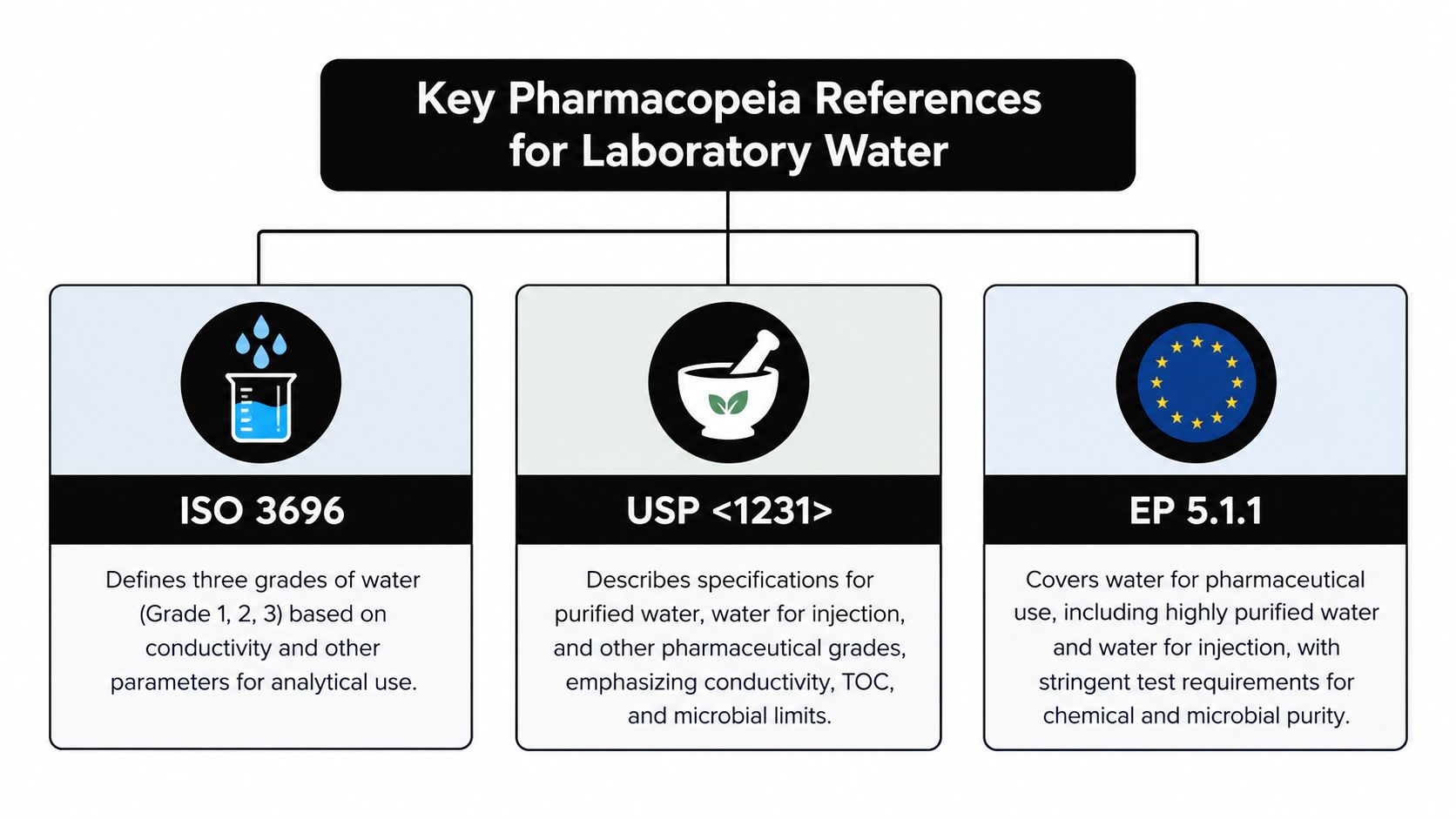
Laboratory water grades aren't interchangeable, and the names used by different standards can create false equivalences. ISO 3696 is especially useful for analytical laboratories because it defines three grades based on measurable characteristics. Grade 1 is intended for the most stringent analytical work, Grade 2 for general analytical applications, and Grade 3 for wet chemistry and reagent preparation. The standard includes tests for pH, conductivity, oxidizable matter, reactive silica, absorbance, and residue after evaporation, as described by ISO 3696's laboratory water standard.
USP <1231> and EP 5.1.1 serve a different procurement purpose. They describe pharmaceutical water categories, including purified water and water for injection, with attention to chemical quality, microbial control, and, where applicable, endotoxin and sterility expectations. Those categories shouldn't be treated as direct one-to-one translations of ISO grades. A pharmaceutical water specification depends on the manufacturing or preparation context, not solely on an analytical purity ranking.
A practical hierarchy for purchasing
A useful internal map looks like this:
- ISO Grade 1: High-sensitivity analytical work, such as HPLC, where ionic, organic, and particulate contamination can affect separation or detection.
- ISO Grade 2: General analytical procedures that need controlled purity but may not require the lowest available background.
- ISO Grade 3: Wet chemistry, washing, and reagent preparation where the method's tolerance is broader.
- USP and EP pharmaceutical categories: Pharmaceutical manufacturing, compounding, sterile preparation, or other uses governed by the applicable compendium and jurisdiction.
- Sterile diluents: Products such as bacteriostatic water must be assessed against their own label, intended use, sterility controls, and regulatory status. A supplier listing for water for injection should be reviewed as a product-specific specification, not assumed to be an ISO grade.
The important procurement insight is that a buyer shouldn't ask only for “high-purity water.” The purchase request should identify the method, applicable standard, required test panel, container format, lot documentation, and whether pharmaceutical or sterile claims are relevant.
Applicable Regulatory Standards for Drinking Water
Laboratory purification systems often begin with municipal or bottled water, so drinking-water regulation still matters even when the final product is laboratory-grade. Feed-water quality affects pretreatment burden, membrane performance, maintenance planning, and the consistency of the purification train.
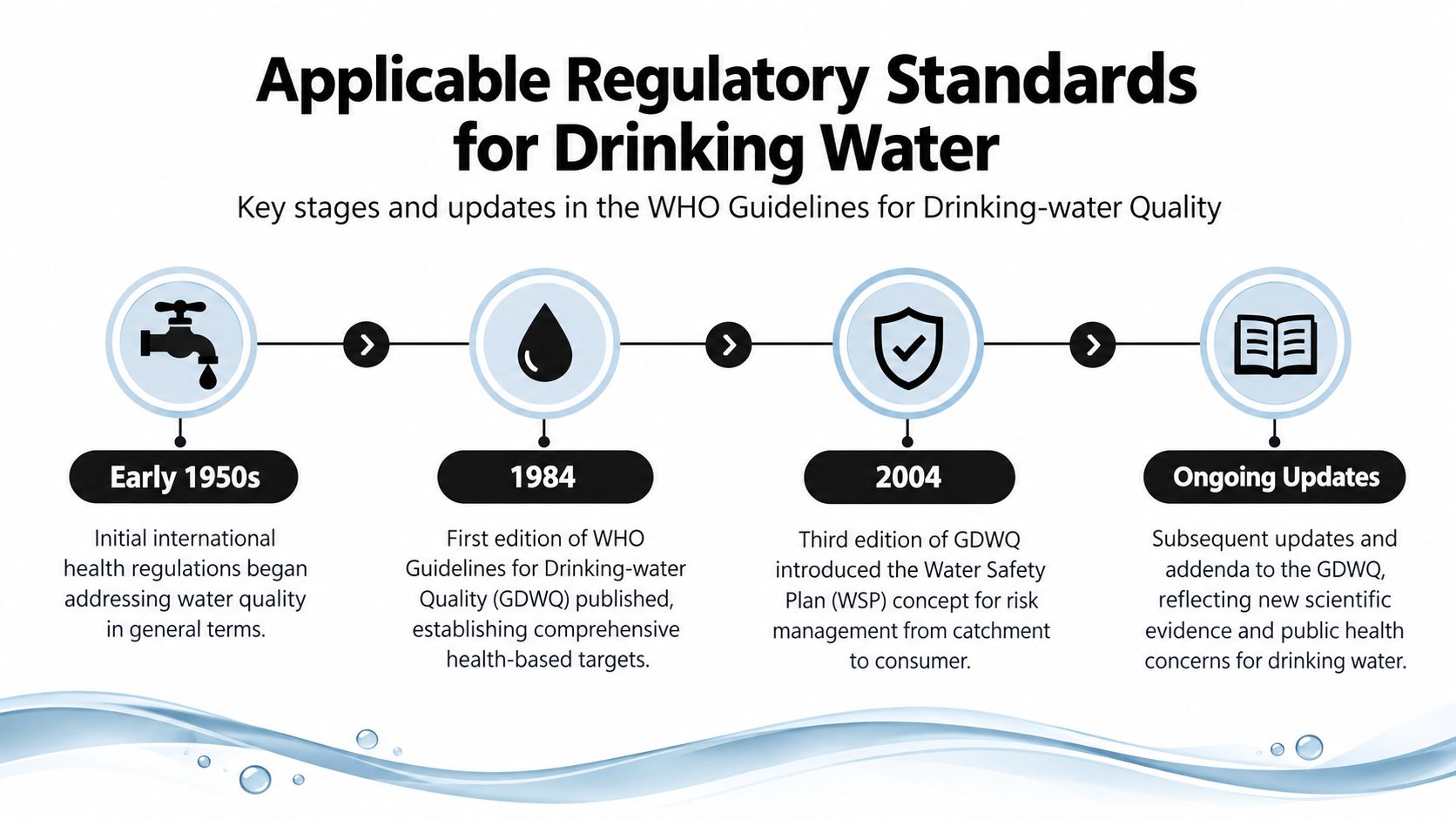
The WHO's standards have developed over a long period. The organization first published International standards for drinking-water in 1958, 1963, and 1971, followed by successive editions of its Guidelines for Drinking-water Quality in 1983–1984, 1993–1997, 2004, and 2011. The documented lineage shows a movement from international benchmarks toward a formal, risk-based public-health framework, as summarized in the WHO drinking-water guidance history.
What the EU framework contributes
In the European Union, Directive 98/83/EC applied from 25 December 1998. Its recast, Directive (EU) 2020/2184, was adopted on 16 December 2020 and began applying on 13 January 2023, according to the official EU directive.
The recast illustrates how legal thresholds translate health protection into compliance decisions:
| Parameter | EU parametric value |
|---|---|
| E. coli | 0 per 100 mL |
| Intestinal enterococci | 0 per 100 mL |
| Chloride | 250 mg/L |
| Sulfate | 250 mg/L |
| pH | 6.5 to 9.5 |
| Bromate | 10 µg/L |
| Cadmium | 5.0 µg/L |
| Chlorate | 0.25 mg/L, or 0.70 mg/L when chlorine dioxide disinfection is used |
The directive also includes operational indicators, such as conductivity at 2,500 µS/cm at 20 °C and total organic carbon with no abnormal change for supplies under 10,000 m³/day. These values describe drinking-water compliance, not a universal specification for purified laboratory water. They're still valuable upstream controls, particularly when suppliers document source-water quality and treatment inputs. Facilities also need a controlled method to test and correct your water's pH when pH affects treatment performance or interpretation.
Critical Test Parameters and Testing Methods
A laboratory water-control program should connect every parameter to a failure mode. Conductivity points to ionic contamination, TOC reveals organic residues, microbial testing measures viable organisms, endotoxin testing addresses pyrogenic risk, and particle control protects sensitive instruments and procedures. No single number proves that water is suitable for every application.
Conductivity and resistivity
Conductivity is commonly measured with a calibrated conductivity cell. Temperature matters because conductivity changes with temperature, so the result must be reported with its reference temperature and measurement conditions. Resistivity expresses the same ionic picture in the opposite direction. Higher resistivity means lower ionic conductivity.
For CLSI Clinical Laboratory Reagent Water, the practical benchmark is resistivity of at least 10 MΩ·cm at 25 °C, as documented in this overview of clinical laboratory reagent water specifications. The same source gives the related TOC, bacterial, and filtration benchmarks below.
TOC and organic contamination
A TOC analyzer oxidizes organic carbon and measures the resulting carbon signal. The result doesn't identify each compound, but it provides a broad indication of organic load that may affect assays, chromatography, or microbial growth.
The CLSI benchmark is TOC below 500 ppb. For procurement, the report should identify the method, sample point, result, unit, date, and instrument status. A low result from a point-of-use sample may not represent the water after storage in a poorly maintained container.
The total organic carbon testing resource can help teams connect the measurement to water-system monitoring and supplier documentation.
Microbial counts, endotoxin, and particles
Microbial burden is usually assessed through membrane filtration followed by culture and colony counting. CLSI Clinical Laboratory Reagent Water guidance gives a bacterial contamination limit of below 10 CFU/mL. Sampling technique matters as much as the test itself. The sample port should be cleaned according to the laboratory's validated procedure, containers should be suitable, and analysts should record holding conditions.
Endotoxin testing is different. LAL assays detect bacterial endotoxins, not viable bacterial cells, so an acceptable microbial count doesn't automatically establish acceptable endotoxin status. Pharmaceutical or injectable applications require the applicable compendial and product-specific criteria.
Particle control is commonly supported by filtration at 0.22 µm or better for the CLSI benchmark. Filtration can reduce particle and microbial passage, but it doesn't remove every dissolved contaminant. The system still needs chemical monitoring.
A practical routine should define sampling points, test ownership, calibration checks, alert limits, action limits, and escalation paths. Teams reviewing unfamiliar reports can use this guide to interpret water test results while keeping the laboratory's governing specification as the final decision rule.
Interpreting Certificates of Analysis for Water Quality
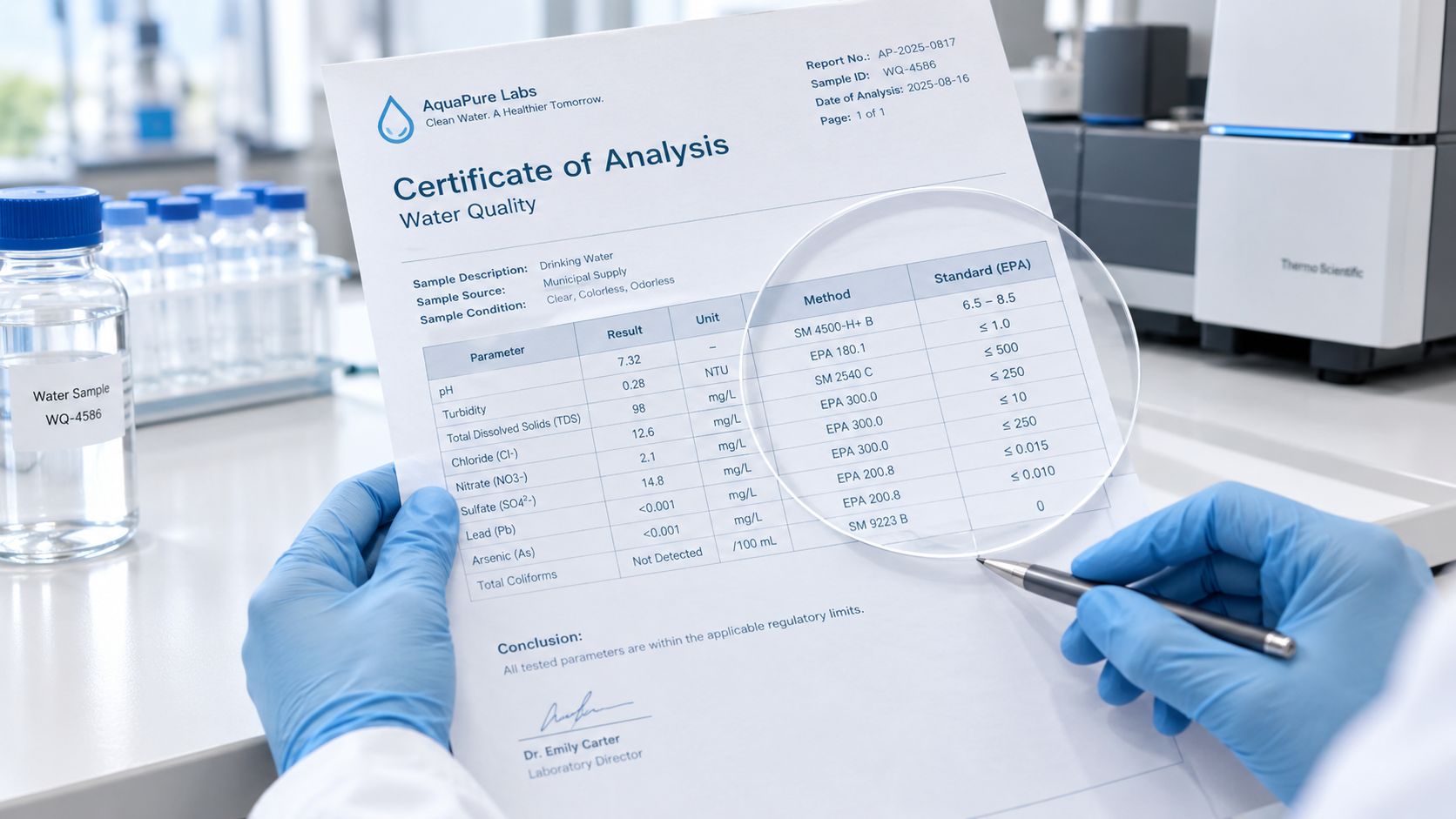
A certificate of analysis is useful only when it can be matched to the exact material received. The lot number, production date, sample date, test date, container format, and stated specification should form one traceable record. A certificate that lacks one of those links may still contain credible data, but it creates a qualification gap.
A line-by-line review
A laboratory manager can review a COA in this order:
- Identity and traceability: Confirm the product name, lot identifier, pack size, manufacture or release information, and supplier identity.
- Specification: Check that the cited standard matches the intended use. ISO Grade 3 isn't a substitute for an injectable-water requirement, and a pharmaceutical category shouldn't be presented as an automatic HPLC grade.
- Method and unit: Look for the analytical method, reference temperature for conductivity or resistivity, unit convention, and reporting limit.
- Result versus limit: Compare the actual result with the acceptance criterion. “Pass” is not enough when the customer's quality agreement requires numeric evidence.
- Microbial and endotoxin status: Confirm whether the test was performed, whether the result is quantitative or qualitative, and whether the method is appropriate for the product claim.
- Approval: Verify analyst or quality-unit review, release status, and any deviation or comment.
A COA showing TOC below the agreed limit supports that specific lot and sample. It doesn't prove that every future lot will behave identically. Likewise, a microbial result near an internal alert level may not be an out-of-specification result, but it deserves trend review and possibly additional sampling.
For a more detailed document-control workflow, teams can consult this guide on how to read a certificate of analysis.
The following video can supplement document training, but it shouldn't replace the governing specification or a qualified review:
A supplier escalation should begin when a result is missing, the method is unclear, the lot doesn't match the shipment, or a result exceeds the agreed limit. The buyer should quarantine the affected material according to the laboratory's procedure, request clarification or retesting, assess potentially affected work, and document the disposition.
Practical Compliance and Procurement Advice for Suppliers
Procurement teams should treat water as a controlled laboratory input, not as a routine consumable. The purchase order, quality agreement, receiving inspection, storage instruction, and COA review should all describe the same product and intended use.
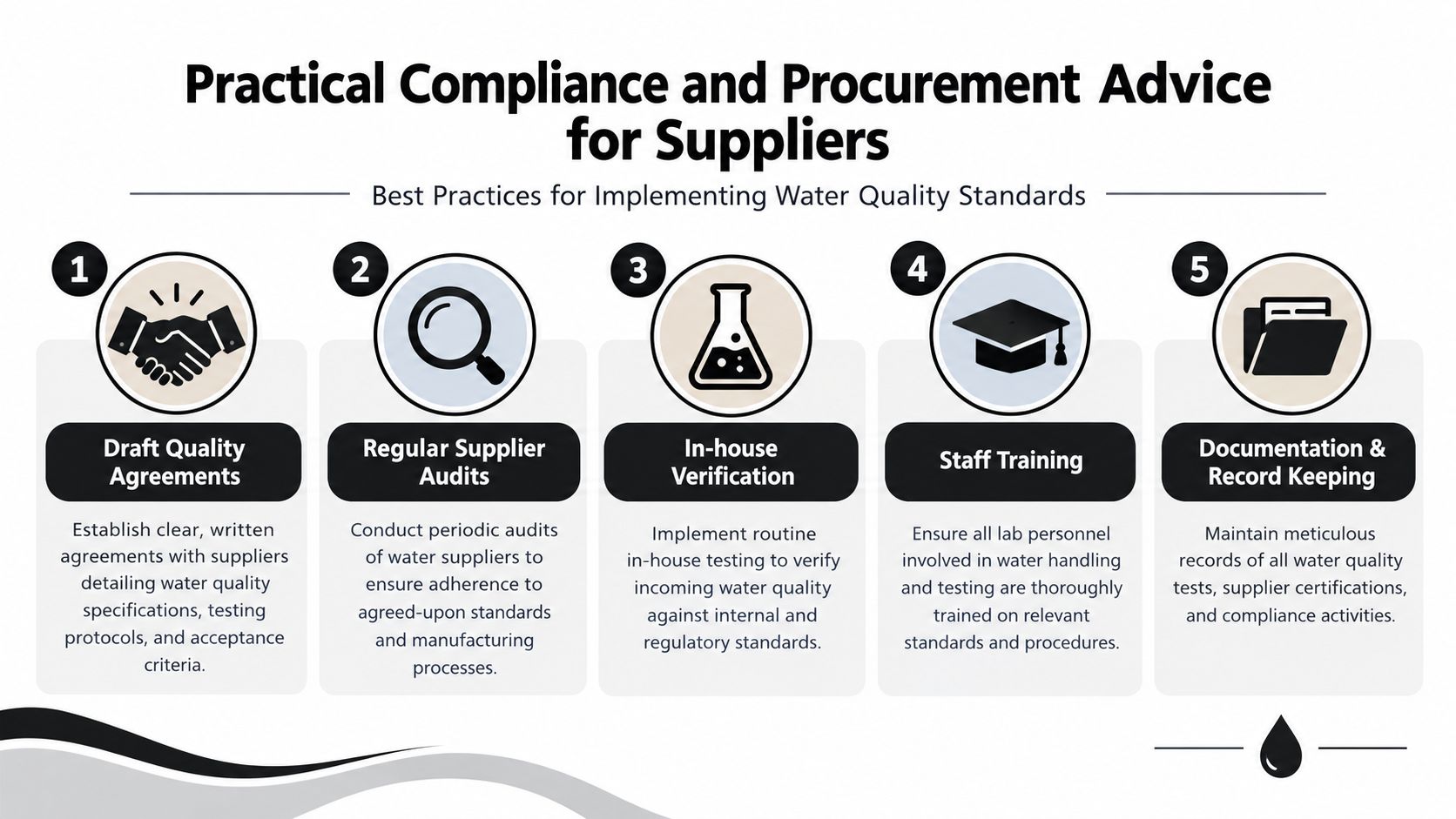
A supplier-control checklist
- Draft quality agreements: Define the water grade, applicable compendium, test panel, methods, acceptance criteria, change-notification duties, deviation handling, and COA content.
- Audit the supplier: Review purification equipment, sanitation practices, sampling locations, laboratory controls, calibration records, and release procedures.
- Verify incoming material: Use risk-based in-house checks for the parameters the receiving laboratory can measure reliably. Where internal capacity is limited, use a qualified third-party laboratory.
- Train handling staff: Personnel should understand container opening, storage duration, sampling hygiene, labeling, and the difference between laboratory-grade and sterile claims.
- Control records: Retain purchase documents, COAs, test results, deviations, supplier communications, and lot-disposition decisions in a searchable system.
Supporting small systems
WHO's June 2026 drinking-water guidance added specific support tools for small water supplies, including risk-based safety plans and inspection protocols, according to the WHO publication for small water supplies. The operational lesson applies to smaller laboratories and regional distributors too. A compliance program must be usable by the people who receive, store, test, and release the material.
A distributor can reduce uncertainty by offering standardized documentation packages, clear storage instructions, retained-sample policies, and access to independent testing. Volume negotiations should never trade away traceability. A lower unit price has little value if a missing COA or ambiguous specification causes a shipment hold.
Herbilabs may be evaluated as one supplier option for laboratories seeking reagent and sterile diluent products with lot documentation and COA access. Any buyer should still qualify the specific product against the laboratory's own intended use, regulatory obligations, and quality agreement.
Conclusion Ensuring Quality and Streamlined Lab Workflows
Water quality standards work best as a connected control system. The laboratory selects a grade based on the method, procurement writes that requirement into the order and quality agreement, the supplier tests the relevant parameters, and receiving staff verify the lot before use.
ISO 3696 helps classify analytical water by grade and test characteristics. USP and EP references address pharmaceutical water categories that require separate interpretation. Drinking-water regulations provide important upstream context, while conductivity or resistivity, TOC, microbial burden, endotoxin, silica, and particles reveal different contamination risks. COA review then turns those requirements into a practical release decision.
The strongest workflow is neither the most complicated nor the one with the longest specification. It's the one that clearly defines what the water must support, how the supplier demonstrates conformity, and what happens when a result is missing or unacceptable. Laboratory managers should review current water specifications, reconcile them with actual methods, update supplier agreements, and train receiving personnel before the next unexplained assay failure.
Herbilabs supplies laboratory reagents and sterile diluents with product-specific documentation for research workflows, including COA-focused purchasing support. Visit Herbilabs to review available products and establish a procurement process aligned with the laboratory's water-quality requirements.


