Private Label, White Label, Wholesale partnerships available - EU, USA and UK - Free shipping from €75
Total Organic Carbon Testing: A Practical Guide
A finished batch of Water for Injection is waiting on release, and the TOC analyzer has returned 8.2 ppb. The quality team needs to decide whether to release, retest, or investigate, while the result sits well below the applicable action limit. That decision depends less on the single number than on the method, sample handling, calibration status, and current pharmacopoeial expectations behind it.
Total organic carbon testing gives laboratories a broad measurement of organic contamination without requiring every compound to be identified separately. The practical challenge is choosing an analyzer and workflow that fit the matrix, concentration range, regulatory method, and operating model. That choice is becoming more important as pharmaceutical guidance moves away from older oxidizable-substances testing and as laboratories consider continuous online monitoring.
Table of Contents
- What Total Organic Carbon Testing Actually Measures
- The Two Principal Methods and When to Use Each
- Sample Preparation and Method Selection by Matrix
- Calibration and QA/QC Built on Pharmaceutical Standards
- Real-World Applications Across Pharma, Environmental, and Industrial Labs
- How 2026 Pharmacopoeial Changes Reshape TOC Testing
- Troubleshooting Common Failures and Building a Smart Procurement Plan
- Bringing the Whole Picture Together
What Total Organic Carbon Testing Actually Measures
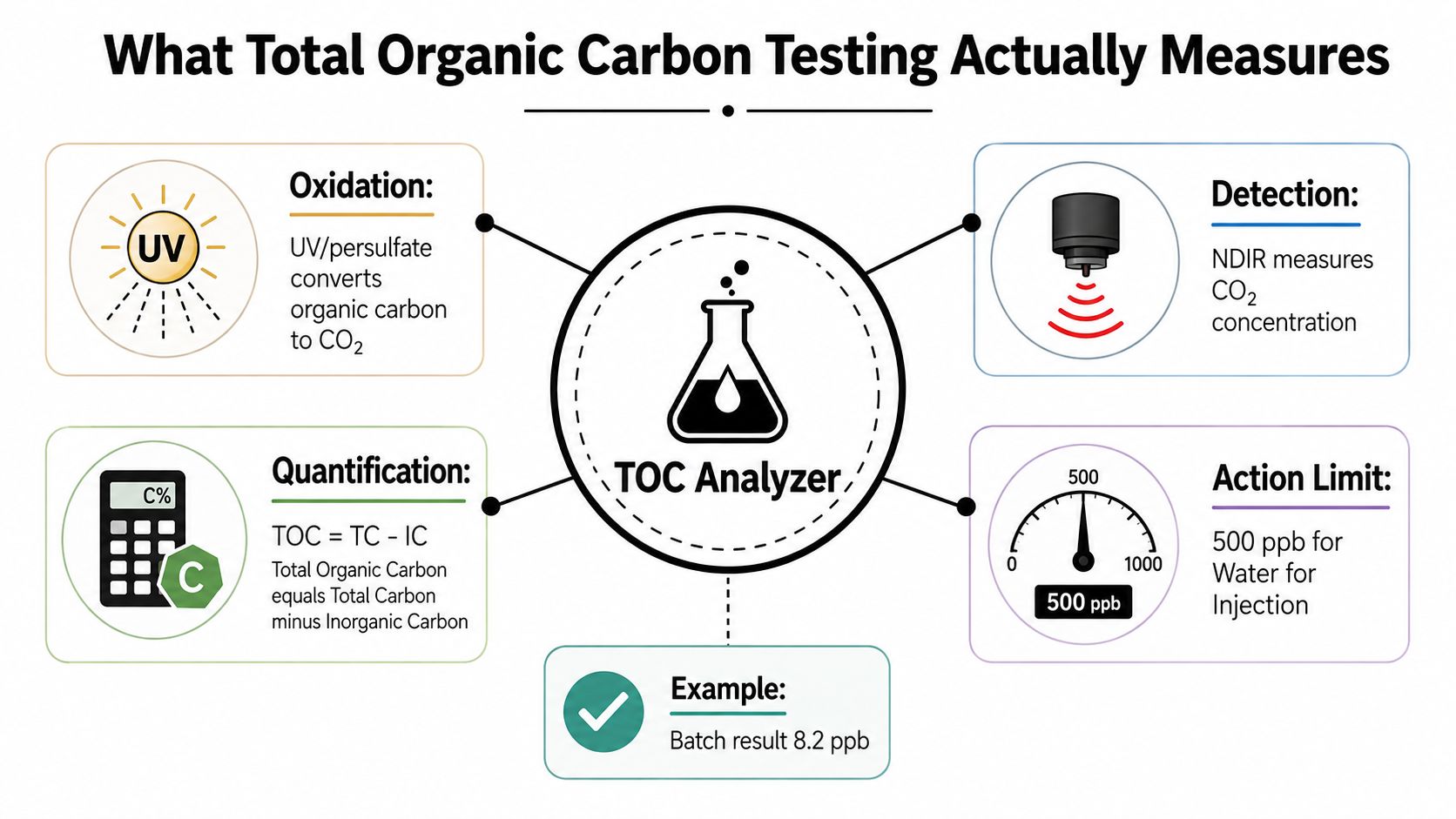
Total organic carbon, or TOC, is the amount of carbon bound in organic compounds within a sample. In a typical analytical sequence, inorganic carbon is removed or measured separately, organic material is oxidized to carbon dioxide, and the resulting carbon dioxide is quantified. Results may be reported in ppm, ppb, or mg/L, depending on the sample and method.
Carbon works as a practical proxy because most organic molecules contain carbon. A TOC analyzer therefore produces a broad contamination signal rather than a compound-by-compound identification. That makes the result useful for pharmaceutical water, environmental samples, cleaning validation, and industrial process control, although a high reading alone generally doesn't reveal which impurity caused it.
TOC compared with related measurements
Total carbon, or TC, includes both organic and inorganic carbon. Inorganic carbon includes dissolved carbon dioxide, bicarbonate, and carbonate. TOC excludes that inorganic fraction, while dissolved organic carbon, or DOC, excludes particulate organic carbon through filtration or another separation step.
TOC also differs from BOD and COD:
- TOC measures carbon directly after oxidation and detection.
- COD measures chemical oxygen demand, reflecting oxygen consumed during chemical oxidation.
- BOD measures biological oxygen demand, reflecting oxygen consumed by microorganisms.
Those measurements answer different questions. BOD can be useful when biodegradability matters, while COD reflects a chemical oxidation response. TOC is often selected when a rapid, broad organic-load measurement is more useful than a compound-specific result.
Practical rule: A TOC result is a contamination indicator, not an impurity identification test.
Sample preparation, oxidation chemistry, calibration, and matrix compatibility all affect whether that indicator is trustworthy. A buyer comparing water testing methods should therefore evaluate the complete workflow, not just the analyzer's headline detection specification. The same principle applies when reviewing supporting documentation such as a certificate of analysis, where method, units, and acceptance criteria need to be read together.
The Two Principal Methods and When to Use Each
Two techniques dominate routine TOC analysis: high-temperature combustion and UV-persulfate oxidation. Both convert organic carbon into a measurable response, but they behave differently when salts, volatile compounds, particulates, or very low carbon levels enter the workflow.
High-temperature combustion sends the sample into a heated furnace, often with a catalyst, where organic compounds are converted to carbon dioxide. An NDIR detector then measures the carbon dioxide response. Combustion is attractive for difficult or concentrated matrices because the furnace can handle a broad organic load and is generally less vulnerable to ionic strength than wet oxidation.
UV-persulfate oxidation uses persulfate reagent and ultraviolet energy to generate strongly oxidizing species. These species convert organic material to carbon dioxide, which may be measured by conductometric, NDIR, membrane-based, or related detection systems. The lower-temperature approach supports compact automation and is commonly considered for high-purity water and online monitoring.
| Parameter | High-Temperature Combustion | UV-Persulfate Oxidation |
|---|---|---|
| Oxidation principle | Furnace oxidation converts organic carbon to carbon dioxide | UV energy and persulfate radicals oxidize organic carbon |
| Matrix fit | Strong choice for saline, concentrated, or variable matrices | Best suited to clean aqueous matrices and controlled high-purity systems |
| Detection challenge | Requires careful control of furnace, catalyst, and carryover | Requires control of reagent quality, blanks, and oxidation completeness |
| Online suitability | Possible, but the hardware can be more demanding | Often convenient for automated online configurations |
| Main operating burden | Catalyst, furnace components, quartz parts, and traps | Persulfate, acid or reagent cartridges, tubing, and lamp maintenance |
| Selection priority | Robustness across concentration and matrix variation | Low-background monitoring and automated process control |
Matching the method to the sample
ASTM D4129 covers water and wastewater from 2 to 20,000 mg/L, while low-level work such as ASTM D6317 addresses 10 to 1,000 µg/L. ISO 8245 applies to waters from 0.3 to 1,000 mg/L. These ranges illustrate why a single analyzer configuration shouldn't be treated as universally suitable. ASTM D4129 provides the relevant matrix and range context.
For high-TDS wastewater or brine, combustion usually deserves close consideration. For clean pharmaceutical or semiconductor water, UV-persulfate can offer a practical path to automation, provided the system demonstrates adequate oxidation and blank control. Emerging variants, including supercritical water oxidation and high-temperature catalytic combustion, extend the available choices, but they don't remove the need to match chemistry to matrix.
The purchasing decision should start with four questions: What is the expected carbon range? What detection limit is required? How many samples or points must be monitored? What maintenance burden can the laboratory support? A method that looks economical at purchase can become expensive if its consumables, cleaning schedule, or validation workload don't fit the laboratory.
Sample Preparation and Method Selection by Matrix
TOC errors often begin before the vial reaches the analyzer. Organic residues from containers, caps, tubing, gloves, cleaning agents, or rinse water can produce a genuine instrument response that has nothing to do with the original sample.
A grab sample generally needs a clean, compatible container. Amber glass with a PTFE-lined cap can help limit light exposure and cap-related contamination, while pre-cleaned HDPE may be appropriate for some trace workflows. Pharmaceutical laboratories should use containers and vials with documented low TOC backgrounds, not ordinary laboratory bottles selected only for convenience.
A practical preparation sequence
- Choose the container for the matrix and reporting level. The lower the expected carbon concentration, the more important the container certificate, cap liner, cleaning process, and transport controls become.
- Control inorganic carbon and preservation. Acidification may be used to drive off inorganic carbon, but the acid itself must be suitable for the method and free from problematic organic background.
- Limit storage delays. Refrigeration is commonly used when immediate analysis isn't possible, but every laboratory should follow the validated method's holding-time requirements rather than assume that cold storage prevents all change.
- Decide whether filtration answers the intended question. Filtration can support dissolved organic carbon measurement, but it can bias a total carbon result by removing particulate organic material.
- Document sampling mode. A grab sample captures one point in time. A composite sample represents a defined collection period and may be more useful for variable discharge streams, while online conditioning can provide a controlled flow to an analyzer.
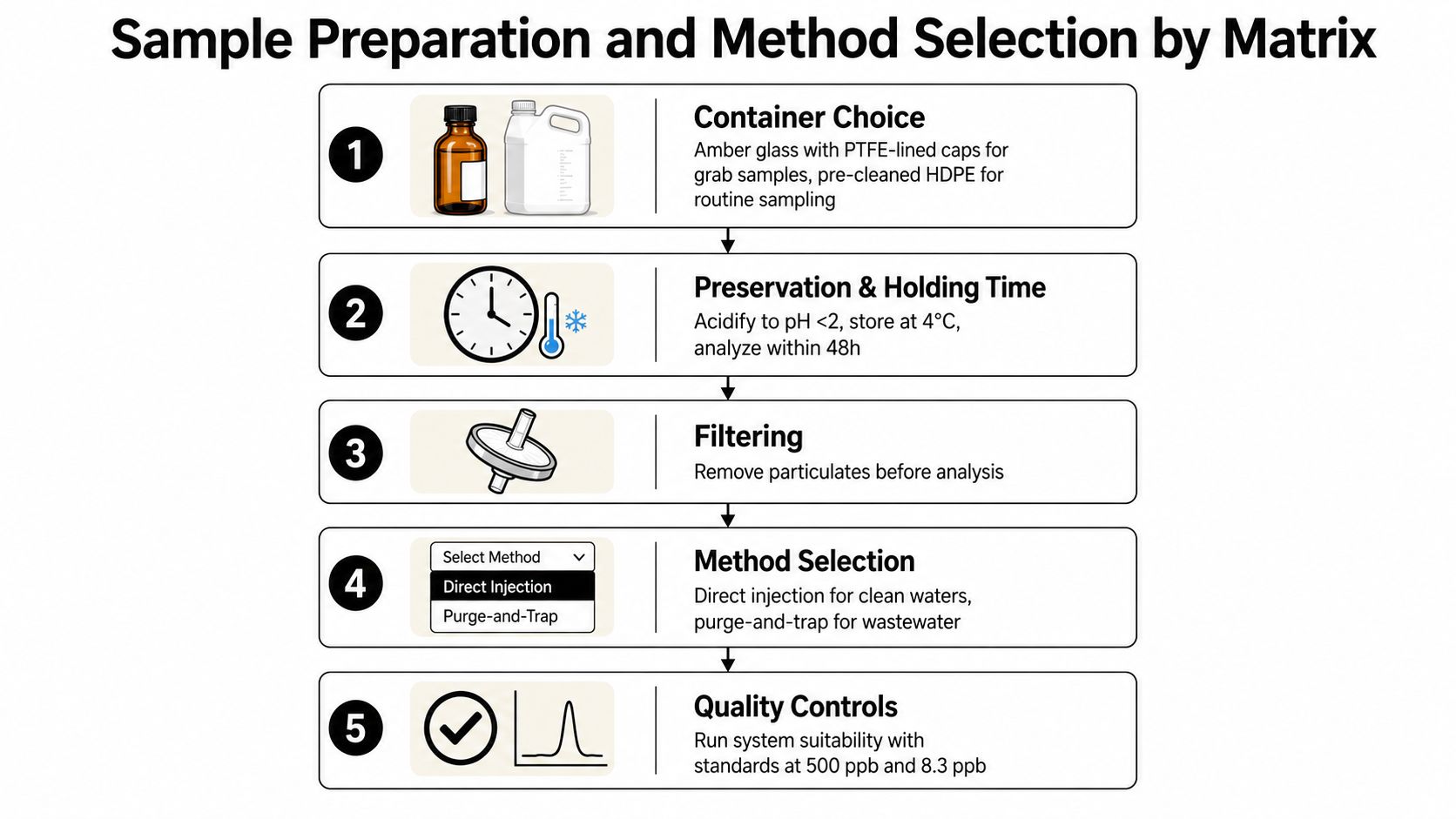
A clean high-purity water stream may suit combustion or UV-persulfate, depending on the validated method and required detection capability. Saline samples and brines often favor combustion because ionic strength can challenge wet oxidation and conductometric detection. High-TDS wastewater may require dilution, furnace operation, and a procedure that prevents saturation. Clean, low-ionic-strength water gives the laboratory more flexibility.
The following video can help analysts connect sampling decisions with the physical workflow at the instrument.
The key question is not whether a sample can be injected. It is whether the selected preparation preserves the measurand the laboratory intends to report.
Calibration and QA/QC Built on Pharmaceutical Standards
Pharmaceutical TOC control depends on more than a calibration curve. The instrument must show that it can oxidize representative compounds, distinguish a low background from a real sample response, and remain stable during routine operation.
USP <643> sets demanding expectations for pharmaceutical water systems. The instrument detection limit is ≤0.05 mg/L, and reagent water is expected to contain ≤0.10 mg/L TOC, according to the USP <643> technical guidance. The same guidance describes NPOC as effectively equivalent to TOC in pharmaceutical waters because particulate organic carbon is considered negligible in that matrix.
What system suitability is checking
Suitability solutions commonly challenge the instrument with sucrose and 1,4-benzoquinone. Sucrose represents an easily oxidized organic compound, while 1,4-benzoquinone challenges the oxidation system more severely. A laboratory may use a single-point check for a controlled routine method or a multi-point calibration when the validated range requires broader response verification.
The acceptance logic matters more than the shape of the curve alone. If the instrument responds correctly to an easy-to-oxidize compound but fails with the more resistant compound, the issue may involve oxidation efficiency rather than detector sensitivity.
| Parameter | USP <643> Threshold | Typical Lab Action |
|---|---|---|
| Instrument detection limit | ≤0.05 mg/L | Confirm low-level capability before sample release |
| Reagent water TOC | ≤0.10 mg/L | Investigate water, vessels, reagents, and carryover if exceeded |
| System suitability recovery | 85% to 115% | Stop release testing and troubleshoot a failed suitability result |
| Water for Injection first response limit | 8.3 ppb | Review the result, blank, handling, and confirmatory workflow |
| Individual organic impurity assessment trigger | Above 0.20 mg/L carbon in the specified circumstance | Identify and assess the impurity before acceptance |
Daily blanks help reveal contamination from vials, tubing, reagents, or the water system. Replicate injections help distinguish random variation from a systematic shift. A blank that rises gradually may point to carryover or water-system deterioration, while an abrupt rise often deserves an immediate review of containers and recent maintenance.
Quality teams can also use quality control testing resources to formalize records for blanks, standards, suitability responses, deviations, and corrective actions. A borderline pass shouldn't be treated as a routine pass when the blank is unstable or the response curve is visibly changing.
Real-World Applications Across Pharma, Environmental, and Industrial Labs
TOC has a different operational meaning in each sector. In pharmaceutical water, it supports organic purity control. In environmental work, it characterizes organic loading across variable natural and industrial matrices. In industrial systems, it can act as an early warning signal for process contamination, fouling potential, or ultrapure-water loss.
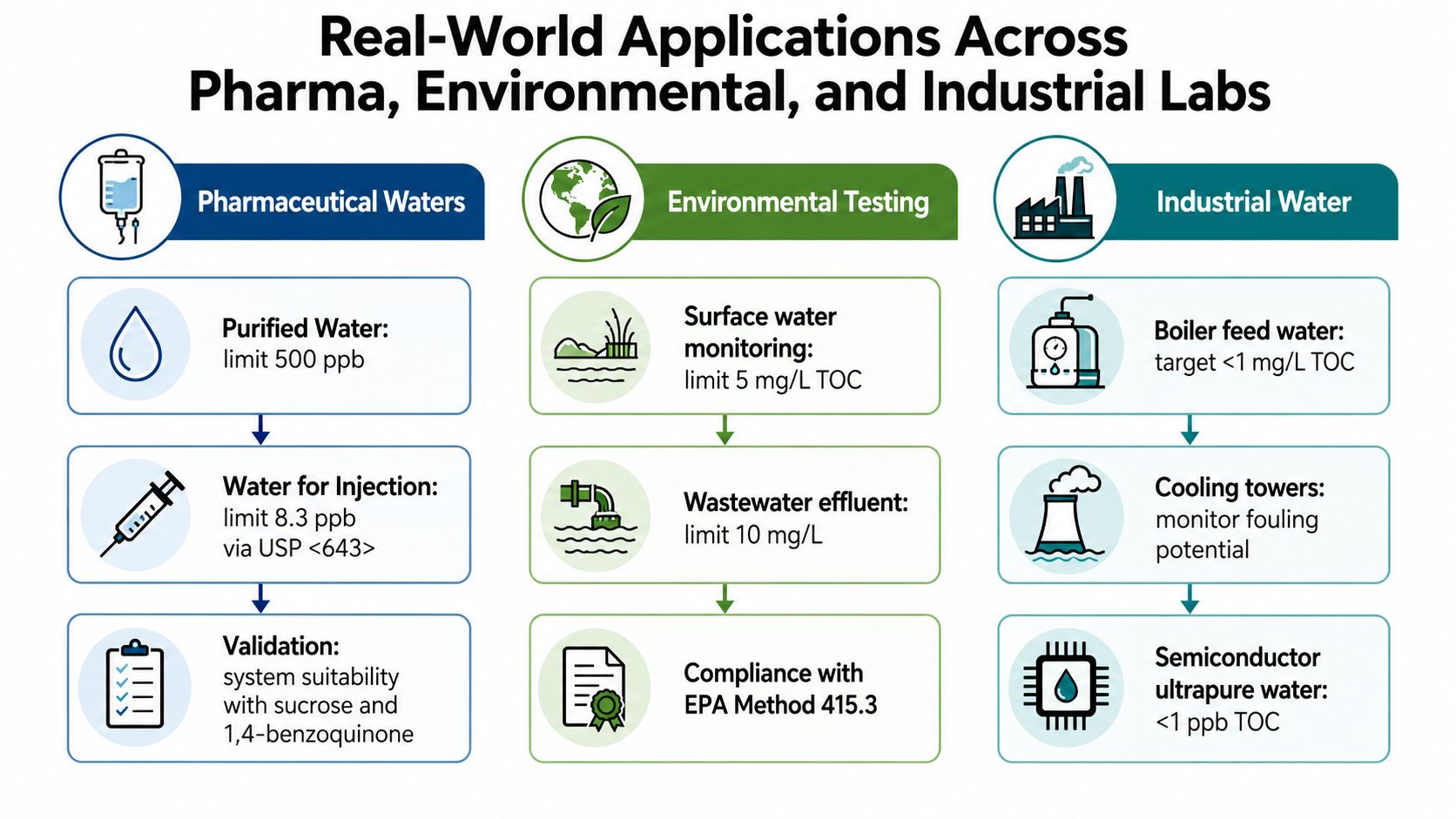
Pharmaceutical laboratories apply TOC to purified water, Water for Injection, cleaning validation rinses, and related qualification samples. Under USP <643>, the commonly cited purified-water limit is 500 ppb, while the Water for Injection workflow includes an 8.3 ppb first response limit. Those limits make sampling technique and low-background materials central parts of the analytical method, not administrative details.
Environmental laboratories may use TOC alongside methods such as EPA 415.1, EPA 415.3, and Standard Method 5310B. The result can support assessment of surface water, drinking water, wastewater, and treated effluent, but the matrix can vary far more than pharmaceutical water. Dilution, filtration decisions, particulates, salts, and heterogeneous organic material therefore deserve more attention.
One technique, several operating models
Semiconductor and other high-purity manufacturing systems may monitor very low TOC levels because organic contamination can affect sensitive process surfaces. Power-generation laboratories may use TOC for feedwater, condensate, or boiler-related monitoring. Food, beverage, and dialysis operations can use TOC as part of water-quality verification, cleaning checks, or release support.
A residential inspection service may approach water characterization differently from a regulated manufacturing laboratory, which is why resources on residential environmental inspections should not be confused with pharmacopoeial release testing. The sample objective, method validation, reporting unit, and acceptance decision are different.
The analyzer must follow the matrix. A process stream with high organic loading may need dilution or combustion. A tightly controlled ultrapure-water loop may benefit from online monitoring. A laboratory supporting multiple sectors may need separate validated methods rather than one universal operating recipe.
How 2026 Pharmacopoeial Changes Reshape TOC Testing
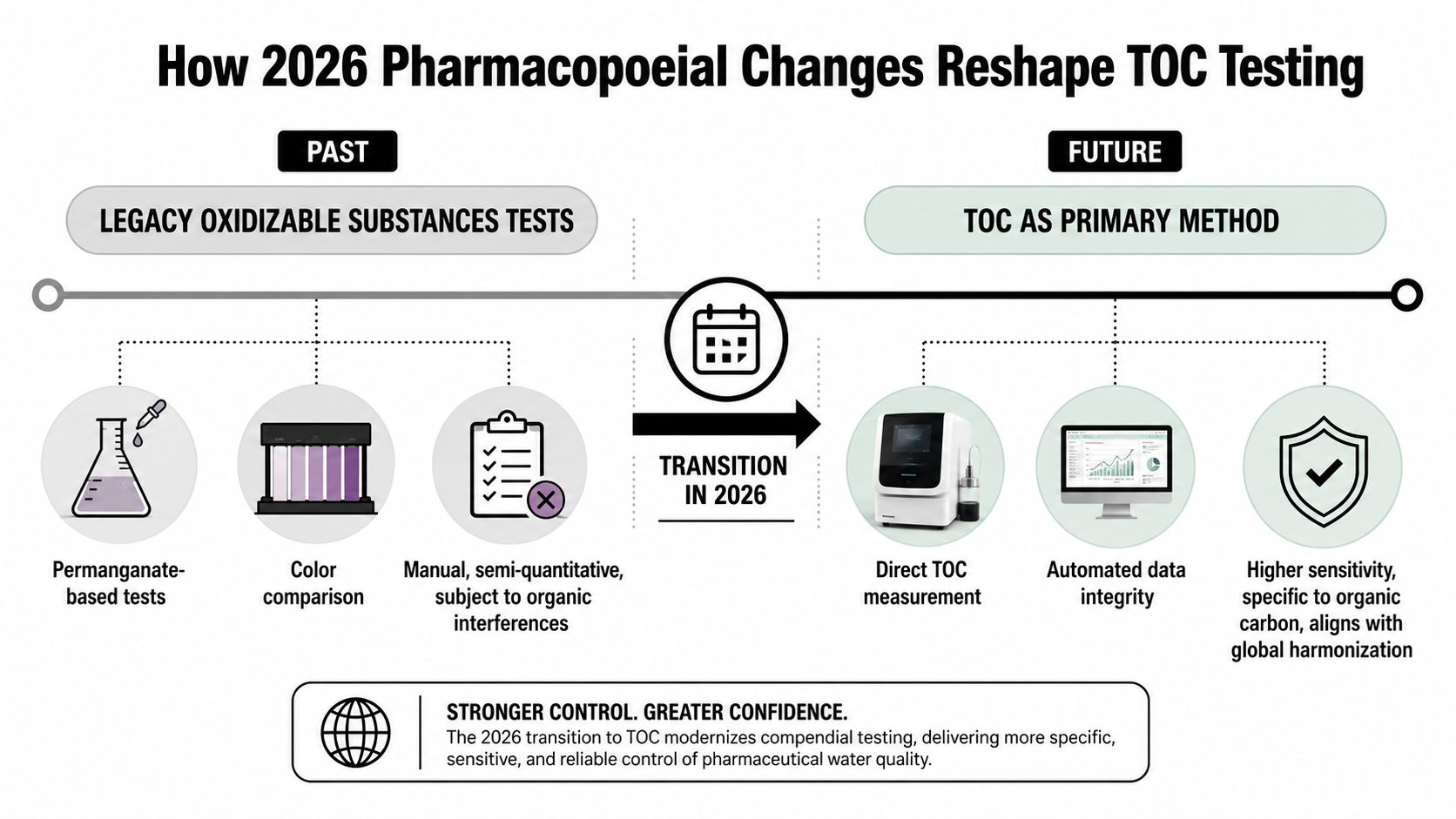
The important change isn't that TOC is more sensitive than an older wet-chemistry test. The larger shift is toward a more standardized, less chemistry-specific measure of organic carbon that laboratories can compare across systems and markets.
The European Directorate for the Quality of Medicines and HealthCare adopted a revision in 2025 that replaces the conventional oxidisable-substances test with TOC in the Sterilised Water for Injections monograph. The revised monographs are set to take effect on 1 July 2026, according to the EDQM announcement. The update also standardizes TOC references to Method A and changes the chapter's reagents to chemical reference substances.
What changes at the laboratory bench
Older oxidizable-substances procedures evaluate how a sample reacts with an oxidant. That response can be useful, but it isn't a direct measurement of total organic carbon and can be influenced by the chemistry of individual compounds. TOC measures carbon after oxidation, which improves cross-site comparability, but it still doesn't identify the source of the contamination.
For laboratories, the transition can affect:
- SOPs and forms: Procedures need updated method references, calculations, suitability checks, and result language.
- Analyzer qualification: Existing instruments must be shown to meet the revised method requirements, not assumed compliant because they already produce TOC results.
- Water-system protocols: Qualification and monitoring plans may need revised acceptance criteria and sampling rationales.
- Reference materials: Procurement teams should confirm that reagents and standards align with the method named in the current monograph.
- Traceability records: Audit packages should connect instrument configuration, calibration, maintenance, standards, and data review.
A wholesaler should therefore ask more than whether an analyzer measures TOC. The relevant questions include whether the platform supports the required method, whether validation documentation is available, and whether consumables can be supplied consistently through the requalification cycle.
Troubleshooting Common Failures and Building a Smart Procurement Plan
A failed TOC result doesn't automatically mean the analyzer needs service. Many failures originate in consumables, sample handling, water quality, or a suitability solution that has been prepared incorrectly.
Start with the symptom
Low spike recovery can indicate exhausted persulfate, reduced catalyst activity, poor reagent delivery, or incomplete oxidation. The analyst should check reagent age, flow paths, catalyst condition, and preparation records before escalating to a service visit.
Baseline drift often points toward unstable acid dosing, detector contamination, changing reagent background, or a temperature problem. Reviewing recent blank trends and maintenance events can narrow the cause faster than repeating sample injections.
Sudden high blanks implicate carryover, contaminated glassware, a compromised rinse-water source, or newly introduced tubing and caps. The fastest check is often a fresh blank prepared with verified low-background materials, followed by an examination of the sample path.
Failed system suitability usually demands a review of calibration slope, standard preparation, oxidation performance, and linearity. A laboratory shouldn't release samples because a later injection happens to fall within range.
A stable blank is part of the result. Without it, a low-level TOC value has no secure foundation.
Procurement questions that survive routine use
A lab buyer should evaluate the full ownership profile:
- Throughput and sampling pattern: Benchtop instruments suit centralized testing, while online units support continuous process observation and alarm-based control.
- Matrix tolerance: Confirm performance with the actual salt load, particulates, acidity, and expected carbon range.
- Consumable continuity: Plan for catalysts, persulfate reagents, acid cartridges, standards, lamps, tubing, and traps according to the instrument design.
- Service response: Ask whether scheduled maintenance and urgent repairs are both covered, and whether replacement parts are locally available.
- Data integrity: Review audit trails, user access, electronic records, export functions, and integration with the laboratory information system.
- Validation support: Request method documents, qualification templates, certificates, and technical assistance for requalification.
The supplier review should also include supplier qualification criteria covering documentation quality, change notification, lot traceability, fulfillment reliability, and technical communication. A lower purchase price doesn't compensate for an unstable consumables supply or slow corrective support.
Bringing the Whole Picture Together
Three decisions converge in total organic carbon testing. Regulatory decisions determine which method, suitability checks, and records a pharmaceutical laboratory must maintain. Technical decisions connect combustion or UV-persulfate oxidation to matrix, detection capability, throughput, and maintenance. Commercial decisions determine whether instruments, standards, reagents, and service capacity will be available when laboratories requalify methods.
ISO 20236, published in its current form in 2024, standardizes measurement of TOC, DOC, total bound nitrogen, and dissolved bound nitrogen, building on an earlier edition issued in 2018. That international standard reinforces the position of TOC as a mature analytical category rather than a niche wastewater procedure. ISO 20236 is especially relevant to suppliers supporting laboratories across multiple regulatory regions.
Market estimates also show that TOC instrumentation is a substantial commercial segment. One estimate places the global online TOC analyzer market at USD 764.0 million in 2023, with a projection of USD 1.1229 billion by 2030 and a projected CAGR of 5.7% to 5.8%. Another estimate values the broader TOC analyzer market at USD 1.4 billion in 2025E, projecting USD 2.33 billion by 2033 at a 6.74% CAGR. These are market estimates, not guarantees for any individual supplier, but they show why procurement teams are treating online capability and lifecycle support as strategic questions. (Grand View Research market estimate)
The immediate next step is a current-state audit. Laboratories and wholesalers should map each analyzer to its validated matrix, review consumable stock and service coverage, and compare existing procedures with the 2026 EDQM requirements before a compliance deadline creates avoidable pressure.
Herbilabs supplies high-purity reagents, sterile diluents, premium glass-vial products, clear certificates of analysis, and wholesale support for laboratory workflows across the EU, UK, and USA. Visit Herbilabs to review its research-use-only product range and discuss dependable supply for analytical and laboratory operations.


