Private Label, White Label, Wholesale partnerships available - EU, USA and UK - Free shipping from €75
Lab Supplier Qualification Criteria: Vet for Quality
A lab team usually notices supplier risk too late. The first signal is often a failed assay, unexpected particulate matter in a sterile diluent, a Certificate of Analysis that doesn't align with incoming results, or a batch that performs differently from the last lot even though the label looks identical.
For laboratories working with high-purity reagents, bacteriostatic water, and reconstitution solutions, supplier qualification criteria can't be borrowed from generic procurement playbooks. The process has to protect scientific reproducibility, contamination control, and regulatory defensibility at the same time. In the EU, UK, and USA, that means screening for real quality capability, not polished sales material.
A defensible program does three things well. It filters weak suppliers early, verifies that the supplier's quality system works in practice, and keeps monitoring after approval so qualification doesn't become a stale file in a shared drive.
Table of Contents
- Building Your Qualification Framework
- Initial Screening and Document Verification
- Conducting Quality System Audits
- Implementing Product Sample Evaluations
- Using Scorecards for Risk-Based Approval
- Establishing Ongoing Performance Monitoring
Building Your Qualification Framework
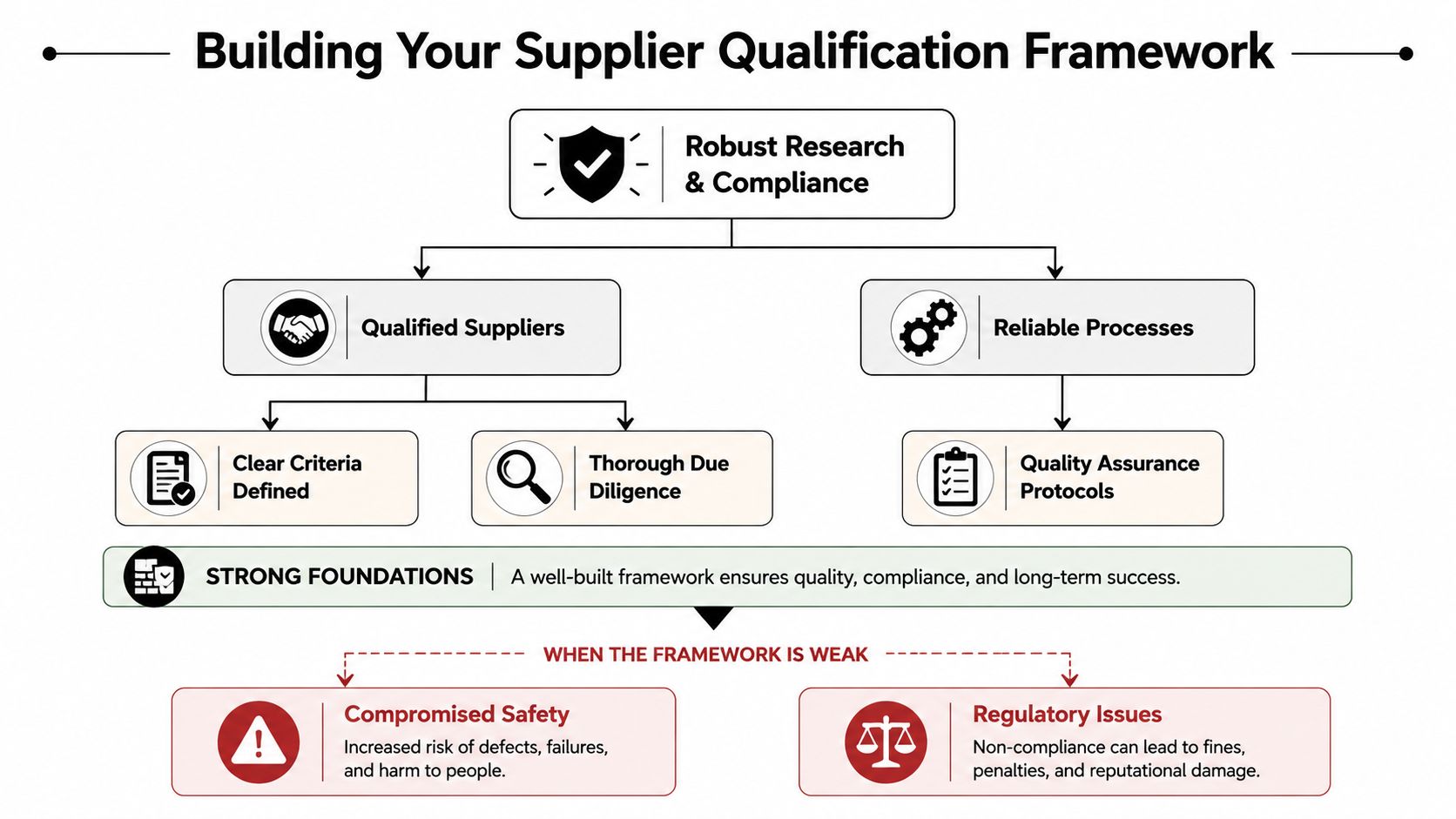
A weak qualification model treats all suppliers the same. That approach fails quickly in laboratory supply chains because not every material carries the same risk. A cardboard shipper and a sterile reconstitution solution shouldn't move through the same review path, and a supplier of analytical-grade reagents can't be judged only on price and lead time.
For laboratory reagents and sterile diluents, the framework has to connect supplier qualification criteria directly to product use. If the material will touch a sensitive workflow, influence assay accuracy, or create contamination risk, the qualification depth has to increase.
Why reagent suppliers need a stricter framework
A reagent supplier can pass a basic commercial review and still fail where it matters. The common weak points are lot consistency, environmental control, traceability discipline, and change control. Those failures don't always show up in a brochure or even in a certificate pack.
The strongest operating model for pharmaceutical and laboratory-grade materials is a four-stage gate process: pre-qualification by supplier self-assessment focused on ISO 9001 or GMP as minimum gates, document review of quality certificates and ESG baselines, on-site or virtual audit of technical competence and change control, and sample evaluation with trial deliveries to confirm purity and contaminant limits before approval. That same methodology also uses auditable weighting where Quality carries 35%, Delivery 25%, Cost 20%, and Risk/Compliance 15%, according to Tacto's supplier qualification overview.
Practical rule: If a supplier can't pass the early gate on certification, product fit, and basic quality documentation, the file shouldn't advance to audit scheduling.
The four gates that matter
A workable framework usually looks like this:
Pre-qualification
Narrow the field using a supplier questionnaire. The baseline asks whether the supplier holds relevant certifications, understands the intended laboratory use, can support traceability, and can provide the required controlled documents.Document review
This stage checks whether claims are supported by current evidence. It also shows whether the supplier's quality system is disciplined or merely performative.Audit
The audit verifies that procedures on paper match operator behavior, equipment control, training practice, and environmental conditions.Sample evaluation
Final approval should depend on technical evidence from actual material, not assumptions.
For labs serving the EU, UK, and USA, this framework also creates something procurement teams often miss. It produces an auditable rationale. If a regulator, customer, or internal quality reviewer asks why a supplier was approved, the answer exists in a controlled record trail, not in email memory.
A good framework also separates gate criteria from differentiators. GMP or ISO status, traceability capability, and contamination control are gates. Innovation support, digital maturity, and service responsiveness are differentiators after the gate is passed. Mixing those categories is how teams approve persuasive suppliers that still create quality exposure.
Initial Screening and Document Verification
The fastest way to waste audit resources is to skip rigorous paper screening. Strong supplier qualification criteria begin with documents because documents reveal whether the supplier understands control, not just sales.
A clean first-pass file should allow a reviewer to answer three questions quickly. What is being supplied? Under which quality system is it made? Can each lot be traced, tested, and released in a controlled way?
What the paper trail should include
For laboratory reagents and sterile diluents, the starting package should include:
- Quality certifications such as ISO 9001 or applicable GMP-related evidence. These don't prove product suitability on their own, but they establish whether the supplier operates inside a defined system.
- Certificates of Analysis
These show lot-specific test results, specification alignment, and release discipline. - Certificates of Origin
These matter when country of manufacture, sourcing consistency, or route-to-market controls affect regulatory or commercial risk. - Batch records or release summaries
These show how the supplier documents production and final disposition. - Specification sheets
These define what the supplier says the material is, including grade, storage conditions, and handling requirements. - Change control and deviation procedures
These indicate whether the supplier has a formal way to manage process drift. - Restricted-party and sanction screening evidence
This belongs at the front of the process, not after commercial discussions begin. - Financial stability information
A supplier that can't sustain operations is a quality risk, not just a commercial one.
One useful supporting check is whether the supplier clearly distinguishes regulated use from research-only use. Labs that resell or distribute materials should understand what Research Use Only means in practice before they qualify a source for those products.
Red flags that justify an early rejection
Documentation review should be skeptical. It isn't a filing exercise.
According to MIT Sloan Management Review on supplier development pitfalls, buyers create avoidable quality failures when they skip early financial stability checks, miss restricted-party screening, or leave out product-specific standards such as GMP from qualification questionnaires. In regulated materials, those omissions are associated with 30 to 40% higher defect rates, and weak threshold design can contribute to 25%+ supply disruptions in high-purity reagent workflows.
That matters because a reagent supplier can look acceptable under a generic vendor form while still being unfit for sterile or contamination-sensitive materials.
A reviewer should stop the file when any of these appear:
| Document issue | What it usually signals |
|---|---|
| Expired certification | Weak document control or lapsed system discipline |
| COA without test method clarity | Limited analytical transparency |
| Product specifications that conflict across documents | Poor master data control |
| No evidence of change control | High risk of unannounced process variation |
| Missing sanction screening | Compliance gap at the front end |
| No financial review for strategic supply | Elevated continuity risk |
The goal of initial screening isn't to find reasons to continue. It's to find reasons a supplier shouldn't be allowed near a critical workflow.
Another common error is over-relying on Pareto logic. Identifying the worst performers doesn't tell a team how to qualify a new supplier correctly. Good screening focuses less on ranking vendors against each other and more on whether each supplier can meet minimum conditions without ambiguity.
Conducting Quality System Audits
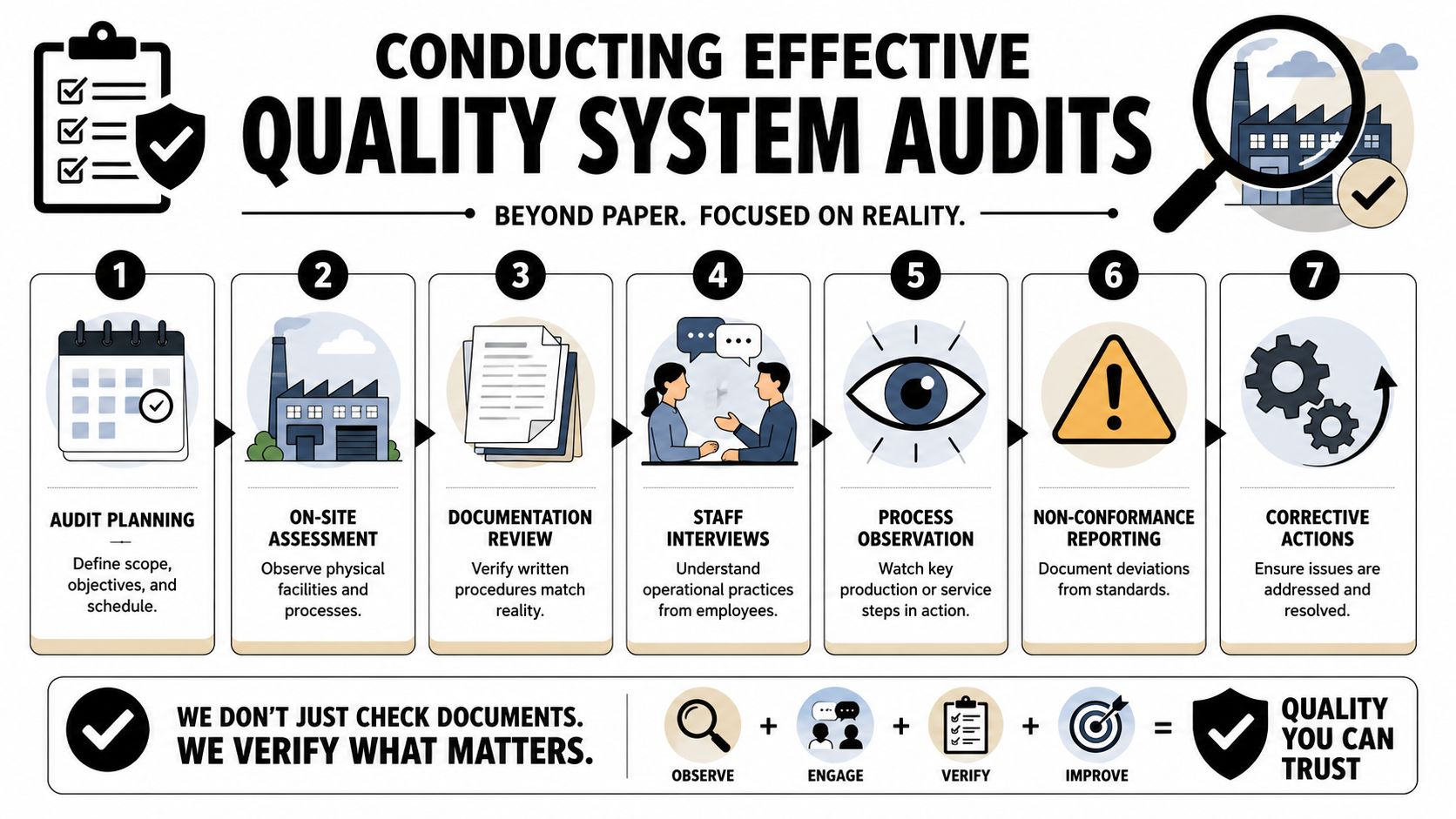
An audit is where supplier qualification criteria stop being theoretical. A document set may be complete, current, and well formatted. The audit shows whether operators follow those procedures, whether supervisors understand escalation, and whether management controls change.
For critical materials, a remote document review alone isn't enough. Sterile diluents, reagent waters, and contamination-sensitive products require direct observation of controls that paperwork often softens or hides.
What an audit shows that documents cannot
A supplier may present a polished SOP for contamination prevention, but the audit may show poor material segregation, weak gowning discipline, uncontrolled movement between areas, or operators who can't explain what happens after a deviation. That's the difference between a paper system and a functioning one.
For laboratory suppliers, the audit should concentrate on a few realities:
- Environmental control
Cleanliness expectations, material flow, and storage practice must align with the product type. - Production discipline
The team should verify whether the supplier can repeatedly make the same product to the same specification. - Training depth
Operators should understand the task, the risk, and the response when something goes wrong. - Change control
Process, equipment, source-material, and specification changes should trigger formal review. - Deviation handling
Nonconformances should move through documented investigation and closure, not informal workarounds.
Facilities supplying sterile or contamination-sensitive products should also show a coherent contamination prevention model. Teams qualifying these suppliers often benefit from reviewing practical controls used to prevent cross-contamination in laboratory handling and supply environments.
A short visual summary helps align the audit team before fieldwork begins.
Questions that expose weak control systems
Good audits depend on pointed questions. Generic prompts produce polished answers. Specific prompts produce evidence.
A capable auditor asks things like:
- Show the last approved process change
Who reviewed it, what risk assessment was used, and how were customers notified if applicable? - Walk through one released lot
Start with incoming materials and finish at final release documentation. - What happens when a batch falls outside expectation
The answer should reference deviation, investigation, disposition, and CAPA. - How is production capacity planned
This helps reveal whether urgent orders create shortcuts. - Which process parameters are most critical
If the supplier can't answer clearly, technical understanding may be shallow. - How are retained samples stored and trended
Retains matter when complaints or drift appear later.
Audit for contradictions. If the quality manager describes one process and the production lead describes another, the system isn't controlled.
The best audit reports also separate observations into categories. Critical gaps affect product trust immediately. Major gaps require corrective action before approval. Minor gaps may still allow conditional progress if the supplier responds quickly and convincingly.
Implementing Product Sample Evaluations
A supplier isn't qualified because the paperwork is clean and the audit was polite. The material itself has to perform. For reagents and sterile diluents, sample evaluation is the point where the supplier's claims meet laboratory evidence.
This stage should be designed like a controlled study, not a casual bench check. A sample that “seems fine” doesn't belong in a qualification file.
How to test a sample before approval
The evaluation protocol should match the product category and intended use. For analytical reagents, the focus is usually identity, purity, contamination profile, stability, packaging integrity, and lot consistency. For sterile diluents, sterility-related controls, container closure integrity, particulate risk, and storage behavior become much more important.
A practical sample protocol usually includes:
Identity confirmation
Verify that the material is what the label says it is, using the lab's established methods.Purity assessment
Review supplier COA data against in-house testing. Depending on the material, this may involve chromatographic or other compendial-style approaches.Contaminant review
Check for impurities that could alter assay performance, cell response, or reconstitution integrity.Packaging inspection
Evaluate vials, caps, seals, labels, lot coding, and shipping condition.Storage and handling verification
Confirm the material behaves as expected under the required storage conditions.Trial use in intended workflow
A supplier sample should be challenged in the same type of work it will support after approval.
When purity is central to the workflow, teams should tie sample acceptance back to the lab's own standards for experimental reproducibility. In this context, a strong understanding of material purity and its impact on experimental integrity becomes operational rather than theoretical.
What good sample evaluation looks like for sterile diluents
Sterile diluents need tighter scrutiny than many buyers expect. The sample isn't only being checked for label accuracy. It is being checked for whether it remains suitable when it enters a sensitive handling chain.
A solid review asks:
| Evaluation point | Why it matters |
|---|---|
| Visual clarity | Particles and haze can indicate contamination or packaging problems |
| Container closure condition | Seal weakness can compromise sterility assurance |
| Lot coding and traceability | Investigations fail when units can't be traced cleanly |
| Shipping condition | Mishandling can invalidate otherwise good product |
| In-use behavior | Reconstitution performance has to be consistent |
A sample evaluation should fail fast when the product doesn't align with the intended use. There is no value in forcing an approval path for a material that already shows avoidable ambiguity.
Trial deliveries add another useful layer. They test whether the supplier can reproduce the same control level under normal fulfillment conditions, not only in a hand-selected qualification sample. That distinction matters because some suppliers manufacture well but ship poorly, relabel inconsistently, or lose traceability discipline outside special review batches.
Using Scorecards for Risk-Based Approval
Approval decisions often go wrong at the last moment. The team has gathered documents, audit notes, and sample results, then someone says the supplier “looks good enough.” That phrase has no place in a controlled quality system.
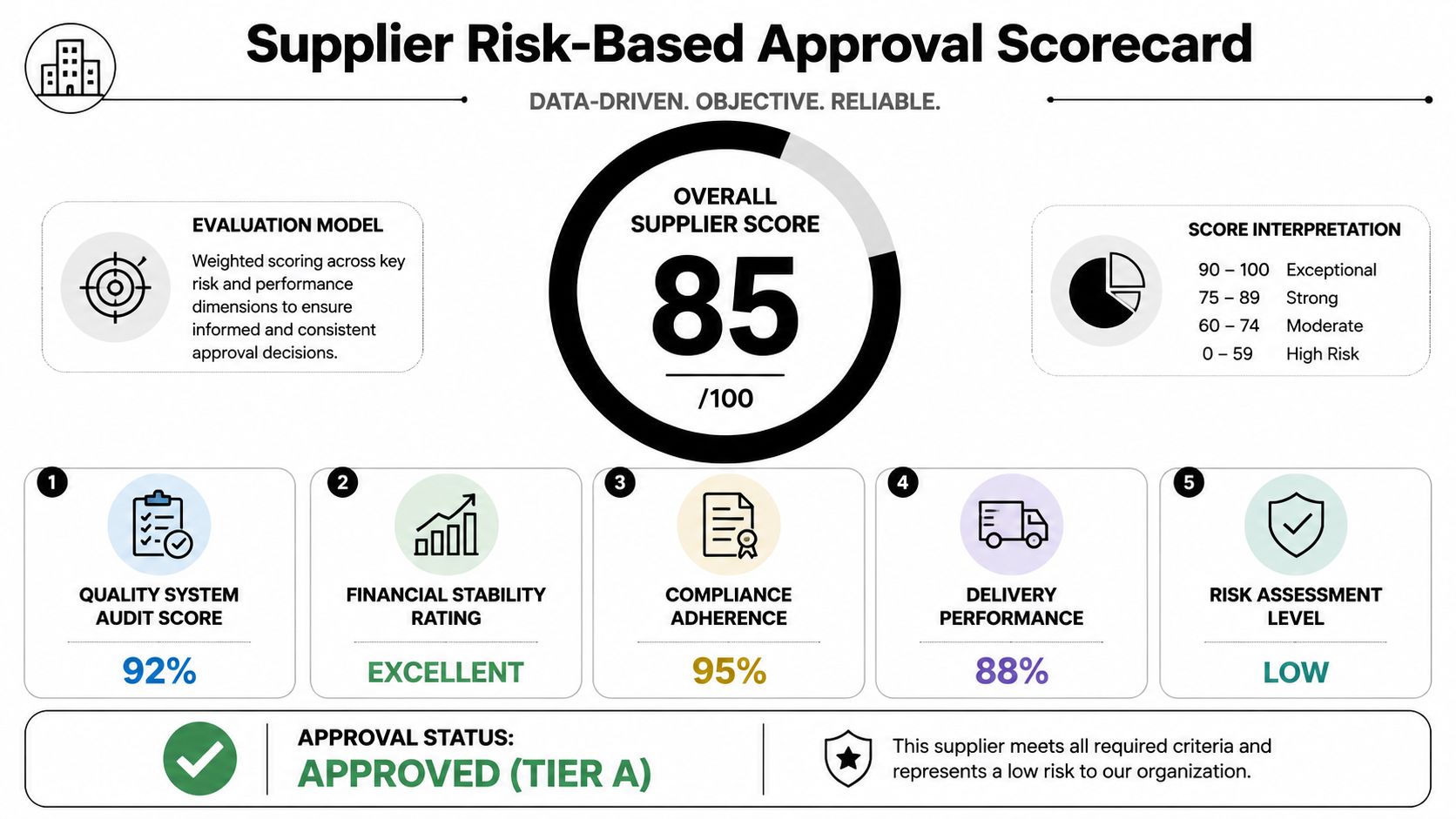
A scorecard turns supplier qualification criteria into a decision model that can be defended later. It doesn't replace judgment. It disciplines judgment.
Why scoring beats gut feel
A risk-based model prevents a common mistake. Teams sometimes approve a supplier with excellent pricing and acceptable delivery even though the quality system is mediocre. For lab reagents and sterile diluents, that trade-off is unsafe because quality weaknesses don't stay isolated. They show up later as test variability, complaint investigations, holds, and wasted research material.
A defined threshold fixes that. To achieve full approval, a supplier must score at least 80 out of 100 overall and exceed 70% in each critical dimension, including quality requirements, regulatory compliance, delivery performance, and financial stability, according to QC Advisor's supplier qualification criteria. That model matters because it prevents a supplier from compensating for one serious weakness with strength elsewhere.
A practical scorecard for laboratory supply chains usually includes these dimensions:
- Quality system performance
Audit outcome, deviation handling, CAPA closure quality, document control discipline. - Regulatory and compliance fit
Certification status, product use alignment, sanction screening, traceability expectations. - Delivery capability
Lead-time realism, packaging control, shipping reliability, responsiveness on exceptions. - Financial stability
Business continuity risk, ownership stability, ability to support ongoing supply. - Product performance
Sample evaluation outcome, lot consistency indicators, fit for intended laboratory use.
A practical onboarding checklist after approval
Approval should trigger controlled onboarding, not informal purchasing. The first purchase order is where many quality systems lose precision.
A useful onboarding checklist includes:
- Approved material specification loaded
Procurement and QA should use the same controlled specification. - Quality agreement or technical terms confirmed
Change notification, deviation reporting, and complaint handling should be explicit. - Approved manufacturing site recorded
The file should state where product may be made and released. - Accepted documents listed
Required COA format, batch traceability expectations, and shipping records should be defined. - Incoming inspection plan assigned
New suppliers usually need tighter receiving review than mature suppliers. - Escalation contacts verified
Quality, logistics, and commercial owners should all be named. - First deliveries flagged
Early lots should receive enhanced review until performance is established.
The scorecard should answer one question cleanly. Would an auditor understand why this supplier was approved, restricted, or rejected without asking for verbal context?
Conditional approval can still be useful. If the supplier passes core quality gates but has remediable gaps, approval can be limited by product type, region, or temporary enhanced controls. What shouldn't happen is silent tolerance of unresolved major findings.
Establishing Ongoing Performance Monitoring
Qualification doesn't end at approval. That's the most expensive misconception in supplier quality. A supplier can meet every entry criterion and still drift later through process changes, source-material changes, staffing problems, contamination events, or storage failures.
That risk is especially sharp with sterile diluents and laboratory reagents because changes that seem operational can alter scientific performance. A storage lapse, packaging change, or weak environmental control may not appear immediately in routine paperwork.

Why one-time qualification fails
The case for dynamic re-qualification is no longer theoretical. A 2025 FDA report found that 42% of qualified suppliers failed post-qualification because of unforeseen changes in raw material traceability or manufacturing environment control, while 73% of companies lack automated re-qualification triggers, as summarized by QualityFWD's review of supplier qualification management.
Those numbers expose a structural weakness. Many companies know how to approve suppliers, but they don't know how to detect when approval should be challenged.
For sterile diluents and reconstitution solutions, that gap is dangerous because temperature-controlled storage and batch testing need continuous verification. A supplier file that passed review last year doesn't protect the next shipment if the process changed unannounced.
Triggers that should force re-qualification
Monitoring should be active and rule-based. It shouldn't depend on whether someone happens to notice a trend.
Useful triggers include:
- Change in raw material source
If the upstream source changes, traceability and product equivalence need review. - Manufacturing site change
A different site may mean different equipment, personnel, and environmental controls. - Repeated incoming discrepancies
Even minor inconsistencies matter when they repeat. - Contamination or sterility-related complaint
These events should escalate immediately. - Unexplained shift in lot behavior
Assay performance drift is often the first practical warning sign. - Shipping or storage excursion
This is especially relevant for temperature-sensitive materials. - Late or incomplete change notifications
Weak communication is often a symptom of weak control. - CAPA slippage
If corrective actions are repeatedly delayed or poorly evidenced, the supplier's reliability should be reassessed.
A useful monitoring cadence combines routine review with exception review. Routine review looks at delivery performance, complaint history, document quality, and trend signals. Exception review starts when a defined trigger occurs and reopens qualification activities at the right depth.
A simple working model looks like this:
| Monitoring layer | What it does |
|---|---|
| Routine supplier review | Tracks standard performance over time |
| Event-triggered review | Reacts to changes, deviations, or complaints |
| Targeted re-audit | Verifies control when risk has increased |
| Re-sampling or trial lot review | Confirms product still meets expectations |
| Status decision | Maintains, restricts, or removes approval |
The strongest programs also link supplier monitoring to CAPA. If a supplier promises corrective action after a deviation, the lab should verify effectiveness, not just receipt of a response. A closed email loop isn't the same thing as a closed quality issue.
Dynamic re-qualification matters because supplier quality isn't static. It moves with process changes, people changes, market pressure, and operational shortcuts. A qualification system that doesn't revisit supplier risk is incomplete by design.
Labs and distributors that need high-purity reagents, sterile diluents, clear COAs, and dependable fulfillment across the EU, UK, and USA can review Herbilabs as a supply partner. Their focus on tested batches, temperature-controlled storage, Research Use Only compliance, and wholesale support makes them relevant for teams that expect supplier qualification standards to hold up under real QA review.


