Private Label, White Label, Wholesale partnerships available - EU, USA and UK - Free shipping from €75

10 Ml Sterile Vial: Complete Technical and Procurement Guide
Buying a 10 ml sterile vial isn't the same as buying a contamination-proof workflow. Vendor documentation can establish how the container was manufactured, sterilized, tested, and sealed, but it can't control what happens after a technician opens the package, swabs the stopper, inserts a needle, stores the vial, or inspects the solution. The most popular advice, “choose a sterile vial and the sterility problem is solved,” leaves out the point at which many real failures begin.
For peptide and reagent work, the practical decision has two parts. The container must fit the filling and closure system, and the lab must protect that container from particles, microorganisms, unsuitable solvents, and repeated handling. A sound procurement specification therefore covers geometry, glass quality, closure compatibility, documentation, inspection, storage, and access practices, not just the word “sterile” on a product page.
Table of Contents
- The Sterility Myth Most Buyers Believe
- Understanding ISO 10R Standards and Dimensions
- Material Selection and Chemical Compatibility
- Sterility Assurance Beyond the Vendor Label
- Reconstitution Workflows for Peptides and Reagents
- Handling and Storage Protocols That Prevent Contamination
- Procurement Strategy for Wholesalers and Distributors
- Quality Assurance and Regulatory Compliance Framework
The Sterility Myth Most Buyers Believe
A sterile vial leaves the supplier with a defined sterile status. It doesn't remain automatically protected once the packaging is opened or the stopper is punctured. That distinction matters in any workflow involving reconstituted peptides, sensitive reagents, or repeated access, because contamination can be introduced by the environment, the operator, the needle, the stopper surface, or particles released during handling.
Independent hospital-pharmacy evidence illustrates the inspection problem. In the cited investigation, manual visual inspection and semi-automated visual inspection detected 100% of visible particles, while automated visual inspection detected 28% and missed textile fibres. The same research identified glass particles, stopper fragments, and textile fibres in vials exposed to less controlled conditions. These findings come from research on visual inspection methods for parenteral products, and they point to a practical weakness in the phrase “sterile vial.” A vial can begin sterile and still contain a visible contamination risk after poor handling.
The real control point is the workflow
A lab manager should separate three questions:
- Was the vial sterile when released? Review the supplier's sterility documentation and lot traceability.
- Is the closure intact? Check for damaged crimps, displaced stoppers, broken seals, or compromised packaging.
- Has the vial remained controlled during use? Assess the workspace, access frequency, swabbing procedure, needle practice, and storage.
The third question is where many purchasing decisions fail. A low-cost vial with excellent release documentation may still be unsuitable if the laboratory repeatedly accesses it in an uncontrolled area. Conversely, an appropriately selected vial, used with disciplined aseptic technique, gives the research team a more defensible sterility-assurance process. Guidance on sterility assurance levels can help teams frame vendor claims within the wider control strategy rather than treating a label as the entire assurance program.
Practical rule: Treat vendor sterility as the starting condition, not the final outcome.
Procurement should therefore ask how the vial will be used before comparing unit prices. A single-use preparation, a controlled fill line, and a repeatedly accessed research vial have different risk profiles. The container specification must match the actual workflow, because sterility assurance depends on both the supplied package and the people handling it.
Understanding ISO 10R Standards and Dimensions
The phrase ISO 10R describes a standardized vial format, not merely a container that happens to hold 10 ml. A widely used global specification identifies the format at approximately 24 × 45 mm, with a 20 mm closure finish, as described in the SCHOTT adaptiQ ISO glass vial reference. The dimensions support interoperability across filling, stoppering, crimping, nesting, and transport systems.
The most common buyer confusion comes from treating the two measurements as if they describe the same thing. 10 ml refers to the nominal fill volume, while 20 mm refers to the neck or closure finish. The vial's brimful capacity is often about 13.5 ml or 13 to 14 ml, which leaves practical headspace above the nominal fill. That additional capacity isn't a claim that the vial should be filled to the brim. It reflects the difference between a working fill volume and total internal capacity.
Reading the specification sheet correctly
| Parameter | Specification | Practical implication |
|---|---|---|
| Nominal volume | 10 ml | Defines the intended working fill, not the total internal capacity |
| ISO format | ISO 10R | Supports compatibility with standardized handling and filling equipment |
| Approximate body diameter | 24 mm | Affects nests, trays, transport, and equipment fit |
| Approximate height | 45 mm | Influences machine clearances, labels, and packaging configuration |
| Closure finish | 20 mm | Determines stopper and crimp-seal compatibility |
| Brimful capacity | About 13.5 ml or 13 to 14 ml | Provides usable headspace above the nominal fill |
| Crown diameter | 20 mm | Helps define the closure interface |
| Inner crown diameter | 12.6 mm | Relevant to stopper fit and sealing geometry |
| Ready-to-use nest packing | 48 vials per nest | Affects filling-line loading and material handling |
A separate packaging reference also describes the configuration as approximately 24 mm in diameter by 45 mm in height, with a 20 mm crimp finish, as shown by this ISO 10R nested-vial specification. The finish is the hardware-fit issue. A buyer who orders a 10 ml body but pairs it with a stopper or crimp intended for another finish can create leakage, poor compression, or failed closure integrity even when the vial itself is dimensionally correct.
For peptide preparation, fill calculations must also distinguish the nominal vial size from the desired final concentration. A resource on calculating peptide concentration is useful for separating vial geometry from the volume of diluent required. Teams should also document how vial volume matches the research application, especially when the workflow includes headspace requirements, repeated withdrawal, or automated equipment.
Material Selection and Chemical Compatibility
For injectable primary packaging, Type I borosilicate glass remains the conventional material because it combines chemical inertness, low interaction with drug products, and strong barrier performance. The ISO 10R format is commonly produced from this glass, which is tied to the DIN EN ISO 8362-1 and ISO 8362 family of specifications. For peptide and reagent work, those properties matter because the container should not contribute avoidable extractables, leachables, or reactive surfaces to a preparation.
The correct material choice starts with the formulation, not the vial catalogue. A lab should review the solvent, pH, sensitivity to light, storage duration, temperature exposure, and number of stopper punctures. Type I glass is often the conservative choice for chemically sensitive preparations, while amber glass becomes relevant when light exposure threatens stability. Material purity and container selection should be considered alongside broader material purity requirements for experimental integrity.
Where glass works well
Borosilicate glass provides a strong moisture and gas barrier, and it generally tolerates the thermal conditions associated with validated sterilization processes. It also allows direct visual inspection of the solution and any suspended particles. Those advantages are valuable for lyophilized peptides, reconstitution solutions, and laboratory preparations where chemical neutrality is more important than impact resistance.
Glass has a cost. It can fracture during transport, loading, or manual handling, and a damaged vial may compromise both the product and the sterility boundary. Protective secondary packaging and careful receipt inspection are therefore part of the material decision, not optional extras.
Where alternatives require caution
Plastic containers can reduce breakage risk and may be useful for diagnostic samples, transport, or applications where impact resistance matters. They aren't automatically equivalent to Type I glass for every peptide or solvent. Polymer compatibility depends on the specific material and formulation, and buyers must consider possible leachables, extractables, adsorption, and gas permeation.
Bacteriostatic water containing 0.9% benzyl alcohol and other peptide solvents should be reviewed against the complete container system, including the vial, stopper, liner, and any syringe-contact materials. The question isn't whether the liquid fits inside the container. It is whether the formulation remains chemically and physically stable throughout its intended storage and access period.
For sensitive research materials, a supplier should provide material specifications and relevant compatibility or extractables information rather than relying on a generic statement such as “laboratory grade.” That documentation gives the buyer a basis for choosing glass or plastic according to the preparation's actual risks.
Sterility Assurance Beyond the Vendor Label
A supplier's sterility certificate describes the vial at release. It does not guarantee sterility after shipping, unpacking, storage, or repeated access. Commercial sterile 10 ml vial systems may include documentation aligned with USP <71> sterility testing and USP <85> bacterial endotoxin testing. Other products specify depyrogenated vials manufactured under cGMP requirements. The ready-to-fill sterile vial reference from VGD shows how standardized 20 mm closures and case configurations can support controlled supply.
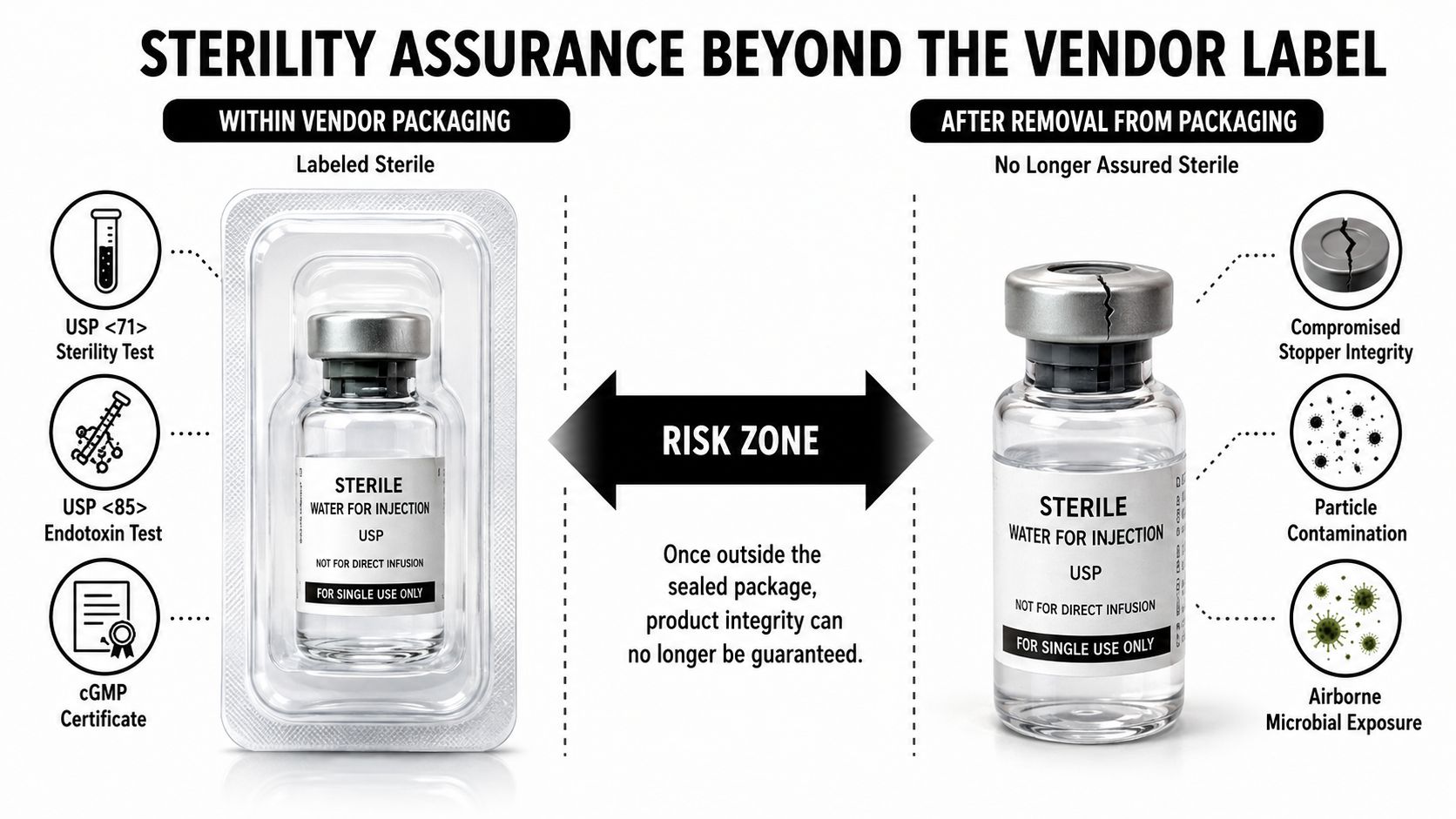
USP <1207> defines container closure integrity around preventing leakage beyond the maximum allowable leakage limit. For procurement, that means evaluating the complete closure system, not only the sterilization record. The stopper, crimp, vial finish, transport protection, and handling procedure all affect whether the contents remain protected.
Single-use and repeated-access workflows
Single-use sterile water for injection provides the simpler control model. The operator opens the container, completes the preparation, and uses the contents within the validated workflow. Fewer entries mean fewer opportunities for contamination during access.
Multi-dose bacteriostatic water requires tighter discipline. The 0.9% benzyl alcohol preservative supports a multi-dose research workflow, but it does not replace clean technique. Each entry requires a disinfected stopper, sterile equipment, controlled handling, and a documented storage and discard policy.
Procurement errors often appear after delivery. A compromised tray, damaged crimp, mismatched stopper and finish, or prolonged exposure during international transit can weaken the sealing system before the vial reaches the laboratory. Inspect packaging and closure condition at receipt, then quarantine damaged units rather than assuming the vendor's release result covers later handling.
A cracked or repeatedly damaged stopper can compromise protection even when the vial passed release testing. The same risk applies to a vial left open on a bench, stored outside specified conditions, or accessed with equipment that contacted a nonsterile surface.
The supplier controls the package before release. The laboratory controls the package after access begins.
A defensible procedure identifies authorized users, stopper-disinfection steps, labeling requirements, storage location, and discard timing. Record those controls in the laboratory's standard operating procedure, rather than relying on informal instructions between technicians.
Reconstitution Workflows for Peptides and Reagents
Lyophilized peptides remain inactive as a dry cake until the correct solvent and handling method return them to solution. The vial size matters, but the preparation outcome depends more directly on the peptide's structure, the diluent, the target concentration, and the mechanical stress applied during dissolution.
Consider a 5 mg peptide intended to reach 2 mg/ml. The required final volume is calculated by dividing the mass by the target concentration, producing 2.5 ml of solution. That calculation describes the preparation volume. It doesn't automatically determine whether the peptide should be placed in a 10 ml vial, a smaller vial, or aliquots, because headspace, access frequency, and storage requirements still need review.
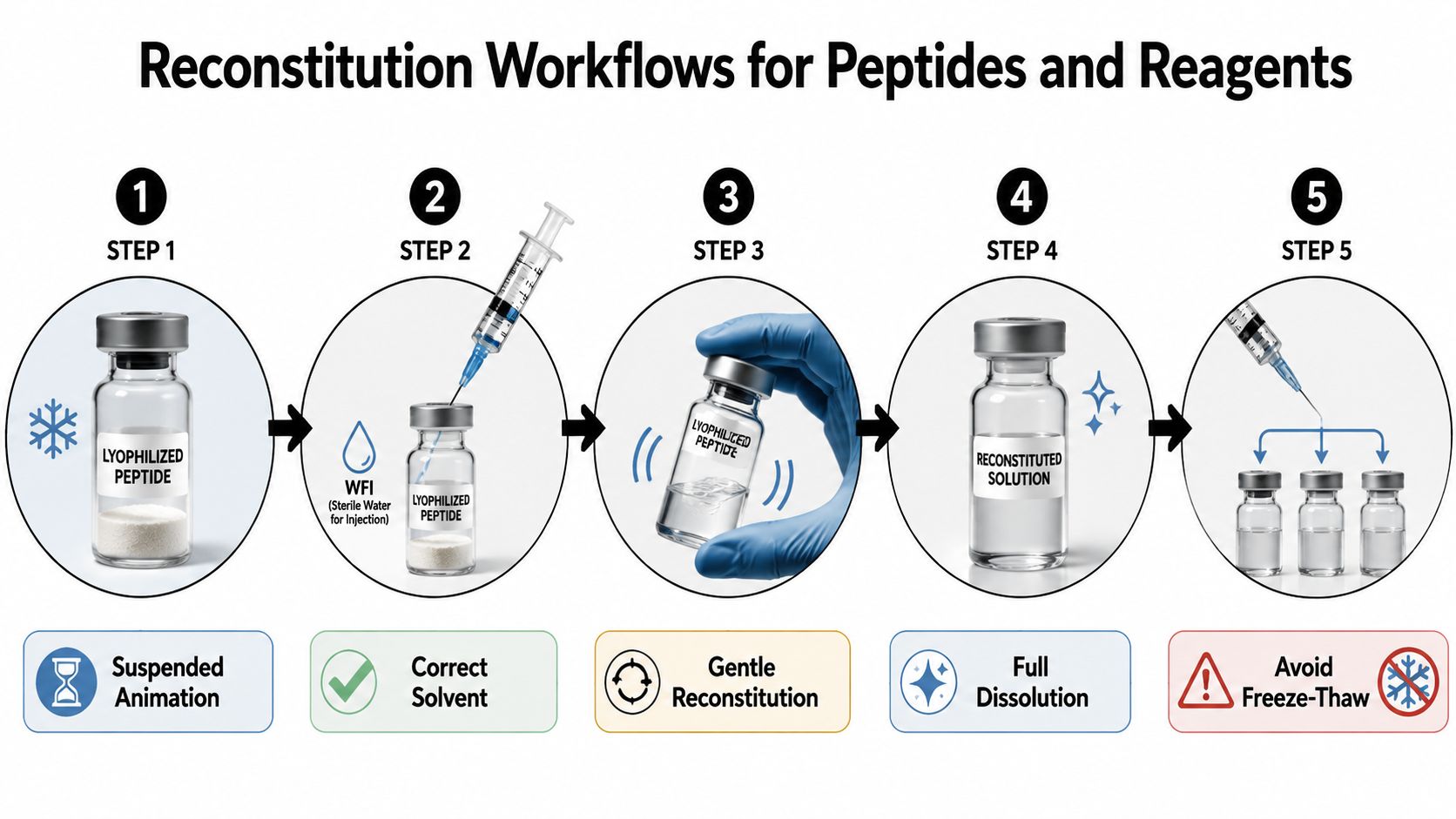
A controlled preparation sequence
Inspect before opening. Confirm the label, lot, expiry information, vial condition, and appearance of the lyophilized cake. A damaged crimp or compromised stopper should stop the process before the diluent is introduced.
Select the diluent deliberately. Sterile water suits an immediate single-use workflow. Bacteriostatic water containing 0.9% benzyl alcohol may suit a controlled multi-dose research workflow, provided the formulation and protocol permit it.
Introduce the liquid gently. Directing a forceful stream at the dry cake can create foaming or local mechanical stress. A slow addition against the vial wall is generally less disruptive than aggressive injection.
Allow dissolution. Gentle swirling can distribute the solvent without the harsh agitation that may damage delicate peptide structures. The solution should be checked for persistent particles, cloudiness, or incomplete dissolution before use.
Aliquot when the protocol requires it. Dividing a preparation into smaller sterile containers can reduce repeated punctures and limit freeze-thaw exposure, but each transfer creates another handling event that must be controlled.
Precipitation or incomplete dissolution should not be “fixed” by adding random solvent or increasing agitation. The operator should first verify the solvent, concentration calculation, pH suitability, temperature, and peptide-specific instructions. A clear final solution is not proof of sterility, and a sterile container is not proof that the peptide retained its intended structure.
Handling and Storage Protocols That Prevent Contamination
The most reliable handling protocol is simple enough to follow every time and specific enough to audit. It begins at receipt, before the 10 ml sterile vial enters a refrigerator, cabinet, or clean bench. Packaging damage, loose components, unusual particulates, or a compromised closure should be recorded and escalated before the vial is used.
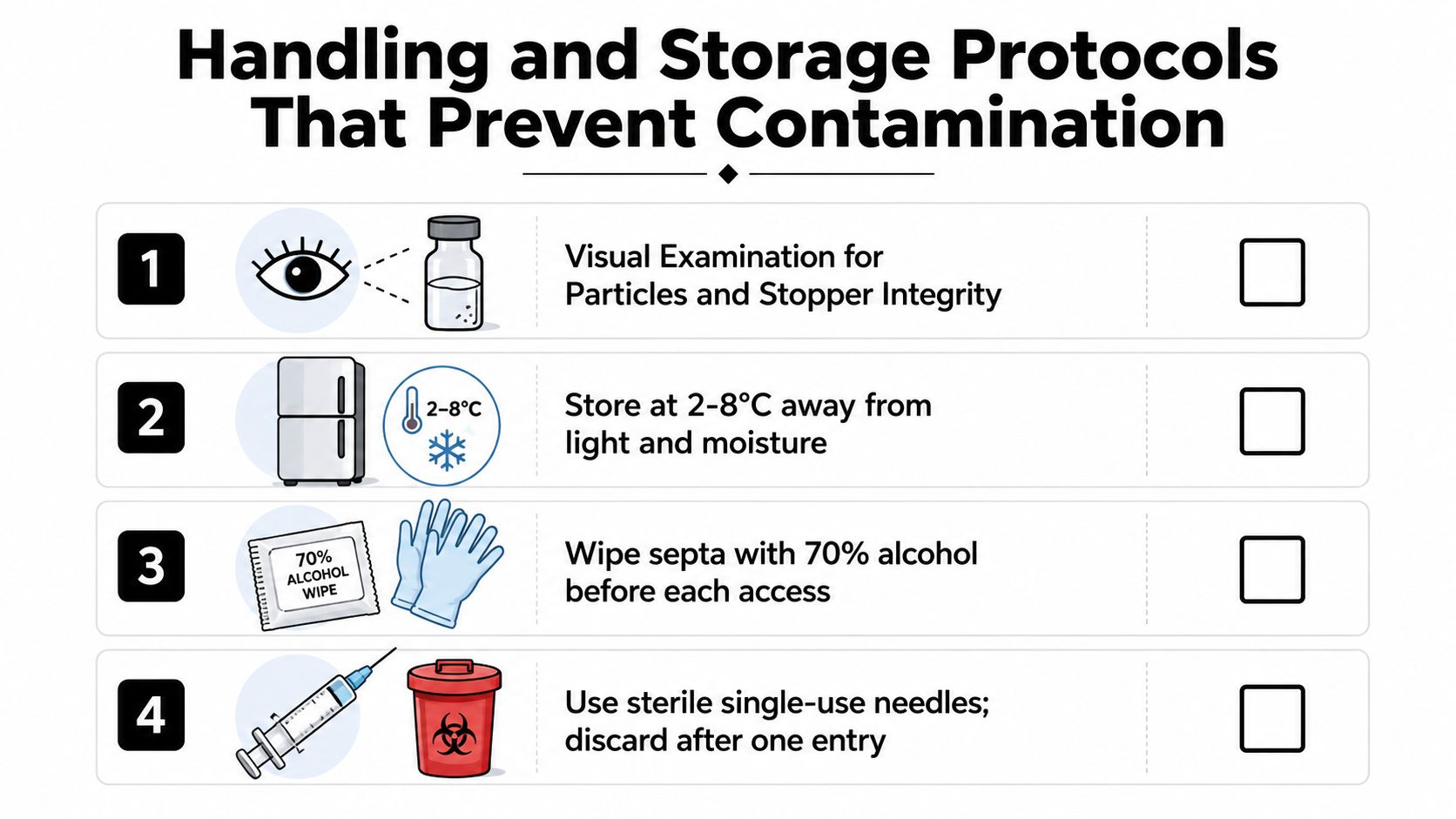
A practical control sequence
Examine the vial against suitable light. Look for visible particles, cracks, chips, stopper displacement, damaged crimping, and abnormal solution appearance. Manual inspection deserves attention because the cited hospital-pharmacy evidence found that automated inspection missed some visible contamination categories.
Store according to the product specification. Many laboratory protocols use refrigerated storage at 2 to 8°C, away from light and moisture, when the formulation requires it. That range appears in the assigned handling visual, but the product's own validated storage instructions take priority. Temperature excursions should be documented rather than ignored.
Disinfect the access surface. Allow the stopper to dry after an appropriate alcohol swab before inserting a sterile needle. Touching the disinfected surface with gloves, packaging, or a syringe compromises the control.
Use sterile single-use equipment. A fresh needle and syringe for each entry reduce carryover and prevent contact contamination. A needle should never be reused just because the same vial remains on the bench.
The handling environment also deserves attention. Textile fibres can enter a preparation from clothing, wipes, or poorly controlled surfaces, while glass particles may result from breakage or damaged components. A clean work area, deliberate movements, and closed storage reduce those avoidable sources.
Opened and unopened status
An unopened vial should remain in its original protective packaging until needed. Once accessed, the laboratory should label the date and time of first entry, record the storage condition, and follow the formulation's validated in-use period. No universal discard period should be invented for every peptide or reagent. Partially used multi-dose containers should be discarded when the approved in-use period ends, the stopper is damaged, contamination is suspected, or storage conditions fall outside the documented requirement.
A vial should be discarded because its control status is uncertain, not because someone hopes the remaining liquid will be usable.
Procurement Strategy for Wholesalers and Distributors
Wholesalers should purchase the complete container system, not a vague volume description. A request for “10 ml sterile vials” should define ISO 10R geometry, 20 mm finish, glass type, stopper material, crimp requirements, sterilization status, packaging format, and documentation. This specification prevents a common cross-border failure: the vial body arrives correctly, but the closures, nests, or filling equipment do not match.
Packaging formats can affect the cost and handling risk. Some suppliers quote individual vials, while others quote nests, trays, cases, or master cases. The market reference describes packages of 50 vials per case and master cases of 960. Confirm the unit behind every quotation before comparing landed cost, warehouse capacity, or customer allocations.
Supplier activity in the sterile-vial market is also substantial. A market reference estimates the sector at about $11.03 billion in 2025 with roughly 6% CAGR, as documented in this sterile-vial market reference. Treat that projection as market context, not evidence that a particular lot will perform reliably.
What a distributor should verify
- Documentation access: Obtain the COA, lot number, sterility information, endotoxin results, material specification, and packaging details before placing a volume order.
- Closure matching: Confirm that the stopper and crimp suit the exact 20 mm finish and the customer's sealing equipment. Small mismatches can produce incomplete seals during filling.
- Shipping controls: Define packaging, temperature exposure limits, customs documents, and responsibility for damage or excursions during international transport.
- Commercial terms: Compare landed cost, minimum order quantities, replenishment reliability, and replacement procedures, not only the unit quote.
- Customer communication: State Research Use Only status clearly and pass handling and storage requirements to downstream buyers.
A documented procurement process should record supplier checks, approvals, purchasing decisions, and receiving controls. Those records help distributors investigate sealing failures across EU, UK, USA, and LATAM routes, where customs, labeling, and delivery conditions vary.
Quality Assurance and Regulatory Compliance Framework
A sound buying decision combines four records: the product specification, the batch documentation, the closure evidence, and the supplier's traceability process. A COA should identify the product and lot, while supporting records should make it possible to verify material, sterility, endotoxin status, packaging, and release information. Buyers shouldn't accept a general compliance statement as a substitute for lot-specific evidence.
USP <71> and USP <85> references help establish the testing framework for sterility and bacterial endotoxins. USP <1207> adds another critical dimension, container closure integrity, because the protection comes from the complete vial, stopper, crimp, and interface rather than from the glass alone.
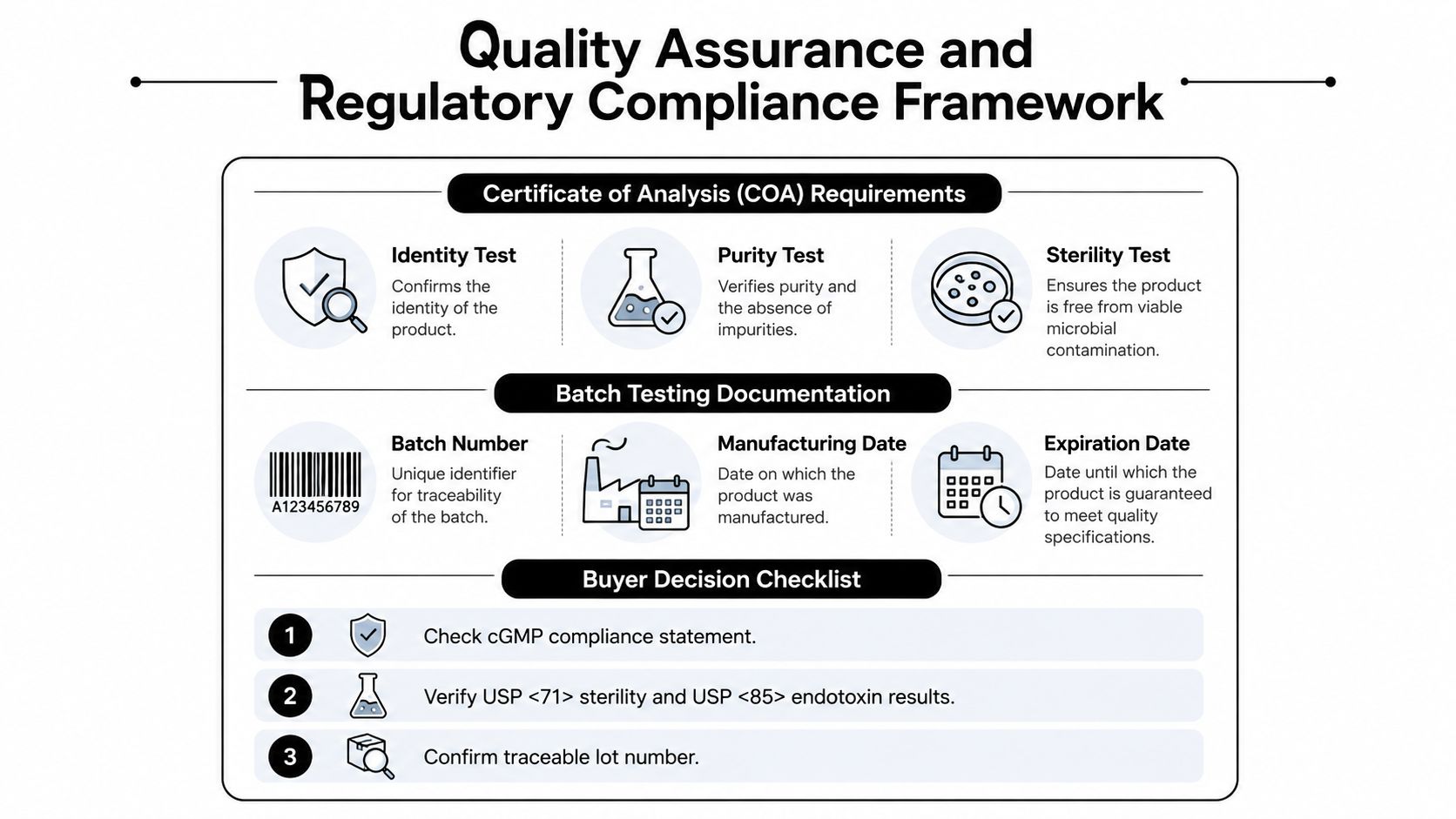
A buyer's decision screen
A supplier comparison should ask:
- Can the supplier identify the lot? The vial, closure, COA, and shipment should connect through a traceable lot number.
- Are claims testable? Sterility, endotoxin, depyrogenation, and material claims should be supported by relevant documentation.
- Does the closure system fit? Confirm finish, stopper, crimp, and sealing process together.
- Is the supply chain visible? Review manufacturing location, packaging configuration, transport controls, and response procedures.
- Can support answer technical questions? Slow or vague answers before purchase often become larger problems after delivery.
Cost reduction should come after the technical specification is fixed. Guidance on cutting costs with supplier negotiation tips can help buyers negotiate volume, freight, and replenishment terms without removing the controls that protect research integrity. The cheapest vial is expensive if a closure mismatch causes leakage, a damaged shipment delays a study, or incomplete records prevent a customer from accepting the lot.
For laboratories and distributors, quality assurance is therefore operational. The strongest supplier is the one that can connect a correctly dimensioned container to documented testing, compatible closures, controlled logistics, and responsive corrective action.
Herbilabs supplies sterile diluents and reconstitution solutions, including a 10 ml multi-dose glass-vial format with 0.9% benzyl alcohol for Research Use Only, alongside clear COAs and wholesale options. Review the available Herbilabs products, confirm compatibility with the intended peptide or reagent workflow, and contact the team to discuss sourcing, documentation, and distribution requirements.