Private Label, White Label, Wholesale partnerships available - EU, USA and UK - Free shipping from €75

Sterile Glass Vials Buyer and Technical Guide for Labs
A reconstitution workflow can fail before the researcher notices a problem. The powder may dissolve slowly, the stopper may seat unevenly, or a vial that looks perfectly clean may no longer protect the contents after transport and handling. The immediate temptation is to blame the diluent or the glass, but the more useful question is whether the complete container-closure system was selected, processed, and handled for the intended formulation.
Sterile glass vials remain central to injectable drugs, vaccines, lyophilized products, and powders for reconstitution because they combine transparency, chemical durability, impermeability, dimensional stability, and compatibility with established sterilization and depyrogenation processes. Yet the glass is only one part of the decision. Wholesalers, distributors, and laboratory users also need to assess stopper compatibility, crimping, headspace, integrity testing, storage, documentation, and the formulation's behavior over time.
This guide treats vial selection as a workflow decision rather than a catalog exercise. It also places sterile packaging in the broader context of specialized medical manufacturing, including FDM SLA SLS medical applications, where material control, repeatability, and process validation influence the reliability of the finished device or component.
Table of Contents
- Introduction to Sterile Glass Vials for Modern Labs
- What Sterile Glass Vials Are and How They Work
- Glass Types and Why Material Choice Matters
- Vial Sizes Fill Volumes and Headspace Explained
- Closures Septa Sterilization and Integrity Assurance
- Packaging Cold Chain and Reagent Compatibility in Practice
- How Wholesalers Can Evaluate Suppliers and Stay Compliant
Introduction to Sterile Glass Vials for Modern Labs
A buyer may begin with a simple request: a sterile vial for a reconstitution kit, a research diluent, or a lyophilized material. The request sounds straightforward until the operational questions appear. What volume must the vial hold? Will the contents be withdrawn once or repeatedly? Does the formulation require freeze-drying? Will the vial face temperature changes during shipping? Has the supplier validated the stopper and seal together, or only tested the glass?
These questions matter because sterile glass vials function as primary packaging and part of sterility assurance, not as passive storage vessels. Industry guidance describes the vial, closure, and seal as a combined container-closure system for sterile pharmaceutical products, with the system helping protect against contamination and preserve product quality (industry guidance on glass containers and container-closure systems).
A practical reconstitution failure
Consider a distributor preparing a multi-pack for research users. The catalog description lists a sterile glass vial, but the supplier hasn't clearly identified the stopper material, closure dimensions, or integrity test method. During use, one vial develops visible moisture around the neck after a freeze-drying cycle. Another accepts the needle cleanly but shows inconsistent withdrawal resistance. A customer interprets those signs as contamination, while the distributor has no qualification file to distinguish a cosmetic issue from a true seal failure.
That scenario illustrates the central buying principle: appearance alone doesn't prove container integrity. The buyer needs evidence covering the vial, stopper, overseal, processing history, and intended use. Health Canada's sterile manufacturing guidance specifically states that visual inspection isn't an acceptable integrity test and emphasizes maintaining sterility during lyophilization and transfer (Health Canada GMP guidance for sterile production technologies).
For wholesalers, that distinction improves more than technical confidence. It supports better assortment planning, clearer customer conversations, and faster investigation when a user reports fogging, leakage, particulates, or poor reconstitution behavior. The strongest supplier relationship is built around documented process control, not a claim that the vial is merely “sterile.”
What Sterile Glass Vials Are and How They Work
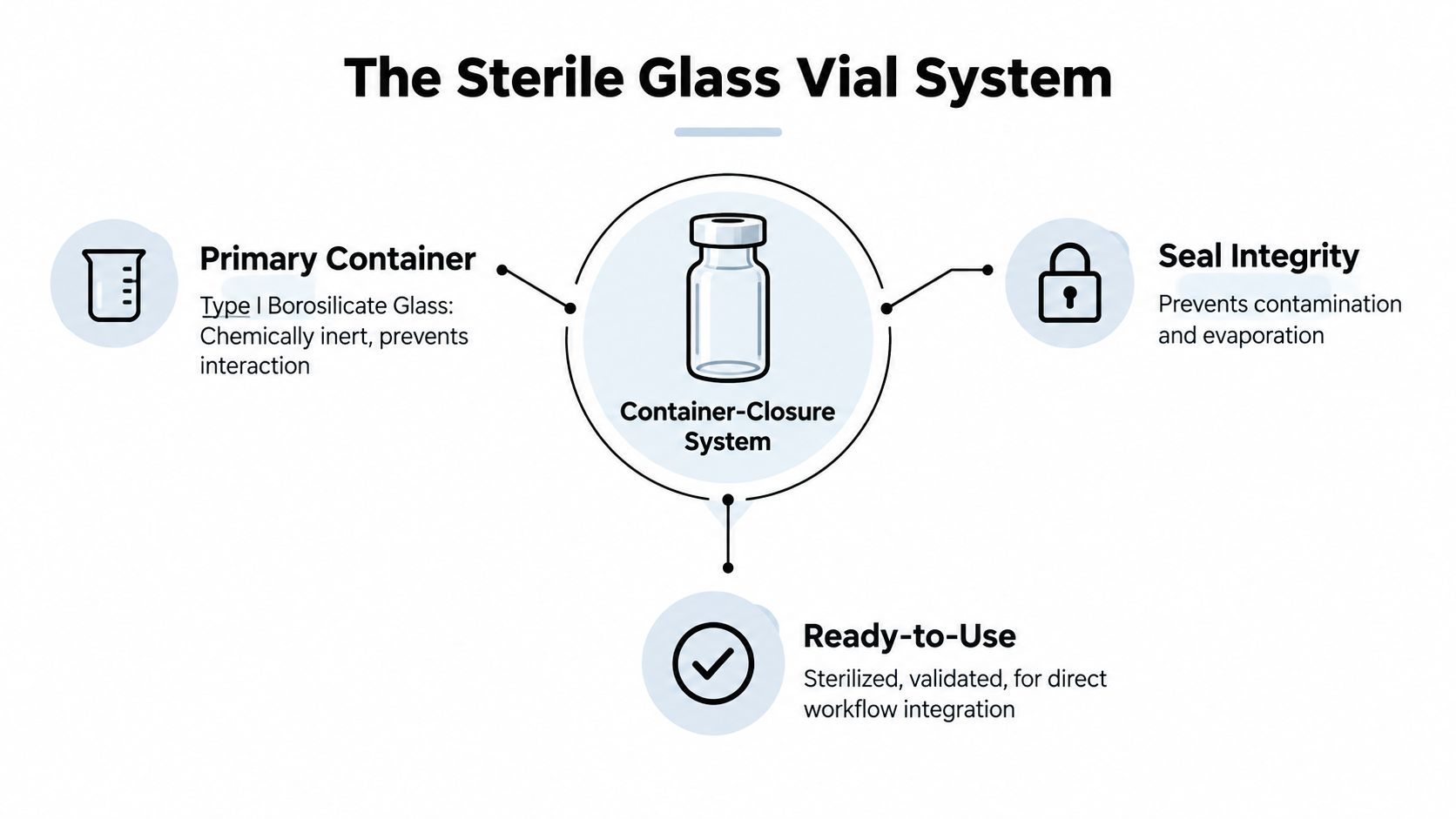
A sterile glass vial is a container-closure system, not just a small bottle. The glass body forms the main barrier, the stopper closes the opening, and the aluminum seal keeps the stopper seated. These parts work like a coordinated lock. If the neck finish, stopper, or crimp is poorly matched, the system can fail even when the glass meets its specification.
The three parts that protect the contents
The first part is the primary container, usually pharmaceutical glass selected for chemical and thermal performance. The second is the closure system, commonly a rubber stopper or septum. It must permit controlled needle access while limiting contamination and evaporation. The third is the overseal, generally an aluminum component crimped around the vial neck. It retains the stopper and can show evidence of opening or interference.
This structure explains why sterility assurance extends beyond the vial wall. The container must remain compatible with its contents, while the closure must preserve the seal through filling, transport, storage, and withdrawal. A researcher may handle the vial correctly and still see leakage, difficult needle penetration, or reconstitution problems when the neck finish, stopper dimensions, and crimping process are not configured together.
How ready-to-use systems change the workflow
Traditional processing may require a facility to wash, depyrogenate, and sterilize vials before filling. Ready-to-use, or RTU, vial systems move those operations to an off-site validated supply chain. The vials arrive washed, depyrogenated, and sterilized, so the filling site can reduce in-house preparation and place more attention on aseptic handling (RTU sterile glass vial processing information).
RTU status does not remove receiving responsibilities. The site still needs to check packaging condition, lot identification, storage requirements, and supplier release documentation. RTU means preparation was controlled upstream. It does not mean the package can be stored or handled casually after arrival.
Sterile glass vials support parenteral medicines, vaccines, lyophilized products, and powders that require reconstitution. Market reports describe continued demand across injectable, vaccine, and biologics manufacturing, although their estimates use different market definitions (Fact.MR sterile vials market report).
For wholesalers and researchers, the practical lesson is clear: choose the complete system. Glass provides the foundation, but handling, capping, compatibility, and needle access determine whether that foundation protects the formulation throughout its workflow.
Glass Types and Why Material Choice Matters
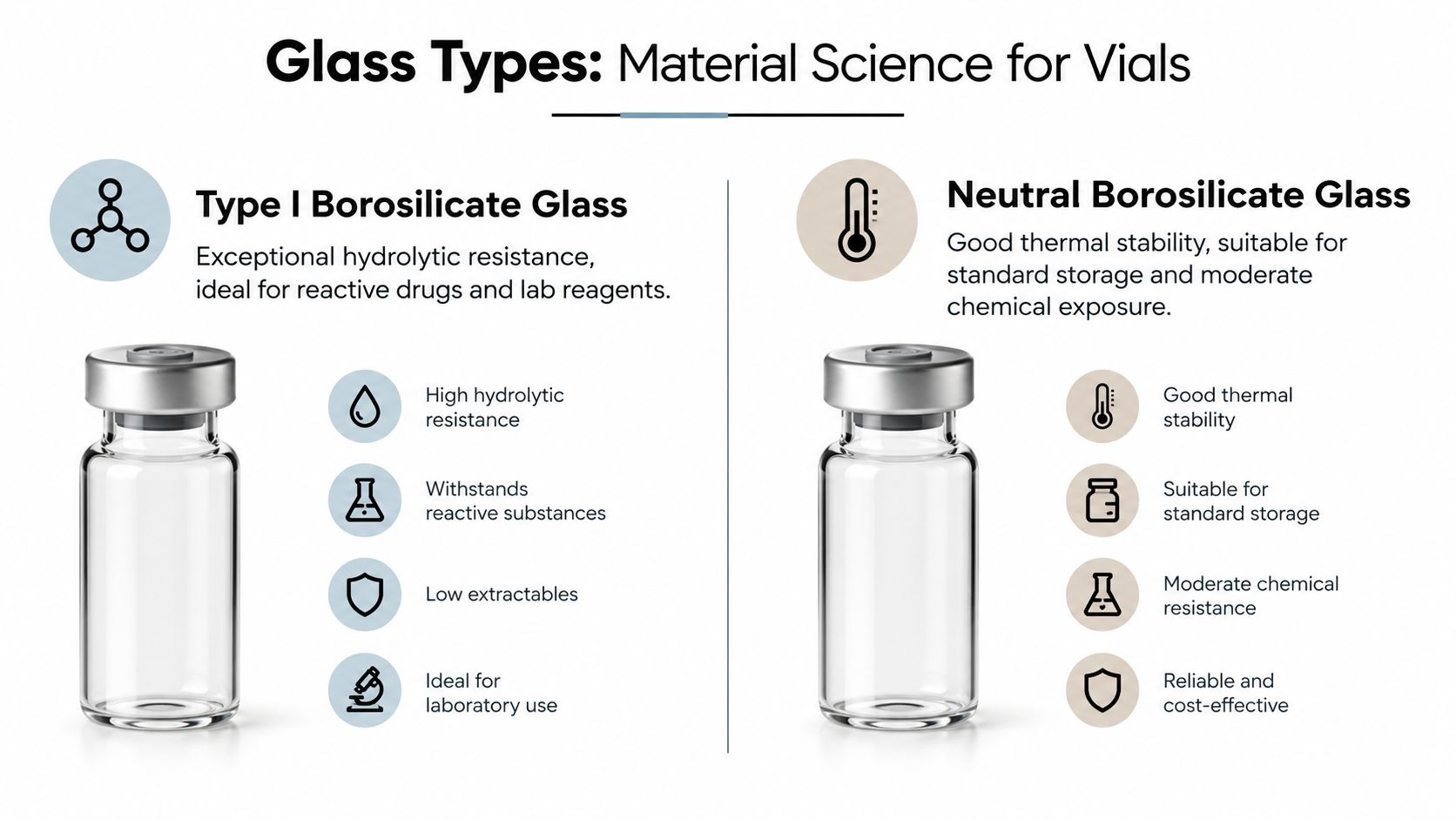
A vial may pass sterility checks and still perform poorly during reconstitution. For injectable or reconstituted formulations, buyers often start with Type I borosilicate or neutral borosilicate glass because these materials offer hydrolytic resistance, chemical inertness, and thermal stability. Those properties help limit unwanted interaction between the container and its contents during processing and storage.
The glass name is only the starting point. Revised USP <660> places more emphasis on performance than composition alone. Qualification should therefore examine hydrolytic resistance, extractables, and inner-surface durability. A supplier that says only “borosilicate” has not supplied enough information to complete the selection decision (vial manufacturing and glass performance information).
Comparing material performance with formulation risk
Type I glass is commonly considered for chemically demanding formulations or products that are particularly sensitive to extractables. Neutral borosilicate glass may fit applications where thermal stability and established pharmaceutical compatibility meet the formulation's needs. These descriptions guide a comparison, but they do not replace compatibility testing for biologics, peptides, buffered solutions, or products stored for extended periods.
Glass delamination presents a separate risk. It occurs when flakes or particles detach from the inner glass surface. The FDA identifies tubing-made vials, high-pH solutions, longer contact time, and terminal sterilization among conditions associated with increased risk (FDA summary on glass delamination). Earlier peer-reviewed work also reported less delamination in vials with smoother inner surfaces, while sulfate treatment and high pH increased delamination under stressed conditions.
Practical rule: “Sterile” describes microbial control. It does not prove formulation compatibility throughout the intended shelf life.
For a reconstitution workflow, the container-closure system matters more than the glass label alone. Forming method, inner-surface condition, formulation chemistry, sterilization method, storage duration, stopper fit, and capping quality can all affect performance. Buyers handling higher-pH products or sensitive biologics should request compatibility evidence and review how the vial will be handled, capped, accessed, and reconstituted.
A useful comparison is:
- Type I borosilicate: A strong candidate for demanding injectable and reconstitution applications, provided performance and compatibility are documented.
- Neutral borosilicate: Suitable when its properties match the formulation and process, with qualification data required rather than label-based assumptions.
- Any glass type: Requires review of inner-surface quality, sterilization conditions, storage time, and particulate monitoring when delamination could affect product quality.
Vial Sizes Fill Volumes and Headspace Explained
A vial's nominal size is a catalog classification, not necessarily the amount a user should fill. The practical capacity depends on the formulation, withdrawal method, stopper design, required headspace, and whether the vial will support lyophilization or reconstitution.
Nominal volume versus working volume
A vial marketed as a small-volume container may need space above the liquid for mixing, pressure changes, or freeze-drying. Filling too close to the shoulder can make agitation difficult and increase the chance of wetting the stopper. Underfilling can also create avoidable waste if the user needs multiple withdrawals or must compensate for residual liquid left in the vial and needle.
The buyer should define the working fill volume first, then choose the nominal vial size. That approach is more reliable than selecting a vial because its printed capacity appears to match the liquid volume. For reconstitution workflows, the practical question is whether the user can add the diluent, dissolve the material, withdraw the intended amount, and handle the vial without obstructing the stopper or creating unnecessary losses.
A distributor comparing a compact vial with a larger format should assess:
- Fill operation: Can the filling line or manual operator work consistently without overfilling?
- Headspace: Is there enough room for lyophilization, mixing, or pressure variation?
- Withdrawal pattern: Will the contents be used once, or will repeated punctures occur?
- Presentation: Does the format fit a single vial, a kit, or a multi-pack assortment?
- Shipping: Will the additional empty space increase movement inside the package?
The following table provides practical guidance rather than a universal fill specification. Final volumes should come from the formulation owner and validated process.
| Nominal Size | Typical Usable Fill | Best For | Headspace Consideration |
|---|---|---|---|
| Small-volume vial | A fill below the nominal label capacity | Single-use research reagents and compact reconstitution workflows | Preserve room for mixing and avoid wetting the stopper |
| Mid-range vial | A controlled fill that leaves operational clearance | Multi-step preparation or moderate withdrawal needs | Balance usable liquid against handling space |
| 10 mL format | A practical choice for larger diluent or reconstitution workflows | Research kits and users who need more working volume | Retain sufficient headspace for agitation and withdrawal |
| Larger-volume vial | A fill selected around process and handling limits | Multi-use or higher-volume laboratory applications | Evaluate stopper access, movement during shipping, and repeated puncture risk |
A supplier listing such as a 10 mL sterile vial format can help a buyer compare presentation and intended use, but the product page shouldn't replace a formulation-specific fill assessment. The correct size is the one that supports the complete workflow with minimal waste and controlled handling.
Closures Septa Sterilization and Integrity Assurance
A sterile vial can fail at the closure even when its glass body meets specification. An incompatible stopper, uneven crimping, or exposure during processing can turn a sound container into an unreliable package. For reconstitution workflows, the vial should be judged as a container-closure system, not as glass alone.
Build assurance in layers
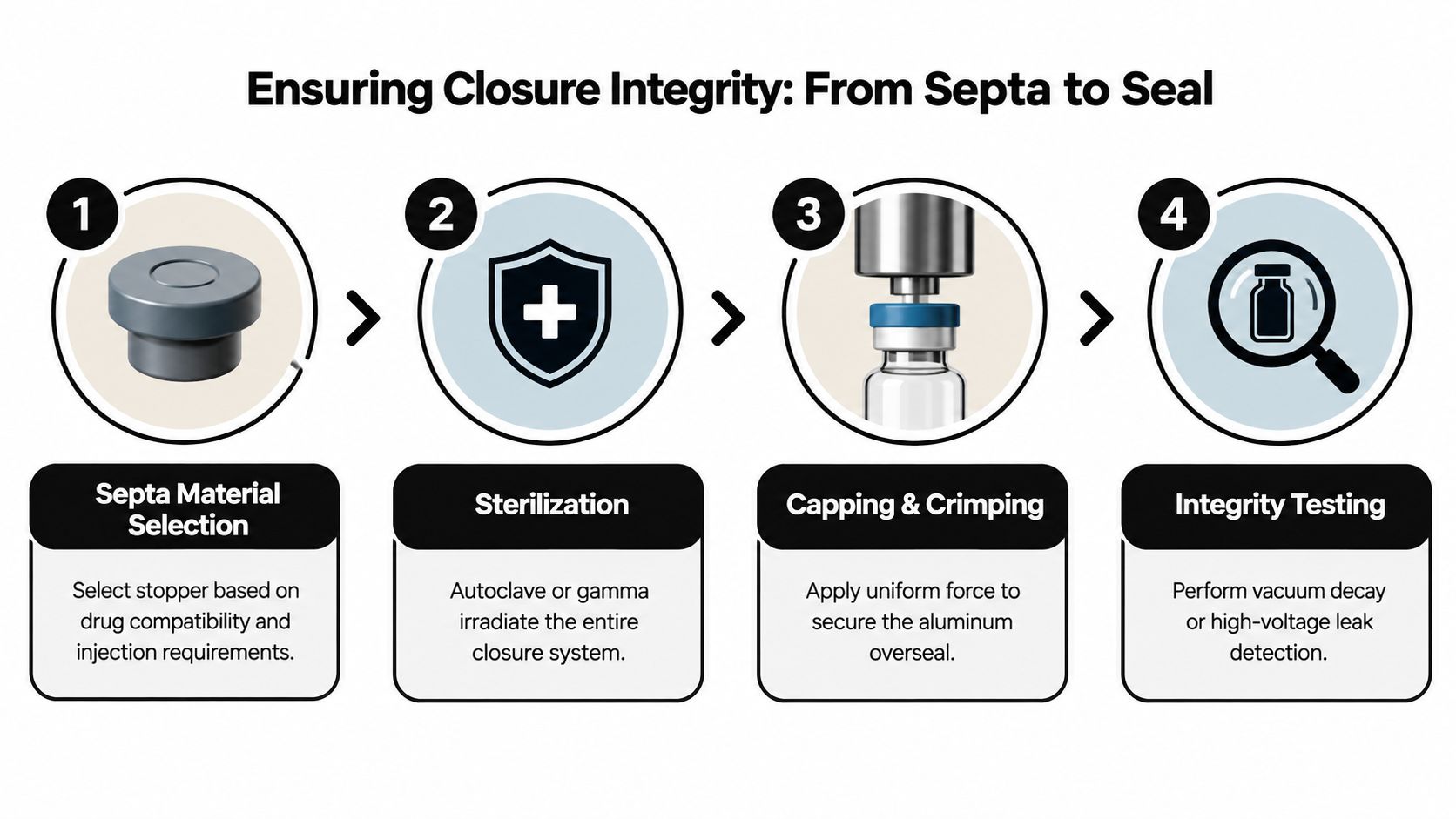
Start with cleaning and preparation. Ready-to-use components may undergo washing, depyrogenation, and validated sterilization. These steps control different risks: sterilization doesn't remove endotoxins. Depyrogenation addresses pyrogen risk, while sterilization addresses viable microorganisms. Both controls therefore belong in the assurance chain.
The next layer is closure selection. The stopper or septum must suit the formulation and the planned injection or withdrawal method. Review chemical compatibility, puncture behavior, resealing performance where relevant, and resistance to the process conditions. A stopper is like a working interface: it must protect the contents while still allowing the user to access them correctly.
Capping then fixes the system in place. The overseal should provide consistent retention and compression without damaging the stopper or distorting the neck finish. A neat-looking crimp is only an appearance check. Validated integrity testing must show whether the seal performs as intended.
Lyophilization exposes weak points
Lyophilized products create a particular risk because partially stoppered vials remain open to the surrounding process until final stoppering. Sterility must be maintained during transfer, loading, drying, and closure. Fogging in the vial neck can look concerning, but it does not by itself prove that integrity has been lost when capping and process controls are validated.
Visual inspection can identify obvious defects, damaged packaging, or visible particulates. It cannot replace deterministic container-closure integrity testing. A supplier evaluation should therefore ask:
- Closure identity: Which stopper or septum material is supplied, and what compatibility evidence supports the intended formulation?
- Capping control: How are crimp force, alignment, and seal consistency controlled?
- Integrity method: Does qualification use vacuum decay or another validated deterministic method?
- Lyophilization control: How is sterility maintained while vials remain partially stoppered?
- Release evidence: Are lot-specific records available for the vial and closure system?
A supplier resource on vial integrity testing can help buyers distinguish appearance-based inspection from validated integrity assessment. That distinction matters most when handling, capping, and reconstitution all affect the same seal.
Packaging Cold Chain and Reagent Compatibility in Practice
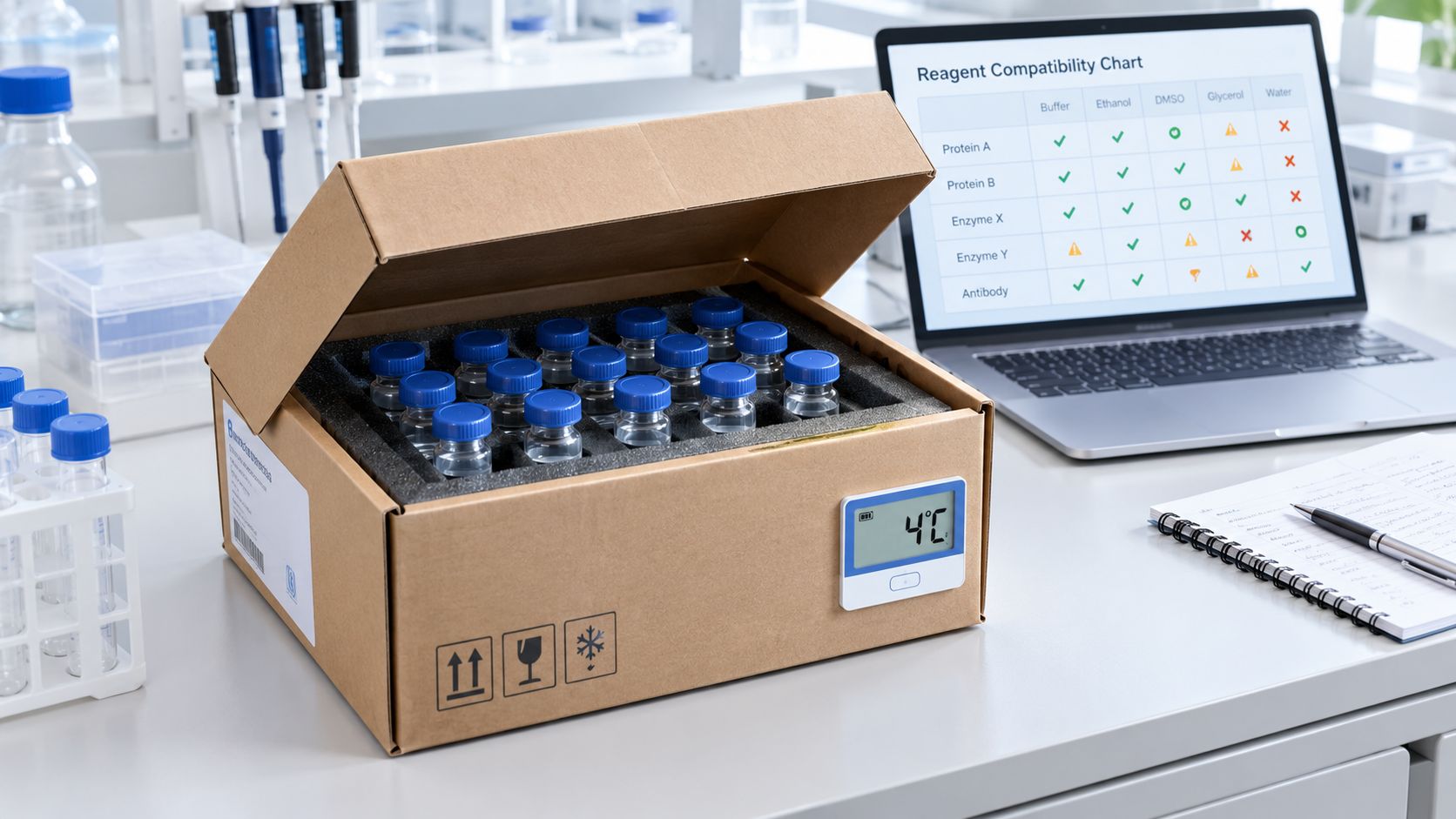
A sterile vial can leave the supplier intact and still arrive unsuitable for use. The secondary package must restrain the vial, shield the closure, and match the storage needs of the contents. For reconstitution workflows, packaging is part of the container-closure system. Glass alone cannot protect a product if handling or transport compromises the seal.
Treat logistics as part of the specification
Temperature-controlled storage supports formulation stability, but it cannot correct weak packaging. A suitable shipping configuration limits vial-to-vial contact, protects the crimped closure, and includes clear receiving instructions. On arrival, staff should examine the outer carton, cushioning, labels, and visible damage before stock enters controlled storage.
Handling can affect the closure after release testing is complete. Dropped cartons, pressure applied to the stopper, and loose vials moving repeatedly in a box create risks that lot testing may not reveal. Wholesalers should assess dispatch packaging alongside vial manufacture and closure specifications.
Practical packaging checks include:
- Secure presentation: Vials stay separated and protected from direct collision.
- Label continuity: Lot details, product identity, and storage information remain readable after transit.
- Receiving procedure: Staff know how to quarantine damaged or questionable units.
- Storage discipline: Stock reaches the specified environment without unnecessary delay.
- Customer guidance: Resellers receive clear transport, storage, and handling instructions.
The liquid also needs a compatibility review. Reconstitution diluents and research reagents may interact with the container through formulation chemistry, contact duration, sterilization history, or storage conditions. High-pH and buffered formulations deserve closer examination because they can contribute to glass surface changes. The question is whether the complete vial, stopper, cap, and contents remain suitable through storage and reconstitution.
Benzyl alcohol, where present, should be assessed from formulation-specific extractables, leachables, and stability information rather than assumed compatible. This evidence matters when the formulation remains in contact with the vial for an extended period or has a low tolerance for particulates.
Fogging calls for a measured response. Condensation or process appearance may explain it, yet the observation should be reviewed against capping controls, storage history, and available integrity data. A practical packaging requirements guide helps distributors organize these checks before shipment and respond consistently to customer questions.
How Wholesalers Can Evaluate Suppliers and Stay Compliant
A supplier should be evaluated as a controlled process, not as a source of attractive unit pricing. The strongest buying decision connects the product specification to the intended use, then verifies that the supplier can support every important claim with current documentation.
Use a practical supplier scorecard
Start with the vial and closure identity. The supplier should clearly state the glass classification, dimensions, closure components, sterilization status, and intended use limitations. For research-use-only products, labeling and terms should remain consistent with that status. A distributor shouldn't imply clinical, diagnostic, or therapeutic use when the product is supplied for research purposes.
Next, review the documentation package:
- Lot-specific COA: Confirms the supplied lot and identifies the tests or release criteria applied to it.
- Purity and contaminant testing: Shows how the supplier evaluates the contents and controls unwanted contamination.
- Integrity evidence: Explains the method used to assess the vial-closure system rather than relying only on visual inspection.
- Manufacturing transparency: Identifies where filling, sterilization, packaging, and testing occur.
- Change control: Describes how the supplier communicates changes to materials, processes, or packaging.
- Fulfillment reliability: Clarifies lead times, storage conditions, dispatch practices, and handling of deviations.
A supplier that can't explain the relationship between its COA, batch records, and release process creates work for the buyer's quality team. A supplier that answers technical questions clearly makes downstream customer support more consistent.
Supplier test: Ask what evidence supports compatibility with the specific formulation, storage period, sterilization process, and withdrawal pattern. A generic glass certificate isn't the same as a complete container-closure qualification.
Vendor governance also benefits from a broader operational framework. A SEA vendor management guide can help distributors structure supplier onboarding, performance reviews, documentation control, and escalation paths. Those practices are useful when a business manages several vial, stopper, diluent, and packaging suppliers across different markets.
Herbilabs offers research-use-only reconstitution solutions in sterile, non-pyrogenic premium glass vial formats, with lot-specific Certificates of Analysis and packaging options that include individual and multi-pack presentations. For wholesalers, the relevant questions remain the same as for any supplier: confirm the intended use, review the documentation, assess packaging and storage controls, and match the format to the research workflow.
The final decision should reflect risk. Standard workflows may need routine documentation and consistent fulfillment. Sensitive formulations, extended storage, lyophilization, or repeated withdrawal should trigger deeper requests for compatibility, integrity, and process qualification data.
Distributors and laboratory buyers can visit Herbilabs to review research-use-only reconstitution solutions and sterile glass vial formats suited to structured reconstitution workflows. Before ordering, they should match the vial size and documentation package to the intended formulation, storage conditions, and customer handling process.