Private Label, White Label, Wholesale partnerships available - EU, USA and UK - Free shipping from €75

Packaging Requirements for Lab Reagents and Peptides
A vial leaves a lab bench in Europe, gets relabeled at the warehouse, crosses a carrier hub, and lands in customs with a temperature sticker, a COA, and a box that looked fine until the inner stopper shifted. That's the actual shape of packaging requirements for lab reagents and peptides. One weak link, a label that doesn't match the contents, a closure that isn't compatible, or a parcel built for the wrong handling lane, can turn a routine shipment into a rejection, a delay, or a compromised product.
For distributors and resellers, the hard part is that no single rulebook covers the whole journey. EU PPWR, dangerous goods transport rules, sterile-barrier expectations, and carrier parcel standards all touch the same package, but they govern different parts of it. A practical guide has to treat the vial, the label, the outer box, and the paperwork as one system, because that's how compliance gets judged in the world.
Table of Contents
- When a Single Package Becomes a Multi-Region Compliance Problem
- The Regulatory Stack Governing a Lab Reagent Package
- Container and Closure Specifications That Protect the Product
- Labeling, Documentation, and Carrier-Specific Rules
- Sterility, Cold Chain, and Contamination Controls
- How Wholesale Partners and Customs Brokers Verify Compliance
- A Practical Compliance Checklist and Common Questions
When a Single Package Becomes a Multi-Region Compliance Problem
A peptide vial ordered by a U.S. researcher from an EU supplier looks simple on the sales screen. In the warehouse, it's not simple at all. The same parcel may need to survive a road handoff, an air leg, a customs review, and a last-mile delivery where the outer carton gets treated like ordinary freight even though the contents are anything but ordinary.
That's why a useful packaging requirements process starts with the route, not the product photo. The shipper has to think about carrier handling, import declarations, storage temperature, and whether the inner package is only protecting the vial or is also carrying a regulatory story that customs, the airline, or the consignee will inspect. A box that is physically sturdy but poorly documented still fails, because the failure happens at the checkpoint that matters most.
Practical rule: if a shipment crosses more than one jurisdiction or transport mode, the package has to satisfy the strictest relevant layer, not the easiest one.
For lab supply distributors, that layered reality is easy to underestimate. A distributor might prepare a sealed vial correctly, then lose the shipment because the consignee details are incomplete, the label conflicts with the invoice, or the carrier expects reinforced seams and durable address marking that the warehouse team treated as optional. A good general reference on careful parcel packing can help with the physical side, and a useful starting point is this shipping store guide on fragile-item packing, but lab shipments still need a regulatory overlay that ordinary fragile goods don't.
The core mistake is to think of packaging as a single document. It's really a stack of decisions, each one tied to a different control point. If one link breaks, the problem can show up as leakage, seizure, a customs hold, or a product that reaches the buyer but no longer meets the intended use.
The Regulatory Stack Governing a Lab Reagent Package
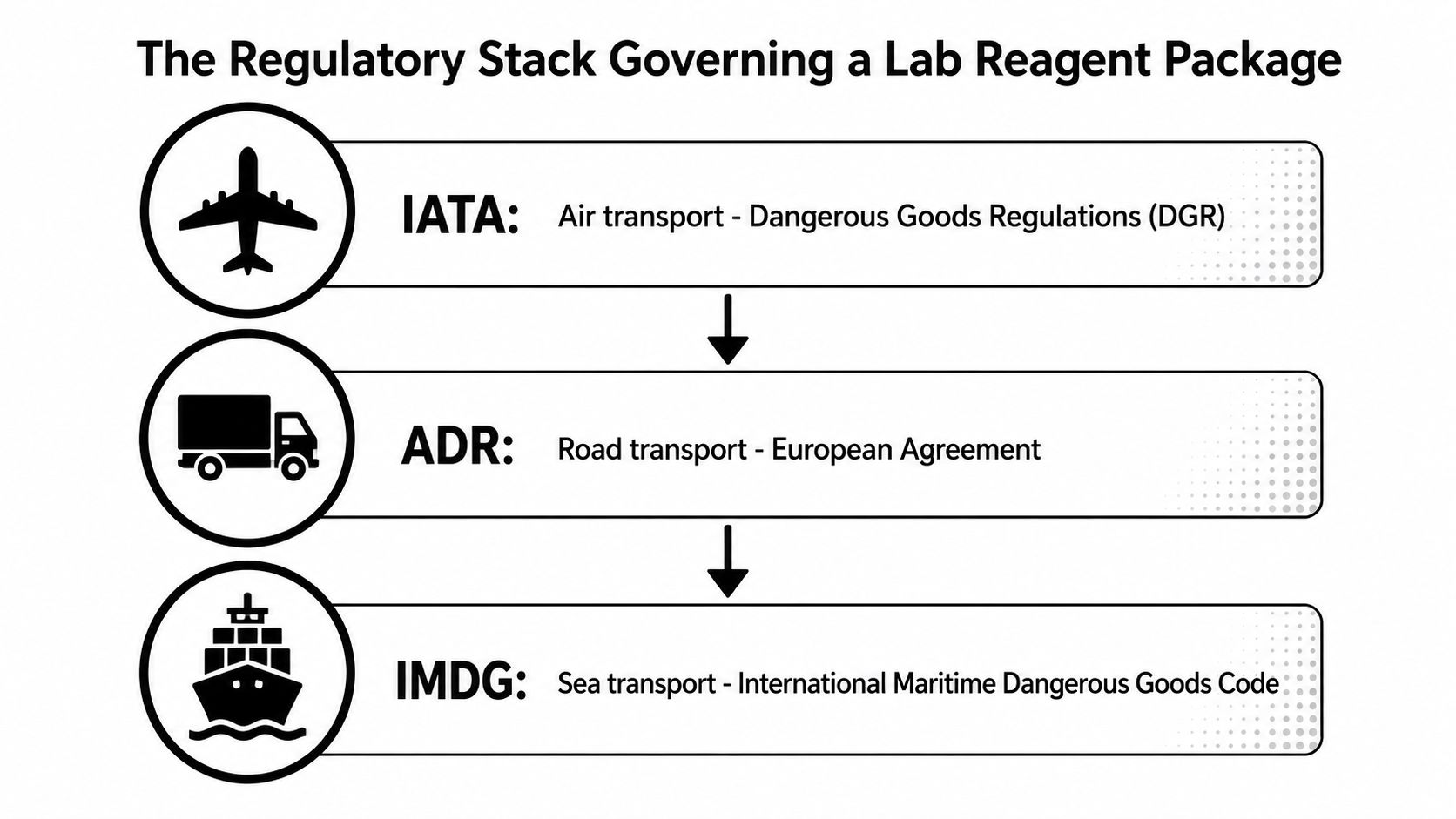
A lab reagent can leave the warehouse looking ready and still fail at the first check point because the package has to satisfy more than one rule set at once. The lane matters. IATA DGR governs air shipments, ADR governs road movements in Europe, and IMDG governs sea transport. Each mode changes what the outer pack must show, how the inner containers are restrained, and how much handling abuse the system has to survive without shifting or leaking. ICAO guidance requires the proper shipping name, the UN or ID number where assigned, and shipper and consignee identification on each package, with inner packaging cushioned and immobilized so movement is limited during transport ICAO packaging, marking, and labelling guidance.
Why transport mode changes the package
A road parcel that clears a short regional move can still fail an air acceptance check if the marks are incomplete or the tested specification does not match the declared hazard. The carrier is not reviewing the box as a generic parcel. It is checking whether the package matches the risks of that transport mode, and whether the evidence on the outside matches the test basis behind it. For regulated chemical shipments, the package has to be chosen and tested to the strictest packing group that applies, then marked durably so the compliance claim is visible to the people handling it.
WHO guidance adds another layer for pharmaceutical and sterile liquid packaging. The container-closure system has to form a validated barrier against moisture, light, oxygen, temperature variation, biological contamination, and mechanical damage. WHO also says packaging must not leak or permit diffusion or permeation, closures should be as inert as possible, and the system has to be strong enough for normal handling WHO TRS 902 Annex 9.
For EU market access, packaging is moving into a more harmonized rule set. The Packaging and Packaging Waste Regulation 2025/40 entered into force on 11 February 2025 and is scheduled to apply from 12 August 2026, covering all packaging and packaging waste regardless of material or origin European Commission packaging waste overview. For sellers into the EU, that turns packaging design into a legal and operational decision, not just a freight choice.
Distributors that keep these layers aligned usually depend on disciplined documentation, because the label set, the shipment file, and the physical pack all have to say the same thing. That is where automated document workflows for enterprises help, since route changes and product changes can quickly create mismatches if the paperwork is handled by hand.
For internal recordkeeping and audit readiness, the packaging trail should sit with the shipment file instead of getting scattered across email threads. Supplier-facing regulatory compliance documentation gives buyers and partners a place to verify the same evidence the carrier or broker may ask to see.
Container and Closure Specifications That Protect the Product
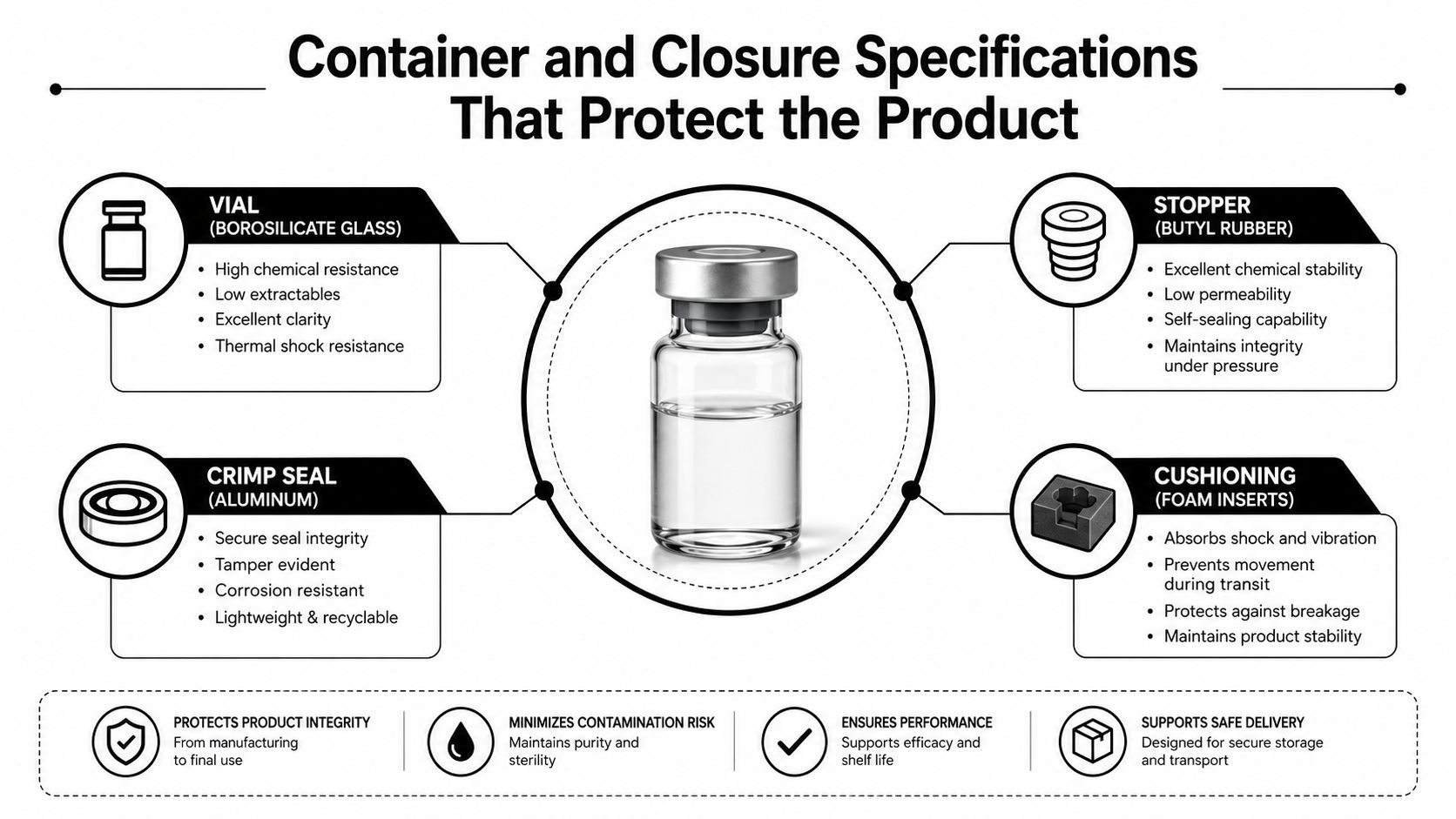
The most common packaging failure in a lab shipment starts inside the box, not outside it. If the vial, stopper, seal, and cushioning don't work together, the shipment may look intact while the product inside is already compromised. WHO's sterile-packaging guidance is clear on the principle, the container-closure system has to preserve integrity, resist leakage, and avoid interactions with the contents WHO TRS 902 Annex 9.
What the vessel has to do
A vial is not just a vessel, it's part of the product's stability profile. Glass choice matters because the container has to resist handling damage while remaining compatible with the formulation. The closure matters because a stopper that isn't inert enough can create interactions that affect content quality over time. The seal matters because tamper evidence and retention of closure integrity are part of the acceptance criteria, not afterthoughts WHO TRS 902 Annex 9.
That's why container-closure compatibility shouldn't be treated as a generic assumption. If the system leaks, permits permeation, or reacts with the contents, the effect can show up as loss of potency, contamination risk, or a failed integrity check during transit or storage. In other words, the “primary package” is doing technical work, not just holding liquid.
A strong outer shipper can't rescue a weak inner system. If the closure fails, the outer box only hides the problem until the consignee opens it.
For lab reagents and peptides, the best practice is to treat the primary package as qualified inventory. That means the vial format, stopper material, and closure method are selected with the product in mind, not chosen because they're the cheapest available container on a shelf. Cushioning still matters, but it protects a validated primary package rather than substituting for one.
There's also a practical compliance benefit. A closure that resists movement and a seal that visibly shows tampering make receiving checks faster and less ambiguous. That helps distributors, but it also helps customers who need to trust that the exact unit they received matches the lot that left the facility.
Labeling, Documentation, and Carrier-Specific Rules
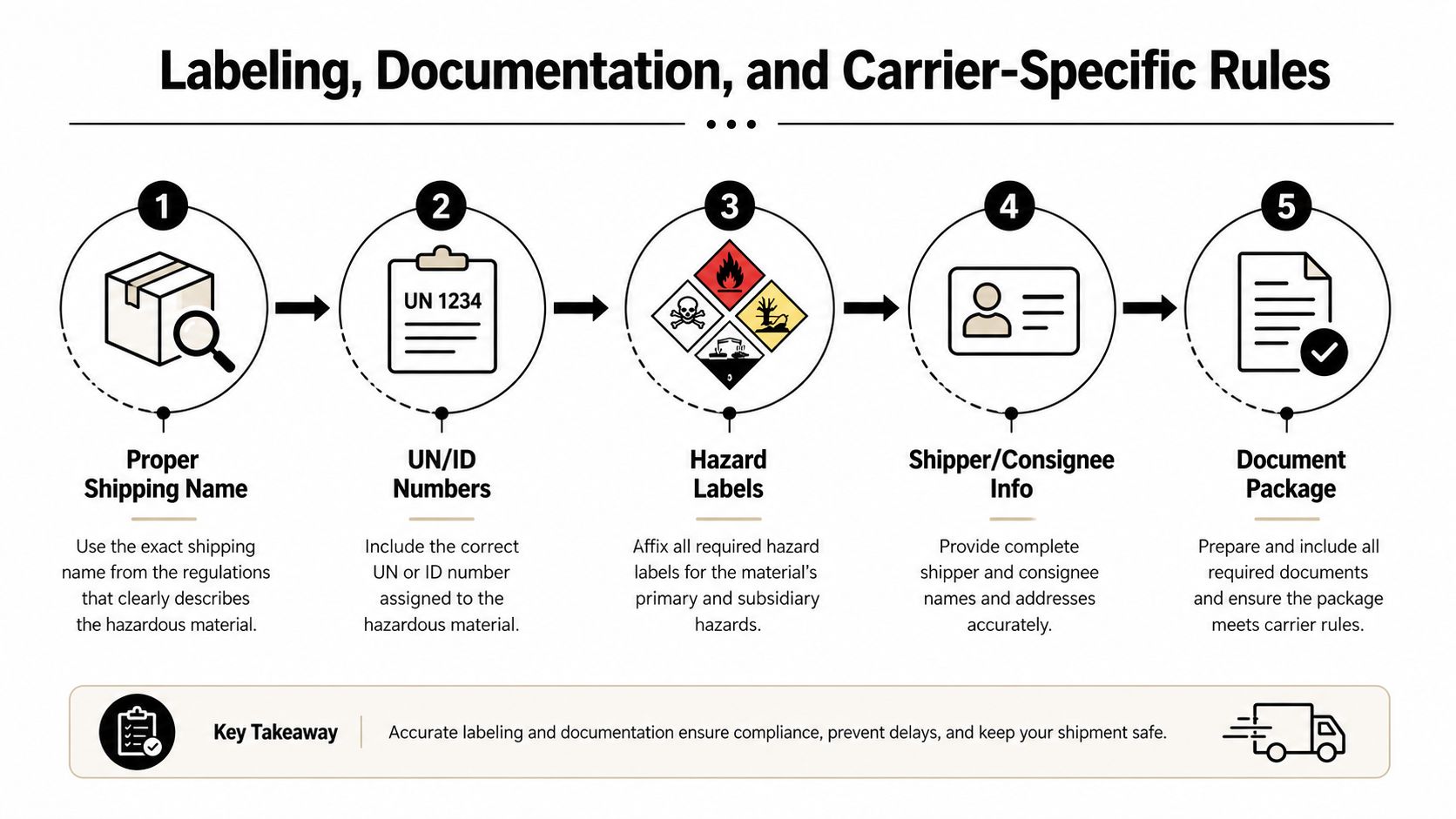
A shipment can be sealed correctly and still fail review if the markings, documents, and carrier instructions disagree. For dangerous goods, the outside of the package has to show the proper shipping name, the UN or ID number where assigned, the hazard marks, and the shipper-consignee details, and those elements need to line up with the transport classification and the paperwork ICAO packaging, marking, and labelling guidance.
The label set has two jobs
The vial label identifies the product inside. The transport label identifies the parcel for handlers, carriers, and customs. Those are different functions, and mixing them up creates avoidable delays. A shipment may be fine in the lab, then stall at the dock because the outer label does not match the shipping documents or the consignee details are incomplete.
The customs file is just as strict. A Certificate of Analysis, lot number, and clear Research Use Only statement often matter because the broker needs to show what the goods are, how they were made, and how they are classified. A practical guide to reading the paperwork is available in this guide to reading a Certificate of Analysis, and that sort of document review keeps declarations aligned with the actual shipment.
Carrier rules add another layer. Small-parcel guidance from the Industrial Packaging Performance group says package adequacy should be checked with pre-shipment laboratory testing, and it also notes that carriers should be reviewed individually because requirements can differ IOPP small parcel guidance. UPS also expects enough cushioning, reinforced seams, and durable address labeling UPS fragile-item shipping guidance. Those requirements matter because the carrier may override a product's normal packing assumption if the parcel will not survive the handling lane.
For international labeling standards, especially where import review becomes part of the acceptance path, distributors often need a country-specific lens. A practical place to compare label expectations is this Australian import label requirements reference, since import review does not always look like domestic shipping review.
Bottom line: the outer mark, the customs file, and the inner product identity have to tell the same story, or the shipment starts looking suspicious before anyone opens it.
Sterility, Cold Chain, and Contamination Controls
A sterile shipment only stays sterile if every handling step protects it. For sterile liquids and sensitive reagents, contamination control starts at fill, continues through packing, and still matters when the parcel reaches the buyer. WHO's packaging integrity guidance makes the practical point clear, the package has to resist leakage, limit permeation, and shield the contents from environmental stress and biological contamination.
For products where sterility assurance is part of the buying decision, the packaging choice has to match the actual risk. A quick reference to sterility assurance levels helps when a distributor needs to separate a true sterile presentation from a package that is only clean, sealed, or temperature-protected.
Cold chain is a handling system, not a sticker
Temperature-controlled shipment only works when every handoff is planned. Insulated mailers, gel packs, and phase-change materials help only if the warehouse, carrier, and last-mile delivery path are all set up for the same temperature window. If the shipment is packed for cold conditions but waits too long at one stage, the internal condition can drift even when the outer box still looks intact.
Ambient, refrigerated, and frozen routing should be chosen by product state, not convenience. Lyophilized materials often tolerate different shipping conditions than reconstituted materials, but the decision still has to follow the validated stability profile and the handling profile for that lot. The core question is whether the product stays within its intended condition for the full transit path, not whether a cold pack sits in the box.
Multi-dose formats add another contamination concern. Preservatives, where appropriate, change the risk profile, but they do not remove the need for sterile handling or closure integrity. Endotoxin control and lot traceability matter because a shipping event that exposes the product to heat, contamination, or poor sealing can create a quality problem before the product is ever used.
A practical habit is to tie temperature handling to batch documentation. COAs, lot numbers, and storage instructions should travel with the shipment record so the receiver can confirm the exact condition and identity of what arrived. That matters when one buyer wants proof of traceability and another wants proof that the cold chain stayed intact from dispatch to delivery.
If the storage condition cannot be proven, it should not be treated as preserved.
How Wholesale Partners and Customs Brokers Verify Compliance
Wholesale partners rarely ask for everything. They ask for the few things that prove the shipment is legitimate, traceable, and unlikely to create a problem after acceptance. Customs brokers do the same, but with a different lens, they care about what can be declared, defended, and released without adding risk at the border.
The first filter is documentary consistency. The product description, COA, lot number, invoice, and transport marks need to line up. If a consignee sees a research reagent on one document and a regulated chemical description on another, the file gets slower, not faster. That's true whether the shipment enters the EU, UK, or U.S. market, because the broker's job is to minimize ambiguity.
What gets checked first
- Identity: Does the COA match the item name, lot, and concentration on the invoice and package?
- Use status: Is the Research Use Only statement clear, and does it match the intended channel?
- Traceability: Can the supplier show which batch left the facility?
- Transport fit: Are the marks and package style consistent with the route and carrier?
- Receiving clarity: Can the partner identify the product quickly and store it correctly on arrival?
The useful distinction is between negotiable and essential items. A buyer may accept a different carton size or a different outer insert, but they won't usually accept missing lot traceability or a confused document trail. If a customs broker can't reconcile the paperwork with the shipment, the package may not move until the record is fixed.
That's also why wholesale onboarding often focuses on repeatability. The partner doesn't just want one perfect shipment. They want evidence that the same standard can be reproduced across future lots and routes. In practice, that means the supplier's packaging controls matter as much as the product spec itself, because packaging is part of what the buyer is buying.
A Practical Compliance Checklist and Common Questions
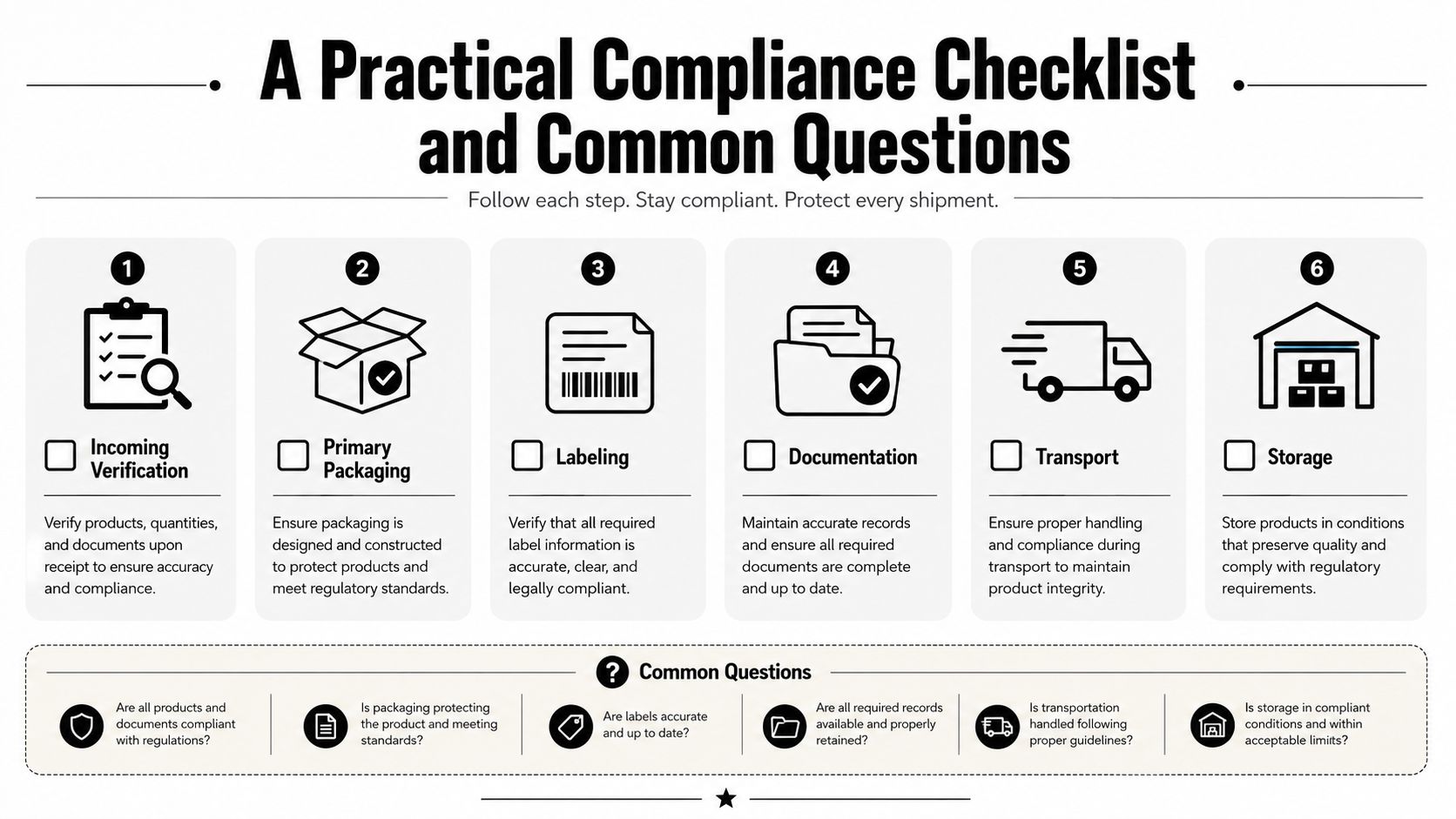
| Stage | Key Verification Point | Reference Source |
|---|---|---|
| Incoming Verification | Product identity, lot number, and route fit are confirmed before packing starts | WHO TRS 902 Annex 9 |
| Primary Packaging | Vial, stopper, seal, and cushioning protect integrity and prevent leakage | WHO TRS 902 Annex 9 |
| Labeling | Shipping marks, UN or ID numbers, and consignee details match the file | ICAO packaging, marking, and labelling guidance |
| Documentation | COA, invoice, and RUO statement are aligned before handoff | How to read a Certificate of Analysis |
| Transport | Carrier-specific packing strength and testing expectations are checked | IOPP small parcel guidance |
| Storage | Temperature condition and receiving instructions are clear on arrival | WHO TRS 902 Annex 9 |
Quick questions distributors ask
How do small peptide shipments differ from bulk freight? Small parcels depend more on carrier handling, label clarity, and how well the inner packaging prevents movement. Freight can tolerate different handling assumptions, but the product still has to remain stable and traceable from dock to receipt.
What happens when customs questions a COA? The quickest response is the full document chain, product identity, lot traceability, and a clean invoice match. Partial answers usually slow the file down and create a longer hold.
How should returns of temperature-sensitive RUO products be handled? Returned stock should be treated as condition-sensitive inventory, not automatically restockable. The receiving team needs a documented review of temperature exposure, packaging condition, and lot identity before any disposition decision.
Do accessible packaging expectations matter here? Yes. Clear typography, low-force openings, and tactile or unambiguous markings help reduce handling errors and misidentification, especially in multi-SKU environments where staff move quickly.
For distributors and resellers, the standard is simple. If the package cannot be identified, traced, protected, and received without guesswork, it is not ready to ship.


