Private Label, White Label, Wholesale partnerships available - EU, USA and UK - Free shipping from €75

USP Sterile Water for Injection: Essential Lab Guide 2026
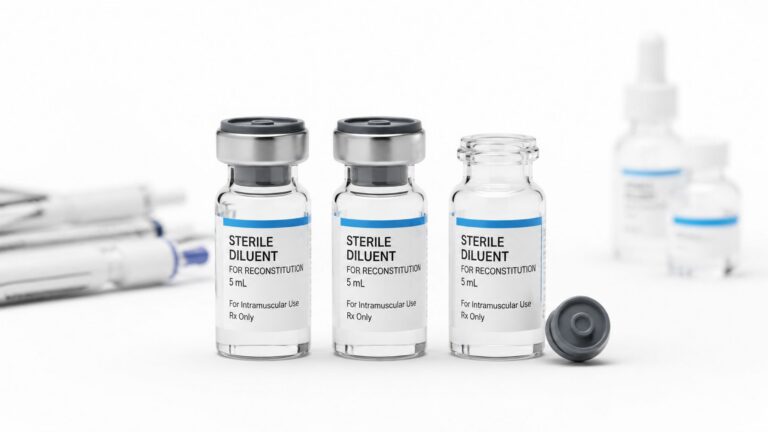
A researcher has a lyophilized peptide on the bench, a protocol that specifies a sterile diluent, and a narrow margin for error. At that moment, the water vial can look interchangeable with every other clear liquid in the cold room. It isn't. A poor diluent choice can change concentration accuracy, introduce contamination risk, or create biological effects that have nothing to do with the compound under study.
That's why USP Sterile Water for Injection matters far beyond procurement language. In peptide work, reconstitution is part of the experiment, not a clerical step. If the solvent is wrong, the result can still look clean on paper while the underlying preparation has already compromised integrity.
Many teams first encounter the issue after a failed run, unexpected instability, or confusion between similar products sold under “sterile water” labels. The practical distinction is explained well in this overview of the role of sterile diluents in research. The short version is simple. USP Sterile Water for Injection is a tightly specified preparation intended for a narrow purpose, and the strict rules around it exist because small deviations can cascade into safety and reproducibility problems.
Table of Contents
- The Critical Role of a Simple Solvent
- What Is USP Sterile Water for Injection
- Decoding USP Specifications and Quality Testing
- SWFI vs Bacteriostatic Water vs Sterile Water for Irrigation
- Common Applications in Research and Reconstitution
- Safe Handling Storage and RUO Compliance
- How a Quality Supplier Ensures Conformance
The Critical Role of a Simple Solvent
In regulated and research environments alike, water is often treated as a background material. That's a mistake. The solvent used to bring a dry powder into solution directly affects sterility risk, compatibility, and the interpretability of downstream results.
For peptide researchers, this becomes especially important when the compound is sensitive, expensive, or handled in small volumes. A contaminant introduced during reconstitution won't always be obvious. It may show up later as assay noise, loss of activity, abnormal appearance, or inconsistent performance between lots and users.
Why the rules are so strict
USP rules for Sterile Water for Injection aren't bureaucratic decoration. They exist because the product sits at a critical junction between manufacturing control and final use. Once a user pierces the container and starts admixture, that water becomes part of the finished preparation pathway.
Practical rule: If a diluent can alter safety, stability, or interpretation, it should be treated as a controlled reagent, not as generic lab water.
The strict handling model reflects a hard reality. A preservative-free sterile product offers fewer margins for user error after opening. That's not a weakness in the product. It's a design choice made to avoid introducing additional agents that may interfere with the intended application.
Where research integrity gets lost
Most failures around sterile diluents don't come from dramatic negligence. They come from ordinary shortcuts:
- Substituting by label similarity: “Sterile water” isn't enough as an identifier.
- Reusing opened containers casually: Preservative-free products don't forgive repeat access.
- Ignoring compatibility: The right powder with the wrong diluent is still a bad preparation.
In peptide work, these mistakes can distort the very thing the experiment is trying to measure. The compound may be sound. The preparation may not be.
What Is USP Sterile Water for Injection
A common failure point in reconstitution work starts with the assumption that any sterile water in a vial will behave the same. It will not. USP Sterile Water for Injection is a tightly defined pharmaceutical article used where the solvent becomes part of the preparation itself.
It is a sterile, nonpyrogenic, solute-free preparation of distilled water with a pH range of 5.0 to 7.0, typically 5.5, and it contains no bacteriostats, antimicrobial agents, or added buffers (DailyMed product description for Sterile Water for Injection, USP). That definition matters because every omitted ingredient is intentional. No preservative means fewer compatibility risks during reconstitution. It also means less tolerance for poor handling after the container is opened.
The name gives a useful compliance summary:
- USP identifies a preparation expected to meet pharmacopeial quality standards.
- Sterile indicates control of viable microbial contamination during manufacture and packaging.
- For Injection signals intended use in parenteral preparation after proper admixture, not general substitution for other laboratory or medical water products.
In peptide research, that distinction affects data quality as much as product safety. A diluent can change solubility, stability, aggregation behavior, and the interpretation of a failed reconstitution. Teams that treat SWFI as interchangeable with any sterile water often end up troubleshooting the peptide when the actual problem started with the vehicle. A concise Water for Injection quality requirements overview is useful background, but the operational point is straightforward. The solvent has to match the application, not just the label word “sterile.”
USP Sterile Water for Injection is also hypotonic because it contains no added solutes. DailyMed states that direct intravenous, intramuscular, or subcutaneous administration without first making it isotonic causes immediate hemolysis of red blood cells (DailyMed product description for Sterile Water for Injection, USP). For practitioners, the implication is simple. SWFI is a vehicle for reconstitution or dilution. It is not a finished injectable solution by itself.
That point is easy to miss because the composition looks deceptively simple.
In practice, USP Sterile Water for Injection is manufactured to function as a controlled solvent in aseptic preparation. For peptide users, that usually means initial reconstitution of a lyophilized material before further dilution into a matrix that fits the study design. The strict definition exists to protect both sides of the workflow. Patient-facing safety depends on correct osmotic and microbiological control, and research-facing integrity depends on knowing the solvent did not introduce the artifact.
Decoding USP Specifications and Quality Testing
A vial can pass a casual visual check and still be wrong for reconstitution. In peptide work, that mistake shows up later as unexplained assay noise, apparent instability, or a response that gets blamed on the compound instead of the diluent. USP controls exist to prevent that kind of hidden variable from entering the study.
A concise overview of Water for Injection quality requirements is useful background. On the bench, the more important question is what each release criterion is designed to exclude, and what can go wrong when control slips.

The limits that matter most
Sterility is only one part of suitability. SWFI is used in workflows where the solvent must stay as close to analytically silent as possible, which is why release testing focuses on microbial control, pyrogen control, and consistency of the finished packaged product.
The practical priorities are straightforward.
| Quality element | Why it matters in practice |
|---|---|
| Endotoxins | Pyrogenic residues can persist even when viable microorganisms are absent. In research systems, that can trigger inflammatory or stress responses that look like compound activity. |
| Microbial burden | Tight microbial control reduces the chance that the diluent becomes the contamination source during reconstitution or transfer. |
| pH control | A defined pH range supports lot-to-lot consistency and helps avoid avoidable shifts during initial dissolution. |
The Health Canada product monograph for Sterile Water for Injection ties those risks to explicit finished-product limits, including bacterial endotoxins at no more than 0.25 EU/mL and microorganisms at no more than 10 CFU/100 mL (Canadian product monograph for Sterile Water for Injection).
Those values matter because they separate two different failure modes. One is overt contamination. The other is a preparation that remains visually clear and culture-negative yet still introduces pyrogenic material into the experiment.
Why sterility alone is an incomplete screen
Teams outside QA often treat "sterile" as a complete answer. It is not. A sterile unit can still fail the purpose of SWFI if nonviable bacterial residues, container-related contamination, or process variation alter the reconstitution environment.
For peptide researchers, that distinction is not academic. Endotoxin carryover can change cell behavior, distort potency readouts, and create false toxicity signals. Poorly controlled water can also complicate root-cause analysis because the peptide, the storage condition, and the handling step all become suspects at the same time.
That is why USP requirements are strict. The goal is not paperwork compliance. The goal is to keep the solvent from becoming an uncontrolled experimental factor.
Reading a COA like a quality document
A Certificate of Analysis should confirm that the lot was released against the right specification and that the lot remains traceable back to its manufacturing and packaging record. In practice, I look for evidence that the supplier controlled the hazards that are hardest to detect once the vial is opened.
Endotoxin and microbiological results are the first checks because the consequences are immediate. Packaging and sterility assurance matter just as much, even though users usually notice them only after a failure. A compromised closure system or weak fill-finish control can negate otherwise acceptable water quality.
Why packaging belongs in the specification discussion
For SWFI, container format is part of the control strategy, not a logistics detail. The package, closure, sterilization method, and labeled use conditions work together to preserve the state verified at release.
That is the logic behind strict handling expectations in research and pharmacy settings. If the water meets specification at release but is exposed to avoidable contamination after opening, the original conformance no longer protects the study.
SWFI vs Bacteriostatic Water vs Sterile Water for Irrigation
A common failure starts at the bench before any peptide is touched. A researcher reaches for “sterile water,” the label looks familiar, and the wrong product enters the workflow. The sample may still dissolve, but the study conditions have changed. That is the real risk. The error often stays hidden until stability shifts, compatibility questions appear, or a result cannot be reproduced.

The practical distinction is not the word “sterile.” It is intended use, formulation, and the controls built around that use. SWFI is preservative-free. Bacteriostatic Water for Injection contains a preservative, commonly benzyl alcohol, to support a different handling model. Sterile Water for Irrigation is supplied for irrigation use and should remain in that category.
Comparison at a glance
| Product | Composition | Typical packaging intent | Best fit |
|---|---|---|---|
| Sterile Water for Injection | Preservative-free, solute-free | Single-dose containers or pharmacy bulk package formats | Reconstitution where no preservative should be introduced |
| Bacteriostatic Water for Injection | Preservative-containing water for injection | Multi-use handling model where permitted by product instructions | Workflows that specifically allow preservative-containing diluent |
| Sterile Water for Irrigation | Sterile water labeled for irrigation use | Large-volume external-use formats | Irrigation and rinsing, not injection-oriented preparation |
Why the distinction matters in peptide work
For peptide research, the choice of diluent affects more than basic solubility. A preservative can alter the chemical environment, change how a material behaves during storage, or complicate interpretation if potency or degradation results drift. If the protocol calls for a preservative-free vehicle, Bacteriostatic Water is not an equivalent substitute. It is a different formulation.
That difference matters during investigations. Once benzyl alcohol or another preservative is introduced, any unexpected signal in the assay can no longer be assigned cleanly to the peptide, the container, or the storage condition. The diluent becomes another variable that had no reason to be there.
Where substitution errors happen
Bacteriostatic Water is often chosen for convenience because repeat access is part of its use model. Convenience is not a quality rationale. The right question is whether the material, method, and written instructions allow a preservative-containing diluent.
Sterile Water for Irrigation creates a different problem. It is often stored nearby, named similarly, and purchased by teams that focus on availability rather than route-specific use. In a controlled lab, that product should be segregated clearly from injection-oriented materials. Similar names are not a sufficient basis for substitution.
In research, the diluent should support the protocol, not change it.
A practical selection rule
Use the labeled purpose and the protocol together.
- Choose SWFI when the preparation requires a sterile, nonpyrogenic, preservative-free vehicle.
- Choose Bacteriostatic Water only when the instructions explicitly permit a preservative-containing diluent and repeated access is part of the approved handling model.
- Choose Sterile Water for Irrigation for irrigation tasks only, not for peptide reconstitution or other injection-oriented preparation steps.
The strict separation exists for a reason. It protects study integrity, reduces preventable deviations, and keeps a simple solvent from becoming the source of an avoidable failure.
Common Applications in Research and Reconstitution
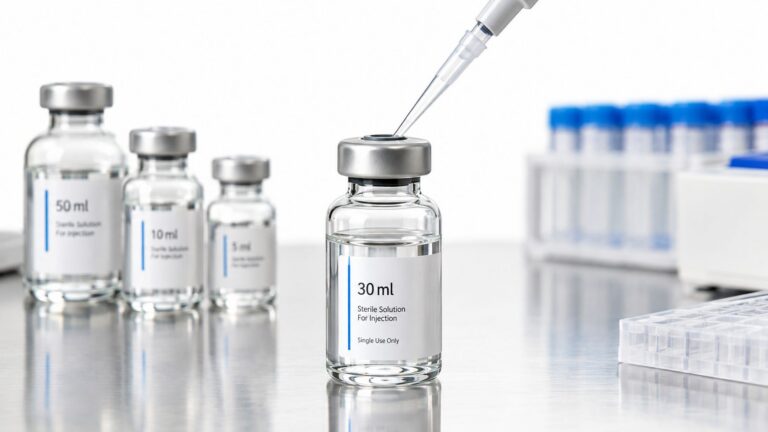
In peptide laboratories, the most common use of USP Sterile Water for Injection is reconstituting lyophilized powders before further dilution, aliquoting, or analytical work. The quality of that first step often determines whether the rest of the workflow is controlled or improvised.

The goal is not just to dissolve the material. The goal is to do it without introducing new variables. Sensitive compounds can be affected by agitation, contamination during repeated handling, or inaccurate volume measurement. Aseptic discipline matters because the diluent has no preservative cushion.
A practical reconstitution sequence
A clean process usually follows this pattern:
- Confirm the intended diluent against the reagent instructions before opening anything.
- Calculate the target volume so the final concentration is clear before the first puncture.
- Disinfect the closure surfaces of both containers using the lab's aseptic procedure.
- Withdraw and transfer carefully with a sterile syringe and needle to avoid coring, splashback, or excess air exchange.
- Let the powder hydrate gently before mixing further.
That last step is frequently rushed. Many lyophilized materials benefit from gentle wetting rather than forceful shaking. If the peptide foams, clings to the stopper, or forms a stubborn film, rough handling often makes the problem worse rather than better.
What researchers often get wrong
Three patterns show up repeatedly in failed or inconsistent reconstitutions:
- Volume added by guesswork: “About right” is not concentration control.
- Hard shaking: Mechanical stress can create appearance issues and complicate dissolution.
- Repeated entries into a single-dose vial: This increases contamination risk without any preservative protection.
A careful operator also watches the solution after reconstitution. Unexpected cloudiness, visible particulate matter, or incomplete dissolution should trigger review before the material is used downstream.
This demonstration is useful for visualizing careful bench technique during vial handling and transfer:
Why this matters for peptide work
Peptide users sometimes focus heavily on purity of the active material and too lightly on the reconstitution event. But the solvent contact step can influence solubility behavior, handling losses, and confidence in the final concentration. If the experiment depends on dose-response interpretation, that's not a secondary issue.
Gentle technique protects both sterility and concentration accuracy. Fast hands often create slow problems later.
The best outcomes usually come from standardizing the process. One written method, one set of tools, one accepted handling sequence. That reduces operator-to-operator variation and gives the team a better chance of identifying real compound behavior rather than preparation noise.
Safe Handling Storage and RUO Compliance
A common failure point is not the certificate of analysis. It is the moment an opened vial stays on the bench because someone expects to need it again later. In peptide research, that shortcut can distort concentration assumptions, introduce contamination, and undermine confidence in every downstream readout built on that reconstitution step.
USP Sterile Water for Injection is controlled tightly because the product contains no antimicrobial preservative. Once container closure integrity is breached, the user takes over a large part of the risk profile. Product labeling and handling limits exist to protect sterility, but also to protect the validity of the work. If the diluent is compromised, the experiment is compromised.
Storage and first-entry discipline
Storage control starts before the vial is opened. Sterile Water for Injection should be stored at 20°C to 25°C (68°F to 77°F), and the Hikma product information distributed by FFF Enterprises identifies it as supplied in single-dose containers or Pharmacy Bulk Packages that are not intended for IV infusion (Hikma product information via FFF Enterprises).
Those details are not administrative fine print. The stated temperature range supports product quality during warehousing and use. The single-dose designation defines how the container is meant to be handled after entry. In a peptide lab, treating a single-dose vial as a reusable stock item creates a preventable contamination pathway with no preservative backstop.
Labs should keep the controls simple and enforceable:
- Store by label conditions: Keep vials within the labeled temperature range and protect carton and closure integrity.
- Pierce only for an active task: Do not open a vial in anticipation of possible later use.
- Maintain traceability after entry: If first-entry time, operator, or environment cannot be verified, the vial should not stay in circulation.
In-use timing and disposal
Time limits matter for the same reason sterility testing matters. A sterile product is released based on validated manufacturing controls, not on the assumption that open-container handling will remain safe indefinitely.
The ASHP Sterile Water for Injection shortage FAQ notes a 6-hour limit for single-use containers in ISO 5 environments and a 4-hour limit for Pharmacy Bulk Packages (ASHP Sterile Water for Injection shortage FAQ). Those limits should be treated as operational boundaries, not targets to stretch. In research settings, especially peptide work where small concentration errors or contamination events can invalidate a full assay series, conservative disposal is usually the lower-cost decision.
Teams get better results when they write this into SOPs. Record first entry. Define the allowable environment for use. Discard opened containers if timing or handling history is uncertain.
RUO doesn't lower the handling standard
For laboratory buyers, what Research Use Only actually means is often misunderstood. RUO status changes the regulatory context of sale and intended use. It does not relax expectations for aseptic handling, label compliance, storage control, or documentation.
That distinction matters in practice. A contaminated or overheld vial does not become acceptable because the work is nonclinical. It still wastes peptide material, still obscures root-cause analysis, and still puts data integrity at risk. In quality terms, RUO changes the use case. It does not excuse poor control of the solvent that touches the product first.
How a Quality Supplier Ensures Conformance
A vial can arrive sealed, labeled correctly, and still be a poor-quality choice if the controls behind it are weak. In practice, conformance is built upstream. It starts with water generation, continues through sterile processing and packaging, and holds only if release, storage, and distribution are controlled as one system.
That matters because sterile water is usually the first material that touches the peptide or research compound. If the supplier loses control of endotoxin, particulates, container closure integrity, or lot traceability, the failure does not stay with the solvent. It carries directly into reconstitution accuracy, assay reliability, and deviation investigations.
A useful industry example is the revision to European Pharmacopoeia Monograph 0169, implemented on April 1, 2017, which broadened accepted WFI production methods beyond distillation to include membrane-based approaches such as reverse osmosis with electrodeionization and ultrafiltration where equivalence or superiority is demonstrated (overview of Water for Injection production and shortages). The same source notes that 2018 SWFI vial shortages were linked to manufacturing delays at Pfizer and limited output from Fresenius Kabi, which led to back orders and forced many organizations to adopt alternative conservation and supply strategies (overview of Water for Injection production and shortages).

What a serious supplier actually controls
A supplier that understands USP conformance controls more than a purchase order and a label file. The work should include:
- Qualified production methods: The water system and sterilization approach must consistently meet pharmacopeial expectations, not just produce acceptable results on a good day.
- Lot-specific release review: Each batch should have documented review for applicable tests, deviations, and final disposition before shipment.
- Container and closure suitability: Vial, stopper, and seal performance have to protect the released quality state through transport and normal laboratory handling.
- Traceability and investigation readiness: If a complaint or anomaly appears, the supplier should be able to reconstruct the full lot history quickly.
In QA terms, this is the difference between passing a specification once and maintaining a controlled state. Researchers feel that difference when a solvent performs consistently across lots.
Why supply resilience is part of quality
Supply continuity belongs in the quality discussion because shortages change user behavior. Labs start extending hold times, substituting water types, splitting packs, or buying from unfamiliar channels with thinner documentation. Each of those decisions raises the chance of contamination, mislabeling, or an avoidable OOS result.
For peptide research, the consequence is usually hidden at first. The material dissolves, the assay runs, and the data drift appears later as unexplained variability. At that point, root-cause work becomes expensive because the solvent, the handling practice, and the peptide lot all have to be questioned.
Reliable supply reduces that risk. So does plain communication about limits, storage conditions, and intended use.
A capable partner should provide clear product records, preserve storage conditions during fulfillment, and state product boundaries without marketing language. Herbilabs supports research teams, resellers, and distribution partners with high-purity sterile diluents, transparent documentation, and dependable fulfillment across major research markets. For laboratories that need a reliable source of Research Use Only reconstitution solutions and related labware, explore Herbilabs.