Private Label, White Label, Wholesale partnerships available - EU, USA and UK - Free shipping from €75

The Critical Role of Sterile Diluents in Research
Learn about the essential function of sterile diluents in maintaining the safety and validity of laboratory experiments.
The Foundation of Aseptic Reconstitution
The integrity of any biological experiment often hinges on the purity of its simplest components. We can all picture that moment of frustration when results are skewed, and the search for a cause begins. Often, the culprit is an overlooked variable introduced during preparation. This is where sterile diluents become fundamental. These are contamination-free liquids, meticulously prepared to be free of microorganisms and pyrogens, designed for one primary purpose: reconstituting lyophilized compounds.
Reconstitution is the process of restoring a freeze-dried substance to its liquid form. Lyophilized powders are stable and have a long shelf life, but they are biologically inactive until dissolved. The process involves carefully introducing a precise volume of a sterile diluent into the vial containing the powder. The goal is to achieve complete dissolution without introducing any microbial contaminants that could compromise the compound’s structure, function, or the validity of the entire experiment. Think of it as waking up a molecule from hibernation. The environment it wakes up in must be perfectly clean.
This careful transition from a stable powder to a biologically active solution is a cornerstone of aseptic technique. The choice of diluent is the first critical decision in this process. The main categories are sterile water and bacteriostatic water, each with distinct properties suited for different applications. Understanding their differences is essential for any researcher working with the sensitive compounds found in a modern laboratory, many of which are available in our comprehensive shop.
Differentiating Common Sterile Diluents
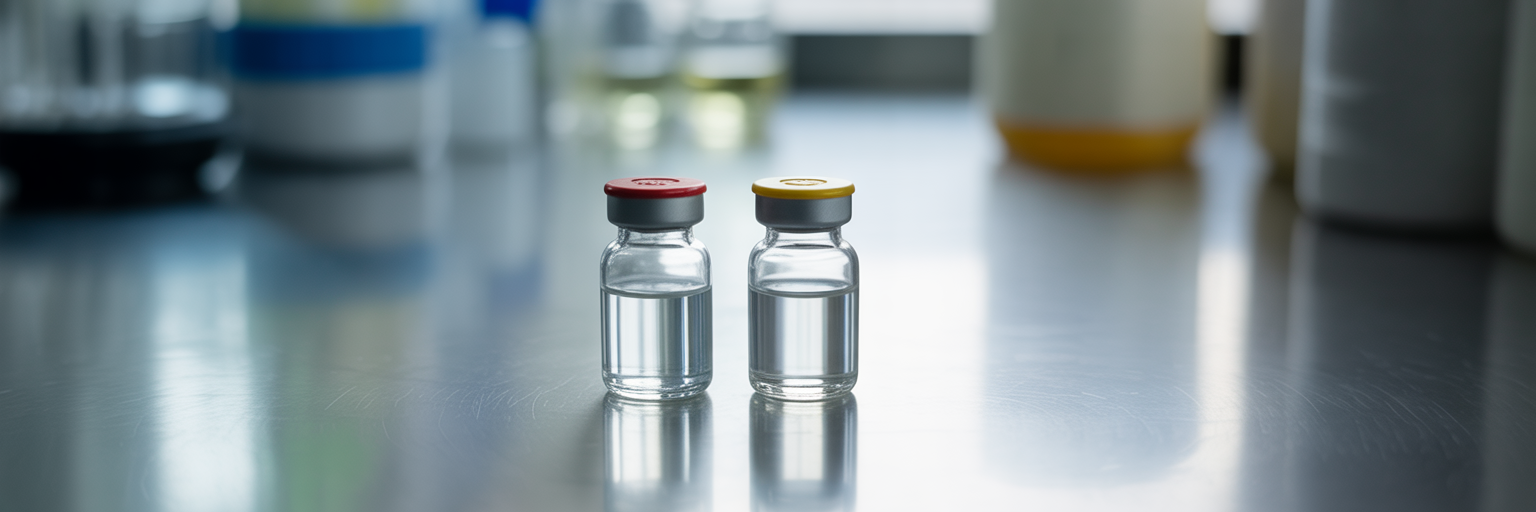
With the foundational concept of reconstitution established, the next step is selecting the correct liquid. The two most common options, sterile water and bacteriostatic water, are not interchangeable. Their suitability depends entirely on the experimental protocol, the nature of the compound being reconstituted, and the intended dosage schedule. Making the wrong choice can introduce variables that affect results or even ruin a sample.
Composition: The Preservative Difference
The defining difference lies in a single ingredient. Sterile water for injection is simply pure, sterile H₂O. Bacteriostatic water, on the other hand, is sterile water containing 0.9% benzyl alcohol. This addition acts as a bacteriostatic agent. It is crucial to understand that it does not kill existing microbes but effectively inhibits their growth and reproduction. This preservative is the key to its extended use profile.
Usage Protocols: Single-Dose vs. Multi-Dose Vials
This compositional difference directly dictates how each diluent can be used. Since sterile water contains no preservative, once a vial is opened and entered with a needle, it is no longer guaranteed to be sterile. It is strictly for single-dose applications. Any remaining liquid must be discarded to prevent potential contamination. In contrast, the benzyl alcohol in a product like our 30ml reconstitution solution allows for multiple entries into the same vial. The preservative maintains sterility, making it a multi-dose diluent that can be used for up to 28 days after the first puncture.
Application-Specific Considerations
So, what is bacteriostatic water best for? It is ideal for protocols requiring multiple small doses over time, such as in peptide research. However, benzyl alcohol can be toxic to certain cell lines or interfere with specific assays. For highly sensitive applications like cell cultures or when reconstituting a compound for a single, immediate use, sterile water is the safer choice. As Peptides Explorer highlights, this distinction is fundamental to proper laboratory practice.
| Feature | Sterile Water for Injection | Bacteriostatic Water for Injection |
|---|---|---|
| Composition | Pure, sterile water (H₂O) | Sterile water with 0.9% benzyl alcohol |
| Primary Function | Single-dose diluent | Multi-dose diluent |
| Mechanism | Provides a sterile liquid medium | Inhibits bacterial growth after opening |
| Vial Lifespan After Opening | Must be discarded after single use | Up to 28 days if stored correctly |
| Common Applications | Sensitive cell cultures, single-use reconstitutions | Peptide research, multi-dose protocols |
The Advantages of Bacteriostatic Water in Research Workflows
Beyond its basic composition, the practical benefits of bacteriostatic water directly impact laboratory efficiency, cost, and safety. The ability to draw multiple doses from a single vial is not just a matter of convenience; it represents a more sustainable and reliable approach for many research projects. The primary bacteriostatic water uses revolve around this multi-dose capability, which translates into several clear advantages.
- Cost-Effectiveness: Research budgets are always a consideration. With single-use sterile water, any unused portion of a vial must be discarded after one use. In a long-term project involving daily or frequent administrations, this waste adds up, increasing procurement costs. Bacteriostatic water minimizes this waste. A single vial can serve an entire series of experiments over its 28-day lifespan, significantly reducing the number of vials needed.
- Workflow Efficiency: Consider a peptide titration study or an experiment requiring slightly different volumes each day. Opening a new vial of sterile water for every small withdrawal is inefficient and cumbersome. A multi-dose vial of bacteriostatic water streamlines this process. It allows for repeated, small-volume withdrawals without the repetitive unsealing of new containers, saving valuable time and reducing procedural complexity. This is why we offer various sizes, including a convenient 10ml reconstitution solution, to match different project scales.
- Enhanced Safety and Purity: The bacteriostatic agent provides a crucial layer of protection. As confirmed by guidelines explained in a resource from USC Scalar, the preservative is effective for up to 28 days. This ensures that the reconstituted substance remains free from bacterial growth, protecting its integrity and potency. For experiments that span weeks, this consistency is paramount. It guarantees that the dose administered on day 25 is just as pure as the one from day one, ensuring the reliability of the collected data.
Best Practices for Handling and Storage

Using bacteriostatic water correctly is as important as choosing it in the first place. Its multi-dose benefit is entirely dependent on meticulous handling and storage protocols. Any lapse in aseptic technique can introduce contaminants that the benzyl alcohol may not be able to inhibit, compromising the entire vial. The question of how to store bacteriostatic water and handle it properly is not a suggestion but a requirement for valid research. Following these non-negotiable steps is essential.
- Storage Protocols: Before its first use, bacteriostatic water can be stored at room temperature. However, once the vial has been punctured, it must be refrigerated immediately at a temperature between 2-8°C (36-46°F). This temperature range is crucial for preserving the efficacy of the benzyl alcohol. Storing it in a dark place, like its original box, also protects it from light that could degrade the preservative over time.
- Aseptic Withdrawal Technique: Every single entry into the vial must be treated as a sterile procedure. Before each puncture, vigorously disinfect the rubber stopper with a fresh 70% isopropyl alcohol wipe and allow it to air dry completely. Always use a new, sterile needle and syringe for every withdrawal. Reusing needles is a primary cause of contamination and must be avoided without exception.
- Pre-Use Inspection: Get into the habit of visually inspecting the solution before drawing a dose. Hold the vial up to a light source and check for any particulates, cloudiness, or discoloration. A properly stored solution should be perfectly clear. If you notice any change in its appearance, discard the vial immediately, regardless of how much is left.
- Adherence to Expiry: The 28-day rule is absolute. After the first puncture, the vial is viable for a maximum of 28 days. It is good practice to write the date of the first use directly on the vial’s label. After 28 days have passed, the vial must be discarded, even if there is solution remaining. As outlined in guides like the one from PeptidesSkin.com, this practice is a critical step in maintaining sterility.
Impact on Experimental Accuracy and Reproducibility
The meticulous practices for handling diluents are not just about procedural correctness; they directly influence the scientific outcomes of your work. A compromised diluent is an uncontrolled variable that can silently alter experimental results, leading to inaccurate data and flawed conclusions. In research, where reproducibility is the gold standard of validity, even the smallest inconsistency can have significant consequences.
This is especially true when using sterile diluents for peptides. Peptides are complex molecules with specific three-dimensional structures that are essential for their biological function. Microbial contamination or a shift in pH caused by a compromised diluent can denature a peptide, changing its shape and rendering it inactive or altering its effects. An experiment could fail not because the hypothesis was wrong, but because the active compound was no longer functional before it was even administered. This introduces a level of uncertainty that undermines the entire study.
Standardized, correct diluent management is therefore a cornerstone of reliable science. It ensures that every dose administered is consistent in its purity, potency, and pH. This consistency is what makes an experiment reproducible. Just as building topical authority with internal linking creates a reliable and structured knowledge base, disciplined laboratory protocols create a reliable and structured data set. These practices are a fundamental component of Good Laboratory Practice (GLP), separating rigorous, credible research from unreliable noise. For those interested in maintaining high standards, we regularly share insights on our blog about laboratory best practices.
Future Considerations in Diluent Formulations
As research becomes more sophisticated, the tools that support it must also advance. While current sterile diluents are effective for a wide range of applications, the scientific community is continually pushing boundaries, creating a need for more specialized and advanced formulations. The “simple” diluent is poised to become an area of quiet innovation.
One area of development is the search for innovations in preservatives. While benzyl alcohol is a reliable bacteriostatic agent, researchers are exploring alternatives that may offer broader antimicrobial coverage or improved compatibility with the next generation of highly sensitive biologics and cell therapies. The goal is to find preservatives with fewer potential interactions, expanding the utility of multi-dose vials to even more delicate applications.
We are also seeing a growing demand for specialization. The increasing complexity of therapeutic proteins, monoclonal antibodies, and custom peptides is driving the need for custom diluent formulations. These might include buffers to maintain a specific pH, excipients to enhance solubility, or stabilizers to prolong the active life of a reconstituted compound. The diluent is shifting from a passive solvent to an active component in ensuring drug stability.
Finally, the role of regulation will continue to guide these advancements. Regulatory bodies like the United States Pharmacopeia (USP) set the standards for safety and quality. As new formulations emerge, these organizations will establish the rigorous testing and validation protocols required to ensure they are safe and effective. As research targets become more complex, the importance of the diluent will only grow, demanding greater precision and care from every researcher.