Private Label, White Label, Wholesale partnerships available - EU, USA and UK - Free shipping from €75

Sodium Chloride Injection USP: Research & Reseller Guide
A distributor receives a purchase inquiry for sterile diluent, a peptide researcher needs a clean reconstitution workflow before samples degrade, and a junior lab technician reaches for the nearest saline vial because it looks interchangeable with sterile water. Those situations seem routine until one small specification turns into the difference between reproducible work and avoidable trouble.
Sodium Chloride Injection USP sits in that category of materials that looks simple on a shelf but carries a lot of hidden decisions. The label tells only part of the story. For clinical teams, it's a standard IV fluid. For peptide labs, resellers, and wholesalers, it's also a packaging question, a documentation question, a compatibility question, and a supply chain question.
That's where many buyers get stuck. Public information usually explains patient-facing uses well enough, but it often leaves research users and B2B sellers with practical gaps. They still need to know which specifications matter most, what “USP” signals, how handling changes in a research workflow, and what documentation supports confident resale across the EU, UK, USA, and LATAM.
Table of Contents
- The Unsung Hero of the Modern Laboratory
- Deconstructing Sodium Chloride Injection USP
- A Spectrum of Formulations and Concentrations
- Clinical Care Versus Research Use
- A Practical Guide to Reconstitution and Compatibility
- Quality Control and Packaging for Wholesalers
- Navigating Regulatory and Distribution Realities
The Unsung Hero of the Modern Laboratory
The material that causes the least excitement during procurement often causes the most disruption when it's wrong. A missed lot document, unclear packaging description, or poorly matched diluent can delay peptide work, complicate resale, or force a lab to discard prepared material.
That's why sodium chloride injection USP deserves closer attention than it usually gets. In practice, it isn't just “saline.” It's a sterile, specification-driven product used across clinical workflows, lab preparation, and commercial distribution. Each group touches it differently, but all of them depend on consistency.
For a researcher, the main question is often compatibility. For a wholesaler, it's usually traceability, packaging integrity, and whether the product can be positioned clearly without creating regulatory confusion. For a reseller, the problem is often even more basic. Buyers ask whether a vial is suitable for aliquoting, repeated handling, or peptide reconstitution, and standard clinical literature rarely answers in practical detail.
Practical rule: Basic reagents deserve the same scrutiny as expensive actives. If the diluent is poorly documented, the rest of the workflow inherits that risk.
Sodium chloride injection USP also carries unusual weight because it serves as a reference material in so many settings. People assume they already understand it. That assumption leads to shortcuts. A junior buyer may focus on concentration and ignore container type. A new distributor may focus on “sterile” and overlook whether the product documentation supports the intended market.
A good handling strategy starts with understanding the label, not just recognizing it.
Deconstructing Sodium Chloride Injection USP
The name looks straightforward, but each term signals a different requirement. Buyers who understand those parts make better decisions during sourcing, storage, and customer support.

What each part of the name tells the buyer
Sodium chloride is the dissolved electrolyte itself. In plain terms, it is salt prepared in a controlled aqueous solution. In laboratory and clinical contexts, that matters because sodium and chloride contribute to fluid balance and tonicity.
Injection means the solution is prepared for parenteral use. That signals sterile manufacturing expectations, nonpyrogenic handling, and a product type that's suitable for intravenous administration when used according to official labeling. It also tells a research buyer something important. This isn't just salt dissolved in water. It's a material produced to a more stringent standard than ordinary bench-top solution prep.
USP refers to the United States Pharmacopeia standard named on the product. In practical terms, it tells buyers the product is defined by official identity, strength, quality, and purity expectations in the U.S. market. For distributors, that designation matters because customers often use “USP” as shorthand for trust, even when their actual need is more specific, such as sterile presentation, lot traceability, or controlled excipient profile.
Why 0.9% became the default reference point
The familiar 0.9% Sodium Chloride Injection, USP contains 154 mEq of sodium and 154 mEq of chloride per 1,000 mL, with an osmolarity of 308 mOsmol/L, which is close to human plasma at approximately 280 to 310 mOsmol/L, according to the Pfizer labeling for Sodium Chloride Injection, USP. That closeness is why it is described as isotonic.
A simple way to think about isotonicity is balance across a membrane. If the surrounding fluid is too concentrated, water shifts out of cells. If it's too dilute, water shifts in. A near-matched environment reduces that stress.
Many new buyers get confused. They assume “0.9%” is just a formula tradition. It's better understood as a practical standard for a solution that behaves in a way that is broadly compatible with extracellular conditions.
| Term | What it means in practice | Why it matters |
|---|---|---|
| 0.9% | A defined sodium chloride concentration | Supports standardization |
| Isotonic | Close to plasma osmolality | Reduces disruptive fluid shifts |
| USP | Official pharmacopeial standard | Signals controlled quality expectations |
The label isn't marketing language. It's the first technical document in the supply chain.
A Spectrum of Formulations and Concentrations
Not every sodium chloride solution behaves the same way. That sounds obvious, but buyers often treat all saline products as interchangeable until a protocol, storage decision, or customer question exposes the difference.

How tonicity changes behavior
The most useful comparison is not by brand or container. It's by tonicity.
Hypotonic solutions contain less solute relative to the reference point represented by isotonic saline. In broad terms, they tend to move water toward cells. That's why they need careful use in any setting involving sensitive biological material.
Isotonic solutions, with 0.9% sodium chloride as the familiar standard, sit in the middle. They are generally chosen when the goal is to avoid strong osmotic shifts and maintain a more neutral environment for handling or administration.
Hypertonic solutions contain more solute relative to isotonic saline. They tend to draw water outward. In specialized protocols or clinical contexts, that effect may be desirable, but it also means they are not generic substitutes for normal saline.
Why distributors should care about the difference
A wholesaler doesn't need to memorize every possible end use to stock correctly. The key is understanding that the concentration changes the commercial conversation.
- For isotonic stock, buyers usually ask about sterility, packaging, and whether the product is suitable as a general diluent.
- For hypotonic options, questions often shift toward protocol specificity and caution around biological compatibility.
- For hypertonic products, the buyer usually has a narrow intended purpose and expects tighter technical discussion.
A reseller who collapses those distinctions into “saline is saline” creates avoidable support problems. Product pages, quotations, and COA packets should make the concentration impossible to overlook.
A short internal decision table helps:
| Formulation class | General behavior | Typical commercial implication |
|---|---|---|
| Hypotonic | Lower solute environment | Requires careful positioning |
| Isotonic | Balanced reference environment | Broadest general demand |
| Hypertonic | Higher solute environment | Narrower, purpose-specific demand |
This is also why education matters in sales. A buyer may ask for “normal saline” when they really mean “a sterile sodium chloride solution.” Those are not automatically the same request.
Clinical Care Versus Research Use
Clinical users and research users may purchase the same nominal product, but they don't evaluate it the same way. That difference shapes labeling, handling, and the kind of support distributors need to provide.
Two settings with different priorities
In clinical care, sodium chloride injection USP is judged against patient-facing requirements. Official labeling centers on use as a source of water and electrolytes, fluid replacement, and a diluent for compatible drugs. The core questions are safety, indication, administration, and approved presentation.
Research labs usually start somewhere else. They care about lot consistency, vial suitability, excipient simplicity, aliquoting practicality, and whether repeated handling will introduce unnecessary variability. A peptide user doesn't ask first whether the product can support routine IV use in a hospital. The user asks whether the solution is clean, stable in handling, and appropriate for the intended laboratory workflow.
That gap creates confusion when junior buyers rely only on clinical inserts. They may assume patient-use documentation fully answers research-use questions. It often doesn't.
Where public guidance falls short for RUO
Public labeling from regulators focuses on clinical use as a diluent but rarely gives detailed guidance on long-term in-vial stability, compatibility with common peptide excipients, or ideal vial types for lab-scale aliquoting, as noted in the FDA labeling context for sodium chloride injection. That's one reason RUO distributors across the EU, UK, and the Americas run into repeated customer questions that the insert alone can't settle.
For teams dealing in research products, the distinction behind Research Use Only definitions and limitations matters because product positioning must match the intended market. “USP” describes a standard and official product identity. “RUO” describes how a product is marketed and used in a research context. Those ideas can intersect, but they are not interchangeable labels.
A clinical insert can confirm what the product is. It usually can't tell a peptide reseller how buyers will handle it after the seal is broken.
That has practical consequences:
- Customer support changes: Research clients ask workflow questions, not bedside dosing questions.
- Documentation priorities change: Labs may want sterility information, lot data, and packaging details before they order.
- Risk points change: Repeated puncture, aliquoting, and small-batch use become part of the practical handling story.
A distributor who understands that split can answer questions faster and avoid overpromising what standard clinical labeling covers.
A Practical Guide to Reconstitution and Compatibility
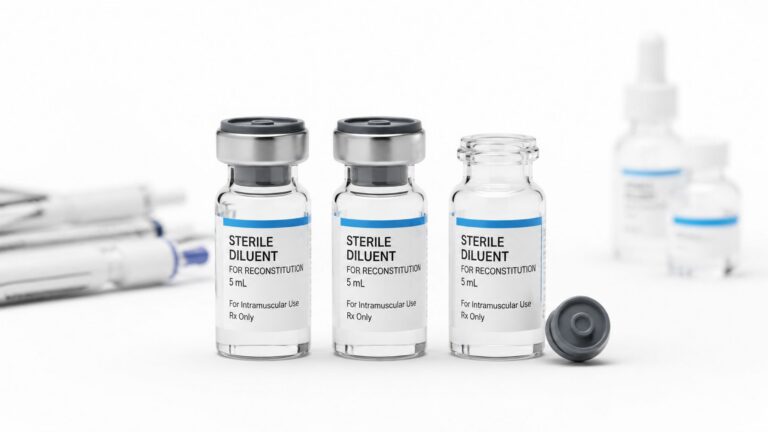
For peptide work, the appeal of sodium chloride injection USP is rarely just familiarity. Its primary value is control. Researchers often choose it when they want a sterile diluent with a defined composition and without extra antimicrobial ingredients that could complicate sensitive work.

Why researchers choose it for some peptide workflows
According to the FDA chemistry review document for Sodium Chloride Injection USP, Sodium Chloride Injection USP 0.9% is formulated with a pH between 4.5 and 7.0 and contains no antimicrobial agents. In research settings, that matters because excipient control is often part of the experiment, not just a manufacturing detail.
A peptide researcher comparing saline to another sterile diluent usually asks two practical questions. First, does the diluent introduce anything unwanted? Second, does it provide a reasonable environment for the material being reconstituted? In some workflows, the answer favors a simple sterile saline presentation over preserved options.
Researchers who need a broader comparison between saline and Water for Injection in laboratory workflows often review the intended use first, then choose the diluent that best matches the protocol's sensitivity to tonicity, excipients, and handling pattern.
A clean reconstitution workflow
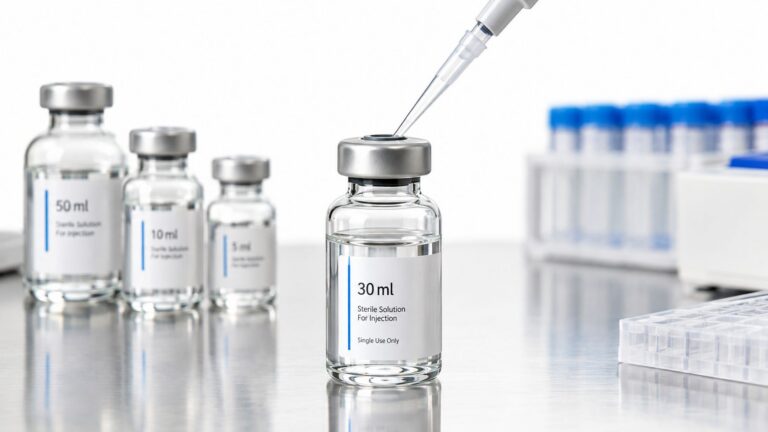
Good technique starts before the stopper is pierced. The vial, workspace, and transfer tools should all be treated as part of one sterile chain.
A practical routine usually includes the following:
- Inspect the container first. Check clarity, seal integrity, lot labeling, and visible particulate absence before use.
- Prepare the workspace. Use a clean area and sterile tools. Most contamination problems begin during setup, not during mixing.
- Add diluent gently. Direct the stream toward the vial wall when possible, especially with delicate lyophilized material.
- Swirl instead of shaking. Vigorous agitation can stress fragile biomolecules and create foam that makes inspection harder.
- Label the reconstituted vial immediately. Date, lot, identity, and any protocol-specific note should be added before the vial leaves the bench.
Many avoidable losses come from rough handling rather than bad chemistry. If a peptide forms bubbles, clings to the stopper, or appears slow to dissolve, forceful shaking usually makes interpretation worse.
A visual refresher helps when training new staff:
Compatibility questions that deserve attention
Compatibility is where general advice becomes dangerous. A sterile isotonic diluent may still be a poor fit for a specific peptide, excipient system, or storage plan.
The safest way to think about compatibility is by separating three issues:
- Chemical compatibility: Whether the molecule remains suitable in the chosen solution.
- Container compatibility: Whether the vial, stopper, or transfer path introduces adsorption, leachables, or handling problems.
- Workflow compatibility: Whether the preparation method matches how the lab will use the material.
Bench reminder: Reconstitution success depends on the whole system. The powder, diluent, stopper, syringe, vial material, and storage plan all interact.
That's why experienced labs don't treat sodium chloride injection USP as a universal answer. They treat it as a controlled starting point. For some peptide workflows, that's exactly what's needed.
Quality Control and Packaging for Wholesalers
A wholesaler doesn't only sell a sterile solution. The wholesaler sells confidence that the product arriving at a customer site is the same product described on paper. That confidence comes from documentation and packaging working together.

What a buyer should expect in documentation
A Certificate of Analysis should be readable, batch-specific, and relevant to how the product will be sold. If the document looks generic or detached from the actual lot, buyers should slow down.
A practical review checklist includes:
- Product identity: The name, strength, batch or lot reference, and presentation should match the physical goods.
- Sterility status: The documentation should clearly support the sterile claim rather than leaving it implied.
- Nonpyrogenic expectation: If that claim is part of the product profile, the supporting quality record should be available in the supplied documentation set.
- Release alignment: The release date, batch status, and traceability details should make downstream recall management possible.
- Container description: Vial, bag, stopper, and closure details should be specific enough for a research buyer to assess fit.
The value of that detail becomes obvious when a reseller handles technical questions from universities, private labs, or peptide clients. The customer usually doesn't ask for “good quality.” The customer asks for evidence.
Packaging choices affect product integrity
Container choice changes how the product is perceived and how it performs in real workflows. Single-use vials, multi-dose style presentations, and larger bags all create different handling patterns even before the first transfer.
Glass often appeals to research buyers because it signals premium presentation and can support cleaner small-volume handling expectations. Plastic containers may fit broader distribution needs or specific institutional preferences. Neither format is automatically superior in every setting. The better choice depends on puncture frequency, aliquoting plan, transport conditions, and customer expectation.
For B2B sellers, three packaging questions matter more than aesthetics:
| Packaging question | Why it matters to the wholesaler |
|---|---|
| Is the seal secure? | Damage in transit can turn inventory into waste |
| Is the format aligned with use? | Wrong size or closure creates customer complaints |
| Is the batch traceable at unit level? | Returns, recalls, and QA reviews become manageable |
Distributors working with sterile diluents also benefit from understanding the role of sterile diluents in research workflows, because customers often compare products less on price than on documentation quality and packaging credibility.
Better packaging doesn't only protect the vial. It reduces support tickets, replacement claims, and arguments about whether contamination happened before or after delivery.
That point matters in wholesale. Margins can disappear quickly when a “simple saline” line starts generating preventable QA disputes.
Navigating Regulatory and Distribution Realities
The hardest part of selling sodium chloride injection USP across research and distribution channels isn't usually the chemistry. It's matching product identity, market positioning, and supply reliability without blurring the boundaries between them.
USP labeling and RUO positioning are not the same thing
A product labeled to USP standards carries one set of implications around composition and official quality expectations. A product marketed for research use carries another set of implications around intended use, claims, and customer communication. Sellers who mix those concepts carelessly create regulatory friction for themselves and confusion for buyers.
That matters especially in cross-border distribution. A reseller may source a pharmacopeial-grade sterile solution, then offer it into a customer base made up largely of peptide researchers and lab operators. The documentation packet, website language, and customer guidance all need to stay aligned with the market being served. If the sales language drifts into unsupported claims, the problem starts long before any shipment issue appears.
Supply continuity matters as much as specification
A technically sound product still fails commercially if supply is unstable. Sodium chloride injection USP is used at such broad scale that large, approved manufacturing capacity has become part of the purchasing story. The Baxter announcement on FDA approval for supply from its Sabinanigo, Spain facility highlights that demand is substantial and that major regulated markets rely on multiple approved production sites.
For wholesalers and distribution partners, that leads to a few practical conclusions:
- Source from transparent suppliers. A strong specification sheet is not enough without batch and site clarity.
- Warehouse carefully. Sterile products need disciplined storage and handling processes to preserve integrity through the full chain.
- Plan for substitution rules early. Even close-looking presentations may not be interchangeable for every customer or protocol.
- Support imports with documentation. The smoother the paperwork, the fewer delays at the border and the fewer downstream customer disputes.
The strongest distributors treat sodium chloride injection USP as both a technical product and a logistics product. That mindset usually separates reliable partners from opportunistic traders.
Herbilabs supports research teams, resellers, and wholesale partners that need sterile diluents, clear documentation, and dependable fulfillment across the EU, UK, and USA. For buyers looking for premium RUO packaging, transparent batch support, and responsive supply partnership options, Herbilabs is a practical place to start.