Private Label, White Label, Wholesale partnerships available - EU, USA and UK - Free shipping from €75
Third Party Verification for Lab Supplies Explained
A distributor receives a new shipment of bacteriostatic water or a lyophilized peptide, checks the accompanying COA, and finds exactly the fields buyers expect: product name, batch number, test date, method, and a clean result. Weeks later, researchers report inconsistent performance. The immediate question isn't whether the supplier provided paperwork. It's whether the paperwork represents independent verification, or merely a polished version of the manufacturer's own quality-control record.
That distinction affects every party in the chain. A weak verification claim can leave wholesalers with returned stock, researchers with unusable data, and distribution partners with a credibility problem they can't solve by forwarding another PDF. A strong process creates an evidence trail that connects the specific batch, the analytical method, the testing body, and the decision to release the product.
Table of Contents
- Why Third Party Verification Matters for Lab Supplies
- Types of Verification Used in Laboratory Supply Chains
- How the Verification Process Works Step by Step
- How to Evaluate and Select a Verification Provider
- Reading Certificates of Analysis and Verification Reports
- Balancing Cost Turnaround and Assurance Levels
- Implementation Checklist and Frequently Asked Questions
Why Third Party Verification Matters for Lab Supplies
The term third party verification has a precise operational meaning. ISO describes third-party conformity assessment as an activity performed by a body independent of both the producer and the user, while ISO/IEC 17029 sets expectations around competence, consistent operation, and impartiality for validation and verification bodies. ISO's conformity-assessment standard therefore points to the central issue, independence isn't decorative language, it's the control that separates an evaluation from a supplier's own assertion.
A manufacturer's in-house QC can be valuable. It can support batch release, identify process drift, and provide fast feedback when production conditions change. But the manufacturer controls the sample selection, testing environment, methods, interpretation, and report issuance. A second-party audit, such as a distributor visiting a supplier, adds oversight but still represents a commercial relationship between buyer and seller. Neither arrangement creates the same separation as an independent laboratory testing material without being responsible for its production.

The batch matters more than the logo
A recognizable laboratory name or an impressive certificate doesn't prove that the received material was tested. The report needs to identify the same product, batch, and relevant matrix that reached the buyer. A historical COA, a generic specification sheet, or a certificate issued for a different manufacturing run may describe what the supplier intends to make rather than what the shipment contains.
For high-purity reagents, sterile diluents, and research-use-only compounds, the consequences can spread beyond a single failed experiment. Researchers may lose samples, instrument time, and confidence in their results. Wholesalers may need to quarantine inventory while investigating whether the problem arose during manufacture, filling, storage, transport, or documentation.
Practical rule: A verification claim is only as useful as the chain connecting the tested sample to the delivered batch.
Independent verification also helps expose conflicts that internal QC cannot always reveal. A supplier may report a passing result, but an external evaluator can challenge the sampling plan, inspect the method reference, question an incomplete result, or detect that the report doesn't contain enough information to support the stated conclusion.
The market's scale reflects why these controls now matter beyond specialist compliance teams. One market estimate places global third-party verification services at about $15 billion in 2025, with a projected 12% CAGR through 2033 and a projected value of roughly $45 billion. The same coverage says North America and Europe together represent more than 70% of revenue, showing that verification has become a large, regulated business function rather than a niche paperwork exercise. Archive Market Research's market coverage links this expansion to fraud prevention, regulatory pressure, and identity assurance across industries.
For lab wholesalers and researchers, the practical lesson is simple. A COA should be treated as evidence to evaluate, not as a trust substitute. The remaining questions are what was tested, who tested it, under which method, and whether the documentation supports the product decision being made.
Types of Verification Used in Laboratory Supply Chains
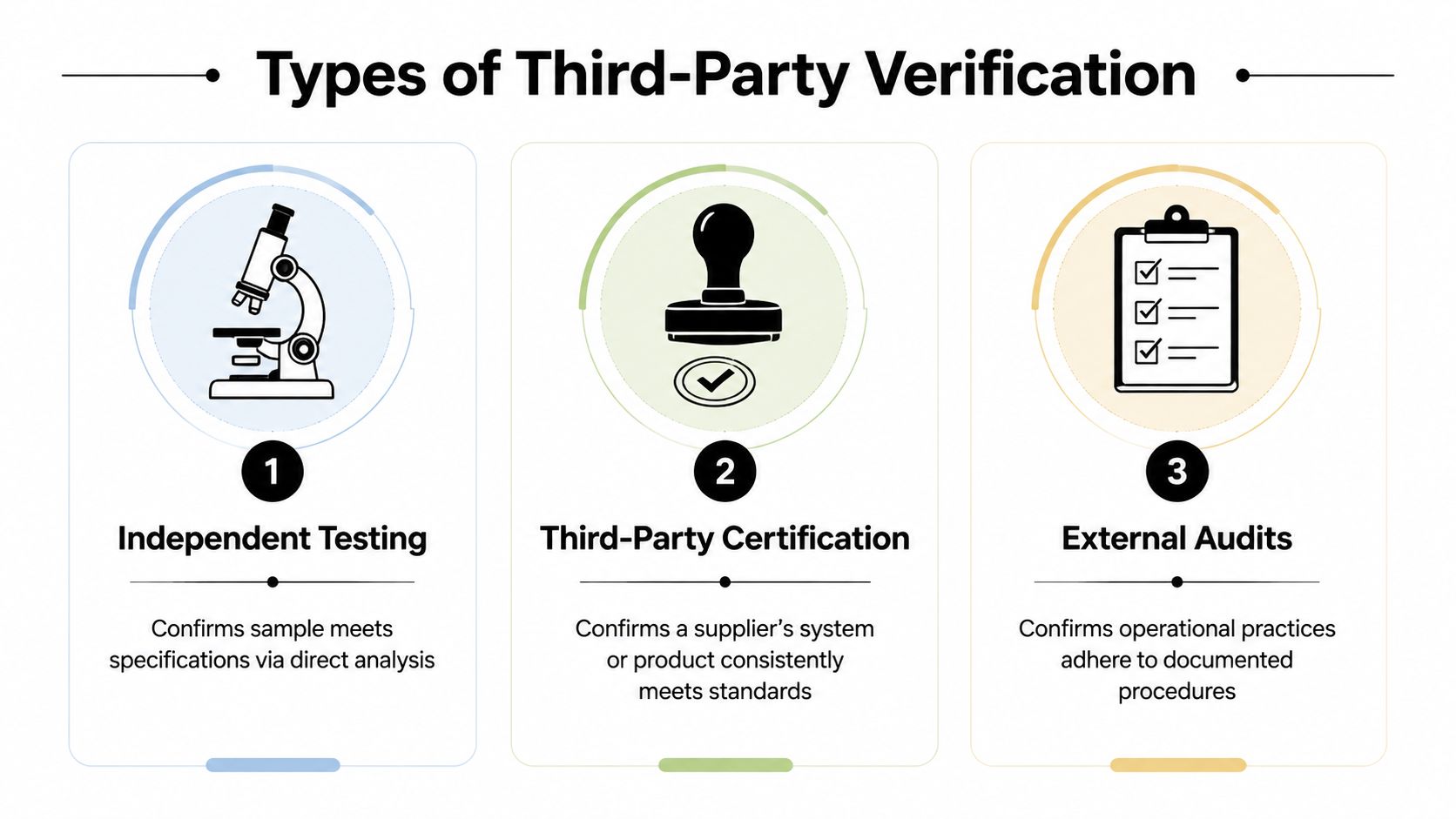
Laboratory supply chains commonly combine three forms of assurance, independent testing, third-party certification, and external audits. Each answers a different question, and none can stand in for the others.
Independent testing examines the material
Independent testing asks whether a sample meets defined specifications. For a peptide, the laboratory may assess identity with mass spectrometry and examine purity using an appropriate chromatographic method. For bacteriostatic water or another diluent, the test plan may address the parameters relevant to its specification, such as chemical quality, contamination controls, or endotoxin-related requirements where applicable.
The strength of this approach is its connection to a particular sample. Its limitation is equally important: one passing sample doesn't establish that every future batch will match it. Sampling also matters. A test can be technically correct while still offering weak assurance if the submitted material wasn't representative of the shipment.
Researchers comparing analytical panels may also benefit from a specialized resource such as finding a GLP biomarker panel, particularly when the intended workflow requires more than a basic identity or purity check.
Certification examines a system or defined product
Certification evaluates whether an organization, management system, or product conforms to a recognized standard. It may provide evidence about documented procedures, responsibilities, corrective actions, and controlled operations. ISO explains that management-system certification falls within third-party conformity assessment, but certification isn't a substitute for batch testing. A certified facility can still release a nonconforming lot, especially if sampling, deviation handling, or a particular analytical method is weak.
laboratory quality-control testing becomes useful as a reference point. Buyers should distinguish between a supplier's general quality system and the independent analytical evidence attached to the material being purchased.
Audits examine how work is performed
An external audit reviews processes, records, equipment, personnel practices, environmental controls, and facility conditions. In sterile filling operations, an audit may examine cleaning records, controlled-area practices, material flow, training, deviation management, and batch documentation. It can reveal whether the organization follows its written procedures consistently.
Audits are periodic observations, not continuous surveillance. They can identify a weak process, but they don't automatically prove the quality of every product made afterward. Conversely, a batch report may show a passing result while an audit reveals poor document control or inadequate handling practices.
The most dependable supply-chain program uses these modalities together. Independent testing evaluates the product, certification evaluates the system or defined standard, and auditing evaluates execution. Manufacturer-issued COAs can support the file, but a supplier-generated document should be labeled accurately. It isn't the same as an independent report merely because it includes a method name, a signature, or a laboratory-style layout.
How the Verification Process Works Step by Step
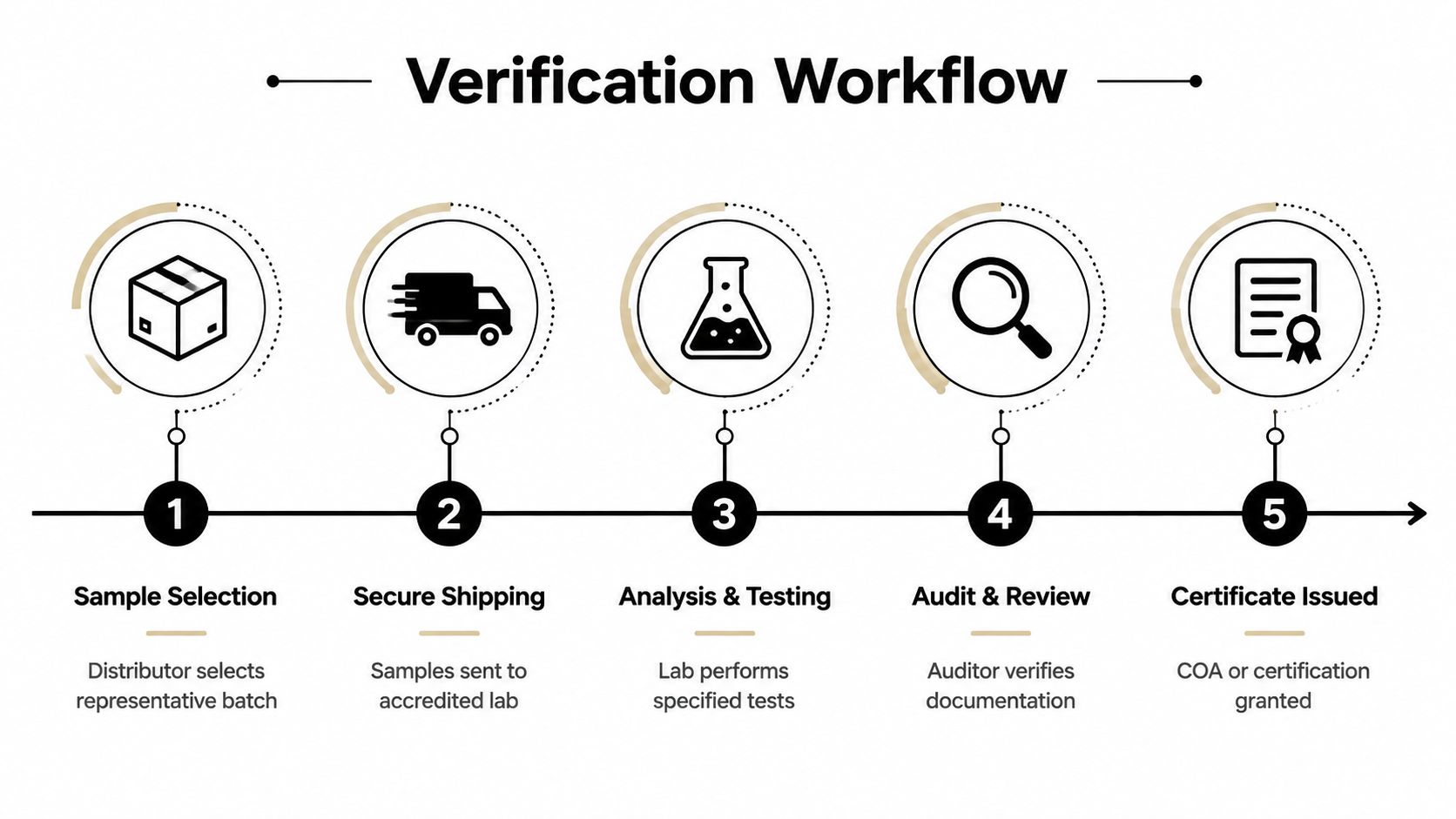
A credible verification program begins before a sample reaches the laboratory. The distributor or buyer first defines the product specification, the risk of failure, and the evidence required for release. That decision determines whether the program needs targeted testing, a broader analytical panel, a one-time check, or recurring review of incoming batches.
1. Select and identify the sample
The submitted material should represent the batch under review. The record should include the product name, batch or lot identifier, packaging condition, quantity, collection date, and the person responsible for sampling. A distributor shouldn't accept a sample that can't be reconciled with the inventory later released to customers.
2. Secure the shipment and preserve custody
The sample needs a documented path from collection to receipt. Chain-of-custody records should show who sealed it, who transported it, when the laboratory received it, and whether the package arrived intact. Storage and transport conditions should match the material's requirements, particularly for temperature-sensitive or moisture-sensitive compounds.
A missing custody step doesn't automatically invalidate a result, but it weakens the buyer's ability to prove that the laboratory tested the intended material. That weakness becomes serious when a supplier disputes a result or a downstream user reports a problem.
3. Confirm the analytical plan
The laboratory should state the methods it will use and explain what each method can establish. HPLC may support a purity assessment, mass spectrometry may support identity confirmation, and endotoxin testing may address a defined contamination risk. The method must fit the compound and matrix. A generic method name without validation information or suitability evidence is a documentation gap.
Novel or unusual compounds can create delays because the laboratory may need to establish or adapt a method before reporting a meaningful result. Expedited testing may shorten queue time, but it shouldn't remove necessary method review.
4. Review the report before release
The buyer should examine the report for batch alignment, acceptance criteria, actual results, units, method references, deviations, and authorized approval. A result marked only “pass” may be insufficient if the purchase decision depends on a measurable purity, concentration, or contamination threshold.
The review should also compare the external report with the supplier's COA. Differences don't always indicate fraud, but they require explanation. The two documents may use different methods, samples, specifications, or reporting conventions.
5. Issue the release decision
The final output may be a test report, a batch-specific COA, or a certification record, depending on the scope of the work. The buyer should record whether the batch was accepted, conditionally accepted, quarantined, or rejected, together with the person who made that decision.
The common mistake is treating document issuance as the end of verification. Operationally, the decision record is just as important as the report because it shows how the business responded to the evidence.
How to Evaluate and Select a Verification Provider
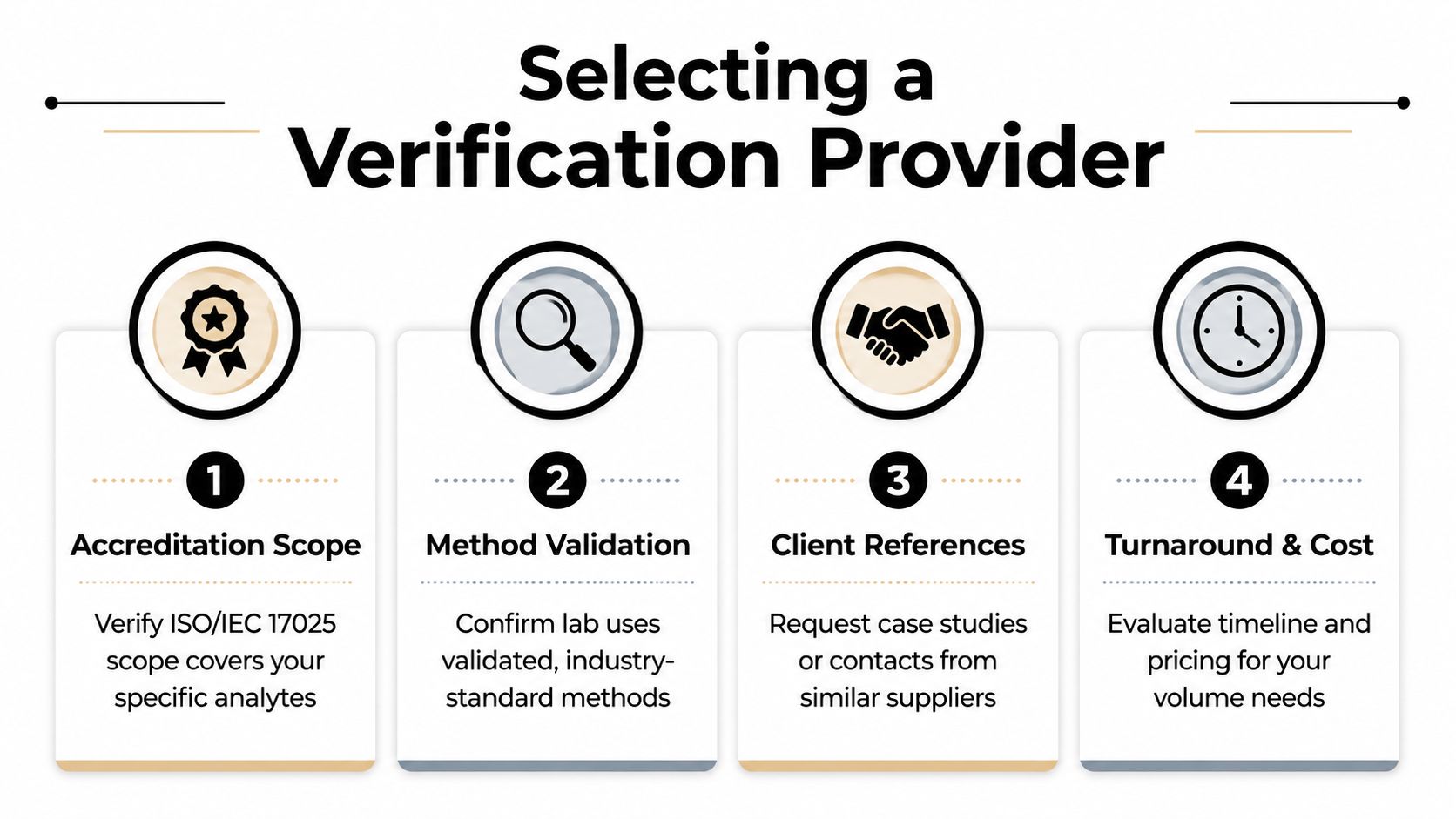
A provider can be accredited and still be unsuitable for a particular product. The key question isn't just whether the laboratory displays an accreditation badge. It's whether the accreditation scope covers the exact analytes, methods, and matrices relevant to the material being evaluated.
A strong shortlist starts with scope documentation. Buyers should request the provider's current scope, identify the tests that apply to the product, and confirm whether subcontracted work is disclosed. ISO/IEC 17029 emphasizes competence and impartiality for validation and verification bodies, but buyers still need to assess practical fit, including sample handling, technical communication, and report detail. Supplier qualification criteria can help procurement teams organize those checks before commercial terms are finalized.
Strong and weak provider signals
| Strong provider signal | Weak provider signal |
|---|---|
| Current scope identifies relevant methods and matrices | Certificate displays an accreditation logo without scope detail |
| Chain-of-custody procedure is available | Sample receipt and custody steps remain unclear |
| Methods include suitability or validation information | Report names a technique but gives no method reference |
| Technical staff can explain limitations | Sales staff promise certainty without defining test limits |
| Reports identify the responsible laboratory and approver | Generic certificates lack signatory or laboratory accountability |
| Subcontracted testing is disclosed | The buyer can't determine who performed the analysis |
Turnaround and cost still matter, but speed shouldn't be evaluated in isolation. A laboratory that offers rapid reporting but can't explain its method, sample controls, or result interpretation may create more risk than it removes. Conversely, a technically strong provider may not suit a distributor that needs predictable capacity across multiple product categories.
Provider independence deserves a direct question. The buyer should ask whether the laboratory has ownership, financial, or operational ties to the manufacturer, whether the manufacturer selected the reported results, and whether adverse findings are retained in the record. A provider that refuses to explain its impartiality controls is a poor choice for high-consequence verification.
For peptide buyers who need a practical introduction to reading a COA for peptides, the same principle applies: document quality depends on traceability and method transparency, not visual polish.
Using one provider can simplify data comparison and supplier management. A panel of specialized laboratories may be more appropriate when one provider lacks scope for a required analyte or matrix. The decision should follow technical coverage and independence, not convenience alone.
Reading Certificates of Analysis and Verification Reports
A COA should allow a technically competent reader to reconstruct the release decision. The document doesn't need to be complicated, but it must identify what was tested, how it was tested, what the laboratory found, and who approved the result.
The first pass should focus on identity and traceability. Product name, batch number, container or sample identifier, date of analysis, and report number should align with the shipment. If the received batch differs from the report by even a small identifier, the buyer should pause the release process until the discrepancy is resolved.
Fields that deserve close review
- Product identity: The name and form should match the purchased material, not a broader product family.
- Batch traceability: The lot number should correspond to the containers received.
- Test method: The report should name the analytical procedure or recognized method used.
- Acceptance criteria: Specifications should be stated clearly enough to understand the decision.
- Actual results: Numerical findings, units, detection limits, or defined observations are more informative than an unsupported pass statement.
- Testing date: The date should make sense for the batch and the shipment.
- Laboratory accountability: The report should identify the testing body, authorized signatory, and relevant accreditation reference where applicable.
A manufacturer-issued COA isn't automatically worthless. It can provide useful production information and help compare internal and external findings. The problem arises when it's presented as independent evidence without identifying an external testing body or explaining the relationship between the manufacturer and evaluator. The guide to reading a peptide COA from Novagenesis Biopharma offers another useful document-reading reference for buyers who need to examine peptide reports critically.
| Red Flag | Trust Signal |
|---|---|
| “Pass” appears without actual results | Results include values, units, and relevant limits |
| Batch number is absent or doesn't match the shipment | Report and packaging carry matching identifiers |
| Method is described with a vague label only | Method reference and suitability information are available |
| Supplier is the only identified testing party | Independent laboratory and signatory are named |
| Accreditation is outdated or impossible to verify | Current accreditation scope supports the reported work |
| Report uses identical wording across unrelated batches | Batch-specific observations and dates are recorded |
| Deviations or exclusions are omitted | Exceptions are documented with their disposition |
A questionable COA calls for a controlled response, not an argument with the supplier. The buyer can request the complete report, raw data where contractually available, sample receipt records, method details, and an explanation of any mismatch. If the answer remains incomplete, the buyer should commission confirmatory testing or quarantine the shipment. A shipment should be rejected when the identity cannot be established, the custody record is unreliable, or the report clearly doesn't cover the material received.
A useful internal reference is how to read a certificate of analysis. It can support consistent review across purchasing, warehouse, technical, and customer-service teams.
Balancing Cost Turnaround and Assurance Levels
Verification spending should follow the consequence of failure, not the visual appeal of a certificate. The cost drivers are practical: the number of analytes, matrix complexity, method-development needs, sample logistics, expedited service, and whether the buyer commissions a single batch test or maintains an ongoing program.
A low-risk buffer may need a focused specification check, while a sterile diluent or a compound used in a sensitive research workflow may justify broader review and more frequent sampling. The decision depends on the product's vulnerability, supplier history, storage conditions, intended use, and the damage caused by a false release.
A risk-based decision model
- Define the failure consequence. Consider wasted studies, customer complaints, regulatory exposure, contamination risk, and recall complexity.
- Identify the uncertainty. New suppliers, unfamiliar matrices, weak historical records, and changing manufacturing sites deserve closer scrutiny.
- Match tests to the risk. Don't pay for unrelated analyses, but don't omit identity, purity, or contamination controls that support the actual release decision.
- Set the cadence. One-time testing may suit initial qualification, while recurring verification may be needed when product risk or supplier variability remains high.
- Agree on response rules. Contracts should define quarantine, retesting, investigation, notification, and cost responsibility before a failure occurs.
Spending less on a high-risk batch can be expensive if the missing test is the one that would have prevented release.
Turnaround creates a similar trade-off. Expedited service may protect a customer commitment, but a rushed review can create gaps in method suitability, custody documentation, or technical interpretation. Distribution partners should build verification time into purchasing schedules instead of making every incoming batch an emergency.
Supplier agreements can also distribute costs more sensibly. A wholesaler may require the manufacturer to provide internal QC while reserving independent testing rights, or may negotiate recurring verification as part of the supply relationship. The agreement should specify who selects the laboratory, who receives unfavorable results, and whether the supplier can substitute a test provider without approval.
The goal isn't maximum testing. It's defensible assurance, where every paid control has a clear connection to a known failure mode.
Implementation Checklist and Frequently Asked Questions
A verification program becomes useful when staff can apply it consistently during procurement, receiving, and customer support. The following checklist is designed for wholesalers, distribution partners, peptide resellers, and researchers evaluating a new supplier.
Before procurement
- Define the release requirement: List the product identity, critical specifications, required methods, and acceptable report format.
- Check provider scope: Confirm that the independent laboratory's accreditation and technical capability cover the relevant analytes and matrices.
- Request sample documentation: Ask for a representative COA and the provider's chain-of-custody and reporting procedures.
- Assess independence: Establish whether the evaluator has a commercial or operational relationship with the manufacturer.
- Set escalation rules: Decide when a shipment is accepted, quarantined, retested, or rejected.
During procurement and receiving
- Match the batch: Compare the shipment's identifiers, seals, packaging, and dates with the report.
- Record custody: Document receipt condition, storage placement, and any temperature or packaging concerns.
- Compare documents: Review the supplier COA against the independent report and investigate differences.
- Hold unresolved material: Keep discrepancies out of released inventory until technical staff complete the review.
After release
- Archive the evidence: Store reports, approvals, deviations, and correspondence in a retrievable quality record.
- Monitor supplier performance: Track recurring discrepancies, late reports, damaged shipments, and corrective actions.
- Schedule reassessment: Revisit verification frequency when the supplier, facility, formulation, packaging, or process changes.
- Protect customer traceability: Retain enough batch information to investigate complaints without relying on memory or forwarded emails.
Frequently asked questions
Do research-use-only products need the same rigor as clinical-grade materials?
Research-use-only status doesn't remove the need for accurate identity, traceability, or fit-for-purpose quality controls. The required assurance level can differ from clinical materials, but a researcher still needs evidence that the product is what the documentation says it is and that limitations are clearly disclosed.
How should international sourcing be handled?
The buyer should compare the supplier's local framework with the requirements governing the destination market, then focus on evidence that remains understandable across jurisdictions. Accreditation scope, method references, custody records, and batch alignment are more useful than a certificate whose legal or technical meaning the receiving team can't interpret.
What happens if the provider's accreditation has lapsed?
The buyer should determine whether the report was issued while the accreditation was active, whether the reported method was within scope at that time, and whether the lapse affects the intended release decision. Until the situation is documented, the affected batch should remain under controlled review.
How can verification enter a distribution agreement?
The agreement should name the required documentation, approved testing options, batch-notification rules, audit access, adverse-result disclosure, retention expectations, and responsibilities for confirmatory testing. It should also prevent a supplier from replacing independent verification with an in-house COA without written approval.
Third party verification isn't a one-time checkbox. It's an operating discipline that links supplier selection, analytical evidence, warehouse controls, release decisions, and customer communication. When those links are visible, a clean COA supports trust. When they aren't, the document may only make weak assurance look finished.
Herbilabs provides laboratory supplies such as bacteriostatic water, reconstitution solutions, and other research-use-only materials with product COA information and independent third-party laboratory results available for review. Visit Herbilabs to examine its quality documentation and discuss wholesale or distribution requirements with the team.