Private Label, White Label, Wholesale partnerships available - EU, USA and UK - Free shipping from €75
CGMP Compliance Requirements: A Practical Guide
A lab supply team can do everything right on paper, ship a sterile diluent on time, and still get a painful call from a customer when a lot doesn't test as expected. The first reaction is usually operational, not regulatory. Someone pulls the supplier file, checks the certificate of analysis, reviews the receiving log, and tries to answer a simple question with messy evidence, where did the issue start?
That moment is where cGMP compliance requirements stop being abstract. They become the system that decides whether a company can trace a problem, explain a decision, and prevent a repeat. For lab reagent and sterile diluent suppliers, cGMP is less about passing a one-time audit and more about proving that the product leaving the warehouse was made, sampled, documented, labeled, and released under controlled conditions.
Table of Contents
- Why cGMP Compliance Matters for Lab Supply Companies
- cGMP Regulatory Frameworks in the USA, EU, and UK
- The Eight Core Program Elements of cGMP Compliance
- Supplier Qualification and Incoming Material Controls
- Documentation Quality Systems and Validation Standards
- Personnel Facilities and Labeling Compliance
- Building Your cGMP Compliance Action Plan
Why cGMP Compliance Matters for Lab Supply Companies
A distributor receives a return from a customer who says a sterile diluent failed its test. The bottle is only the starting point. Quality teams then have to pull the supplier's COA, incoming material records, storage logs, batch documentation, and any deviation report tied to the lot before anyone can judge whether the problem began at receiving, filling, labeling, or release.
That is the practical face of cGMP compliance requirements. FDA expectations treat cGMP as a control system over methods, facilities, and manufacturing controls that is meant to assure identity, strength, quality, and purity. FDA cGMP regulations overview also describes cGMP as a way to assure proper design, monitoring, and control of manufacturing processes and facilities, which is why it became the baseline quality framework in major markets.
For lab supply companies, that means every reagent, diluent, and solution has to move through a documented quality path. The path starts with qualified materials, continues through controlled processing and testing, and ends with labeling and shipment records that can support traceability if a customer questions a lot later. End-product testing helps, but it cannot replace a system that prevents bad inputs from being used in the first place.
Practical rule: If a team cannot explain how a lot was sampled, verified, released, and labeled, it does not have a compliant lot. It has a product with incomplete evidence.
The most common mistake is treating cGMP as a final inspection activity. Regulators expect a living quality system that catches problems before they reach the customer and leaves enough evidence behind to reconstruct what happened. In a lab supply environment, that matters as much for a bottle of reagent water as it does for a sterile diluent used in reconstitution.
cGMP Regulatory Frameworks in the USA, EU, and UK
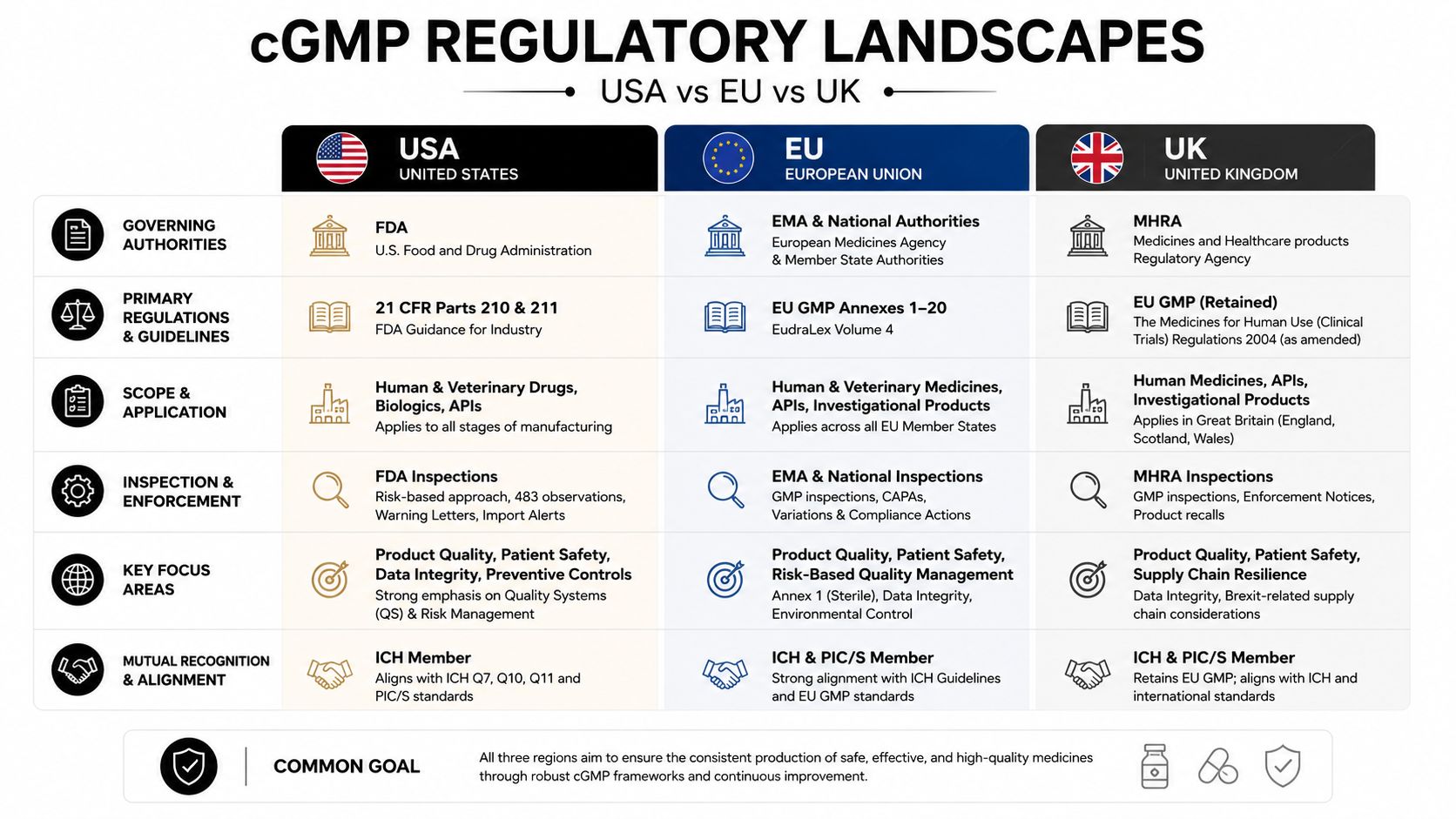
A sterile diluent packed for one market can still fail review in another if the evidence package does not match local expectations. The regulatory frameworks in the United States, EU, and UK point companies toward the same operating idea, build quality into the process instead of trying to prove it only at the end. In the United States, the FDA's core pharmaceutical regulations were codified in 21 CFR Parts 210 and 211 in 1978, and they established requirements for methods, facilities, and controls in manufacturing, processing, packaging, and testing (historical cGMP overview). That historical framework still shapes how lab supply companies handle production records, laboratory controls, and release decisions.
How the major jurisdictions differ
In the EU, GMP expectations are organized through EudraLex Volume 4, with national authorities applying the framework through their own inspection practices. In the UK, the MHRA operates an independent GMP system after Brexit, while still staying closely aligned with the EU model in day-to-day expectations. Companies selling across borders often notice the differences most in documentation style, inspection procedure, and the wording used in quality records. The control logic stays recognizable across all three systems.
For lab reagent and sterile diluent businesses, the practical question is which market sets the highest bar for a given operation. A company filling RUO vials for U.S. distribution may need one set of release records, while a European partner may ask for a different document format or a different way of showing supplier qualification. The same discipline still applies, controlled materials, trained people, clean facilities, and documented decisions that can be traced back to the lot.
The overlap matters more than the differences. All three jurisdictions expect companies to define responsibilities, maintain records, manage deviations, and show that incoming materials and final labels were controlled. Strong companies usually build one quality system that can support multiple jurisdictions, then adjust the paperwork layer where local expectations differ.
Compliance lens: cross-border sellers do not need three separate quality systems. They need one disciplined system that can produce the right evidence in each market.
The Eight Core Program Elements of cGMP Compliance
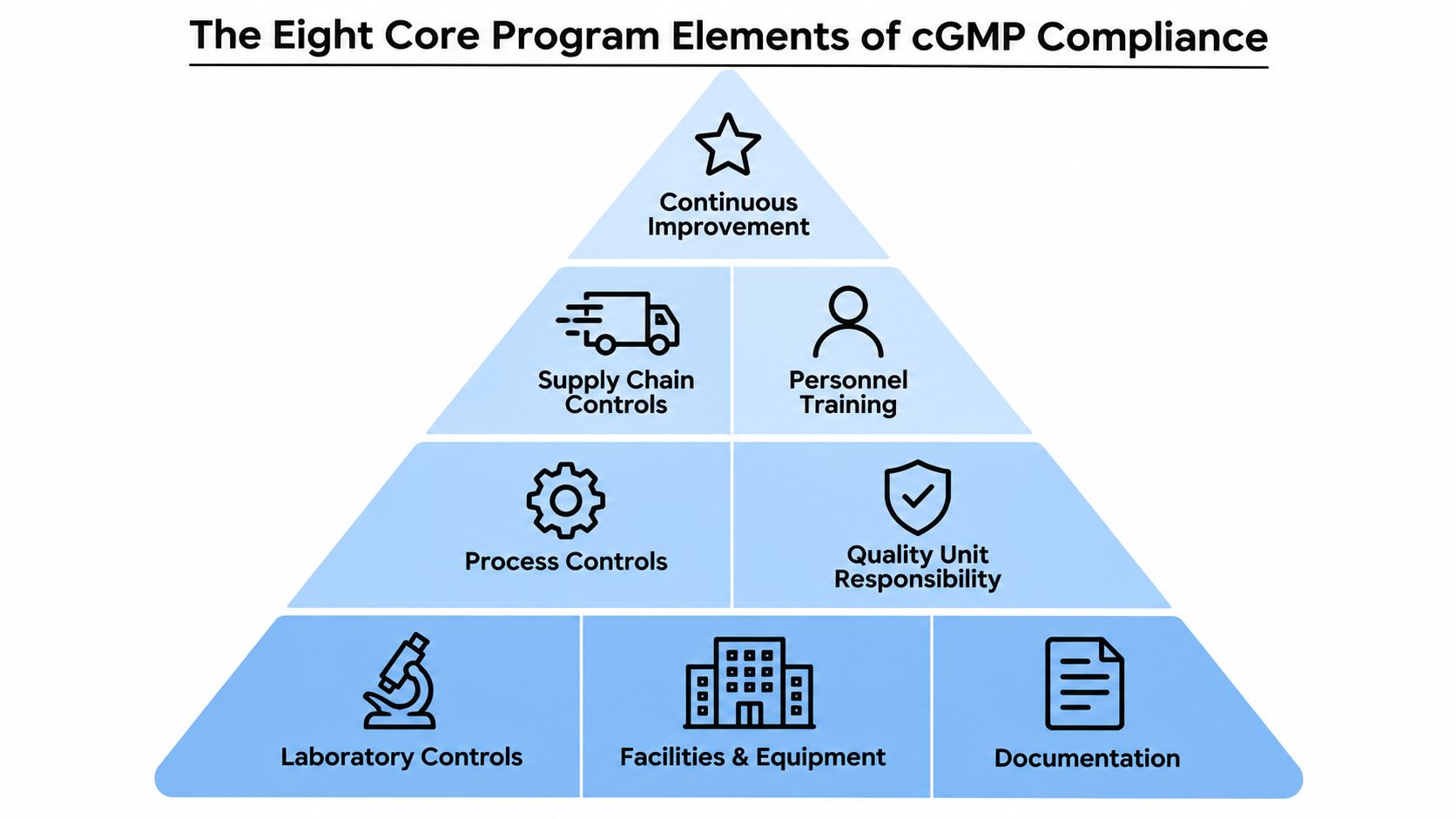
The easiest way to make cGMP less intimidating is to break it into operational building blocks. For a lab supply company, the framework below is the most practical way to think about the program, because it mirrors what gets audited in real facilities.
The structure that holds everything together
At the base sits documentation and records, because no control exists if the evidence disappears. Next comes quality management, the formal system that assigns responsibility, reviews deviations, and decides when a lot can move forward. On top of that are the operational controls, process validation, personnel and training, facilities and equipment, and supplier qualification and incoming controls.
The last two pieces are the ones lab supply teams often underestimate, COA verification and labeling and packaging controls. A clean formulation still fails if the incoming ingredients were never verified correctly, and a compliant reagent can still become noncompliant if the label says the wrong grade, wrong storage condition, or wrong intended use.
A useful way to read the eight elements is to treat them as questions a quality team must be able to answer at any time.
- What system controls the work? That points to the quality management system.
- What proof exists? That points to records and documentation.
- Can the process repeat consistently? That points to validation.
- Did trained people do the work in a suitable facility? That points to personnel, facilities, and equipment.
- Were suppliers and incoming lots verified before use? That points to qualification, sampling, and COA review.
- Was the final package labeled and traceable correctly? That points to packaging and labeling controls.
This structure matters because companies often try to fix cGMP by buying a new form, writing one SOP, or adding a final review signature. That's too narrow. The program has to work across the whole chain, from purchasing through release, because regulators expect quality to be built into every step, not rescued at the end.
Supplier Qualification and Incoming Material Controls
Incoming materials are where cGMP becomes concrete. FDA requires representative sampling of each shipment of each lot of active and inactive ingredients before release for manufacturing, and the sampling plan must be based on statistical criteria such as component variability, confidence level, and required precision (FDA component control Q&A). The reason is straightforward, a material can arrive with a clean appearance and still be wrong, contaminated, or misidentified.
What supplier controls need to prove
For lab reagent companies, supplier qualification starts before the shipment arrives. Purchasing needs to know which suppliers are approved, what each supplier may provide, and what evidence is required before a lot can be used. A COA is useful, but it represents only part of the control system. It still needs to be checked against internal specifications, and the incoming sample has to support the decision to release or reject the lot.
Confusion usually starts here. A clean COA does not excuse weak sampling. A strong supplier relationship complements incoming inspection, it does not replace it. A retest policy also does not repair a poor receiving process. If the wrong ingredient enters the process, the later finished-product test may still miss the original problem.
One practical way to tighten the system is to align supplier records, receiving checks, and document retention so each lot has a complete trail. Many teams also use contract language to clarify roles, and a structured supplier agreement process can help formalize expectations between purchasing, quality, and external partners, such as the approach described by Closer Innovation Labs Corp. supplier eSign.
Incoming material control is a quality decision that happens before production starts.
For teams that want a clearer way to approve vendors, review lots, and check COAs, Herbilabs' guidance on supplier qualification criteria offers a practical reference point. The main point is simple, supplier qualification has to connect purchasing, receiving, and release into one controlled workflow. When those steps sit in separate silos, one missing record can become a serious traceability problem.
Documentation Quality Systems and Validation Standards
Documentation is the evidence that cGMP happened. FDA expects firms to run a documented quality system with qualified raw materials, operating procedures, deviation investigation, and reliable testing laboratories, rather than relying on end-product inspection alone (FDA cGMP regulations overview). In practice, that means batch records, SOPs, test records, and deviation reports have to work together as one coherent system.
What good documentation does
A good batch record shows what was made, when it was made, who made it, what materials were used, and what checks were performed. A good SOP tells the operator how to do the work consistently. A deviation report explains what went wrong, what was investigated, and what prevented the issue from recurring. If any one of those is weak, the whole quality story starts to break.
For sterile diluent and reagent suppliers, validation is just as important as paperwork. Process validation shows that filling, mixing, filtration, and container handling perform consistently under defined conditions. Cleaning validation matters when shared equipment could carry residue between lots. Analytical method validation matters when the lab is relied on to decide whether a lot is acceptable. None of those steps should exist only as a theory in a quality manual.
A strong SOP library also keeps daily work from drifting. Teams looking for a practical way to write and maintain procedures can use a clear reference on avoiding documentation rot in SOPs, especially when the problem is not writing the first version but keeping the living version aligned with actual work.
Where companies usually slip
The most common gap is not missing paperwork, it's stale paperwork. An SOP that no longer matches the filling line, the label template, or the QC workflow creates quiet noncompliance, because staff improvise around the document instead of following it. Another common issue is parallel systems, one for operations, one for QA, and one for regulatory files. That duplication makes inspections harder, not easier.
For a more structured internal approach to records control, many teams keep their reference materials tied to a single source of truth, such as regulatory compliance documentation. The goal is consistency. If a procedure changes, the record system should show the change, the reason for it, and who approved it.
Personnel Facilities and Labeling Compliance
People, rooms, and labels carry more compliance risk than many teams expect. A technician can follow the right method and still create a problem if they were never trained on that version of the SOP. A fill room can look clean and still fail expectations if maintenance, environmental control, or cleaning records are not current. A label can be professionally printed and still be wrong if it does not match the approved product status.
A useful way to picture this is to treat the personnel, facility, and labeling functions as one connected control system. If one part drifts, the others start absorbing the gap. A trained operator who works from an outdated instruction, a storage area with poor controls, or a label template that no longer matches release status can each create a different compliance failure, but the root problem is the same: the system no longer matches the work being done.
The human side of compliance
FDA materials describe cGMP as a system of controls over methods, facilities, and manufacturing controls that assures product identity, strength, quality, and purity, and that framing still applies whether the product is a sterile diluent or a lab reagent. For personnel, that means training cannot stay generic. It needs to match the tasks people perform, and the record set needs to show that the instruction was completed, refreshed when procedures change, and tied to the current version of the SOP. Supervisors should be able to trace who was trained on which SOP, who is qualified to perform each task, and who is responsible for reviewing the work.
The day-to-day version of that requirement is simple. If a person labels cartons, pulls retained samples, or signs off on cleaning status, they should be trained on the exact process they are expected to follow. A training file that only proves attendance does not tell an auditor much. A file that shows the task, the SOP version, the trainer, and the date of qualification gives a clear compliance trail.
Facilities and equipment deserve the same discipline. Cleanable surfaces, controlled storage, maintained filling equipment, and a dependable calibration program are part of the quality system, not facilities trivia. If a room is used for sterile diluent filling, the room conditions and equipment state need to support the intended quality outcome every day, not only on audit day. That is why environmental control records, maintenance logs, and cleaning verification need to be read together, the same way a batch reviewer reads a full record package rather than a single page.
Why labeling deserves special attention
Labeling is where lab supply companies often feel the tension between speed and control. Research Use Only, or RUO, labels, batch identifiers, storage instructions, and hazard communication all have to stay aligned so the customer receives a product with the right intended-use status and traceability. If the batch number on the carton does not match the release record, the recall path becomes difficult immediately.
Inspection-ready labels are boring labels. They do not create interpretation problems for warehouse staff, customers, or auditors.
For companies that sell RUO reagent and diluent products, the label is part of the control system. It should support traceability, prevent misuse, and keep the product status unambiguous across the full shipping and receiving chain. That is why training, maintenance, and labeling should be managed as one integrated workflow rather than three separate departments with unrelated checklists. A team that uses compliance tracking software can keep training, label approval, and follow-up tasks in the same view, which makes it easier to spot when a label change, a qualification gap, or a facility issue needs attention.
Building Your cGMP Compliance Action Plan
A practical action plan starts with the areas most likely to create a release problem, not the areas that are easiest to fix. The first pass should cover supplier qualification, incoming sampling, documentation control, label review, and training records, because those are the places where a lot can lose its traceability fast. Once those controls are stable, process validation and facility/equipment qualification become much easier to sustain.
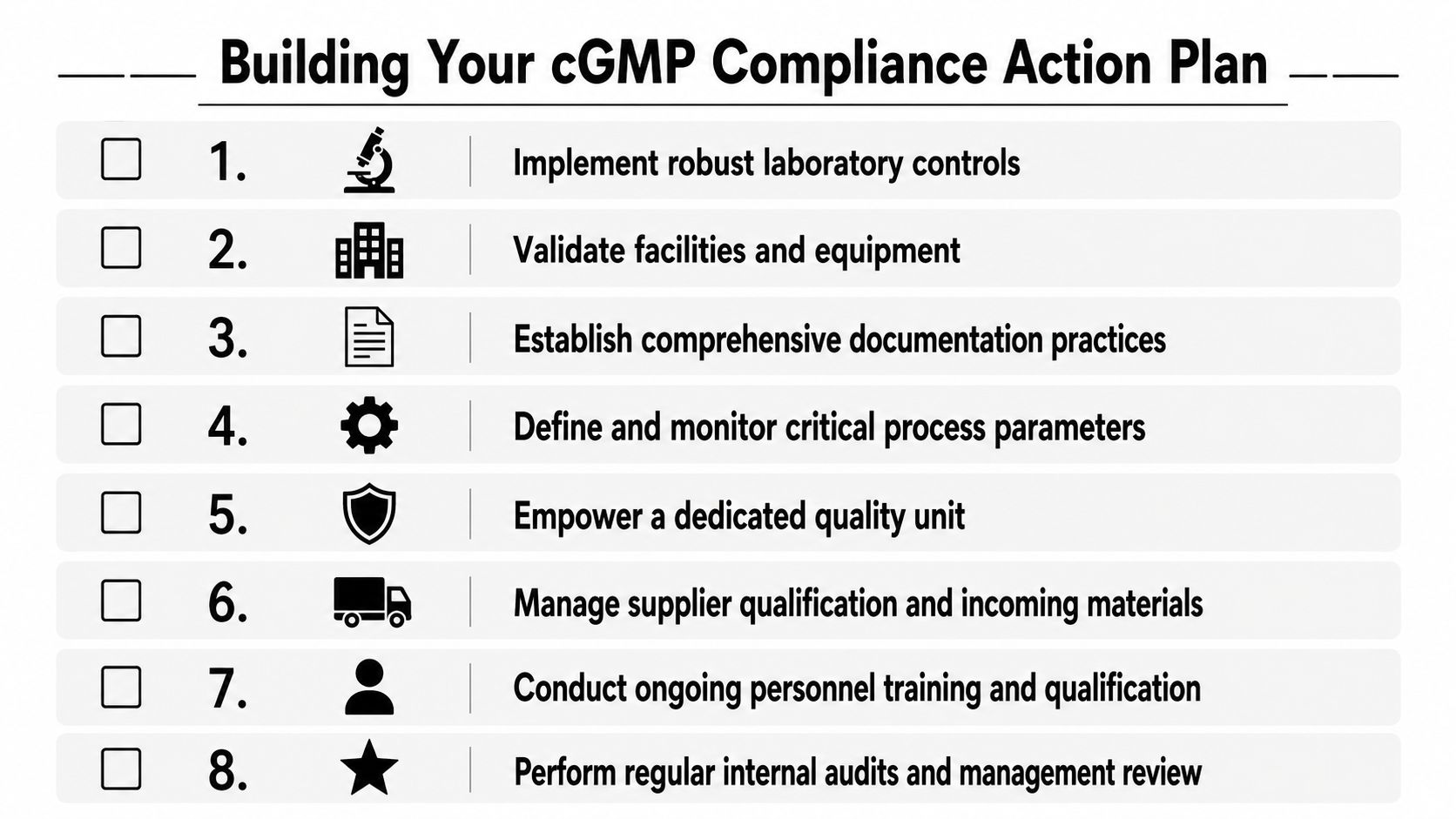
Here is a simple way to prioritize the work.
| Priority | Action |
|---|---|
| High | Lock down supplier qualification, incoming sampling, and COA verification |
| High | Review batch records, SOPs, deviation logs, and label approval steps |
| Medium | Confirm personnel training files, equipment maintenance, and calibration records |
| Medium | Verify process validation and cleaning validation coverage |
| Ongoing | Run internal audits and management review on a repeating schedule |
For teams that want software support rather than spreadsheets and manual follow-up, a system like compliance tracking software can help centralize training, document control, and task tracking in one place. The value is not the software itself, it's the visibility it gives when QA needs to know what is current, what is overdue, and what still needs sign-off.
The strongest programs stay calm under inspection because they don't scramble to build records after the fact. They already know where the evidence lives, who owns each step, and how each lot moved from receipt to release.
Herbilabs works with lab supply teams that need controlled reagents, sterile diluents, and clear lot documentation across EU, UK, and USA operations. For companies building tighter cGMP programs around COAs, supplier controls, and RUO labeling, Herbilabs offers a practical reference point and a source of products built for traceability.