Private Label, White Label, Wholesale partnerships available - EU, USA and UK - Free shipping from €75
What Is Bac Water? Understanding Its Composition & Uses
Bac water is sterile, nonpyrogenic water for injection containing 0.9% benzyl alcohol, or 9 mg/mL, and it's designed so a single vial can support multiple withdrawals under controlled use. In practice, that means it isn't just “clean water.” It's a standardized diluent built for reconstituting drugs or research compounds for intravenous, intramuscular, or subcutaneous injection after another substance is added.
A reader usually asks what bac water is at the exact moment it becomes important. A peptide vial is on the bench. A syringe is ready. The powder in that vial may represent weeks of planning, procurement, or downstream assay work. One wrong choice at the reconstitution step can compromise sterility, consistency, and confidence in the result.
That's why bacteriostatic water deserves more respect than it usually gets. In labs and distribution channels, it sits in the background as a support material. But the support material often determines whether a workflow stays controlled after the first vial puncture. For a new lab technician, the confusion usually starts with naming. “Bac water” sounds casual. The actual product is regulated, specific, and purpose-built. For a wholesaler or sourcing partner, the confusion is different. Two vials may look similar, yet only one may reliably meet the composition and handling expectations that reproducible work depends on.
The useful question isn't only what is Bac Water. The better question is why a sterile diluent with a preservative has become such a basic part of reconstitution workflows, and why quality control matters just as much as the label on the vial.
Table of Contents
- The Critical First Step in Research Integrity
- Understanding Bacteriostatic Water Composition
- Bac Water vs Sterile Water vs Saline Solution
- Common Research Uses for Bacteriostatic Water
- Safety Protocols and Storage Best Practices
- Quality Control and Sourcing for Wholesalers and Labs
- The Foundation of Reliable Research
The Critical First Step in Research Integrity
A common bench scenario looks simple. A technician opens a box, removes a lyophilized vial, and reaches for a diluent. The powder may be stable in dry form, but once reconstitution begins, the margin for error narrows quickly. The choice of water now affects sterility, handling, repeat access, and the practical life of the prepared material.
That's where bac water enters the picture as more than a convenience item. In many research workflows, one vial needs to be entered more than once. A team may prepare a compound, draw a portion, return later, and repeat the process under aseptic handling. A standard sterile diluent without a preservative doesn't support that same use pattern in the same way.
A small decision with large downstream effects
A poor diluent choice can create problems that don't announce themselves immediately. The solution may still look clear. The label may still look professional. But if the vial isn't suitable for repeated puncture, the risk profile changes with every access event.
Practical rule: Reconstitution is not a clerical step. It's a control point that affects everything that follows, including consistency between withdrawals and confidence in the material inside the vial.
For researchers, this matters because repeatability starts before measurement. For wholesalers, it matters because customers rarely complain about a diluent on day one. They complain when results vary, handling feels uncertain, or quality questions surface after a product has already entered the workflow.
Why the right diluent supports better decisions
Bac water solves a narrow but important operational problem. It gives labs a sterile vehicle intended for dilution or dissolution before injection, while supporting a multiple-dose format when handled correctly. That combination is what makes it foundational rather than interchangeable.
New team members often assume the active compound carries all the value. In reality, the inactive components of a workflow often protect that value. A delicate powder can be excellent, but if it's reconstituted with the wrong support material or with poorly controlled product quality, the experiment starts on uncertain ground.
For that reason, the first question on the bench shouldn't just be “what needs to be mixed?” It should also be “what diluent was selected, and can its specification be trusted?”
Understanding Bacteriostatic Water Composition
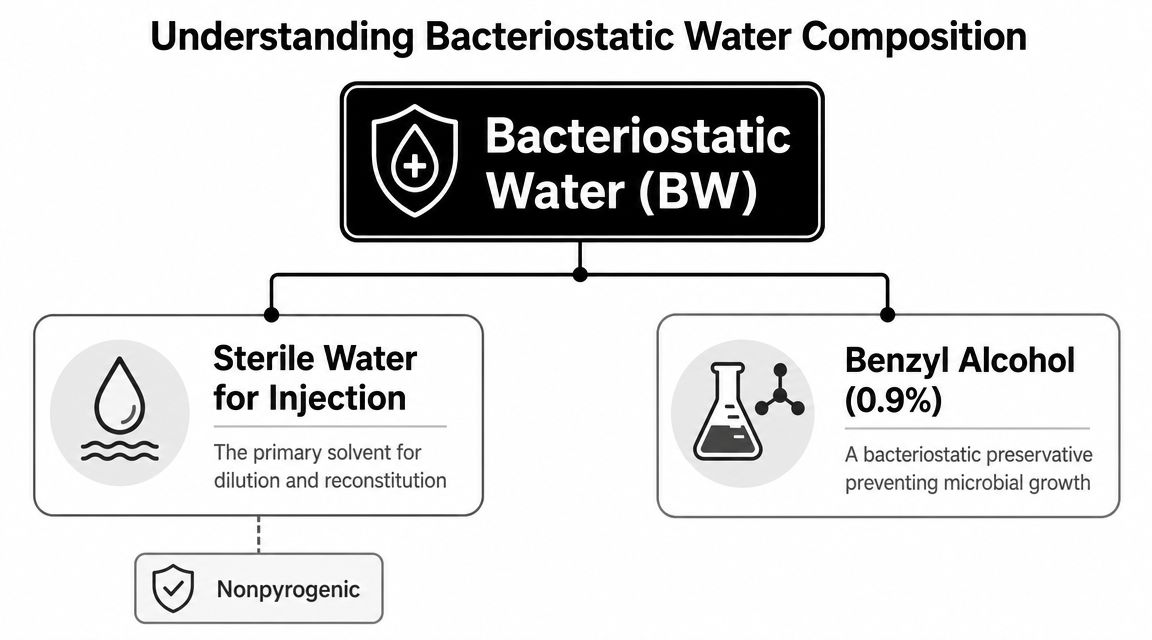
Bacteriostatic Water for Injection, USP is formally defined by DailyMed's FDA labeling for Bacteriostatic Water for Injection, USP as a sterile, nonpyrogenic preparation of water for injection containing 0.9% benzyl alcohol, or 9 mg/mL, as a preservative. The same labeling states that it's supplied in a multiple-dose container, is indicated for diluting or dissolving drugs for intravenous, intramuscular, or subcutaneous injection after addition of suitable drugs, and is not for use in neonates.
What the product actually is
That definition clears up the biggest misunderstanding. Bac water is not a therapeutic product by itself. It's a sterile vehicle used after another substance is added. Its job is to support proper dilution or dissolution, not to create the biological effect being studied.
The composition is simple, but the simplicity is deceptive. Every word in that definition matters.
- Sterile water for injection means the water is prepared for parenteral use.
- Nonpyrogenic means the product is intended to avoid pyrogen-related contamination concerns.
- Benzyl alcohol at 0.9% gives the product its bacteriostatic character.
- Multiple-dose container describes how the vial is intended to function in use.
Why benzyl alcohol matters
The preservative doesn't turn the vial into an indestructible sterile environment. It slows bacterial growth. That distinction matters because many readers hear “bacteriostatic” and assume “sterilizing.” Those are not the same thing.
A practical analogy helps. Benzyl alcohol acts more like a security guard than a cleanup crew. It helps prevent stray contaminants from establishing and multiplying after repeated vial access, but it doesn't excuse poor technique and it doesn't reverse contamination once handling has gone wrong.
Benzyl alcohol supports repeated sterile access. It doesn't replace aseptic technique.
This is why bac water is useful in repeated-withdrawal workflows while plain sterile water is often chosen for different handling assumptions. The preservative is the feature that distinguishes the product in day-to-day lab use.
A second point often gets overlooked by buyers. The benefit depends on the correct concentration being present. If a gray-market or poorly controlled product contains the wrong amount of benzyl alcohol, then the operational logic behind using bac water starts to break down. A label may say “bac water,” but the product only performs as expected if the composition matches the standard.
Bac Water vs Sterile Water vs Saline Solution
Three clear liquids sit in many storerooms and get treated as if they're interchangeable. They aren't. The selection should follow the protocol, the intended use after reconstitution, and whether repeated withdrawals are expected.
Diluent comparison guide
| Characteristic | Bacteriostatic Water | Sterile Water for Injection | Normal Saline (0.9% NaCl) |
|---|---|---|---|
| Core composition | Sterile water with benzyl alcohol preservative | Sterile water without bacteriostatic preservative | Sterile salt solution |
| Primary function | Dilution or reconstitution where repeat access may be needed | Dilution or reconstitution when preservative-free handling is required | Dilution where isotonic salt content is appropriate |
| Container use pattern | Commonly used in multi-dose workflows | Often treated as single-use depending on product format and protocol | Depends on product format and application |
| Why teams choose it | Preservative supports repeated withdrawals under aseptic handling | Chosen when preservative-free diluent is preferred or required | Chosen when sodium chloride content matters to the preparation |
| Main caution | Not suitable for every drug or every patient population | Less forgiving for repeat vial entry because there's no bacteriostatic preservative | Not a universal substitute for water-based reconstitution |
The easiest way to think about the difference is to ask what problem the liquid is solving.
Bac water solves a repeat-access problem. Sterile water solves a preservative-free dilution problem. Saline solves an isotonicity problem. If the wrong problem is being solved, the wrong liquid gets chosen.
How labs usually choose
When a workflow involves a powdered material that will be re-entered across multiple withdrawals, teams often lean toward bac water because the preservative supports that pattern of use. When a protocol or compatibility requirement calls for no preservative, sterile water is the more appropriate reference point. When sodium chloride is relevant to the intended preparation, saline enters the discussion for that reason, not because it's “close enough.”
A buyer evaluating options can compare water for injection product types and handling contexts to see where formulation differences matter in practice. The useful mindset is functional rather than superficial. Clear liquids can behave very differently in a controlled workflow.
A vial should be chosen for the job it's designed to do, not because it looks similar on the shelf.
Many avoidable mistakes start when someone sees “water,” ignores preservative status, and assumes all reconstitution steps are equivalent. They aren't. If a lab intends multiple punctures, a non-preserved diluent changes the contamination risk profile. If a formulation requires something preservative-free, bac water may be the wrong choice even though it's common.
The correct diluent is the one that fits the protocol, compatibility requirements, and access pattern of the vial after opening.
Common Research Uses for Bacteriostatic Water
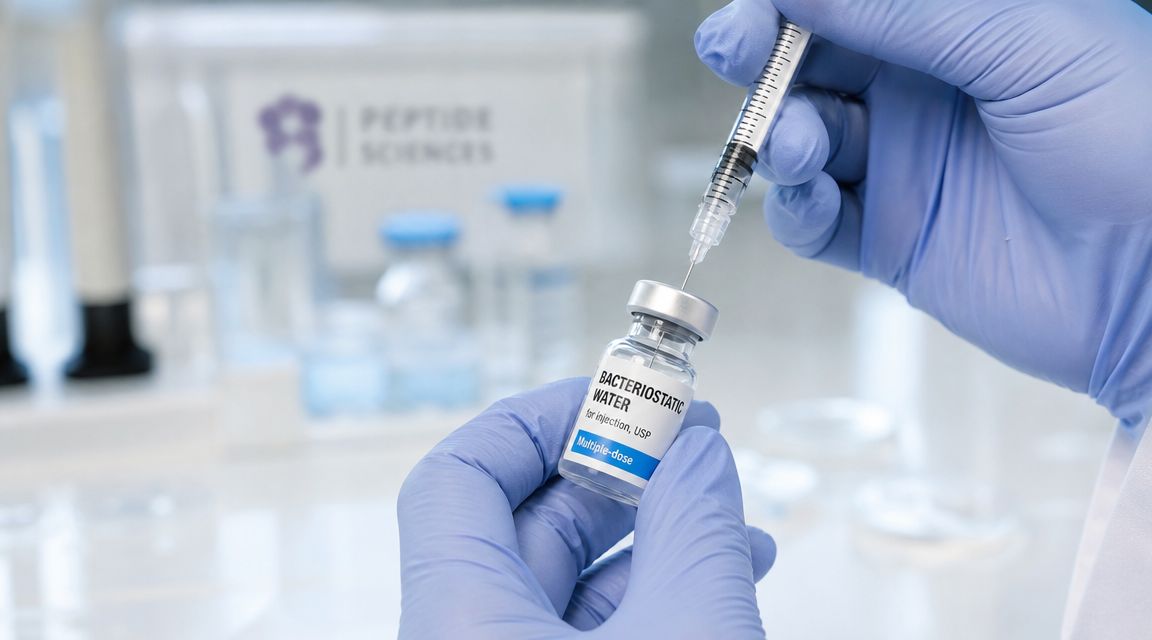
In research settings, bac water is most closely associated with reconstitution of powdered materials that won't be used all at once. That's why it appears so often in peptide workflows, hormone-related experimental preparations, and other situations where a dry compound is converted into a liquid that must remain usable across more than one withdrawal.
Why peptide workflows rely on it
Lyophilized peptides are a good example because they make the value of bac water easy to see. In dry form, the material is packaged for stability and storage. Once the researcher needs a working solution, the powder has to be dissolved in a suitable sterile diluent. If the study design calls for repeated draws from the same vial over time, the preservative becomes operationally useful.
The practical advantage is stated clearly in this overview of bacteriostatic water benefits and research workflows: the main advantage of bac water is multi-dose stability, making it useful for reconstituting powdered substances where repeated withdrawals are needed, reducing vial waste and improving convenience in research workflows.
That benefit affects daily lab behavior. A researcher can prepare one vial carefully, label it, store it correctly, and withdraw measured portions later under aseptic technique instead of opening a fresh diluent for every small use event.
Where the workflow gains show up
The gains are usually practical before they're financial.
- Less avoidable waste: When one prepared vial can support multiple controlled withdrawals, teams discard fewer partially used materials.
- Smoother titration work: Repeated small-volume access becomes easier to manage in workflows where measurements are adjusted over time.
- Better continuity: A single, properly prepared vial can support a sequence of related research actions without constant re-preparation.
For teams that need a procedural reference, how to mix peptides with bacteriostatic water gives a lab-oriented overview of the reconstitution process.
A short visual walkthrough also helps clarify how the material is handled in real settings:
The key point is simple. Bac water earns its place when a workflow needs controlled reuse after the first puncture. If there's only one immediate withdrawal and no need for preservative-supported repeat access, another diluent may fit better. The value of bac water is not that it's universally superior. The value is that it matches a specific and very common research need.
Safety Protocols and Storage Best Practices
The most useful property of bac water can also invite complacency. A preservative-supported vial feels forgiving, so some users become casual after the first puncture. That's where quality slips start. The vial must still be handled as a sterile product every time it's accessed.
Handling rules that protect the vial
A practical handling protocol should stay simple enough that every technician follows it the same way.
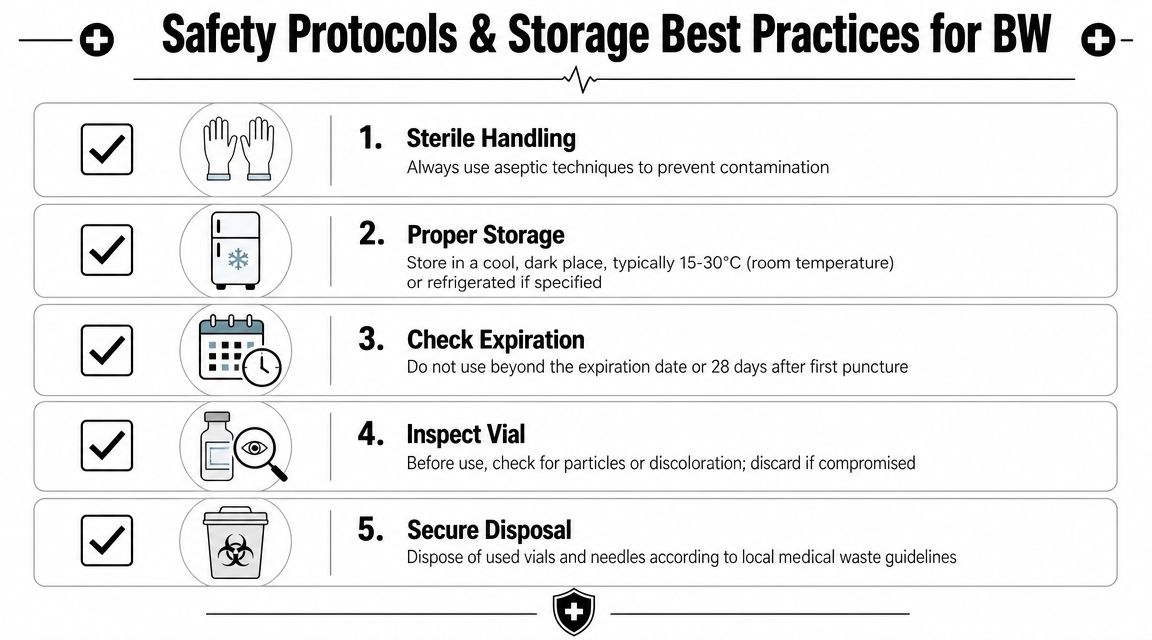
- Swab the stopper each time: The septum should be disinfected before each needle entry so contamination isn't introduced mechanically.
- Use sterile needles and syringes: Re-entry only works safely when every access event stays clean.
- Store under appropriate conditions: The label or product instructions should guide storage, and the vial should be kept away from avoidable heat and light exposure.
- Label the first puncture date: Staff need a visible date on the vial, not a memory-based estimate.
- Discard compromised vials: If the solution shows cloudiness, particles, discoloration, or any sign of mishandling, it shouldn't stay in circulation.
A broader lab reference on bacteriostatic water storage protocols can help teams standardize those steps across benches and shifts.
What to check before every withdrawal
The most important time limit is the post-opening handling window. This summary of bac water handling guidance notes that the preservative design supports a 28-day post-opening use window, which has become a standard benchmark, and ties that window to the time-limited protection offered by the 0.9% benzyl alcohol preservative.
That point is often misunderstood. The vial doesn't suddenly “expire” because the liquid changes appearance on a specific day. The issue is that the preservative-supported protection is not treated as indefinite after repeated access.
The 28-day benchmark is a handling rule, not a suggestion. It exists because repeated puncture changes the risk profile over time.
A quick pre-use check should answer three questions:
- Was the vial opened within the accepted use window?
- Does the liquid still look normal?
- Has the vial been stored and accessed correctly?
If any answer is uncertain, the safest response is disposal and replacement. That may feel conservative in the moment, but it protects the sample, the assay, and the credibility of the resulting data.
Quality Control and Sourcing for Wholesalers and Labs
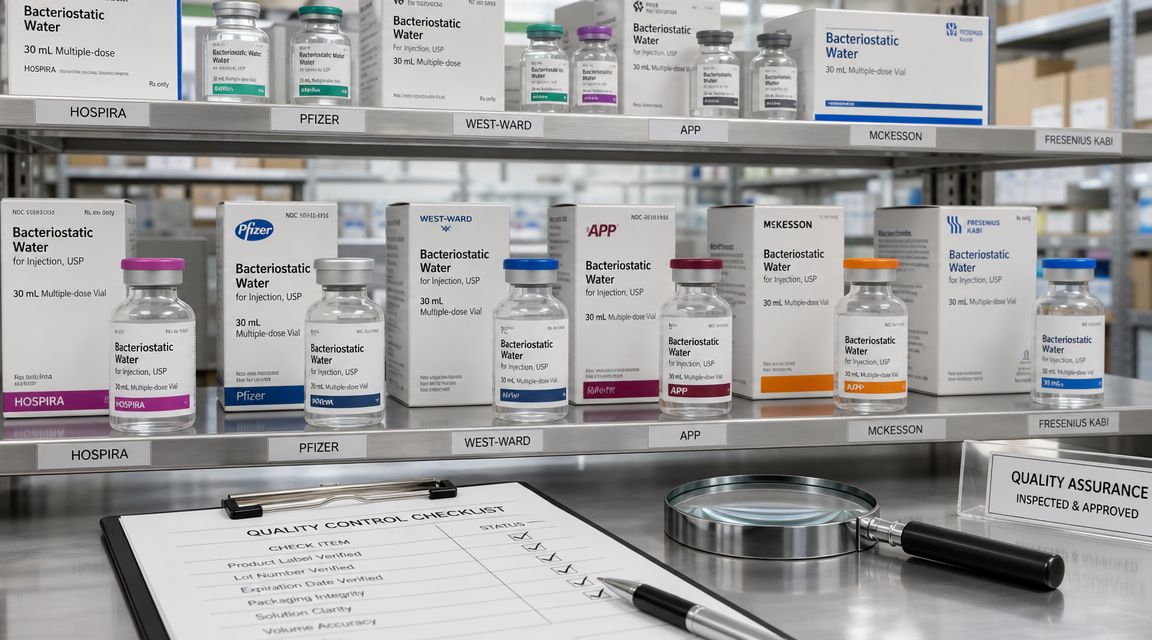
A receiving team opens a new shipment of bac water. Every vial is sealed. Every label looks clean. Every carton appears professional. That visual check matters, but it does not answer the question that protects research and the business behind it: does the product in the vial match the specification the lab expects to use?
What separates a compliant vial from a risky one
Bacteriostatic water is simple on paper, which is exactly why sourcing mistakes get overlooked. A buyer may assume that water plus benzyl alcohol is a low-risk commodity. In practice, small deviations create large downstream problems. If preservative concentration is wrong, if pH falls outside the expected range, or if contamination controls are weak, the vial stops behaving like a standardized research supply and becomes a variable in the experiment.
A useful warning comes from an independent video discussing lab-testing claims for unregulated bac water products. It describes products with pH outside the USP range of 4.5 to 7, incorrect benzyl alcohol levels, and endotoxin contamination. Those are not minor paperwork defects. They affect whether the diluent performs as expected and whether a lab can trust work built on that material.
For a lab, the risk is technical. Reconstitution conditions change without the team realizing it. For a wholesaler, the risk is technical and commercial at the same time. An unverifiable product can trigger complaints, returns, internal audits, and damage to customer confidence.
What buyers should ask suppliers to prove
A careful buyer should ask for records that show control of the product, not broad assurances about quality.
- Composition verification: The supplier should document that the formulation matches the expected standard for bacteriostatic water.
- Sterility and contamination controls: The batch release process should show how the product is checked before distribution.
- Batch-level traceability: Each vial or case should tie back to a lot record rather than only a catalog description.
- Use classification: If the product is positioned for laboratory workflows, its Research Use Only status should be stated clearly where applicable.
- Packaging consistency: Closures, labels, and vial presentation should stay consistent across batches so handling procedures remain consistent too.
This matters for reproducibility as much as compliance. Researchers often focus on the active compound, but the diluent is part of the system. If one lot of bac water differs from the next, the lab has introduced an uncontrolled input before the assay even begins.
Herbilabs states that it supplies bacteriostatic water and reconstitution solutions for laboratory use under a Research Use Only framework. That kind of statement is useful only when it is backed by clear documentation, lot control, and a supply chain the buyer can review.
Buyers should purchase a defined specification with traceable controls, not rely on packaging that merely looks legitimate.
The practical sourcing standard is straightforward. Choose suppliers that can show what the vial contains, how the batch was released, and how the product can be traced if a question arises later. That protects bench work, customer relationships, and the credibility of the final data.
The Foundation of Reliable Research
Bac water looks simple because its ingredients are simple. But the role it plays isn't minor. It is a standardized sterile diluent containing 0.9% benzyl alcohol that supports repeated withdrawals when the workflow and handling practices call for that format. That's why it shows up so often anywhere powdered compounds must be reconstituted and used across time rather than in a single immediate step.
The most useful takeaway is that bac water shouldn't be treated as background inventory. In a controlled research environment, the diluent affects how a vial is handled, how long it remains suitable after opening, and how confidently a team can interpret downstream work. When the preservative concentration, sterility, or documentation is uncertain, the problem isn't just a purchasing issue. It becomes a research integrity issue.
For wholesalers and distribution partners, this raises the standard. Customers don't just need product availability. They need consistent packaging, credible batch controls, and sourcing decisions they can defend to internal teams. For labs, the same principle applies on the bench. Good technique matters, but good technique can't rescue a poor-quality vial.
Reliable science often depends on small decisions that don't look dramatic at the time. Selecting, handling, and sourcing bacteriostatic water properly is one of those decisions. Teams that treat it with the same discipline they apply to their core reagents usually get something valuable in return. Fewer avoidable variables, clearer workflows, and stronger confidence in the work built on top of that first reconstitution step.
For labs, peptide resellers, and distribution partners that need documented bacteriostatic water and related sterile reconstitution supplies for laboratory workflows, Herbilabs is one option to review. The company provides RUO-focused lab supply information for EU, UK, and international research customers, which can help buyers compare sourcing standards, product documentation, and fulfillment fit before placing recurring orders.