Private Label, White Label, Wholesale partnerships available - EU, USA and UK - Free shipping from €75

How to Mix Peptides with Bacteriostatic Water: Guide
A sealed vial of lyophilized peptide can look deceptively simple. The powder is dry, compact, and stable. Significant risk begins the moment liquid enters that vial.
The reconstitution step determines whether many research workflows stay controlled or start drifting. A rushed reconstitution can introduce contamination, create the wrong concentration, damage a delicate peptide during mixing, or leave behind partially dissolved material that undermines every downstream step. When the compound is costly and the experimental plan depends on consistency, those mistakes aren't minor handling issues. They become data quality problems.
Individuals researching how to mix peptides with bacteriostatic water usually need more than a checklist. They need the reasoning behind each movement, each pause, and each handling decision. That reasoning is what prevents avoidable errors.
Table of Contents
- Precision in a Vial The Critical First Step in Peptide Research
- Gathering Your Tools and Setting a Sterile Stage
- Translating Concentration into Volume The Reconstitution Math
- A Step-by-Step Guide to Mixing Peptides
- Preserving Peptide Integrity After Reconstitution
- Verifying Success and Solving Reconstitution Problems
Precision in a Vial The Critical First Step in Peptide Research
The critical moment usually looks ordinary. A researcher has the peptide vial, the diluent, a syringe, and a plan. What happens next determines whether the reconstituted solution reflects the intended concentration and whether the peptide enters the study intact.
Reconstitution isn't just prep work. It's a control point. If sterility slips, contamination risk rises. If the volume is wrong, the concentration is wrong. If the peptide is handled too aggressively, the material may still look usable while behaving unpredictably in the workflow.
That is why careful teams treat mixing as part of the experiment, not as a task that happens before the experiment starts. The vial doesn't get a second first opening. Once the stopper is pierced and the liquid is added, every handling choice leaves a trace in the final solution.
Practical rule: The goal isn't only to dissolve the powder. The goal is to create a solution that remains accurate, clean, and reproducible from the first draw to the last.
The most common costly errors happen because someone focuses on speed instead of mechanism. They inject too fast, shake the vial, skip stopper disinfection, or estimate the volume instead of calculating it. Each shortcut looks small. Together they can make later results hard to trust.
A useful starting point is understanding why bacteriostatic water is selected in repeated-access workflows and how that choice fits into a controlled process. Herbilabs covers that distinction clearly in its guide to selecting bacteriostatic water for research workflows.
The right mindset is simple. Every action should protect one of three things: sterility, concentration accuracy, or peptide integrity. If a step doesn't support one of those outcomes, it probably doesn't belong in the procedure.
Gathering Your Tools and Setting a Sterile Stage
A clean reconstitution starts before any liquid is drawn. Most handling failures begin with setup errors, not mixing errors. Missing tools, cluttered surfaces, and unverified labels force unnecessary movement and create opportunities for contamination.
What needs to be on the bench
The work area should be prepared with only the items required for the task:
- Lyophilized peptide vial. Confirm the vial label matches the intended compound and stated mass. The amount in the vial is the basis of every calculation that follows.
- Bacteriostatic water. This is the diluent used when the same vial will be accessed repeatedly. One example sold for research workflows is the Herbilabs reconstitution solution, a bacteriostatic water product intended for dissolving lyophilized materials.
- Sterile syringe and needle. The syringe is both a measuring device and a transfer device. If it isn't sterile or if the graduation marks are ignored, both contamination control and concentration control suffer.
- Alcohol prep pads. These are for disinfecting vial stoppers before needle entry.
- Gloves and basic PPE. Gloves reduce direct contact contamination and help maintain a controlled handling routine.
- Lab marker and label. Once the vial is mixed, it should be identified immediately with the compound name, concentration, and reconstitution date.
- Certificate of Analysis. The COA should be reviewed before reconstitution so the compound identity and listed specifications are clear.
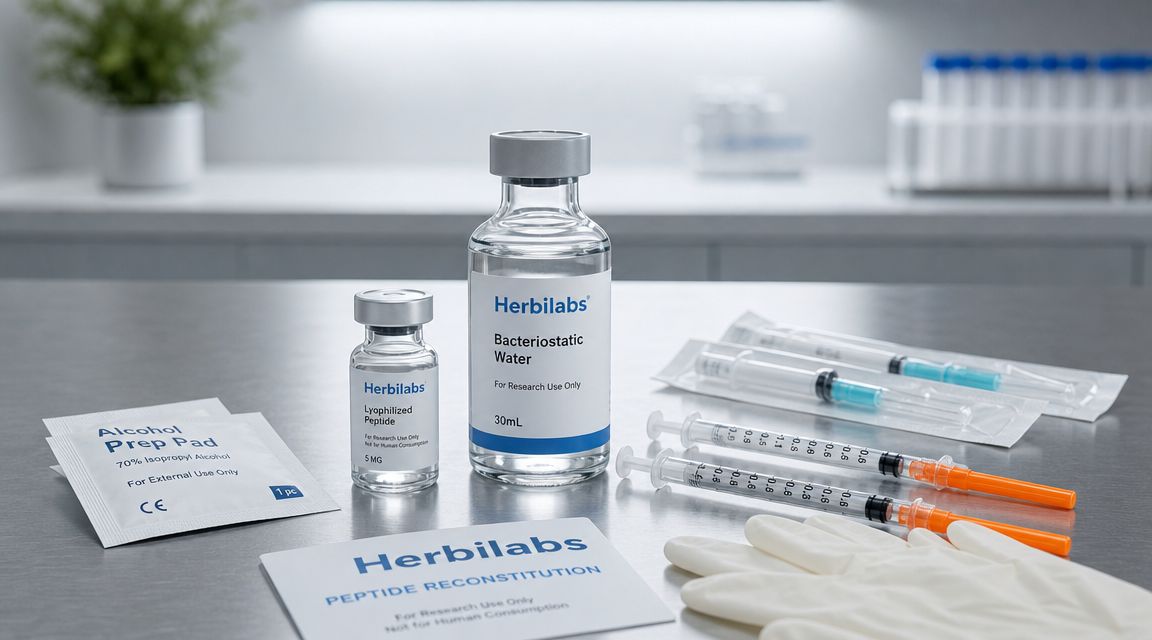
The COA check matters because reconstitution math is only as good as the information used to set it up. If the vial mass is misunderstood or the vial is confused with a different peptide, the final solution can be perfectly mixed and still be wrong.
Why the sterile field matters before the needle moves
A sterile field doesn't need to be elaborate, but it does need to be intentional. The surface should be clean, dry, and uncluttered. Open packaging should be minimized. Hands should be gloved before handling sterile components, and the vial stoppers should be swabbed and allowed to dry before puncture.
A lot of contamination comes from interruptions. Someone realizes the label isn't ready, reaches across the bench for a pen, sets down an uncapped syringe, then returns to the vial. Each extra motion widens the chance of non-sterile contact.
Clean handling is a sequence, not a single action. A swabbed stopper doesn't stay effectively protected if the rest of the workflow is disorganized.
Researchers who want a tighter routine can borrow from standard aseptic techniques for accurate lab research. The key idea is that sterility is easier to preserve than to recover. Once doubt enters the process, the solution should be treated cautiously.
Translating Concentration into Volume The Reconstitution Math
Many peptide handling problems start with uncertainty about concentration. The powder dissolves, but the researcher still isn't sure what each measured volume now contains. That uncertainty can be avoided with one simple calculation done before the syringe is filled.
The formula that controls the whole workflow
The standard calculation is:
Volume of diluent = Amount of peptide / Desired concentration
If a vial contains 5 mg of peptide and the desired final concentration is 1 mg/mL, then the required bacteriostatic water volume is 5 mL. That produces a solution where each 0.1 mL contains 0.1 mg.
The concentration determines how usable the solution will be in the actual research protocol. A more concentrated solution reduces the volume needed per measured draw. A less concentrated solution may allow finer control in protocols that require smaller dose increments by mass.
Here is the same vial recalculated at different target concentrations.
Example Reconstitution Calculation for a 5mg Peptide Vial
| Desired Final Concentration (mg/mL) | Required Bacteriostatic Water (mL) | Resulting Dose per 0.1mL (mg) |
|---|---|---|
| 1 | 5 | 0.1 |
| 2 | 2.5 | 0.2 |
| 2.5 | 2 | 0.25 |
| 5 | 1 | 0.5 |
The lesson in that table is practical. The vial content doesn't change. Only the dilution volume changes. That change alters how much peptide is present in every measured fraction of liquid.
A common mistake is choosing the water volume first because it seems convenient, then trying to work backward later. That approach creates confusion at the point of use. It's better to decide the target concentration from the needs of the protocol and then calculate the volume from that decision.
If the concentration isn't written down before mixing, the risk of a handling error rises immediately.
Another avoidable problem is forgetting vial capacity. The mathematically correct volume still has to fit the physical container without creating an awkward fill level that complicates mixing or withdrawal. Matching the calculation to the container therefore becomes critical. A practical reference on matching vial volume to a research application can help prevent that mismatch.
For researchers learning how to mix peptides with bacteriostatic water, the math should feel boring. That's a good sign. The calculation isn't supposed to be improvisational. It should be repeatable enough that the physical reconstitution becomes the only variable worth watching closely.
A Step-by-Step Guide to Mixing Peptides
The actual mixing step is where precision has to become physical technique. The right volume on paper won't protect the peptide if the liquid is injected badly or the vial is agitated too aggressively.
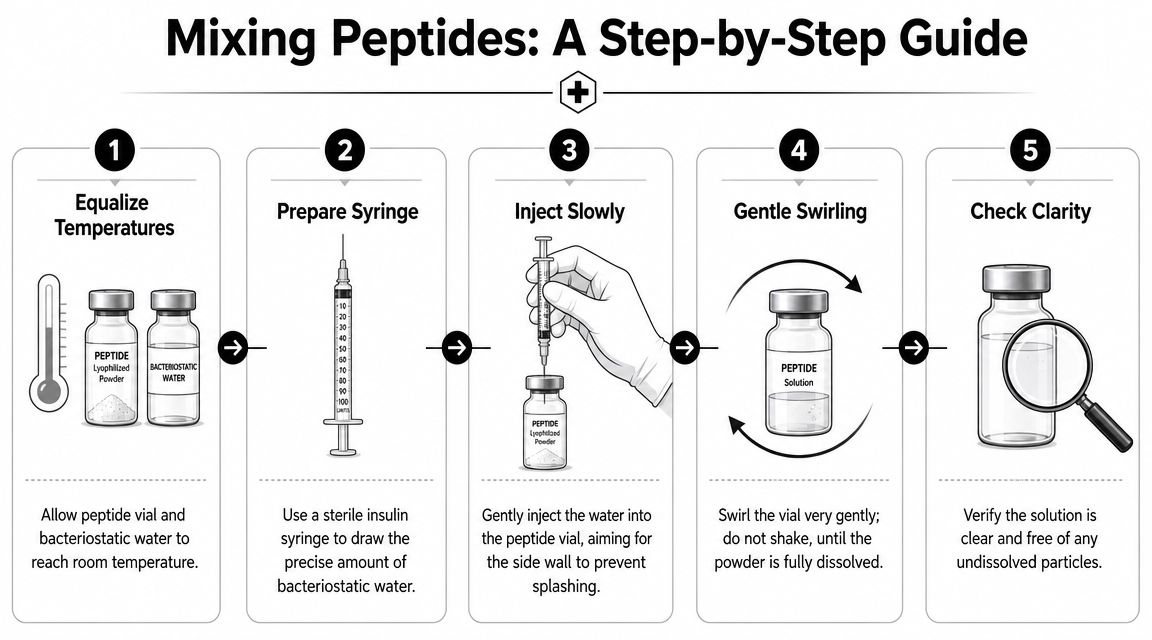
A useful visual reference appears below.
Before adding any liquid
Both the peptide vial and the bacteriostatic water should be allowed to reach room temperature before mixing, and the standard handling guidance for repeated vial access favors bacteriostatic water over plain sterile water because it contains preservatives that reduce bacterial growth after opening, as described in this peptide reconstitution guidance on bacteriostatic water.
That temperature step gets ignored more often than it should. Cold components can slow dissolution and make researchers think the peptide is resisting the solvent when the issue is due to temperature difference. Room-temperature handling also makes the liquid behavior more predictable during injection.
The sequence should stay controlled:
- Disinfect both vial stoppers with fresh alcohol pads.
- Allow the alcohol to dry before needle entry.
- Draw the pre-calculated volume of bacteriostatic water into a sterile syringe.
- Check the syringe marking twice before moving to the peptide vial.
Drying time after swabbing matters because a wet stopper is not the same as a clean, ready stopper. Rushing through this point can transfer residue and undermine the whole purpose of the disinfection step.
A short video can help reinforce the physical flow of the process.
The injection step that causes most problems
Insert the needle through the peptide vial stopper and direct the flow down the inside wall of the vial, not straight into the powder bed. Then depress the plunger slowly.
This is the step that protects the peptide from unnecessary force. A direct jet into the powder can create splashing, foaming, and localized turbulence. Even when the solution later looks acceptable, that rough entry can make dissolution less uniform and increase bubble formation.
Shaking is the next major error. The vial should be gently swirled or rolled between the fingers. The objective is to bring solvent into contact with the peptide without whipping air into the solution or stressing the material mechanically.
A peptide doesn't need persuasion. It needs contact time and a quiet solvent environment.
How to know when mixing is complete
Once the liquid is in the vial, the researcher should pause and watch rather than immediately manipulate the vial further. Many lyophilized peptides dissolve readily once the solvent has spread across the powder surface.
The endpoint is visual. The solution should appear uniform and free of visible residue. If particles remain briefly after the first swirl, patience is better than force. More agitation isn't automatically better mixing.
That restraint is one of the hardest parts of learning how to mix peptides with bacteriostatic water correctly. The instinct to hurry usually shows up right after the liquid goes in. In practice, the best handling often looks uneventful: slow injection, minimal movement, and a calm final solution.
Preserving Peptide Integrity After Reconstitution
A successfully dissolved peptide can still be mishandled minutes later. Post-reconstitution care is where many labs lose consistency, especially when multiple people access the same vial over time.
Label first and refrigerate promptly
The vial should be labeled as soon as the solution is clear. At minimum, the label should include the peptide identity, the final concentration, and the reconstitution date. If a team works in shared storage, adding initials or a study identifier helps preserve traceability.
That label isn't clerical housekeeping. It prevents one of the most damaging bench mistakes in peptide work, which is using a correctly mixed vial under the wrong concentration assumption.
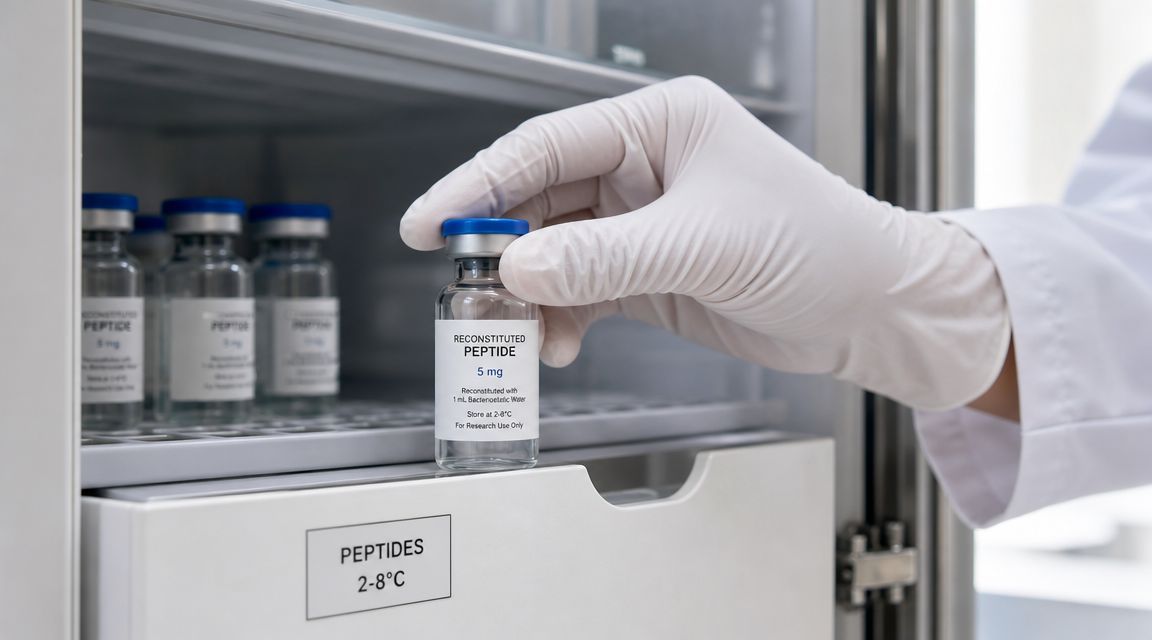
Reconstituted peptide solutions should then be moved to refrigerated storage without unnecessary bench time. Repeated warming and cooling cycles can complicate handling quality even when contamination is avoided.
Short-term handling versus long-term storage
Storage windows depend on whether the peptide is still lyophilized or has already been reconstituted. Guidance compiled for peptide reconstitution states that lyophilised peptides can remain stable for up to 48 months at -20°C, while refrigerated storage at 2–8°C is typically measured in weeks. One source cites 2–8 weeks, and another recommends use within 28 days after reconstitution with bacteriostatic water, according to this compiled peptide storage guidance.
Those constraints explain an important trade-off. Bacteriostatic water supports short-term refrigerated use after reconstitution, but it doesn't create indefinite stability. It reduces bacterial growth risk after opening. It does not remove the need for conservative storage windows or cold-chain discipline.
A practical storage routine looks like this:
- Keep unopened lyophilized material under appropriate cold storage if the protocol calls for delayed use.
- Store reconstituted vials in refrigeration and return them promptly after each access.
- Minimize repeated handling by planning withdrawals carefully.
- Check the label every time before drawing from the vial.
Researchers often think of reconstitution as the only sensitive moment. In reality, every later stopper puncture becomes part of the same chain of custody. Precision doesn't end when the powder disappears.
Verifying Success and Solving Reconstitution Problems
A vial can be dissolved and still not be acceptable. Quality control at this stage depends on visible inspection and disciplined judgment. The solution should be evaluated before it is treated as ready.
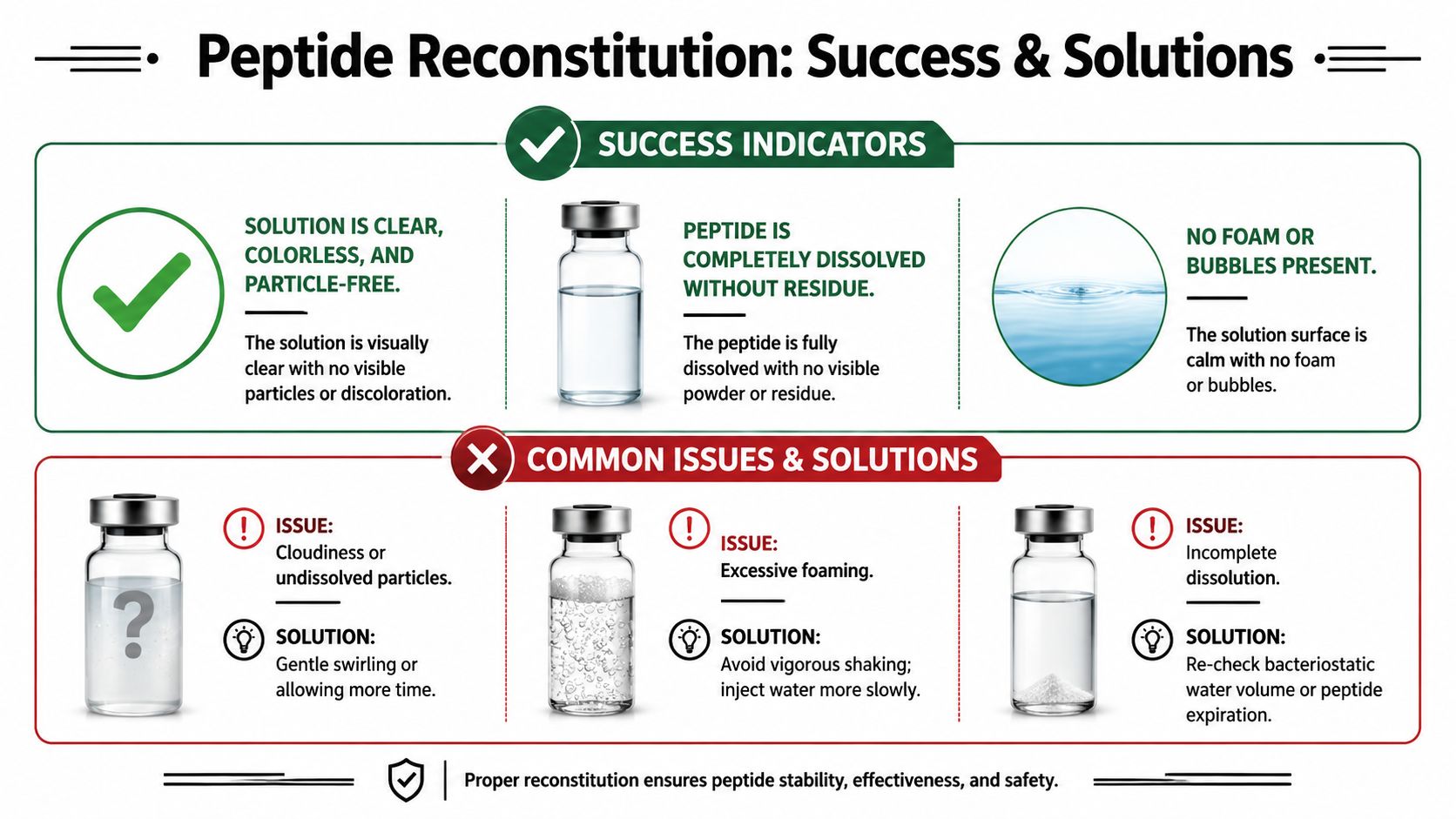
Clear solution versus warning signs
Expert guidance indicates that most lyophilized peptides dissolve within a few minutes, though some protocols advise waiting 15–30 minutes if particles remain before swirling again. The same guidance uses visible clarity as the key success criterion and identifies cloudiness, undissolved particulates, bubbling from overly fast injection, and contamination from poor stopper disinfection or non-sterile handling as common failure modes in this peptide troubleshooting reference.
That gives a practical comparison:
| Observation | Likely meaning | Action |
|---|---|---|
| Clear, particle-free solution | Reconstitution appears successful | Label and store appropriately |
| Small particles shortly after mixing | Dissolution may still be incomplete | Wait, then gently swirl again |
| Persistent cloudiness | Possible incompatibility, incomplete dissolution, or contamination | Treat cautiously and assess whether to discard |
| Excess bubbles or foam | Injection was likely too fast or mixing was too vigorous | Let the vial rest and reassess clarity |
| Visible residue at bottom after adequate wait | Incomplete dissolution or setup error | Recheck the recorded volume and vial details |
A practical go or no-go check
The first go/no-go rule is visual clarity. If the solution isn't clear and uniform after appropriate settling time and gentle handling, it shouldn't be assumed acceptable just because most of the powder disappeared.
The second rule is procedural confidence. If stopper disinfection was skipped, if non-sterile handling occurred, or if the wrong volume may have been added, the issue is no longer just cosmetic. It becomes a reliability problem.
When uncertainty affects sterility or concentration, caution is cheaper than rebuilding a compromised data set.
Troubleshooting should stay conservative. A peptide that needs more time is different from a peptide solution that shows persistent haze or signs of contaminated handling. Researchers protect integrity by distinguishing those cases early and documenting what happened instead of forcing a questionable vial back into service.
Herbilabs provides research-use bacteriostatic water, reconstitution solutions, and sterile labware for teams that need controlled peptide preparation workflows. Researchers, resellers, and distribution partners can review available products and technical information at Herbilabs.