Private Label, White Label, Wholesale partnerships available - EU, USA and UK - Free shipping from €75
Essential Protocols for Bacteriostatic Water Storage in Labs
Follow these essential protocols to ensure the purity and efficacy of bacteriostatic water in your laboratory.
The integrity of countless research hours can hinge on something as fundamental as the water used for reconstitution. A single contamination event can invalidate entire data sets, making reagent purity a non-negotiable cornerstone of scientific validity.
The Foundation of Reagent Purity
At its core, bacteriostatic water is a simple yet critical solution: sterile water containing 0.9% benzyl alcohol. It is vital to understand that this alcohol is not a sterilizing agent that kills all microbes on contact. Instead, it acts as a bacteriostatic preservative, meaning it inhibits bacterial reproduction. This specific property is what allows for multi-dose use, setting it apart from other laboratory waters.
Using improperly stored or contaminated water can have severe consequences. Imagine discovering that weeks of peptide synthesis experiments are invalid because the reconstitution solution introduced subtle pH shifts, denaturing your sensitive compounds. This leads not only to skewed results but also to the financial loss of valuable reagents and irreplaceable time. Common misconceptions often lead to the misuse of different lab-grade waters, each designed for a specific purpose.
To prevent these issues, proper management rests on three pillars: temperature control, aseptic handling, and shelf-life adherence. These principles form the essential framework for any lab aiming to ensure the integrity of its reagents from the moment they arrive to the moment they are used.
| Water Type | Composition | Primary Use Case | Shelf Life After Opening |
|---|---|---|---|
| Bacteriostatic Water | Sterile Water + 0.9% Benzyl Alcohol | Reconstituting multi-dose medications/peptides | 28 days |
| Sterile Water for Injection | Sterile Water (no preservative) | Single-dose injections, diluting solutions | Discard immediately |
| Deionized (DI) Water | Purified water with mineral ions removed | Cleaning glassware, preparing non-critical buffers | Not sterile; not for injection |
| Water for HPLC | Ultra-purified, filtered, and tested for low UV absorbance | Mobile phase in High-Performance Liquid Chromatography | Use immediately; susceptible to contamination |
Optimal Storage Conditions for Unopened Vials
Before a vial is ever opened, its stability is entirely dependent on its storage environment. These initial conditions set the stage for the solution’s performance and ultimate shelf life. The question of how to store bac water begins long before the first use.
Controlled Room Temperature: The Stability Zone
Unopened vials of bacteriostatic water must be kept at a controlled room temperature. According to United States Pharmacopeia (USP) guidelines, this is defined as a temperature between 20°C to 25°C (68°F to 77°F). This range is not arbitrary; it is determined by the chemical stability of the benzyl alcohol preservative. Within this zone, the preservative remains effective without degrading, ensuring the solution is ready for its intended 28-day post-opening lifespan.
The Dangers of Temperature Extremes
Deviating from this temperature range introduces significant risks. If the vial freezes, the expansion of water can cause invisible micro-fractures in the glass, compromising the vial’s sterility. Freezing can also cause the benzyl alcohol to precipitate out of the solution, creating an uneven concentration upon thawing. Conversely, exposure to heat accelerates the chemical degradation of the preservative, effectively shortening the bacteriostatic water shelf life before the vial is even opened.
Mitigating Light-Induced Degradation
Beyond temperature, light is another environmental factor that can compromise the solution. Direct sunlight or prolonged exposure to UV light can trigger photodegradation of the benzyl alcohol. The simplest solution is often the most effective: store vials in their original cardboard boxes or inside dark cabinets. For optimal physical storage, always keep vials:
- Upright to prevent pressure on the stopper
- In a clean, dry environment away from moisture
- In low-traffic areas to minimize the risk of being dropped or knocked over
Post-Opening Protocol and Aseptic Handling
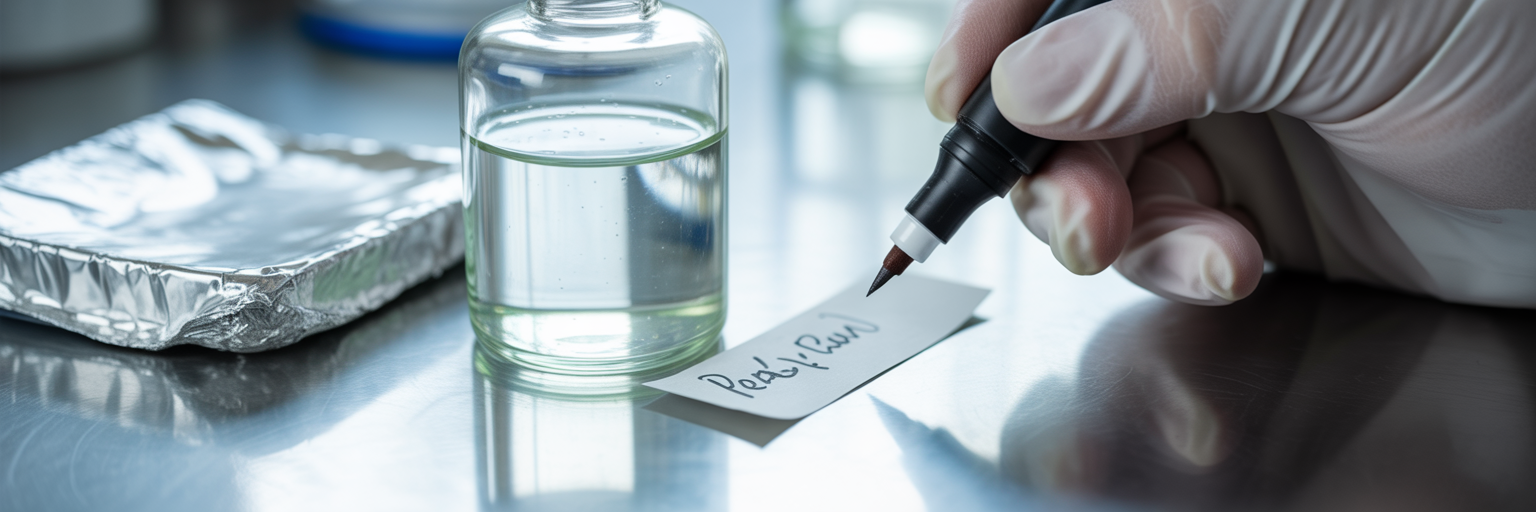
Once the seal on a vial is punctured, the clock starts ticking and the risk of contamination rises dramatically. The most critical rule to follow is the non-negotiable 28-day discard date. This is an industry-standard safety limit based on the gradual decline in the preservative’s efficacy and the cumulative risk of microbial entry with each use. After the first puncture, the vial must be refrigerated at 2°C to 8°C (36°F to 46°F). It is important to remember that cold temperatures slow microbial growth but do not stop the chemical degradation of the preservative.
Adhering to strict lab sterile water procedures during every withdrawal is the only way to maintain sterility. A high-quality reconstitution solution is designed for these protocols, but its integrity depends entirely on your technique.
- Prepare a clean, designated workspace, free from drafts or clutter.
- Remove the protective plastic cap from the vial to expose the rubber septum.
- Vigorously scrub the rubber septum with a sterile 70% isopropyl alcohol swab for at least 15 seconds.
- Allow the alcohol to air dry completely. Do not fan or blow on it, as this can reintroduce contaminants.
- Using a new, sterile needle and syringe, draw back a volume of air equal to the amount of solution you will withdraw.
- Puncture the center of the stopper and inject the air into the vial. This equalizes the pressure and makes withdrawal easier.
- Invert the vial and carefully withdraw the desired amount of solution.
- Withdraw the needle and safely cap it using a one-handed scoop technique or dispose of it immediately in a designated sharps container.
The final, and perhaps most overlooked, step is to immediately label the vial with the date of first opening and the calculated “discard after” date. This simple action prevents ambiguity and ensures compliance.
Advanced Strategies for Contamination Prevention
While aseptic technique is fundamental, several advanced strategies for preventing bac water contamination can further protect your experiments from subtle, often overlooked, threats. The first step is always ensuring that all your lab supplies, which you can explore in our comprehensive shop, are sourced from reliable providers that prioritize quality.
The surrounding environment plays a significant role. Whenever possible, perform withdrawals in a laminar flow hood or a designated clean zone. This minimizes the risk of airborne particulates settling on the vial stopper or needle. You must also reinforce the “one needle, one syringe, one time” principle. Reusing a syringe, even for the same solution, can introduce micro-contaminants and compromise the entire vial.
A common but preventable issue is “coring,” which occurs when a small piece of the rubber stopper is sheared off by the needle and falls into the solution. To avoid this, insert the needle with the bevel facing up at a 45-degree angle. Once the bevel has passed through the stopper, straighten the needle to a 90-degree angle before proceeding. This slicing motion is much less likely to create a core than a direct puncture.
Finally, be mindful of cross-contamination. Never use the same syringe to draw bacteriostatic water, inject it into a peptide vial, and then return to the water vial to draw more. This action can transfer traces of the peptide back into your stock solution, contaminating it for all future uses.
Understanding Shelf Life and Chemical Degradation
The 28-day rule is not an arbitrary guideline; it is rooted in the chemistry of the preservative itself. The bacteriostatic water shelf life is a direct function of the stability of benzyl alcohol. Upon exposure to air, heat, and light, benzyl alcohol begins to degrade through oxidation. As it breaks down, its ability to inhibit bacterial growth diminishes, leaving the solution vulnerable.
This chemical breakdown can lead to catastrophic research failures. For instance, compromised water can cause subtle pH shifts that denature proteins or peptides, rendering them biologically inactive. In other cases, it may allow bacteria to proliferate in a reconstituted solution, introducing endotoxins that skew cellular assays. For those using sensitive analytical techniques like HPLC, impurities from degraded benzyl alcohol can appear as ghost peaks, complicating data analysis. As academic resources like a detailed explanation from USC Scalar note, proper storage is essential to maintain this chemical stability.
A critical and counterintuitive fact is that a solution can be chemically compromised long before it appears cloudy or discolored. Visual inspection alone is not a reliable indicator of purity. This is why you must strictly distinguish between the manufacturer’s printed expiry date for a sealed vial and the 28-day post-opening expiry date. Once opened, the 28-day clock is the only one that matters. For those interested in exploring more scientific topics on reagent integrity, further articles can be found on our blog.
Implementing Robust Monitoring and Documentation Systems
Effective bacteriostatic water storage guidelines extend beyond individual actions to encompass systemic, auditable lab management. Creating an error-resistant environment begins with meticulous documentation. Implement temperature logs, whether manual or digital, for all refrigerators and storage areas. These logs are not just for compliance; they are your first line of defense in quality control, providing a clear record that conditions have remained stable.
Incorporate a formal visual inspection protocol into your standard operating procedures. Before each use, technicians should check for particulates, discoloration, and vial integrity. This simple checklist can prevent a compromised vial from ever being used. To manage inventory and minimize waste, adopt a First-In, First-Out (FIFO) system. Arrange your stock so that vials with the earliest expiry dates are always at the front and used first.
For labs seeking to reduce human error, modern Laboratory Information Management Systems (LIMS) offer powerful solutions. By using barcodes, these systems can automatically track vial opening dates, calculate the 28-day discard date, and even send alerts to lab managers when a vial is nearing expiration. This level of automation transforms reagent management from a manual task into a reliable, integrated process. Verifying the purity of your materials is also paramount, and accessing a Certificate of Analysis (CoA) for each batch provides an essential layer of documentation and confidence.
Safe Disposal of Expired and Compromised Solutions
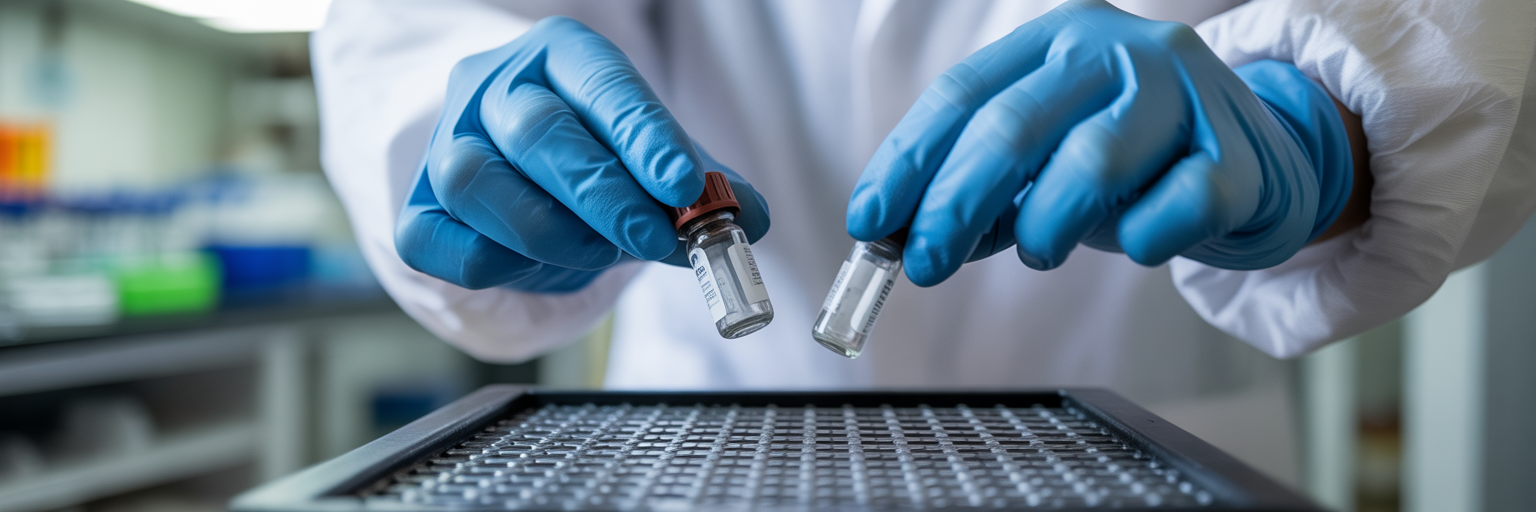
The final step in the lifecycle of bacteriostatic water is its safe and appropriate disposal. A clear protocol ensures that expired or compromised solutions are removed from circulation, protecting both future experiments and lab personnel. A vial must be discarded immediately if it meets any of the following criteria:
- The vial is past its 28-day post-opening discard date.
- The vial is past the manufacturer’s printed expiry date.
- The solution appears cloudy, discolored, or contains visible particulate matter.
- The vial has known or suspected cracks, a compromised seal, or other physical damage.
- The vial has been stored outside the recommended temperature range for a significant period.
The liquid itself is typically considered non-hazardous. In most institutions, it can be poured down a laboratory sink with a steady stream of running water to ensure dilution. However, you must always follow your institution’s specific disposal guidelines. The empty vial, on the other hand, requires different handling. To prevent injury, it must be disposed of in a designated sharps container or a broken glass box, never in the general trash.