Private Label, White Label, Wholesale partnerships available - EU, USA and UK - Free shipping from €75
What Does Bac Water Do? an Essential Guide
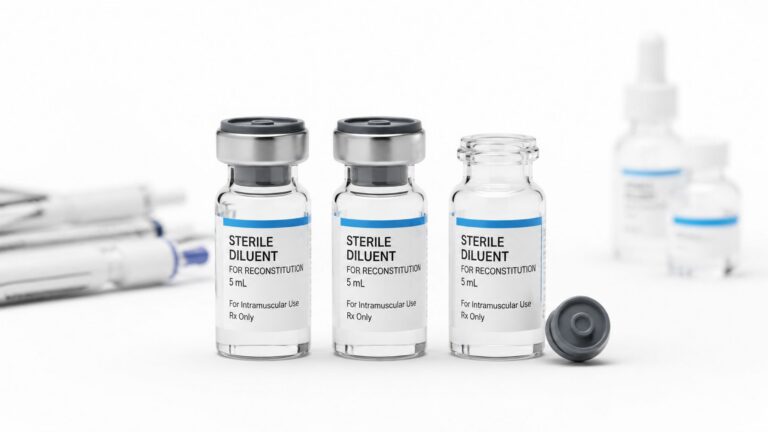
A researcher opens a cold-storage box, pulls out a vial of lyophilized peptide, and reaches the point where mistakes become expensive. The powder is stable as shipped, but the experiment can't start until that vial is reconstituted correctly. At that moment, the question usually isn't just what bac water is. Instead, the critical question is what does Bac Water do, and why do experienced labs insist on specific handling rules.
Bac water is often treated like a routine supply item. That mindset causes preventable problems. The diluent affects sterility, repeat access to the vial, storage discipline, and whether a compound stays usable long enough for a multi-dose workflow. For wholesalers and distribution partners, the same details matter for product selection, labeling accuracy, and customer safety.
The difference between a reliable reconstitution workflow and a risky one usually comes down to understanding the reason behind the protocol. Bac water isn't just water in a vial. It's a controlled tool for a specific job.
Table of Contents
- An Introduction to Reagent Reconstitution
- The Science of Bac Water What Sets It Apart
- Key Applications in Research and Reconstitution
- Bac Water vs Sterile Water vs Saline
- Critical Safety Protocols and Handling Procedures
- Storage Shelf Life and Quality Indicators
- A Purchasing Guide for Researchers and Distributors
- Frequently Asked Questions About Bac Water
An Introduction to Reagent Reconstitution
Most peptide and hormone workflows begin with a powder for one reason. Dry form is easier to keep stable during shipping and storage. The problem starts when that powder has to become a usable liquid without compromising the material.
A new researcher often assumes any sterile liquid will do. That assumption doesn't hold up in practice. Reconstitution is not just about dissolving a compound. It's about preserving the vial's usability across the actual workflow, especially when the same container will be accessed more than once.
Bac water solves a narrow but important problem. It gives labs a diluent intended for reconstitution and repeated vial entry, rather than a one-time transfer liquid that becomes a contamination liability as soon as the stopper is pierced. That distinction matters for sensitive materials and for distribution partners supporting customers who expect consistent handling guidance.
Practical rule: The diluent should match the protocol, not just the powder. If the vial will be entered repeatedly, the wrong choice creates avoidable contamination risk.
The cost of getting this wrong isn't limited to wasted reagent. A bad diluent choice can distort timing, storage assumptions, and dose preparation. For research operations, that affects reproducibility. For resellers and procurement teams, it affects returns, complaints, and confidence in the supply chain.
The Science of Bac Water What Sets It Apart
Bac water is sterile, non-pyrogenic water for injection that contains 0.9% benzyl alcohol (9 mg/mL), which acts as a bacteriostatic preservative and supports use in multi-dose vials for up to 28 days after opening under proper aseptic conditions, as described in the DailyMed labeling for Bacteriostatic Water for Injection, USP.

Why the preservative matters
The key feature is the benzyl alcohol. Without it, the vial is merely sterile water at the moment of manufacture. Once a needle enters the stopper, the environment changes. Human handling, stopper contact, air exposure, and repeat access all create opportunities for contamination.
Benzyl alcohol acts as a growth inhibitor. That wording matters. Bac water is not a sterilizer that fixes poor handling after the fact. It is closer to a gatekeeper than a cleanup agent. It helps stop introduced bacteria from proliferating, but it doesn't excuse sloppy technique and it doesn't magically neutralize every contamination event.
That is why trained operators still wipe stoppers, use fresh sterile needles, and avoid repeated unnecessary punctures. The preservative lowers risk. It doesn't remove the need for discipline.
What bacteriostatic really means
In practical lab language, bacteriostatic means the solution is formulated to inhibit bacterial growth after opening. It does not mean the vial is invulnerable. It means the product is suitable for controlled multi-dose use when the user also maintains aseptic practice.
Three properties separate bac water from plain sterile water in daily handling:
- Preservative support: The 0.9% benzyl alcohol is the defining feature that allows multi-use handling under proper conditions.
- Non-pyrogenic formulation: The product is prepared for injection-related use and is intended to avoid fever-causing contaminants.
- Workflow compatibility: It is widely used for reconstituting lyophilized materials that need accurate dilution and more than one withdrawal.
Bac water works because it protects the opened vial from becoming immediately impractical for repeat use. It does not work if the user treats the preservative as a substitute for sterile technique.
For researchers asking what does Bac Water do, the answer is simple but specific. It extends the usable handling life of a reconstitution vial by inhibiting bacterial proliferation after entry, while remaining suitable as a diluent for injection-related preparation.
Key Applications in Research and Reconstitution
The most common use case is straightforward. A lab receives a freeze-dried compound, the protocol calls for liquid preparation, and the same vial may need to support multiple measured withdrawals over time.

Where bac water fits in the workflow
Lyophilized peptides, hormones, and similar research compounds are often handled this way because the dry form is practical for storage. Once reconstitution begins, the lab needs a diluent that matches the expected access pattern. Bac water is used when one preparation event will be followed by multiple withdrawals from the same container.
That is its primary utility. It enables safe, repeated withdrawal from a single vial for multi-dose protocols, while still requiring proper aseptic handling. It also matters that product quality in the market can vary, including mislabeled products that don't contain the correct preservative concentration, as discussed in this technical overview of bacteriostatic water handling and dosage considerations.
A practical mixing reference can help teams standardize technique. This guide on how to mix peptides with bacteriostatic water is one example of the type of operational instruction that reduces avoidable handling errors.
What repeated access changes
Repeated stopper entry changes the risk profile of the vial. The first puncture is not the only event that matters. Every subsequent withdrawal creates another chance to introduce contamination, damage the stopper, or compromise the contents through poor handling.
That changes how experienced labs think about reconstitution. The task is not just “get powder into solution.” The task is to create a usable liquid preparation that remains reliable across the actual planned usage window.
Common situations where bac water fits well include:
- Multi-dose peptide work: One reconstituted vial supports several measured withdrawals rather than a single immediate use.
- Routine hormone preparation: The operator needs concentration stability across repeated access events.
- Training and distribution settings: Teams need a standard answer for when customers ask why one diluent is preferred over another.
A short demonstration can help reinforce the mechanics before a team writes its own SOP.
The trade-off is worth stating clearly. Bac water gives more operational flexibility than preservative-free sterile water for multi-dose use, but only if the lab protects that advantage with clean technique, correct labeling, and disciplined storage after reconstitution.
Bac Water vs Sterile Water vs Saline
Confusion between diluents causes more handling errors than is often realized. The vial labels may look similar, but the use case is not.
How the choice affects use
Bac water contains a preservative and is used when repeated vial access is part of the plan. Sterile Water for Injection is preservative-free and better aligned with single-use preparation. Saline introduces sodium chloride and is isotonic, which makes it a different category of fluid with different application logic.
The biggest mistake is substituting one for another without checking what the protocol needs. A powder that tolerates one diluent may not belong in another. A workflow designed for repeated withdrawals also shouldn't assume that sterile water offers the same handling margin as bac water.
For teams comparing options, this overview of bacteriostatic or sterile water for research use is a useful reference point.
| Characteristic | Bacteriostatic Water | Sterile Water for Injection | Sterile Saline (0.9% NaCl) |
|---|---|---|---|
| Preservative content | Contains benzyl alcohol | No preservative | Not the same category as bac water. Use depends on protocol |
| Typical access pattern | Multi-dose workflows | Single-use workflows | Depends on intended formulation |
| Primary role | Reconstitution and dilution with repeat vial entry in mind | Reconstitution where preservative-free medium is required | Diluent where isotonic saline is specifically needed |
| Isotonicity | Not used as a stand-in for saline | Not isotonic | Isotonic |
| Key caution | Preservative doesn't replace aseptic technique | Loses practical protection after opening | Shouldn't be substituted casually for water-based diluents |
The correct comparison isn't which liquid is “better.” The correct question is which liquid matches the compound, the access pattern, and the safety requirement.
One point deserves special emphasis. Saline and bac water are not interchangeable just because both may appear in injectable preparation contexts. One is selected for preservative-supported reconstitution logic. The other is selected when isotonic saline is required.
Critical Safety Protocols and Handling Procedures
The most dangerous misunderstanding is thinking bac water is safe because it is sterile. Sterility does not mean universal suitability. Use depends on route, context, and what the solution is being asked to do.
Why direct injection is the wrong use
Bac water is a diluent. It is not a general-purpose standalone injection fluid. Used incorrectly by itself, it can cause hemolysis, which is red blood cell rupture due to osmotic shock. It is also not for spinal administration, and it is contraindicated in newborns because of the risk of gasping syndrome related to benzyl alcohol toxicity, as noted in the RxList drug reference for bacteriostatic water.
Many online summaries fall short for readers. They say bac water is for mixing, but they don't explain why that rule exists. The reason is biochemical, not bureaucratic. Plain aqueous fluid without the right physiological context can damage cells. The presence of benzyl alcohol adds another layer of concern for vulnerable populations.
Safety note: A vial being intended for injection-related preparation does not make it appropriate for direct injection on its own.
Who must never receive bac water
Newborns are the clearest red-line category. Bac water must not be used in that population because benzyl alcohol toxicity can produce severe and life-threatening consequences. That is not a minor precaution and not a “use with care” situation. It is a contraindication.
The spinal route is another hard boundary. If a user is considering intrathecal or similar spinal administration, bac water is the wrong product.
For distributors, these are not fine-print details. They belong in product education, reseller training, and support responses. Any guide that leaves them out creates avoidable downstream risk.
Handling rules that actually protect the vial
Labs often know the rules but apply them inconsistently. The basic controls are simple, and they matter because every shortcut increases uncertainty.
- Swab the stopper every time: The vial top should be disinfected before entry, not just on first use.
- Use a new sterile needle for each puncture: Re-entering with a used needle defeats the point of controlled handling.
- Limit unnecessary entries: Every puncture adds opportunity for contamination and stopper wear.
- Label the vial clearly after first use: Teams should mark the opening date and intended discard point.
- Reject bad appearance immediately: Cloudiness, particles, leaks, discoloration, or a damaged closure are reasons to stop.
A second operational point is often missed in small research environments. The preservative reduces risk only inside a controlled range of use. If the vial is repeatedly handled with poor technique, left uncapped in an unclean area, or transferred between users without traceability, the preservative advantage narrows quickly.
Researchers focused on validity should treat aseptic technique as part of the experiment, not as an accessory to it. Distributors should treat the same rules as part of product stewardship.
Storage Shelf Life and Quality Indicators
An opened vial does not remain equally protected forever. The standard in-use rule exists because preservative-supported handling has limits, especially once repeated access and environmental exposure begin to accumulate.
Why storage conditions change the risk
The accepted in-use window is 28 days after opening under ideal storage conditions of 20 to 25°C and protection from light, and benzyl alcohol can oxidize or precipitate if stored above 30°C, which may reduce preservative effectiveness before that point. That matters for home-lab environments, shipping interruptions, warm storerooms, and any space without temperature control.

Teams that need a handling reference can use resources on essential storage practices for bacteriostatic water to align local SOPs with actual environmental risks.
Storage failures often look ordinary. A vial sits near a window, stays in a vehicle, or remains in a warm stockroom after receiving. None of those scenarios announce themselves as a contamination event, but they can undercut the assumptions behind the standard in-use window.
What to inspect before use
Visual inspection is one of the few controls every operator can apply immediately. Before any withdrawal, the user should inspect the vial itself, not just the label.
Key indicators to check:
- Clarity of solution: Bac water should remain clear. If it appears cloudy, it shouldn't be used.
- Particulate matter: Floating particles suggest compromised integrity.
- Closure condition: A damaged stopper or cracked vial raises sterility concerns.
- Color change or residue: Any unexpected appearance change is a discard signal.
One sourcing detail belongs here because it affects quality control directly. Some suppliers provide a Certificate of Analysis and maintain batch traceability. For example, Herbilabs supplies RUO bac water in glass vials and provides batch documentation for laboratory buyers. That doesn't replace inspection at receipt and before use, but it does improve the paper trail for procurement teams.
Storage discipline is part of quality control. A clean batch can still become an unreliable vial if the environment is wrong.
A Purchasing Guide for Researchers and Distributors
Price alone is a weak filter for bac water. Procurement teams should look first at whether the product is formulated and documented as bac water, rather than assuming the label tells the whole story.
A practical buying checklist includes:
- Verified composition: The label and documentation should clearly identify bacteriostatic water and the benzyl alcohol preservative.
- Batch documentation: COAs and lot traceability matter when a customer questions quality.
- Packaging integrity: Glass vials, intact stoppers, and sealed presentation reduce handling concerns in transit and storage.
- RUO clarity: The seller should state the intended research-use context plainly.
- Consistent fulfillment conditions: Shipping and storage practices should support product integrity before the vial even reaches the bench.
For distributors, a key test is whether support teams can answer technical questions without improvising. If a vendor can't explain contraindications, storage limits, or multi-dose handling logic, the supply relationship is carrying hidden risk.
Frequently Asked Questions About Bac Water
Can bac water kill bacteria already inside the vial
No. Bac water is bacteriostatic, not a rescue product for contaminated handling. It inhibits bacterial growth rather than sterilizing a compromised vial.
Can a researcher use bac water instead of saline
Not as a casual substitute. Saline and bac water serve different purposes. If a protocol requires isotonic saline, bac water is not the interchangeable option.
Is bac water the same as sterile water
No. The practical difference is the preservative. Sterile water is preservative-free, while bac water contains benzyl alcohol for multi-dose handling logic.
Does the 28-day rule always hold
Only when storage and handling stay within proper conditions. Heat, light exposure, and repeated poor technique can reduce confidence before that point.
What should a buyer watch for when receiving stock
Check labeling, vial clarity, closure integrity, lot traceability, and whether the supplier provides supporting batch documentation. If the product appearance or paperwork is questionable, it shouldn't enter active inventory.
Why do experienced labs care so much about stopper handling
Because the stopper is the gate between a controlled internal environment and every contamination source outside it. Once teams understand that, wiping the top and using a fresh needle stop looking like rituals and start looking like core contamination control.
Researchers and distributors who need RUO laboratory supplies can review the bac water and reconstitution resources available from Herbilabs. The catalog focuses on sterile diluents, batch-tracked labware, and documentation that supports safer purchasing and more consistent research handling.