Private Label, White Label, Wholesale partnerships available - EU, USA and UK - Free shipping from €75
Water Bacteriostatic: A Guide for Research & Reconstitution
A researcher opens a cold pack, sets a lyophilized vial on the bench, and reaches for a diluent. A wholesale buyer reviews a supplier list and sees several products that all seem to promise the same thing. In both cases, the risky assumption is that water is just water.
With water bacteriostatic, small formulation details carry practical consequences. The wrong diluent can shorten usable life after reconstitution, create avoidable contamination risk, or introduce sourcing uncertainty that doesn't show up until a batch is already in circulation. For researchers, that can mean compromised samples. For distributors and resellers, it can mean customer complaints, returns, or questions that should've been resolved before purchase.
The useful question isn't only what bacteriostatic water is. The better question is whether the vial is correctly formulated, appropriate for the intended protocol, and supported by documentation that can stand up to scrutiny.
Table of Contents
- The Critical Role of the Right Diluent
- Deconstructing Bacteriostatic Water
- Comparing Bacteriostatic Water With Other Sterile Diluents
- Primary Applications in Research and Reconstitution
- Ensuring Quality Purity and Supplier Trust
- Proper Storage Handling and Disposal Protocols
- Frequently Asked Questions for Professionals
The Critical Role of the Right Diluent
A vial can be expensive, fragile, and perfectly manufactured, then lose value at the moment of reconstitution. That isn't because the active compound suddenly changed. It's because the diluent becomes part of the working system.
In research and reconstitution workflows, the diluent affects how a product is dissolved, how it will be handled after first puncture, and how much risk is introduced every time a syringe enters the stopper. Teams often focus on the active ingredient and underestimate the support material around it. That mistake shows up later as inconsistent handling, shortened usability, or uncertainty about whether a reconstituted vial should still be trusted.
This is one reason bacteriostatic water has become more prominent across healthcare and laboratory settings. The global bacteriostatic water for injection market was valued at USD 905 million in 2024 and is projected to reach USD 1.35 billion by 2030, reflecting a 5.9% CAGR, according to Strategic Market Research's bacteriostatic water market report. That growth ties the product to injectable drug delivery, hospital pharmacy demand, and research workflows rather than treating it as a minor accessory.
Why this category keeps expanding
The broader lesson is simple. Multi-step preparation depends on small controls.
A peptide reseller might care about reducing avoidable support tickets. A distributor might care about batch consistency. A new researcher might care about not wasting a vial after the second use. All three are dealing with the same issue: whether the selected diluent matches the handling pattern.
Practical rule: The right diluent doesn't rescue poor technique, but it does shape how much room the workflow has for repeated handling.
That matters most when the vial won't be used once and discarded. If the protocol involves repeated withdrawals, the diluent isn't just a solvent. It becomes a control point for integrity, documentation, and safe use over time.
Deconstructing Bacteriostatic Water
A common failure point in reconstitution starts with a simple assumption. Two clear vials look interchangeable, so the diluent gets treated like a commodity. In practice, that choice changes how long a vial can be used, what handling risks need to be controlled, and whether a buyer can trust the product after repeated access.
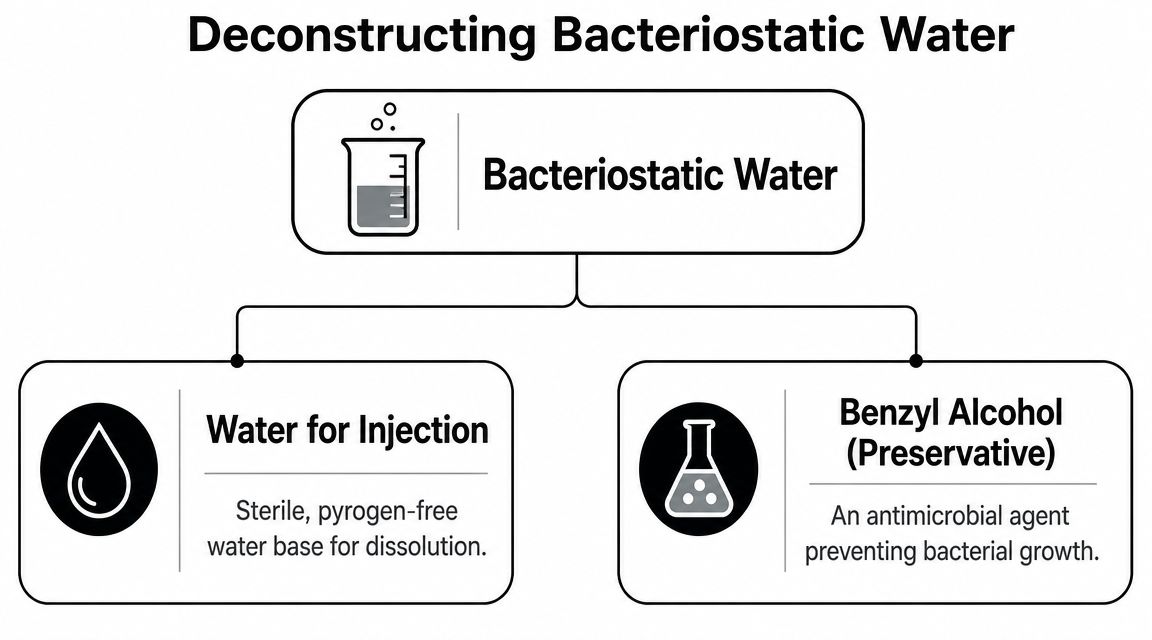
Bacteriostatic water is a standardized sterile diluent designed for multi-dose use. FDA-linked labeling describes bacteriostatic water for injection as a sterile, nonpyrogenic water preparation containing 0.9% (9 mg/mL) benzyl alcohol as a bacteriostatic preservative, intended for multiple withdrawals from one vial, as stated in the DailyMed product labeling.
The Function of the Preservative
The easiest bench explanation is simple. Benzyl alcohol works like a guard at the vial door. It helps suppress bacterial growth if the stopper is punctured more than once, but it does not remove contamination that has already entered the container.
That point prevents a costly misunderstanding. "Bacteriostatic" does not mean self-sterilizing. If aseptic technique is poor, if a stopper is handled carelessly, or if the product was filled under weak quality controls, the preservative does not reverse that problem. It only helps limit bacterial proliferation under the conditions the formulation was designed for.
For researchers and wholesalers, product verification becomes part of scientific discipline. You are not only buying sterile water with an additive. You are buying a formulation that must match its label claim, hold its specification, and arrive from a supplier whose documentation supports repeated-use intent. If a listing is vague about composition, packaging, or handling category, that uncertainty belongs in the risk assessment.
Another detail often missed is that bacteriostatic water has specification boundaries, not just ingredients. The benzyl alcohol concentration must be correct. The pH must stay within an expected range. The packaging and closure system must support sterile withdrawals. A product page discussing water for injection categories and sterile preparation standards can help clarify why these distinctions matter at the sourcing stage, especially for buyers comparing similar labels across suppliers.
Why the exact formulation matters
Each part of the formulation has a job, and each job affects real-world use:
- Sterile water base: provides the vehicle for dissolution or reconstitution.
- Benzyl alcohol at the labeled concentration: helps suppress bacterial growth during repeated vial entry.
- Controlled pH range: supports formulation consistency and expected preservative performance.
- Multi-dose packaging intent: aligns the diluent with workflows that involve more than one withdrawal.
A vial can leave manufacturing in a sterile state and still become untrustworthy later if the formula is off-spec, the supplier cuts corners, or the user handles it poorly.
That is why water bacteriostatic should be evaluated like any other controlled research input. The label, the preservative system, the closure design, and the supplier's records all affect whether the product protects workflow integrity or introduces avoidable risk.
Comparing Bacteriostatic Water With Other Sterile Diluents
Most confusion starts when several clear liquids get grouped together as if they're interchangeable. They aren't. The correct choice depends on whether the workflow is single use or multi-dose, whether preservatives are acceptable, and whether the receiving protocol allows benzyl alcohol.
A researcher comparing product listings should separate these questions early. Is the vial meant to be punctured once or repeatedly? Does the reconstitution protocol permit a preservative? Is the use case strictly research, or does the receiving environment require a specific sterile water category?
A practical selection framework
For buyers who need a quick reference, one useful baseline is to compare bacteriostatic water to water for injection products used in sterile preparation. The names sound close, but the intended handling pattern can be very different.
A simple way to decide:
- Choose bacteriostatic water when the protocol allows a preservative and the same vial may be accessed more than once.
- Choose sterile water for injection when the formulation must remain preservative-free or the application is effectively single-use.
- Avoid substituting purified or general lab water into injection-style reconstitution logic. Even if the label looks technical, that doesn't make it an equivalent sterile diluent.
Sterile diluent comparison
| Water Type | Preservative | Primary Use | Vial Type |
|---|---|---|---|
| Bacteriostatic water for injection | Benzyl alcohol present | Reconstitution or dilution where repeated withdrawals are intended | Multiple-dose container |
| Sterile water for injection | No preservative | Reconstitution or dilution where preservative-free handling is required | Commonly treated as single-use workflow |
| Purified water or general lab water | Not appropriate as injection-style preservative system | General laboratory tasks, not a substitute for controlled sterile diluent use | Varies by product |
The biggest mistake isn't usually reading the wrong label. It's assuming that any sterile-sounding water can fill the same role.
If repeated vial access is part of the plan, the buyer should evaluate the diluent for that handling pattern before the order is placed.
That applies to wholesalers too. A distributor who understands the distinction can answer customer questions faster and prevent the common mismatch between a multi-use expectation and a single-use diluent.
Primary Applications in Research and Reconstitution
The most familiar use case is a small vial of freeze-dried material waiting to be brought back into solution. The active compound may be delicate, costly, or intended for a sequence of measured withdrawals rather than immediate one-time use.
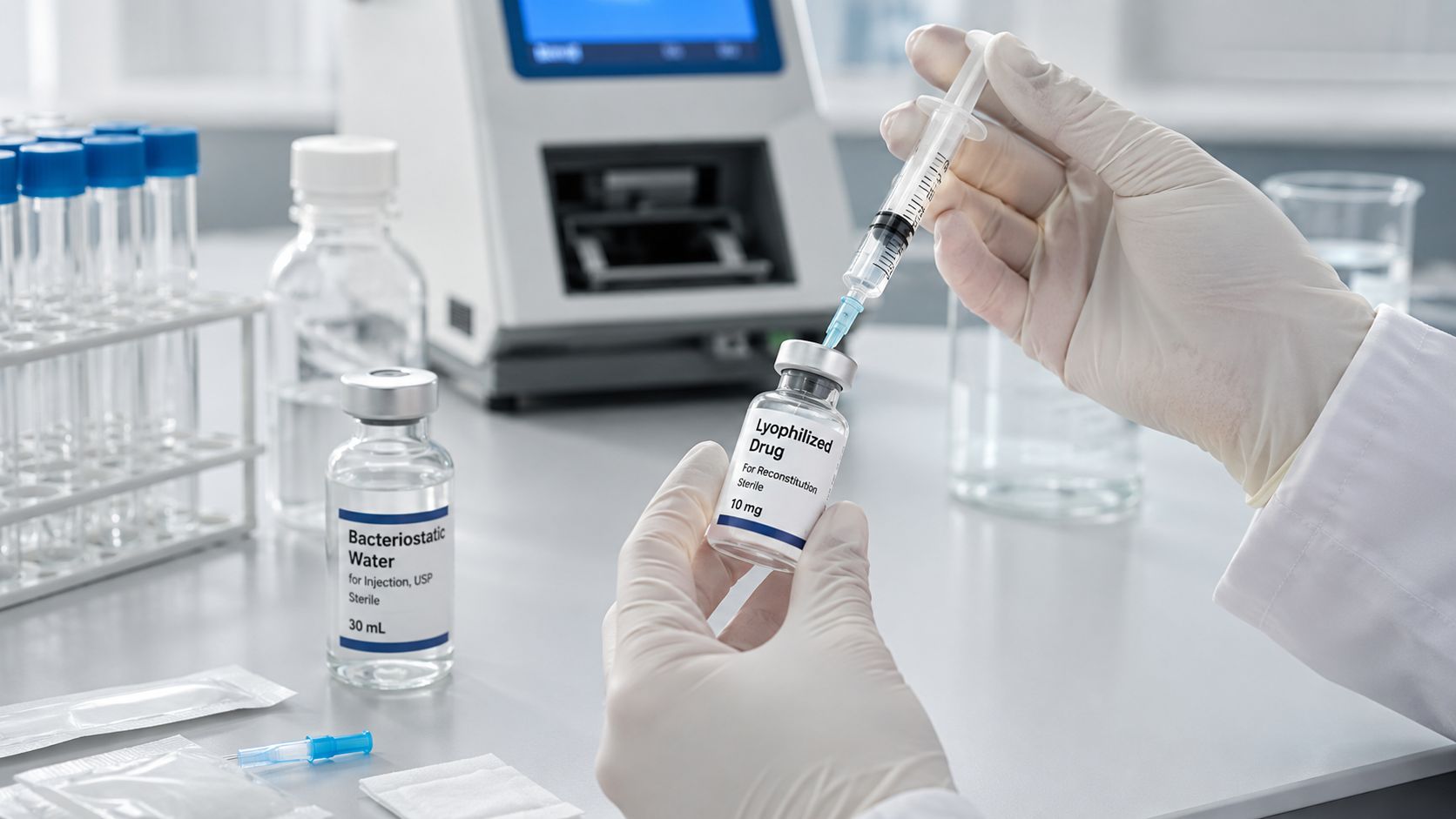
A common peptide workflow
In peptide research, the practical attraction of water bacteriostatic is simple. It suits a workflow where a vial is reconstituted once and then accessed again later under controlled technique. That doesn't make it automatically correct for every compound, but it does explain why it's often selected when repeated withdrawals are expected.
A careful reconstitution sequence usually looks like this:
- Check the receiving protocol first: some compounds require preservative-free diluents, so the diluent choice must follow the product requirement.
- Introduce the liquid gently: forcing fluid directly onto fragile material can create unnecessary agitation.
- Label the vial after reconstitution: once the dry material becomes a working solution, tracking starts to matter as much as chemistry.
- Plan the withdrawal pattern: a vial used once a day has different handling pressure than one punctured repeatedly during the same session.
Researchers who need a procedural walkthrough can review this guide to mixing peptides with bacteriostatic water.
Where repeated withdrawals matter
Repeated access is where bacteriostatic water earns its place. The preservative doesn't replace sterile technique, but it supports a workflow that would otherwise have less tolerance for repeated puncture.
That matters in small-batch research, pilot work, and inventory-conscious environments. If a single reconstituted vial is expected to serve over multiple withdrawals, the handling model should reflect that from the start.
A short visual overview can help reinforce the bench process:
For distributors and peptide resellers, this use case also explains customer demand. Buyers aren't always looking for "just water." They're often trying to protect the useful life and consistency of a reconstituted research vial across multiple uses.
Ensuring Quality Purity and Supplier Trust
A common failure starts at purchasing, not at reconstitution. A buyer approves a vial because the listing looks professional, the price is attractive, or the label sounds technical. Weeks later, the lab is trying to explain inconsistent results, and the problem traces back to a diluent that was never properly verified.
That risk matters to two groups in particular. Researchers need confidence that the diluent will behave as expected in controlled work. Wholesalers need confidence that every lot they pass downstream can be documented, traced, and defended if a customer asks questions.
Independent reviews of grey-market bacteriostatic water have raised concerns about pH drift, preservative mismatch, and contamination indicators, as discussed in this review of grey-market bacteriostatic water quality concerns. In practical terms, a vial can look clean and still be wrong. Clear liquid is not proof of correct formulation any more than a sealed carton is proof of proper manufacturing.
What to verify before buying
A careful buyer asks for records that tie the vial in hand to a specific batch. If the supplier cannot provide that chain of evidence, you are working from trust alone.
Focus on a few checks that directly affect product identity and handling confidence:
- COA availability: batch-specific documentation should be available, legible, and matched to the lot being sold.
- Benzyl alcohol confirmation: the preservative system should be stated clearly and reflected in the supporting documents.
- pH alignment: the formulation should fall within the expected specification range for bacteriostatic water.
- Packaging suitability: the container, stopper, and labeling should support multi-dose use rather than resemble a generic sterile water substitute.
- Supply consistency: repeat orders should come with the same level of documentation and the same product standard each time.
For teams building an incoming-inspection routine, these storage and receiving checks for bacteriostatic water inventory can help standardize what gets reviewed before stock is released for use.
Why provenance matters more than marketing
Supplier evaluation should work like chain-of-custody review in a lab. You are not only asking what the product is. You are asking who made it, how it was tested, whether the lot can be traced, and whether the paperwork stays consistent from shipment to shipment.
A polished storefront does not verify endotoxin control. A label that says bacteriostatic water does not confirm that benzyl alcohol is present at the stated concentration. Those details need documentation.
One market option in this space is Herbilabs laboratory supply and sterile diluent catalog, which states that it provides batch-tested sterile diluents and COA-backed research products. The point of citing a supplier model like this is not brand recognition. It is to show what transparent sourcing should look like.
The most important question for a buyer is simple: can the supplier prove what is in the vial?
For private-label and wholesale partners, weak provenance creates a downstream quality problem. If one lot is questioned, the issue reaches customer support, returns, and brand reputation very quickly.
Proper Storage Handling and Disposal Protocols
A vial can leave the supplier in good condition and still fail at the bench. The weak points are usually ordinary ones. Heat exposure, poor aseptic technique, repeated stopper damage, or incomplete dating.
For that reason, storage rules are not housekeeping details. They are part of contamination control and traceability control. If a researcher cannot confirm where a vial was kept, when it was first punctured, or who handled it, the preservative no longer carries much practical value. In a shared lab or wholesale environment, that uncertainty spreads fast through inventory decisions.
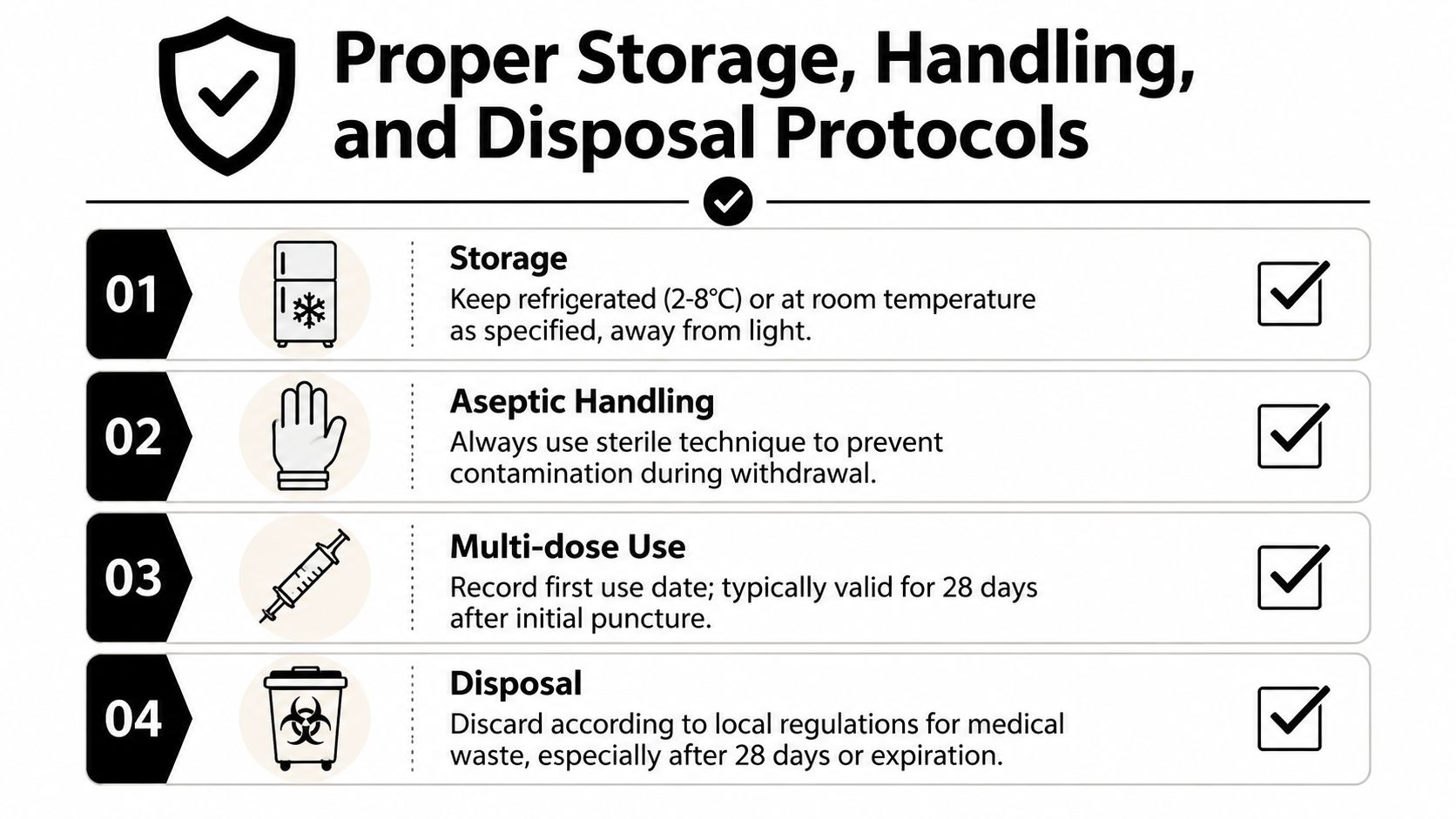
Benchside handling that protects the vial
Store the vial under labeled room-temperature conditions and keep the environment consistent. Frequent temperature swings matter because stability depends on the full system, not only on the water. The container, stopper, preservative, and handling history all contribute to whether the vial remains fit for use.
Benzyl alcohol works like a guard at the door, not a cleanup team inside the room. It helps limit bacterial growth after repeated punctures, but it does not reverse contamination introduced by poor technique. That distinction matters because new staff often treat "bacteriostatic" as if it means "self-sterilizing." It does not.
A practical routine should be plain enough that every technician follows it the same way every time:
- Inspect before first use: confirm the solution is clear and free of visible particles, the stopper is intact, and the label and expiration details are readable.
- Protect closure integrity: disinfect the stopper before each entry, let it dry, and avoid repeated unnecessary punctures in different locations.
- Use sterile withdrawal technique: use sterile needles and syringes, and keep hands and nonsterile surfaces away from critical contact points.
- Record first puncture and subsequent use: dating the first entry and maintaining a simple usage log makes later discard decisions defensible.
- Separate active from questionable stock: a vial with uncertain handling history should not remain mixed with routine-use inventory.
Teams that want a repeatable receiving-to-bench routine can use these storage practices for bacteriostatic water inventory control as a reference point for standardizing handling steps.
A preservative reduces risk under proper use. It does not compensate for poor aseptic discipline, missing records, or damaged packaging.
Disposal and end of use decisions
Disposal should follow the product instructions, site protocol, and local laboratory or medical waste rules. The key principle is simple. Once confidence in the vial drops, the vial should leave service.
Remove a vial from use if you see cloudiness, particulates, closure damage, leaks, label loss, or any unexplained change in appearance. Do the same if the dating record is missing, the storage history is uncertain, or contamination is suspected. In practice, many disposal errors happen because teams focus on how much liquid remains instead of whether the vial still has a trustworthy history.
For shared inventory, an end-of-use check keeps the decision objective:
- Verify documentation: if the first-puncture date or handling record is incomplete, treat the vial as unsuitable for continued use.
- Review physical condition: check for stopper wear, cracks, leakage, discoloration, or visible contamination.
- Quarantine doubtful vials immediately: do not leave them on the same shelf as approved stock.
- Discard through the facility's approved waste stream: the exact method depends on local requirements and whether the vial is classified with medical or laboratory waste.
Good storage protects the contents. Good records protect the decision to use, hold, or discard that vial.
Frequently Asked Questions for Professionals
A common failure point happens after the basics are already understood. A buyer receives a clean-looking vial, a lab opens it for repeated use, and then someone has to decide whether that vial still belongs in active inventory. The hard part is rarely the definition of bacteriostatic water. The hard part is deciding, with records and evidence, whether the product is still appropriate for the exact protocol in front of you.
Does the 28 day rule always decide disposal
The 28 day rule is a time limit, not a stand-alone quality decision. It works like an outer boundary on a map. You still need to know what happened inside that boundary.
An opened multi-dose vial may still need to be removed earlier if the handling record is incomplete, the stopper has been punctured heavily, the storage history is uncertain, or the reconstituted material has its own tighter requirements. One industry discussion from Farris Labs on bacteriostatic water use and sourcing notes the common role of this dating rule, but practical release or discard decisions still depend on the labeled product, site procedure, and the condition of the vial at the point of use.
For researchers, that protects experiment integrity. For wholesalers and resellers, it protects downstream customers from receiving advice that treats all opened vials as equivalent when they are not.
When should bacteriostatic water be avoided
Use should stop wherever the protocol calls for a preservative-free diluent. That includes any application where benzyl alcohol is not acceptable for the material, method, or intended population.
This point causes confusion because "sterile" and "bacteriostatic" are not interchangeable terms. Sterility describes the starting condition. Bacteriostatic describes the presence of a preservative intended to inhibit bacterial growth after entry. If a method requires water without that preservative, substituting bacteriostatic water changes the formulation itself, not just the container label.
Earlier in the article, the limits tied to benzyl alcohol were noted. The operational lesson is simple. Match the diluent to the protocol exactly, and do not let stocking convenience decide the chemistry.
What do wholesalers need from suppliers
A wholesaler should evaluate a diluent supplier the way a lab evaluates a reference standard. The question is not only "Can they ship product?" The better question is "Can they prove what each lot is, how it was handled, and whether the labeling stays consistent from order to order?"
That is where sourcing mistakes begin. A catalog page can look acceptable while the underlying controls are weak.
A useful supplier review includes questions like these:
- Can the supplier provide batch-specific documentation without delay?
- Is the product labeled clearly as bacteriostatic water versus preservative-free sterile water?
- Do the stated storage and handling instructions match the product configuration being sold?
- Is lot traceability maintained through distribution, not just at the manufacturing stage?
- Can your sales or support team answer technical questions from research buyers without guessing or improvising?
Those checks matter in practice. If a reseller cannot verify the preservative system, concentration, lot record, and labeling history, the problem does not stay on paper. It reaches the bench as reconstitution errors, avoidable returns, and damaged confidence in the supply chain.
Herbilabs supports research buyers, resellers, and wholesale partners with sterile diluents and related laboratory supplies for RUO workflows. Readers who need batch documentation, reconstitution products, or distribution information can review the available options at Herbilabs.