Private Label, White Label, Wholesale partnerships available - EU, USA and UK - Free shipping from €75
Sterile Water vs Bacteriostatic: The Definitive Guide 2026
A lab team often reaches the same point in a workflow. The peptide is lyophilized, the protocol is set, the calculations are correct, and only one decision remains. Which diluent goes into the vial.
That choice looks simple until it isn't. In sterile water vs bacteriostatic decisions, the wrong pick can create avoidable contamination risk, force unnecessary waste, or complicate a procurement plan that already has tight inventory controls. For researchers, that affects sample handling. For wholesalers and resellers, it affects how product moves, how lots are rotated, and what customers can realistically use once the vial is opened.
The practical difference isn't just chemical. It's operational. A team choosing between these two waters is also choosing between single-use handling and repeat access, between preservative-free simplicity and multi-dose convenience, and sometimes between what would be ideal and what is available in the supply chain. A concise overview of why sterile diluents matter in research appears in this guide on sterile diluents in research.
Table of Contents
- Choosing the Right Diluent for Your Research
- Core Composition and Purpose
- Detailed Side-by-Side Comparison
- Practical Applications for Researchers and Peptide Users
- Sourcing and Supply Chain Insights for Wholesalers
- Your Decision Making Flowchart
- Frequently Asked Questions
Choosing the Right Diluent for Your Research
A common failure point in reconstitution doesn't happen at the balance or the pipette. It happens when someone assumes the two clear vials on the bench are interchangeable.
That assumption creates problems fast. A peptide scheduled for repeated withdrawals over several days gets mixed with preservative-free water. Another sample meant for immediate single use gets mixed with a preserved diluent without anyone checking whether the downstream application tolerates that preservative. Neither mistake looks dramatic when it happens. Both can compromise the handling plan that follows.
Research teams usually don't need more vague advice here. They need a working rule set that matches the way benches and stockrooms operate.
The decision is about workflow, not appearance
Sterile water and bacteriostatic water can look identical in a vial, but they support different use patterns. One fits single-use handling. The other is built for repeated access when aseptic technique is maintained.
The safest choice is usually the one that matches how many times the vial will be entered after reconstitution.
That matters for peptide users in particular. Reconstituted materials are often handled over time, not all at once. The diluent choice should reflect that reality before the stopper is punctured.
The error most teams can avoid
The most common practical mistake isn't misunderstanding what benzyl alcohol is. It's choosing the diluent first and thinking through the use pattern second.
A better sequence is simpler:
- Start with the withdrawal pattern: Will the solution be used once, or will the vial be accessed again later?
- Check application sensitivity: Some workflows require preservative-free handling.
- Confirm handling discipline: Multi-dose use only works if the team maintains clean vial-entry technique every time.
- Review stock position: If supply is constrained, the best technical option may not be the easiest product to keep available.
That framework makes sterile water vs bacteriostatic decisions much more consistent.
Core Composition and Purpose
The basic distinction starts at formulation. These are not two labels for the same liquid. They are different products with different intended uses.

What sterile water actually is
Sterile Water for Injection is water without a preservative. Its value is straightforward. It offers a clean, additive-free diluent for situations where the preparation will be used as a single-dose or immediate-use solution.
That absence of additives is exactly why teams choose it. It removes preservative exposure from the equation. It also means the vial doesn't provide post-opening antimicrobial protection. Once opened, the handling burden shifts fully to the user and the use window becomes much tighter.
For labs reviewing product specifications, water for injection product guidance is useful because it frames sterile diluents in terms of intended use rather than just label language.
Why bacteriostatic water exists
Bacteriostatic Water for Injection is typically sterile water plus 0.9% benzyl alcohol (9 mg/mL), and that benzyl alcohol acts as a preservative that inhibits microbial growth after first puncture, according to this bacteriostatic water vs sterile water reference.
That single formulation change alters the practical purpose of the vial. Instead of being limited to immediate or single-use handling, the water becomes suitable for multi-dose workflows when aseptic technique is maintained. The preservative doesn't excuse poor handling, but it does support repeated withdrawals in a way preservative-free sterile water does not.
The real split is regulatory and operational
The important historical distinction isn't a dramatic invention story. It's the separation of single-dose and multi-dose sterile diluents in product labeling and clinical practice.
In plain terms, one product exists for preservative-free use, and the other exists because repeated puncture creates a different contamination-control problem. That is why composition and purpose cannot be separated in day-to-day lab decisions.
Practical rule: If a team expects repeated access to the same reconstituted vial, the preservative is not a minor detail. It's the feature that defines whether the workflow makes sense at all.
Detailed Side-by-Side Comparison
Direct comparison is where sterile water vs bacteriostatic becomes useful instead of abstract. The product labels matter, but bench behavior matters more. Labs need to know how each vial behaves once the seal is broken and the workflow begins.
Sterile Water vs. Bacteriostatic Water at a Glance
| Attribute | Sterile Water for Injection | Bacteriostatic Water for Injection |
|---|---|---|
| Preservative | None | 0.9% benzyl alcohol (9 mg/mL) |
| Intended handling pattern | Single-use or immediate-use workflows | Multi-dose workflows with aseptic handling |
| Post-opening antimicrobial protection | None | Preservative helps inhibit microbial growth after puncture |
| Typical use logic | Best when the entire preparation is used promptly | Best when repeated withdrawals are expected |
| Reuse after opening | Not suited for repeated withdrawals | Commonly used for repeated withdrawals within labeled handling guidance |
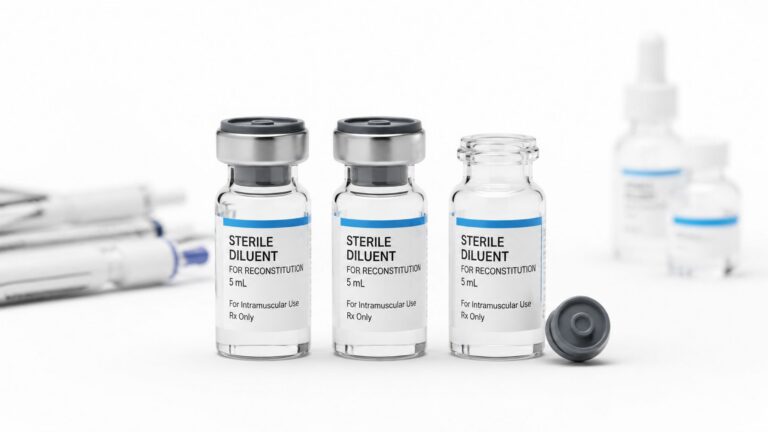
The visual summary below helps when training staff or briefing customers on product differences.

What the trade-offs look like in practice
The most important formal distinction appears in U.S. labeling. DailyMed describes bacteriostatic water for injection as a sterile, nonpyrogenic preparation containing 0.9% (9 mg/mL) benzyl alcohol as a preservative, while sterile water for injection contains no preservative and is intended for single-use handling. That same guidance also reflects an opened-vial use window of about 28 days for bacteriostatic water, while sterile water should be discarded after use, as shown in the DailyMed labeling information.
For repeated withdrawals, the about 28 days rule is the practical dividing line that most users remember. It only applies when aseptic handling is maintained.
Here is where teams often overcomplicate the decision. They treat purity and safety as if one product must "win" outright. That isn't how these diluents work. Each product is safer inside the handling model it was designed for.
- Sterile water works well when use is immediate: No preservative means no extra excipient in the preparation. The trade-off is that the vial offers no help once opened.
- Bacteriostatic water works well when access is repeated: The preservative supports a multi-dose pattern. The trade-off is that the additive must be acceptable for the intended application.
- Neither product fixes poor technique: A contaminated stopper, reused syringe, or badly documented open date can ruin either workflow.
- The label should drive the bench routine: Staff training should match the intended handling pattern from the start.
The topic also benefits from a visual walkthrough. This embedded overview is useful for teams that train by demonstration rather than SOP text alone.
A final point matters for compatibility. The preservative in bacteriostatic water can be a clear advantage in one protocol and an immediate exclusion in another. That means selection should always start with the compound and the intended use pattern together, not one in isolation.
Practical Applications for Researchers and Peptide Users
Most researchers don't compare these waters in theory. They compare them at the moment a vial has to be reconstituted correctly, cleanly, and without wasting material.
When bacteriostatic water fits the workflow
Bacteriostatic water makes sense when a reconstituted compound will be accessed more than once over its use period. That's common in peptide work, especially when a single vial supports multiple measured withdrawals rather than one immediate administration or one-time preparation.
The reason is practical, not cosmetic. Repeated stopper punctures create repeated opportunities for contamination. A preserved diluent aligns better with that pattern than preservative-free sterile water.
For teams working through peptide handling procedures, this peptide mixing guide with bacteriostatic water shows the kind of process discipline that matters more than brand preference.
A clean multi-dose routine usually includes:
- Disinfect the stopper every time before needle entry.
- Use a new sterile syringe and needle for each withdrawal.
- Record the open date clearly on the vial or in the lab log.
- Store the vial according to product instructions and protect it from unnecessary handling.
- Discard the vial when the permitted use window ends or sooner if contamination is suspected.
Multi-dose convenience only works when the team treats each withdrawal as a fresh sterile event.
When sterile water is the cleaner choice
Sterile water is the better fit when the preparation will be used immediately or in a single-use pattern. In that situation, the absence of a preservative is an advantage because it keeps the formulation simple.
This choice often suits small-batch reconstitution where the entire prepared volume is consumed promptly. It also suits applications where the protocol or compound is sensitive to additives and calls for preservative-free handling.
Researchers should ask two questions before opening the vial:
- Will the full preparation be used right away?
- Does the application require preservative-free dilution?
If the answer to both points is yes, sterile water is usually the cleaner operational choice.
What doesn't work
Problems start when teams mix products and workflows that don't match.
- Using sterile water for a planned multi-dose schedule: This creates unnecessary risk because the vial has no preservative support after opening.
- Using bacteriostatic water without checking compound suitability: The preservative can make the product inappropriate for some applications.
- Treating labeling as optional: If the product is intended for one handling pattern, staff shouldn't improvise another.
- Skipping open-date records: A vial without a date becomes a compliance and quality problem immediately.
For peptide users, the strongest habit is simple. Decide the full use pattern before reconstitution starts. Once the powder is mixed, there is no benefit in debating what should have been chosen.
Sourcing and Supply Chain Insights for Wholesalers
A stockout rarely shows up first as a bench problem. It shows up in purchasing, receiving, and customer support, after a buyer has committed to the wrong vial format for the way their customers will use it. That is why wholesalers should treat sterile water and bacteriostatic water as inventory planning decisions, not just product catalog entries.

What procurement teams should verify
In practice, the best wholesalers screen these products the same way they screen any controlled lab consumable. The label has to identify the formulation without ambiguity. Lot records have to support traceability after the case is broken and redistributed. Packaging has to survive warehouse handling without creating mix-ups between preserved and preservative-free stock.
The purchasing checklist should reflect how the product will behave after sale, not just how it looks on intake:
- Verify formulation and label language: Customers need to distinguish preserved from preservative-free inventory immediately. If that takes interpretation, picking errors become much more likely.
- Review batch documentation: Certificates of Analysis and lot records should support receiving checks, complaint handling, and customer questions about specific lots.
- Check packaging suitability: Closures, vial size, and label durability should hold up through storage, shipping, and repeated handling in distribution.
- Align SKU mix with customer use patterns: Buyers serving repeat-withdrawal workflows need a different stocking plan than buyers supplying single-use reconstitution.
- Check substitution risk before ordering deep inventory: If one product is likely to be used as a fallback for the other, the sales and quality teams need clear language on what can and cannot be substituted.
Herbilabs is one market option supplying sterile diluents and reconstitution solutions in RUO glass vials with COA-based documentation. For wholesalers, details like that matter because the difficult questions usually come after delivery, when the vial is in active use and the original listing copy is no longer in front of the customer.
How shortages change the decision
Shortages expose weak purchasing logic fast. A product line that looks efficient on paper can create waste, customer friction, and preventable support tickets once allocation starts and buyers begin accepting substitutes.
Sterile water for injection has faced documented shortages, and the American Society of Health-System Pharmacists outlines handling practices such as single-use container use, dating first entry, and discarding within a limited in-use window in controlled settings in ASHP's sterile water shortage FAQ. For a wholesaler, that kind of guidance matters because shortage management is not only about getting any stock. It is about getting stock that still fits the customer's workflow without creating avoidable waste or misuse.
I look at three pressure points first when supply tightens:
- Waste rate: Single-use inventory can drive higher discard volume if customers are running workflows that involve repeated vial entry or partial use.
- Support burden: Substitution increases the chance that customers will use a product outside its intended handling pattern unless sales materials and labels are explicit.
- Inventory segregation: Similar-looking products with different post-opening expectations should stay clearly separated in receiving, storage, and picking.
The broader issue is resilience. Distributors that understand post-opening behavior can set a better product mix, reduce avoidable spoilage, and protect customer outcomes when supply becomes uneven.
Your Decision Making Flowchart
A good selection rule should be usable at the bench, in receiving, and during customer support calls. If it takes a long explanation every time, the rule isn't practical enough.

A practical selection path
Start with the handling pattern, because that removes most uncertainty immediately.
- Identify the task clearly. Is the water being used for dilution or reconstitution in a controlled research workflow?
- Ask whether the vial will be entered more than once. If yes, bacteriostatic water is usually the logical fit because it supports repeated withdrawals.
- Check whether the application must avoid preservatives. If yes, sterile water is the better match.
- Review the product instructions for the compound itself. The diluent must fit the material being prepared, not just the convenience of the user.
- Consider inventory reality. If supply is tight, make sure the substitute product still matches the intended handling model and compliance requirements.
This can be reduced to a bench card:
- Single use and preservative-free needed: choose sterile water.
- Multiple withdrawals planned: choose bacteriostatic water.
- Application-specific restriction present: follow the product instruction over general habit.
- Supply disruption in play: don't substitute casually. Reassess handling, storage, and discard implications.
The value of a flowchart isn't that it makes the decision simplistic. It keeps teams from making the same preventable mistake under time pressure.
Frequently Asked Questions
Can bacteriostatic water replace sterile water in every case
No. The products were separated in practice and labeling for a reason. The major milestone was the regulatory and clinical distinction between single-dose and multi-dose sterile diluents. Sterile water is labeled for injection and irrigation, while bacteriostatic water is labeled only for injections because the benzyl alcohol preservative supports repeated withdrawals and reduces microbial growth risk in the vial, as described in this explanation of the historical and practical split.
The implication is simple. Bacteriostatic water is not a universal substitute. If a protocol requires preservative-free handling, the presence of benzyl alcohol matters.
What goes wrong when sterile water is reused
The main problem is mismatch between product design and handling behavior. Sterile water doesn't contain a preservative, so repeated withdrawals from an opened vial create a less protected situation after the first puncture.
That doesn't mean contamination is guaranteed. It means the workflow now relies entirely on technique while using a product that was intended for single-use handling. In quality systems, that is an avoidable risk, not a clever workaround.
If a team knows repeated withdrawals are coming, choosing sterile water anyway is usually a planning error.
How should opened vials be stored and discarded
The first rule is to date the vial at opening. An undated vial quickly becomes difficult to defend in any controlled workflow because no one can confirm where it is in its use window.
The second rule is to treat every entry as a sterile event. Clean stopper, fresh sterile device, controlled handling, and prompt return to appropriate storage conditions all matter.
A short storage and disposal checklist helps:
- For opened bacteriostatic water: Mark first puncture clearly and keep handling consistent through the allowed use window.
- For opened sterile water: Use promptly according to the intended single-use handling model, then discard.
- For any vial with unclear history: Discard it rather than guess.
- For damaged or suspect packaging: Remove it from use immediately and document the issue if required by local SOPs.
The final question should always be operational. Not "Can this still be used?" but "Can this still be used without creating uncertainty?"
Labs, peptide users, and distributors that need a consistent source of sterile diluents can review Herbilabs for RUO reconstitution solutions, batch documentation, and supply options that fit controlled research workflows.