Private Label, White Label, Wholesale partnerships available - EU, USA and UK - Free shipping from €75

Is Reconstitution Solution the Same as BAC Water?
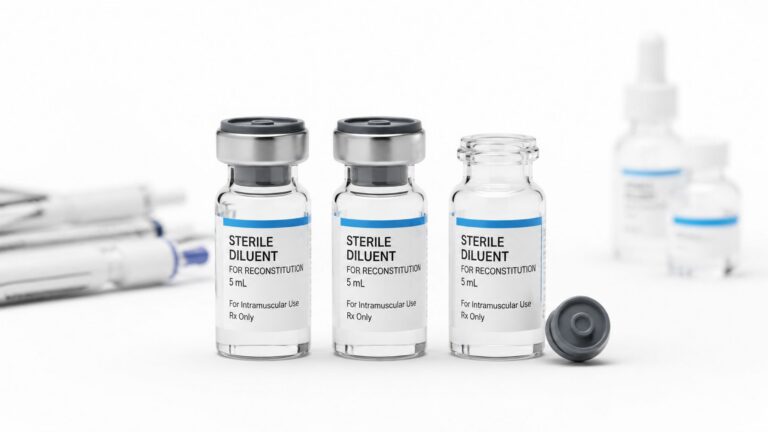
Reconstitution solution and BAC water are not the same. Bacteriostatic Water is a specific type of reconstitution solution made of sterile water for injection with 0.9% benzyl alcohol, while reconstitution solution is the broader category that can also include preservative-free sterile water, saline, or other diluents.
That difference matters the moment a researcher stands at the bench with a lyophilized peptide in one hand and two sterile vials in the other. One vial may be appropriate for repeated withdrawals in a controlled research workflow. The other may be the right choice only when the full volume will be used immediately and preservative exposure is undesirable.
A lot of buying confusion starts because the labels sound interchangeable. They aren't. The practical question isn't only “is reconstitution solution the same as BAC water.” The essential question is which diluent fits the protocol, the handling pattern, the sensitivity of the material, and the compliance context around Research Use Only products.
For peptide researchers, assay developers, and resellers, the wrong choice creates avoidable problems. A preservative-free diluent used as if it were multi-dose increases contamination risk. A preserved diluent used in a preservative-sensitive application can create compatibility concerns. Teams that work with sterile diluents every day already know that small labeling differences often drive large workflow consequences.
That's why procurement teams and technical buyers increasingly look beyond the name on the vial. They check formulation, packaging, intended use, and handling rules before ordering. Anyone comparing products should also understand the broader role of sterile diluents in research workflows, because the label alone rarely tells the full story.
Table of Contents
- Introduction
- Unpacking the Terms Reconstitution Solution vs BAC Water
- Composition and Properties A Detailed Comparison
- Matching the Diluent to the Application Common Use Cases
- Safety Compatibility and Handling Protocols
- Your Decision Checklist Choosing the Correct Diluent
- Guidance for Resellers and Distributors
Introduction
A common lab scenario starts with a simple assumption that turns out to be costly. A researcher receives a peptide, reads “reconstitute before use,” then sees two possible diluents stocked in the cold room or supply cabinet. One is labeled sterile water. The other is labeled bacteriostatic water. Both look suitable at a glance, and both may even be described somewhere online as reconstitution solutions.
That's where confusion usually starts.
The more accurate answer is that reconstitution solution is a functional category, while Bacteriostatic Water is a specific formulation containing a preservative such as 0.9% benzyl alcohol. In practice, some Bacteriostatic Water can be used as a reconstitution solution, but not every reconstitution solution is Bacteriostatic Water, as explained in this discussion of reconstitution solution versus bacteriostatic water.
Why the distinction changes real decisions
In a controlled research setting, the label affects more than semantics. It changes how the vial is handled after opening, whether repeated withdrawals make sense, and whether the preservative profile aligns with the application. That means the choice sits at the intersection of science, safety, and inventory management.
For researchers, the issue is experimental integrity. For resellers and distributors, it's customer guidance and product fit. A buyer asking whether they are “the same” often isn't asking for a dictionary definition. They're trying to avoid ordering the wrong thing for a multi-use peptide vial, a single-session assay, or a protocol that calls for preservative-free handling.
The smart comparison isn't name against name. It's formulation against workflow.
The decision becomes clearer once the terms are separated cleanly, and once the buyer stops treating all sterile diluents as interchangeable.
Unpacking the Terms Reconstitution Solution vs BAC Water
The cleanest way to think about these terms is to separate category from product.
Reconstitution solution describes the job a liquid performs. It's any sterile diluent used to dissolve a lyophilized or powdered compound before use. That category can include sterile water, saline, sodium chloride solutions, or other formulation-specific diluents depending on the protocol.
Bacteriostatic Water, often shortened to BAC water, is not the whole category. It's one specific member of it.

Category versus formulation
An easy analogy helps. Reconstitution solution is like saying “vehicle.” Bacteriostatic Water is like saying “van.” A van is a vehicle, but not every vehicle is a van. The same logic applies here.
BAC water is a specific formulation of sterile water containing 0.9% benzyl alcohol by volume as a preservative. Reconstitution solution is the broader functional term. So the relationship runs in one direction only. All BAC water qualifies as a reconstitution solution, but not all reconstitution solutions are BAC water.
That single composition difference drives everything else that follows. Once a preservative is present, the product enters a different handling and use profile than a preservative-free sterile diluent.
Why buyers get tripped up
Suppliers, marketplaces, and secondary sellers often compress the language because “reconstitution solution” sounds simpler and more generic. That shorthand creates problems when a buyer assumes every product sold for reconstitution behaves the same after opening.
A preservative-free sterile diluent may be entirely appropriate for one protocol and completely wrong for another. BAC water may be convenient for repeated withdrawals, but that doesn't make it universally compatible with every research use. The terms overlap in purpose, not in identity.
Practical rule: If the protocol depends on repeated entries into the same vial, the presence or absence of preservative isn't a minor detail. It's the first thing to verify.
The question behind the question
When someone asks, is Reconstitution Solution the same as BAC water, the useful answer is no, but sometimes BAC water is one acceptable type of reconstitution solution. The deciding factors are formulation instructions, application sensitivity, and labeling.
That's why experienced technical teams don't stop at the product name. They review the ingredient profile, intended use, and post-opening handling expectations before approving a diluent for stock.
Composition and Properties A Detailed Comparison
At the bench, product selection gets easier once the comparison is stripped down to composition, use pattern, and handling. The table below focuses on the most common point of confusion: Bacteriostatic Water versus Sterile Water for Injection.
| Attribute | Bacteriostatic Water (BAC Water) | Sterile Water for Injection |
|---|---|---|
| Basic composition | Sterile water for injection with 0.9% benzyl alcohol as a preservative, as described in this overview of Bacteriostatic Water for peptide reconstitution | Preservative-free sterile water used as a generic reconstitution solution |
| Functional category | A specific type of reconstitution diluent | A reconstitution diluent within the broader category |
| Typical use pattern | Suitable for multi-dose use | Intended for single-use reconstitution |
| Post-opening handling | Helps maintain sterility after opening for about 28 days when used appropriately | Should be used promptly after opening and treated as single-use |
| Preservative exposure | Contains benzyl alcohol | No preservative |
| Best fit | Repeated withdrawals from the same vial in compatible research workflows | Immediate use, full-volume use, or preservative-sensitive work |
What the preservative changes
The most important row in that table is the first one. BAC water includes 0.9% benzyl alcohol, and that's what gives it a different handling profile from plain sterile water. Without that preservative, sterile water remains what many labs need for one-time preparation, but it shouldn't be treated like a multi-entry vial.
The chemistry also changes the buyer's decision logic. Procurement teams shouldn't ask only whether a liquid is sterile. They should ask whether the formulation supports the intended number of withdrawals and whether the compound being reconstituted tolerates that formulation.
For buyers comparing SKU descriptions, reviewing a product's water for injection specifications can help separate marketing labels from actual formulation details.
What doesn't work in practice
Problems appear when teams flatten the distinction.
- Using sterile water like BAC water: This increases risk because preservative-free solutions aren't meant to function as multi-dose diluents.
- Using BAC water in every situation by default: This can create avoidable compatibility questions in sensitive applications.
- Buying by product title alone: Labels like “reconstitution solution” don't tell the whole story unless the formulation is explicit.
A technical buyer should expect the specification sheet to make the preservative status obvious. If it doesn't, the product description is incomplete for serious lab use.
Matching the Diluent to the Application Common Use Cases
The right diluent depends less on what sounds familiar and more on how the vial will be used. In practice, most mistakes happen because the handling pattern wasn't considered at the time of purchase.

When BAC water usually makes sense
BAC water fits workflows where a reconstituted material will be accessed more than once and the formulation is compatible with the preservative. That's why it's commonly associated with peptide research protocols that involve repeated withdrawals from the same vial over time.
Examples include:
- Multi-session peptide work: A single vial is prepared, then aliquots are withdrawn across several research sessions.
- Inventory efficiency in small labs: A team wants to avoid opening a fresh single-use diluent for every draw when the protocol supports multi-dose handling.
- Distributor bundles for peptide users: Resellers often pair BAC water with products where customers expect repeated vial access under RUO conditions.
One market example is the Herbilabs Reconstitution Solution, which is described as a sterile, non-pyrogenic water solution with 0.9% benzyl alcohol for research use and reconstitution of peptides, proteins, and antibodies. That positioning matters because it tells the buyer it belongs to the preserved-diluent side of the category.
When a preservative-free solution is the better choice
Some workflows call for a cleaner formulation profile even if that means less convenience after opening.
A preservative-free reconstitution solution is often the better fit when:
- The full volume will be used immediately.
- The protocol or manufacturer documentation specifies preservative-free handling.
- The material is sensitive to additives.
- The application involves cell culture, sensitive enzymatic work, or other setups where extra formulation components may be undesirable.
Convenience should never outrank compatibility. A multi-dose diluent is useful only when the protocol supports it.
The reseller's practical lens
For resellers, the most useful way to frame the choice is not “general versus premium.” It's “single-use preservative-free versus multi-dose preserved.” That language maps to real handling outcomes and helps reduce support tickets from customers who assumed every sterile vial can be treated the same way.
A buyer who only asks for “something to reconstitute peptides” usually needs one follow-up question: will the vial be used once or entered repeatedly? That answer often determines the correct shelf-ready recommendation faster than a long product lecture.
Safety Compatibility and Handling Protocols
Sterility claims don't replace sterile technique. That point gets overlooked most often with BAC water because the preservative can create a false sense of forgiveness.
BAC water's defining ingredient is 0.9% benzyl alcohol, and its safety profile is not identical to preservative-free diluents. Regulatory distinctions matter here. BAC water is explicitly contraindicated for use in neonates, which is one of the clearest signs that it should never be treated as just another generic sterile liquid. The same safety context also underpins the post-opening 28-day sterility benchmark used in laboratory handling protocols.

Non-negotiable handling rules
Regardless of which diluent is chosen, the handling standard has to stay high.
- Check the label first: Confirm whether the vial is preserved or preservative-free before opening it.
- Use aseptic technique: Swab vial stoppers, use clean equipment, and avoid casual repeated punctures.
- Match the product to the protocol: A multi-dose-capable diluent doesn't make every compound multi-dose compatible.
- Discard according to the product type: Preservative-free solutions shouldn't be stretched across repeated use patterns.
Anyone writing SOPs or training staff on preserved diluents should also align those instructions with broader safe handling practices for bacteriostatic water.
Where compatibility problems start
A lot of preventable issues come from treating the preservative as irrelevant. It isn't. The same ingredient that supports multi-dose handling can be a limitation in sensitive applications. That's why compatibility review matters before the vial ever reaches the bench.
The buyer should verify four things:
- Compound tolerance to benzyl alcohol.
- Expected number of withdrawals after opening.
- Protocol language around single-use or preservative-free requirements.
- Use context, especially where regulated or human-use discussions might arise.
A bacteriostatic preservative reduces contamination risk in the vial. It does not excuse poor handling.
What good lab practice looks like
Good practice is conservative. If the formulation or intended use is unclear, technical teams should pause and verify rather than improvise. If a protocol requires single-use handling, the presence of leftover volume doesn't change that. If a product is preserved for multi-dose use, that doesn't authorize broader interchangeability beyond its labeling and compatibility profile.
That's the operational difference between a lab that stocks diluents and a lab that manages them well.
Your Decision Checklist Choosing the Correct Diluent
A useful purchasing decision can usually be made with a short checklist. The goal isn't to memorize product categories. It's to remove ambiguity before a vial is opened.

Six questions worth asking before ordering
Will the vial be used once or accessed repeatedly?
If the plan involves repeated withdrawals, a preserved multi-dose diluent may be the appropriate direction. If the full contents will be used immediately, a preservative-free option may be cleaner and simpler.Does the compound tolerate benzyl alcohol?
Sensitive materials shouldn't be paired with a preserved diluent by assumption. Compatibility should be confirmed from the product sheet or protocol.What does the manufacturer or protocol specify?
This should outrank convenience. If documentation calls for sterile water, saline, or another specific diluent, that instruction should drive selection.Is the workflow strictly RUO?
Buyers and resellers should make sure the intended use matches the product's labeling and documentation.How will the vial be handled after opening?
Aseptic technique, stopper disinfection, and storage discipline matter whether the product is preserved or not.Does the product listing include enough technical detail?
If the listing doesn't clearly state preservative status, intended use pattern, packaging, and supporting documentation, it's not detailed enough for serious procurement.
A fast decision rule
If the protocol needs repeated access and the formulation is compatible, BAC water belongs on the shortlist. If the protocol is single-session, preservative-sensitive, or explicitly calls for preservative-free preparation, use a generic reconstitution solution that matches that requirement instead.
That's the practical answer hidden inside the broader SEO question of whether reconstitution solution is the same as BAC water. It isn't. The correct choice comes from use case, not naming overlap.
Guidance for Resellers and Distributors
Resellers sit in the middle of the confusion. End users often search by broad terms, but support teams have to translate those searches into the right product and the right expectations.
The first job is classification. Customers should understand that BAC water is a specific preserved diluent, while reconstitution solution may refer to a broader set of products. That framing prevents the most common misunderstanding before it becomes a returns issue or a technical complaint.
What customers want besides the vial
Buyers increasingly look for more than a basic sterile product description. They want formulation clarity and handling context. According to this discussion of Bacteriostatic Water versus sterile water purchasing considerations, the preservative in Bacteriostatic Water is what enables multi-dose use, but it can also be a limitation in sensitive applications. The same source notes growing buyer attention to documentation and handling context such as glass vials, low endotoxin claims, and clear RUO-only positioning.
That has direct implications for wholesale and distribution teams.
- Lead with formulation clarity: State whether the diluent contains benzyl alcohol or is preservative-free.
- Sell the handling profile, not just the volume: Customers need to know whether the product is intended for multi-dose or single-use workflows.
- Keep documentation visible: COAs, lot information, packaging details, and RUO labeling help technical buyers make faster decisions.
- Train support staff on compatibility language: “Can be used for reconstitution” is not the same as “interchangeable with every reconstitution solution.”
Better merchandising reduces bad purchases
A distributor's product page should answer the buyer's operational questions immediately. What is it made of. Is it preserved. Is it for repeated withdrawals or single use. What kind of packaging is used. Is it clearly positioned for research use only.
The strongest reseller pages don't just describe the product. They reduce misuse before the order is placed.
Teams that merchandise diluents this way usually make life easier for everyone downstream, including research customers, procurement managers, and internal support staff.
Herbilabs provides sterile diluents and related lab supplies for RUO workflows across the EU, UK, and USA. For distributors, peptide resellers, and research buyers who need clear formulation details, packaging information, and documentation, Herbilabs is one option to review when building a more accurate diluent catalog.