Private Label, White Label, Wholesale partnerships available - EU, USA and UK - Free shipping from €75

Bacteriostatic Water for Peptides: Safe Use Guide
A familiar problem sits on many lab benches right now. The peptide lot looks fine, the lyophilized cake is intact, the assay design is sound, and yet the data starts drifting after reconstitution. One vial stays clear, another turns hazy, and a third gives inconsistent behavior after repeated withdrawals. Researchers often first suspect the peptide, the pipetting, or the assay itself.
Often, the failure point is simpler. The reconstitution solvent was treated like a commodity instead of a controlled input.
For multi-use peptide work, bacteriostatic water for peptides is not a convenience item. It is a quality control decision that affects sterility, repeatability, storage life, and whether a project survives repeated vial access without avoidable contamination. A useful overview of why this matters in research workflows appears in this discussion of accurate pharmaceutical research handling. The solvent is part of the method. If it is off-spec, mislabeled, or poorly handled, the peptide may never get a fair test.
Table of Contents
- The Unseen Variable in Peptide Research
- The Foundation of Peptide Reconstitution
- The Chemistry of Preservation Explained
- Best Practices for Reconstitution and Storage
- Quality Control A Non-Negotiable Standard
- Troubleshooting Common Reconstitution Issues
- Frequently Asked Questions for Researchers and Distributors
The Unseen Variable in Peptide Research
A peptide project rarely fails in one dramatic moment. It usually degrades through small handling errors that stack up. The wrong diluent, rough mixing, repeated punctures into an unpreserved vial, or an off-spec bottle purchased from a marketplace vendor can all push a clean method into noisy data.
That is why solvent choice belongs under quality control, not under convenience. A lyophilized peptide is stable because the formulation has been kept dry and protected. The moment a researcher reconstitutes it, the peptide enters a more fragile state where microbial risk, pH behavior, and repeated access start to matter.
A small input can invalidate a large workflow
Labs routinely spend more time validating the peptide source than validating the water used to dissolve it. That's backwards for any protocol involving multiple withdrawals. Every puncture is a contamination opportunity. Every mislabeled vial introduces uncertainty that no downstream assay can fully correct.
Operational reality: If the diluent is not controlled, the peptide is not controlled.
For that reason, bacteriostatic water for peptides has become the standard choice in multi-dose research settings. Its role is straightforward. It provides a sterile water base with preservative support for repeated withdrawals under proper aseptic technique, reducing the risk that the reconstitution step becomes the weakest part of the method.
Why experienced labs treat this as a control point
Peptide workflows depend on consistency across days, not just at the moment of mixing. That requirement changes how the solvent should be evaluated. It is not enough that water looked clear on arrival. The lab needs confidence in formulation, packaging integrity, storage handling, and documentation.
When a team sees variability after reconstitution, the corrective action should include a solvent review. Check what was ordered, what concentration was claimed, how the vial was stored, how long it remained in use, and whether the source can document USP-grade formulation. Those details decide whether the peptide was ever given a stable environment.
The Foundation of Peptide Reconstitution
A peptide vial can leave the manufacturer in good condition and still become unreliable within minutes of reconstitution. I see that failure point often. The peptide gets the scrutiny, but the water is treated like a generic supply item. That assumption causes preventable losses.
Lyophilized peptides are shipped dry because dry storage limits hydrolytic exposure, slows many degradation pathways, and reduces handling risk during transport. The moment liquid is introduced, the peptide enters a more demanding environment. Solvent composition, sterility, container integrity, and access technique now affect the sample directly.
Why peptides arrive freeze-dried
Freeze-drying gives the lab a controlled starting point. It separates long-term storage from day-to-day use. That matters for sensitive peptides, because stability in powder form is often better than stability in solution.
Once reconstituted, convenience increases and margin for error narrows. The sample is easier to aliquot, but it is also easier to contaminate, dilute incorrectly, or expose to unsuitable excipients. Labs that care about reproducibility treat reconstitution as a controlled preparation step, not a routine mix-and-go task.

What bacteriostatic water actually is
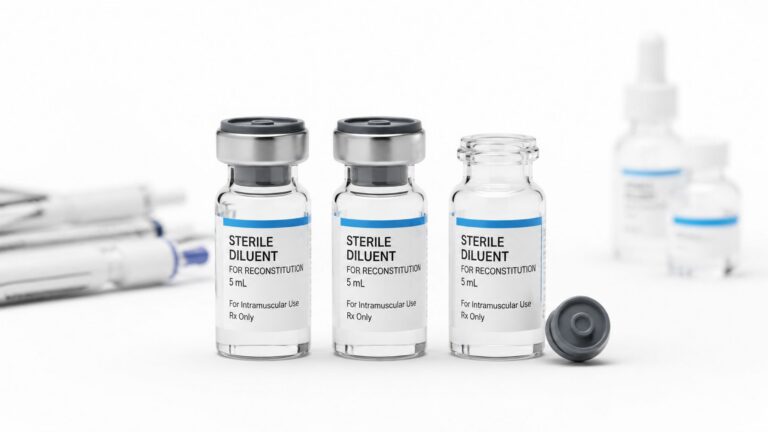
Bacteriostatic water is sterile Water for Injection formulated with 0.9% benzyl alcohol. In peptide work, that formulation is used for multi-dose handling where the vial may be accessed more than once. Sterile water does not contain a preservative, so its use pattern is different and less forgiving after opening.
The specification matters. A vial labeled loosely as "BAC water" is not automatically suitable for research use. The label should identify the formulation clearly, the manufacturer should document USP-grade compliance where claimed, and the packaging should arrive intact with lot traceability. Counterfeit and improperly compounded products are a real problem in this category. If the benzyl alcohol concentration is wrong, the fill quality is poor, or the container was mishandled in transit, the peptide is being reconstituted into an uncontrolled system.
Researchers who need a practical review of the preservative mechanism can refer to this explanation of how benzyl alcohol supports controlled multi-use handling.
Diluent comparison
The right question is whether the diluent fits the protocol, access pattern, and peptide chemistry.
| Attribute | Bacteriostatic Water | Sterile Water | Saline Solution (0.9% NaCl) |
|---|---|---|---|
| Composition | Sterile WFI with benzyl alcohol preservative | Sterile water without preservative | Sterile saline solution |
| Intended use | Multi-dose peptide reconstitution where repeated withdrawals are required | Short-term, single-use or very limited handling | Situations where saline compatibility is required |
| After opening | Preservative supports repeated access within the stated handling window | No preservative protection | Depends on product specification |
| Contamination risk with repeated puncture | Lower when handled aseptically | Higher because there is no preservative | Depends on formulation and use pattern |
| Typical fit | Common choice for routine peptide workflows | Better for select compounds that require preservative-free handling | Sometimes used for peptide-specific compatibility needs |
Concentration planning deserves the same level of control. A 5 mg vial reconstituted with 1 to 2 mL will produce a workable stock for many research protocols, but that is only a starting calculation. Final volume should be set by target dose, draw accuracy, peptide solubility, and how many withdrawals the study design requires. As noted earlier, common reconstitution ranges are widely used because they keep measurement practical, not because they suit every peptide.
Source qualification decides whether those calculations mean anything. A clean-looking vial is not proof of proper formulation. For bacteriostatic water used in peptide research, acceptable sourcing means verified manufacturer details, legible lot information, intact seals, documented storage conditions, and a specification that matches the intended use. If any of those checks fail, replace the diluent before it reaches the bench.
Reconstitution quality starts with the water, not with the syringe.
The Chemistry of Preservation Explained
The preservative system is simple in concept but easy to misuse. Bacteriostatic water works because the formulation is precise, not because the label says “BAC water.”

What bacteriostatic really means
A bacteriostatic agent inhibits bacterial replication. It does not sterilize a contaminated vial after careless handling. That distinction explains why aseptic technique still matters. The preservative slows a contamination event from becoming rapid overgrowth. It does not excuse poor bench practice.
A useful way to think about it is traffic control. The preservative acts like a barrier that stops expansion. It does not remove every car already on the road. If bacteria are introduced through a used needle, a dirty stopper, or repeated sloppy access, the preservative is not a reset button.
Bench rule: Preservative support is not a substitute for sterile technique.
Why the exact formulation matters
The chemistry only works as intended at the correct specification. The solution's pH ranges from 5.7 to 7.0, and at 0.9% benzyl alcohol it provides bacteriostatic activity with negligible interference on peptide structural integrity, as described in Tydes' explanation of bacteriostatic water in peptide research. That same source notes that the solution is clear and non-pyrogenic, which is critical for avoiding pH-driven precipitation or denaturation during reconstitution.
This is why off-spec products are dangerous even when they look identical to compliant material. Too little preservative weakens the multi-use protection. Too much introduces unnecessary chemical stress. A peptide can dissolve and still be sitting in the wrong environment.
Labs that want stronger process discipline should review how benzyl alcohol safeguards research integrity. The key lesson is simple. The stated 0.9% is not a marketing detail. It is the control limit that makes the product useful.
Best Practices for Reconstitution and Storage
Technique determines whether a good diluent stays good. Even USP-grade material can be wasted by poor handling at the bench.
A clear visual reference helps standardize this process across staff and sites.

Bench protocol that protects the peptide
The sequence below is the one that prevents most avoidable failures.
- Prepare the workspace. Use a clean surface and gather the peptide vial, bacteriostatic water vial, sterile syringe, and alcohol swabs before anything is punctured.
- Sanitize both stoppers. Wipe the rubber closures and let them air dry. Wet alcohol that hasn't dried yet can become its own contamination vector.
- Draw the planned volume carefully. Pull the diluent slowly to reduce bubbles and measurement error.
- Inject against the vial wall. The stream should run down the interior glass, not strike the peptide cake directly.
- Mix gently. Swirl. Don't shake.
- Inspect the solution. The expected end point is a clear solution unless the peptide's known behavior says otherwise.
- Label immediately. Record concentration, date of reconstitution, and discard date.
The handling motion during step four matters more than many users think. Direct force on the lyophilized cake can foam the solution or stress sensitive material. Slow side-wall addition gives the peptide time to wet and dissolve evenly.
For labs standardizing staff training, this guide to mixing peptides with bacteriostatic water is a useful process reference.
This demonstration is also helpful for visual learners and new technicians:
Storage discipline after first puncture
Storage policy should be documented, not improvised. Unopened bacteriostatic water has a structural shelf life of up to three years at controlled room temperature of 20–25°C, while opened vials are limited to 28 days after first access and must then be discarded according to Umbrella Labs' handling summary for bacteriostatic water.
For day-to-day practice, the key controls are straightforward:
- Date the vial at first puncture: If the first access date is missing, the vial should be treated as noncompliant.
- Keep reconstituted material refrigerated: The validated handling window depends on storage at 2–8°C in the sources cited earlier.
- Protect from repeated casual handling: One vial passed around by multiple users accumulates risk quickly.
- Discard on appearance change: Cloudiness, particulates, or packaging damage are enough reason to reject the vial.
A common failure in shared labs is that someone remembers expiration date but forgets puncture date. Those are not the same control point. Once the stopper has been breached, the clock is tied to handling history.
Quality Control A Non-Negotiable Standard
A failed peptide run often gets blamed on the peptide. In practice, the diluent is often the hidden variable that should have been screened before it ever reached the bench. Bacteriostatic water is only as reliable as its formulation control, packaging integrity, and supplier traceability.

A common sourcing failure in research
The procurement risk is straightforward. Products sold under the same name are not necessarily equivalent, and the gray market includes mislabeled, poorly formulated, and counterfeit vials. A bottle labeled "bacteriostatic water" may be off-spec on preservative content or compromised during repackaging, which means the researcher is starting with an uncontrolled input.
That matters because a bad diluent can distort the entire interpretation of a peptide study. If the preservative concentration is wrong, if the solution was not prepared under suitable controls, or if the container closure has been compromised, the peptide may appear unstable when the underlying issue occurred upstream in sourcing.
A counterfeit or off-spec diluent can make a sound peptide lot appear defective.
What to verify before a vial enters inventory
Quality control starts at procurement and continues through receiving inspection. The same checks apply whether the buyer is a research lab, reseller, or distributor.
- Formulation identity: The label should state bacteriostatic water for injection and identify the preservative content clearly.
- Container and closure integrity: Use factory-sealed glass vials. Repackaged product adds uncertainty around sterility and stopper performance.
- Traceability: Lot number and expiration date must be present, legible, and consistent across the vial and supporting paperwork.
- Batch-specific documentation: A certificate of analysis should match the lot in hand. Generic files with no lot linkage do not support release into inventory.
- Supply chain handling: Poor fulfillment conditions introduce risk before the vial reaches the lab.
A COA has value only when it is current, lot-specific, and supported by a supplier that can answer basic quality questions. I treat missing lot linkage, vague documentation, or evasive answers about filling and packaging as a stop sign, not a minor paperwork gap. Once that vial is used for reconstitution, any resulting ambiguity is now embedded in the experiment.
One market option is Herbilabs, which supplies research-use-only bacteriostatic water in glass vials with downloadable COAs and lot traceability through its webshop. That does not reduce the buyer's responsibility to verify incoming material. It does mean the minimum documentation and packaging controls are available for review.
For wholesalers and peptide distributors, this is also a quality assurance issue with direct commercial consequences. One off-spec vial can trigger disputed results, replacement claims, internal investigation time, and avoidable damage to customer trust. Procurement decisions belong inside assay control, not outside it.
Troubleshooting Common Reconstitution Issues
Problems after reconstitution usually fall into a few repeat categories. The visible symptom is often the last step in a chain that started with solvent choice, concentration planning, or handling technique.
When the solution turns cloudy
Cloudiness after reconstitution is a warning sign. Common causes include peptide precipitation, pH incompatibility, physical stress from forceful mixing, or degraded input material. If a solution is expected to be clear and it is not, routine practice should be to stop and investigate rather than proceed and hope the assay clarifies the issue.
Use a simple triage sequence:
- Check the handling record: Was the diluent added slowly down the vial wall, or was the cake hit directly?
- Review the storage history: Was the vial left warm for extended periods after mixing?
- Confirm the diluent identity: Was the correct product used, or was a sterile diluent substituted without noting the change?
- Inspect the vial itself: Damaged stopper, broken seal, or visible particulates point to rejection.
Another recurring issue is incomplete dissolution. Gentle swirling over time is acceptable. Aggressive shaking is not. If the peptide still resists dissolution, the lab should review whether the target concentration is too high for that material or whether the peptide has a known solvent compatibility requirement that was overlooked.
If a peptide only dissolves after rough treatment, the lab should question the preparation conditions, not congratulate itself for forcing the vial clear.
When bacteriostatic water is not the right choice
A balanced protocol leaves room for exceptions. For certain labile peptides, benzyl alcohol can alter solution pH or integrity, making sterile water, which is safe for only 24–48 hours, or saline a better choice for short-term, single-dose research, according to Arpovo Health's comparison of bacteriostatic water and other reconstitution solutions.
That doesn't weaken the case for bacteriostatic water for peptides. It sharpens it. The correct rule is not “always use bacteriostatic water.” The correct rule is “match the diluent to the peptide and the access pattern.” For routine multi-use workflows, bacteriostatic water is usually the operational standard. For especially fragile compounds used in a single session, a preservative-free option may be safer.
Frequently Asked Questions for Researchers and Distributors
Can reconstituted peptides be frozen
Some labs freeze aliquots of reconstituted material to avoid repeated thaw-warm cycles in a working vial. Whether that is appropriate depends on the peptide protocol and the lab's validation data. Freezing should never be treated as a universal rescue step for a poorly planned reconstitution. If a peptide is likely to be used across multiple sessions, aliquoting strategy should be decided before reconstitution rather than after the vial has already been handled repeatedly.
For distributors, the important point is communication. Product pages and technical sheets should separate storage advice for unopened diluent from storage advice for the reconstituted peptide. Those are different questions.
Can an opened vial be used after the stated use window
No responsible QC program should allow that. Once the stated multi-use window has passed, the vial should be discarded. The preservative inhibits bacterial replication, but it does not make the vial indefinitely reusable, and it does not reverse contamination introduced through repeated handling.
If a lab wants longer continuity, it should open a fresh vial and document the lot change. Stretching an expired working vial to save cost is poor practice when the downstream cost of invalid data is much higher.
What should distributors control before resale
Distributors should check more than outward packaging. Minimum controls include incoming inspection, lot traceability, storage discipline, and documentation retention. If the company sells to universities, private labs, or peptide resellers, support teams should also be able to answer basic technical questions about vial format, labeling, intended RUO status, and the importance of closure integrity.
A useful checklist looks like this:
- Receiving control: Match lot numbers, labels, and quantity at intake.
- Document control: Keep the corresponding COA with the inventory record.
- Packaging review: Reject cracked glass, damaged caps, or compromised seals.
- Inventory rotation: Move older compliant stock first and quarantine anything with uncertain history.
- Customer communication: State RUO status clearly and avoid vague handling language.
Is saline interchangeable with bacteriostatic water
Not automatically. Saline may be suitable in peptide-specific situations, but it should not be swapped in casually because ionic conditions can change how a compound behaves. The peptide's compatibility profile should drive that choice. If the protocol was built around bacteriostatic water, any substitution should be documented as a method change.
What is the cleanest rule for choosing a diluent
Use bacteriostatic water when the peptide is expected to be accessed repeatedly and the compound is compatible with the preservative system. Use a preservative-free option only when the peptide is known to be sensitive and the work is short-term and single-session. In both cases, source quality and aseptic handling still decide whether the method remains valid.
Herbilabs serves labs, resellers, and distribution partners that need research-use-only sterile diluents with traceable documentation, glass-vial packaging, and practical support for peptide workflows. Teams that need a documented source for bacteriostatic water for peptides can review the available options at Herbilabs.