Private Label, White Label, Wholesale partnerships available - EU, USA and UK - Free shipping from €75

Why Bacteriostatic Water is Essential for Accurate Pharmaceutical Research
Learn why the correct solvent is a critical factor for maintaining sterility, accuracy, and reproducibility in drug development and scientific experiments.
The Critical Role of Solvents in Experimental Integrity
The integrity of scientific discovery rests on reproducibility. Yet, as a 2021 article in Nature highlighted, a significant portion of preclinical research findings cannot be consistently reproduced, often due to subtle inconsistencies in methodology. The choice of a solvent might seem like a minor detail, but it is a critical control point that underpins the validity of an entire study. This becomes especially apparent when working with sensitive biological compounds like peptides and proteins, which are often preserved through lyophilization, or freeze-drying.
These powdered compounds are inert and stable, but they require careful reconstitution to become biologically active for experiments. The process of how to reconstitute lyophilized drugs introduces several fundamental challenges that every researcher must address to ensure the accuracy of their work. These challenges directly impact the reliability of the final data.
The core difficulties include:
- Ensuring the compound dissolves completely without being damaged.
- Achieving the precise target concentration needed for accurate dosing.
- Preventing microbial contamination that could degrade the sample or introduce experimental artifacts.
A poor solvent choice can lead to compound degradation, inaccurate concentrations, and contaminated samples. These issues not only produce unreliable results but also waste valuable time, expensive reagents, and institutional resources. Ultimately, overlooking the importance of the right solvent directly compromises the integrity of the research itself.
Deconstructing the Composition of Bacteriostatic Water
Bacteriostatic water is a specialized, high-purity solution designed specifically to address the challenges of reconstitution in a research setting. Its composition is simple yet precise, combining an ultra-pure water base with a preservative agent to ensure both sterility and stability for multi-dose applications. Understanding these two components is key to appreciating its role in maintaining experimental accuracy.
The Sterile Water Base: A Foundation of Purity
The foundation of bacteriostatic water is sterile, non-pyrogenic water. Achieving this level of pharmaceutical research water purity involves rigorous purification methods, such as multi-column distillation or reverse osmosis. These processes remove not just minerals and microorganisms but also endotoxins, which are fever-inducing substances known as pyrogens. The absence of these contaminants is non-negotiable, as even trace amounts can interfere with biological assays, particularly in cell culture or in vivo studies, leading to skewed and unreliable results.
The Preservative: The Role of Benzyl Alcohol
What distinguishes bacteriostatic water is the addition of a preservative. The solution contains 0.9% benzyl alcohol in bacteriostatic water, which functions as a bacteriostatic agent. It is important to distinguish this from a bactericidal agent, which actively kills bacteria. Instead, a bacteriostatic agent inhibits bacterial reproduction. This means that if any microbes are accidentally introduced into a multi-dose vial, the benzyl alcohol prevents them from multiplying, effectively preserving the sterility of the solution over time. This preservative is what makes the solution safe and reliable for repeated use from a single vial.
Together, these components create a powerful tool for researchers. The ultra-pure water provides a clean, inert solvent that will not interfere with the reconstituted compound, while the benzyl alcohol acts as a safeguard against contamination. For more insights into maintaining high standards in your research, you can explore the resources on our Herbiolabs blog.
Maintaining Sterility in Multi-Dose Research Protocols
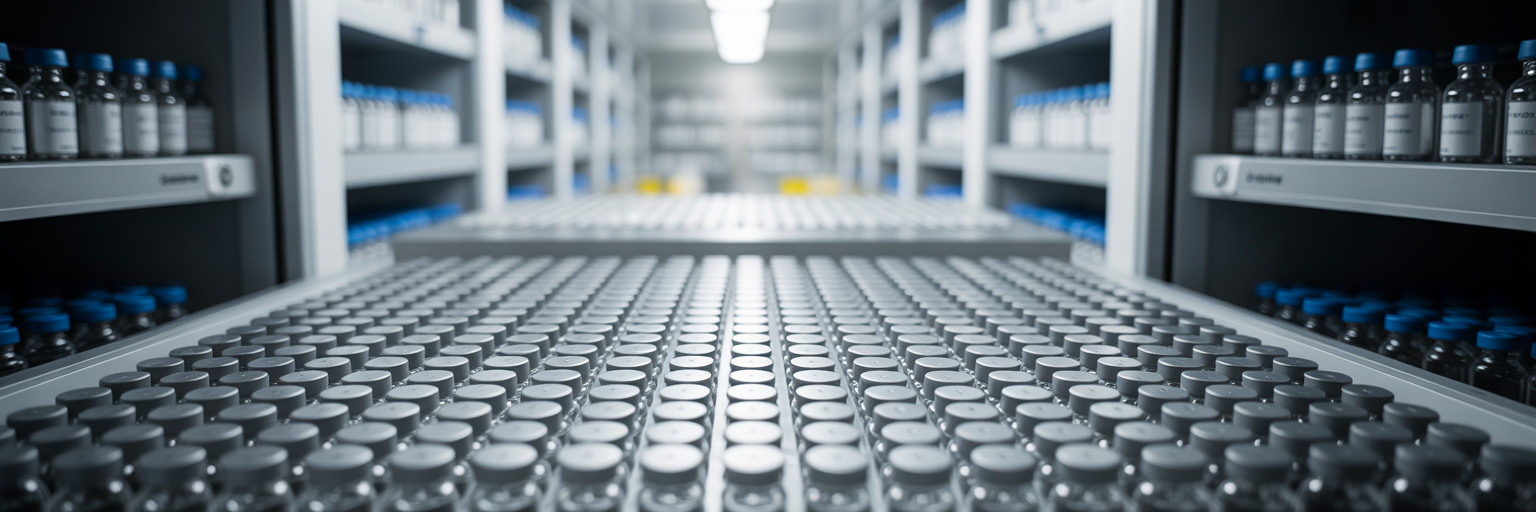
The primary practical advantage of bacteriostatic water becomes clear in common research scenarios involving multi-dose vials. Imagine a scientist who needs to administer small, precise amounts of a reconstituted compound over several days or weeks for a long-term study. Each time the vial’s rubber septum is punctured with a syringe, there is an unavoidable risk of introducing airborne or surface bacteria into the solution. Without a preservative, this contamination could quickly compromise the entire stock.
This is where the 0.9% benzyl alcohol becomes essential. It actively suppresses the growth of any potential contaminants, preserving the solution’s sterility and potency. This protective quality allows for a standard 28-day shelf life after the first use, a guideline supported by standards like the United States Pharmacopeia (USP) General Chapter <797> for sterile compounding. This extended usability minimizes waste and significantly reduces costs compared to single-use sterile water vials, which must be discarded after a single puncture.
The impact on experimental consistency is profound, especially when working with sensitive compounds like peptides. Using bacteriostatic water for peptides ensures:
- Dose Integrity: The potency of the compound remains unchanged from the first dose to the last, preventing gradual degradation due to microbial activity.
- Concentration Stability: The concentration of the active compound is not altered by the metabolic byproducts of bacterial growth.
- Reduced Variability: A dose drawn on day one is chemically and biologically identical to a dose drawn on day twenty, which is crucial for improving the reproducibility of results.
For researchers conducting multi-dose protocols, sourcing a reliable solution is paramount. A 30ml vial of our reconstitution solution is designed to meet these rigorous standards, ensuring your experiments remain consistent and uncontaminated.
A Comparative Analysis of Common Reconstitution Solvents
The choice of solvent is context-dependent, and a direct comparison clarifies why bacteriostatic water is often the superior option for multi-dose research protocols. While other solvents have their place in the laboratory, they lack the specific combination of purity and preservation needed for repeated-use applications. The central question often comes down to sterile vs bacteriostatic water, but understanding the full range of options provides a clearer picture.
The following table outlines the distinct properties and applications of common laboratory solvents to guide researchers in selecting the appropriate one for their specific experimental needs.
| Solvent | Composition | Primary Use Case | Key Limitation |
|---|---|---|---|
| Bacteriostatic Water | Sterile Water + 0.9% Benzyl Alcohol | Multi-dose vials for peptides and other drugs | Benzyl alcohol can be incompatible with certain compounds or cell lines. |
| Sterile Water for Injection | Sterile, non-pyrogenic water | Single-dose applications; compounds sensitive to preservatives | No preservative; high risk of contamination after opening. Single-use only. |
| Sterile Saline (0.9% NaCl) | Sterile Water + 0.9% Sodium Chloride | Isotonic solutions for injection or cell culture | Salts can affect the solubility and stability of certain proteins and peptides. |
| Distilled/Deionized Water | Purified water, non-sterile | General lab use (e.g., buffer preparation, glassware rinsing) | Not sterile or pyrogen-free; completely unsuitable for injectable solutions. |
The decision-making process involves balancing the need for multi-dose capability against potential compound sensitivity. For single-use applications or for compounds known to be incompatible with benzyl alcohol, sterile water is the appropriate choice. Similarly, sterile saline is necessary for isotonic solutions, though researchers must be aware that salts can impact compound stability, an effect explored in research published in the Journal of Pharmaceutical Sciences. For most other multi-dose protocols involving stable compounds, bacteriostatic water is the standard for ensuring safety and reproducibility.
Protocol for Accurate and Safe Compound Reconstitution
A proper reconstitution technique is just as important as selecting the right solvent. This practical peptide reconstitution guide outlines the formal protocol for ensuring your compounds are prepared accurately and safely, preserving their structural integrity and biological activity. Following these steps minimizes the risk of error and ensures consistent results.
- Preparation: Before you begin, allow both the lyophilized compound vial and the bacteriostatic water to reach room temperature. This simple step prevents thermal shock to the compound, which can occur when a cold powder is mixed with a room-temperature liquid.
- Solvent Addition: Using a sterile syringe, slowly inject the required volume of bacteriostatic water down the inner side of the vial. Do not inject the solvent directly onto the lyophilized powder. This technique minimizes foaming and protects delicate peptide or protein structures from mechanical stress, known as shearing.
- Mixing: Once the solvent is added, gently swirl or roll the vial between your palms until the powder is completely dissolved. Never shake the vial vigorously. Shaking can cause denaturation or aggregation of proteins and peptides, rendering the compound biologically inactive and useless for your experiment.
- Visual Inspection: After mixing, visually inspect the final solution. It should be clear and completely free of any visible particulates. Any cloudiness or floating particles could indicate solubility issues, contamination, or degradation of the compound.
- Proper Storage: Once reconstituted, the solution should be stored under refrigeration, typically between 2-8°C. This maintains the compound’s stability for the standard 28-day use period, ensuring its potency is preserved for the duration of your protocol.
Adhering to this protocol is fundamental for reliable research. For those needing the right tools for the job, various sizes of reconstitution solution are available in our shop.
Connecting Solvent Choice to Research Reproducibility
The discussion of solvents and reconstitution techniques ultimately returns to the core principle of scientific integrity. Seemingly small details, like choosing the right solvent or gently swirling a vial instead of shaking it, are directly linked to the reliability and reproducibility of experimental data. Reproducibility is the cornerstone of the scientific method, and inconsistent results can often be traced back to these minor procedural variations that are easily overlooked.
Standardizing on high-purity bacteriostatic water for multi-dose protocols is a powerful and straightforward strategy for reducing inter-assay and inter-lab variability. It introduces a control at one of the most basic steps of an experiment, ensuring that the compound being tested remains stable and uncontaminated from start to finish.
By controlling for variables like microbial contamination and compound degradation, researchers can be more confident that their observed results are genuine biological effects, not procedural artifacts. This strengthens the validity of their conclusions and upholds the integrity of the entire research enterprise. For those committed to the highest standards of research, our full range of laboratory solutions can be explored at Herbiolabs.