Private Label, White Label, Wholesale partnerships available - EU, USA and UK - Free shipping from €75

How Benzyl Alcohol Safeguards Research Integrity
Learn how bacteriostatic agents like benzyl alcohol work to prevent microbial contamination and maintain the stability of sensitive research compounds.
In multi-dose vials, every puncture of the septum introduces a risk of microbial contamination that can invalidate weeks of research. This is where bacteriostatic agents become the unseen guardians of scientific integrity, ensuring that reconstituted solutions remain stable and pure.
The Foundational Role of Preservatives in Multi-Dose Solutions
To understand why preservatives are essential in a research setting, it is important to distinguish between two types of agents. Bactericidal agents actively kill microbes, while bacteriostatic agents simply inhibit their growth and reproduction. Think of it as the difference between a stop button and a pause button. For many sensitive research compounds, the “pause” approach is far superior. Killing bacteria can cause them to lyse, or burst, releasing cellular byproducts that might interfere with the experiment or degrade the active compound.
This brings us to the practical challenge of multi-dose vial contamination. Each time a researcher draws a dose, the needle puncture creates a potential entry point for airborne or surface microbes. Without a preservative, a single contamination event could turn an entire vial of expensive, carefully prepared solution into a bacterial culture, compromising every subsequent experiment drawn from it.
This is where benzyl alcohol, typically at a 0.9% concentration, has become the industry benchmark. Its long history of effective use and well-documented safety profile in laboratory applications make it a trusted choice. It effectively puts bacterial growth on pause, maintaining the purity of the solution across multiple uses.
The benefits for a researcher are immediate and tangible. It allows for significant cost savings by enabling the use of a single vial for multiple experiments instead of preparing a fresh one each time. This convenience also streamlines workflows, as it allows researchers to prepare a stock solution and draw precise doses over time, a process made simple with a reliable reconstitution solution. By preventing microbial growth, benzyl alcohol ensures that the first dose is just as pure as the last.
The Molecular Mechanism of Benzyl Alcohol

While the practical benefits are clear, the effectiveness of benzyl alcohol lies in its elegant molecular action. The core of the benzyl alcohol preservative mechanism is rooted in its chemical structure. As a lipophilic, or fat-loving, molecule, it has a natural affinity for the lipid bilayer that forms the bacterial cell membrane. Instead of attacking from the outside, it essentially dissolves into the membrane, disrupting its highly organised and fluid structure.
Imagine a perfectly built brick wall. Benzyl alcohol acts like a solvent that seeps between the bricks, weakening the mortar and making the entire structure unstable. This disruption has immediate and cascading consequences for the bacterium. The membrane becomes excessively permeable, causing vital intracellular components like potassium ions and ATP, the cell’s primary energy currency, to leak out. The cell loses its ability to maintain its internal environment and generate energy.
This functional collapse directly inhibits the complex processes required for life and reproduction. Without a stable energy supply and the necessary building blocks, the machinery for protein synthesis and DNA replication grinds to a halt. The bacterium can no longer divide or grow, effectively placing it in a state of suspended animation. This is the essence of its bacteriostatic effect. It does not necessarily kill the microbe but prevents it from multiplying and contaminating the research sample.
The standard 0.9% concentration is not arbitrary. As documented by regulatory bodies like the U.S. Food and Drug Administration, this specific level is optimised to be effective against a broad spectrum of common laboratory contaminants. At the same time, it is low enough to minimise the risk of unwanted chemical interactions with the dissolved research compound, striking a crucial balance between efficacy and inertness. A recent analysis by the U.S. Food and Drug Administration shows that this concentration is the established standard for bacteriostatic water for injection.
Navigating Compound Compatibility and Stability
Although benzyl alcohol is a reliable preservative, its interaction with the active compound is a critical consideration for any researcher. The primary goal is to ensure the preservative does its job without compromising the integrity of the peptide or protein being studied. This is where a deep understanding of peptide reconstitution stability becomes paramount.
Primary Risks of Incompatibility
The most significant concern is the potential for the preservative to induce unwanted changes in the active compound. Key risks include:
- Protein Aggregation: Benzyl alcohol’s lipophilic nature can cause it to interact with hydrophobic regions of a peptide or protein. This interaction can disrupt the compound’s delicate three-dimensional structure, causing molecules to clump together or aggregate. These aggregates are not only inactive but can also cause issues in analytical systems.
- Particle Formation: Beyond aggregation, incompatibility can lead to the formation of visible or sub-visible particles. The challenge of preservative-induced particle formation is a significant topic in formulation science, with a 2023 review in Pharmaceutics highlighting the delicate balance required for peptide formulations.
- Chemical Degradation: In some cases, the preservative or other excipients in the solution can catalyse chemical reactions like oxidation or hydrolysis, breaking down the active compound over time.
Principles for Assessing Compatibility
There is no universal rule for compatibility, as every peptide is different. However, researchers can follow several principles to mitigate risks. Preventing protein aggregation and ensuring stability involves a careful balancing act. Choosing high-purity solvents and appropriate supplies is the first step in mitigating these risks, so it is wise to browse a comprehensive shop for laboratory needs.
| Factor | Potential Risk if Mismatched | Mitigation Strategy |
|---|---|---|
| Peptide/Protein Structure | Hydrophobic regions may interact with benzyl alcohol, leading to aggregation. | Review literature for data on similar compounds; conduct small-scale tests. |
| Solution pH | If pH is near the compound’s isoelectric point, solubility decreases, increasing aggregation risk. | Adjust buffer system to maintain a pH where the compound is most stable and soluble. |
| Concentration of Compound | Higher concentrations can increase the likelihood of aggregation. | Start with lower, validated concentrations; assess stability before scaling up. |
| Presence of Other Excipients | Salts or other stabilizers can either enhance or reduce stability in the presence of a preservative. | Formulate with minimal necessary excipients; test compatibility of all components together. |
Note: This table provides general guidelines for assessing peptide reconstitution stability. Researchers should always consult compound-specific literature and perform their own validation tests.
Best Practices for Laboratory Application

Knowing the science is one thing, but applying it correctly in the lab is what ensures reproducible results. Proper technique when using bacteriostatic water for research is not just about following steps, it is about maintaining the integrity of your entire experimental setup. A sloppy reconstitution can introduce more variables than the preservative can handle.
Here is a straightforward protocol for reconstituting a lyophilized compound:
- Prepare a Sterile Workspace: Before you begin, ensure your work area is clean. Working in a laminar flow hood is ideal, but at a minimum, the bench should be wiped down with 70% ethanol.
- Sanitize the Vials: Use a fresh alcohol pad to vigorously wipe the rubber septum of both the bacteriostatic water vial and the vial containing your lyophilized compound. This removes any surface contaminants.
- Use a Sterile Syringe: Always use a new, sterile syringe and needle for each reconstitution. Reusing syringes is a primary source of cross-contamination.
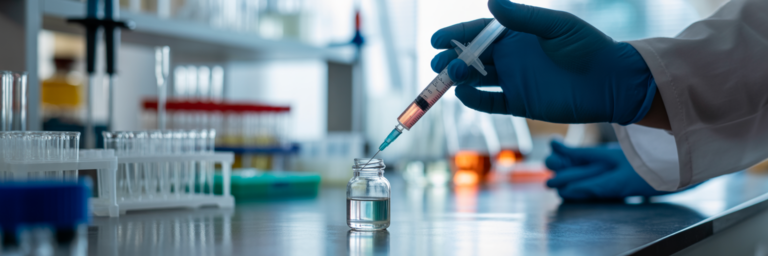
- Inject Slowly and Indirectly: When injecting the solvent, aim the needle tip against the inside wall of the vial. Allow the liquid to run down the glass gently. Avoid spraying the solvent directly onto the lyophilized powder, as the force can denature sensitive peptides.
Once reconstituted, proper storage is crucial. Most peptide solutions should be refrigerated at 2-8°C and protected from direct light. Meticulous record-keeping is non-negotiable. Label every vial with the compound name, final concentration, and the date of reconstitution. This simple habit is fundamental for experimental reproducibility.
Finally, remember that the solution has a finite lifespan. Even with a preservative, the vial should be discarded after the recommended period, typically 28 days. With each puncture, the risk of contamination increases slightly, and the preservative’s effectiveness can diminish. For long-term projects requiring multiple reconstitutions, securing a multi-pack of reconstitution solution can ensure consistency and prevent delays. Adhering to these best practices is crucial, and more in-depth guides on laboratory techniques can often be found on specialized research resources like our blog.
The Future of Preservative Technology in Research
While benzyl alcohol remains the core component in what is known as bacteriostatic water, a sterile solution designed specifically for this purpose, researchers are exploring new frontiers. The ongoing search for alternatives to benzyl alcohol is not driven by its failure, but by the need for a more diverse toolkit to handle increasingly complex and sensitive biologics. Agents like m-cresol and chlorobutanol are also used, but each presents its own unique profile of efficacy, compatibility, and potential interactions.
The evolution of preservative technology extends beyond just the chemical agent. Significant advancements are being made in holistic formulation science. This includes the development of sophisticated buffer systems that better maintain pH and the use of stabilizers like sugars or amino acids. These components can protect the active compound from degradation, reducing the chemical burden placed on the preservative.
Innovations in packaging also play a vital role. Improved vial septums that reseal more effectively after puncture and the adoption of closed-system transfer devices physically reduce the initial risk of contamination. The ultimate goal is not to find a single replacement for benzyl alcohol, but to create tailored preservation strategies. By combining optimized chemical formulations with advanced physical barriers, the future of research solutions will offer enhanced stability and safety for even the most delicate compounds.