Private Label, White Label, Wholesale partnerships available - EU, USA and UK - Free shipping from €75

BAC Water for Peptides: A 2026 Reconstitution Guide
A lab manager opens the cold room, pulls a vial of lyophilized peptide from a rack, and pauses at the same decision that shapes a lot of downstream results. The powder is expensive, the assay window is tight, and the team will need more than one withdrawal from the vial over the next several days. At that point, the question isn't just how to dissolve the peptide. The question is which diluent supports reliable handling, clean documentation, and fewer avoidable failures.
That's where BAC water for peptides usually enters the workflow. It is often first encountered as a mixing liquid. Serious buyers and experienced technicians treat it as more than that. The preservative system, the vial format, the storage rules, and the supplier's quality controls all affect whether a reconstituted peptide remains usable across repeated access.
The practical difference shows up fast in real operations. A single researcher may care about whether the peptide dissolves cleanly. A lab manager also cares about puncture handling, labeling discipline, purchasing cadence, and whether a reseller can trust what's on the vial label. Those concerns all start with understanding what bacteriostatic water is, and where it fits, and where it does not.
Table of Contents
- The Critical First Step in Peptide Research
- What Exactly Is Bacteriostatic Water
- BAC Water vs Sterile Water vs Saline
- The Correct Peptide Reconstitution Protocol
- Safe Storage and Handling of Reconstituted Peptides
- Procurement and Quality for Labs and Resellers
- Frequently Asked Questions About BAC Water
The Critical First Step in Peptide Research
A lyophilized peptide looks stable and uncomplicated until the moment reconstitution begins. From that point forward, the compound is only as dependable as the handling around it. The wrong diluent can shorten the usable window, increase contamination risk, or create confusion later when someone else on the team tries to trace what happened in the vial.
In multi-session research, the first puncture changes everything. Once a stopper has been accessed, each later withdrawal becomes part chemistry problem and part handling problem. That's why experienced labs don't treat reconstitution as a minor prep step. They treat it as a controlled handoff from dry storage to active use.
Why the diluent choice matters early
For a peptide that will be used once and discarded immediately, several sterile options may appear interchangeable at first glance. In real lab schedules, that's rarely the situation. Teams often need repeated withdrawals from the same vial, and that creates a need for a diluent built for multi-use handling rather than one-time access.
Practical rule: If a vial will be punctured more than once, the diluent decision should be made as part of the lab's contamination-control plan, not as an afterthought at the bench.
Bacteriostatic water thus becomes the default professional choice in many peptide workflows. It supports repeated vial access in a way plain sterile water does not. That difference has implications far beyond the bench. Procurement teams need to know which format fits usage volume. Quality teams need to know whether the product matches label claims. Resellers need to know whether customers are being given a correct solvent recommendation or a generic one.
What good practice looks like
A disciplined peptide workflow usually includes:
- A defined diluent standard: One approved option for multi-use reconstitution, with documented storage rules.
- Clear labeling: Reconstitution date, concentration, and discard timing written on the vial or in a connected record.
- Supplier verification: Lot traceability and product documentation checked before the vial ever enters inventory.
- Aseptic access habits: Fresh sterile needles and syringes, stopper disinfection, and cold storage where required.
When those basics are in place, the peptide has a much better chance of delivering reproducible research results instead of preventable variability.
What Exactly Is Bacteriostatic Water
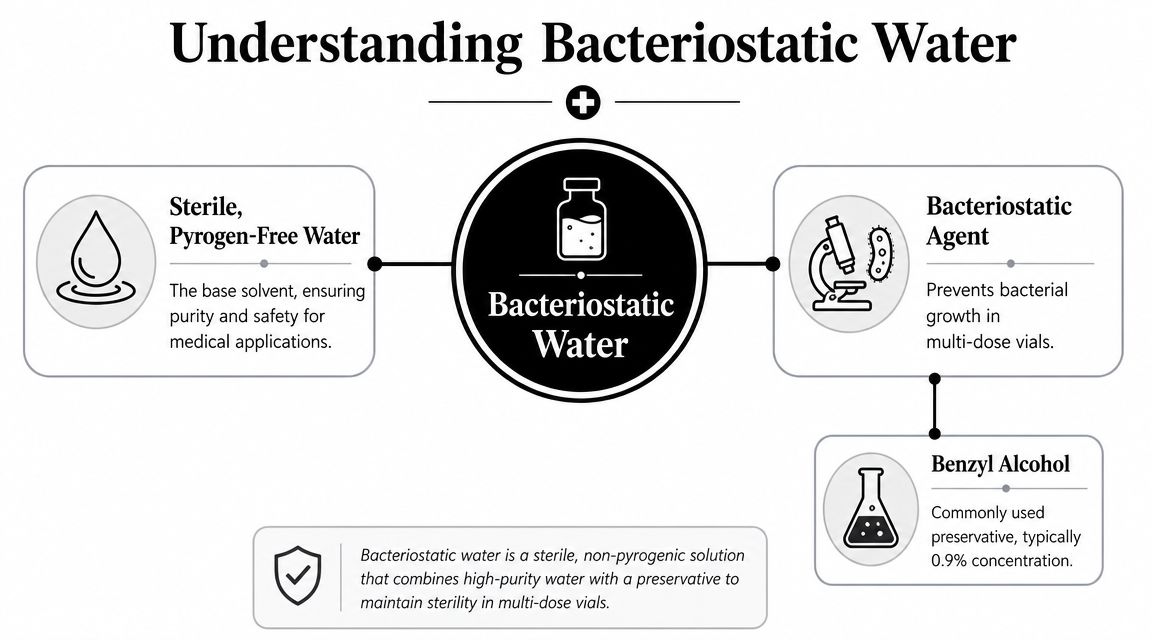
Bacteriostatic water is not a special peptide-only invention. It is a defined pharmaceutical diluent. FDA and DailyMed labeling describe it as water for injection containing 0.9% (9 mg/mL) benzyl alcohol as a preservative, with a standard unopened storage range of 20 to 25°C (68 to 77°F) according to DailyMed labeling for bacteriostatic water.
The formulation that matters
Two parts define the product.
First, there is the water base. This is the sterile diluent portion used to dissolve or dilute a dry material.
Second, there is the preservative. In this formulation, that preservative is benzyl alcohol at 0.9%. That percentage matters because it is what distinguishes bacteriostatic water from plain sterile water in practical handling terms.
A simple way to explain it is this:
- Sterile water starts clean
- Bacteriostatic water starts clean and includes a preservative system for repeated access
That does not mean the vial becomes immune to bad technique. It means the formulation is designed to inhibit bacterial growth after puncture, which is why it is associated with multi-dose handling.
Why the preservative changes workflow
This is the point many new buyers miss. “Bacteriostatic” does not mean the product sterilizes whatever enters the vial. It means the preservative helps suppress bacterial proliferation after access. That makes the product operationally useful when a vial has to serve more than one withdrawal.
BAC water solves a repeat-access problem, not a careless-technique problem.
In peptide work, that distinction is critical. The reconstitution step often happens once, but the vial may then be used across multiple sessions. Without a preservative, every puncture increases the consequence of even small contamination events. With a preservative-based diluent, the workflow becomes more tolerant of repeated use, provided the team still follows sterile handling.
For lab managers, this formulation detail also ties directly to compliance and purchasing. If a reseller or supplier labels something as bac water, the product should match the core standard. If it doesn't, the label is not enough. The chemistry has to match the claim.
BAC Water vs Sterile Water vs Saline
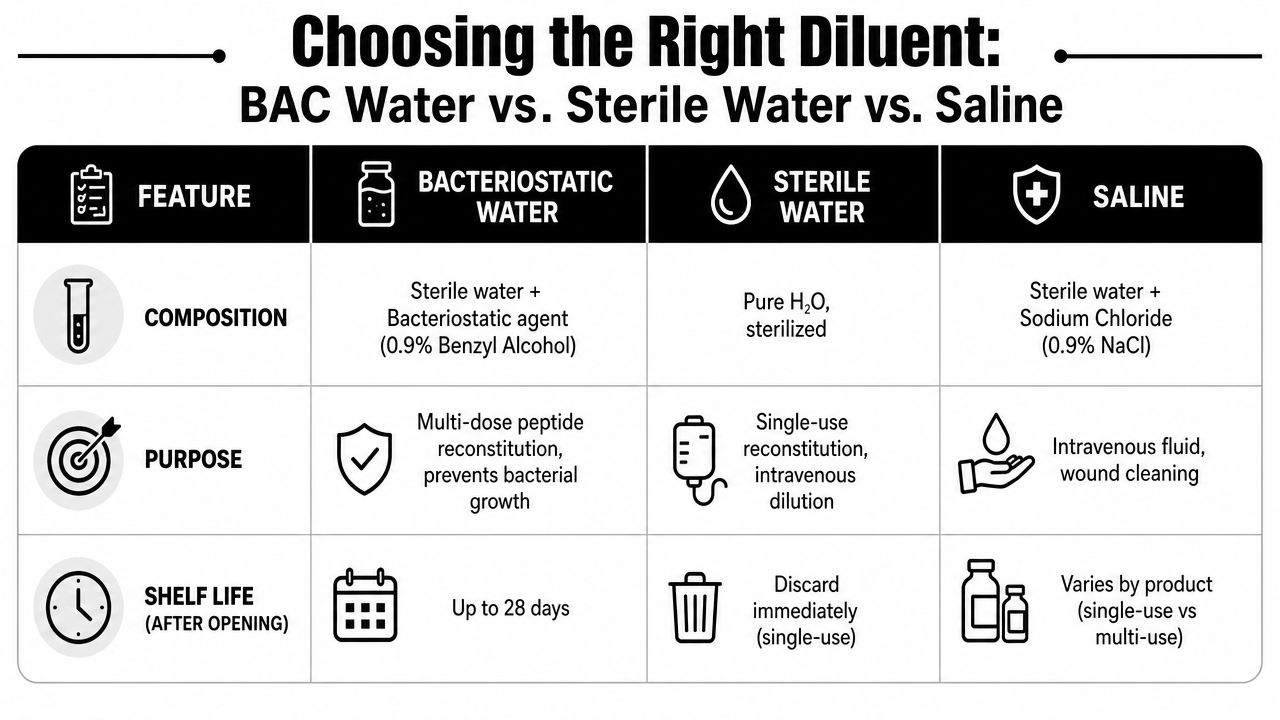
Most confusion around peptide reconstitution comes from products that all look similar on a shelf. Clear liquid in a sealed vial can hide important differences in composition and intended use. For peptide labs, the practical question isn't which liquid is “clean.” The practical question is which liquid matches the access pattern, peptide compatibility requirements, and storage plan.
A decision table for common lab use
| Diluent | Composition | Best fit in peptide workflow | Key limitation |
|---|---|---|---|
| Bacteriostatic water | Sterile water plus 0.9% benzyl alcohol preservative | Multi-use reconstitution where repeated withdrawals are expected | Not universal for every peptide or excipient system |
| Sterile water | Sterile water without preservative | Single-use or immediate-use applications | No preservative support after access |
| Saline | Sterile water plus sodium chloride | Situations where a protocol specifically calls for it | Not the default choice for general peptide reconstitution |
The strongest practical benchmark comes from peptide workflow guidance. Bacteriostatic water can support up to 28–30 days of usable storage for a reconstituted peptide at 4°C, while sterile water without a preservative is often considered stable for only 24–72 hours after reconstitution, according to Palmetto Peptides guidance on bacteriostatic water for peptide research.
That one distinction answers a large share of routine purchasing questions. If the vial will be used across days or weeks, bac water is usually the operational fit. If the material will be used immediately and discarded, sterile water may be acceptable where the peptide specification allows it.
Labs that need plain diluent without preservative often compare options such as water for injection products used in controlled reconstitution workflows.
Where confusion usually starts
The most common mistake is assuming “sterile” means “good for any peptide application.” It doesn't. Sterility describes the starting condition of the liquid. It doesn't describe what happens after the stopper is punctured and the vial is used again.
Another source of confusion is saline. Some buyers treat saline as a neutral substitute because it is also sterile and common in medical environments. In peptide work, that shortcut can be sloppy. Saline changes the solution environment, and unless a specific protocol calls for it, it should not be treated as a generic stand-in for bacteriostatic water.
A practical buying framework looks like this:
- Choose bac water when the vial is expected to support repeated withdrawals.
- Choose sterile water when the peptide documentation or compatibility requirement excludes benzyl alcohol.
- Choose saline only with protocol justification rather than convenience.
The right diluent is the one that matches the peptide and the handling plan, not the one that happens to be closest in the supply cabinet.
The Correct Peptide Reconstitution Protocol
Technique matters as much as diluent choice. A peptide can be paired with the correct bacteriostatic water and still be compromised by poor handling. Fast injection, direct blasting onto the powder cake, reused sharps, weak labeling, and warm bench storage all create avoidable variability.
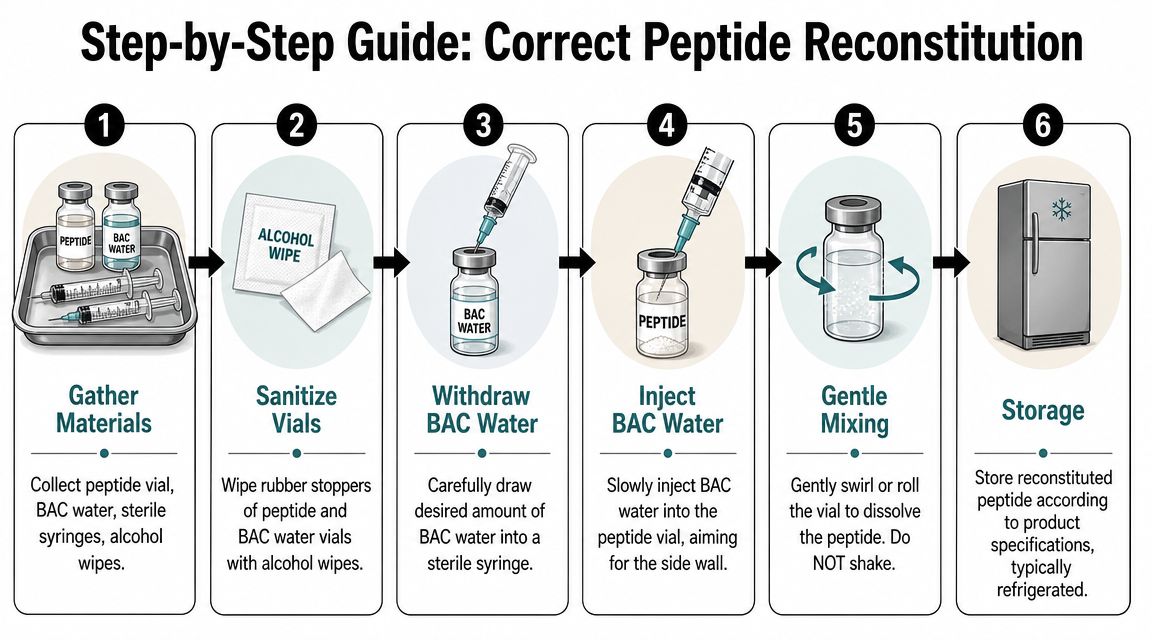
A visual summary helps standardize bench practice across teams.
Before the needle touches the stopper
Set up the workspace first. The peptide vial, bac water vial, sterile syringe, sterile needle, alcohol wipes, and labeling materials should be ready before any seal is punctured. The goal is a smooth sequence with minimal open handling and no searching for supplies mid-process.
Basic prep should include:
- Confirm the peptide identity: Match vial label, batch record, and intended concentration.
- Review the peptide's handling notes: Some compounds have compatibility limits that override standard habits.
- Clean the stopper surfaces: Use alcohol wipes and allow the rubber surfaces to dry.
- Prepare the label in advance: Record concentration and reconstitution date at the time of mixing, not later from memory.
A demonstration of bench handling can help standardize team technique:
The actual reconstitution sequence
Once the setup is clean, the actual reconstitution should be slow and controlled.
- Withdraw the required volume carefully: Use a fresh sterile syringe and needle. Avoid multiple in-and-out motions through the diluent stopper.
- Aim for the vial wall: Inject the bac water down the inner side of the peptide vial rather than straight into the powder.
- Let the solvent settle: A gentle addition reduces foaming and mechanical stress.
- Mix without shaking: Swirl or roll the vial gently until dissolution is complete.
Shaking is one of the most persistent bad habits in peptide handling. It feels efficient, but it can be rough on fragile material. Slow reconstitution protects the structure better than aggressive agitation.
A clean dissolve is usually quiet. Fast force isn't a sign of good technique.
For repeated-use workflows, industry guidance commonly places the limit at about 28 days after first puncture when refrigerated at 2 to 8°C, but that working window depends on strict aseptic handling during every withdrawal, as described in industry guidance on bacteriostatic water use for multi-dose reconstitution.
Small protocol details that prevent expensive mistakes
A few details carry more weight than they seem to:
- Never reuse a needle or syringe: Even one shortcut can introduce contamination.
- Inspect the solution after mixing: Cloudiness, particles, or unexpected appearance should trigger review.
- Document immediately: Labeling after the fact creates concentration and dating errors.
- Return to storage promptly: A peptide left warming on a bench between uses accumulates avoidable stress.
When labs convert this sequence into a written SOP and train every technician on the same method, reconstitution becomes much more reproducible.
Safe Storage and Handling of Reconstituted Peptides
Once a peptide is in solution, the main job becomes preservation. Good reconstitution can still be undone by casual storage. Vials get left in the wrong rack, labels fade, the concentration isn't written clearly, or someone uses the same bottle for repeated access without a puncture-date record.
Labeling and refrigeration discipline
A reconstituted vial should never go into a refrigerator as an anonymous clear liquid. At minimum, the label should identify the peptide, the concentration, and the reconstitution date. Many labs also add the discard date or a linked inventory record so that no one has to estimate later.
Cold storage should be treated as part of the SOP, not as a suggestion. Reconstituted peptides are commonly kept refrigerated, and the handling notes for the specific peptide should always take priority if they call for something more restrictive. For teams refining this process, these essential storage practices for bacteriostatic water help frame storage discipline around contamination control and stock management.
Handling rules that protect the vial
The daily habits around an in-use vial matter more than many people expect.
- Use a fresh sterile withdrawal setup each time: The preservative reduces risk, but it doesn't excuse sloppy access.
- Wipe the stopper before each puncture: Repeated access without surface sanitation defeats the point of careful storage.
- Minimize time out of refrigeration: Pull the vial, withdraw what is needed, and return it promptly.
- Protect the record trail: If multiple technicians share a vial, a written log prevents guesswork.
Plainly stated, the vial has two enemies after reconstitution. One is contamination. The other is uncertainty. A peptide with unclear dating or unclear concentration is often as operationally useless as a contaminated one because no one can defend the result quality later.
Procurement and Quality for Labs and Resellers
A common failure starts long before reconstitution. The vial arrives, the label looks acceptable, and purchasing logs it into inventory. Weeks later, a technician notices the diluent does not behave as expected, or QA finds that the paperwork behind the lot is incomplete. At that point, the problem is no longer a bench problem. It is a procurement, traceability, and compliance problem.
What buyers should verify before ordering
For a lab manager or reseller, bacteriostatic water is a controlled input. It works like any other specification-sensitive supply item. If the formulation, sterility controls, or packaging record are unclear, the downstream risk shifts to your team.
Start with the product identity itself. The label should state that it is sterile water containing benzyl alcohol as the preservative, and the intended supply category should be clear for the market you serve. Compatibility also needs review before a buyer standardizes one diluent across every SKU, because some compounds are not appropriate for a preservative-containing solution. That point belongs in vendor qualification, not in a troubleshooting discussion after stock has already shipped.
A practical approval checklist usually includes four items:
- Formulation clarity: The preservative system should be named on the label or supporting specification.
- Lot-level documentation: Buyers should be able to request traceability records and quality documents tied to the batch.
- Packaging controls: Stopper type, vial size, and tamper condition affect how the product fits your workflow.
- Use classification and labeling consistency: Research-use supply should be labeled in a way that matches the channel and customer expectation.
For teams building a repeatable supplier screen, this guide to selecting bacteriostatic water for research use is useful because it frames selection as a quality system decision, not just a price comparison.
One example in the market is Herbilabs Reconstitution Solution 10ml, a research-use multi-dose vial described as a sterile, non-pyrogenic solution containing 0.9% benzyl alcohol for reconstituting peptides, proteins, and antibodies.
Format choice affects waste and risk
Vial size changes daily operations. It affects how often a container is accessed, how much stock remains after a project run, and how much uncertainty purchasing creates for the next reorder.
Analysts at Peptideware, in their product commentary on 3 mL bacteriostatic water single-use vials, describe growing interest in smaller formats for workflows that involve single reconstitutions or lower-volume use. The business logic is straightforward. Smaller units can reduce leftover inventory and limit repeated entry into the same container. Larger multi-dose vials can still make sense for higher-throughput labs, but only if turnover is fast and access control is disciplined.
That is why procurement and QA should review format together. A reseller may want smaller packs because they fit a broader range of customer order sizes and reduce complaints tied to unused surplus. A research lab may prefer multi-dose stock because it simplifies inventory, but only if the team can document consistent handling and batch rotation.
The purchasing decision shapes result reliability long before a technician inserts a needle into the stopper.
Frequently Asked Questions About BAC Water
A common failure point shows up after the purchase order is approved, the peptide arrives on time, and the protocol looks straightforward. The team assumes any vial labeled "bac water" is interchangeable. That assumption can create avoidable risk in the lab and unnecessary exposure for QA, procurement, and resellers.
Can expired BAC water still be used
Labs that work under controlled documentation should reject expired BAC water. Once a product passes its labeled expiry, sterility assurance and preservative performance can no longer be treated as confirmed by the manufacturer. Even if the liquid still looks normal, the paperwork problem remains. Using expired diluent weakens traceability and makes deviation review harder if results are later questioned.
Why DIY and grey market shortcuts create risk
BAC water only works as intended when three things are controlled together: water quality, preservative concentration, and sterile filling conditions. A home-mixed substitute may copy the concept, but not the control system behind it.
Grey market supply adds a different problem. The label may say "bac water," yet the buyer may have no batch documentation, no clear manufacturing origin, and no reliable way to verify what preservative system is present. For a lab manager, that is not just a chemistry concern. It affects supplier qualification, complaint handling, and resale liability.
Is bac water compatible with every peptide
No. A critical point often missed is that some specific compounds are not suitable for contact with 0.9% benzyl alcohol and may require plain sterile water instead. Compatibility should be checked against the peptide's formulation requirements, manufacturer instructions, or internal method documents rather than assumed from habit.
A useful way to frame this is to treat BAC water as a tool, not a default. The right solvent depends on the material being reconstituted and the intended handling period after mixing.
What visible signs should trigger rejection
Clear diluent should remain clear unless the product has known appearance characteristics documented in its specifications. Visible particulates, unexplained cloudiness, seal damage, leaks, or inconsistent labeling all justify rejection or quarantine.
In a well-run workflow, visual inspection is the first screen, not the only one. Procurement teams should also confirm lot identity and supplier records before stock is released for use or resale.
Is BAC water enough by itself to keep a vial safe
BAC water helps limit microbial growth during repeated withdrawals, but it does not replace aseptic technique. Stopper disinfection, sterile needles and syringes, correct labeling, temperature control, and controlled storage time still determine whether the reconstituted vial remains usable.
The preservative works like a backup safeguard, not a substitute for clean handling.
Labs, resellers, and procurement teams that want a documented source for research-use reconstitution supplies can review Herbilabs for bac water, sterile diluents, and related labware, then compare vial format, documentation, and workflow fit against their own SOP and quality requirements.