Private Label, White Label, Wholesale partnerships available - EU, USA and UK - Free shipping from €75
A Researcher’s Guide to Selecting Bacteriostatic Water
Understand how to choose and use bacteriostatic water correctly to ensure the integrity and reproducibility of your scientific experiments.
The Foundation of Repeatable Experiments
In scientific research, reproducibility is the ultimate standard of truth. Yet, a significant percentage of experiments are difficult to replicate. The cause often lies not in the core hypothesis but in overlooked variables, such as the purity of reagents. We can all picture that moment of frustration when results fail to align, forcing a meticulous review of every step. More often than not, the culprit is a seemingly minor detail.
This is where the choice of solvent becomes a foundational pillar of experimental integrity. High-purity solvents are not just a line item on a purchase order; they are an active defence against contamination and inconsistency. Bacteriostatic water for research is a sterile, non-pyrogenic water solution containing a specific preservative designed for multi-dose applications. Its purpose is to ensure that every withdrawal from a vial is as pure as the first.
Choosing the correct solvent is essential for preventing microbial contamination that can alter results or degrade sensitive compounds. For researchers working with peptides or other biologics, maintaining the substance’s potency is paramount. Using a subpar solvent can compromise the entire experiment before it even begins. Adhering to strict laboratory water standards is not about following rules for their own sake; it is about building a foundation of reliability that allows your core findings to stand with confidence. For more insights into maintaining rigorous lab practices, you can explore the articles on our blog.
Understanding the Core Composition and Mechanism
While the previous section established why high-purity solvents are critical, this one focuses on what makes bacteriostatic water uniquely suited for its role. Its effectiveness comes from a simple yet precise formulation: sterile water combined with a preservative. This composition is what allows for safe, repeated use from a single vial, a feature that distinguishes it from other laboratory solvents.
The Role of 0.9% Benzyl Alcohol
The active preservative in bacteriostatic water is benzyl alcohol at a concentration of 0.9%. This specific concentration is carefully calibrated to be effective at inhibiting microbial growth without interfering with most common laboratory reagents, particularly peptides. This solution of benzyl alcohol water is the key element that extends the vial’s usability beyond a single puncture, providing both flexibility and efficiency in a research setting.
The Bacteriostatic Mechanism of Action
It is important to understand that benzyl alcohol is bacteriostatic, not bactericidal. This means it prevents bacteria from reproducing rather than killing them outright. By disrupting the integrity of the bacterial cell membrane, it effectively halts proliferation. This mechanism is sufficient to prevent contamination in a multi-dose vial, ensuring the solution remains sterile for its intended lifespan. Think of it as a security guard that stops intruders from multiplying, rather than a fumigator that eliminates everything.
Enabling Multi-Dose Use
The preservative function is what enables a vial to be accessed multiple times over a period of up to 28 days after the first use. This is a significant advantage for long-term experiments or for researchers who are reconstituting peptides in small amounts over several weeks. In contrast, sterile water for injection contains no preservatives and must be discarded after a single entry. This multi-dose capability makes bacteriostatic water a more economical and practical choice for many research applications, reducing waste and simplifying workflows.
Matching Vial Size to Research Scope
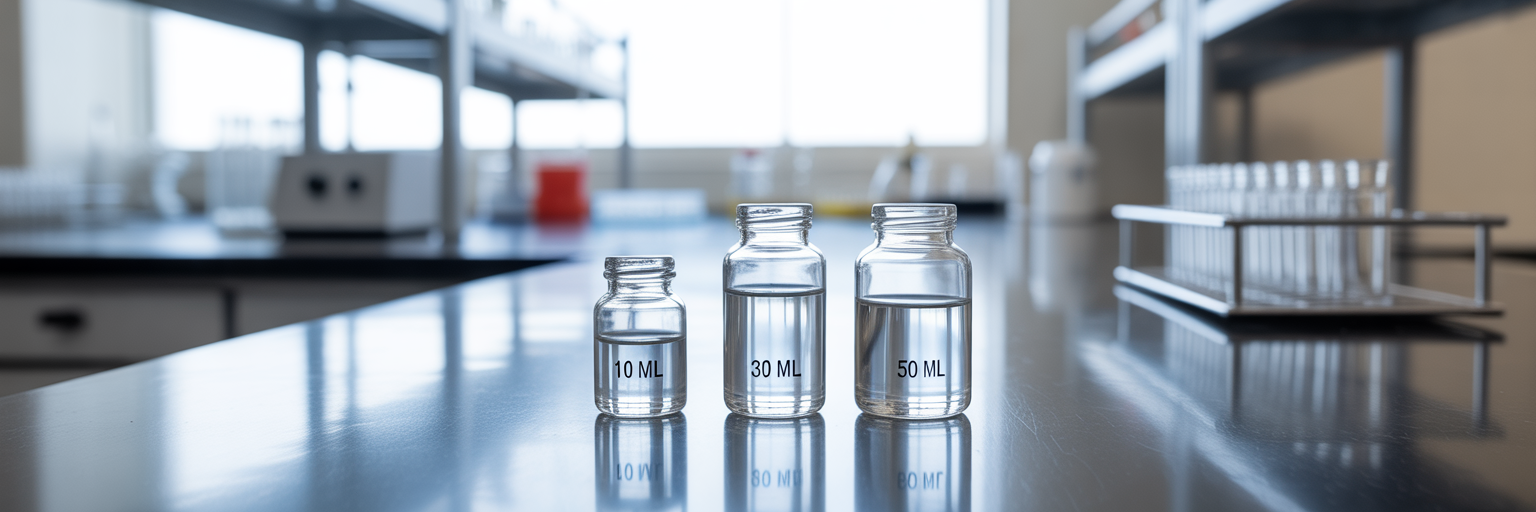
With a clear understanding of its composition, the next practical step is selecting the right vial size. This decision is more than a matter of simple logistics; it involves a careful balance of project needs, usage frequency, and cost-effectiveness. Choosing incorrectly can lead to either unnecessary waste or disruptive shortages in the middle of an experiment.
Common Vial Volumes and Their Applications
Bacteriostatic water is typically available in standard volumes like 10 mL, 20 mL, and 30 mL. Smaller vials are ideal for short-term projects, pilot studies, or when working with a single substance that requires infrequent reconstitution. For larger projects, high-throughput labs, or studies involving multiple peptides, a larger volume like our 30 mL reconstitution solution is often more suitable and efficient.
A Cost-Benefit Analysis
While larger vials generally offer a lower cost per millilitre, this benefit is only realised if the entire volume is used before its 28-day post-opening expiration. According to a guide from PeptidesExplorer, a 30 mL vial can cost between $3 and $8, so discarding a half-full vial is a tangible waste of resources. It is crucial to honestly assess your projected usage. A slightly higher cost per mL on a smaller vial is far better than paying for a product that ends up in the biohazard bin.
A Framework for Selection
So, how do you choose? Consider these factors: the total volume needed for reconstituting peptides, the frequency of withdrawals, and the number of different substances you are preparing. If your work involves reconstituting multiple compounds daily, a larger vial or a multi-pack like our 10x10ml reconstitution solution set can provide both the necessary volume and the flexibility of multiple sterile vials. Also, do not forget the practical constraint of storage space in a crowded lab refrigerator.
Distinguishing Bacteriostatic Water from Other Sterile Solvents
In a busy lab environment, vials of clear liquids can look deceptively similar. Accidentally using the wrong solvent can invalidate an entire experiment, making it essential to distinguish bacteriostatic water from other sterile fluids. This section clarifies the key differences to prevent critical errors.
The most common point of confusion is the sterile water vs bacteriostatic water comparison. The defining difference is the absence of a preservative like benzyl alcohol in sterile water for injection. This makes it strictly a single-dose product. Once opened, any remaining volume must be discarded to prevent the risk of microbial contamination. Sterile water is necessary for applications where the subject may be sensitive to preservatives or when a compound is incompatible with benzyl alcohol.
Other fluids, such as normal saline (0.9% sodium chloride), are designed to be isotonic with body fluids and are used for IV drips and dilutions. Sterile water for irrigation, on the other hand, is prepared for washing wounds or surgical sites and is not intended for injection. As an article from Palmetto Peptides highlights, the multi-dose nature of bacteriostatic water makes it particularly well-suited for peptide research, where multiple small doses are often prepared from a single vial. Using the wrong solvent is not just a procedural misstep; it is a variable that can compromise your data.
| Solvent | Composition | Primary Use | Shelf-Life After Opening |
|---|---|---|---|
| Bacteriostatic Water | Sterile Water + 0.9% Benzyl Alcohol | Reconstituting multi-dose medications/peptides | Up to 28 days |
| Sterile Water for Injection | Sterile Water (no preservatives) | Reconstituting single-dose medications; large volume injections | Use immediately; discard remainder |
| Normal Saline (0.9% NaCl) | Sterile Water + 0.9% Sodium Chloride | Isotonic solution for injections, IV drips, and dilutions | Depends on packaging (single or multi-dose) |
| Sterile Water for Irrigation | Sterile Water (no preservatives) | Washing wounds, surgical sites; not for injection | Use immediately; discard remainder |
Note: This table summarizes the key differences to guide proper selection. Always refer to the product label and specific experimental protocol before use.
Ensuring Quality, Compliance, and Supplier Integrity
Once you have identified the right type and volume of solvent, the final critical decision is where to source it. The integrity of your supplier directly impacts the integrity of your research. Using an unverified product introduces risks of contamination, incorrect concentrations, or impurities that can silently undermine your results. We stand firm in our belief that quality assurance is not a premium feature; it is a non-negotiable requirement.
Verifying Quality Standards
The first mark of a quality product is its adherence to established benchmarks. Look for bacteriostatic water that meets United States Pharmacopeia (USP) grade standards. This certification ensures the product has been tested for purity, strength, and quality. Meeting these laboratory water standards confirms that the solvent is free from pyrogens and other contaminants that could interfere with your experiment.
Sourcing from Reputable Suppliers
Always choose suppliers who are transparent about their credentials, such as registration with regulatory bodies like the FDA. As a general buying guide from Alibaba notes, vetting suppliers is a crucial step to ensure product integrity. A reputable vendor will operate with transparency, providing clear documentation and traceability for their products. The risk of using a cheap, unverified solvent is the potential invalidation of weeks or months of work.
Reading the Label
The product label itself is a key source of information. Before use, verify that it clearly states “Bacteriostatic Water for Injection,” lists the 0.9% benzyl alcohol concentration, and includes the vial volume, an expiration date, and a lot number. The lot number is essential for traceability in the event of a product recall or quality issue. A supplier committed to quality will provide all this information clearly, as seen on the product pages in our online shop.
Protocols for Proper Handling, Storage, and Use
Purchasing a high-quality product is only half the battle. Proper handling and storage are essential to maintain its sterility and effectiveness throughout its use. A small lapse in protocol can introduce contamination, negating the benefits of using bacteriostatic water in the first place. This final section provides a clear, actionable guide to ensure safety and efficacy from the first withdrawal to the last.
Before opening, vials should be stored at a controlled room temperature, typically between 20°C to 25°C (68°F to 77°F). Once a vial has been entered, it must be refrigerated at 2°C to 8°C (36°F to 46°F). The most critical rule is the 28-day shelf life after the first use. Immediately upon opening, write the date on the vial label. After 28 days, the vial must be discarded, regardless of how much solution remains.
Aseptic technique is mandatory for every withdrawal. Before each entry, vigorously disinfect the rubber stopper with a sterile 70% alcohol swab and allow it to air dry. You must use a new, sterile needle and syringe for every single withdrawal to prevent cross-contamination between vials or from the environment. For researchers who perform frequent, small reconstitutions, handling a smaller vial like our 10ml reconstitution solution can simplify these procedures and reduce the risk of error.
To ensure safe and effective use every time, follow this simple checklist:
- Verify the Label: Confirm the product is Bacteriostatic Water, check the expiration date, and ensure the solution is clear and free of particulates.
- Label the Date: Write the date of first use directly on the vial.
- Disinfect the Stopper: Use a fresh alcohol swab to clean the stopper before every entry.
- Use Sterile Equipment: Always use a new, sterile needle and syringe for each withdrawal.
- Store Correctly: Keep opened vials refrigerated and discard after 28 days.