Private Label, White Label, Wholesale partnerships available - EU, USA and UK - Free shipping from €75

Wholesale Pricing Structure: Lab Supply Guide
You're probably staring at a price list that looks clean on paper and still feels wrong in the warehouse. The unit cost seems fine, the discount looks competitive, and then cold-chain freight, COA handling, packaging, and a few awkward customer requests chew through the margin faster than the spreadsheet suggested. That's the trap in wholesale pricing structure, especially for lab supply and peptide products where temperature control, RUO language, and regional paperwork all change the floor price.
The only sane way to run this is to anchor every decision in landed cost and then build outward from there. Wholesale pricing in major markets is already margin-based, not a simple markup game, and the official trade data backs that up. In Canada, wholesaler gross margins were 15.9% of total operating revenue in 2023, up from 15.7% in 2022, while cost of goods sold fell 4.5% to $1,277.6 billion in the same accounts, which is exactly why the sale price has to cover acquisition cost plus a thin margin that changes by subsector, not a lazy retail haircut. U.S. wholesale trade is benchmarked the same way through wholesale gross margin datasets in the Economic Census and trade margin measurement from the U.S. Census framework.
For lab and peptide suppliers, that margin-first mindset matters more than in almost any other category. A refrigerated vial does not behave like a dry good, and a buyer who wants a fresh COA, fast replacement, and compliant RUO labeling is not buying a box on a shelf, they're buying a managed service wrapped around the SKU. The line sheet only works when the economics underneath it are already disciplined, which is why convincing buyers with line sheets matters after the floor is set, not before.
Table of Contents
- Anchoring Your Wholesale Pricing Structure in Margin
- Comparing Cost-Plus, Tiered, Volume, and MAP Models
- Building the Price List and Cost Sheet
- Regional Pricing Realities Across EU, UK, USA, and LATAM
- Contract Clauses That Protect the Structure
- Negotiation Tactics That Hold Margin
- Operating Rhythm and Final Checklist
Anchoring Your Wholesale Pricing Structure in Margin
The first mistake is treating gross margin as the goal. For lab supplies, gross margin is the constraint, not the outcome, because the product includes storage, documentation, fulfillment friction, and the cost of getting the shipment to arrive usable. A wholesaler can post an attractive percentage and still lose money if cold-chain handling, packaging, and payment friction aren't built in from the start.
Start with landed cost, not retail fantasy
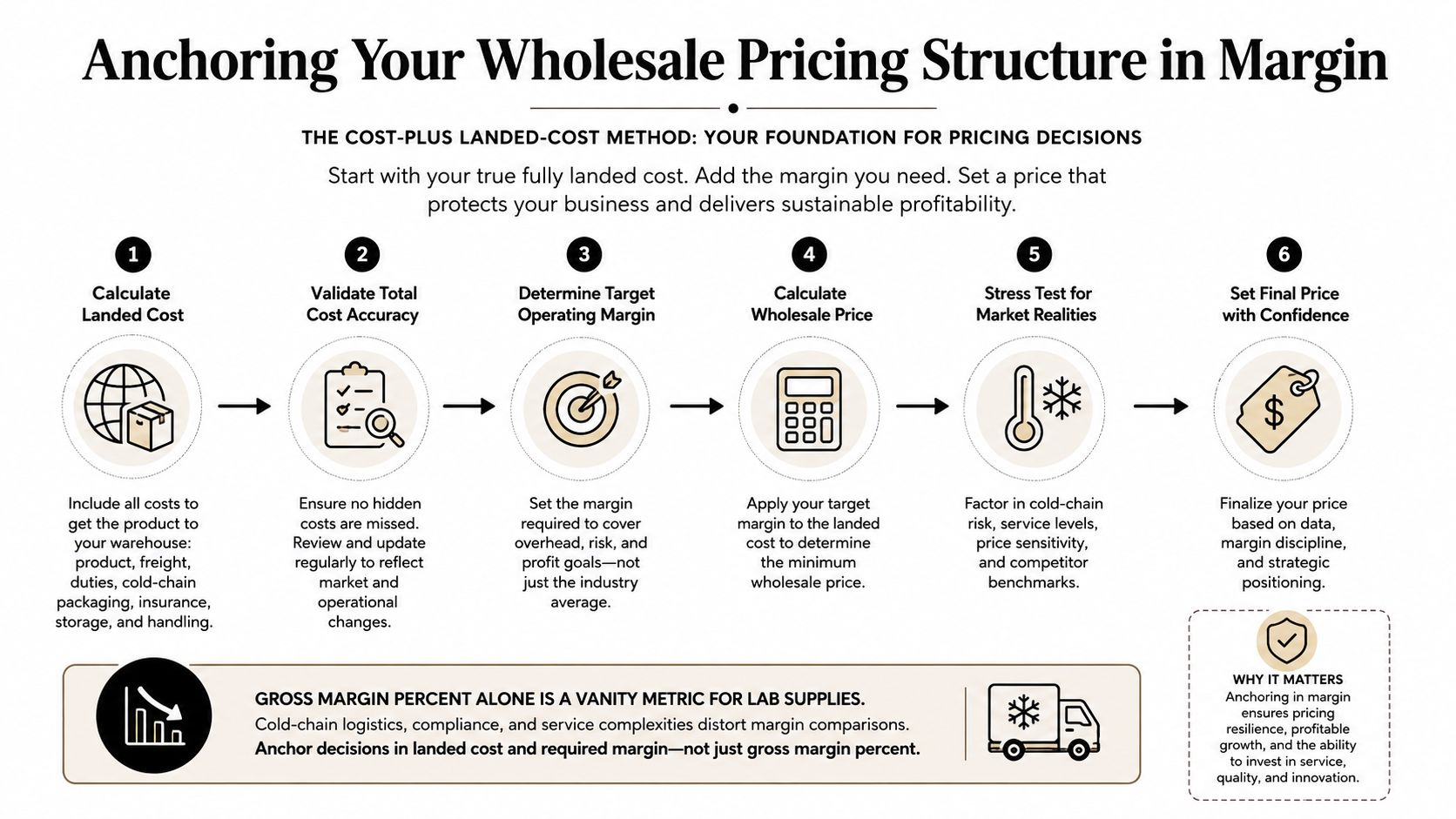
The pricing floor should begin with true landed cost per SKU. That means unit cost plus freight, duties, cold-chain surcharge, packaging, and payment fees, then overhead layered on top. A practical model is simple: if a SKU costs less than the floor only because a cost line was ignored, the price list is broken before it reaches the buyer.
A useful internal rule is to set a floor margin and work backward from it. In lab consumables, that floor usually needs to stay high enough to survive reorders, replacements, and service load, because the first order is rarely the full story. A clean spreadsheet does more here than a clever sales script.
Practical rule: if a price only works because someone ignored freight or COA admin, it isn't a wholesale price, it's a future write-off.
The buyer-facing materials should reinforce that discipline. A strong line sheet makes the structure obvious, and the internal cost build should stay separate from the external presentation. For a useful operational reference on laboratory cost layers, HerbiLabs' strategic approach to laboratory supply costs is worth reviewing alongside the commercial sheet.
Build the floor before you build the list
The right sequence is fixed. First, calculate landed cost. Second, add overhead. Third, set the margin floor. Fourth, test the result against the channel discount you're willing to give. Fifth, pressure-test the SKU against cold-chain and service assumptions. Sixth, decide whether it deserves a place on the list at all.
That sequence protects margin better than chasing a market average. Wholesale pricing structures are highly segment-specific, and the same holds in lab supply because a stable dry SKU, a temperature-sensitive reagent, and a regulated RUO product all carry different operating loads. If a buyer needs help understanding the product range, the wholesale assortment and packaging logic on HerbiLabs' site can be used as a practical reference point for how commercial structure and fulfillment structure should align.
A better line sheet also helps buyers understand why your price isn't arbitrary. When the sheet clearly separates SKU, pack size, and wholesale tier, the conversation shifts from “why is this expensive” to “which service level am I paying for.”
Bottom line: margin comes first, price comes second. Any wholesale pricing structure that reverses that order will eventually bleed.
Comparing Cost-Plus, Tiered, Volume, and MAP Models
A buyer asks for a better unit price, the rep wants to protect the deal, and ops has to keep the cold-chain bill from eating the margin. That is the test for a wholesale pricing structure. Different SKUs need different models, and the model should follow the buying pattern, not the sales team's preference.
Use the right model for the right SKU
Cost-plus fits bespoke items and narrow buyer bases. The floor is clear, the margin stays visible, and there is no discount incentive to train buyers to wait for special treatment. For a $40 landed cost item, a 45% margin produces a $72.73 wholesale price.
Tiered pricing works when order size changes the economics in a real way. It rewards larger commitments without forcing the list price down for every buyer. Volume discounts make sense when repeat orders reduce handling, pick-pack touches, and cold-chain coordination. MAP belongs on branded catalog items where reseller behavior can crush the advertised floor and create channel conflict.
If your team wants a reference for how cost has to tie back to work, use how job costing works. The same discipline applies here, because every SKU has to carry its own freight, temperature control, and service burden.
Margin impact at a $40 landed cost
| Pricing model | 50 units | 250 units | 1000 units |
|---|---|---|---|
| Cost-plus | No discount incentive, full margin preserved at every tier | No discount incentive, full margin preserved at every tier | No discount incentive, full margin preserved at every tier |
| Tiered pricing | Higher margin at low volume, limited concession | Lower margin at mid volume, controlled trade-off | Lowest margin, strongest commitment |
| Volume discount | Best when repeated orders reduce handling and freight waste | Better when replenishment is predictable | Strongest on recurring large accounts |
| MAP | Protects advertised floor, margin depends on channel discipline | Protects advertised floor, margin depends on channel discipline | Protects advertised floor, margin depends on channel discipline |
The table is meant to be blunt. Cost-plus protects the floor and keeps the math clean. Tiered pricing gives up margin in exchange for commitment. Volume discounts only work when logistics savings are real, not assumed. MAP protects the channel, but only if resellers respect the floor.
That is the practical split. Cost-plus should carry custom or fragile items, tiered pricing should govern predictable consumables, volume discounts should reward reorder behavior, and MAP should defend branded inventory where price discipline matters more than a quick sale. In lab and peptide supply, that also means pricing has to reflect COAs, RUO constraints, and cold-chain handling, because those costs do not disappear just because a buyer orders more.
Building the Price List and Cost Sheet
A price list that starts with the sheet, not the math, invites margin leaks. The working file is the source of truth. Every number should trace back to an input, and every discount should survive a buyer's question. If the file cannot explain itself, someone will find the gap.
Make the sheet tell the truth
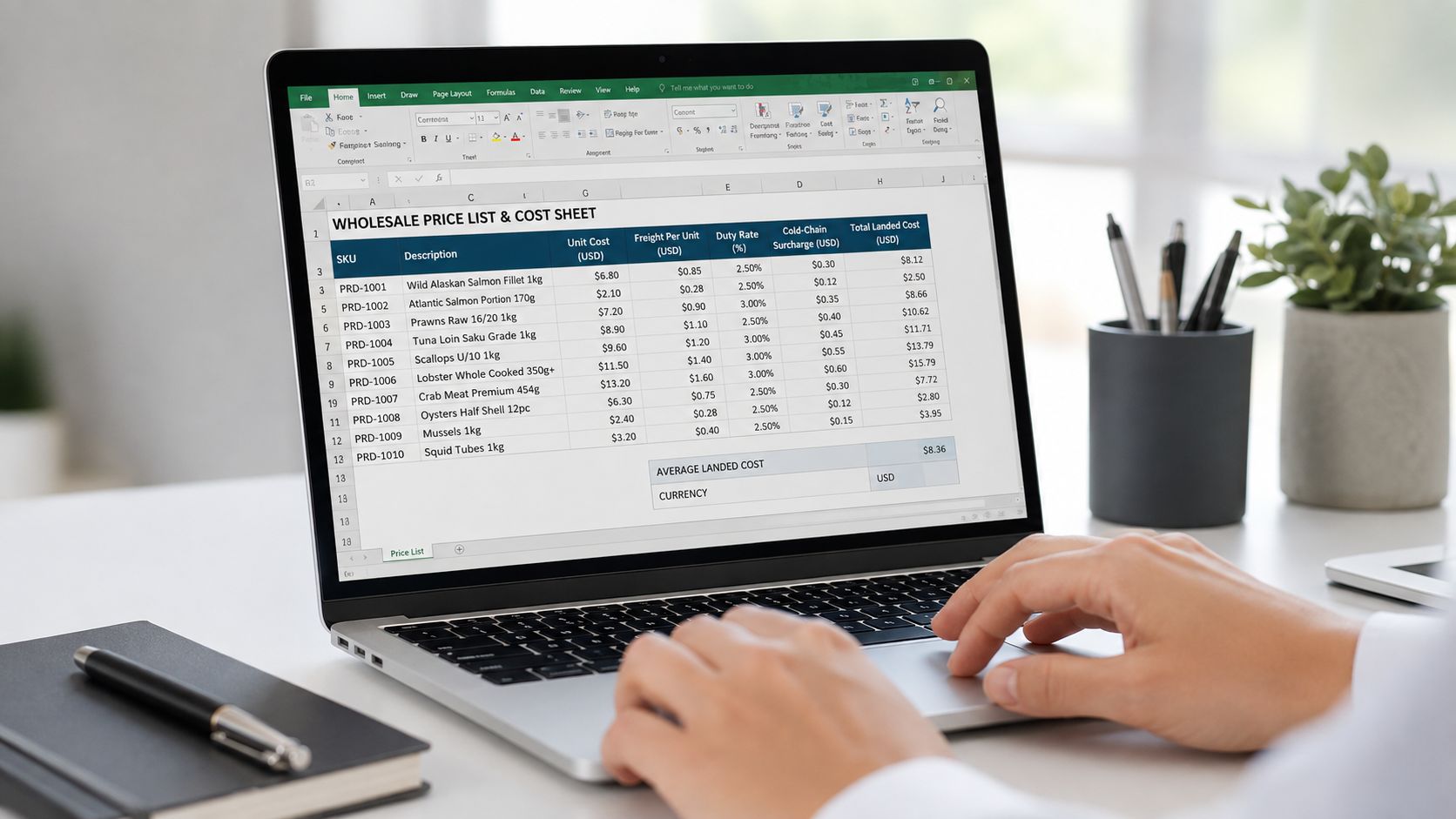
The working sheet should include SKU, description, unit cost, freight per unit, duty rate, cold-chain surcharge, total landed cost, target margin %, tier breaks, wholesale price, distributor price, and MAP. That set keeps the commercial terms tied to the actual delivery cost, which matters in lab and peptide supply because COAs, RUO constraints, and cold-chain handling all affect the floor price. Keep the formulas simple enough for a new ops hire to audit without guessing.
A clean formula chain looks like this:
- Landed cost =
SUM(C2:E2)+F2+G2 - Wholesale price =
Landed/(1-margin%) - Tiered price can be handled with
IFlogic tied to quantity breaks - MAP protection can be guarded with
MINso the displayed price never falls below the floor
That split matters. The internal sheet carries the full logic, while the buyer-facing PDF shows only the terms needed for the deal. Buyers should see the commercial price, not the mechanics they will argue over.
Separate the working file from the buyer file
Keep the internal version under version control with review dates and ownership. Keep the external version as a clean PDF or locked sheet that shows the terms, not the formulas. That separation cuts down on arguments over internal assumptions and keeps the pricing team focused on decisions.
Good discipline: every wholesale list should be answerable in one sentence, and every internal formula should be traceable in one click.
Update windows matter too. If freight shifts or a supplier quote changes, the version date is part of the price record. Buyers notice inconsistency faster than they notice a fair number.
Regional Pricing Realities Across EU, UK, USA, and LATAM
A single SKU can carry four different margin profiles depending on where it lands. A serious wholesale pricing structure needs regional buffers, not a flat international discount policy. EU, UK, US, and LATAM each bring different tax treatment, customs friction, and documentation burden, and that is where margin disappears.
Different regions, different margin leaks
In the EU, the pressure point is usually VAT treatment and intra-EU movement, not headline customs duty. In the UK, post-Brexit import VAT and CDS declarations need to be built into the quote. In the US, sales-tax nexus and RUO labeling decide whether the sale can move cleanly. In LATAM, import substitution rules in countries such as Brazil and Mexico can slow entry and distort landed-cost assumptions.
Use a buffered landed-cost model by territory. A shipment that clears under DAP can turn margin-negative under DDP once paperwork, handling, and local tax treatment are added. Smaller shipments feel this harder, because compliance costs sit on fewer units.
The customs process needs its own operating note, and HerbiLabs' customs clearance procedures are a useful reminder that sensitive or regulated goods live and die on documentation discipline.
| Region | Typical Duty Band | Tax / VAT Treatment | RUO Labeling | Recommended Landed-Cost Buffer |
|---|---|---|---|---|
| EU | €0–€12 depending on HS code and product class | VAT treatment depends on movement, registration, and destination country | Must match the intended research use and local classification | Use a wider buffer when HS code or paperwork is uncertain |
| UK | 0%–12% depending on HS code and import category | Import VAT and CDS declarations apply on entry | Keep RUO language explicit and consistent with the invoice set | Add buffer for customs handling, broker fees, and delay risk |
| USA | 0%–6.5% depending on HS code, with state tax exposure on the commercial side | Sales-tax nexus can change the quote shape after the sale is booked | RUO language required per FDA guidance and product positioning | Buffer for state-level tax handling and clearance variation |
| LATAM | Variable by country and product, often driven by local import rules and licensing | Import duties and VAT can change sharply by destination | RUO and product-use documents often need extra support to clear | Use the widest buffer of the four regions |
Don't let paperwork create fake arbitrage
Cross-region price arbitrage falls apart fast when the documents do not support the transfer. RUO-only labeling, COAs, and product classification all decide whether the shipment lands the way sales expected. If the commercial team prices every route as frictionless, the warehouse pays for that optimism.
Quote by region, not by wishful thinking. Tie the buffer to the route, the paperwork load, and the delivery term, then stop pretending every territory should accept the same price ladder.
Contract Clauses That Protect the Structure
A price list without contract discipline is just a suggestion. Buyers will push on lead times, payment terms, documentation, and exclusivity until the margin story weakens. Put the guardrails in writing before the first shipment leaves the warehouse.
Put the commercial rules in the agreement
MOQ has to be explicit. Lead-time service levels have to be explicit. COA and QA documentation requirements have to be explicit. If a customer wants a discount ladder, tie it to reorder commitments and clear buy volumes, not vague intent. Otherwise they take the lower tier and never deliver the throughput that justified it.
A price-list update window belongs in the contract too. If raw cost moves or cold-chain freight shifts, the supplier needs a defined path to reset pricing without reopening the whole relationship. The same rule applies to FX exposure. If the quote crosses currencies, the agreement should allow recalibration when rates, import costs, or broker charges move materially.
Before locking contract terms, review supplier qualification criteria so the vendor pipeline supports the margin protections you want on paper.
For teams that want better exception handling, the guide to AI in supply chain for shows how document review, workflow alerts, and route control fit into commercial discipline.
Clauses that protect margin and clauses that don't
- MOQ clause: tie discounts to actual order minimums, not friendly promises.
- Lead-time SLA: define on-time performance and the remedy when cold-chain handoff slips.
- Exclusivity scope: limit territory, product family, and duration.
- MAP enforcement: preserve audit rights and keep the floor intact.
- COA and QA requirements: make documentation a condition of shipment acceptance.
- Price-list update window: specify how often prices can change and how notice is delivered.
- FX fallback: allow price adjustment when currency movements hit the route.
- Force-majeure carve-out: exempt cold-chain failures outside reasonable control.
A rebate schedule can still work, but it needs careful wording. Make the rebate apply after the invoice cycle, and do not phrase it as permission to advertise below MAP. Rebate terms reward account behavior. MAP protects market behavior. Those are separate controls, and the contract should say so plainly.
Refuse open-ended MAP waivers, unlimited audit liability, and vague exclusivity promises that sound helpful but leave the supplier exposed.
Negotiation Tactics That Hold Margin
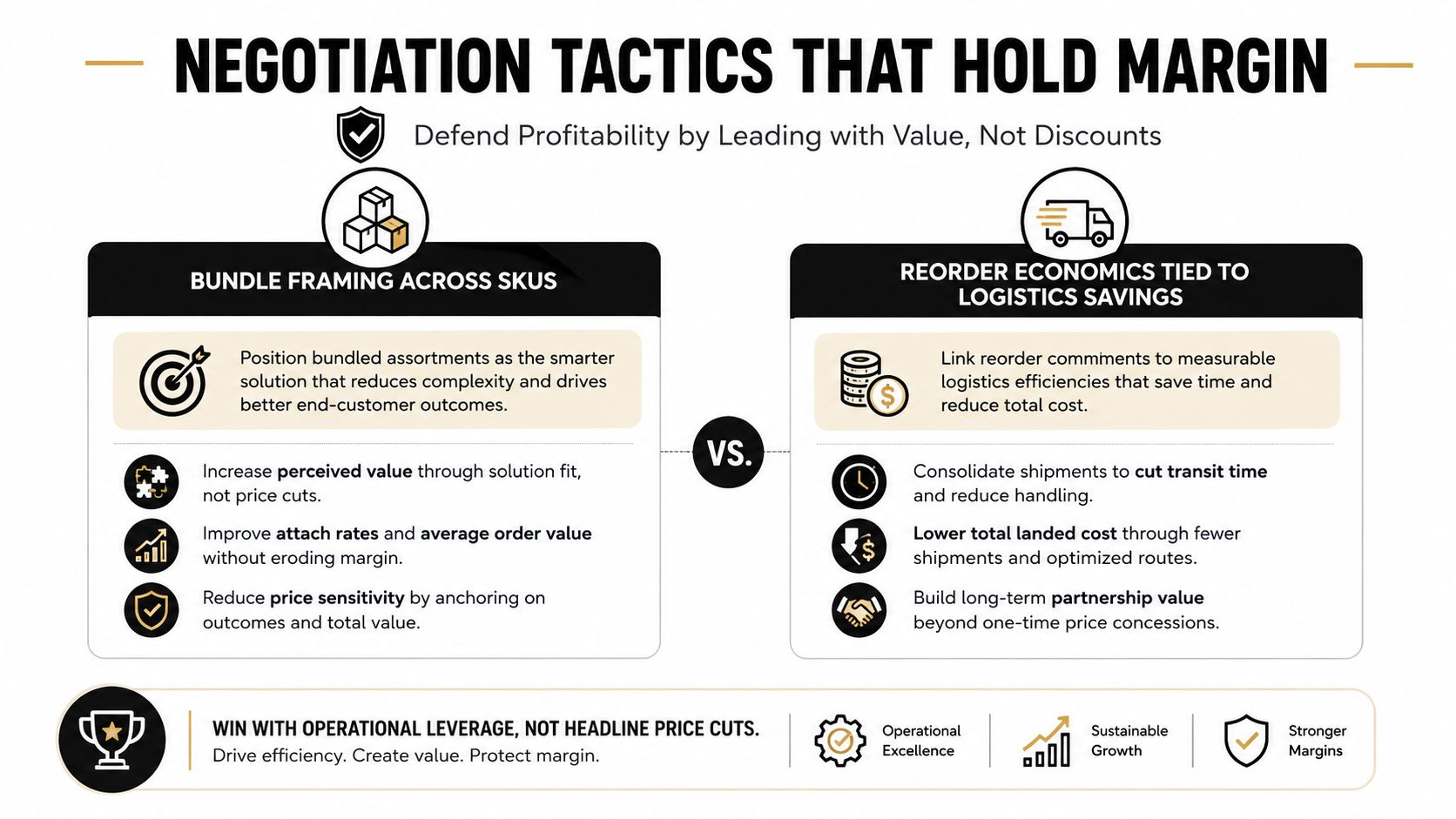
The cleanest way to protect margin is to stop conceding on list price first. Buyers often ask for a headline discount because that's the easiest number to move, but the supplier usually has more room in terms, logistics, and packaging than in the shelf price itself. That's where the negotiation should go.
Trade flexibility on terms, not on the floor
Bundle framing works when several SKUs are regularly ordered together. Instead of cutting the unit price on the hottest item, the supplier can build a package that includes the core SKU, the replenishment SKU, and the accessory line. That keeps the list price credible while giving the buyer a better total program.
Reorder economics are the other lever. If repeat orders reduce freight touches, consolidation steps, or account servicing, those savings can be shared without collapsing the price list. The buyer gets a fairer program, and the supplier keeps the structure intact.
A useful script is direct: the supplier can say the requested discount is available only if the buyer agrees to the tier that reflects the actual commitment. That turns a price fight into a volume trade, which is where the economics belong.
Know what to concede and what to hold
The easy concessions are usually payment terms, packaging format, or drop-ship windows. Those can improve the buyer's experience without rewriting the commercial floor. The hard stops are MAP floor, COA currency, exclusivity, and compliance language. If those move, the whole structure starts to wobble.
A counter-offer matrix helps keep the conversation sane.
- Buyer asks for lower price, answer with a larger commitment tier.
- Buyer asks for faster ship windows, answer with a service-specific fee or limited lane.
- Buyer asks for custom packaging, answer with a packaging charge or MOQ adjustment.
- Buyer asks for extended payment terms, answer with a tighter reorder commitment.
- Buyer asks for exclusivity, answer with territory limits and performance triggers.
Every concession should be scored on margin impact before it leaves the room. If the concession changes cash flow, service load, or compliance burden, it deserves a cost. If it doesn't, it probably wasn't a real concession anyway.
Operating Rhythm and Final Checklist
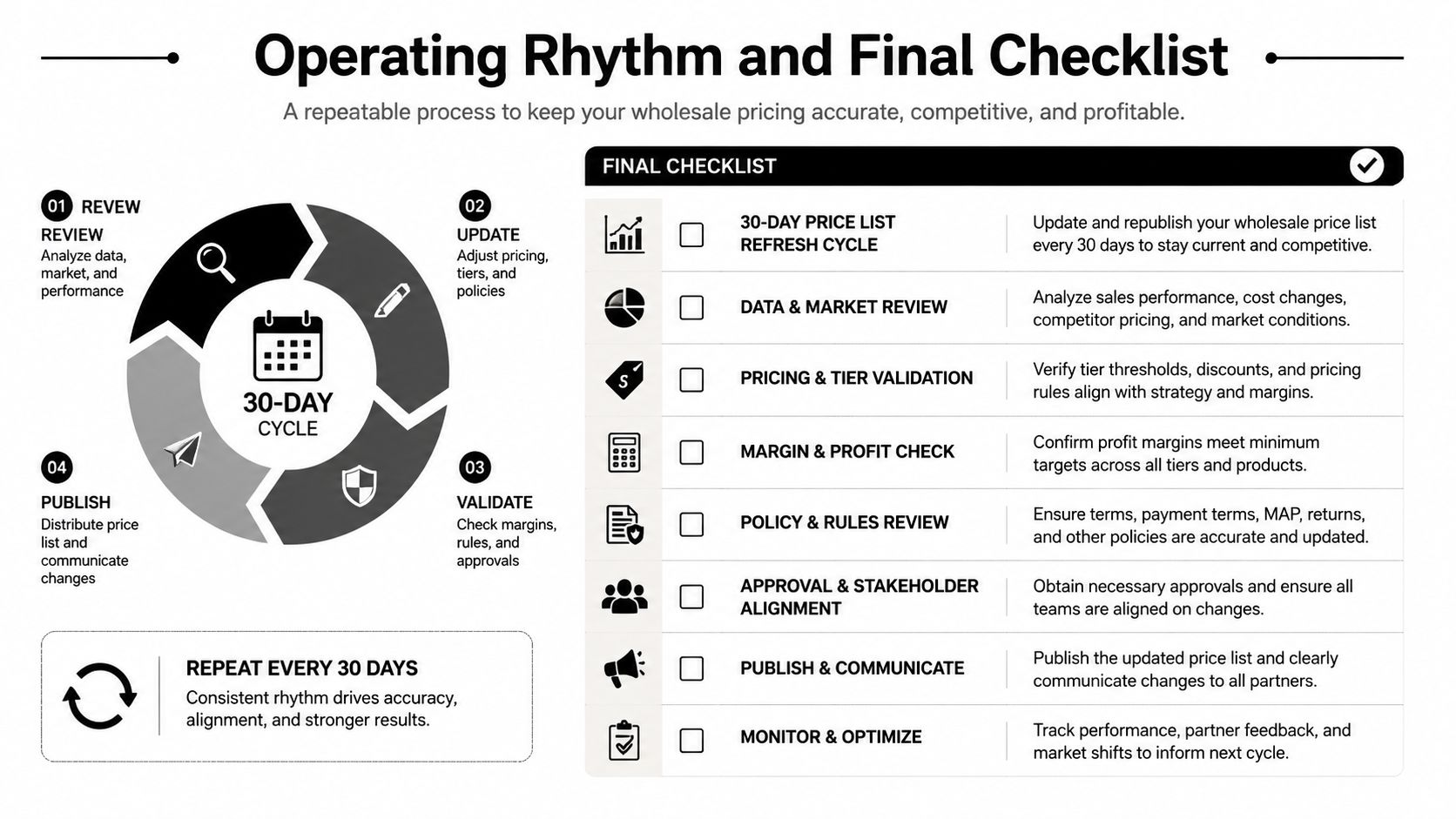
A wholesale pricing structure only holds when someone manages it on a fixed rhythm. Leave the list untouched until a buyer pushes back or a supplier raises costs, and margin drift will do the damage for you. Price control is an operating habit, not a one-time setup.
Keep the cadence tight
A 30-day refresh cycle is the right pace for supplier quote updates, FX movement, and cold-chain freight variance. A 60-day review should reconcile actual MOQ attainment, MAP compliance, and COA rejection rates. A 90-day strategic reset should revisit tier ladders, regional margin mix, and the renegotiation plan for top accounts.
That cadence keeps the structure tied to actual trading, not the assumptions from launch. It also forces the commercial team to catch drift before it becomes normal. If a SKU keeps missing margin, the process is usually broken before the math is.
The operating KPIs should stay narrow and hard to game:
- Gross margin per SKU
- Landed-cost drift percentage
- Average discount depth
- On-time-in-full rate against lead-time SLAs
- MAP violation count
- COA pass rate
Week-one checklist for a new ops hire
A new ops hire should start by locking the commercial floor and checking the weak points.
- Confirm the landed-cost build for each active SKU.
- Verify the pricing model used for each product family.
- Check regional buffers for EU, UK, USA, and LATAM routes.
- Review contract clauses for MOQ, SLA, MAP, COA, and FX language.
- Prep negotiation notes for the top accounts and the weakest margins.
- Set the review dates for the 30-day, 60-day, and 90-day cycle.
- Archive the current version of the buyer-facing price list.
If a pricing system cannot survive a monthly review, it is a guess.
HerbiLabs works with lab buyers and distribution partners who need clear wholesale structure, documented RUO products, and temperature-aware fulfillment across the EU, UK, and USA. For teams that want a supplier-side view of pricing discipline, product packaging, and commercial terms, visit HerbiLabs and review how the catalog, wholesale options, and documentation fit into a margin-first buying process.


