Private Label, White Label, Wholesale partnerships available - EU, USA and UK - Free shipping from €75

Customs Clearance Procedures for Lab Supplies: A 2026 Guide
The call usually comes at the worst possible moment. A broker says the box of bacteriostatic water and lyophilized reagents has landed, but customs wants a permit that doesn't match the invoice, the HS code looks off, and the COA doesn't line up with the declared description. For lab supply teams, that's rarely a paperwork nuisance, it's a release problem, a cash-flow problem, and sometimes a customer-service problem all at once.
The shipments that look routine on the shelf can turn fragile at the border. RUO-labeled vials, temperature-sensitive diluents, and reagent kits invite more scrutiny than generic freight because customs officers and brokers aren't just checking what the carton says, they're checking whether the story across the documents makes sense. If the invoice, packing list, transport document, and permit disagree, the file stops being “ready to clear” and becomes a manual review.
This guide is written for that reality. It focuses on customs clearance procedures for regulated lab supplies, where the biggest risk isn't a missing stamp, it's a mismatch between product reality, regulatory claims, and the data customs receives first.
Table of Contents
- Why Lab Supply Shipments Get Stuck at Customs
- Classifying Goods and Preparing Core Documents
- Compliance Layers Specific to Lab Supplies
- Duties, VAT, and Strategies for Managing Landed Cost
- Regional Differences Across EU, UK, USA, and LATAM
- Common Delays and the Mitigation Strategies That Reduce Hold Risk
- Working With a Broker and Your Repeatable Clearance Workflow
Why Lab Supply Shipments Get Stuck at Customs
A lot of first-time importers assume customs only cares whether the box is legal. In practice, the officer cares whether the paperwork tells one coherent story. The World Bank's Logistics Performance Index uses customs clearance as a core benchmark of trade facilitation, scoring the speed, simplicity, and predictability of customs formalities on a 1 to 5 scale (World Bank metadata glossary). That matters because lab-supply moves rise or fall on predictability, not just transit speed.
A bacteriostatic water shipment can get hung up for reasons that feel absurd until the file is reviewed line by line. The description might say “research reagent” while the permit names a more specific item. The COA might show one formulation, the inner label another, and the invoice a third. Once that happens, customs can stop the file for clarification, inspection, or a reclassification request.
Practical rule: The box doesn't clear on intent. It clears on matching data.
The problem gets sharper with lab supplies because many of them sit in a gray area between ordinary consumables and controlled or regulated products. RUO-labeled vials, lyophilized reagents, and cold-chain diluents often need a cleaner compliance story than general freight. If a shipment is inspected, customs may want to compare the declaration with labels, supporting permits, and product data, so a vague description is a self-inflicted delay. Packaging also matters here, since a broker will ask different questions if the outer pack, temperature protection, and inner labeling do not line up with the declared contents, which is why the packaging requirements for lab materials have to be set before the shipment leaves the dock.
The timing window also matters. Straightforward shipments can clear in less than 24 hours, while routine cases often stretch to 1 to 5 days, and inspections or document problems can push that to 10+ days (Dimerco). For U.S. ocean shipments, entries can be processed up to 5 days before arrival, while air shipments are handled once the aircraft is “wheels up” and en route, which shows how tightly customs clearance is gated by advance data. Dimerco
That's why lab shipments fail so often at the same few points. The issue usually isn't the science, it's the file. A permit that names one formulation, an invoice that names another, or a COA that doesn't support the declared use is enough to move the shipment from routine release into manual review.
Classifying Goods and Preparing Core Documents
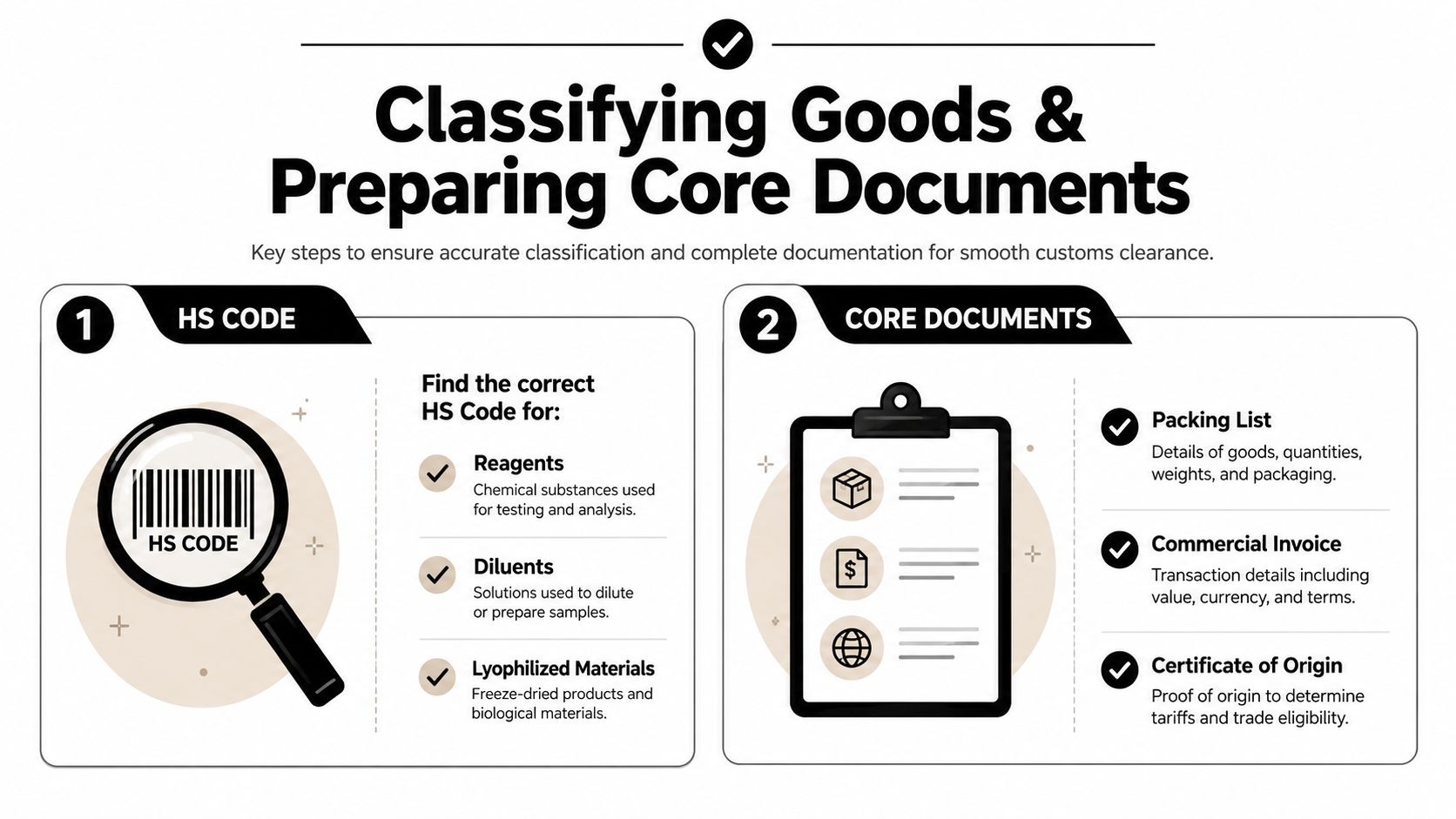
The fastest way to make customs nervous is to classify a lab product by vibe instead of substance. A reagent, a diluent, and a lyophilized material may look similar in the warehouse, but they can land in very different tariff buckets depending on composition, use, and regulatory treatment. That's why HS code work has to happen before filing, not after the broker asks for a correction.
Start with the product master, not the shipment
The cleanest teams keep a master product database with validated HS or HTS classifications, standard descriptions, country of origin, unit measures, and shipment notes. That database becomes the source for invoices and pre-alerts, instead of letting each shipment introduce a new description. FedEx lists consignee, product description, quantity, country of origin, value, and HS code as core clearance inputs, and that aligns with the basic rule customs follows, the declaration has to reconcile across every document (FedEx PDF).
The core documents should be treated as one file, not separate admin tasks. A commercial invoice, packing list, bill of lading or air waybill, certificate of analysis, and any import permit need to agree on the same product identity. If the invoice says one vial count, the packing list another, and the transport document a different consignee, the broker ends up reconciling instead of filing.
Broker-facing standard: use one product description, one unit convention, one valuation method, and one origin statement across the whole packet.
Invoice templates do real work. They should capture Incoterms, reason for shipment, unit weights, terms of sale, and enough product detail that a customs officer can understand the goods without guessing. UPS notes that customs can inspect or test goods to verify the declaration, so a file that reads like a guess invites verification.
The pre-alert matters just as much as the final packet. A good broker pre-alert gives the broker enough time to check HS logic, spot missing permits, and flag mismatched labels before arrival. Industry guidance also notes that customs declarations are increasingly filed electronically, with entry filing and risk review occurring after advance filings such as ISF or AMS in the U.S., which makes pre-submission consistency the most critical control point (FedEx PDF).
For packaging consistency, the practical checklist at HerbiLabs packaging requirements is the kind of reference that helps prevent the kind of mismatch customs officers notice immediately.
Compliance Layers Specific to Lab Supplies
Lab shipments don't fail only on classification. They fail when the compliance layer underneath the label is missing, thin, or contradictory. A vial marked Research Use Only has to be handled like a regulated statement, not a marketing line, because that statement can affect how the shipment is interpreted at the border and how the broker describes it in the declaration.
RUO labeling has to match everywhere
RUO claims should appear consistently on the invoice line, inner packaging, and outer carton, but they need to align with the export documentation rather than contradict it. If the carton says RUO and the COA or permit suggests a different use, the declaration becomes less credible. The safer approach is to keep the wording simple and identical, so no one at customs has to decide which document is “more true” than the others.
Restricted or controlled substances are a different tier. If a product needs a permit, it needs to be in the file before arrival, not after a hold notice. When a shipment contains sensitive materials, customs can ask for additional evidence, and general freight habits like “the broker will sort it later” are a bad fit.
Cold-chain evidence is documentation, not decoration
Temperature-controlled shipments need proof, not reassurance. A storage-and-shipping log, calibrated data logger traces, and a COA that matches the product claim give the broker something defensible if customs questions integrity or handling. Without that evidence, the broker has to answer with opinions, and customs doesn't clear opinions.
For regulated lab supplies, a permit, free-sale certificate, or manufacturer attestation is only useful when it solves a specific border question. If the goods are ordinary RUO consumables, piling on extra documents can create noise. If the goods sit near a restricted category, the right attestation can prevent a manual examination.
A practical rule is to keep one compliance packet per SKU family, then update it when the formulation, use statement, storage condition, or import destination changes. That keeps the file inspection-ready instead of scramble-ready.
The same logic applies to labeling and documentation storage. Clear scans, batch-level COAs, and a clean chain of custody help the broker answer routine questions without going back to the shipper for basic proof. For deeper guidance on this layer, the regulatory compliance documentation reference is the sort of internal control page teams usually wish they had before the first hold.
Duties, VAT, and Strategies for Managing Landed Cost
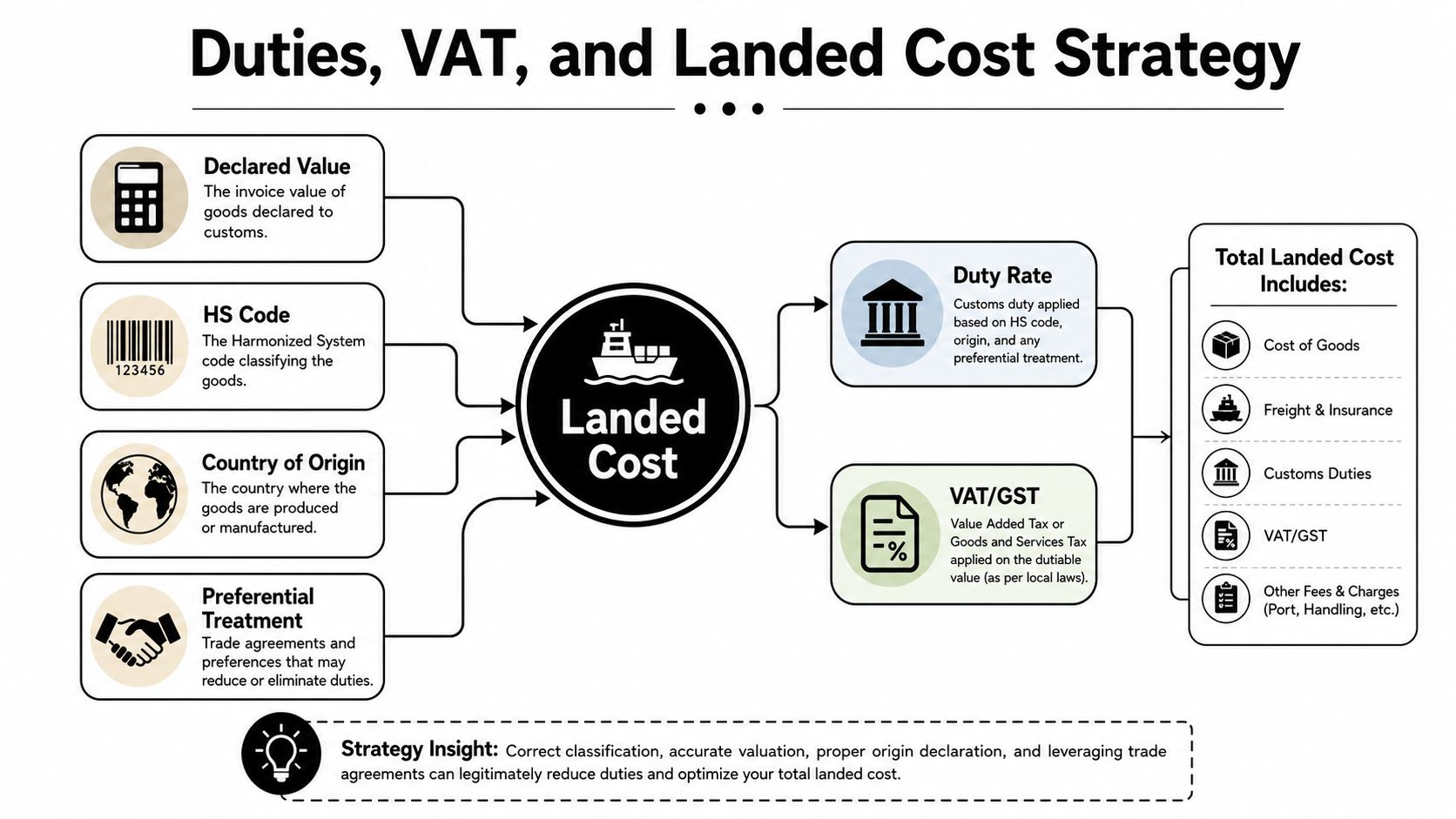
Customs does not build landed cost the way a warehouse team does. It starts with declared value, HS code, country of origin, and any preferential treatment, then calculates duty and taxes from that base. A clean classification can change the economics of a shipment just as much as it changes the clearance path.
The cost logic customs uses
The standard method is direct. File the declaration with the correct HS code and declared value, let customs assess duty, VAT, or GST, respond to queries quickly, then pay the assessed charges to obtain release. The hard part is that customs can compare invoice data against labels, packing data, and supporting permits, so valuation quality matters as much as the rate itself.
For EU imports, landed cost usually adds duty first, then VAT on the duty-inclusive value. For U.S. imports, the main exposure is usually duty and compliance timing rather than VAT, but the entry summary and review still happen after arrival, which creates a post-arrival compliance window that planners need to budget for. If a finance team wants a practical VAT explanation in plain English, how to calculate VAT for developers is a useful non-customs reference that shows why tax gets layered on top of customs value.
The best landed-cost discussions are boring on purpose. They show what the broker will use, what the importer-of-record will pay, and which line items can move if the HS code or origin changes. Lab-supply distributors protect margin there, because a small classification correction can change the commercial picture.
Special procedures that actually help
Some shipments need more than a basic duty payment and release. Warehousing and transit procedures can let goods be stored or moved before duties are paid, and that can improve cash flow for distributors holding inventory or resellers moving stock across borders (Gerlach Customs).
| Scenario | Procedure that may help | Why it helps |
|---|---|---|
| Distributor holding inventory | Warehousing | Defers duty timing until goods enter free circulation |
| Reseller shipping to multiple LATAM destinations | Transit | Moves goods before final clearance in each market |
| University importing for one project | Direct import clearance | Simpler when duty deferral is not worth the extra control |
The question is whether the business model justifies the procedure. If the importer is rotating stock through several markets, transit can reduce duplicate handling. If the importer is holding finished inventory, warehousing can be the better fit. If the order is a one-off project shipment, the simplest path is often the least risky. For urgent lab orders, expedited shipping options for regulated supplies can still make sense, but only if the customs file is ready before the cargo lands.
For teams that need a broader operational baseline, Tariff Duty Calculator is a useful reference for the way customs clearance costs are built, and the same logic helps when a broker explains why one SKU clears cheaply while another gets pulled for review.
Regional Differences Across EU, UK, USA, and LATAM
A shipment of RUO-labeled vials can clear cleanly in one market and stall in another for reasons that have nothing to do with the product itself. The paperwork may be identical, but the filing channel, local review habits, and broker expectations shift by region. For lab supplies, those differences matter because one missing permit, one vague description, or one mismatch in consignee data can stop the entry even when the freight leg is already complete.
The EU uses a shared tariff structure, but the actual declaration still runs through national customs administrations. The UK now operates under its own customs regime after Brexit, so UK entries follow a separate process and declaration environment. The U.S. relies heavily on electronic filing through ACE, and pre-arrival coordination is tighter than many first-time importers expect, especially for shipments that need advance review before release. Dimerco provides a useful overview of how that filing structure works in practice, and it helps explain why U.S. entries are often more timing-sensitive than teams assume.
LATAM is even less uniform. Brazil, Mexico, and Colombia each run their own customs systems and local filing conventions, so broker choice matters more there than in markets where the process is more standardized. If the shipment includes importer onboarding or entity verification, teams often need separate compliance packs such as KYB and AML document requirements, because the importer record can become part of the delay before the goods are even reviewed.
Customs Clearance Snapshot by Region
| Region | Typical Entry Filing | Advance Filing Window | Key Local Quirk |
|---|---|---|---|
| EU | Electronic declaration through national customs systems | Varies by member state and transport mode | Central tariff rules, local administration differences |
| UK | Independent UK customs declaration process | Transport-dependent | Post-Brexit regime with its own filing environment |
| USA | ACE-based entry and entry summary process | Ocean cargo can be processed up to 5 days before arrival, air handled once wheels up | Advance filing discipline is central to release timing |
| LATAM | National customs portal or broker-assisted filing | Varies widely by country | Local broker involvement is often more important than self-filing |
The core document set does not change much. Customs still wants a commercial invoice, packing list, transport document, and the correct permits. What changes is the system that receives the file, the person who can submit it, and the timing rules attached to that submission. For lab shipments, that means the broker should see the paperwork early enough to check product descriptions, declared use, and any permit references before the cargo reaches the border.
A strong broker relationship matters most in markets where the portal looks standard but local practice decides the outcome. Some systems are electronic but still depend on country-specific habits, and a good local agent knows which detail gets questioned first. For teams that need urgent transport, expedited shipping options only help if the customs file is ready before the shipment lands.
Common Delays and the Mitigation Strategies That Reduce Hold Risk
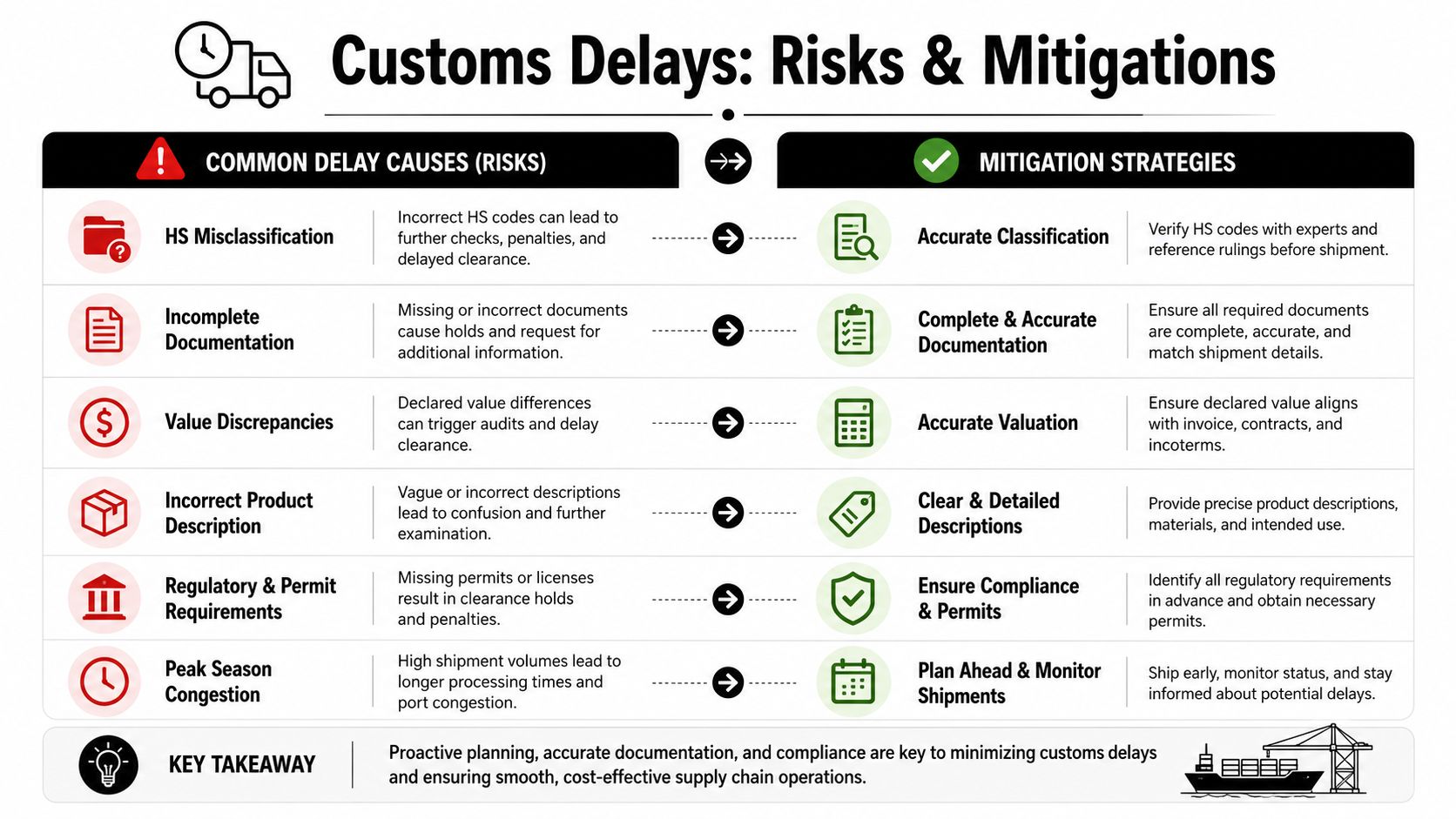
The delay list is short, and teams already know the items. What matters is being honest about which controls reduce hold risk and which ones just make the file look neat. Customs can use automated risk engines or channel selection to decide whether a shipment is auto-released, document-checked, or physically inspected, so clearance outcomes depend on data quality more than on hope or speed alone.
The delays that matter most
HS misclassification is usually the costliest mistake because it can change duty exposure, trigger partner-agency review, or force reclassification. Value discrepancies come next, especially when the invoice, packing data, and transport paperwork do not agree. Missing permits and vague descriptions round out the list, because they push a file from automatic processing into manual review.
Customs can also examine or test goods, which means a shipment can stall after arrival even when the transport leg went exactly as planned. That is why the operational window includes advance filing, entry filing, entry summary review, and possible physical examination or laboratory testing (GoFreight). For lab goods, that matters more than it does for plain consumer cargo because a small description problem can turn into a question about product identity or use.
What works: one controlled product master, one broker-facing file, and one response owner for customs queries.
Mitigation that changes outcomes
Some habits are theater. Printing three copies of the invoice does not help if the invoice itself is wrong. Sending the broker a better email subject line does not matter if the HS code was guessed. The controls that move the needle are more basic and less glamorous.
- Validate descriptions before booking: Make the invoice line, packing line, and transport description match before the cargo leaves.
- Lock HS code ownership: Assign one internal owner to approve product classification so every shipment does not reinvent the code.
- Pre-send permit packs: Give the broker permits, COAs, and temperature evidence before the file lands.
- Set an escalation owner: Give customs queries one human who can answer in hours, not days.
- Use broker pre-alerts: Let the broker see the file before arrival, so corrections happen while there is still time.
The practical response to a hold notice is speed plus consistency. Customs wants the missing piece, not a debate about why the file should have been obvious. That is why the best teams maintain response templates, internal service levels, and a clear approval chain for product data.
The same principle applies after release. If a shipment was held once, the next file should carry the fix forward so the same error does not recur. Repeated delays are usually a process failure, not bad luck.
A short video can help teams internalize the sequence and the common failure points.
Working With a Broker and Your Repeatable Clearance Workflow
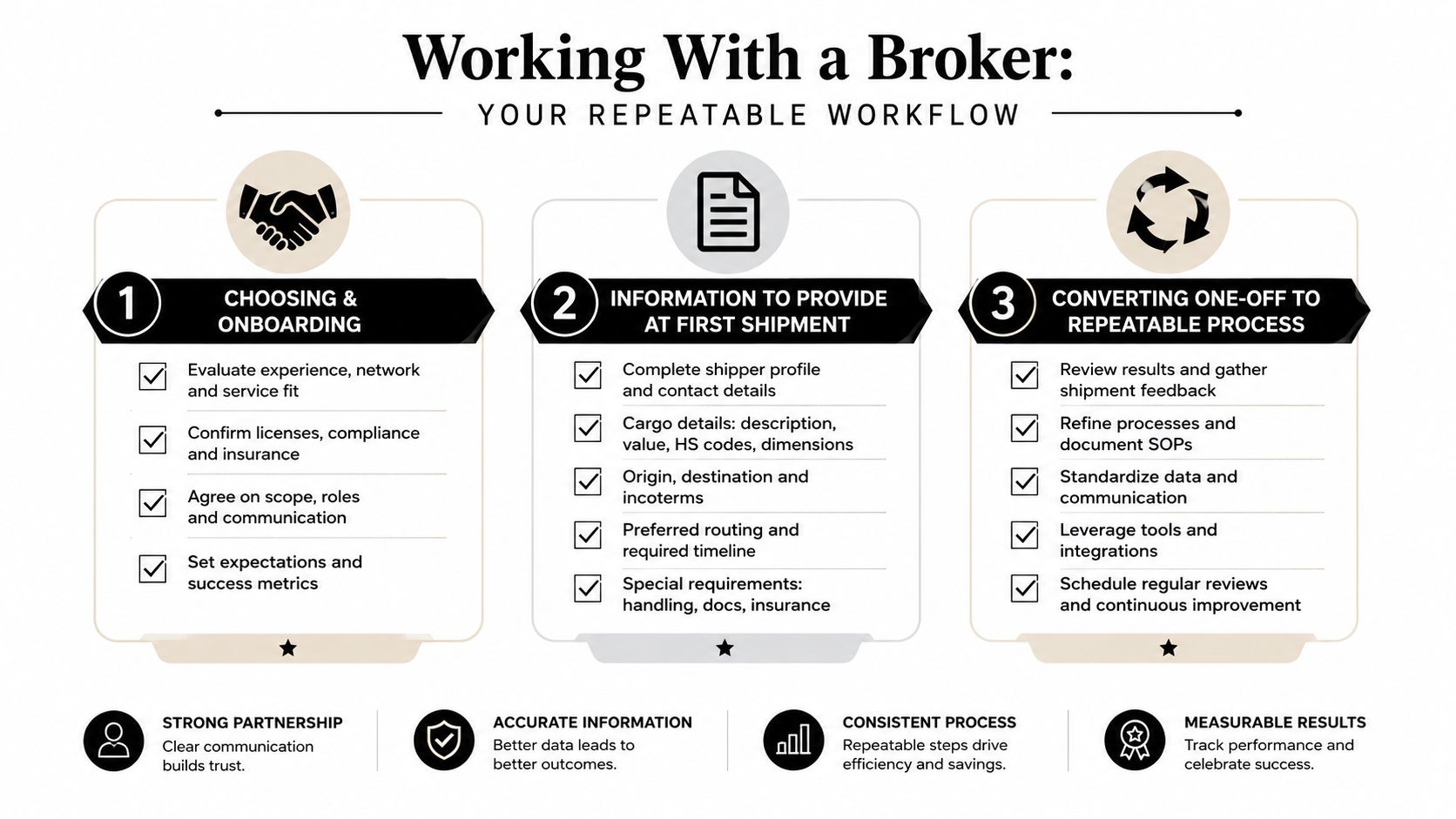
A customs broker is most valuable when the broker doesn't have to ask the same questions every time. That starts with onboarding, where the importer shares product master data, HS decisions, consignee details, proof of origin, permits, and the exact labeling logic used on cartons and invoices. If the broker has to reconstruct the product file from scratch, the workflow is already too manual.
The repeatable workflow
- Choosing and onboarding: Pick a broker that handles regulated lab goods, not just generic freight.
- Information at first shipment: Send the product master, COAs, permits, labels, and contact chain before arrival.
- Converting to repeatable process: Store the fixed data once, then update only what changes, such as batch, value, or destination.
A simple pre-shipment checklist keeps everyone aligned:
- Commercial invoice: Product descriptions, value, origin, Incoterms, and HS code all consistent.
- Packing list: Quantities, weights, and carton structure matching the shipment.
- Transport document: Bill of lading or air waybill aligned with consignee and route.
- Compliance packet: COA, permits, RUO statements, and temperature evidence where required.
- Broker contact: One named person who answers customs questions fast.
The practical FAQ is short. Clearance can be fast for straightforward shipments, but it can also stretch into several days when customs checks the file or inspects goods. Duties are usually paid by the importer of record unless the commercial terms shift that responsibility. If a shipment is held, the right move is to answer the exact customs question, not to resend the whole folder.
A repeatable workflow turns customs from a surprise into a process. It won't remove scrutiny, but it does remove avoidable friction. The next shipment should be easier than the last one because the file, the broker, and the importer now share the same playbook.
For lab supply teams that want fewer holds, cleaner filings, and a broker-ready packet from the first shipment onward, Herbilabs is worth contacting today to build a customs workflow that matches the way regulated products move.


