Private Label, White Label, Wholesale partnerships available - EU, USA and UK - Free shipping from €75

Expedited Shipping Options a Global Guide for Labs
A freezer pack is conditioned, the reagent is picked, the airway bill is printed, and the customer is watching tracking before the carton even leaves the dock. That's a normal day in lab logistics now. The hard part isn't only moving a box fast. The hard part is getting a temperature-sensitive reagent through handoff points, customs review, and final delivery without losing stability, paperwork integrity, or trust.
For labs, distributors, and peptide resellers, delays don't stay inside the shipping department. A missed delivery can stall a run, force a rebooked instrument slot, or leave a buyer deciding whether the material is still usable. That's why expedited shipping options have become a practical operating requirement for scientific supply chains, especially across the EU, UK, USA, and LATAM where compliance expectations differ and border friction can erase the time bought by a premium service.
Table of Contents
- The Critical Role of Speed in Modern Research
- Decoding Expedited Shipping A Breakdown of Key Services
- Best Practices for Packaging and Temperature Control
- Navigating Global Regulations for Lab Reagents
- How to Choose the Right Carrier and Service Level
- Optimizing Your Lab's Fulfillment Workflow
- FAQs on Expedited Shipping for Scientific Materials
The Critical Role of Speed in Modern Research
A researcher waiting on a temperature-sensitive reagent usually doesn't care what the service code says on the label. The question is simpler. Will the material arrive within the usable window, with the required documents, and in a condition that supports the experiment?
That pressure has pushed fast fulfillment out of the premium category. The global expedited shipping service market was valued at USD 43.6 billion in 2023 and is projected to reach USD 93.8 billion by 2033, with a projected CAGR of 8.3%, according to market data on expedited shipping growth. The same source notes that 62% of professional consumers now consider rapid delivery a baseline expectation for maintaining research continuity.
Research timelines don't tolerate vague delivery windows
In scientific supply chains, speed protects more than convenience. It protects scheduling. A delayed vial can idle personnel, leave booked equipment unused, and compress the time available for sample prep, validation, and reporting.
That's especially true when the shipment contains materials that shouldn't sit in uncontrolled conditions. Reagents shipped in glass vials, sterile diluents, and other research materials often need controlled packing, short transit, and immediate receipt. When any one of those pieces fails, the problem isn't abstract. Someone at the destination has to decide whether to quarantine, reject, or risk using the shipment.
Practical rule: In lab logistics, the delivery promise has to cover both transit speed and product usability on arrival.
Fast delivery is now part of scientific service quality
Many generic shipping guides treat expedited transport as a simple upgrade from ground to air. Labs know that isn't enough. Fast delivery only works when dispatch timing, packaging performance, courier handling, and receiving discipline are aligned.
That's why buyers increasingly expect suppliers to offer multiple expedited shipping options rather than a single “express” checkbox. Some orders need same-day local movement. Others need next-day domestic coverage. Cross-border shipments may need a service that leaves extra room for documentation review even when the physical route is fast.
For regulated scientific materials, the true value of speed is continuity. The shipment that arrives when promised keeps the work moving. The shipment that misses a customs question, arrives warm, or lands after receiving hours creates more operational damage than a standard service selected from the start.
Decoding Expedited Shipping A Breakdown of Key Services
Not every urgent shipment needs the fastest possible mode. Labs spend too much on speed when they choose by label instead of by risk. The useful way to compare expedited shipping options is to ask four questions: how quickly the material must arrive, how fragile the temperature profile is, whether the route is domestic or cross-border, and how much shipment control is needed after handoff.
What expedited actually changes
Expedited shipping typically delivers domestic orders within 1 to 3 business days and international shipments within 2 to 5 business days, depending on customs clearance and destination country, according to Shipium's expedited shipping benchmarks. The same source states that expedited methods can reduce transit times by up to 30% compared with standard shipping, while often costing 30% to 60% more. It also notes that next-day delivery holds the largest market share at 37.2%.
The reason expedited service works isn't mysterious. It gets priority treatment in routing, handling, and mode selection. Freight that would normally wait for consolidation or move through more touch points is pushed through faster channels.
For labs shipping into the UK, buyer expectations can be unforgiving once a delivery date is shown at checkout or on a distributor portal. Teams managing customer communications may find useful context in this guide on meeting UK delivery promises, especially when fulfillment claims need to match what operations can execute.
How the main services differ
Some service names vary by carrier, but the operational patterns stay fairly consistent.
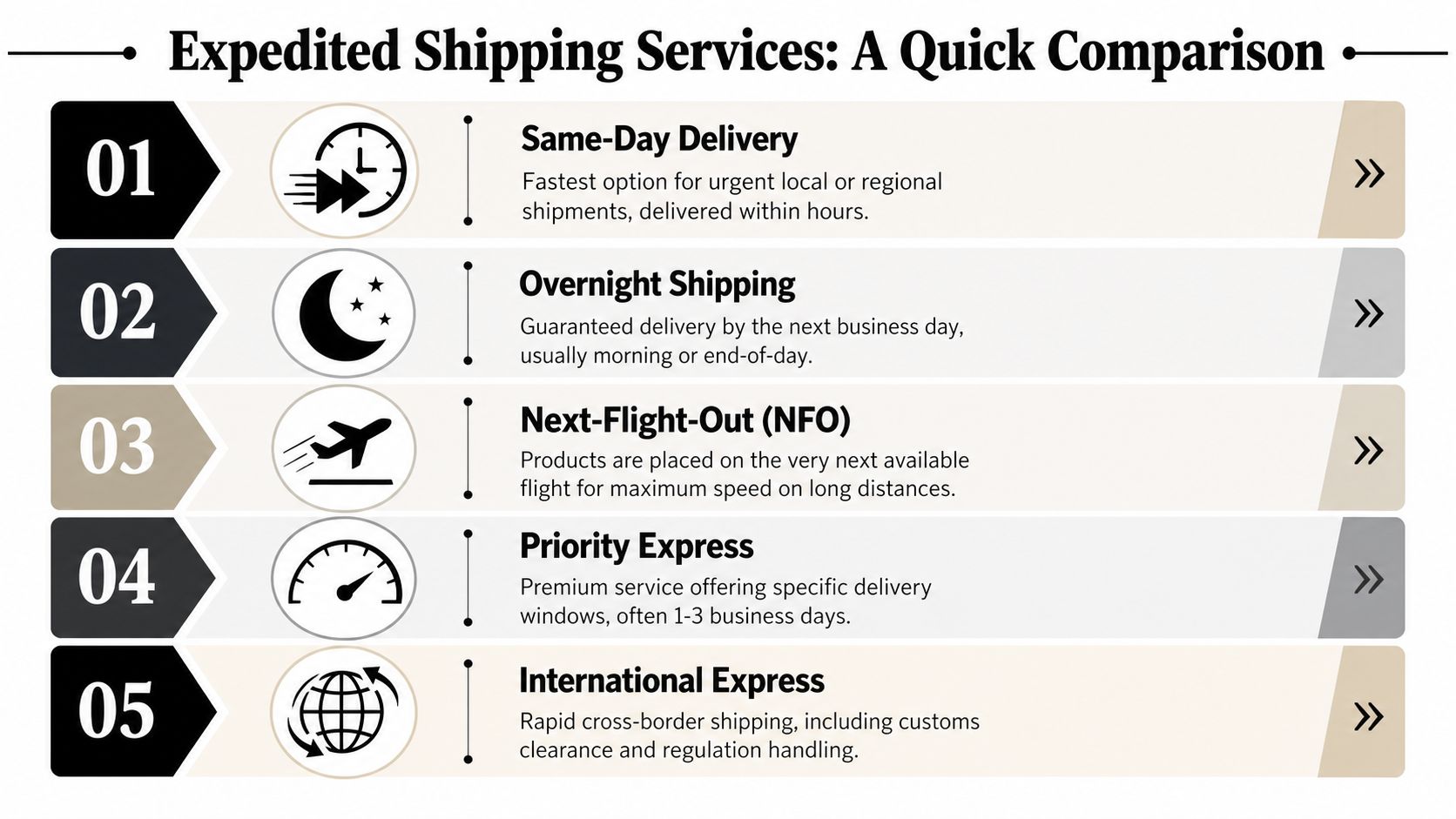
| Service Type | Typical Timeline | Ideal Use Case | Relative Cost |
|---|---|---|---|
| Same-day delivery | Within hours | Local emergency replenishment, hospital-adjacent or city-to-city urgent moves | Highest |
| Overnight shipping | Next business day | Domestic reagent orders that need quick receipt without special charter handling | High |
| Next-flight-out NFO | Fastest available flight movement | Irreplaceable or urgent long-distance shipments where every hour matters | Very high |
| Priority express | 1 to 3 business days | Planned urgent orders that still need budget discipline | Medium to high |
| International express | 2 to 5 business days | Cross-border lab shipments requiring customs processing and premium transit | High |
Same-day delivery works best when the shipment is local or regional and the consignee can receive immediately. It's strong for replacement vials, short-range temperature-sensitive moves, and emergency orders that can't wait for a hub cycle. It's weak when customs, airline schedules, or rural last-mile constraints are involved.
Overnight shipping is often the best domestic compromise. It gives labs a clear delivery target without the expense and complexity of dedicated movement. For many reagent orders, overnight is fast enough if the pack-out is qualified for that time window and the consignee receives the parcel promptly.
Next-flight-out, or NFO, is the specialist tool. It puts product on the next available flight and usually requires tighter operational coordination on both ends. It's expensive, but it can be the right choice when a missed run costs more than the freight.
Fast service only pays off when receiving is ready. A box that sits in a reception area can undo the premium paid for transport.
Priority express fits the large middle ground. It's useful when the product is sensitive but not in immediate rescue mode. This service often gives a defined delivery window without the cost of NFO.
International express is the category most labs underestimate. The linehaul may be quick, but the primary variable is paperwork readiness and border handling. A strong international express service has value because it combines speed with repeatable customs processing, not because the plane flies faster.
Best Practices for Packaging and Temperature Control
Cold-chain performance starts long before the courier scans the carton. Most failures come from poor matching between the product and the shipper design. A reagent that is stable under chilled conditions but vulnerable to freeze-thaw stress shouldn't be packed the same way as material intended to stay very cold throughout transit.
Build around the product profile
The first decision is passive versus active temperature control.
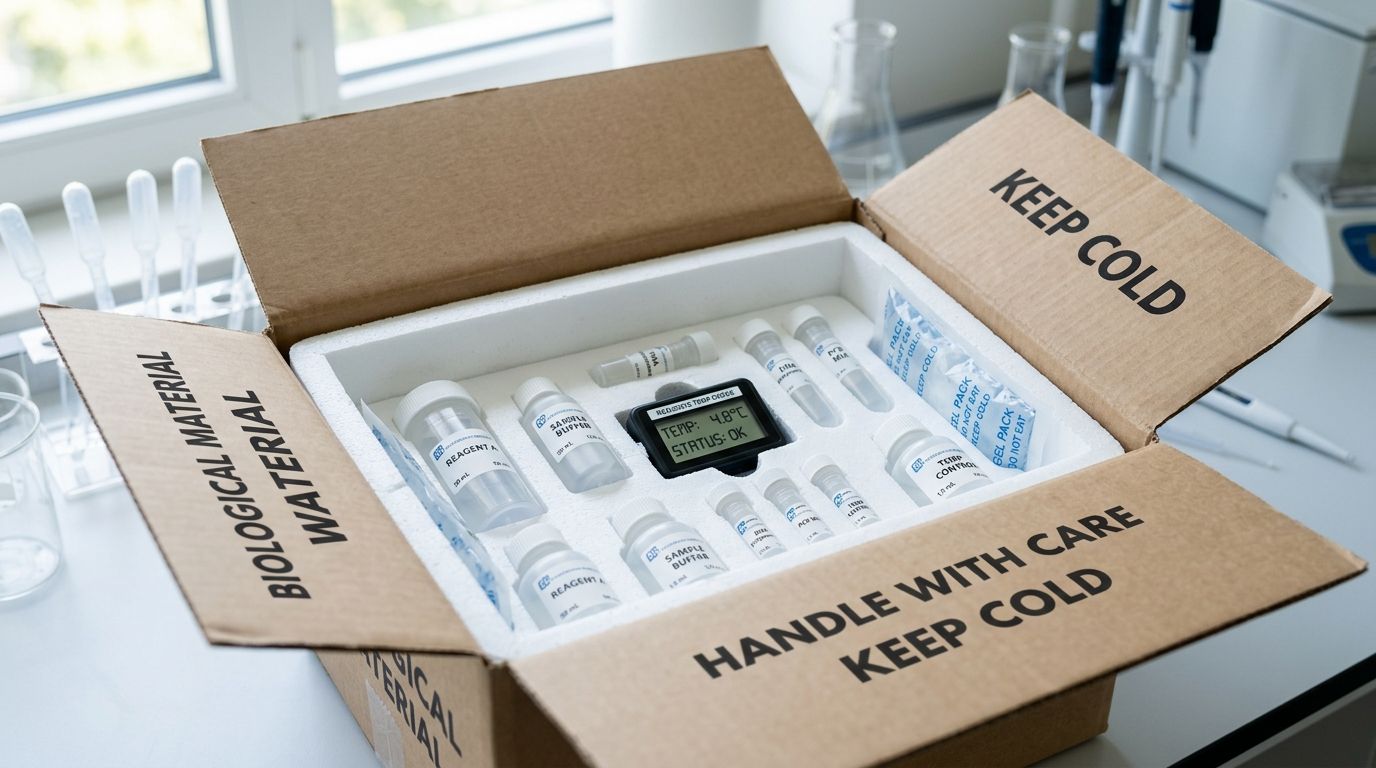
Passive systems use insulated shippers with coolants such as gel packs or dry ice where appropriate. They're practical for many reagent lanes because they're simpler, lower cost, and easier to scale. They work best when transit time is predictable and the packaging configuration has been validated for the route and season.
Active systems use powered containers or managed temperature units. They make sense for high-value loads, complex international lanes, or shipments where excursions would create unacceptable risk. They add cost and handling complexity, so they shouldn't be chosen by default.
A sound pack-out usually includes these elements:
- Primary container protection: Glass vials need cushioning that prevents contact shock and limits movement inside the secondary packaging.
- Absorbent and containment layers: If a vial leaks or a cap loosens, the spill needs to stay controlled within the package.
- Insulation matched to duration: Don't choose a shipper by appearance. Choose one that has been qualified for the expected route and ambient conditions.
- Clear external labeling: Temperature markings, orientation cues, and receiving instructions help handlers and consignee staff make better decisions.
For palletized or bulk outbound movements, secondary stabilization matters as much as vial protection. Teams shipping larger consignments sometimes review industrial wrapping and containment systems such as Crayex's shrink hooder offerings when they need a more secure outer load format for warehouse-to-distributor transfers.
Create a usable cold chain record
A temperature logger is useful only if the lab can interpret it quickly and trust the setup. The device should be activated correctly, placed where it represents product conditions, and recovered without confusion at receipt.
Receiving advice: Put unpacking instructions inside the lid, not only on the airway pouch. The person opening the shipment may never see the external documents first.
Labs also benefit from a short release workflow. Check the outer carton, review the logger status, verify vial condition, and confirm that the documentation matches the product identifiers before material enters storage or use. That routine turns a hurried handoff into a defensible cold-chain record.
This walkthrough gives a helpful visual reference for cold-chain thinking in scientific shipments:
The biggest mistake is treating packaging as a commodity purchase. For sensitive reagents, packaging is part of the product protection system. If the route changes, the season shifts, or customs dwell becomes more likely, the packaging design should be reviewed with the same seriousness as the carrier choice.
Navigating Global Regulations for Lab Reagents
A premium courier service can move a shipment quickly to the border. It can't make incomplete or unclear paperwork disappear. That's the blind spot in many discussions of expedited shipping options for scientific materials. Transit speed is often overplanned. Documentation scrutiny is underplanned.
Why fast service still gets stuck
Recent regulatory shifts have increased pressure on lab shipments. Updated EU REACH Annex XVII requirements and tightening around RUO classifications in the United States are creating customs delays for expedited lab shipments, and standard emergency services often don't account for the extra documentation scrutiny, according to UPS urgent-services guidance referenced in this regulatory context. In practice, that means a shipment sold internally as a 24-hour move can become a multi-day compliance issue if documents raise questions.
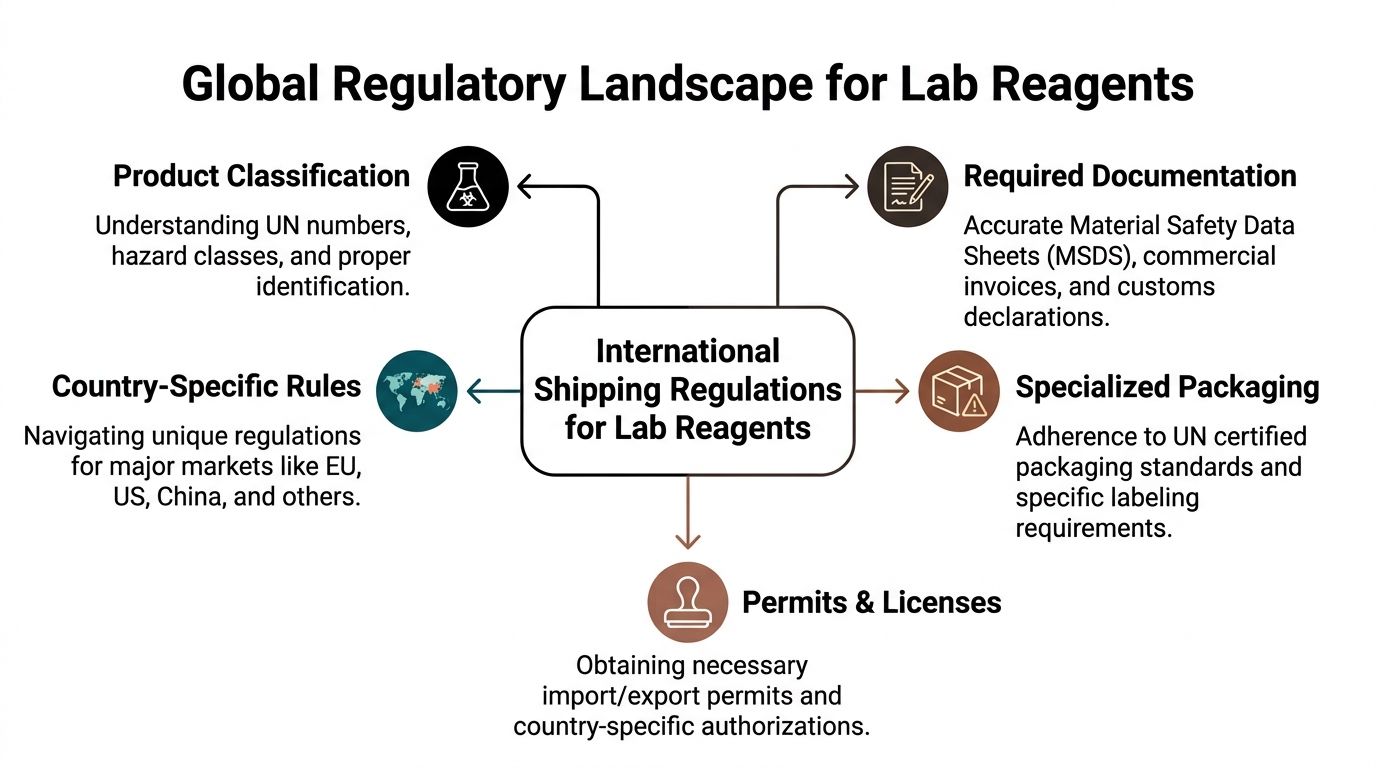
The problem usually isn't one dramatic error. It's a stack of small mismatches. Product description wording may be vague. The consignee name may not align across invoice and import records. The declared use may be too broad for a sensitive category. A carrier may accept the booking, but customs officers still need the submission to make sense on its face.
For EU, UK, USA, and LATAM routes, labs should assume that classification, declared use, and document consistency matter as much as flight speed. A parcel can move flawlessly through the network and still stall at clearance because one field invites a question.
Documents that usually decide clearance
Three document groups carry most of the weight for reagent shipments.
First, the commercial invoice. This has to describe the goods in language that is accurate, specific, and consistent with the classification used for customs. Generic wording creates work for reviewers and risk for the importer.
Second, the SDS and supporting technical documentation where applicable. These documents should be current, readable, and aligned with the product identifiers shown on the shipment. If a product is sold under a batch-controlled label, the supporting paperwork should make that easy to verify.
Third, the product-specific compliance file, which may include certificates, declarations, and internal references used by the importer or distributor. Teams that need a cleaner handoff between shipping and compliance often benefit from centralizing records in one controlled process. A useful example of that discipline is a structured approach to regulatory compliance documentation.
Classification errors are another recurring source of delay. An incorrect tariff description or a sloppy product category can create avoidable reviews. Buyers and distributors that want a practical primer on avoiding costly compliance errors often start with classification discipline because it improves both customs clarity and internal consistency.
The fastest cross-border shipment is the one that gives customs officers no reason to ask a follow-up question.
A workable pre-clearance checklist for lab reagents usually includes:
- Use statement check: Make sure RUO wording is consistent across the invoice, product label, and any supporting declarations.
- Identity match: Confirm that SKU, batch references, and product names align across all documents.
- Importer readiness: Verify that the consignee can receive and support clearance with any local documents required.
- Language clarity: Avoid marketing descriptions. Customs documents should read like operational records.
The key point is simple. In regulated scientific shipping, customs is part of the transit plan. Labs that treat compliance as a final paperwork task usually pay for fast service and then lose the time at the border.
How to Choose the Right Carrier and Service Level
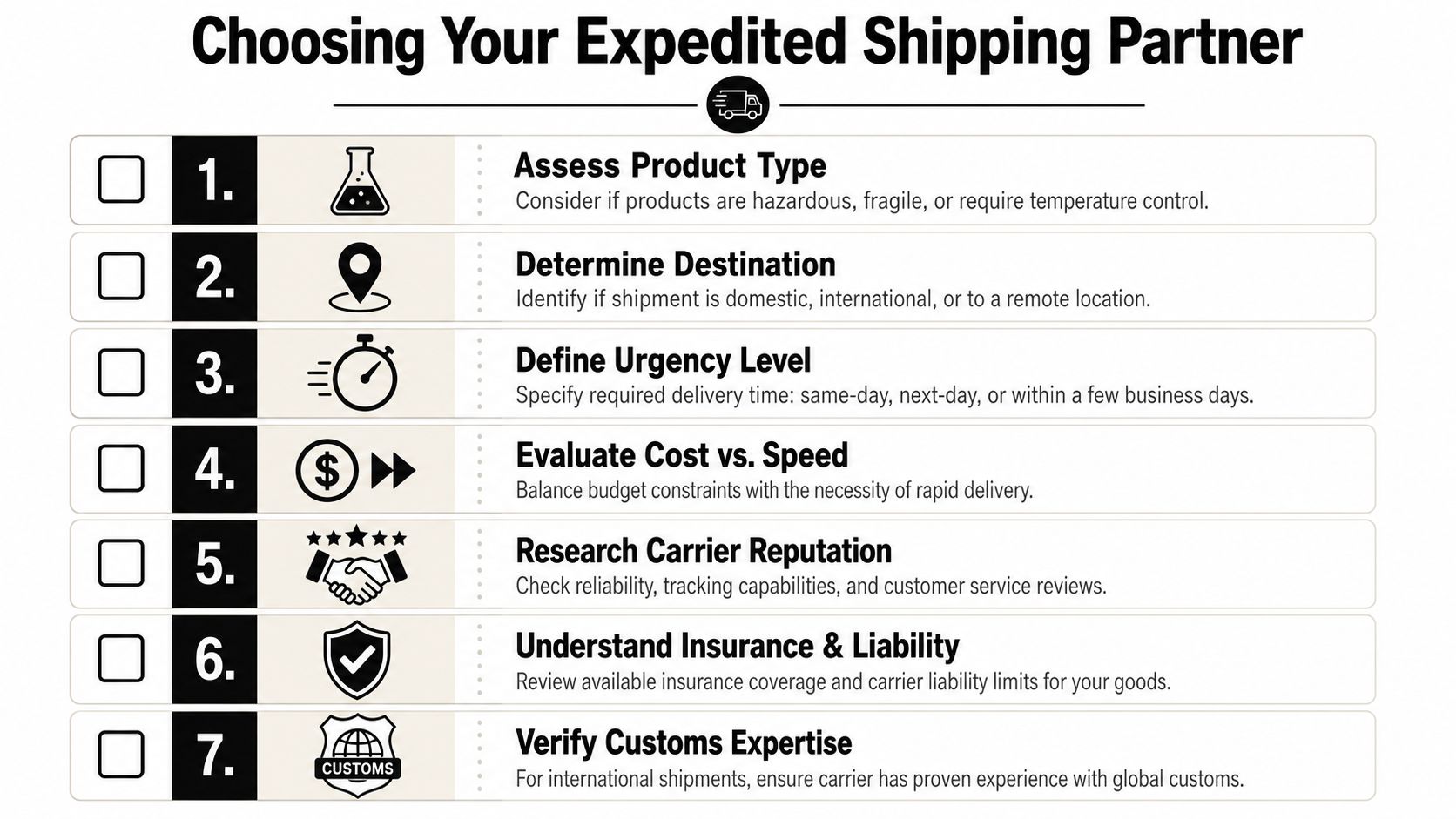
Carrier selection for lab reagents shouldn't start with a tariff sheet. It should start with a risk profile. The right provider for ambient consumables may be the wrong one for chilled glass vials moving across a border with tighter review.
Questions that matter before rate shopping
The first question is whether the carrier can support the actual product condition, not the generic service level. A provider may offer overnight delivery but have weak cold-chain handling at depots, limited exception management after hours, or poor communication when a parcel is held.
The second question is whether the carrier understands the destination lane. Performance on EU domestic shipments doesn't automatically translate to UK imports or LATAM distribution. Labs need a partner that can tell operations what usually happens on a route, what documents are commonly queried, and who intervenes when something stalls.
Another useful screen is internal supplier governance. Teams with formal vendor onboarding and review procedures often use a qualification framework similar to supplier qualification criteria so the logistics decision isn't separated from quality and compliance review.
A practical carrier scorecard
A carrier scorecard doesn't need to be complicated to be effective. It needs to force the right questions.
- Temperature capability: Can the provider handle passive and, where needed, active temperature-control shipments without improvisation?
- Exception response: When a parcel misses a connection or goes on hold, is there a named support path or only general customer service?
- Tracking quality: The best systems show more than scan events. They help operations understand where intervention is still possible.
- Customs coordination: For international moves, can the carrier or broker team review documents before departure when the lane warrants it?
- Receiving fit: Some premium services arrive at times that don't match the consignee's staffing. That creates preventable failed delivery attempts.
Selection test: Ask the carrier to describe how it handles one delayed, temperature-sensitive international reagent shipment from first alert to final resolution. The answer usually reveals more than the quote.
The lowest rate rarely reflects the full cost of a failure. For scientific shipments, the meaningful comparison is between service cost and the operational damage caused by delay, unusable product, repeat dispatch, and customer confidence loss. The carrier worth keeping is the one that reduces those risks consistently.
Optimizing Your Lab's Fulfillment Workflow
Fast shipping doesn't rescue a disorganized warehouse. Most avoidable failures happen before pickup. Orders miss cutoffs, coolant isn't conditioned on time, labels are printed before compliance review, or receiving instructions never make it into the box.
Turn rush shipping into a standard process
Labs that ship sensitive materials reliably usually make urgent fulfillment boring. They use the same disciplined sequence each time.
One effective model is to lock the workflow in this order:
- Order review first. Confirm product, destination, service level, and documentation requirements before picking begins.
- Pack-out decision second. Choose the validated packaging configuration based on route, season, and product sensitivity.
- Document release third. Print or attach paperwork only after the final product and shipment details are confirmed.
- Carrier booking last. Book once the shipment is physically ready, not earlier.
That order matters because early booking encourages teams to rush the steps that protect the reagent. Labs focused on maintaining continuity in time-sensitive workflows often build that discipline into broader operational planning, much like the principles outlined in keeping research momentum with same-day lab supplies.
What usually breaks the workflow
Three breakdowns show up repeatedly.
The first is cutoff blindness. A shipment prepared for overnight service after the effective carrier cutoff isn't an overnight shipment anymore, even if the label says so. Internal handoff times should sit earlier than the carrier's published deadline.
The second is split ownership. If quality controls the documents, operations controls packaging, and customer service promises delivery without a single release checkpoint, errors creep in fast. One accountable release step prevents many of these mismatches.
The third is weak return handling. Temperature-sensitive returns can't be processed like standard merchandise. Labs need a written rule for when material can be accepted back, what evidence is required, and whether disposition is possible or automatic quarantine is required.
A stable fulfillment workflow usually includes:
- Prebuilt packing stations: Keep insulation, coolant, cushioning, labels, and logger devices together.
- Route-specific packing instructions: Staff shouldn't have to guess which shipper suits which lane.
- Document templates: Consistent descriptions reduce compliance drift.
- Receiving communication: Let the consignee know what's coming, when it should arrive, and who must sign for it.
The gain isn't only speed. It's predictability. When fulfillment becomes repeatable, expedited service becomes more trustworthy and less expensive to manage.
FAQs on Expedited Shipping for Scientific Materials
Labs rarely struggle with the idea of urgency. They struggle with the edge cases. The questions below come up when speed, compliance, and product integrity collide.
Common questions from labs and distributors
Which expedited service is usually the safest choice for a temperature-sensitive reagent?
The safest choice is the one that matches the validated packaging window and the route reality. Overnight domestic service is often the best balance for many shipments. For long-distance or highly time-critical moves, dedicated or next-flight-out services may be more appropriate if the consignee is ready and the paperwork is already clean.
Why do some expedited shipments still move slowly once picked up?
Because the transport mode is only one part of the chain. Expedited freight can reduce transit from a standard 3 to 7 day ground window to 1 to 2 days by eliminating terminal handoffs and consolidation delays through dedicated cargo vans or next-flight-out air services, as described in this expedited freight guide. But if the parcel is held for compliance review, misses receiving hours, or waits on customs clarification, the saved transit time disappears.
Should a lab always choose the fastest available service for urgent orders?
No. The fastest listed service can be the wrong one if the route is cross-border and documentation risk is high. A slightly slower premium service with better customs support often protects product integrity better than the absolute fastest booking.
What should the consignee do when a temperature-sensitive shipment arrives?
Receive it immediately, inspect the carton, review any temperature indicator or logger, verify product identity against the documents, and move the material to the correct storage condition without delay. If anything looks wrong, quarantine first and decide second.
How should high-value scientific shipments be insured?
Insurance should be reviewed before dispatch, with declared value, exclusions, and evidence requirements understood by both shipper and consignee. The important point isn't buying insurance generically. It's making sure the policy and carrier liability terms fit temperature-sensitive, potentially irreplaceable research material.
What is the first response when customs delays a reagent shipment?
Get the exact reason for the hold, identify who owns the next action, and respond with the specific document or clarification requested. Broad resubmissions waste time. A focused answer tied to the shipment reference usually works better.
Are greener expedited shipping options realistic for labs?
Sometimes, but sustainability choices have to respect product stability. Practical steps include reducing avoidable re-shipments, selecting packaging with less waste where validated, consolidating planned urgent orders, and avoiding unnecessary use of the highest-intensity service when a lower premium tier will protect the product just as well.
The main lesson is that expedited shipping for scientific materials isn't just a freight purchase. It's a controlled process involving classification, packaging, timing, and receiving discipline. Labs that treat it that way get better outcomes and fewer surprises.
Labs and distributors that need dependable research supply fulfillment can explore Herbilabs for high-purity reagents, sterile diluents, clear compliance documentation, and global delivery support built around scientific workflows.


