Private Label, White Label, Wholesale partnerships available - EU, USA and UK - Free shipping from €75
Molecular Biology Reagents Explained for Reliable Results
A PCR run fails after hours of preparation. The controls look unusual, the amplification curve is weak, and the team starts checking primers, cycling conditions, and template concentration. Later, the problem traces back to a reagent that was contaminated, degraded, or supplied with the wrong formulation. The failed run has consumed samples, instrument time, staff attention, and confidence in the result.
That scenario affects more than researchers. Wholesalers, distributors, and laboratory procurement teams also carry operational risk when a product arrives without a clear lot record, loses stability during shipping, or can't fit the customer's workflow. Molecular biology reagents should therefore be treated as reliability controls, not ordinary consumables. Purity, formulation, packaging, documentation, and fulfillment all influence whether a procedure produces usable data.
Table of Contents
- Why Reagent Quality Decides Experiment Success
- What Molecular Biology Reagents Are and How They Work
- Common Classes of Molecular Biology Reagents You Will Use
- Purity Quality Control and How to Read a COA
- Storage Handling and Compatibility Best Practices
- Choosing the Right Reagent for Your Application and Scale
- Smart Procurement Checklist for Molecular Biology Reagents
Why Reagent Quality Decides Experiment Success
A molecular biology workflow behaves like a chain of controlled handoffs. Sample preparation leads to amplification, detection, analysis, and a decision about the next experiment. If one reagent carries nuclease contamination, an unsuitable salt concentration, or reduced enzyme activity, the visible failure may appear several steps later. The team can then spend time troubleshooting the wrong part of the process.
PCR shows why input quality matters. The polymerase copies the target, primers define it, nucleotides supply building blocks, and the buffer provides the chemical conditions for the reaction. A problem in any one component can look like a faulty template or instrument. The consequence is more than a repeat run. A poor input can make a valid sample appear negative or make an inconsistent assay seem dependable.
PCR also helped establish enzyme-and-buffer mixtures as standard research products. Current market structure reflects that development. Kits and reagents held 38.5% of product-type share in 2025, according to MarketsandMarkets' molecular biology reagents market coverage. Ready-to-use formulations reduce preparation steps and give laboratories more consistent starting conditions.
The cost of an unreliable input
A failed run can consume a day of instrument access, samples, and staff time. For a distributor, the same event may lead to customer complaints, replacement shipments, and uncertainty about whether other units from the lot are affected. In a high-throughput laboratory, a small variation can reach many reactions before its source becomes clear.
Packaging and logistics belong in the same control system. A reagent may meet its specification at release yet arrive compromised by a broken seal, unsuitable temperature exposure, incomplete lot documentation, or an unclear storage requirement. These details determine whether researchers can trace a result and whether supply partners can respond quickly when performance changes.
Market estimates also show why reliable inputs matter at scale. One analysis values the molecular biology enzymes, reagents, and kits market at USD 15.93 billion in 2025, projecting USD 34.11 billion by 2033 and a 10.29% CAGR from 2026 to 2033, as reported in Grand View Research's market analysis. Another estimate projects growth from USD 15.05 billion in 2026 to USD 24.26 billion by 2031, according to ResearchAndMarkets' category overview.
Operational rule: If a reagent can change the chemistry of a result, its quality record belongs inside the experiment's control system.
Reliable purchasing begins by asking what a product could cause the laboratory to blame incorrectly. Review contamination risk, activity, formulation, packaging, storage, transport, and lot consistency together. This approach protects reproducibility at the bench and gives wholesalers, distributors, and procurement teams a clearer basis for predictable supply.
What Molecular Biology Reagents Are and How They Work
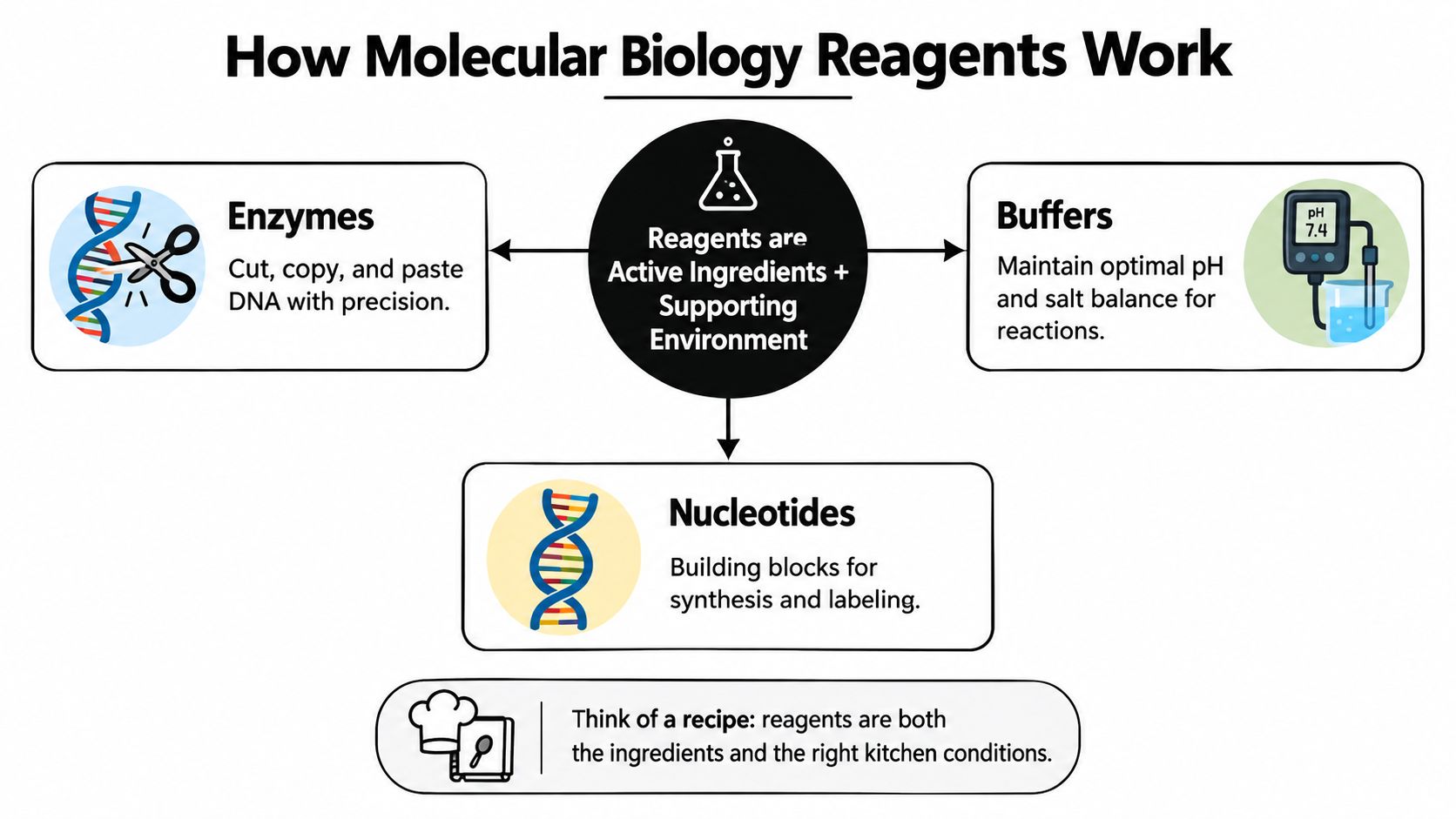
A useful way to understand molecular biology reagents is to compare a workflow with a recipe. The DNA or RNA sample is the raw ingredient, while enzymes, buffers, nucleotides, primers, probes, and diluents provide both the active ingredients and the conditions required for the reaction. A recipe can fail because an ingredient is missing, but it can also fail because the oven temperature, liquid balance, or mixing order is wrong.
Start with the reaction's job
Every reagent earns its place by performing a specific job.
- Enzymes perform controlled biological actions. A DNA polymerase copies DNA, a restriction enzyme cuts at a recognition sequence, and a ligase joins compatible ends.
- Buffers and salts create the chemical environment. They help maintain pH and ionic conditions so an enzyme can interact with its substrate.
- Nucleotides act as the raw building blocks for DNA or RNA synthesis. During PCR, the polymerase incorporates them into the growing strand.
- Primers and probes provide sequence direction and detection. Primers mark where amplification begins, while probes can signal the presence of a target in an assay.
The distinction from general laboratory chemicals matters. A chemical may meet a broad analytical specification and still be unsuitable for a sensitive nucleic acid workflow. Molecular biology applications need materials screened for contaminants that can degrade samples or interfere with enzymatic activity.
Follow one PCR reaction
A typical PCR reaction begins with a template containing the sequence of interest. Primers attach to matching regions, the polymerase extends from those primers, nucleotides supply the material for new strands, and the buffer keeps the reaction environment within the enzyme's working range. Repeated temperature cycles produce amplified copies that can be measured or examined.
The same logic applies to cloning and sequencing, although the reagent mix changes. Cloning may require restriction enzymes, ligase, competent-cell materials, and recovery media. Sequencing workflows depend on enzymes, nucleotides, primers, cleanup materials, and detection chemistry. The procedure looks different, but the operational principle remains: the reagent package determines what the workflow can do and how consistently it can do it.
Researchers and buyers often focus on the named enzyme because it appears to be the main active component. That can be misleading. A strong enzyme paired with an unsuitable buffer, contaminated water, or poorly matched storage solution can still produce a weak result. Reliable selection therefore evaluates the complete formulation, not just the headline ingredient.
Common Classes of Molecular Biology Reagents You Will Use
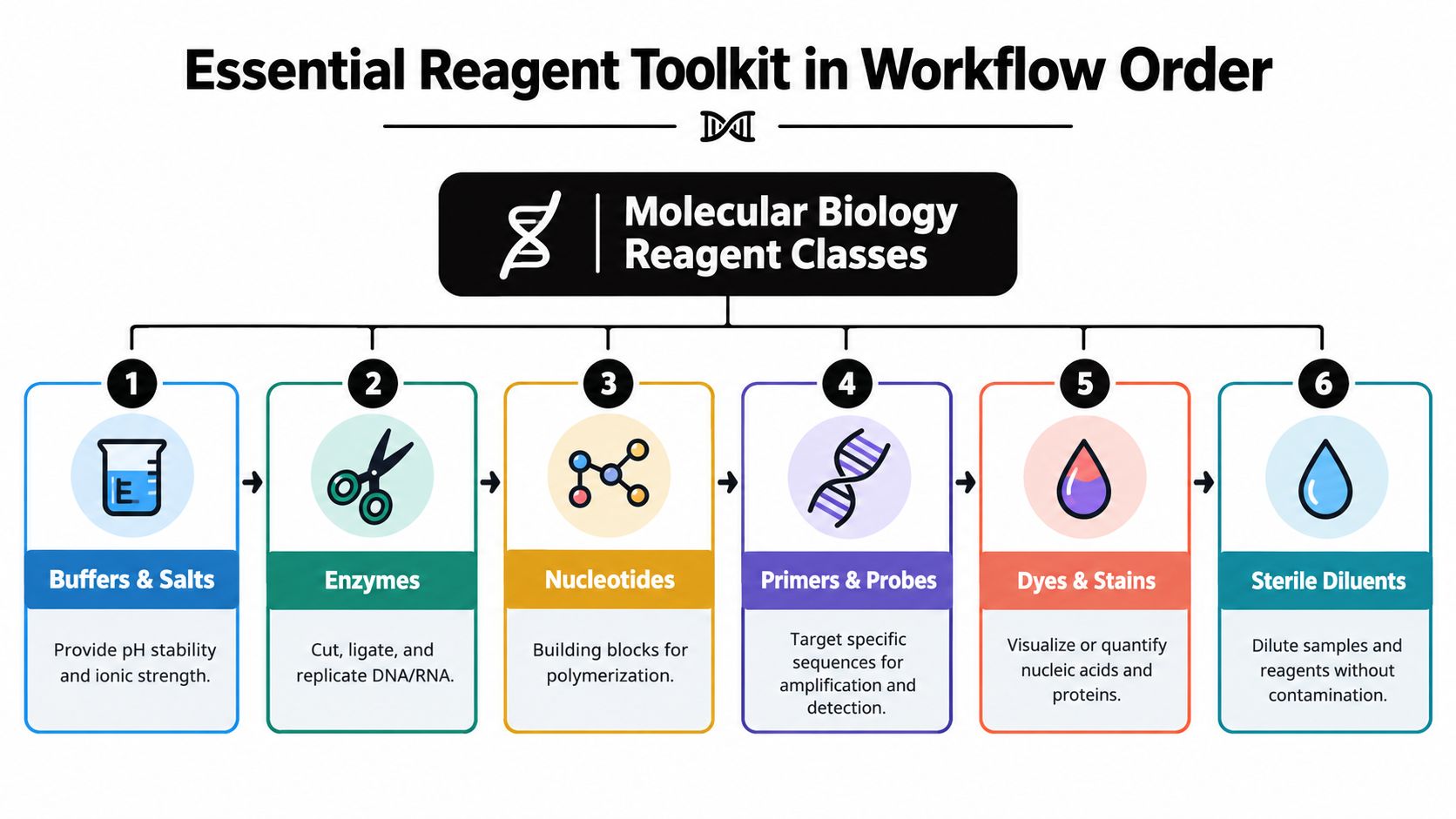
A laboratory's reagent toolkit follows the order of work. The sample must sit in a compatible environment, the reaction needs an active catalyst, synthesis requires building blocks, and the output must be detected or measured. Sterile diluents support preparation throughout the process.
Buffers and salts
Buffers stabilize pH, while salts adjust ionic strength and help control interactions between nucleic acids and enzymes. A PCR buffer, for example, is formulated to support polymerase activity under the assay's cycling conditions. A buffer with the wrong salt balance can reduce amplification or increase nonspecific products.
Enzymes
Enzymes provide the action that makes molecular manipulation possible. Polymerases copy DNA, reverse transcriptases produce complementary DNA from RNA, restriction enzymes cut DNA, and ligases join fragments. The relevant purchasing questions include enzyme specificity, fidelity, activity, storage conditions, and compatibility with the supplied buffer.
An enzyme that has experienced repeated warming may still appear clear and usable, yet deliver inconsistent activity. For that reason, a supplier's activity specification and handling instructions matter as much as the product name.
Nucleotides
Nucleotides support polymerization and labeling. Standard deoxynucleotides feed DNA synthesis, while modified nucleotides can support detection or specialized applications. Contamination, degradation, or an unsuitable concentration can alter yield and introduce variability across runs.
Primers and probes
Primers determine which sequence a PCR reaction can copy. Probes add sequence-specific detection, particularly in quantitative assays. Their performance depends on sequence design, concentration, purity, and compatibility with the reaction chemistry. A well-formulated master mix can't correct a primer that binds unintended targets.
Dyes and stains
Dyes and stains make nucleic acids or proteins visible or measurable. They support gel visualization, fluorescence-based detection, and some quantification workflows. The wrong dye can create background signal, interact poorly with the sample matrix, or produce a misleading visual interpretation.
Sterile diluents
Sterile, non-pyrogenic diluents help laboratories reconstitute lyophilized materials and prepare working solutions without introducing unwanted microorganisms or particulates. Packaging matters here. Premium glass vials can support controlled handling for Research Use Only workflows, provided the product's intended use and documentation match the protocol.
Procurement teams comparing packaging formats and raw-material options may also browse bulk commodity suppliers when building a broader sourcing strategy. The useful comparison isn't only price. It includes grade, lot documentation, container compatibility, sterility, lead time, and whether the product can move through the laboratory's existing preparation process.
Together, these classes form a connected system. A buffer supports the enzyme, the enzyme uses nucleotides, primers define the target, probes or dyes reveal the result, and sterile diluents help prepare materials safely. Treating each item as an isolated purchase makes it easier to miss incompatibilities.
Purity Quality Control and How to Read a COA
Purity is not a single label. A reagent can have a high assay value and still be unsuitable for molecular biology if it contains an active nuclease or another contaminant that affects the workflow. Expert guidance on molecular biology reagent requirements distinguishes molecular biology grade materials from standard chemical grades because sensitive reactions need protection from DNase, RNase, protease, heavy metals, and related impurities.
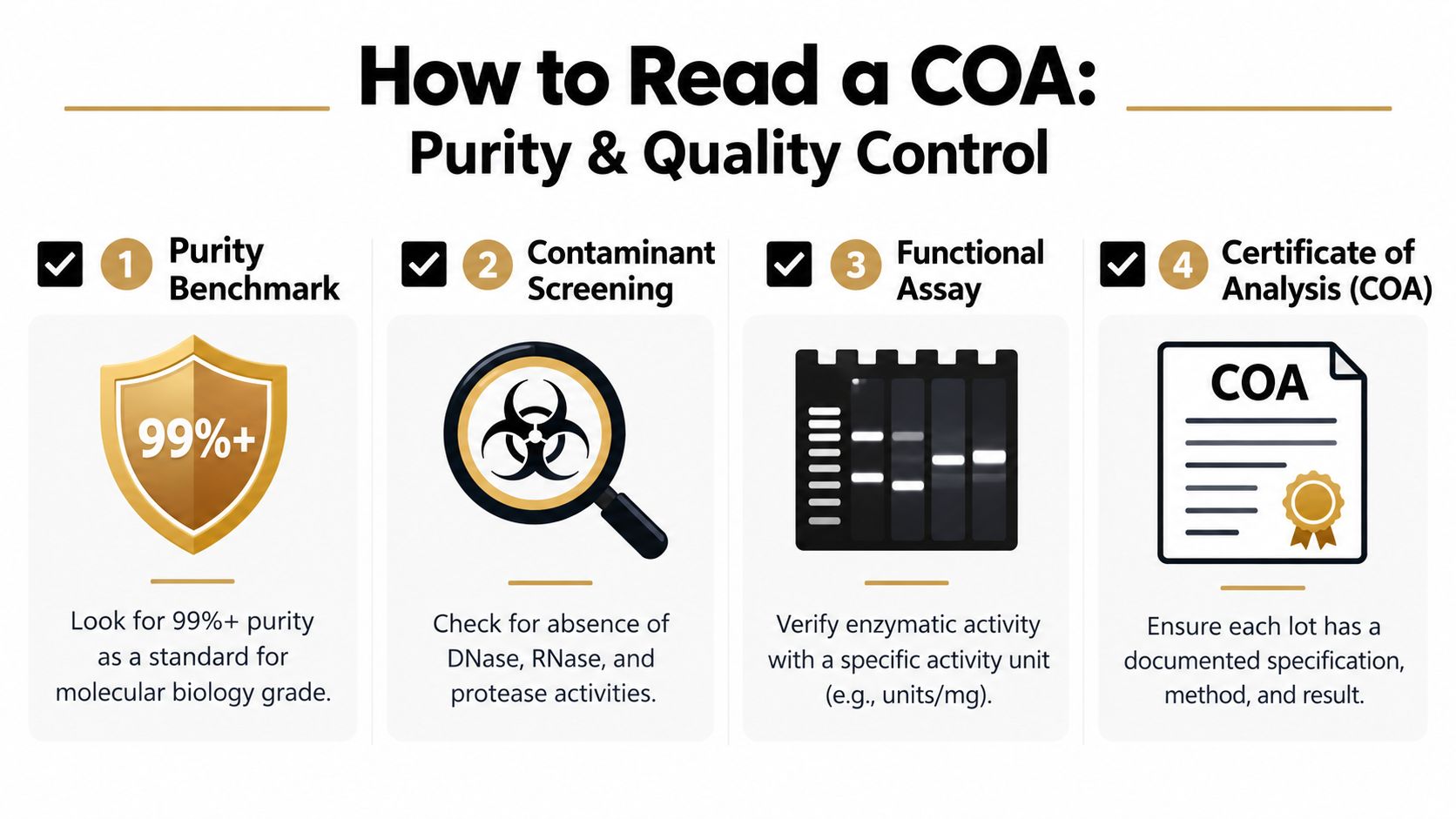
A certificate of analysis, or COA, turns that concern into a lot-specific record. It should identify the product and lot, state the specification, describe the test method, and report the result. A generic product page can explain intended use, but it can't replace evidence tied to the container being received.
Read the document as a risk map
A practical COA review asks what each result protects.
- Purity benchmark: A stated 99%+ purity benchmark can support material selection when the method and specification are clearly documented. The percentage alone isn't enough, because the test may not address biological contamination.
- Nuclease screening: DNase and RNase testing helps protect DNA and RNA from degradation. Some workflows also require screening for protease or nickase activity.
- Functional assay: Enzyme products need an activity result, not only a chemical purity statement. The method should explain how activity was measured and what unit or acceptance range applies.
- Lot identity: The lot number on the COA should match the label or shipment record. A mismatch weakens traceability during troubleshooting.
The wording “nuclease-free” deserves careful attention. Buyers should check whether the claim is supported by a defined test, a detection limit, and a lot-specific result. A supplier that can't explain the method leaves the laboratory to interpret an assurance without knowing its strength.
Questions procurement teams should ask
Before approval, the buyer should request the current COA, storage requirements, expiration or retest information, packaging details, and any restrictions on intended use. The laboratory should also confirm whether the reagent is supplied for research use only, diagnostic development, or another regulated context. Those categories aren't interchangeable.
For a practical review of document fields and supplier evidence, the certificate of analysis reading guide can serve as a reference. The final decision should connect the COA to the protocol. If the assay is sensitive to nucleases, the record must address nucleases. If the workflow requires active enzyme, the record must show activity.
Storage Handling and Compatibility Best Practices
A reagent can leave the supplier in good condition and still fail after poor handling. The laboratory controls the next part of the chain, from receipt and labeling to aliquoting, bench exposure, and return to storage.
Use a controlled handling routine
- Check the shipment on arrival. Confirm seals, labels, lot numbers, temperature indicators where supplied, and visible signs of leakage or precipitation. Record deviations before placing material into stock.
- Follow the product's storage instruction. Enzymes and other sensitive reagents may require frozen storage, while some formulations have different temperature limits. The supplier's label and technical documentation should control the decision.
- Aliquot sensitive materials. Small working aliquots reduce repeated warming and cooling. Each aliquot should carry the lot, concentration where relevant, preparation date, and discard or review date.
- Use clean technique. Fresh tips, clean racks, and separate handling for nucleic-acid-sensitive materials reduce the chance that contamination reaches a shared stock.
- Protect light-sensitive products. Light exposure can alter dyes and other photosensitive components. Use the specified container and minimize unnecessary bench time.
- Check compatibility before mixing. A diluent that works for one protein or lyophilized material may destabilize another. Consider pH, salt, preservatives, sterility, and the final concentration.
Repeated freeze-thaw cycles can reduce enzyme performance, while evaporation can change concentration in a small-volume tube. A precipitate may indicate temperature stress, an incompatible solvent, or a formulation problem. The correct response isn't to shake blindly. The lab should consult the product documentation and record the observation.
Handling principle: The cold chain protects activity, but disciplined labeling protects traceability. Both are required for reproducible work.
Sterile reconstitution solutions need their own storage and access procedure. The bacteriostatic water storage guidance can help procurement and laboratory teams align storage decisions with the product's stated use and handling requirements.
A short visual demonstration can reinforce why aliquoting, labeling, and controlled storage belong in the workflow rather than as afterthoughts.
Compatibility should also be tested at the working scale. A buffer can look acceptable in a tube yet inhibit an enzyme after dilution, and a preservative can affect downstream detection. Small verification runs are often less costly than discovering incompatibility after a full batch has been processed.
Choosing the Right Reagent for Your Application and Scale
A small PCR run and a distributed testing workflow may use similar chemistry, yet they place different demands on the reagent. The manual setup can accommodate separate components and experienced pipetting. An automated or multi-site process needs standardized concentrations, fewer transfers, instrument-compatible packaging, and dependable replenishment.
Start with the biological task. PCR and quantitative PCR require dependable amplification chemistry, clean templates, and primers or probes that match the system. Cloning places more weight on restriction-enzyme specificity, ligation performance, and DNA integrity. Sequencing adds requirements for fidelity, cleanup compatibility, and consistent signal quality. Synthetic biology often repeats assembly, transcription, or expression steps, so stable lot-to-lot performance becomes more important.
Scale changes the risk profile. A reagent that works well during method development may create unnecessary handling or variation in a production workflow. High-throughput and decentralized testing also depend on standardized ready-to-use formats, automation support, and preparation steps that can be performed consistently across sites. Industry coverage has identified AI-enhanced workflow automation, cloud-based molecular biology platforms, smart connected laboratories, and standardized ready-to-use kits as part of this shift. PCR, sequencing, syndromic diagnostics, and decentralized molecular testing remain recurring application areas.
| Application | Critical Reagent Attributes | Format Consideration |
|---|---|---|
| PCR and qPCR | Polymerase activity, clean buffer, primer and probe compatibility | Separate components for flexible optimization, or a master mix for routine consistency |
| Cloning | Restriction specificity, ligation performance, DNA-safe handling | Component kits can simplify assembly while preserving protocol control |
| Sequencing | Fidelity, template integrity, cleanup compatibility, signal consistency | Formulations should match the platform and sample preparation process |
| Synthetic biology | Repeatable enzyme activity, stable formulations, lot traceability | Standardized components support repeated builds and method transfer |
| High-throughput testing | Automation compatibility, low handling burden, consistent fill volumes | Ready-to-use formats, automation-friendly containers, and clear identifiers |
| Decentralized testing | Stability, simple preparation, transport resilience, workflow speed | Compact, standardized formats can reduce preparation steps at distributed sites |
Choose for failure prevention
A ready-to-use kit reduces pipetting variation and training demands, but it may restrict optimization or tie the workflow to one formulation. Separate reagents offer more control over concentrations and conditions. They also require tighter inventory management and create more opportunities for preparation errors.
Choose the format that removes the most likely failure. An established assay may gain consistency from a standardized mix. Method development may require separate buffers and enzymes so the scientist can tune conditions. Automation adds another checkpoint: container geometry, closure, dead volume, fill consistency, and label readability can affect performance as much as the chemistry.
Packaging and logistics therefore function as reliability controls. The right reagent protects the workflow from avoidable transfers, identification errors, supply interruptions, and inconsistent handling. Laboratories increasingly select products for fewer failures, lower variability, and faster turnaround as work expands from manual research into high-throughput and distributed use.
Smart Procurement Checklist for Molecular Biology Reagents
A procurement decision should begin with the intended workflow, not the catalog title. The laboratory, wholesaler, or distributor should define the required grade, application, storage condition, package size, and documentation before comparing unit prices.
Use this checklist during supplier qualification:
- Application fit: Confirm that the reagent supports the exact workflow, such as PCR, sequencing, cloning, protein reconstitution, or automated testing.
- Quality evidence: Request a lot-specific COA with purity, contamination screening, functional results where relevant, methods, and acceptance criteria.
- Traceability: Match lot numbers, labels, shipment records, expiration information, and storage instructions.
- Packaging: Check whether the vial, tube, closure, fill volume, and labeling suit manual handling or automation.
- Cold-chain capability: Confirm controlled storage, shipping conditions, receipt procedures, and escalation steps for temperature deviations.
- Regulatory status: Verify Research Use Only language and ensure the buyer's intended use matches the supplier's stated terms.
- Supply continuity: Ask about batch consistency, production history, reorder availability, and communication when specifications change.
- Commercial support: Evaluate dispatch arrangements, EU shipping terms, wholesale options, and responsiveness before a routine order becomes urgent.
A structured laboratory supplier qualification framework can help teams turn these checks into an approved-vendor process. For distribution partners, the same framework supports customer confidence because it connects technical documentation with fulfillment performance.
The market's projected expansion, including the North American revenue forecast from USD 7,055.6 million in 2025 to USD 14,829.5 million by 2033 in MarketsandMarkets' regional analysis, points to durable demand for dependable inputs. Buyers should respond by qualifying suppliers for the complete operating system, not by treating reagents as interchangeable bottles.
Herbilabs supplies high-purity research reagents and sterile reconstitution solutions in documented formats, including premium glass vials and lot-specific COAs for Research Use Only workflows. Procurement teams and distribution partners can review the available options and fulfillment support by visiting Herbilabs.


