Private Label, White Label, Wholesale partnerships available - EU, USA and UK - Free shipping from €75
Deviation Investigation: A Practical Lab Framework
At 2 a.m., an analyst sees an unexpected HPLC result. A QA reviewer, arriving later, notices that a batch record carries an unsigned step. Neither event can be dismissed as an administrative nuisance. Each raises the same operational questions: what happened, which materials or records may be affected, whether the process remains in control, and what evidence can support the final decision?
A sound deviation investigation answers those questions without guessing. It protects the batch, preserves evidence, tests competing explanations, and converts findings into controls that can be checked later. The strongest laboratories don't measure investigation quality by how polished the report looks. They measure it by whether the same failure returns, whether CAPA works, and whether people across operations, QC, engineering, IT, and QA take ownership.
Table of Contents
- What Deviation Investigation Really Means in a Regulated Lab
- Classifying Deviations Before You Start the Investigation
- Containing the Scene and Handling Evidence Correctly
- Finding the Root Cause With 5 Whys and Fishbone
- Turning Findings Into CAPA That Actually Prevents Recurrence
- Trending, AI, and the Shift to Predictive Quality Oversight
- Putting It All Together With Templates and Common Questions
What Deviation Investigation Really Means in a Regulated Lab
A deviation is a departure from an approved instruction, specification, SOP, validated process, or required record that may affect product quality, data integrity, patient safety, or regulatory compliance. The event might be an out-of-specification result, an incorrect instrument setting, a missed environmental check, a contaminated reagent, or an incomplete batch record. The original event can be small, but its potential scope may extend across products, equipment, records, and batches.
A deviation report records the occurrence. An investigation goes further. It establishes what happened, when it happened, why it happened, what was affected, and how the laboratory will prevent recurrence. That expectation is rooted in FDA 21 CFR 211.192 and related deviation-management principles, which require a thorough investigation of unexplained discrepancies and batch failures, including review of other batches that may have a similar defect. EU GMP Chapter 1 reinforces the need to record significant deviations, determine root cause, and implement appropriate corrective and preventive action.
The inquiry must be risk based
ICH Q9, EU GMP, 21 CFR 211, and ISO 17025 provide the framework auditors and inspectors use when they assess whether a laboratory has controlled its processes. These frameworks don't demand identical forms, but they do demand a defensible approach to risk, evidence, impact, and follow-up.
A superficial conclusion such as “analyst error” leaves the important questions unanswered. Was the instruction unclear? Did the analyst work from the correct revision? Was the instrument fit for use? Did workload, environment, or sample handling contribute? Could another result or batch have been affected?
Practical rule: A deviation investigation isn't complete because someone documented the event. It's complete when the laboratory can defend its scope, reasoning, disposition, and preventive controls.
Skipping the inquiry can become more serious than the initial mistake. A laboratory that fails to investigate an unexplained discrepancy cannot demonstrate control, even if later testing happens to produce an acceptable result. A useful risk-control reference, especially when reviewing operational ownership and escalation, is this 2026 risks and controls matrix.
The working sequence is straightforward: classify the event, contain the scene, preserve evidence, assess impact, determine the most defensible cause, assign CAPA, verify effectiveness, and trend the outcome. Each step supplies evidence for the next. Weakness at the beginning creates uncertainty at the end.
Classifying Deviations Before You Start the Investigation
Classification should precede root-cause analysis because it determines who must be involved, how quickly containment begins, how much evidence is required, and what level of approval is needed. A team that starts investigating before deciding the risk level may under-resource a serious event or spend disproportionate effort on a contained documentation error.
Three classification schemes commonly appear in regulated laboratories:
| Scheme | Categories | Example | Typical investigation timeline |
|---|---|---|---|
| Risk severity | Critical, major, minor | Possible impact on released product or critical data | Defined by the site SOP and escalation rules |
| Intent | Planned, unplanned | Approved temporary departure versus unexpected failure | Planned events require approval before execution |
| Source or system | Product, process, equipment, laboratory system | Instrument malfunction or method execution issue | Set by impact, scope, and local procedure |
The first decision is practical: does the event touch released product, a validated state, critical data, or a condition that could affect patient safety? If so, QA should treat it as a potential critical event until the facts support a lower classification. The containment plan should begin immediately, and the investigation should receive senior quality attention.
An event involving an in-process batch or a non-critical record may be major when product quality or compliance could be affected but remains controllable. A fully contained, cosmetic record issue may be minor, provided the evidence confirms that quality, data integrity, and process control weren't compromised. These examples are decision prompts, not universal classifications. Each site must define its own criteria and escalation rules.
Classification errors expose weak systems
Misclassification often signals that the SOP relies on abstract labels rather than worked examples. A strong procedure shows how the site handles an out-of-specification result, a missed calibration, a missing signature, a repeated minor event, and a suspected data-integrity issue.
The classification can change as evidence emerges. A minor event may become major after a wider record review, while an initially critical concern may be downgraded when containment and impact assessment show no affected product. The investigator should document why the rating changed, who approved the change, and what new evidence supported it.
The time expectation should also come from the quality system. One published GMP framework describes formal initiation within 2 working days in some organizations, an investigation report within 30 working days, and a commonly used 30-calendar-day closure target for major deviations. It also describes escalation to the quality head and market-impact or recall-risk assessment for critical events involving distributed product in its GMP deviation-management framework. These are industry practices, not automatic legal deadlines, so the approved site procedure remains controlling.
Containing the Scene and Handling Evidence Correctly
The first hours determine whether the later report will be credible. The investigator's priority isn't to make the result look better. It's to prevent additional exposure and preserve the original state of the evidence.
Physical containment may include:
- Quarantine status: Place affected batches, raw materials, intermediates, samples, and packaging under clear status control.
- Equipment isolation: Segregate instruments and shared reagents when calibration, cleaning, maintenance, or contamination is in question.
- Record protection: Secure logbooks, worksheets, batch records, labels, and reference standards associated with the event.
- Sample separation: Keep suspect samples separate from control samples and identify both with unambiguous labels.
Digital evidence needs the same discipline. The responsible system owner may need to preserve audit trails, freeze relevant LIMS or CDS entries, export original raw-data files, retain system logs, and capture screen states with timestamps before further use changes the record. A screenshot isn't a substitute for raw data, but it can document what the user saw at the time of discovery.
Chain of custody must be visible
A defensible chain of custody lets another reviewer trace each item from discovery to storage, testing, transfer, and final disposition. For example, a pull sample should carry a unique identifier, collection time, collector signature, witness signature where required, storage condition, and transfer record. Temperature-sensitive material needs secure cold-chain transport and documented receipt.
The same principle applies to electronic records. The team should record who accessed the file, what was exported, where the preserved copy is stored, and whether the source system remains unchanged. Any correction to a record must follow the approved data-integrity process. Investigators shouldn't overwrite the original entry to create a cleaner narrative.
Evidence rule: Containment isn't correction. Don't reprocess, retest for a preferred outcome, alter a record, or discard material until the investigation and quality decision authorize the action.
Retesting may be scientifically justified in some investigations, but it can't be used to replace an inconvenient result. The original result, method conditions, instrument status, sample preparation, and analyst observations remain part of the evidence. If a batch is reworked, released, rejected, or otherwise dispositioned, the report should connect that decision to documented impact assessment and quality approval.
Sloppy containment creates gaps that no root-cause tool can repair. Once a suspect reagent is discarded, a raw-data file overwritten, or a shared instrument returned to service without documentation, the investigator may never reconstruct the original condition. The report can still state what is known, what is uncertain, and why, but it can't claim evidence that no longer exists.
Finding the Root Cause With 5 Whys and Fishbone
Root-cause tools organize the investigation. They do not supply evidence. The investigator must test each proposed cause against records, samples, instrument history, environmental data, method requirements, and interviews. A useful investigation also asks whether the event reflects a recurring process weakness, a failed CAPA, or unclear ownership between laboratory, engineering, and quality teams.
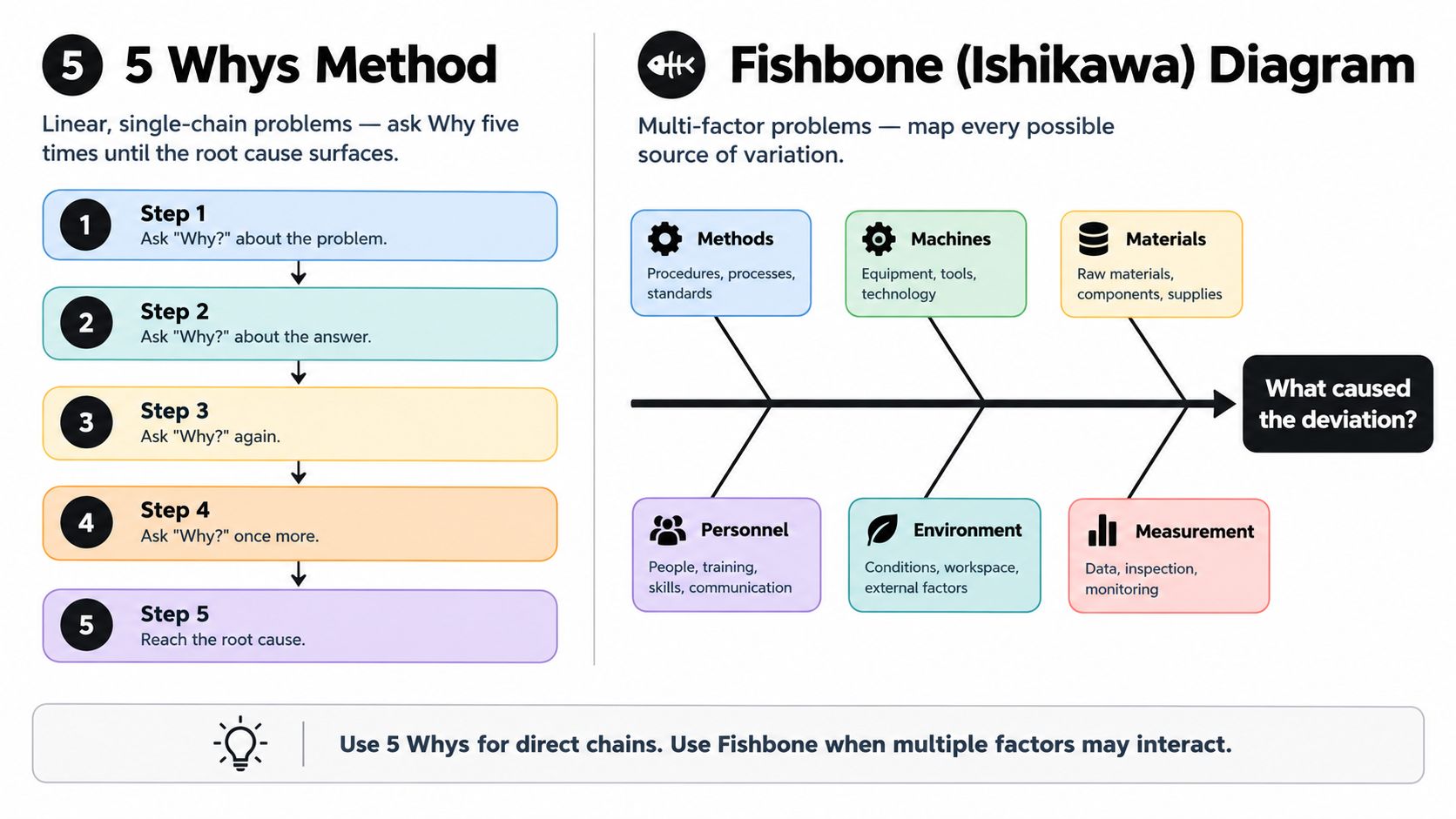
5 Whys works well when the event follows a relatively direct, documented chain. Start with a verified cause and ask why it occurred until the team reaches a controllable system condition. A fishbone, or Ishikawa diagram, suits events involving several interacting categories, including method design, equipment, materials, personnel, measurement, and environment. Trending can help determine whether the event is isolated or part of a pattern, while AI or SPC triage may identify signals early enough to address them before they enter a formal deviation queue.
One HPLC failure, two useful lenses
A failed HPLC assay trace shows mobile-phase contamination during the initial review. That finding describes the condition observed. It does not, by itself, establish the root cause.
A focused 5 Whys chain could be:
- Why did the assay trace fail? The mobile phase introduced contamination into the chromatographic system.
- Why was contaminated mobile phase used? The container was filled from a reagent unsuitable for the method.
- Why was the unsuitable reagent selected? The preparation worksheet did not clearly distinguish the required grade.
- Why was the worksheet unclear? The method revision changed the preparation requirement, but the local worksheet was not updated.
- Why was the update uncontrolled? The document-change workflow assigned no verification step to confirm that laboratory worksheets reflected the approved method.
This chain points to document control and implementation verification, rather than analyst behavior alone. The analyst made the immediate selection, but the investigation must establish why the process allowed that selection without a reliable barrier.
Fishbone analysis broadens the review:
- Personnel: Was the analyst trained on the current method and worksheet?
- Method: Does the instruction specify reagent grade, preparation, labeling, and expiry?
- Machine: Could the HPLC system or solvent line have introduced contamination?
- Material: Were reagent identity, container, storage, and preparation records correct?
- Measurement: Could system suitability and blank results detect the issue?
- Environment: Did the preparation area, container, or handling conditions contribute?
Test each plausible branch rather than accepting the first convenient explanation. Instrument logs, reagent certificates, preparation records, system suitability data, and method history can confirm one branch and eliminate others. Record that reasoning, including unresolved uncertainty.
A practical root cause analysis guide can help structure containment, causal chains, and verification. State whether the cause is confirmed, probable with supporting evidence, or undetermined. An undetermined conclusion is stronger than speculation presented as certainty.
The CAPA handoff should name the system condition requiring change, the owner accountable for changing it, and the evidence that will demonstrate effectiveness. That connection is what turns an investigation from a completed record into a test of process maturity.
Turning Findings Into CAPA That Actually Prevents Recurrence
A corrective action addresses the cause of a detected nonconformity. A preventive action addresses a latent weakness that could produce a similar event elsewhere or later. The distinction matters, but the quality of the action matters more than the label.
“Retrain the analyst” is often a weak response. Training may be appropriate when a demonstrated knowledge or qualification gap caused the event, but training alone doesn't fix an ambiguous worksheet, a poor interface, an unavailable reagent, or an instrument-control failure. The action should change the condition that made recurrence possible.
Write actions that can be tested
A CAPA statement identifies the action, owner, resources, due date, affected systems, and effectiveness check. The effectiveness check should define what evidence will be reviewed and when QA will review it. Numeric targets may be appropriate when the process has a meaningful baseline and a justified acceptance criterion, but a number without a scientific rationale is only decoration.
| Weak CAPA example | Why it fails | Robust CAPA equivalent |
|---|---|---|
| Retrain the analyst on the SOP | It treats the person as the cause and doesn't address unclear instructions | Revise the preparation worksheet, verify method-to-worksheet alignment, and assess analyst execution against the approved revision |
| Remind staff to check equipment status | It relies on memory and doesn't create a control | Add a documented pre-use status check and verify completion during QA review |
| Monitor the process more closely | It doesn't define who reviews what or what triggers escalation | Trend the relevant event category, assign a review owner, and define escalation when the approved threshold is reached |
| Close after procedure revision | A new document doesn't prove the control works | Confirm implementation, review relevant records, and document the effectiveness decision |
A corrective action plan framework can support the transition from a root-cause conclusion to owned, verifiable actions. The action owner needs authority and capacity, not just a name in the quality system. If engineering must modify equipment, IT must preserve audit trails, or operations must change a workflow, those groups need to participate before QA approves the plan.
Prioritize the risk, not the queue
Critical actions shouldn't wait behind low-risk administrative tasks. The investigation should distinguish immediate correction, corrective action, preventive action, and change control. A revised validated process may require additional qualification or validation work. A supplier-related cause may require supplier communication and expanded material review. A data-integrity concern may require specialist assessment and restricted system access.
Closure requires more than completed tasks. QA should ask whether the action was implemented as designed, whether affected personnel and systems received the change, whether the expected control operated in practice, and whether recurrence or related signals appeared. If the check fails, the laboratory should reopen the assessment or initiate further CAPA rather than treating the failed check as a routine closure delay.
Closure test: The right question isn't “Was the action completed?” It is “What evidence shows that the causal weakness is now controlled?”
Trending, AI, and the Shift to Predictive Quality Oversight
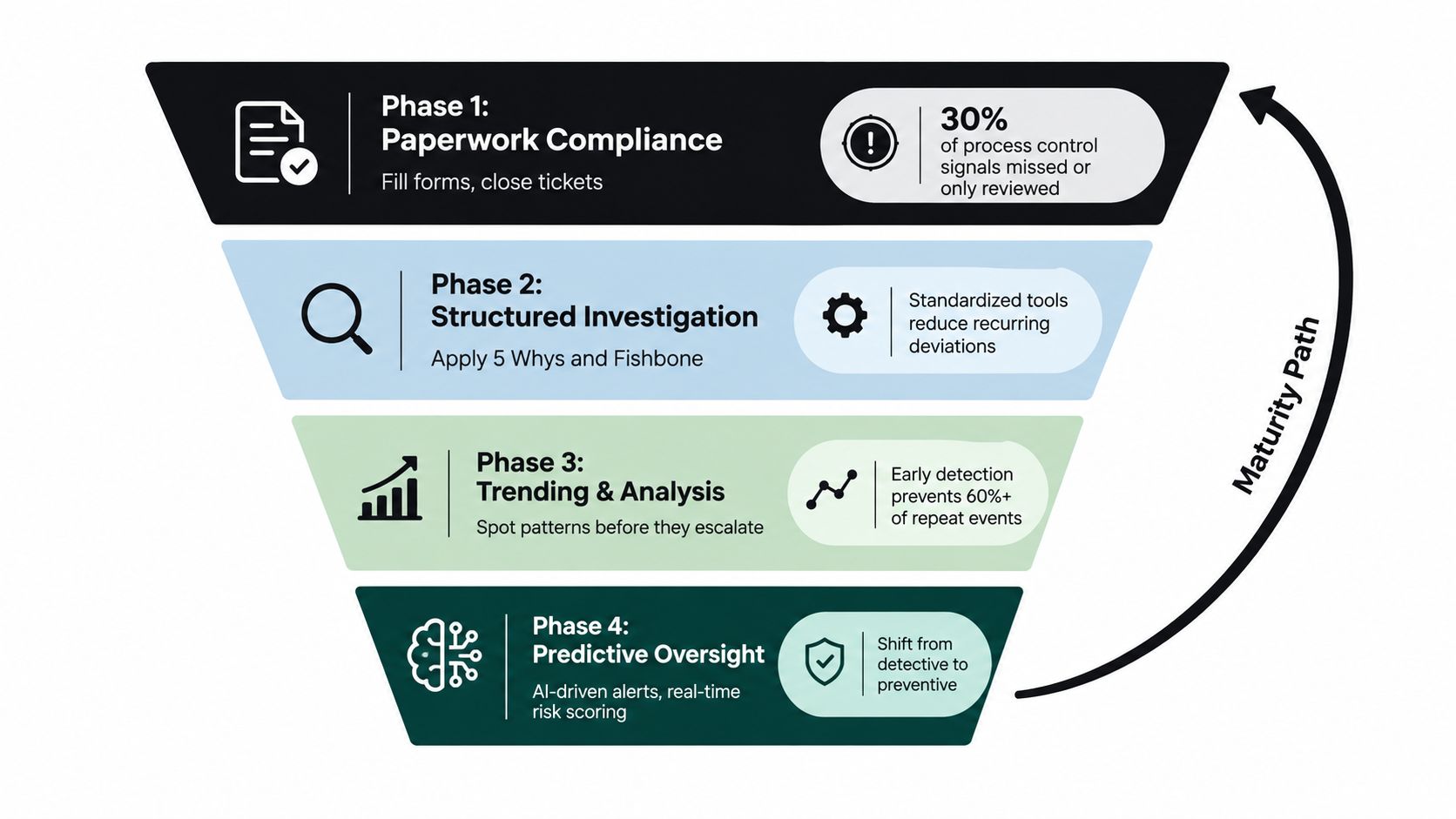
A mature quality system doesn't wait for every signal to become a formal deviation. It watches patterns in near-misses, process parameters, equipment alerts, rejected samples, repeat corrections, and minor events that look harmless in isolation.
Recent industry commentary identifies a bottleneck in investigation work before analysis even begins. Quality teams may spend about an hour gathering information to start each investigation, according to industry commentary on emerging FDA warning-letter trends. The operational lesson is clear: structured metadata and accessible records can reduce the coordination burden before the investigator asks a single “why.”
A useful trending program starts with a controlled taxonomy. Each event should carry consistent fields for site, product, process step, equipment, method, material, cause category, severity, recurrence, CAPA status, and effectiveness outcome. QA can then review Pareto patterns by category, site, product, or process rather than reading isolated narratives.
SPC and AI move attention upstream
Statistical process control can monitor upstream parameters and distinguish ordinary variation from signals that deserve intervention. Recent industry material describes the use of SPC and AI to detect, classify, and investigate deviations faster, and reports that around 30% of GMP deviations may trace back to process-control gaps that SPC can address in its discussion of SPC and deviation investigation. The figure is presented by that industry source as an indicative claim, not a universal benchmark.
AI-assisted triage can cluster similar descriptions, link events to equipment and material histories, identify recurring language, and flag near-misses that manual review may overlook. It can also summarize records for an investigator. It can't decide product disposition, replace a signed quality conclusion, or convert an inferred pattern into a confirmed root cause without human verification.
Teams starting with spreadsheets can standardize categories, require mandatory fields, review recurrence by cause and equipment, and add simple control charts for critical upstream variables. Teams with an electronic quality system can connect deviations to change controls, calibration, training, suppliers, laboratory systems, and CAPA effectiveness records.
A maintenance workflow can also support earlier detection when equipment health affects laboratory reliability. For teams evaluating connected monitoring tools, a maintenance app for healthtech is one example of the type of system that can bring asset signals into operational review. The tool should complement, not replace, the laboratory's approved equipment, calibration, and deviation procedures.
A laboratory's quality assurance program remains the governance layer. The purpose of prediction isn't to eliminate investigations by hiding events. It's to identify signals earlier, contain risk sooner, and reserve formal investigation capacity for events that require documented causal analysis.
For broader quality-system controls, teams can also review this laboratory quality assurance resource while defining ownership, review routines, and evidence requirements.
The maturity shift is from “close the ticket” to “learn from the system.” Management review should ask which deviations recur, which CAPAs fail effectiveness checks, which sites or processes generate similar signals, and where preventive controls could stop an event before it reaches the queue.
Putting It All Together With Templates and Common Questions
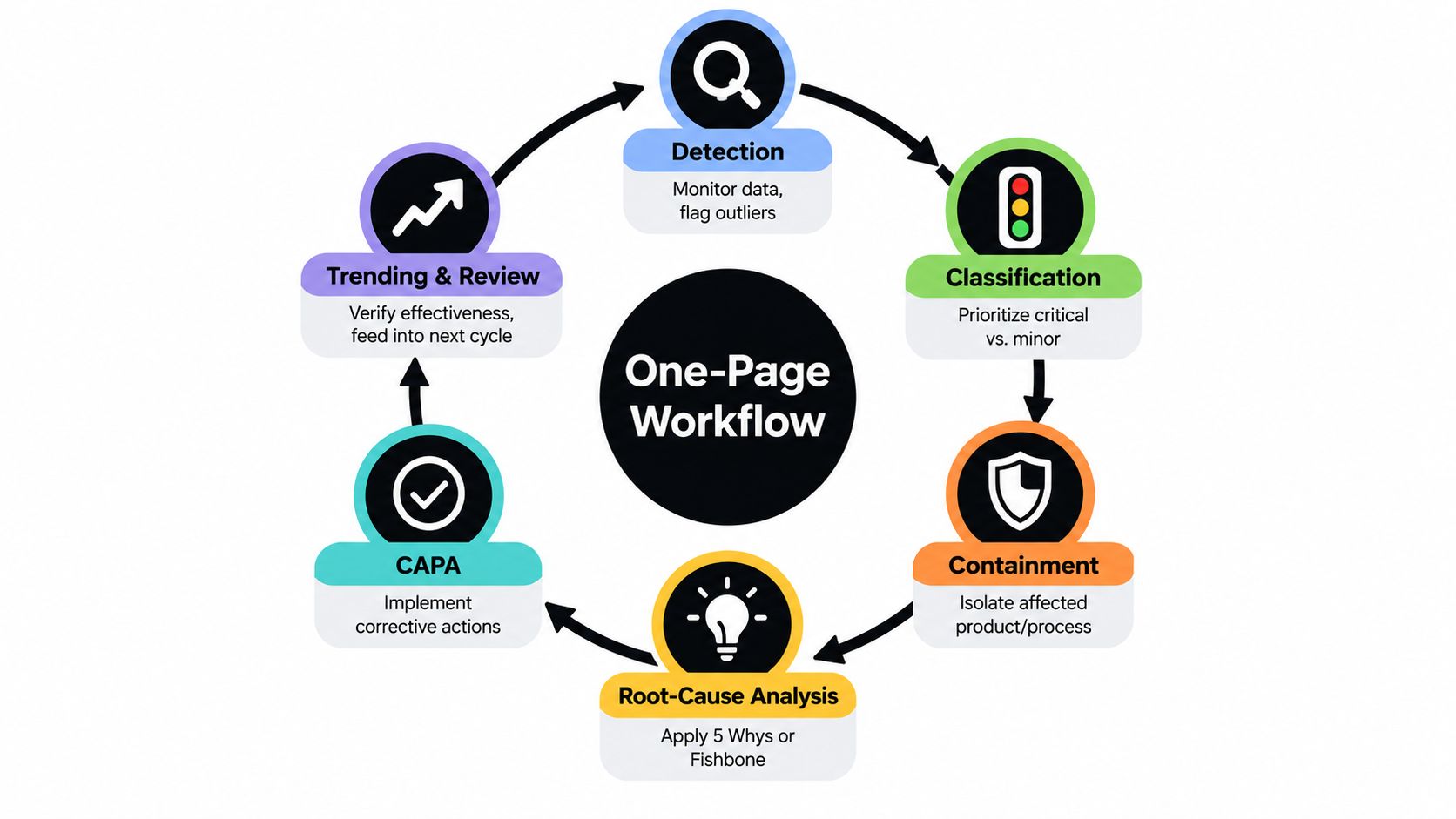
A one-page workflow keeps the investigation connected:
- Detection: Capture the event, time, location, people, product, equipment, and immediate observations.
- Classification: Assign an initial risk level and identify required escalation.
- Containment: Quarantine affected material, restrict equipment or systems, and preserve evidence.
- Root-cause analysis: Build the causal chain, test alternatives, and document uncertainty.
- CAPA: Assign actions that address the confirmed or most defensible cause.
- Trending and review: Check effectiveness and feed the result into broader quality-system learning.
A practical report template
A deviation investigation report should prompt the investigator to provide evidence, not fill space:
- Event description: What occurred, where, when, how it was detected, and which approved requirement was not met.
- Immediate actions: Who stopped, isolated, labeled, secured, or notified, with timestamps and status.
- Impact assessment: Which product, batch, sample, method, equipment, records, systems, suppliers, and released material may be in scope.
- Investigation evidence: Interviews, logbooks, audit trails, raw data, environmental records, calibration status, material records, and relevant historical trends.
- Root cause: Confirmed cause, probable cause with evidence, or undetermined cause, plus the rationale for excluding alternatives.
- CAPA: Specific action, accountable owner, resources, target date, dependencies, and change-control reference where applicable.
- Effectiveness check: Evidence required, review date, acceptance criteria, reviewer, and decision.
- Approval: Investigator, functional reviewers, QA approval, and any required quality or regulatory escalation.
Worksheets that keep analysis disciplined
The 5 Whys worksheet should provide one field for the problem statement, five linked “why” prompts, evidence for each answer, and a final check asking whether the last answer describes a controllable system condition. The fishbone worksheet should prompt review of Methods, Machines, Materials, Personnel, Environment, and Measurement, with a separate evidence field beside every proposed cause.
The investigator checklist should confirm:
- Timeline gates: Classification, containment, investigation start, interim updates, CAPA approval, and closure are recorded.
- Role assignments: QA, laboratory, operations, engineering, IT, regulatory affairs, and supplier contacts are included where relevant.
- Evidence custody: Samples, records, raw data, system logs, transfers, storage, and access history are traceable.
- Scope review: Related batches, products, equipment, methods, sites, and previous deviations were assessed.
- Approvals: The required functional and quality signatures are present before disposition or closure.
Common questions from laboratory teams
Who signs off a critical deviation?
The approved quality procedure should identify the required authority. Critical events typically require QA leadership review, with escalation to the quality head and other functions when product has been distributed, market impact is possible, or patient safety may be affected. The investigator shouldn't assume that the person who discovered the event has authority to approve disposition.
How long should investigation records be retained?
The retention period depends on the applicable regulation, product record requirements, quality-system procedure, contract, and market commitment. The report should reference the governing retention schedule rather than inventing a universal period. Electronic records need controlled access, retrievability, and preservation of relevant audit-trail information.
What triggers a recall rather than a retest?
A potential recall requires a documented assessment of product impact, distribution status, defect significance, and applicable regulatory and market requirements. Retesting doesn't erase the original result or justify release by itself. QA, with regulatory and medical or technical input as appropriate, should make the market decision from the complete evidence.
When should regulatory affairs be involved?
Regulatory affairs should join when the event may affect a filing commitment, approved process, specification, labeling, distributed product, reportable quality defect, or communication with a health authority. Early involvement is safer than discovering late in the investigation that a market notification or submission assessment was required.
How should suspected data-integrity issues be handled mid-investigation?
Preserve the original records and audit trails, restrict inappropriate access, document the concern without altering evidence, and escalate through the site's data-integrity procedure. The team should separate factual observations from assumptions, involve qualified quality and system specialists, and assess whether other records or users may be in scope.
A thorough deviation investigation leaves a clear trail from detection to learning. It doesn't merely explain a failed result or missing signature. It demonstrates that the laboratory can recognize risk, protect evidence, make a reasoned quality decision, and strengthen the system afterward.
Herbilabs supplies laboratory materials and documentation such as clear COAs for research workflows, so teams can include material identity, handling, and product-impact checks in their deviation controls. Visit Herbilabs to review its laboratory supply and documentation options for EU, UK, and USA operations.


