Private Label, White Label, Wholesale partnerships available - EU, USA and UK - Free shipping from €75
White Label Solutions for Life-Science Products
A mid-sized distributor in Germany may receive an attractive hospital inquiry: a private-label range of PCR master mixes, buffer solutions, and related laboratory consumables, all sold under the distributor's own brand. The manufacturer can produce the goods, but the distributor still has to answer practical questions about batch records, labeling, complaints, recalls, transport, and responsibility in every destination market.
That's the starting point for white label solutions in life sciences. Branding can create a market opportunity, but operational controls determine whether the opportunity remains profitable and defensible. A partner that treats white labeling as label replacement alone may create more exposure than value.
Table of Contents
- What White Label Solutions Mean for Life-Science Products
- Why Wholesalers and Resellers Choose White Label Partnerships
- Regulatory and Quality Considerations for RUO Reagents
- How to Select a Reliable White Label Vendor
- Implementation Roadmap from Agreement to First Shipment
- Pricing Logistics and Regional Compliance Strategies
- Hidden Costs and Common Misconceptions About White Labeling
What White Label Solutions Mean for Life-Science Products
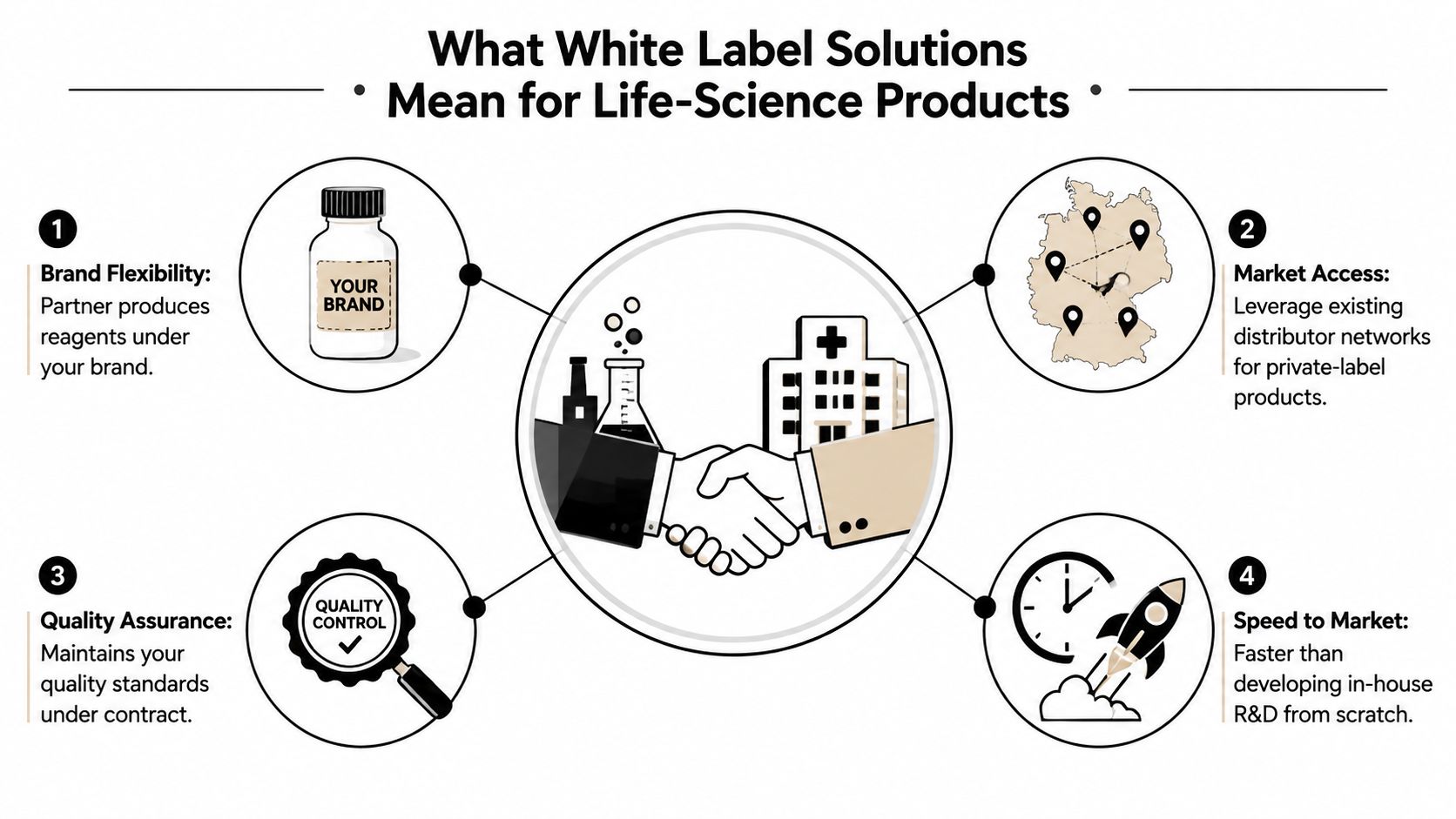
In life sciences, a white label solution usually involves a manufacturer producing a finished or semi-finished product that another company sells under its own brand. The product may be a Research Use Only reagent, sterile diluent, buffer, assay component, pipette consumable, or laboratory kit. The reseller typically controls the market-facing identity, packaging design, sales channel, and customer relationship.
The arrangement sits close to private labeling and contract manufacturing, but the terms shouldn't be treated as interchangeable. A white-label manufacturer commonly supplies an existing formulation or specification to multiple commercial partners, while a private-label program may include more substantial customization for one brand. Contract manufacturing can go further still, with the buyer commissioning a defined formulation, process, or production method.
The distinction matters because responsibility is divided, not eliminated. The manufacturer generally remains responsible for production controls, testing, formulation consistency, and the underlying Certificate of Analysis, or COA. The distributor assumes important obligations once it places the product under its own name, including correct labeling, market positioning, complaint handling, traceability, and coordination of any withdrawal or recall.
Practical rule: A distributor shouldn't approve artwork until the quality agreement defines who owns each document, decision, and corrective action.
White labeling therefore requires more than a logo file. A workable agreement should address lot-number continuity, specification changes, retained samples, stability evidence, deviation handling, release approval, and notification periods for raw-material or process changes. The manufacturer's technical file may support the product, but it doesn't automatically satisfy every destination market or every claim made by the distributor.
A distributor evaluating suppliers can also separate brand-management tools from laboratory controls. For example, PuppetVendors white label functionality illustrates how a branded customer-facing layer can be managed, but a life-science partnership still needs independent technical documentation and release procedures.
The commercial appeal is clear. A distributor can build a recognizable portfolio without investing in its own blending, filling, testing, and packaging infrastructure. It can also concentrate internal resources on customer support, regional sales, tender management, and demand planning. Product sourcing remains outsourced, but brand ownership and downstream accountability move closer to the distributor.
For practical supplier evaluation, a distributor may begin with a focused review of laboratory chemical suppliers and then request the documents that prove whether a proposed partner can support the intended markets.
Why Wholesalers and Resellers Choose White Label Partnerships
Wholesalers choose white label partnerships because the model can change the economics and positioning of a product category at the same time. A reseller that passes through a national brand often competes on availability and price. A distributor with its own branded reagent line can set specifications, package related products together, and develop a direct relationship with laboratories.
The broader private-label market demonstrates how mainstream this strategy has become. In the United States, private label represents close to 21% of consumer goods market volume and roughly US$236 billion in value, according to Grand View Research's white-label cosmetics market overview. Industry tracking also reports US$282.8 billion in U.S. private-label sales in 2025, with store brands growing at nearly three times the rate of national brands during that year, as reported in the same source. Those figures concern consumer goods, not laboratory products, but they show that brand-owned sourcing is no longer a marginal retail tactic.
For a laboratory distributor, the business case usually rests on five practical advantages:
- Margin control: Removing a third-party brand premium can create room for channel discounts, technical support, or a stronger contribution margin.
- Category differentiation: A branded range can distinguish otherwise similar products such as tubes, tips, buffers, and routine RUO reagents.
- Faster launch: An established formulation and production line can reach customers sooner than an internal research and development program.
- Volume consolidation: Consolidating several SKUs under one partner can strengthen negotiations around production planning and supply continuity.
- Portfolio coherence: One label across reagents, diluents, and consumables gives sales teams a simpler proposition for laboratories and procurement departments.
A tender may also favor a proprietary portfolio, particularly where a hospital group wants consistent documentation, packaging, and account management. White labeling won't guarantee tender success, but it can give the distributor control over the commercial presentation and supporting documentation.
| Benefit | Typical Impact | Example Category |
|---|---|---|
| Margin control | More flexibility in pricing and channel discounts | Routine buffers |
| Differentiation | A recognizable alternative in a crowded category | Pipette tips |
| Faster launch | Less internal development work | RUO master mixes |
| Volume leverage | Better coordination across related SKUs | Sterile diluents |
| Portfolio coherence | One commercial identity for procurement teams | Reagents and consumables |
The operational layer still determines whether those benefits survive. A fulfillment partner that supports receiving checks, SKU verification, branded packaging audits, and order-accuracy dashboards can help protect the customer experience after production. Guidance on that process is available through AUSFF's white label solution, which is useful when comparing branding support with the wider demands of fulfillment.
Regulatory and Quality Considerations for RUO Reagents
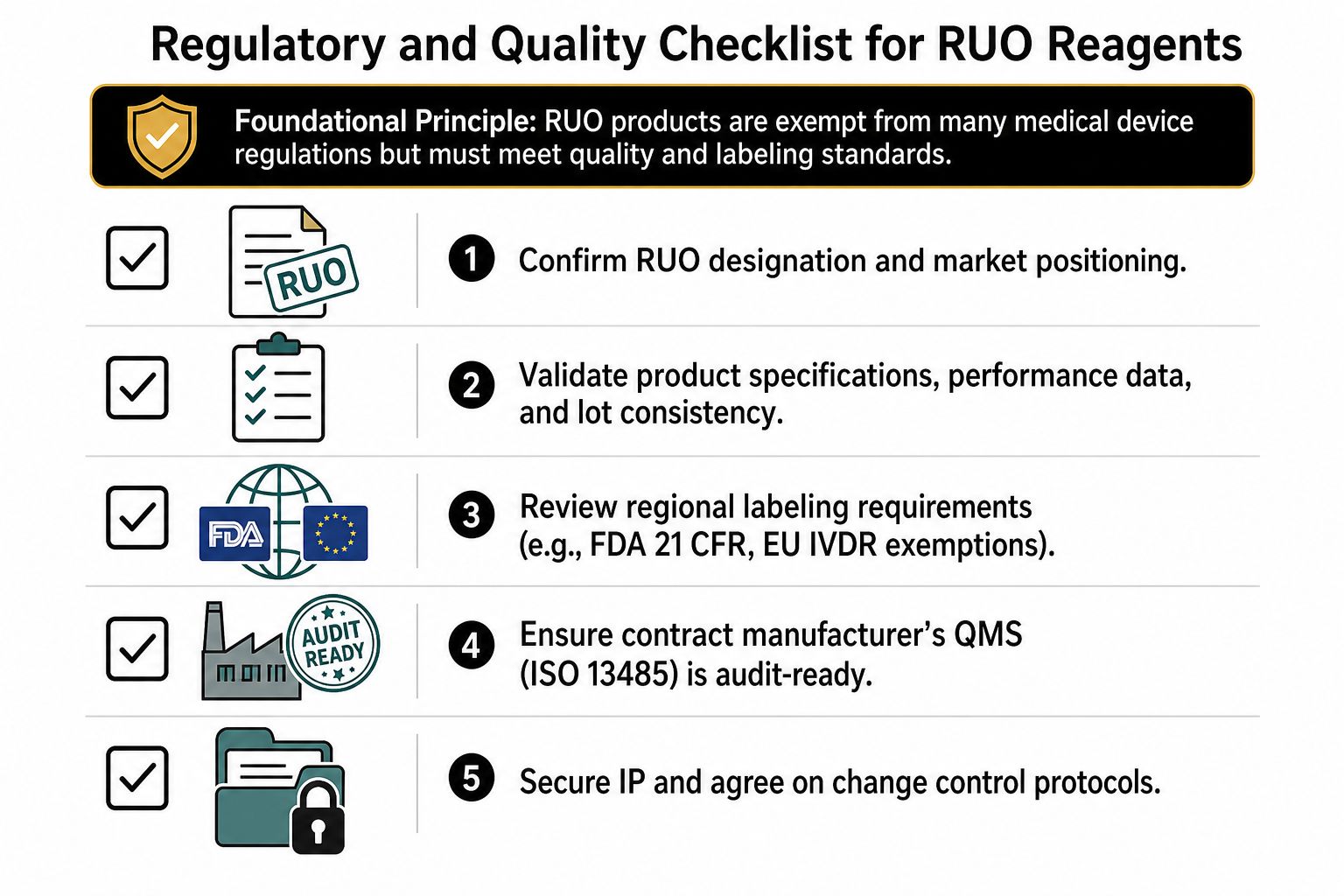
Research Use Only status is a market-positioning and labeling discipline, not a license to ignore quality systems. An RUO reagent isn't marketed for clinical diagnosis, and its label must clearly state “For Research Use Only. Not for use in diagnostic procedures.” The distributor must also ensure that websites, brochures, tender documents, technical support, and sales conversations don't introduce diagnostic claims that conflict with the label.
The documentation chain should be agreed before the first production run. A quality agreement should identify which party supplies, reviews, approves, and retains:
- COAs: Batch-specific results for identity, assay, purity, microbiology, or other agreed specifications.
- Safety Data Sheets: Current hazard and handling information for the applicable destination market.
- Batch records: Evidence of manufacturing, filling, packaging, and release activities.
- Stability data: Support for storage conditions, expiry statements, and shelf-life decisions.
- Deviation and change records: Documentation for out-of-specification events, raw-material changes, and process amendments.
Validated cleaning between production runs, in-house stability testing under ICH conditions, and a COA for every batch help reduce cross-contamination risk and make shelf-life statements more defensible, as described in this private-label manufacturing guide. For lab-adjacent products, the distributor should require documented batch traceability together with microbiological and assay verification before relabeling.
Regional review cannot be delegated blindly
A manufacturer's file may not cover every market where the distributor sells. EU products may require review under the CLP framework, while UK requirements can diverge through the post-Brexit chemical regime. U.S. workplace hazard communication generally requires alignment with OSHA HazCom 2012, and Brazil may require an ANVISA assessment depending on the product, claims, and intended use.
Packaging also needs a technical review. Hazardous reagents may require an applicable UN transport classification, suitable closures, and correct hazard communication. Multi-market distribution can require language controls, translated safety information, and separate artwork versions rather than one universal label.
A distributor should preserve lot-number continuity from manufacturer to warehouse and customer. Complaint records must identify the affected lot, shipment path, customer, storage conditions, and action taken. Recall readiness depends on that chain being searchable, not on a promise that the manufacturer can investigate later.
For a concise explanation of the intended product boundary, distributors can review the Research Use Only definition. The essential principle remains simple: outsourcing production doesn't outsource accountability.
How to Select a Reliable White Label Vendor
A vendor that offers custom labels and attractive unit pricing hasn't necessarily offered a reliable white label solution. The meaningful test is whether the supplier can demonstrate controlled production, transparent release data, and disciplined communication when something changes.
The first review should cover the supplier's quality system. ISO 13485 or ISO 9001 certification, where relevant to the product and intended use, can provide useful evidence of formal controls, but the certificate shouldn't replace an audit of actual procedures. The buyer should request a sample COA, a redacted batch record, a traceability example, and the process used to handle deviations and complaints.
A reliable vendor should also explain how it manages storage and dispatch. Temperature-sensitive reagents need defined storage limits, monitoring records, excursion procedures, and a documented handoff to the carrier. If the vendor can't explain what happens after a temperature alarm, the commercial launch is premature.
| Evaluation Criterion | Superficial Offer | Robust Partnership |
|---|---|---|
| Quality certification | Certificate shown without scope discussion | Certification scope matched to products and processes |
| Batch traceability | Lot number printed on the label | Lot continuity linked to production, release, and shipments |
| COA access | Branded summary only | Raw batch-specific data available for review |
| Stability support | Generic expiry statement | Storage, stability, and change evidence documented |
| Regulatory support | One label offered for all markets | Market-specific dossier and artwork review |
| Change control | Informal email notice | Defined notification, assessment, and approval workflow |
| Complaints | Supplier handles issues privately | Shared SOP with escalation and recall responsibilities |
Questions that expose weak partnerships
The most useful questions are operational rather than promotional:
- Can the vendor provide batch-specific COAs before shipment release?
- How are custom lot numbers assigned and reconciled with the manufacturer's records?
- What notice does the distributor receive before a formulation, supplier, process, or packaging change?
- Which party owns stability studies and approves revised expiry statements?
- How are temperature excursions documented and communicated?
- Can the vendor support separate artwork for EU, UK, U.S., and LATAM destinations?
- How are complaints investigated when the distributor receives the first report?
A supplier-selection checklist such as Novocargo's consejos para seleccionar proveedor can help structure the commercial review, but life-science buyers need to add technical and regulatory questions specific to their products.
A serious partner won't resist reasonable document requests. It will clarify what can be shared, protect confidential information, and still provide enough evidence for the distributor to approve the product responsibly.
Implementation Roadmap from Agreement to First Shipment
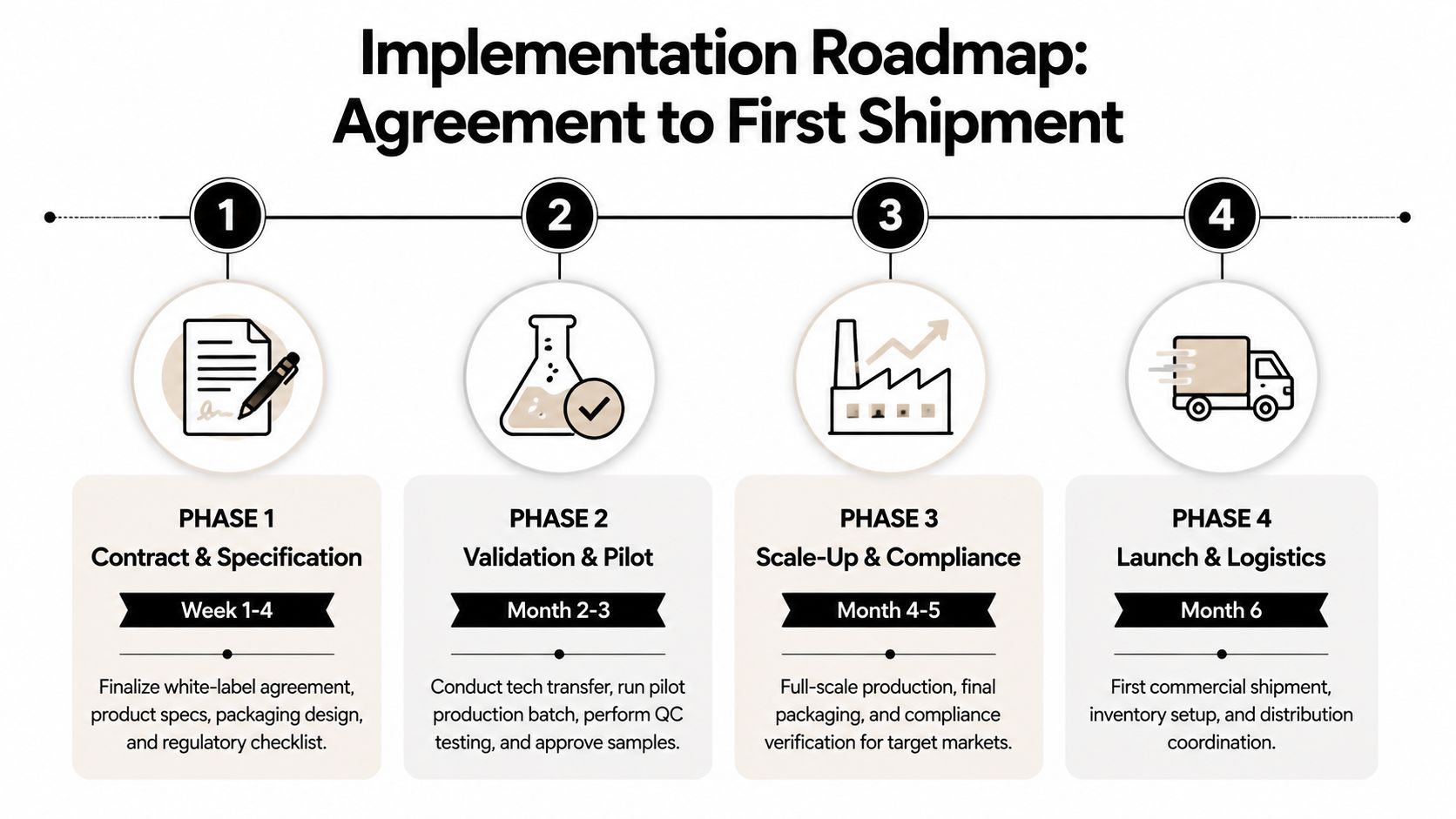
A white-label launch succeeds when it follows a gated project plan, with each phase documented before the next begins. The commercial agreement should define the product specification, artwork ownership, release authority, minimum order rules, change notifications, complaint handling, and approved markets.
The initial planning window commonly spans 12 to 20 weeks, depending on formulation, packaging, documentation, and regulatory readiness. Treat this range as a planning reference rather than a promise. Artwork revisions, customs questions, or failed testing can extend the schedule, so build decision points and owners into the project plan.
Four practical gates
Agreement and specification: Confirm the formula or product specification, storage conditions, packaging format, label claims, COA requirements, and target markets. Sign the quality agreement before ordering production materials.
Artwork and dossier alignment: Review every label element, including RUO wording, lot and expiry fields, storage statements, hazard information, language versions, and manufacturer or distributor details. Regulatory reviewers should approve the final files, not only the marketing team.
Pilot and release review: Run a pilot batch or production trial where appropriate. Inspect samples, review the COA, verify packaging, confirm lot-number logic, and document acceptance criteria before authorizing scale-up.
Manufacturing and shipment: Follow the agreed release process for full production. Incoming inspection should verify quantity, packaging integrity, label accuracy, lot identity, expiry, storage condition, and shipping records before inventory is offered for sale.
Minimum order quantities need early review as well. RUO reagent programs may set MOQs in the 500 to 5,000 units per SKU range, as specified in the project brief. Actual requirements depend on batch size, filling format, shelf life, and packaging procurement. A low MOQ can raise unit cost, while a high MOQ can tie up cash in inventory before demand is proven.
Release discipline matters: No shipment should leave the facility merely because the cartons are ready. The batch needs document approval, physical inspection, and a clear disposition decision.
Artwork revision cycles often delay launch approval. Customs classification disputes can hold goods after production, and an unplanned vendor change may invalidate approved documentation. Assign an owner to each risk, define the required decision, and record approvals so the schedule does not depend on informal email exchanges.
Pricing Logistics and Regional Compliance Strategies
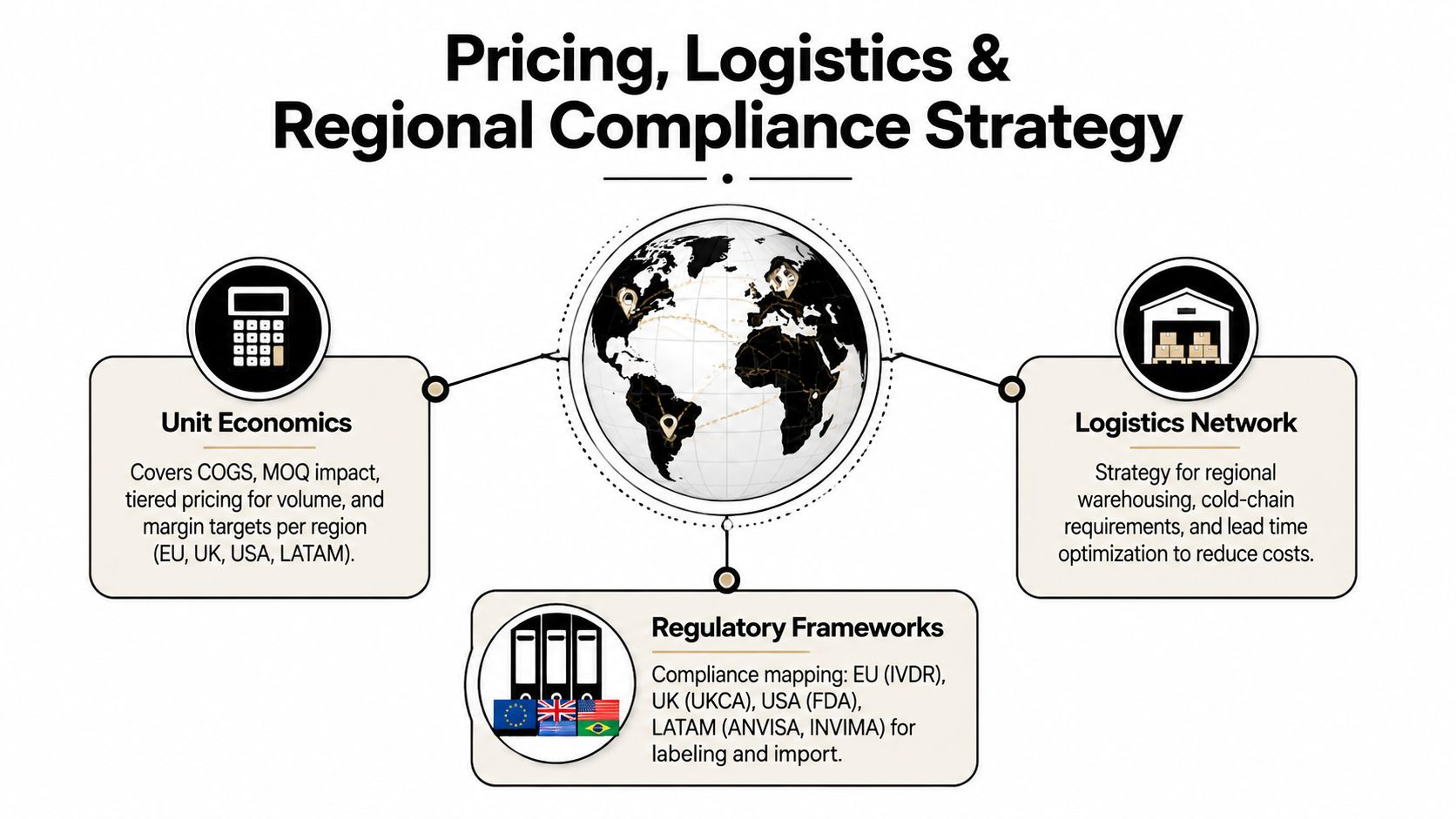
Regional scaling fails when distributors calculate only the ex-works product price. A credible model starts with landed cost, then adds packaging, quality review, storage, temperature-controlled transport, insurance, duties, brokerage, customs handling, returns, and customer support. The final selling price should reflect the cost of keeping the product compliant and available, not just the manufacturer's invoice.
Cost-plus pricing is easy to administer, but it can hide regional differences. Tiered volume pricing may reward larger commitments, yet it can also create excess stock if demand varies by market. A distributor should model each SKU by destination and compare the result with the price customers will accept.
Build one regional matrix
The matrix should connect commercial assumptions with compliance actions:
- EU: Review the applicable IVDR position where product claims or intended use could move beyond RUO, and assess labeling and chemical obligations.
- UK: Check post-Brexit requirements separately rather than assuming EU documentation transfers without amendment.
- USA: Confirm the product's intended use, labeling, import documentation, and any relevant FDA obligations before accepting orders.
- LATAM: Review country-specific importer, labeling, customs, and product requirements. Brazil may involve ANVISA considerations, while Mexico may involve COFEPRIS pathways depending on the product and claims.
Temperature-sensitive products may require GDP-aligned transport controls, qualified packaging, regional warehousing, or a documented response to delivery delays. A bonded warehouse can support customs planning in some arrangements, but it won't resolve an incorrect classification or missing document.
Customs planning belongs in the launch file, not at the end of the shipment process. A distributor can use customs clearance procedures as a starting point for reviewing documentation flow, but the final classification and import obligations should be confirmed for each product and destination.
The pricing model also needs a governance layer. Recent white-label market coverage points toward usage-based billing, modular add-ons, hybrid pricing, and regulatory automation, particularly in software and fintech, as discussed in white-label fintech solutions in 2026. The same commercial lesson applies to laboratory distribution: buyers should ask which services are included, which trigger additional charges, and who absorbs compliance work when a market rule changes.
Hidden Costs and Common Misconceptions About White Labeling
Distributors often assume white labeling eliminates upfront development costs. In practice, responsibility moves downstream. The distributor still funds the systems required to sell, support, document, and control the product.
Several expenses emerge after the agreement is signed:
- Formulation changes: A raw-material supplier change may require review, testing, revised documentation, or reformulation charges.
- Label revisions: A new GHS or CLP classification can require artwork changes, relabeling, disposal, and rework.
- Batch failure: Replacement product, investigation time, expedited freight, customer credits, and lost trust can exceed the original purchase cost.
- Inventory transition: Legacy branded stock and new white-label stock may need separate storage during a label change.
- Support infrastructure: Sales teams require product training. Quality teams need complaint, recall, and document-control procedures.
Private label does not remove regulatory responsibility. An entity placing a product on the market under its own name may assume obligations linked to its presentation, labeling, chemical information, and market conduct. The manufacturer's regulatory file supports the distributor, but it does not automatically cover every claim, language, importer arrangement, or jurisdiction. EU, UK, USA, and LATAM launches therefore require a documented review of who approves labels, maintains batch records, handles complaints, and communicates with authorities or customers.
MOQs are not always negotiable downward. Niche RUO reagents with short shelf lives can create waste risk for the manufacturer, particularly where custom packaging or dedicated labeling is involved. A smaller first order may be available, but it can carry a higher unit cost, limited customization, or a less favorable production slot.
Test the economics with a break-even model covering unit cost, landed cost, setup charges, compliance work, inventory exposure, support time, and the cost of failed or obsolete stock. The brief identifies 12 to 18 months as a realistic break-even timeframe for some mid-volume reagent lines. Treat that range as a planning reference, not a guarantee, and calculate the threshold for each product and region.
Recent packaging obligations create another planning concern. Coverage of the EU packaging framework cites 12 August 2026 as the nearest PPWR deadline, making packaging and disclosure a strategic issue alongside branding, as discussed in white-labeling options in the 2026 software market.
Approve a white-label program only after answering three questions: Who controls the batch, who carries the obligation, and who pays when the assumption fails?
Herbilabs supports wholesale and distribution partnerships for RUO laboratory supplies, including private-label and white-label options for bacteriostatic water, bac water, and reconstitution solutions with batch documentation and defined compliance terms. Visit Herbilabs to discuss product specifications, regional distribution requirements, and a practical path from supplier review to first shipment.


