Private Label, White Label, Wholesale partnerships available - EU, USA and UK - Free shipping from €75
How to Choose Laboratory Chemical Suppliers: A 2026 Guide
A procurement lead approves a laboratory chemical supplier because the quote looks attractive and the catalog appears complete. The first delivery arrives on time, so the vendor gets added to the approved list. Months later, an auditor asks for the batch-specific Certificate of Analysis, the current jurisdiction-specific Safety Data Sheet, and proof that the lot can be traced to its manufacturing site. The supplier sends a generic specification sheet and an outdated document. The “saving” has now become a compliance problem, a replacement order, and a delayed workflow.
That's why supplier selection should be treated like an instrument qualification exercise, not a routine buying decision. Laboratory chemical suppliers serve a market that independent estimates place at USD 22.87 billion in 2024, projected to reach more than USD 39.3 billion by 2033, with a 6.2% CAGR from 2025 to 2033 according to Business Research Insights' laboratory chemicals market analysis. The supplier base now supports academic research, pharmaceutical development, clinical diagnostics, industrial quality control, and life-science R&D.
The right question isn't “Who sells this chemical cheapest?” It's “Who can prove control of the material from synthesis or sourcing through delivery, and what happens if that supply fails?” Three pillars answer it: documentation rigor, country-of-origin and regulatory risk, and qualified backup supply.
Table of Contents
- The Supplier Decision That Can Make or Break Your Lab
- Manufacturers vs Distributors vs Hybrid Suppliers
- Documentation You Should Demand Before Signing
- Purity Claims and Batch Testing Explained
- Logistics Cold Chains and Fulfillment Standards
- Pricing Wholesale Terms and Hidden Costs
- Partnership Models for Wholesalers and Resellers
- Qualification Checklist and Negotiation Playbook
The Supplier Decision That Can Make or Break Your Lab
The most expensive supplier is often the one that looked cheapest on the quotation.
A laboratory chemical supplier may offer a sharply discounted unit price, but the commercial advantage disappears if the shipment arrives with mismatched labeling, incomplete hazard documentation, or a COA that cannot be connected to the actual lot. In regulated work, the lab may need to quarantine the material, repeat testing, investigate the deviation, and explain the gap to an auditor. The invoice is only the first cost.
That scenario is especially serious for EU, UK, and USA buyers. A distributor may issue the invoice while an upstream manufacturer controls the synthesis, classification, registration position, and release testing. If procurement never identifies who owns each responsibility, the lab inherits uncertainty without realizing it.
Procurement rule: A supplier isn't qualified until the lab can trace the product, the paperwork, and the accountable legal entity.
The commercial environment makes this exercise more important. Laboratory chemical suppliers have evolved from catalog sellers into global partners serving recurring demand for reagents, solvents, standards, and consumables. The historical pattern is clear. Fisher Scientific was founded in Pittsburgh in 1902 to provide scientific tools to factories, while its original supplier, Eimer & Amend, dates to 1851. Fisher later established a chemical manufacturing facility in Fair Lawn, New Jersey, in 1955, showing how the sector moved from importing and distribution toward vertical integration, as documented in Fisher Scientific's company history.
A sound qualification file should therefore answer three questions before the first purchase order:
- Can the supplier prove quality? Every critical lot needs traceability and relevant analytical evidence.
- Can the supplier explain regulatory responsibility? The buyer needs to know who handles registration, classification, labeling, export controls, and country-of-origin exposure.
- Can the supplier recover when the primary source fails? A second source is useful only if it has been qualified for the intended application.
Unit price still matters. It belongs near the end of the decision, after the buyer understands the cost of documentation gaps, nonconforming material, customs delays, stockouts, and emergency replacement.
Manufacturers vs Distributors vs Hybrid Suppliers
The supplier model determines how much control the buyer can expect and how much upstream risk remains hidden.
A manufacturer owns or directly controls synthesis, grade definition, production records, and the master quality documentation. That structure usually gives the buyer the clearest path for audits and technical questions. The trade-off is commercial: manufacturers may favor larger order quantities, planned production, and longer lead times.
A distributor buys from one or more manufacturers and adds local inventory, catalog breadth, order consolidation, and customer service. Distributors can be highly effective, particularly when a laboratory needs mixed products quickly. They may not, however, control upstream synthesis, and their technical team may depend on the original manufacturer for batch investigations or revised documentation.
A hybrid supplier operates some combination of manufacturing, repackaging, compounding, dilution, or private-label production. This model can give smaller buyers access to custom formats and responsive fulfillment while retaining more operational control than a pure distributor. It also creates a specific audit question: which activities happen in-house, and which remain outsourced?
Manufacturer vs Distributor vs Hybrid Supplier: Who Controls What
| Control Point | Manufacturer | Distributor | Hybrid Supplier |
|---|---|---|---|
| Synthesis or primary production | Usually controlled directly | Controlled by upstream manufacturer | Partly controlled, depending on product |
| Grade definition | Sets the specification | Passes through the manufacturer's specification | May set or adapt specifications for its service |
| Master COA | Issues or controls the original record | Obtains and supplies upstream documentation | May combine upstream results with in-house release data |
| Repackaging | May occur at the production site | Commonly performed or arranged by the distributor | Often performed in an owned or controlled facility |
| SDS authorship | Responsible for product classification and source data | May provide the manufacturer's SDS or maintain a localized version | May require a new SDS review when formulation or packaging changes |
| Custom dilution or compounding | Possible, often subject to production planning | Usually limited unless outsourced | A central capability for suitable products |
| Failure investigation | Direct access to manufacturing records | Escalation through the upstream source | Shared responsibility between internal and upstream operations |
| Best commercial fit | High-volume or technically critical purchases | Broad catalogs and local availability | Custom formats, private label, and flexible wholesale supply |
For EU and UK procurement, the invoice name shouldn't be mistaken for the regulatory manufacturer. REACH or UK-REACH responsibilities can sit with the manufacturer, importer, or another designated entity, depending on the supply arrangement and jurisdiction. The buyer should request the relevant registration information and identify the party legally responsible for the material placed on the market.
The same principle applies in the USA. A distributor can be the commercial contact without owning the underlying production controls. The contract should state who supplies revisions, handles complaints, retains records, and pays for a confirmed nonconformance.
Documentation You Should Demand Before Signing
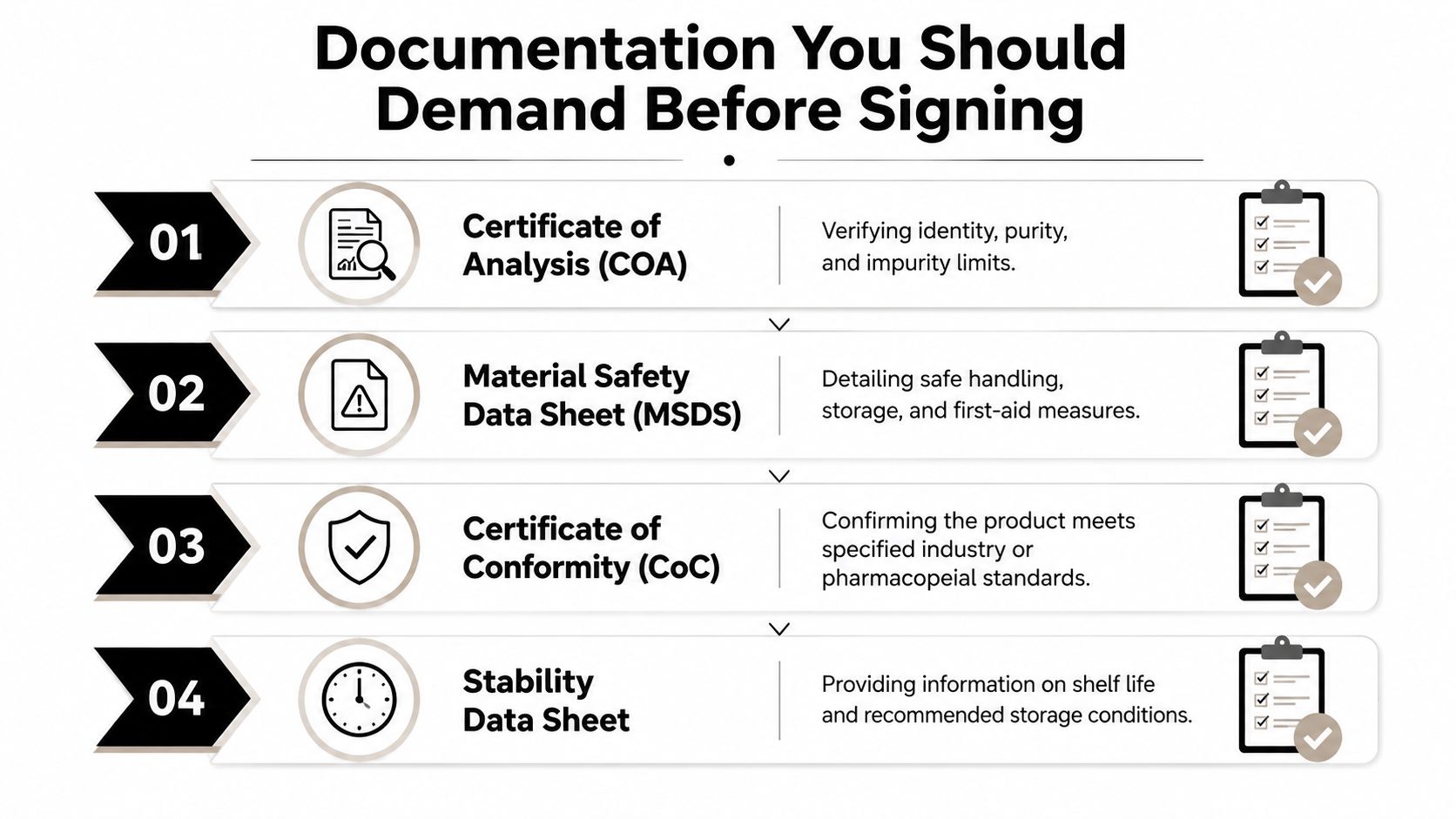
Documentation should function as a series of decision gates. A supplier that delays basic records during qualification will rarely become more transparent after the contract is signed.
The first gate is the batch-specific Certificate of Analysis. A generic product specification describes what the product is supposed to meet. A proper COA identifies the actual lot and reports relevant results, such as identity, chromatographic purity, water content by Karl Fischer, residual solvents by GC, method references, acceptance limits, and traceability. For reference materials, buyers should also examine uncertainty statements and the producer's competence against ISO 17034, with testing performed through systems aligned to ISO/IEC 17025 where applicable. The documentation benchmark is outlined in this technical guide to COA and reference-material quality.
The second gate is the Safety Data Sheet. It should match the product, formulation, packaging context, and buyer's jurisdiction. EU and UK teams should verify the applicable REACH or UK-REACH information. USA buyers should check that hazard communication and labeling support the intended distribution route.
The first qualification call
A procurement team should ask the supplier to provide the following before commercial approval:
- COA ownership: Who issued the COA, and does the document belong to the shipped lot rather than a product family?
- SDS currency: Is the SDS less than 24 months old, and does it reflect the buyer's country and intended use?
- Lot traceability: Can the lot number be traced to a manufacturing site, release decision, and shipment record?
- Reference-standard competence: If the product is a certified reference material, does the producer operate against ISO 17034 requirements?
- Testing competence: Which laboratory performed the analysis, and can its quality system be linked to ISO/IEC 17025 expectations?
- Use designation: Is the material labeled RUO, IVD, or for another defined application, and does that designation match the workflow?
- Change control: How will the supplier notify buyers about formulation, site, packaging, or specification changes?
- Complaint handling: Who owns the investigation when a lot fails incoming testing?
A useful internal process is to store the documents against the supplier, product code, lot, and jurisdiction. Teams that need a more formal standard can compare their process with these laboratory documentation requirements. The supplier should pass documentation review before price negotiations become serious. Otherwise, procurement risks negotiating a discount on a product that cannot be released for use.
Purity Claims and Batch Testing Explained
Purity printed on a label is a claim. A lot-specific analytical record turns it into evidence.
Buyers should separate grade, assay, and intended application. ACS reagent grade may suit controlled routine laboratory work, while HPLC grade is selected for chromatographic performance. USP/NF alignment can matter where a pharmacopeial monograph governs the application. Reference standards require stronger traceability, uncertainty information, and documented characterization than an ordinary reagent.
The phrase “99.9% pure” should trigger a question, not an approval. The buyer needs to know which method produced the result, what the sample matrix was, which impurities were evaluated, what the detection limits were, and whether the result falls inside an approved specification. A strong COA makes those relationships visible.
Reading a COA like a release document
The assay result is only one line. An analytical review should also check:
- Identity: Was identity confirmed with an appropriate technique, such as spectroscopy or chromatography?
- Impurity profile: Does the COA list relevant impurities and acceptance limits, or only a headline assay?
- Method reference: Does it identify HPLC, GC, ICP-MS, Karl Fischer, or another method where relevant?
- Lot match: Does the document's lot number match the container and shipping paperwork?
- Release status: Is the lot approved by an identifiable quality function?
- Retention practice: Can the supplier retain samples for investigation and provide them when a dispute requires independent testing?
Reference-grade supply chains should connect the material to an authoritative reference system, such as an applicable NIST or EUROMET certificate. Reagent-grade supply chains can be entirely appropriate for fit-for-purpose routine work, but they shouldn't be represented as certified reference material.
| Grade | Typical Purity | Documentation Provided | Best-Fit Application |
|---|---|---|---|
| ACS reagent grade | Defined by the applicable specification | Product specification and lot COA should be requested | General analytical and laboratory procedures |
| HPLC grade | Controlled for chromatographic suitability | Lot COA with relevant chromatographic and impurity information | HPLC and other chromatography workflows |
| USP/NF | Tied to the applicable pharmacopeial standard | Conformity evidence and lot documentation | Work governed by USP or NF requirements |
| Reference standard | Characterized against a reference system | Certificate, uncertainty information, methods, and traceability | Quantitative analysis, calibration, and regulated assays |
Before purchase, the buyer should request the COA, then cross-check the lot against the received shipment. The supplier should also explain whether aged inventory is retested and how expiry or retest dates are assigned. For customs and import workflows, teams should separately avoid customs compliance errors by confirming product classification and shipment data before dispatch.
A laboratory's incoming-testing procedure should define what happens when the COA and test result disagree. The supplier's quality-control approach can be assessed through this quality control testing resource. The governing rule remains simple: if the supplier can't show the method, the matrix, and the acceptance criteria, the purity claim is decoration.
Logistics Cold Chains and Fulfillment Standards
A valid COA can't restore a material that was degraded during transport.
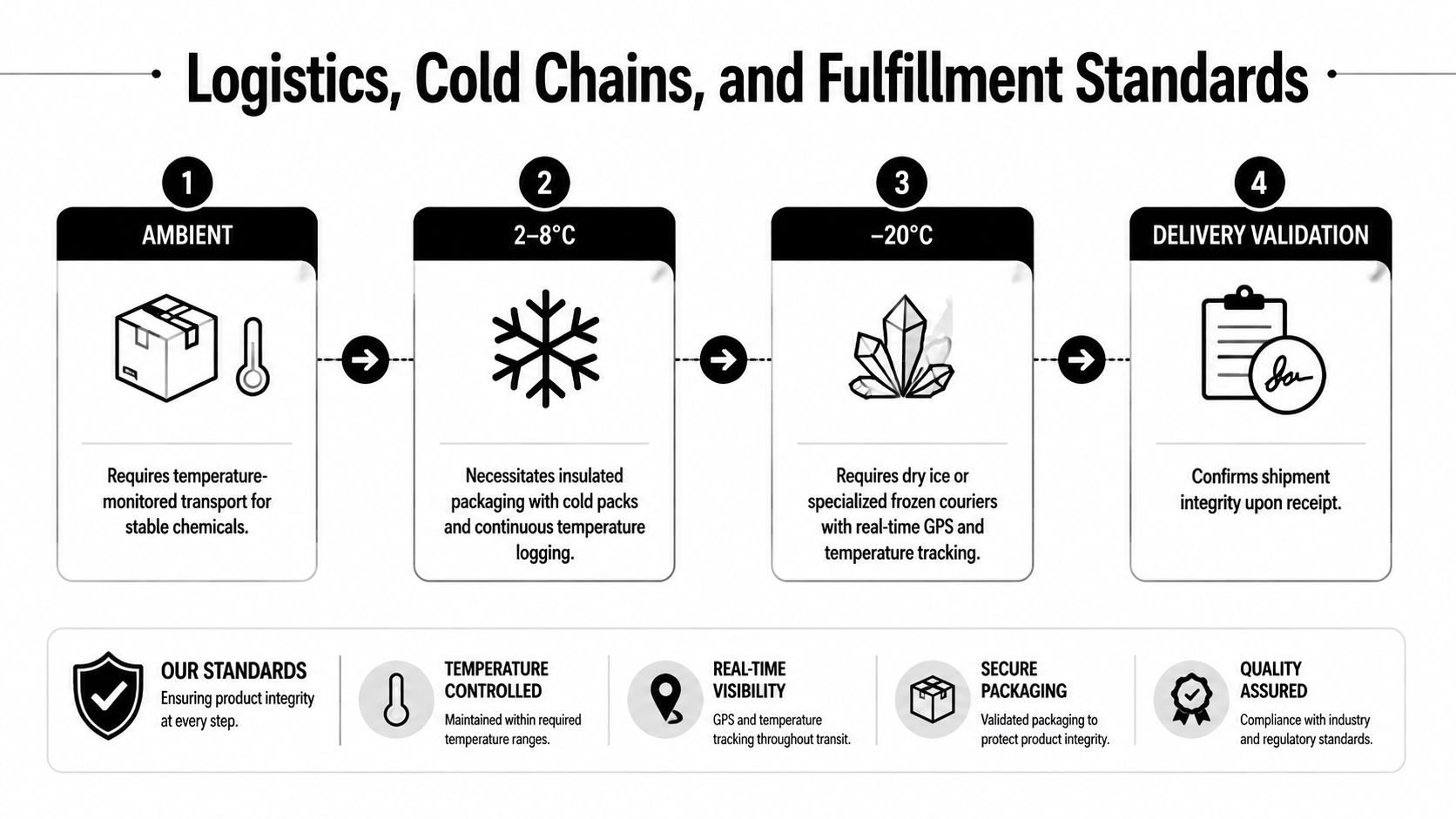
The supplier's logistics process should distinguish between ambient, 2–8°C, and –20°C requirements. Each condition calls for appropriate packaging, handling, monitoring, and receipt checks. Original sealed containers, recommended temperatures, humidity controls, light protection, and container compatibility all affect chemical integrity. Public health training materials emphasize contamination prevention and control of storage, expiry, inventory, and distribution conditions in WHO quality-control training guidance.
The operational checks that matter
For temperature-sensitive materials, the supplier should explain packaging validation, gel-pack configuration, dry-ice replenishment windows, temperature data loggers, and the procedure for reviewing excursions. For ambient chemicals, monitoring may still be necessary where heat, freezing, humidity, or light can affect stability.
International shipments add another layer. Hazardous materials require suitable dangerous-goods classification and carrier handling. Controlled precursors may involve export licensing and restrictions under relevant EU, UK, or USA regimes. Incoterms also transfer responsibility at different points. DDP generally places more delivery responsibility with the seller, while DAP and EXW can leave the buyer carrying more of the transport, import, or collection burden.
Delivery test: The supplier should define what happens when a shipment arrives damaged, delayed, warm, short-dated, or with a broken seal.
The qualification file should include dispatch cutoffs, service-level commitments, customs-broker arrangements, and a receiving SOP. It should also specify whether the buyer must photograph packaging, record logger results, or quarantine the shipment before acceptance. A supplier that can't document its process for a compromised delivery isn't managing cold-chain risk. It's transferring the decision to the receiving laboratory.
Teams assessing visibility across orders, lots, and delivery events can review this supply-chain visibility resource.
A short demonstration is often more useful than a sales presentation. Ask the supplier to show a representative packing record, temperature-monitoring report, dispatch notification, and nonconformance workflow. The test should cover the actual destination country and product category, not an idealized domestic shipment.
Pricing Wholesale Terms and Hidden Costs
Procurement should negotiate landed cost, not the unit price printed on a quotation.
The landed figure includes freight, dangerous-goods surcharges, customs brokerage, duties where applicable, insurance, temperature packaging, receiving labor, testing, disposal, and the cost of working capital. A low price can also create dead stock when the minimum order quantity exceeds actual consumption. Short-dated inventory turns an apparent volume discount into a disposal decision.
Payment terms deserve the same attention. Prepayment can strain cash flow, while extended terms may be available only after credit review or a trading history. Framework agreements can stabilize pricing and allocation, but they should include service commitments, change notification, and an exit route if performance deteriorates. Consignment stock can reduce inventory ownership, although the contract must define expiry responsibility, storage conditions, count accuracy, and return rights.
| Cost Component | Visible on Quote? | Typical Range / Note | Negotiable? |
|---|---|---|---|
| Unit price | Usually visible | Depends on grade, pack size, volume, and source | Often |
| Minimum order quantity | Usually visible | May create excess or short-dated stock | Often |
| Hazardous-goods freight | Sometimes separate | Can materially alter landed cost | Sometimes |
| COA retrieval or document fees | Often hidden | Confirm before the first order | Usually |
| SDS revision or custom labeling | Often hidden | May apply to private-label or localized supply | Usually |
| Split-case charges | Sometimes hidden | Relevant to mixed or low-volume orders | Often |
| Restocking penalties | Contract-dependent | Review before accepting returns terms | Yes |
| Disruption cost | Not visible | Includes delay, replacement, and investigation work | Reduce through safeguards |
The commercial review should model at least the normal order, an urgent order, a rejected lot, a customs delay, and a supplier failure. It should also clarify whether the supplier offers price holds, volume tiers, allocation priority, or rebates tied to actual consumption rather than optimistic forecasts.
Wholesale buyers often need adjacent operational equipment as well. A team evaluating labeling, marking, or production infrastructure may find a separate etching equipment buying guide useful when comparing the total setup cost around a fulfillment operation.
A supplier that is marginally cheaper but creates one major quality or delivery event can erase the apparent saving. The negotiation should therefore target measurable obligations: documentation included, packaging included, response times, replacement terms, and transparent escalation. The invoice is a data point, not the decision.
Partnership Models for Wholesalers and Resellers
Commercial structure should match the buyer's inventory control, regulatory burden, and sales model. A startup reseller shouldn't accept manufacturer-style obligations without manufacturer-level access to records, while a high-volume OEM shouldn't rely on a catalog intermediary that can't reserve supply.
Partnership models at a glance
| Model | Inventory Control | Margin Potential | Typical MOQ | Best-Fit Buyer |
|---|---|---|---|---|
| Direct manufacturer agreement | High visibility into production and allocation | Can support strong economics at scale | Usually higher | High-volume OEM or established procurement program |
| Authorized distribution | Distributor controls local stock and order handling | Moderate, with catalog breadth and service value | Often more flexible | Mid-tier reseller or regional wholesaler |
| Private label or relabeling | Brand owner controls market presentation, supplier controls agreed production steps | Potentially attractive for differentiated catalog brands | Product and packaging dependent | Niche brand with compliance resources |
| Reseller consignment | Supplier retains ownership until sale, subject to contract | Can reduce capital tied up in stock | Negotiated | Startup or testing-demand reseller |
Direct manufacturer agreements make sense when volume justifies production planning, technical review, and territory discussions. The contract should cover exclusivity, allocation, audits, change control, minimum forecasts, and what happens when the buyer misses a forecast.
Authorized distribution is more practical when the reseller needs a broad catalog, local availability, and mixed-order fulfillment. The distributor should still disclose the original manufacturer, approved source, lot documentation route, and substitution rules. “Equivalent product” shouldn't be accepted without technical approval.
Private label can work well for standardized solvents, buffers, sterile diluents, and other products where the formulation, packaging, label review, and intended-use boundaries are clear. It becomes more difficult for controlled substances, custom synthesis, or products requiring specialist regulatory interpretation. In those cases, brand ownership doesn't eliminate supply-chain accountability.
Hybrid suppliers can help smaller buyers move from occasional resale into structured wholesale terms. A buyer may start with branded inventory, qualify demand, then add approved private-label formats without rebuilding the entire sourcing program. The supplier still needs to define which records belong to the brand owner and which remain under the manufacturing quality system.
The decision rule is direct: choose the model that fits SKU count, regulatory exposure, inventory turn, and technical support needs. Margin is meaningless if the buyer can't release, label, store, or replace the product lawfully.
Qualification Checklist and Negotiation Playbook
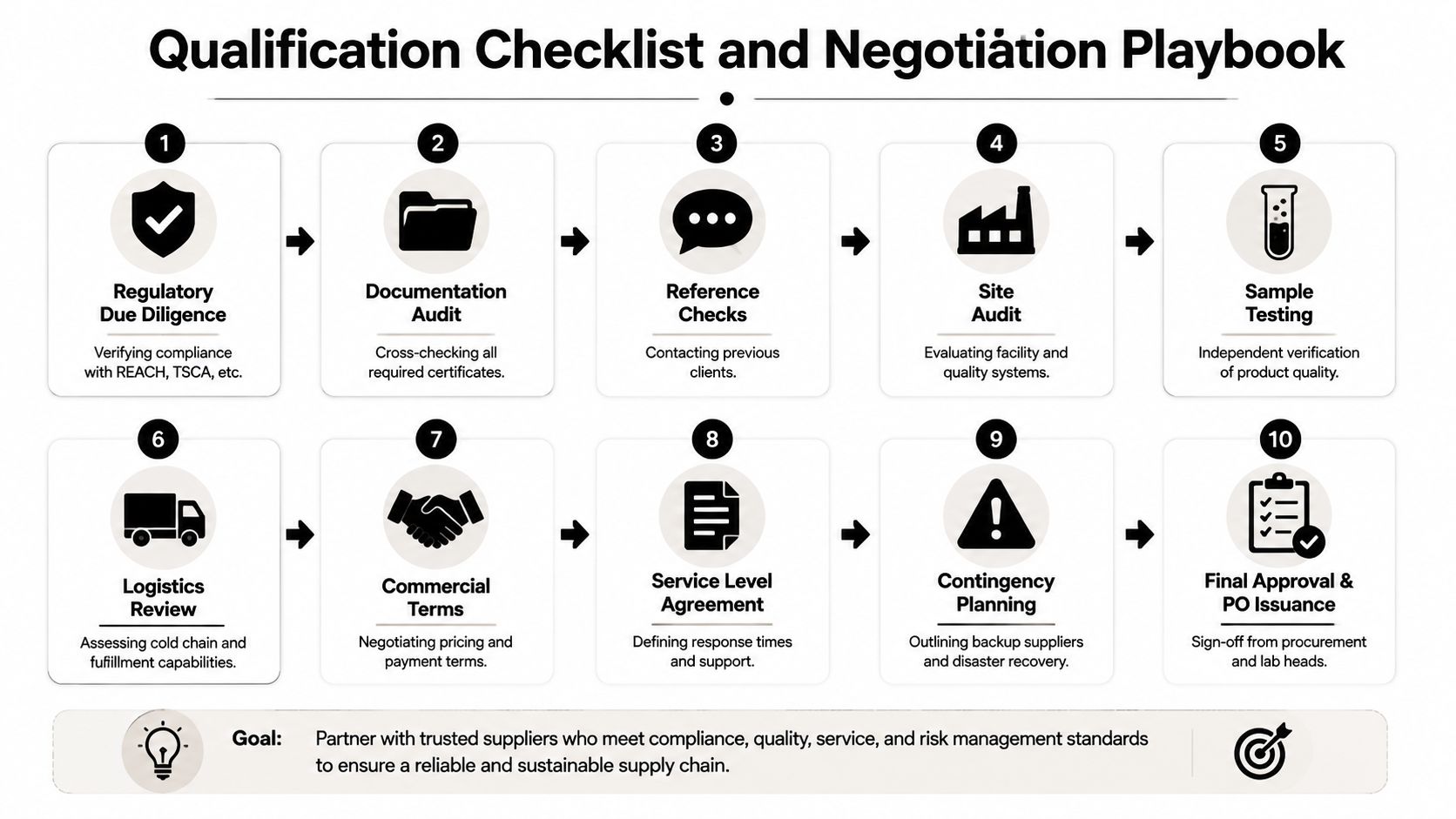
A qualified supplier should survive a controlled workflow before receiving a meaningful purchase order. The sequence below gives procurement, laboratory operations, and EHS a shared pass or fail framework.
- Regulatory due diligence: Confirm the supplier's legal entity, market authorization, applicable REACH or UK-REACH position, USA hazard communication support, and any export-control responsibilities.
- Documentation audit: Match product codes, lots, COAs, SDS versions, specifications, certificates, and intended-use labels.
- Reference checks: Contact comparable buyers and ask about complaint handling, document response, delivery reliability, and substitutions.
- Site audit: Review manufacturing, repackaging, storage, release, sanitation, change-control, and record-retention practices.
- Sample testing: Test a representative sample independently where the material is critical, quantitative, or difficult to replace.
- Logistics review: Inspect packaging qualification, temperature monitoring, dangerous-goods handling, customs support, and receipt procedures.
- Commercial terms: Negotiate landed cost, MOQ, payment, allocation, returns, replacement, document fees, and price-change notice.
- Service-level agreement: Set response expectations for quotations, complaints, COA requests, deviations, and shipment updates.
- Contingency planning: Decide which products require a second qualified supplier, alternate pack size, safety stock, or approved substitute.
- Final approval and PO issuance: Require sign-off from procurement, the laboratory owner, quality, and EHS before release.
The pass criteria should be written into the supplier file. For example, the SDS must be correct for the receiving jurisdiction, the COA must match the actual lot and analytical method, and the trial shipment must arrive with intact packaging and complete records. Delivery performance should be measured across several real orders rather than accepted from a presentation.
Negotiation becomes easier after qualification because the buyer knows which controls matter. Benchmark against several credible alternatives, ask for batch-level commercial pricing where feasible, request temperature loggers for sensitive shipments, and tie price holds to clearly defined cost drivers and currency exposure. A supplier may reject every request, but the response reveals how seriously it treats operational accountability.
For automated vendor onboarding, tax and entity checks can be supported through a supplier tax ID validation API, provided the tool is used alongside human review of regulatory and quality records.
Three questions separate a serious laboratory chemical supplier from a catalog reseller:
- Who owns the synthesis or primary production?
- Where is quality released, and who signs the batch record?
- What is the documented backup when the primary source fails?
If the answers are vague, the supplier isn't qualified, regardless of catalog size or quoted discount.
Herbilabs supplies research-use laboratory reagents and sterile diluents, including wholesale and private-label options for distributors and resellers, with lot documentation and temperature-controlled fulfillment. Procurement teams evaluating a qualified partner can visit Herbilabs to review its product, documentation, and distribution options.