Private Label, White Label, Wholesale partnerships available - EU, USA and UK - Free shipping from €75
Documentation Requirements for Lab Reagents: A Guide
The shipment looked routine until the box sat in a broker's queue and nobody could prove what was inside. The reagent was cold, the label was clean, and the supplier's email said the papers were attached, but the paperwork didn't line up with what customs, the courier, and the end-user all wanted to see. That's the part documentation requirements are not a paper trail, they're a chain of evidence.
In cross-border reagent work, different people verify different documents at different checkpoints. A broker cares about classification and invoice detail, a courier cares about transport risk, an end-client cares about batch identity and quality evidence, and an auditor cares about whether the record is complete and controlled. The documents that survive that journey are the ones tied to a specific decision point, not the ones that look thorough on a folder index.
Table of Contents
- When a Missing Document Stops a Reagent Shipment
- Core Documents Every Lab Reagent Order Depends On
- Breaking Down Each Document by Purpose and Issuer
- Documentation Rules Across EU, UK, USA, and LATAM
- Shipping and Customs Paperwork for Cross-Border Reagents
- Building a Version-Controlled Documentation System
- Common Documentation Mistakes That Block Reagent Orders
When a Missing Document Stops a Reagent Shipment
A cold-chain parcel can fail on something as small as a mismatch between the product description and the evidence file. A lyophilized reagent might move through dispatch cleanly, then stall when the SDS doesn't clearly reflect the hazard profile or the COA doesn't identify the batch in a way the broker can trace back to the invoice. The shipment is still physically intact, but the record set has broken the chain of proof.
The paperwork is checked in layers
Customs officers, couriers, and end-clients are not looking for the same thing. Customs wants a defensible import story, the courier wants transport safety, and the customer wants confidence that the lot matches the order and can be used as claimed. That's why a single “complete” folder often still fails.
Practical rule: the best document set is the one that answers the next reviewer's question without forcing them to email anyone.
That distinction matters because documentation is treated as a formal record of what was done, why it was done, and how outputs were produced. Statistics Canada defines it as a record of the statistical activity that includes the concepts, definitions, and methods used to collect, process, and analyze data, and says the goal is a complete, unambiguous, multi-purpose record. The same logic applies here, a shipment file needs to be usable by several reviewers without reinterpretation (Statistics Canada).
The useful mindset is simple. Don't ask whether a document exists, ask whether it proves the exact thing the reviewer needs at that checkpoint. If it doesn't, the file is incomplete even when the folder looks full.
Treat the file as evidence, not decoration
Many reagent teams get trapped. They collect PDFs because a supplier sent them, then assume the packet is “covered,” even if the documents don't agree on product name, hazard class, or lot identity. A better approach is to map each paper to the person who will inspect it first, then remove anything that doesn't help that person decide.
A reliable shipment pack usually has three layers. One layer supports release from the supplier side, one layer supports border movement, and one layer supports end-user acceptance. If one layer is weak, the others can't fully rescue the order.
The rest of the guide follows that practical logic, not a theoretical checklist. Every document has a buyer, a purpose, and a stage where it gets checked.
Core Documents Every Lab Reagent Order Depends On
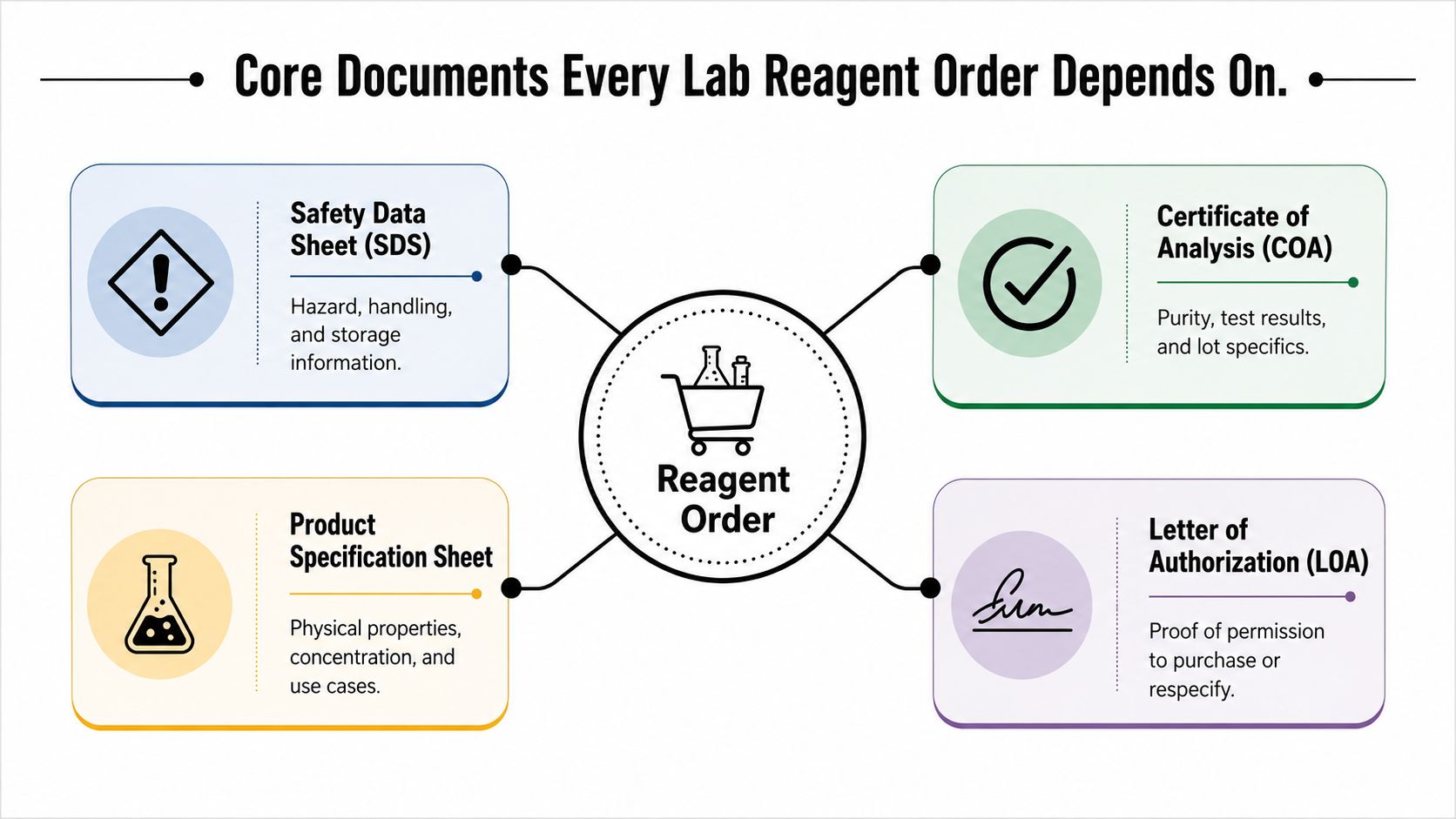
The core packet for a reagent order is easier to understand when each document is treated like a travel document. The COA is the product's birth certificate, the SDS is the hazard passport, the TDS is the user manual, and the RUO declaration is the legal boundary that keeps the product out of clinical use. Teams that understand those roles stop sending documents randomly and start sending the right proof to the right reviewer.
What each core document actually does
A Certificate of Analysis belongs to the lot. It identifies the batch and shows the measured results that support release. A customer checks it when the shipment arrives, and a QC team checks it when the batch is logged into inventory. If the lot number on the vial and the lot number on the COA don't match, the document has already failed.
An SDS travels for safety. It tells couriers and handlers what they need to know about hazards, storage, spill response, and transport. For international movement, this matters before the parcel leaves the dock, not after it arrives. The most useful SDS is the one that matches the exact material being shipped, not a generic template pulled from an old folder.
A Technical Data Sheet sits between marketing language and lab use. It explains properties, concentration, and intended applications in practical terms. Buyers usually request it when they need to compare alternatives or verify whether the reagent fits a method.
An RUO declaration is different from a product claim sheet. It draws the legal line around research use and keeps the seller from implying clinical suitability. In procurement, it matters at the order desk and during compliance review, because the purchaser often needs proof that the item is being sold under a research-only boundary.
A supplier can ship a product with perfect quality data and still create a problem if the RUO status, SDS, or batch reference doesn't line up with the destination market's use case.
What should arrive with every order
The COA and SDS should be expected with most shipments, because they support both quality review and safe handling. The TDS often travels on request or through a product portal, while the RUO declaration is commonly needed during onboarding, account approval, or customer due diligence. A supplier that can't place those documents against the same item code usually creates downstream friction.
For readers who want a deeper way to read batch-level quality evidence, the logic is close to the framework in this guide on how to read a certificate of analysis. The central point is consistent, the document only helps if the batch identity, test scope, and product naming all line up.
Breaking Down Each Document by Purpose and Issuer
The best reagent files are not thick, they're specific. A document earns its place by answering a question that someone will ask at order review, customs clearance, receiving, or audit. That is why each item needs a clear issuer, a stable set of fields, and a known verifier.
COA, SDS, TDS, and RUO in the workflow
A COA is usually issued by the manufacturer or qualified testing lab. The fields that matter most are the batch number, product name, test results, and the date of analysis. End-user QC checks it against the vial label and purchase order, because a COA that predates or mismatches the labelled batch can't support release.
An SDS is issued by the supplier or manufacturer with hazard information structured in the standard safety format. Section 14 is especially important in transport contexts because it speaks directly to shipping classification and handling. Couriers and freight teams check it before acceptance, then brokers and receivers use it if there's a query at border or dock level.
A TDS comes from the supplier and is often used for product fit, not hazard control. It belongs in procurement files, technical evaluations, and end-client qualification, especially when a customer needs to verify concentration or functional range. It's less about compliance proof and more about practical suitability.
An RUO declaration is normally issued by the seller or brand owner. It should state the research-only boundary plainly enough that procurement teams, compliance teams, and customers don't have to guess. The order desk checks it early, because a badly worded RUO document can cause avoidable screening delays.
| Document | Issued By | Key Fields | Verified By |
|---|---|---|---|
| COA | Manufacturer or testing lab | Batch number, test results, product identity | End-user QC, procurement |
| SDS | Supplier or manufacturer | Hazard classification, handling, transport details | Courier, customs broker, safety team |
| TDS | Supplier | Concentration, physical properties, intended use | Buyer, technical reviewer |
| RUO declaration | Seller or brand owner | Research-only boundary, product scope | Order desk, compliance team |
The table above is the practical version of the stack. It shows why one document can't replace another. A COA can't stand in for transport safety, and an SDS can't prove batch potency.
Documentation Rules Across EU, UK, USA, and LATAM
The same reagent can be accepted in one market and questioned in another because the local paperwork burden changes. In the EU, technical documentation has to be ready before market placement, retained for 10 years, and organized so surveillance authorities can verify conformity on request. The file typically needs the manufacturer identity, product description, standards used, risk assessment, and labeling evidence, because incomplete mapping of requirements to proof can block market access (EU technical documentation guidance).
EU and UK settings are similar, but not identical
In the UK GDPR context, documentation is not optional housekeeping. The ICO says most organisations must maintain records of processing activities covering purposes, sharing, retention, recipients, transfers, and security measures, and organisations with 250 or more employees must document all processing activities (ICO documentation guidance). For a reagent distributor, that matters when customer data, order notes, and supplier files are tied to regulated records.
The USA adds a different layer, especially around transport and inventory controls. Teams often have to show that their documents match the product classification and the way the item is represented in trade paperwork. In LATAM, the paperwork is frequently more local in character, because import permits, distributor registrations, and product notifications can sit with the in-country partner rather than the foreign shipper.
A useful resource for teams trying to coordinate those controls is navigate compliance with Legitt AI, especially when contract terms, product statements, and approval workflows all need to stay aligned. The value there is not automation for its own sake, it's reducing the chance that a sales file and a compliance file drift apart.
LATAM often checks the local actor, not just the shipment
This is the point many exporters miss. A packet can be technically correct and still be delayed if the local importer, responsible person, or registered distributor is not identified the way the destination authority expects. That means the same SDS or invoice may need a different local wrapper, even when the physical product is unchanged.
A broker can usually tell quickly whether the file is built for one jurisdiction or several. If the local entity, product category, and import authorization don't line up, the shipment is treated as a question mark, not a routine release.
Shipping and Customs Paperwork for Cross-Border Reagents
The paperwork that travels with the parcel is the part that gets checked first when a shipment lands in a queue. Customs wants the invoice to match the goods, the courier wants the transport declaration to match the risk, and the receiver wants the package data to match the pallet and label. If those three views don't agree, the parcel slows down.
Build the shipment file in dispatch order
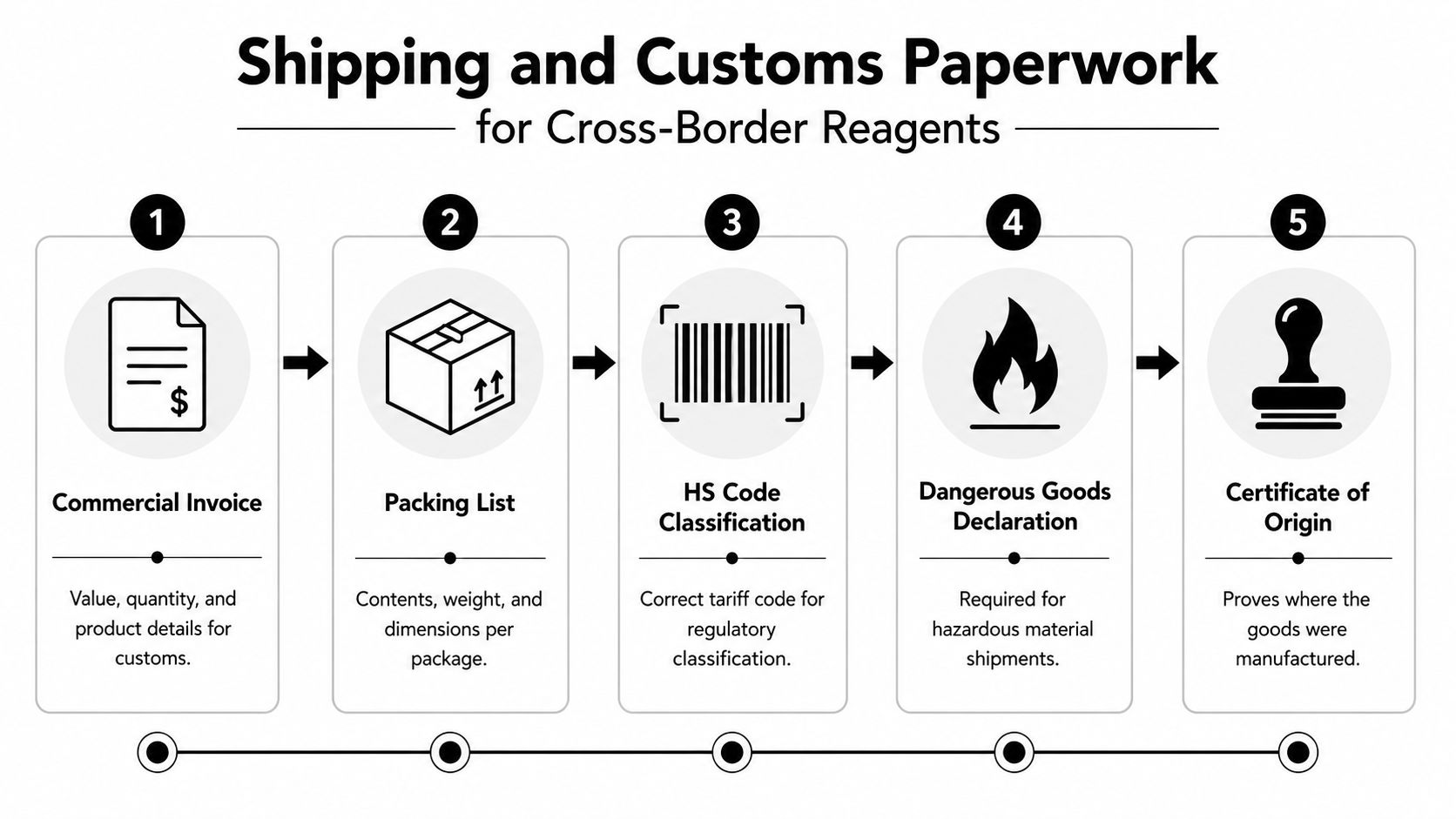
Start with the commercial invoice. It needs to describe the product, quantity, and declared value in language that matches the rest of the file. Customs officers compare it against the packing list and the product description, so any mismatch invites questions.
Then add the packing list. This is the parcel map, what's in each box, how much it weighs, and how it's packed. Couriers use it to handle the consignment, and receivers use it to confirm that the right units arrived.
The HS code classification comes next. That code has to reflect the actual product description, because the tariff line influences how the file is routed. If the HS code and the COA description don't fit together, the importer may have to explain the inconsistency before release.
For hazardous or temperature-sensitive reagents, the dangerous goods declaration or non-hazardous statement becomes the decisive file at booking and handoff. The shipping label alone is not enough when the carrier needs a documented transport basis. For cold-chain shipments, temperature evidence matters too, especially when the receiver needs to confirm the parcel stayed within spec during transit.
If the carrier can't reconcile the declared goods with the transport paperwork, the parcel doesn't get treated as a science problem, it gets treated as a shipping exception.
A certificate of origin can also matter when origin rules or trade preferences are in play. It proves where the goods were manufactured, which helps a broker respond when origin affects duty treatment or import eligibility. For customs process details, the practical checkpointing is well described in this guide to customs clearance procedures.
Building a Version-Controlled Documentation System
A reagent file only works if the version in the folder is the version that matches the shipment in hand. ISO 9001:2015 guidance says organizations must maintain documented information to support process operation and retain it to give confidence that processes are being carried out as planned (ISO guidance on documented information). That is the standard for high-stakes paperwork, controlled evidence, not loose file storage.
Use control, not volume
A controlled system starts with a register. Every COA, SDS, label file, and authorization letter should be tied to a batch, supplier, revision date, and storage location. If a document changes, the file should show what changed and when, because version history is what turns a PDF into evidence.
ALCOA remains a strong discipline here, attributable, legible, contemporaneous, original, and accurate. Those principles matter because they stop teams from backfilling records after a problem appears. They also make audits easier, since the reviewer can see the sequence instead of guessing it.
For teams designing the structure, a good reference point is document management system best practices, especially where naming rules, permissions, and retrieval speed affect daily operations. The most useful systems are not glamorous, they're searchable, locked down, and boring in the best way.
The practical version of control
Lightweight controls work well when the catalog is large. Structured naming, cloud folders with access logs, and supplier portals that push updated SDS files can keep the workflow current without creating a second job for the team. Internal compliance tracking also helps when a document needs to be traced across procurement, QA, and shipping, which is why a toolset like compliance tracking software often gets adopted after the first serious audit scare.
The failure mode is predictable. An outdated hazard sheet, an expired RUO declaration, or a COA that no longer matches the label creates confusion at the worst possible moment. Once that happens, the issue is no longer the shipment, it's the credibility of the record.
Common Documentation Mistakes That Block Reagent Orders
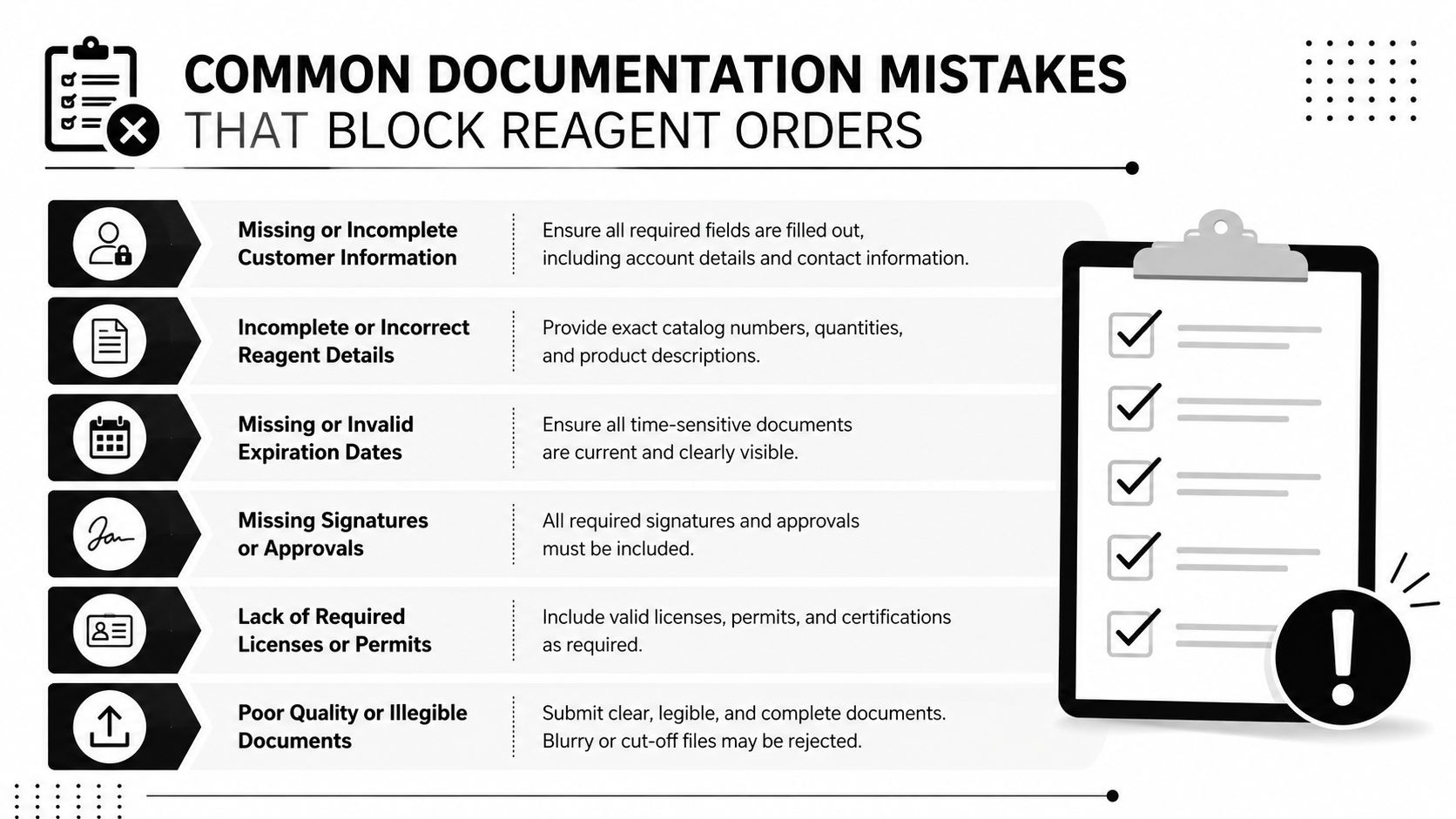
The worst document failures are usually boring. A signature is missing, a batch number is off by one character, or the invoice describes the goods in a way that doesn't match the export file. None of those look dramatic at the desk, but they're exactly the kind of gaps that make a broker stop the order.
The repeat offenders
- Missing signature blocks: If the SDS or order authorization doesn't show a responsible sign-off where the reviewer expects it, the packet looks unfinished. Fix it by standardizing the final-page review before release.
- Batch mismatch: A COA that doesn't match the labelled lot breaks traceability instantly. Fix it by checking the vial, invoice, and COA against the same batch reference before dispatch.
- Wrong tariff logic: An HS code that doesn't fit the product description forces manual correction. Fix it by having the broker validate classification before the first shipment.
- Invoice drift: If the declared value or item description changes between documents, customs may flag the file. Fix it by using one controlled commercial description across sales and shipping.
- Over-documenting the wrong thing: Extra PDFs don't help if the core evidence is weak. Fix it by removing duplicates and keeping only the documents that prove identity, safety, origin, and authority.
A common mistake is assuming that more pages equal more compliance. In practice, a bloated file can hide the problem, which is usually inconsistency rather than scarcity. A lean, matched packet is easier to clear than a messy archive with ten versions of the same answer.
The safest habit is to review the shipment as a chain, not as isolated papers. If one document tells a different story, the entire order inherits that inconsistency.
Herbilabs supports lab teams and distribution partners that need reagent supply handled with fewer paperwork surprises and clearer batch-level traceability. If a cross-border order keeps stalling because the file set isn't tight enough for customs, couriers, or end-client QC, visit Herbilabs and review the product and fulfillment options that fit your workflow.


