Private Label, White Label, Wholesale partnerships available - EU, USA and UK - Free shipping from €75
Where to Buy Reconstitution Solution: A Practical Guide
A researcher finishes reconstituting a lyophilized compound, checks the calculated concentration, and finds that the assay curve is wrong. The repeat produces the same result. Pipettes are calibrated, the dilution math is correct, and the vial looks clean. The problem may be the diluent, not the technique.
That situation is becoming harder to diagnose as bacteriostatic water availability varies by supplier and market. The ASHP shortage detail for bacteriostatic water records Pfizer bacteriostatic water as being on shortage in 2025 and notes that wholesalers or manufacturer representatives may be needed to secure sterile-water products. Buyers searching for where to buy reconstitution solution are therefore being pushed toward unfamiliar sellers, marketplace listings, and improvised purchasing routes.
Table of Contents
- The Sourcing Problem Most Researchers Underestimate
- What a Reconstitution Solution Is
- Legitimate Purchasing Channels at a Glance
- How to Evaluate Any Supplier Before You Buy
- Compliance and Shipping Across EU UK USA and LATAM
- Vials Kits and Wholesale Buying Options
- Red Flags That Signal Counterfeit or Low-Quality Diluents
- Making the Right Call for Your Use Case
The Sourcing Problem Most Researchers Underestimate
A researcher usually inherits a diluent supplier rather than selecting one deliberately. A lab mate leaves behind a vial. A forum recommends a vendor. A search ad promises fast delivery. Each route is convenient, but convenience can conceal weak lot control, incomplete documentation, or a product that was never intended for the stated workflow.
The downstream consequences are serious. A mislabeled or contaminated diluent can compromise concentration calculations, stability observations, analytical controls, and every result generated afterward. A failed assay may look like a peptide problem or a pipetting error when the actual failure began with the water used during reconstitution.
The channel is part of the specification
Reconstitution solution isn't a single standardized SKU. It may refer to sterile water, bacteriostatic water, or another sterile diluent selected for a particular laboratory method. The container, preservative system, sterility claim, storage instruction, and intended use all matter.
The supply route matters just as much. In the UK, medicines and similar products requiring reconstitution are often treated as special containers. Pharmacies must supply the nearest complete pack, or a combination of complete packs, rather than splitting sterile or hygroscopic products. NHSBSA guidance also describes reimbursement based on the nearest number of packs needed to cover a prescription, making pack size and supply channel central procurement considerations. The framework is summarized in this laboratory supply procurement strategy.
Procurement rule: A diluent should receive the same sourcing scrutiny as the lyophilized material it dissolves.
Why the shortage changes the decision
Short supply doesn't make every unfamiliar vendor fraudulent, but it does increase the risk of rushed purchasing. A buyer who can't obtain a familiar sterile-water product may accept a generic “lab-grade” description, a stock COA, or a social-media seller with no traceable business address.
The correct response is not to buy the first available vial. It is to move through a documented decision process: identify the use case, choose the appropriate channel, verify the lot, confirm storage and shipping conditions, and retain the purchase record. Researchers and resellers should treat the diluent as a load-bearing component of the experiment, not a disposable accessory.
What a Reconstitution Solution Is
A reconstitution solution is a sterile diluent used to dissolve or resuspend a lyophilized substance before laboratory use. The term identifies a product category, not one universal formulation. Select the diluent according to the compound, research workflow, expected vial access, and applicable labeling and handling requirements.
The main categories differ in composition and use:
- Sterile Water for Injection, or SWFI, is sterile water without a preservative. It may fit a single-use preparation when the protocol and product documentation allow it.
- Bacteriostatic water, often called bac water, combines sterile water with 0.9% benzyl alcohol as a preservative. That preservative affects repeated access and compatibility with the intended workflow.
- Preservative-free sterile saline contains sterile saline without a bacteriostatic preservative. Use it when the protocol specifies saline. It is not interchangeable with bacteriostatic water.
Research Use Only, or RUO, labeling indicates that the product is sold for laboratory research rather than human or veterinary administration. RUO status does not remove the need to verify sterility controls, endotoxin information, lot traceability, and accurate labeling. It also does not permit therapeutic or administration claims.
The diluent determines working concentration and can affect handling and stability after reconstitution. Single-use and multi-dose formats require separate review. Catalog formats commonly include 2 mL, 5 mL, 10 mL, and 30 mL vials, but container size alone proves nothing about suitability. Confirm the actual fill volume, closure system, preservative content, and use instructions.
| Diluent Type | Composition | Typical Use Case | Storage After Opening |
|---|---|---|---|
| Sterile water | Sterile water without preservative | Single-use laboratory preparation where specified | Follow the supplier's validated instructions |
| Bacteriostatic water | Sterile water with 0.9% benzyl alcohol | Workflows involving repeated access, where compatible | Follow the lot-specific label and storage instructions |
| Preservative-free sterile saline | Sterile saline without bacteriostatic preservative | Protocols that specify saline or require a preservative-free diluent | Follow the supplier's validated instructions |
For a quick comparison of available formulations, review the reconstitution solution category, then request the exact SKU documentation. Check the lot-specific COA, identity and composition details, sterility and endotoxin information, packaging, and storage instructions before ordering. Category wording is a starting point, not evidence that a product fits your protocol.
Legitimate Purchasing Channels at a Glance
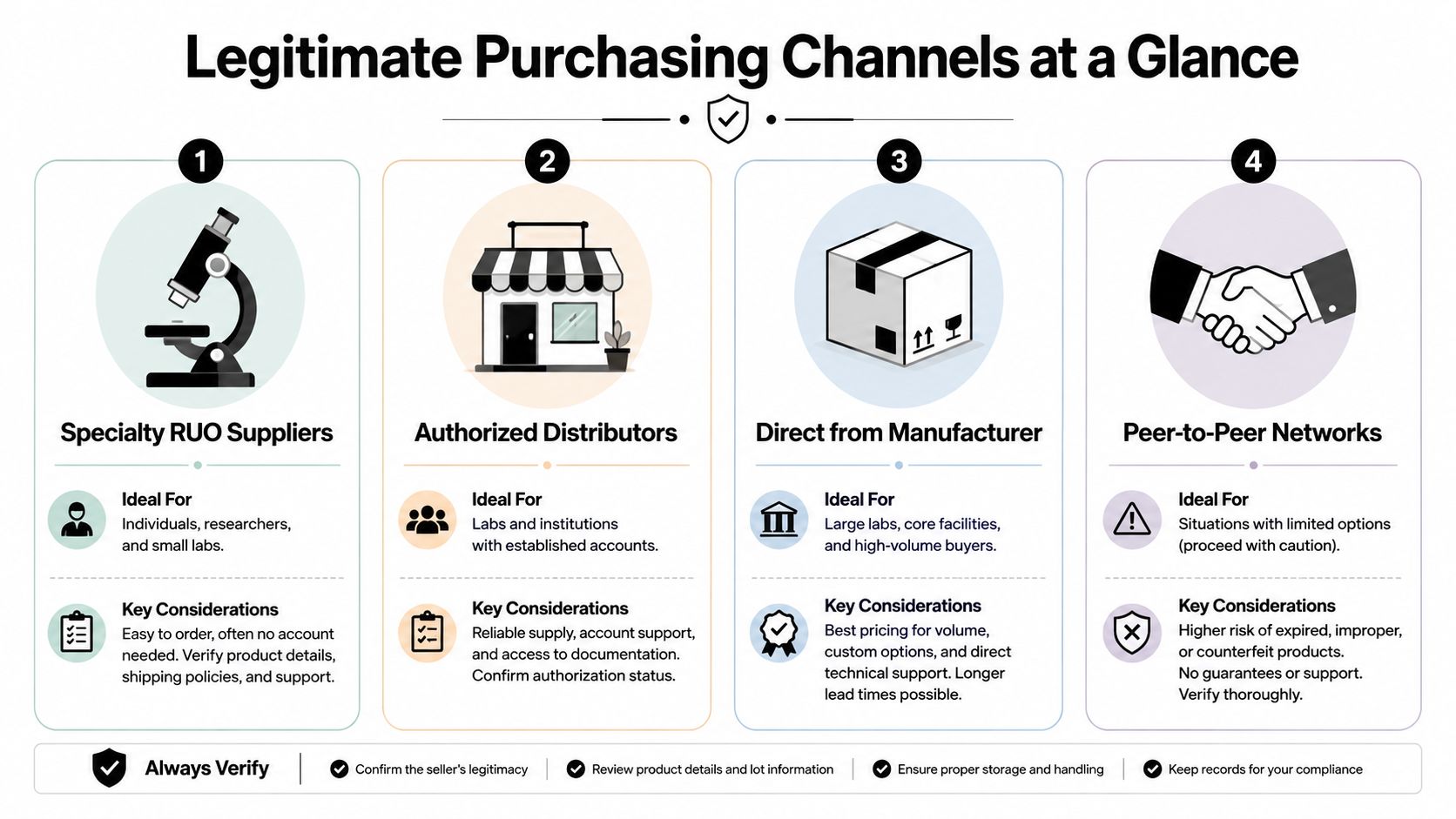
Four legitimate routes serve different buyers. Choose based on the required pack size, documentation, purchasing controls, and expected volume. A solo researcher, an institutional laboratory, and a reseller should not use the same sourcing process.
Specialty RUO suppliers
Specialty RUO suppliers are often the most practical starting point for an individual researcher seeking a research-labeled diluent in a convenient format. They may understand peptide and lyophilized-compound workflows and carry bacteriostatic water, sterile diluents, kits, and related accessories.
Quality varies sharply. Some vendors maintain lot controls and clear technical records. Others rely on generic descriptions, recycled COAs, and unclear manufacturing details. The RUO label does not establish product quality. Verify the exact lot, composition, testing, intended-use statement, and shipping conditions before payment.
Authorized pharmacy wholesalers
Licensed pharmacy wholesalers, veterinary suppliers, and compounding-pharmacy distributors may offer sterile-water products with stronger audit trails. This channel suits institutions, clinics operating within the applicable legal framework, and buyers with established accounts.
It often creates friction for solo researchers. The vendor may require an account, prescription, institutional credentials, or documented end use. Available products may also use pack sizes or labeling designed for regulated clinical applications. Pharmacy availability does not make a product suitable for an RUO workflow.
Institutional catalog vendors
Catalog vendors such as Fisher Scientific, VWR, Sigma-Aldrich, and Medix can fit laboratories that require purchase orders, vendor qualification, and traceable records. Their catalogs may not include the desired bacteriostatic-water format, however, or the available SKU may be configured for another regulated use. Confirm the exact product specification rather than relying on the vendor category.
Direct manufacturer purchasing
Direct purchasing fits resellers, distributors, and larger facilities that can meet commercial order requirements. It can provide clearer batch communication and direct technical support, while a single-vial buyer may find the process inefficient. Ask about minimum order requirements, lot continuity, documentation, and storage during transit.
| Buyer | Most suitable starting channel | Main verification concern |
|---|---|---|
| Solo researcher | Specialty RUO supplier | Lot-specific COA and intended-use labeling |
| Lab manager | Institutional catalog or authorized distributor | Account traceability and consistent supply |
| Reseller | Direct manufacturer or established wholesale supplier | Batch continuity, commercial terms, and resale documentation |
| Institutional buyer | Qualified distributor or approved catalog vendor | Procurement records, audit trail, and compliance review |
Public-sector distribution follows the same controlled logic. The CDC's Infectious Diseases Reagent Resource states that it acquires, authenticates, produces, and distributes more than 1,220 different reagents for BSL-1, BSL-2, and BSL-2+ use, illustrating the scale of centralized reagent supply. Open-market consumer channels cannot provide that level of traceability by default. fredrikstad
How to Evaluate Any Supplier Before You Buy
A supplier should survive a technical interview before receiving payment. The following checks expose most weak vendors without requiring a buyer to inspect the manufacturing site personally.
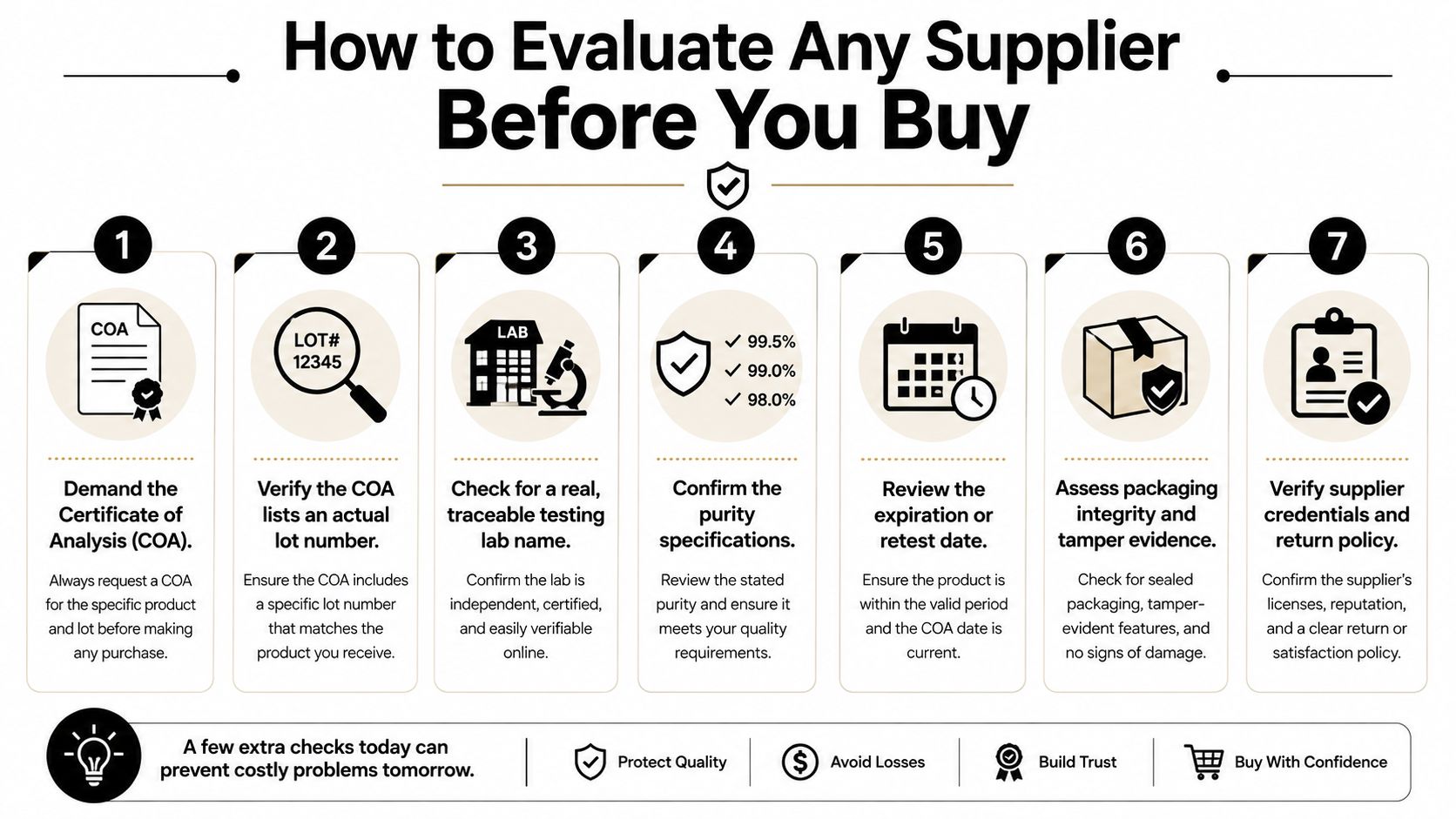
Start with the COA, then test the COA
Request a Certificate of Analysis for the exact lot being offered. The document should include an actual lot number, issue or test information, a named testing laboratory, specification limits, and results rather than generic “passes” language.
The document should address the properties relevant to the product, including sterility, bacterial endotoxin, pH, and identity or purity where applicable. A stock PDF with no lot binding is marketing material, not batch evidence.
Confirm the testing method. Depending on the claimed specification, buyers may expect references to HPLC, Karl Fischer water-content analysis, and bacterial endotoxin testing under a recognized USP or EP method. The supplier should be able to explain which laboratory performed each test and whether the result applies to the purchased lot.
Audit the manufacturing trail
The manufacturing review should answer practical questions:
- Facility controls: Does the manufacturer maintain ISO 9001, ISO 13485, GMP, or an equivalent quality system relevant to the product?
- Cleanroom controls: What cleanroom classification applies to compounding and final filling?
- Batch traceability: Can each vial be traced from raw water and components through final fill and release?
- Packaging validation: Are closures, sterile barriers, seals, and labels controlled?
- Release authority: Who reviews the batch record before shipment?
A vendor doesn't need to provide confidential manufacturing records, but it should provide a coherent answer and supporting documentation.
Inspect fulfillment, support, and business identity
Storage conditions matter from warehouse to delivery. Ask whether the supplier offers cold-chain shipment where required, whether ambient shipping has validation data, how transit excursions are handled, and what happens when a parcel arrives damaged or delayed.
Business legitimacy is equally concrete. Verify the legal business name, physical address, responsive technical contact, return policy, and the relationship between the seller and the manufacturer. A seller that refuses basic questions is making the purchasing decision easy: exclude the seller.
A focused supplier qualification framework can help procurement teams turn these questions into a repeatable approval record. The key is to qualify the specific product and lot, not just the supplier's logo.
Compliance and Shipping Across EU UK USA and LATAM
“Research use only” does not grant automatic shipping permission. The formulation, label, destination, intended use, and connection to another controlled product determine whether a shipment can move legally. Treat regional compliance as a pre-order decision, not a customs problem to solve after dispatch.
In the United States, RUO diluents must remain clearly positioned for laboratory research. Product labels and pages should avoid any suggestion of human or veterinary administration, therapeutic use, dosing, or treatment. Buyers should retain invoices, COAs, end-use statements, and correspondence that support the declared purpose. If a supplier markets the same vial for research and personal injection, exclude it from a compliant procurement process.
In the European Union, distinguish research reagents from medical products and check the rules of the destination member state. Customs officials may request a commercial invoice, precise product description, safety documentation, importer details, and records supporting the RUO classification. A shipment that resembles an injectable product for personal use can receive scrutiny even when the seller calls it a research item.
Regional purchasing checks
The United Kingdom requires separate post-Brexit customs preparation. Commercial invoices, product descriptions, safety documents, and importer information must match the physical shipment. A supplier that ships to the EU may still lack the registrations, carrier setup, or documentation needed for UK delivery.
LATAM is not one regulatory market. Brazil, Mexico, Colombia, and Argentina can apply different requirements to laboratory materials, sterile products, and health-related goods. Before dispatch, confirm import licensing, customs classification, local importer responsibility, and language requirements. Tropical conditions also increase the importance of validated packaging and clear storage instructions.
| Region | Primary Framework | Labeling Requirement | Customs Docs | Restricted Destinations |
|---|---|---|---|---|
| USA | RUO and applicable FDA requirements | Research-only language, no administration claims | Commercial invoice, product description, COA, end-use records | Destination-specific restrictions and controlled-compound rules |
| EU | Member-state requirements alongside applicable EU frameworks | Clear laboratory-use positioning | Invoice, safety documentation, importer details, supporting classification records | Country-specific customs and product restrictions |
| UK | UK customs and product documentation requirements | Accurate RUO description | Full commercial invoice, safety documentation, importer information | Destination and compound-specific restrictions |
| LATAM | National frameworks, including local health authorities | Local classification and use statement | Invoice, import permits where required, technical documents | Varies by country and product classification |
Before ordering internationally, review the shipping restrictions guidance. Products associated with injectable compounds may be non-shippable in jurisdictions where those compounds are scheduled or otherwise restricted. A supplier promising universal delivery without checking the destination is showing weak compliance controls.
The Council of Europe has called for national legislation and guidance on reconstitution practices in health-care establishments, while excluding products intended for distribution to another health-care establishment. That distinction supports a practical procurement rule: separate institutional pharmacy supply from commercial RUO distribution. Confirm the seller's legal role, the product's classification, and the importer's responsibility before treating channels as interchangeable. Pharmacy availability does not automatically make a diluent appropriate for RUO purchasing, and a specialist reseller does not automatically have authority to supply health-care use.
Vials Kits and Wholesale Buying Options
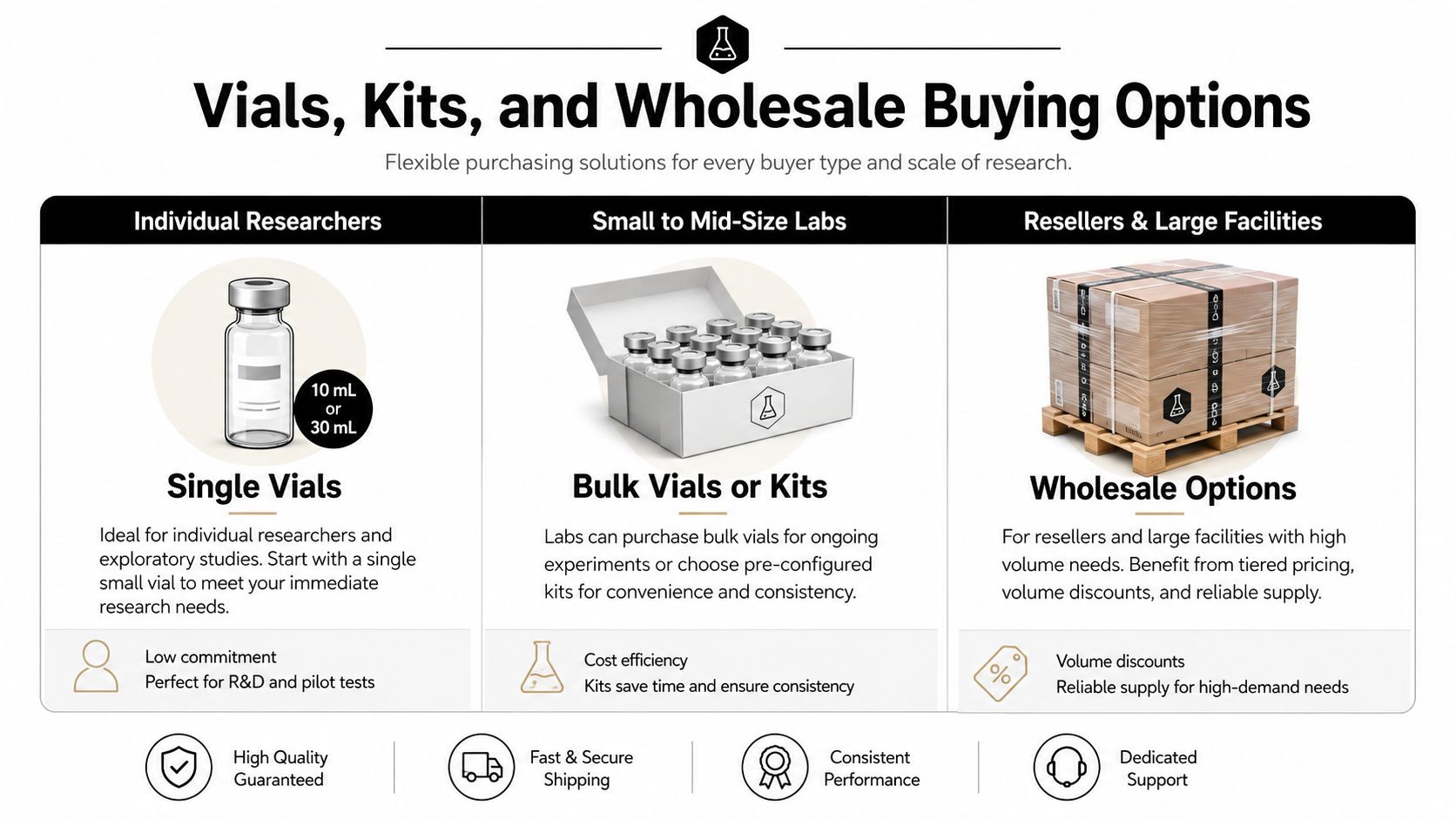
The purchase format should match consumption, access frequency, and documentation needs. A single vial may suit a low-throughput researcher, while a laboratory with recurring work may prefer a kit or a planned replenishment schedule. More inventory isn't automatically better if the buyer can't document storage and lot rotation.
Single-vial purchasing
Individual researchers typically start with a single small vial, often 10 mL or 30 mL where those formats are available. That approach limits unused stock and lets the buyer qualify the supplier before committing to a larger order. The label, lot number, expiry or retest information, and COA should arrive with the product or be readily retrievable.
Kits for repeat workflows
Small labs may choose kits that combine diluent with syringes, alcohol prep materials, or other accessories. A kit can simplify purchasing, but bundled components still require inspection. The lab should verify whether every component is sterile, whether the accessories have separate lot information, and whether the kit's instructions match the actual diluent formulation.
Wholesale and distribution
Resellers should request a written wholesale schedule rather than relying on a public retail page. The commercial discussion should cover:
- Minimum order quantities: Confirm the starting volume, reorder threshold, and whether mixed lots are allowed.
- Business credentials: Expect a resale license, company registration, tax identifier, or documented RUO end-use declaration where applicable.
- Payment terms: Clarify whether the first order must be prepaid and when account terms become available.
- Brand control: Ask about private labeling, co-branded packaging, artwork approval, and lot documentation supplied to downstream customers.
- Distribution rights: Define territory, channel restrictions, minimum advertised pricing, returns, and drop-ship responsibilities.
Opaque pricing is a warning sign. A real manufacturer or established wholesaler should be able to explain how pricing changes with pack configuration, volume, freight, and documentation. A reseller should also know whether the stock is held locally or sent from an undisclosed third party.
Red Flags That Signal Counterfeit or Low-Quality Diluents
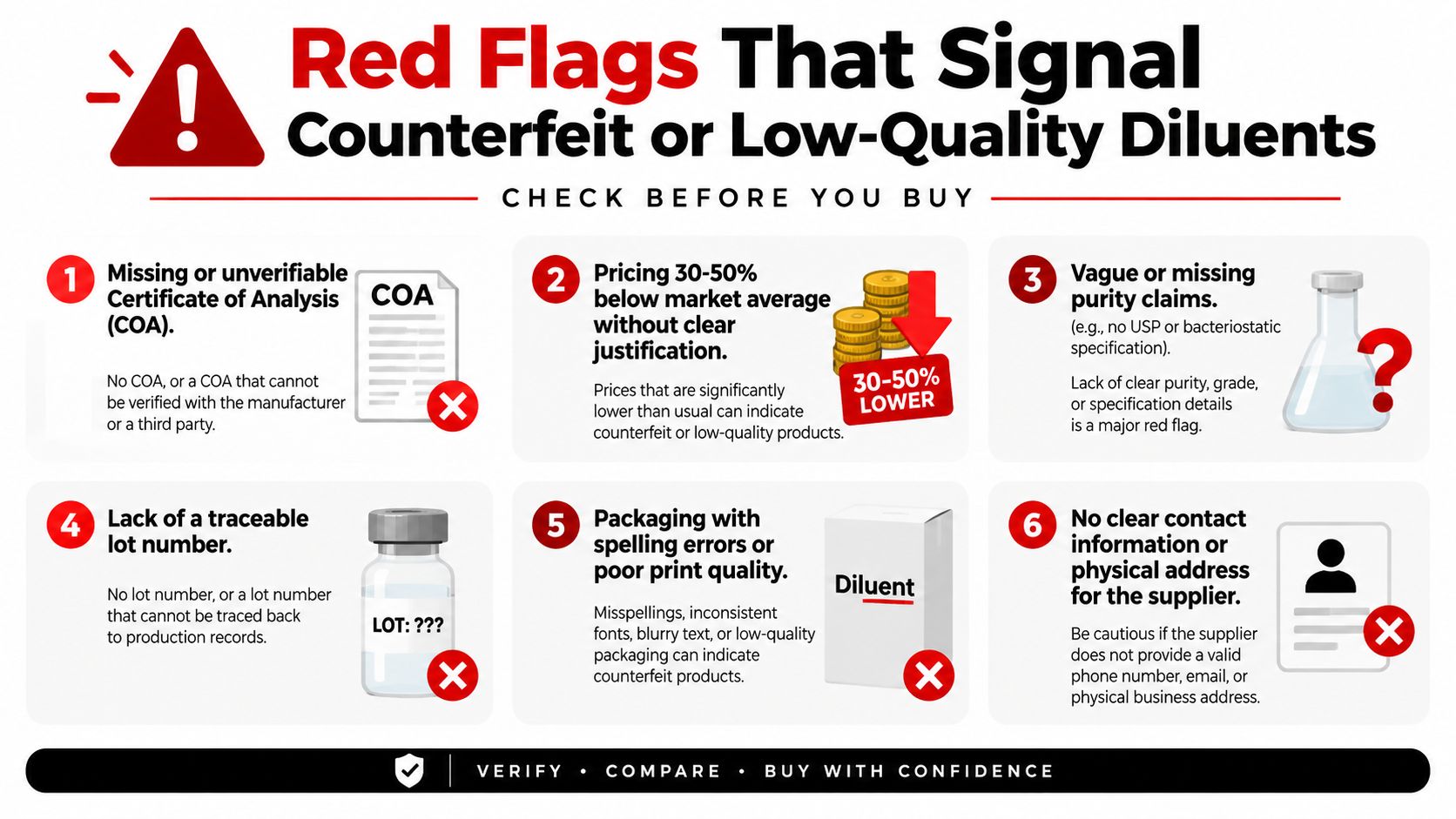
Counterfeit diluent sellers borrow the language of legitimate laboratories. “Sterile,” “pharmaceutical grade,” and “lab-grade” mean little without a traceable lot, defined test method, and responsible manufacturer. Buyers should judge the evidence, not the adjectives.
Documentation failures
A missing COA is the clearest warning. An unverifiable COA is almost as bad. The document should match the product name, lot number, fill format, manufacturer, and test scope. A PDF that uses the same lot number for every product, has no testing laboratory, or contains no result values shouldn't pass procurement review.
Other documentation problems include:
- No lot number: Every vial and outer package should connect to a defined batch.
- Vague purity language: “High purity” isn't a specification. The vendor should identify the applicable test and acceptance criteria.
- Unclear expiry or retest status: Buyers need a usable shelf-life statement tied to the lot.
- Unidentified manufacturer: A seller that won't name the production source can't provide meaningful traceability.
Physical and commercial warnings
Inspect the shipment before opening it into a controlled workflow. Spelling errors, poor print quality, mismatched labels, broken seals, inconsistent fill levels, or damaged closures require quarantine and documentation.
Marketplace and social-channel sellers often create urgency around shortage conditions, use stock laboratory imagery, and move conversations away from the platform before supplying technical records. A low price alone doesn't prove fraud, but an unexplained price gap combined with weak documentation is enough to reject the order.
Quarantine rule: Don't put a questionable vial into an experiment simply because the liquid looks clear.
If counterfeit product is suspected, retain the vial, packaging, shipping label, invoice, payment record, product-page screenshots, seller correspondence, and photographs of all markings. Record the lot and date received, isolate the material from approved stock, notify the supplier in writing, and escalate through the relevant marketplace, institutional quality unit, customs authority, or national regulator. Don't discard the evidence before the investigation is complete.
Making the Right Call for Your Use Case
The practical decision tree is short:
- Individual researcher: Start with a specialty RUO supplier offering a single vial, but require a lot-specific COA and clear storage terms.
- Small laboratory: Consider a documented kit or repeat-order account through an institutional catalog vendor or qualified specialty supplier.
- Reseller: Approach a manufacturer or established wholesaler and define MOQ, lot continuity, labeling, territory, and downstream documentation before placing an order.
- Institutional buyer: Use an approved distributor or catalog route that fits the organization's procurement and audit requirements.
Three checks are essential: verifiable COA, named manufacturing standard, and clear storage and shipping terms.
Short answers to common purchasing questions
Does peptide-use diluent require prescription documentation? It depends on the product, destination, labeling, and intended use. Buyers shouldn't assume that RUO labeling removes customs, institutional, or national requirements.
How should a suspected counterfeit be escalated? Preserve the product and records, notify the supplier, report the listing or seller, and involve the relevant institutional quality team, customs body, or regulator.
What is the typical price per vial in 2025 and 2026 by region? No reliable price range is established by the verified information available here. Quotes vary by formulation, pack size, documentation, shipping conditions, and market availability, so a precise universal range would be misleading.
Does bacteriostatic water expire faster after reconstitution than the printed shelf life suggests? The diluent's printed shelf life applies to the unopened product under stated conditions. Once used in a reconstitution workflow, the resulting solution has a separate stability and handling profile that must come from the compound and protocol documentation.
Match channel to volume, verify documentation before payment, and document every step.
Herbilabs offers RUO reconstitution solutions, including bacteriostatic water and related sterile diluents in individual and multi-pack formats, with COA information and wholesale purchasing options. Researchers and resellers comparing where to buy reconstitution solution can review the Herbilabs catalog and contact the company before ordering to confirm product documentation, pack size, and destination-specific shipping terms.


