Private Label, White Label, Wholesale partnerships available - EU, USA and UK - Free shipping from €75

Reconstitution Solution: A Guide to Selection and Use
A researcher opens the incubator, checks the assay plate, and sees results that don't make sense. The peptide was stored correctly. The instrument passed calibration. The protocol looked clean. Then the smallest step in the workflow gets a second look: the powder was reconstituted with the wrong liquid, mixed too aggressively, or held too long after preparation.
That's why reconstitution deserves more respect than it usually gets. For wholesalers, resellers, and lab teams, it sits at the point where product quality, handling discipline, and experimental reliability meet. A vial can leave the manufacturer in good condition and still become unreliable if the final liquid is prepared without thinking through stability, compatibility, and contamination risk.
Table of Contents
- The Critical First Step in Reliable Research
- What Exactly Is a Reconstitution Solution
- Comparing Common Reconstitution Solutions
- How to Select the Right Solution for Your Application
- Safe Handling and Storage Procedures
- Quality Assurance for Wholesalers and Resellers
- Frequently Asked Questions About Reconstitution
- Can tap water or distilled water be used in an emergency
- Is there one universal reconstitution solution for all peptides
- What signs suggest a reconstituted vial may no longer be trustworthy
- Does freezing and thawing affect potency
- Why is gentle mixing recommended instead of shaking
- How should a reseller answer customers who ask which diluent is “best”
- What's the most common selection mistake
The Critical First Step in Reliable Research
A new researcher pulls a lyophilized vial from cold storage, adds a clear liquid, and expects the hard part to begin with the assay. In practice, the assay may already be compromised if that first liquid was the wrong choice, if the powder was mixed too aggressively, or if the new solution was stored under the wrong conditions.
That is why reconstitution should be treated as a decision point, not a routine prep step.
Lyophilized material is stored dry for a reason. Removing water often helps protect sensitive compounds during shipping and storage, and the protection can disappear once the vial returns to liquid form. From that moment on, you have a different risk profile. Solubility, pH tolerance, microbial exposure, and hold time all start to matter at once.

This is the point many teams underestimate. A dry vial can look standard on the shelf, but two visually similar products may require very different handling once opened. One may tolerate only a narrow mixing and storage window. Another may allow repeated withdrawals because the diluent includes a preservative system. A third may need a buffered environment to stay chemically intact.
A useful way to frame it is kitchen chemistry. Dry ingredients in sealed containers often keep well. Once you add liquid, temperature, timing, and cleanliness start deciding the outcome. Reconstitution follows the same logic, except the consequences are higher. The wrong liquid can reduce solubility, shift pH, introduce contamination risk, or shorten the period in which the preparation remains fit for use.
Practical rule: Reliable results often depend on choices made before the first measurement, at the moment the powder becomes a solution.
This is also where researchers and resellers need more than a definition. They need a selection framework. Start with the compound's stability. Then ask how the vial will be used. Single draw or repeated access? Immediate use or short-term storage? Sterile workflow or higher contamination exposure? Those questions determine whether a simple sterile diluent is enough or whether you need preservation, buffering, or tighter handling controls.
Why this step carries so much weight
Three factors make reconstitution a control point in research and distribution:
- Dry storage and liquid use are different chemical states: A compound that remains stable as a powder may become much more sensitive after dilution.
- The solution choice affects more than dissolution: It can influence pH, osmotic balance, microbial risk, and the usable life of the final preparation.
- Handling conditions shape the outcome: Mixing method, sterility, storage temperature, and withdrawal pattern all affect whether the result is reliable enough to use.
A good reconstitution decision protects the sample, the data, and the people handling the vial.
What Exactly Is a Reconstitution Solution
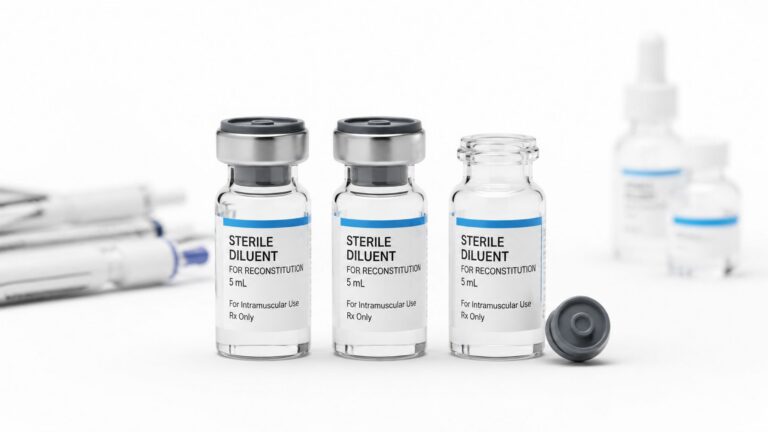
A reconstitution solution isn't one branded formula or one universal bottle. It's a category. According to Free Medical Journals' explanation of reconstitution solutions, it can be sterile water, bacteriostatic water, saline, or a buffered diluent used to dissolve or rehydrate lyophilized material. That distinction matters because preserved diluents support repeated withdrawals, while preservative-free options are typically single-use.
The easiest analogy is engine oil. Someone can ask for “engine oil,” but that phrase doesn't identify one exact product. The right choice depends on the machine, operating conditions, and manufacturer guidance. Reconstitution works the same way. “Reconstitution solution” names the job the liquid performs, not a single standard recipe.

The job of the solution
The liquid has to do more than wet the powder. It has to help create a usable preparation without introducing new problems.
That usually means balancing several needs at once:
- Dissolution: The powder has to go into solution or disperse correctly.
- Purity: The liquid must be appropriate for sterile handling.
- Stability: The final mixture should remain suitable for the intended window of use.
- Workflow fit: Some setups require one withdrawal. Others require multiple vial entries.
A freeze-dried meal is a helpful everyday comparison. Adding liquid brings it back to a usable state, but the result depends on what is added and how it is handled. Too much liquid changes texture. The wrong liquid changes taste. Rough handling ruins the product. In the lab, the consequences are more critical because the outcome isn't flavor. It's data integrity and contamination control.
Where readers often get mixed up
The most common misunderstanding is treating bacteriostatic water as if it were the definition of reconstitution solution. It isn't. It's one subtype inside a wider category.
Another confusion point is assuming “sterile” answers every question. Sterility matters, but it doesn't settle compatibility, preservative impact, pH behavior, or whether the vial is meant for repeated access. A solvent can be sterile and still be the wrong choice for a particular powder or protocol.
A useful test is simple. If the only reason for choosing a diluent is “it's what was on hand,” the selection process wasn't strong enough.
For researchers, this category view prevents shortcut thinking. For resellers, it improves product guidance. The better question isn't “What is reconstitution solution?” The better question is “What kind of reconstitution solution fits this compound and this handling pattern?”
Comparing Common Reconstitution Solutions
A common lab mistake starts with a harmless assumption. Two clear liquids are sitting side by side, both sterile, both meant for mixing powders, so they must be interchangeable. They are not. Choosing among reconstitution solutions works more like choosing the right storage environment for a delicate sample. The liquid does more than dissolve the powder. It sets the conditions the compound has to live in.
The practical decision usually comes down to three questions. Will the vial be used once or entered multiple times? Does the compound tolerate preservatives? Does it need a specific salt balance or pH range to stay stable?
Sterile water
Sterile water is the simplest option. It contains no preservative, which is exactly why it is preferred when additives could interfere with the compound, assay, or formulation.
That simplicity has a cost.
After reconstitution, there is no built-in antimicrobial agent helping limit growth if the vial is handled repeatedly. In practice, sterile water fits best when the material will be prepared for prompt use, or when product instructions call for a preservative-free diluent. A new researcher can imagine this as a clean glass with no lid. It starts clean, but each extra exposure raises the chance of contamination.
Bacteriostatic water
Bacteriostatic water is still sterile water, but with 0.9% benzyl alcohol added as a preservative. That changes the handling logic. The preservative does not make poor aseptic technique safe, but it does add protection for workflows that involve repeated vial entry.
This option is often chosen when a vial will be accessed more than once and the compound is known to be compatible with benzyl alcohol. Compatibility matters first. Some materials tolerate the preservative well. Others may lose stability or fall outside the intended formulation. If your team needs a clearer side-by-side explanation of these tradeoffs, this guide on bacteriostatic vs sterile water for research use is a useful reference.
Saline and buffered diluents
Saline and buffered diluents serve a different purpose. They are selected less for convenience and more for chemical fit.
Saline adds ionic strength. Buffered solutions help hold pH in a narrower range. For some peptides, proteins, and other sensitive materials, that environment can improve solubility or reduce stress during reconstitution. A fragile compound in plain water can behave like a paper label dropped into a sink. It may still dissolve, but not under conditions that preserve its intended structure or performance.
The U.S. Pharmacopeia describes sterile water for injection, bacteriostatic water for injection, and sodium chloride injection as distinct preparations with different formulation roles, which is why substitution should never be automatic (USP Compounding Compendium).
| Reconstitution Solution Comparison | Composition | Primary Use Case | Handling Strength | Key Limitation |
|---|---|---|---|---|
| Sterile water | Sterile water without preservative | Single-use preparation or preservative-sensitive compounds | Simple, additive-free diluent | Higher contamination risk after repeated vial entry |
| Bacteriostatic water | Sterile water with 0.9% benzyl alcohol | Multi-use workflows when the compound is preservative-compatible | Better suited to repeated withdrawals under aseptic handling | Preservative may be unsuitable for some compounds or protocols |
| Saline or buffered diluent | Sterile saline or buffered formulation | Applications needing ionic balance or pH control | Can better support compound-specific stability | Must match the formulation requirements rather than being treated as a general substitute |
A reseller or lab lead should explain these choices in terms of fit, not habit. The best question is not which liquid is most common. It is which liquid gives this compound the safest and most stable environment for how the vial will be used.
How to Select the Right Solution for Your Application
A common bench mistake starts with a rushed assumption. A technician sees a lyophilized vial, reaches for the nearest diluent, and focuses on getting the powder into solution. The vial may dissolve perfectly and still become harder to measure, less stable in storage, or less suitable for repeated use. Good selection starts earlier than the syringe. It starts with the conditions the compound needs to stay usable.
The practical way to choose is to treat the decision like a three-part fit check. First, ask what the compound can tolerate. Second, ask how the vial will be used. Third, ask what happens after reconstitution, including assay conditions and storage. That sequence keeps convenience from overruling chemistry.
Start with the compound's tolerance
A dry powder is not just inactive material waiting for any liquid. It is a formulation with limits. Some compounds tolerate a simple, additive-free environment. Others hold their structure better when ionic strength or pH is controlled. Some are also sensitive to preservatives.
Three questions help narrow the field fast:
Can the compound tolerate preservatives?
If the formulation is preservative-sensitive, bacteriostatic water may create avoidable risk even if repeated vial entry would make it attractive operationally.What helps it go into solution without stressing it?
Solubility is not the same as stability. A compound can dissolve and still shift into a less reliable state. Saline or a buffered diluent may be preferred when the formulation needs a more controlled environment.How much physical agitation can it handle?
Some materials need gentle swirling rather than vigorous shaking. The Royal Children's Hospital guidance on reconstitution also notes that some products require gentle mixing and may have short use windows after preparation, which reinforces why the liquid choice and handling method need to be planned together (Royal Children's Hospital reconstitution guide).
A useful comparison is coffee brewing. Water gets ground coffee wet, but water temperature, contact time, and mineral content affect the final result. Reconstitution works in a similar way. Getting the powder wet is only the first step.
Match the diluent to the real workflow
After compatibility, look at use pattern. A vial accessed once has a different risk profile from a vial punctured several times over several days.
Single-use preparation often favors a preservative-free option if the compound is compatible with it. Multi-use handling may support a preserved diluent, but only when the preservative does not interfere with the compound or the intended application. This leads to many purchasing decisions going off course. The buyer chooses the most convenient stock item, then asks the lab to work around the mismatch.
Use pattern should be stated plainly before the order is placed:
- One withdrawal, immediate preparation
- Several withdrawals under controlled aseptic handling
- Short-term refrigerated use after mixing
- Preparation for a stability or assay workflow with fixed storage conditions
That list sounds simple, but it changes the right answer. A reseller who asks those questions early usually prevents returns, complaints, and wasted vials.
Check what happens after the vial dissolves
Downstream requirements often decide between two otherwise acceptable options. Preservatives, salts, and buffers can affect assay behavior. Concentration targets can also turn a technically correct choice into an awkward one if the final solution is too dilute or too concentrated for accurate handling.
Storage planning matters here too. If the reconstituted vial will be held cold before use, the team should confirm that the selected diluent fits the storage plan and container handling routine. For teams reviewing cold-chain and post-reconstitution practices, these storage practices for bacteriostatic water are a useful operational reference.
As noted earlier, peptide and biopharma workflows often compare refrigerated and frozen conditions during stability work. The important point for selection is straightforward. Choose a diluent that fits the actual storage window your protocol allows, not the one that happens to be on the shelf.
A practical selection framework
| Question | Why it matters | Typical implication |
|---|---|---|
| Does the compound tolerate preservatives? | Additives can change stability or assay behavior | May rule out bacteriostatic water |
| Does the formulation need ionic strength or pH control? | Some compounds perform better in a defined environment | May favor saline or a buffered diluent |
| Will the vial be entered once or multiple times? | Repeated access changes contamination risk | Multi-use handling may favor a preserved option if compatible |
| What concentration is needed after mixing? | Volume affects measurement accuracy and usability | May limit which diluent and fill volume make sense |
| What is the storage plan after reconstitution? | Stability depends on time, temperature, and handling | May narrow the acceptable options further |
A strong selection decision is rarely about the most common diluent. It is about fit. When the compound, the workflow, and the storage plan all point in the same direction, reconstitution becomes more predictable, safer to manage, and easier to reproduce.
Safe Handling and Storage Procedures
A good diluent choice can still be undone by sloppy bench technique. The most common failures are ordinary ones: touching sterile surfaces, puncturing the same vial repeatedly without discipline, forcing liquid into the powder too quickly, or leaving a reconstituted vial half-labeled in the wrong fridge.

The safety tradeoff between preserved and preservative-free diluents is especially important in repeated-use settings. In laboratory research contexts, 0.9% benzyl alcohol in bacteriostatic water is intended to help manage contamination risk during repeated vial entry, a distinction often under-explained in product marketing according to Cenexa Labs' discussion of multi-use reconstitution solution.
Handling rules that prevent avoidable loss
A reliable routine looks simple because the discipline sits in the details.
- Prepare a clean workspace: The bench should be clear, organized, and suitable for aseptic work.
- Sanitize vial septa: Clean the stopper before puncture and let it dry fully.
- Use sterile tools each time: New syringes and needles reduce cross-contamination risk.
- Add liquid slowly: Directing the stream gently against the vial wall can help avoid foam and stress on delicate material.
- Mix gently: Swirling or rolling is usually safer than shaking.
The following visual guide shows the workflow in one place:
For teams handling preserved diluents regularly, essential storage practices for bacteriostatic water provide a useful operational reference for labeling, storage discipline, and vial management.
Storage choices after reconstitution
Once mixed, the vial needs a clear identity. Date, concentration, and handling status should be obvious at a glance. An unlabeled reconstituted vial is one of the fastest ways to lose confidence in a sample.
Storage planning should answer three practical questions:
- Temperature control: Refrigerated handling is common in peptide workflows.
- Light exposure: Sensitive materials may need protection from light.
- Freeze-thaw policy: Repeated freezing and thawing can undermine consistency.
Gentle mixing protects the compound. Clear labeling protects the team.
The strongest labs make storage boring. They use one convention, one label style, one location map, and one rule for discarding questionable material. That consistency does more for quality than dramatic troubleshooting after the fact.
Quality Assurance for Wholesalers and Resellers
A reseller opens two boxes from different suppliers. Both vials look clean. Both labels say sterile. Only one supplier can explain which preservative system is present, how the batch was documented, and what handling limits apply after the customer opens the vial. That difference is what quality assurance looks like in practice.
For wholesalers and resellers, the job is not just to move inventory. It is to reduce avoidable uncertainty for the buyer. A reconstitution solution sits at a decision point in the workflow. If the product identity is vague, the preservative status is unclear, or the paperwork does not match the label, the buyer cannot make a sound choice about stability, intended use, or contamination risk.

What partners should verify before buying
A useful way to screen suppliers is to ask one simple question. Can this company help the end user choose correctly, or only ship a vial? The better supplier does both.
Key checks include:
- Batch documentation: A COA should confirm identity and basic release specifications, so the buyer is not relying on label text alone.
- Packaging format: Glass vials are often chosen because they tolerate storage and handling better than weaker packaging options.
- Clear product identity: The buyer should be able to tell, at a glance, whether the solution is preserved, preservative-free, intended for single use, or suitable for repeated withdrawals under the stated conditions.
- Use-positioning: Product language should match research handling and should not blur the line between laboratory supply and clinical use.
- Supplier explanation quality: A good partner can explain why one diluent fits a given workflow better than another. That matters because selection depends on the compound and the way the customer plans to use it.
One factual example belongs here. Herbilabs offers a Reconstitution Solution 10ml described as a sterile, non-pyrogenic multi-dose research solution containing 0.9% benzyl alcohol, used for reconstituting lyophilized materials such as peptides, proteins, and antibodies.
Why logistics and labeling deserve the same scrutiny as formulation
Formulation quality is only one layer of control. Shipping, storage turnover, and labeling discipline decide whether the product that arrives still matches the condition described in the batch file. A good diluent handled poorly is like calibrated lab glassware stored dirty. The specification may be correct on paper, but confidence in use drops fast.
That is why experienced resellers audit the chain, not just the bottle:
| Supply question | Why a reseller should care |
|---|---|
| Was the batch produced, stored, and shipped under controlled conditions? | Heat exposure, long storage, or poor stock rotation can undermine reliability before the customer even opens the vial |
| Is the label specific about preservative status and research handling? | Clear labeling helps buyers select the right product and reduces preventable misuse |
| Can the supplier explain compatibility limits without guessing? | Buyers need guidance tied to compound stability and contamination risk, not generic claims |
| Are repeat orders consistent in packaging and documentation? | Consistency lowers training burden and makes downstream QA easier |
Partners distributing research materials also need a clear understanding of what Research Use Only means for labeling and customer communication. That protects channel compliance and helps sales teams avoid statements that create risk for both the reseller and the end user.
Frequently Asked Questions About Reconstitution
Can tap water or distilled water be used in an emergency
No. Reconstitution calls for an appropriate sterile diluent selected for the compound and intended use. Tap water introduces obvious purity and contamination concerns. Distilled water doesn't automatically meet sterile handling or formulation requirements. In research work, “close enough” isn't a safe standard.
Is there one universal reconstitution solution for all peptides
No. Reconstitution solution is a category, not one universal formula. Some compounds fit sterile water, some fit bacteriostatic water, and others require saline or a buffered diluent. The right question is always compound compatibility plus workflow needs.
What signs suggest a reconstituted vial may no longer be trustworthy
A vial deserves extra caution if the liquid looks unusual, the solution no longer appears clean, or the container history is unclear. Cloudiness, particles, discoloration, leakage, or uncertainty about handling are all reasons to stop and review the material rather than push forward.
When a vial looks questionable and the handling history is uncertain, discarding it is usually cheaper than defending bad data later.
Does freezing and thawing affect potency
It can. Sensitive materials often respond poorly to repeated freeze-thaw cycles. Even when a protocol includes cold storage, the team should plan that process deliberately rather than repeatedly moving the same vial in and out of storage.
Why is gentle mixing recommended instead of shaking
Some reconstituted products need careful handling because agitation can affect the material itself or create foam that makes the preparation harder to evaluate. Gentle swirling or rolling is the safer default unless product-specific instructions say otherwise.
How should a reseller answer customers who ask which diluent is “best”
A reseller should avoid one-word answers. The most accurate response is that the right option depends on three things: compound compatibility, whether the vial is single-use or multi-use, and whether the downstream assay tolerates preservatives, salts, or buffers.
What's the most common selection mistake
Teams often choose the most convenient bottle rather than the most compatible one. That shortcut can create a chain of problems: weak solubility, shorter usable time, or avoidable contamination risk.
A practical framework keeps the decision grounded:
- Check the powder first: Ask what formulation environment the compound needs.
- Check the handling pattern next: One withdrawal and repeated withdrawals are different use cases.
- Check the assay last: Make sure the chosen diluent won't interfere with downstream work.
Herbilabs supports research workflows with sterile diluents, reconstitution solutions, and labware for partners across the EU, UK, USA, and other markets. Teams that need batch clarity, RUO-aligned supply, or wholesale support can review the product range and contact options at Herbilabs.