Private Label, White Label, Wholesale partnerships available - EU, USA and UK - Free shipping from €75

What Is Endotoxin Testing? a 2026 Guide
You've got a peptide reconstituted, the sterility check looks clean, and the assay still behaves strangely. That's the moment many labs discover that sterility and endotoxin control are not the same problem at all. Endotoxin testing exists for the contamination that can survive a clean-looking workflow, hide in water or labware, and still distort results in cell culture, animal work, or injectable products.
A practical way to think about what is endotoxin testing is this, it looks for a bacterial residue rather than a living microbe. That residue, usually from Gram-negative bacteria, can stay active even when the material is sterile. For teams managing QC, research reagents, or peptide workflows, that difference is the whole point. If a lab also needs a structured workflow around reagent selection, documentation, and sample handling, an operational resource like the AI platform for pharma teams can be useful as a process reference while the assay itself stays the lab's responsibility.
Table of Contents
- Why Endotoxin Testing Exists in Every Lab
- How Endotoxin Testing Actually Works
- Choosing Between LAL, rFC, and MAT Methods
- Regulatory Limits and EU/mL Thresholds
- Sample Preparation for Peptides and Diluents
- Validation, QA, and Troubleshooting Results
- Choosing Reagents and Services With Confidence
Why Endotoxin Testing Exists in Every Lab
A tech reconstitutes a peptide in water that passed sterility, runs the assay, and the cell response still goes sideways. Nothing is visibly wrong, no colony growth appears, and yet the material still isn't suitable for the work at hand. That's the exact gap endotoxin testing is meant to close.
Endotoxins are heat-stable lipopolysaccharide fragments from Gram-negative bacteria, so they're not alive in the way microbes are alive. They're debris with biological activity, and they can survive conditions that remove or kill cells. That is why a sample can be sterile and still carry a risk for pyrogenic or assay-disrupting effects.
Practical rule: sterility answers whether organisms are alive, endotoxin testing answers whether bacterial residue is still present.
The problem shows up in more than injectable drug manufacturing. It also matters in in vitro assays, animal studies, labware qualification, and any workflow where a trace contaminant can change signaling, viability, or interpretation. Endotoxin doesn't need to be abundant to matter, because the test is designed around measurable contamination thresholds rather than a simple yes-or-no cleanliness check.
That distinction becomes especially important in research-grade materials. Peptides, diluents, and reconstitution solutions often get treated as if “high purity” and “sterile” solve the same problem, but they don't. A sterile solvent can still carry endotoxin, and a clean-looking vial can still become the source of a bad result.
For a new lab tech, the simplest mental model is this. Sterility removes living contamination, endotoxin testing looks for the molecular leftovers that sterilization may miss. That separation is why QC teams keep both controls in the conversation.
How Endotoxin Testing Actually Works
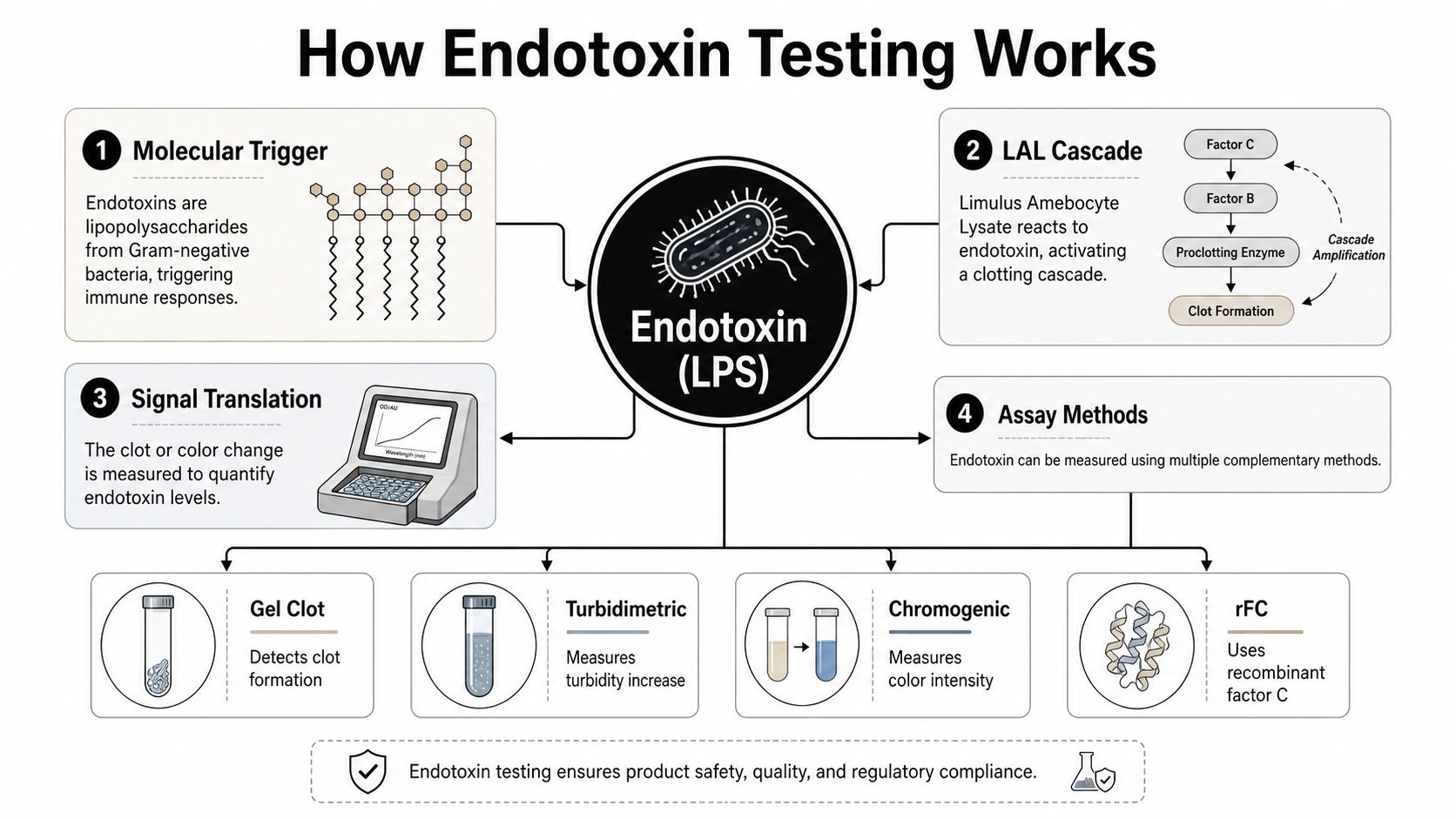
Think of endotoxin detection like a smoke detector tuned to a very specific kind of smoke. It does not wait for visible damage, and it doesn't need the whole fire, just the molecular trigger that tells the system something bacterial is present. That is why the chemistry is built around a cascade rather than a culture plate.
The LAL cascade in plain language
The classic method uses Limulus Amebocyte Lysate, or LAL, a clotting reaction from horseshoe crab blood cells. When endotoxin is present, the cascade activates and produces a measurable signal. The signal is then translated into a reading the lab can use for release decisions or matrix checks.
The assay family branches into different readouts. Gel-clot gives a clot or no clot result. Turbidimetric methods watch for increased cloudiness. Chromogenic methods measure color intensity. Each one is built on the same trigger-response idea, but they report the signal in a different way.
What the formats are really measuring
The format choice is less about philosophy and more about how the signal is captured. Gel-clot is simple and direct. Turbidimetric and chromogenic methods are easier to quantify because they turn the reaction into a measurable optical change. That matters when a lab needs more than a pass or fail answer.
Endotoxin Units, or EU, describe biological activity, not mass. Two samples with the same amount of material can behave differently if their endotoxin activity differs, which is why the unit is tied to the assay response rather than a chemical weight.
A useful shortcut, EU tells the lab how strongly the sample behaves in the assay, not how much bacterial material it contains by weight.
That distinction keeps the method grounded in function. The lab is not measuring a generic impurity, it is measuring a trigger that can provoke a biological response. Once that idea is clear, the later discussion about validation and limits makes much more sense.
Choosing Between LAL, rFC, and MAT Methods
Some labs still default to LAL because it's familiar and widely established, while others are moving toward recombinant approaches or cell-based alternatives. The right choice usually depends on the sample type, interference risk, and the level of regulatory comfort the workflow needs. A good method decision starts with the product, not with the instrument catalog.
| Method | Principle | Typical Sensitivity | Best Fit | Key Trade-off |
|---|---|---|---|---|
| LAL | Horseshoe crab lysate reacts to endotoxin through a clotting cascade | Varies by assay format | Routine QC for drugs, devices, water, and many research samples | Broad acceptance, but some matrices interfere and the supply chain depends on animal-derived material |
| rFC | Recombinant Factor C responds to endotoxin without animal lysate | Varies by platform | Labs looking for a recombinant option for cleaner sourcing and supply stability | Can require additional validation in regulated workflows |
| MAT | Human immune cells respond to pyrogenic stimuli | Broader pyrogen coverage | Samples where LAL interference is a problem or where a wider pyrogen picture is needed | More complex than LAL and not always the first choice for routine release |
Traditional LAL remains the default in many routine settings because it is familiar and technically direct. rFC appeals to teams that want to move away from animal-derived reagents. MAT becomes relevant when the question is broader than endotoxin alone, or when the sample matrix makes LAL hard to trust.
Sensitivity claims should always be read in context of the actual platform and validation package. A gel-clot screen, a kinetic chromogenic run, and a recombinant assay are not interchangeable just because they all target endotoxin. The better question is which one fits the material, the risk, and the release decision.
For a peptide supplier, for example, the decision often comes down to whether the assay must support routine QC, screen incoming lots, or troubleshoot a problematic matrix. That's why method selection is operational, not academic. A lab chooses the method that gives a defensible answer without introducing avoidable interference.
Regulatory Limits and EU/mL Thresholds
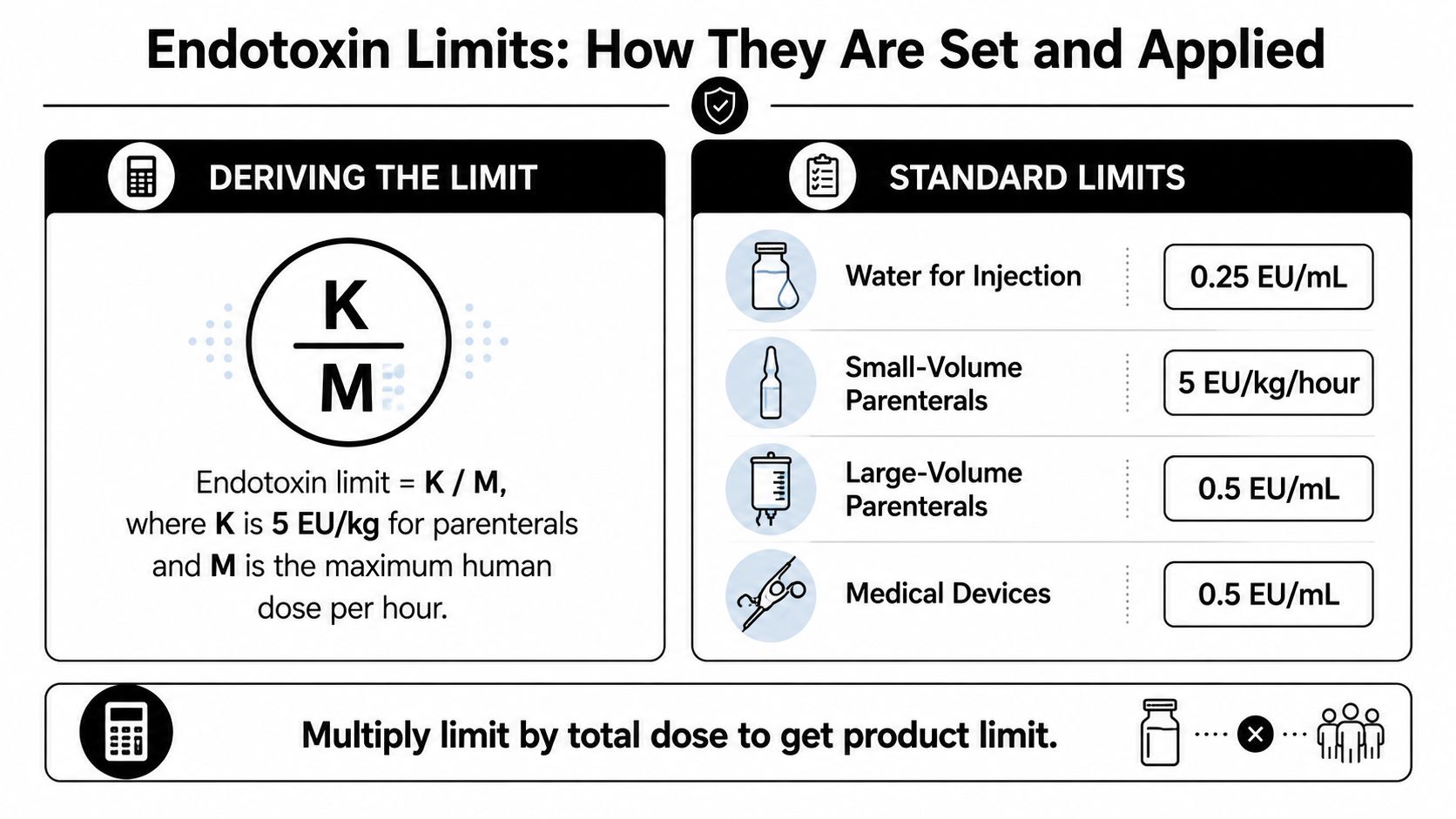
Regulatory language gets confusing because the limit is not one universal number. It depends on the product, the route of administration, and the risk associated with the contact site. A water product, a parenteral drug, and an intraocular device do not share the same tolerance.
How the limit is derived
The core idea is to calculate a product-specific limit using the dose relationship described in pharmacopeial practice. In the FDA guidance, Water for Injection, Sterile Water for Injection, and Sterile Water for Irrigation were each assigned 0.25 EU/mL in the records cited in the brief, and those values reflect a measurable contamination threshold rather than a vague cleanliness target. The same guidance also shows that endotoxin testing replaced older rabbit-based thinking with faster, more sensitive analytical control (FDA bacterial endotoxins and pyrogens guidance).
For medical devices, the limit is also product-specific. ANSI/AAMI ST72-derived limits cited by STERIS include <20 EU/device for circulatory-contacting devices, <2.15 EU/device for cerebrospinal-fluid-contacting devices, and <0.2 EU/device for intraocular devices (STERIS bacterial endotoxin testing guide). The tighter the anatomical site, the lower the tolerance.
Rule of thumb: higher-risk contact sites demand lower endotoxin limits, and the limit should match the route or device, not a generic lab habit.
Why these numbers matter in practice
Limits shape sampling, release, and lot disposition. A water system might be monitored as a process control point, while a device lot may need extraction and testing of defined samples before release. The limit is not just a label on paper, it drives how the lab prepares, samples, and accepts product.
That logic is also why compendial chapters matter. USP made bacterial endotoxin testing compendial in 1980 through General Chapter <85>, and later regulatory acceptance cemented the method as a standard QC tool (historical review of endotoxin testing). Once a method becomes compendial, the lab's job shifts from asking whether to test to asking how to test correctly for that specific product.
Sample Preparation for Peptides and Diluents
A peptide can look pristine and still fail the test if the reconstitution fluid or transfer tool carried endotoxin. That is why prep matters as much as the assay itself. The sample is only as clean as the vessel, solvent, and handling steps that touch it.
Where endotoxin hides in peptide workflows
Endotoxin can appear in bacteriostatic water, reconstitution solutions, glass vials, pipette tips, caps, and even on surfaces that look visually clean. Sterile is not enough, because the test detects non-viable bacterial components, not live microbes. A material can pass sterility and still fail endotoxin control, especially if the workflow uses water or contact surfaces that were never qualified for pyrogen risk.
The practical fix starts before the sample gets into the tube. Use endotoxin-free consumables, avoid mixing general-purpose labware into a pyrogen-sensitive workflow, and confirm whether a raw peptide powder, a finished solution, or both should be tested. Wholesale and reseller partners usually need visibility into both points, because contamination can enter during manufacture or during reconstitution.
Dilution, interference, and choosing the right solvent
A sample sometimes needs dilution to reduce inhibition or enhancement in the assay. That step only helps if the diluent itself is qualified. If the solvent carries endotoxin or interacts with the detection chemistry, the result stops being interpretable.
For peptide workflows, the decision tree is straightforward.
- Raw material testing: useful when the supplier needs to qualify incoming peptide lots before formulation.
- Finished solution testing: useful when the final product, reconstitution mix, or ready-to-use aliquot is what the customer receives.
- Both stages: sensible when a reseller wants traceability from ingredient to final vial.
The most important discipline is consistency. Use the same endotoxin-conscious handling for reconstitution solutions, storage vials, and transfer tools, or the result becomes a test of the workflow rather than the material. For a practical example of how peptide handling is framed in a supplier workflow, see this peptide reconstitution guide.
Validation, QA, and Troubleshooting Results
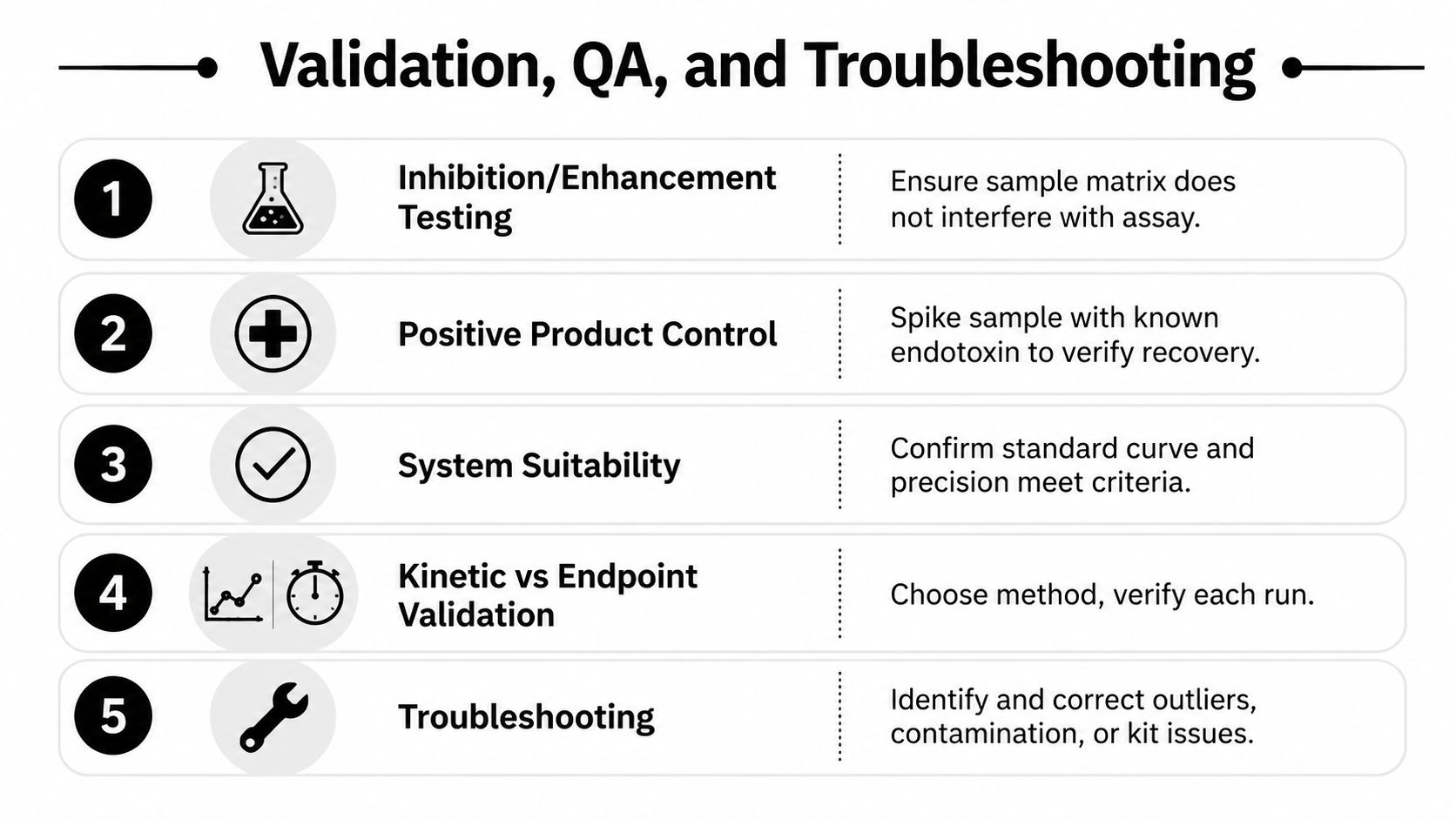
An endotoxin result is only useful if the run is valid. That means the sample matrix was checked for interference, the spiked control recovered as expected, and the method behaved the way the validation package says it should. Without those checks, a clean number can still be a bad number.
What to verify before trusting the result
Inhibition and enhancement testing tells the lab whether the sample matrix is suppressing or amplifying the assay signal. If the matrix interferes, the result may understate or overstate the true endotoxin content. Positive product control checks whether a known endotoxin spike can be recovered in that exact sample environment.
System suitability matters too. The standards, curve behavior, and replicate precision all need to meet the method's acceptance criteria before the run should support release or investigation. Kinetic and endpoint methods differ in how they're validated, so the lab should follow the specific platform's requirements rather than assuming every assay behaves the same way.
Troubleshooting the three failures that show up most often
When a run goes wrong, the first job is to find the failure mode, not to rerun the same mistake. The usual culprits are matrix interference, low spike recovery, or inconsistent replicates.
- Interference: review dilution, sample composition, and any buffer that could suppress the cascade.
- Low recovery on a spiked control: check the diluent, the endotoxin standard handling, and whether adsorption to the container is affecting the spike.
- Inconsistent replicates: inspect pipetting technique, timing, mixing, and whether the assay components were handled consistently across wells or tubes.
A contamination trail often leads back to water, glassware, transfer technique, or a utility that was assumed to be clean enough. The faster the team separates assay failure from sample contamination, the faster the investigation becomes useful.
For a broader QC workflow, a lab manager can keep the documentation chain tight by linking the endotoxin result to the lot record, the control record, and the sample prep record. A practical QC reference for that style of documentation is Herbilabs quality control testing.
When the spike fails, treat the run as a process audit, not just a bad result.
Choosing Reagents and Services With Confidence
The smartest buying decision is usually the one that reduces ambiguity later. An in-house LAL setup works when the lab has trained staff, qualified consumables, and enough volume to justify the method. A contract lab makes more sense when the sample is irregular, the matrix is troublesome, or the team needs a documented external result fast.

What belongs on the paperwork
A solid Certificate of Analysis should clearly identify the method, the endotoxin units, the limit of detection or reporting limit, and the spike recovery or validity criteria used for that lot. If that information is missing, the number is much harder to defend during a customer audit or internal review. The same standard should apply to diluents and reconstitution solutions, not just to finished drug-like materials.
Supplier vetting should also ask whether the reagent line is supported with clear batch documentation, sterile handling, and lot consistency. For peptide resellers and wholesalers, that matters as much as the assay result itself because the customer often needs both the material and the paper trail.
One practical option in that supply chain is Herbilabs supplier qualification criteria, which fits into the kind of documentation-first review many distributors already use.
Questions worth asking before onboarding a line
- What method is used: LAL, recombinant, or another validated approach.
- What documents are supplied: COA, lot traceability, and release criteria.
- How is endotoxin controlled: raw material, water, glassware, and final fill.
- How are complaints handled: replacement, investigation, and lot traceability.
- How are reconstitution solutions qualified: not just for sterility, but for endotoxin risk too.
Herbilabs provides RUO labware, sterile diluents, and COA-backed documentation for batches tested for contaminants, including endotoxins. For labs and distributors that want to qualify materials with fewer surprises, visiting Herbilabs is a sensible next step, especially when peptide handling, diluent choice, and QC paperwork all need to line up before release.


