Private Label, White Label, Wholesale partnerships available - EU, USA and UK - Free shipping from €75
What Is Bacteriostatic Water Used for: A Comprehensive Guide
Bacteriostatic water is primarily used as a sterile, multi-dose diluent for reconstituting lyophilized powders and diluting medications before intravenous, intramuscular, or subcutaneous injection. Its defining feature is 0.9% benzyl alcohol, a preservative that allows repeated withdrawals from a single multiple-dose vial when handled with proper aseptic technique.
Most readers asking what is bacteriostatic water used for are standing in one of two places. They either have a vial of expensive powder that needs to be reconstituted correctly, or they source reconstitution supplies and need to know what separates a compliant multi-dose diluent from a generic sterile liquid. In both cases, the primary issue isn't the label. It's workflow control.
A poor diluent choice can turn a clean preparation process into a contamination risk, a stability problem, or a documentation problem. A good one supports repeat withdrawals, cleaner inventory planning, and more reliable handling across the bench, clinic, warehouse, or reseller chain.
Table of Contents
- Why the Right Diluent Is Critical for Your Research
- Understanding Bacteriostatic Water Composition and Mechanism
- Primary Uses for Bacteriostatic Water in the Lab
- Choosing Your Diluent Bacteriostatic Water vs Alternatives
- Safe Handling Storage and the 28 Day Rule Explained
- A Note for Researchers and Wholesalers RUO and COAs
- Frequently Asked Questions About Bacteriostatic Water
Why the Right Diluent Is Critical for Your Research
A lyophilized peptide vial can look simple on the bench. It isn't. Once the seal is broken and the first milliliters go in, the quality of the diluent starts affecting everything downstream, including how the powder dissolves, how often the vial can be accessed, and how much avoidable waste enters the workflow.
That matters because reconstitution isn't a side task. It's a control point. Teams that handle biologics, peptides, hormones, and similar compounds need a diluent that fits the intended pattern of use, not one that merely looks interchangeable.
The scale of that need is easy to underestimate. The global bacteriostatic water for injection market was valued at USD 1.0 billion in 2022 and is projected to reach USD 2.0 billion by 2032, with a projected 7.8% CAGR, according to Market Research Future's bacteriostatic water market analysis. That isn't a niche consumable profile. It's a signal that multi-dose injectable preparation remains operationally important across research and biopharmaceutical settings.
Small vial, high consequence
For a researcher, the wrong choice often shows up as a handling problem. A vial meant for multiple withdrawals gets paired with a single-use diluent, or a preservative-containing diluent gets used without checking compound compatibility. For a wholesaler, the failure point is usually documentation. Product claims don't line up with labeling, concentration details are missing, or post-opening guidance is too vague to support customer use.
Practical rule: Treat the diluent as part of the method, not as packaging filler.
A professional setup starts by asking a short set of questions:
- How many withdrawals are expected: One reconstitution and immediate use is a different workflow from repeated withdrawals over days.
- What is being dissolved: Some compounds tolerate a broader pH and preservative profile than others.
- What does the buyer need to document: Research organizations and resellers often need clear labeling, preservative concentration, and use limitations.
- What failure is most expensive: In some labs it's contamination. In others it's wasted compound or a rejected batch.
Bacteriostatic water sits in that decision point because it was formulated for repeated-access preparation. Used correctly, it supports cleaner multi-dose handling. Used casually, it creates false confidence.
Understanding Bacteriostatic Water Composition and Mechanism
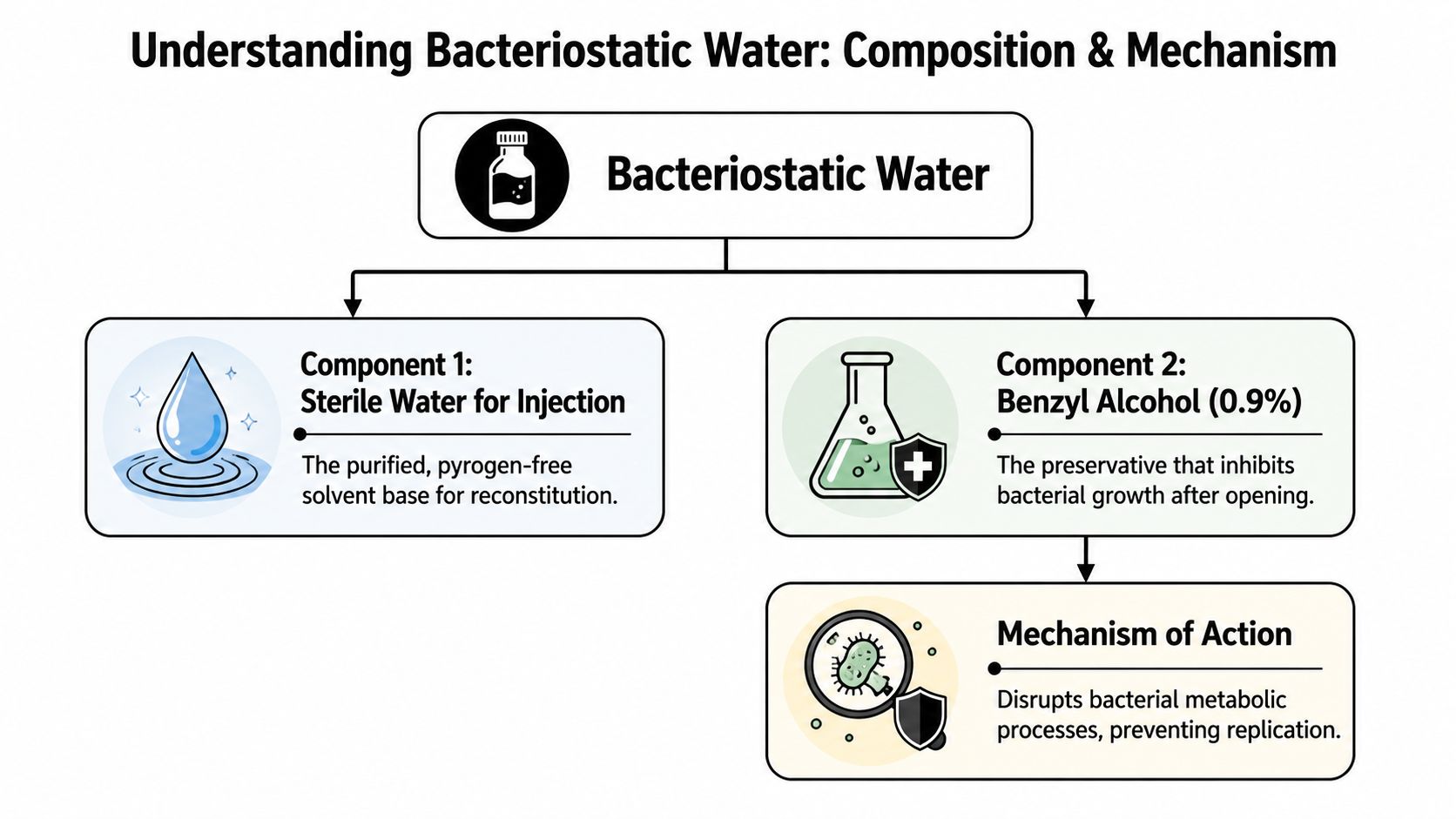
Bacteriostatic water isn't just sterile water with a different name. It is a specific formulation with a specific job. Understanding that formulation helps explain both its value and its limits.
What is actually in the vial
According to FDA labeling on DailyMed for Bacteriostatic Water for Injection, it is sterile water for injection containing 0.9% (9 mg/mL) benzyl alcohol as a preservative. It is supplied in a multiple-dose container and has a pH of approximately 5.7, with a range of 4.5 to 7.0. The same labeling states that it is intended only for dissolving or diluting drugs before injection and is not for use in neonates.
That short specification explains most of its practical role.
- Sterile water for injection: This is the solvent base.
- Benzyl alcohol: This is the preservative that supports repeated withdrawals.
- Multiple-dose packaging: This tells the user the vial is designed around repeated access, not one puncture and discard.
- Defined pH range: This affects compound compatibility and is one reason "water is water" is a bad assumption.
What bacteriostatic means in practice
The word bacteriostatic doesn't mean bacteria are killed on contact. It means bacterial growth is inhibited. In handling terms, that's a major distinction.
If a stopper is punctured repeatedly under good aseptic technique, the preservative helps reduce microbial growth risk during the allowed use window. If contamination is introduced through poor handling, the vial doesn't reset itself back to sterile condition. The preservative is protective, not magical.
A multi-dose vial is safer than an unpreserved alternative only when the operator treats each withdrawal as a contamination event to be prevented.
Many product descriptions are misleading here. They imply "longer-lasting water," though its actual function is narrower and more useful. Bacteriostatic water is designed to support controlled repeated withdrawals from one vial.
Why the formulation matters to compatibility
The pH and preservative system make bacteriostatic water suitable for many compounds, but not all of them. Researchers should check whether the compound's preparation instructions call for a preservative-free diluent or another vehicle. Wholesalers should avoid blanket compatibility language unless the original product documentation supports it.
A good technical listing will identify the formulation plainly. It won't blur the line between a vehicle and a therapeutic product.
Primary Uses for Bacteriostatic Water in the Lab
The clearest answer to what is bacteriostatic water used for is this: it is used when a compound must be dissolved or diluted before injection and the workflow benefits from repeated withdrawals from the same vial.

Reconstituting lyophilized compounds
One of the most common lab uses is reconstituting lyophilized powders. That includes research peptides and other compounds supplied in dry form because the powder is easier to store and ship before mixing.
In practice, the appeal is operational. A preserved multi-dose diluent gives the handler more control when the reconstituted preparation won't be consumed in a single draw. That is why peptide researchers and resellers often pair these vials with SOPs for precise mixing volumes and clear dating practices. For a practical example of that workflow, this guide to mixing peptides with bacteriostatic water shows how buyers often approach reconstitution planning.
Supporting repeat-dose workflows
Bacteriostatic water is also used to dilute medications that will be accessed more than once after preparation. The product's role is still the same. It is a vehicle, not a treatment. But in a repeated-access environment, that distinction matters because the vial supports a process, not an outcome by itself.
Typical settings include:
- Peptide preparation: Useful when a freeze-dried research compound needs a measured liquid volume before aliquoting.
- Hormone therapy preparation: Common in workflows where repeated withdrawals are expected from a prepared vial.
- Injectable drug dilution: Relevant when a product is supplied concentrated and must be diluted before use.
- Lab inventory control: One multiple-dose vial can simplify stocking compared with managing many single-use units for the same repeated-access task.
A second benefit is reduced unnecessary disposal in workflows built around multiple withdrawals. Instead of puncturing and discarding a single-use diluent each time, the preserved vial supports repeated access when handled correctly.
Some readers prefer to see the handling sequence demonstrated before writing or revising an SOP. This walkthrough is useful for that purpose:
What it should not be used for
The most common misuse is treating bacteriostatic water as if it were a general-purpose injectable liquid. It isn't. Its intended role is to dilute or dissolve another drug or compound before injection.
If the workflow doesn't require a preserved multi-dose vehicle, bacteriostatic water may not be the right choice.
That point protects both research integrity and product positioning. For a lab, it prevents sloppy substitutions. For a reseller, it avoids overbroad claims that create regulatory and customer-service problems later.
Choosing Your Diluent Bacteriostatic Water vs Alternatives
Most buying mistakes happen because people compare labels instead of use cases. Bacteriostatic water, sterile water for injection, and sterile saline can all appear interchangeable at a glance. They aren't.
Diluent Comparison
| Characteristic | Bacteriostatic Water | Sterile Water for Injection | Sterile Saline (0.9% NaCl) |
|---|---|---|---|
| Preservative present | Yes, benzyl alcohol | No | Not the defining feature in this comparison |
| Typical workflow fit | Multi-dose preparation | Single-use or immediate-use preparation | Situations where isotonic saline is the required vehicle |
| Repeated withdrawals | Designed for repeated access under aseptic technique | Generally a poor fit for repeated withdrawals | Depends on product format and intended use |
| Composition focus | Water plus preservative | Water only | Water plus sodium chloride |
| Best use question | Will this vial be accessed more than once? | Is this a one-time preparation? | Does the protocol require saline rather than plain water? |
A catalog page shouldn't decide this for the buyer. The method should.
For teams that need a plain diluent specification without preservatives, products listed as water for injection fit a different use case than bacteriostatic water. That's the key distinction. Not branding, but workflow intent.
When sterile water makes more sense
Sterile water for injection is the better choice when the preparation is single-use or immediate-use and there is no reason to maintain a preserved multi-dose vial. It avoids preservative exposure and removes any assumption that repeated withdrawals are acceptable.
This matters in tightly controlled reconstitution steps where the vial is opened, used once, and discarded according to protocol. In that context, bacteriostatic water's preservative offers no real advantage.
Use sterile water when:
- The compound instructions specify preservative-free dilution
- The reconstituted material will be prepared once and used immediately
- The workflow is designed to eliminate repeat punctures altogether
When saline is the better fit
Sterile saline serves a different purpose because it contains sodium chloride. That means it shouldn't be treated as a substitute just because it is sterile and injectable-grade. If the protocol or product documentation calls for isotonic saline, then saline is the appropriate vehicle.
This is especially important for distributors writing product copy. "Sterile" is not enough information. The relevant question is whether the compound requires water, preserved water, or saline.
The wrong comparison is "Which one lasts longer?" The right comparison is "Which vehicle matches the compound and the withdrawal pattern?"
The decision logic buyers actually need
A practical purchasing rule looks like this:
- Start with the compound requirement. If instructions call for a specific vehicle, that ends the discussion.
- Check expected vial access. Repeated withdrawals favor a preserved multi-dose product.
- Review documentation quality. The listing should state formulation, limitations, and handling guidance clearly.
- Avoid convenience substitutions. Saline, sterile water, and bacteriostatic water solve different problems.
That logic reduces errors on both sides of the transaction. Researchers make cleaner preparation decisions. Wholesalers reduce returns, misuse complaints, and customer confusion.
Safe Handling Storage and the 28 Day Rule Explained
The most misunderstood part of bacteriostatic water isn't what it is. It's how long people think it remains safe after opening, and why.
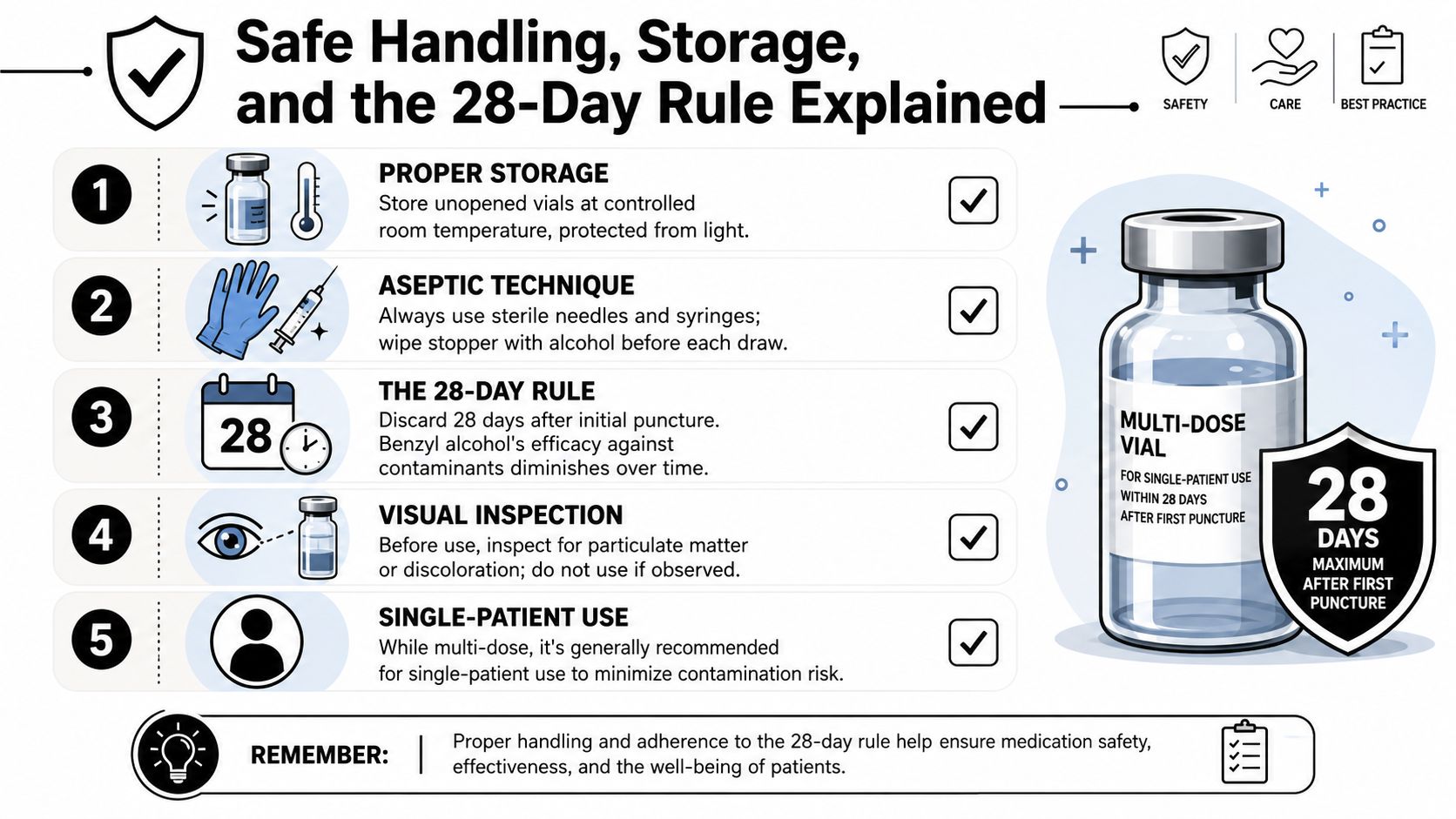
According to Molewater's explanation of bacteriostatic water use and handling, bacteriostatic water is a vehicle only and should be used after adding drugs that require dilution. Common practice allows for up to 28 days of use after opening, but that window depends on strict aseptic technique, because the preservative only inhibits growth and does not sterilize a contaminated solution.
Why the 28-day limit exists
The 28-day rule is often repeated as if it were a simple shelf-life claim. It isn't. The better way to understand it is as a risk-management window for a preserved multi-dose container that is being punctured over time.
Each stopper puncture introduces opportunity for contamination. The benzyl alcohol helps inhibit bacterial growth, but it doesn't reverse poor handling. So the practical meaning of the rule is not "this vial stays sterile for 28 days no matter what." The meaning is "this vial may support repeated withdrawals within a limited period if aseptic practice is maintained."
Write the first puncture date on the vial immediately. Memory is not a control system.
Handling steps that protect vial integrity
Safe use is procedural. Teams that handle bacteriostatic water well tend to standardize a few essential steps:
- Disinfect the stopper every time: Use an alcohol wipe and let the surface dry before puncture.
- Use a fresh sterile needle and syringe: Reusing hardware defeats the purpose of a preserved vial.
- Minimize unnecessary punctures: Plan withdrawals to avoid casual repeated access.
- Store the vial away from heat and light: Consumer-facing guidance commonly states this because poor storage adds avoidable stress to the product.
- Inspect before every use: If the solution isn't clear or the closure looks compromised, don't use it.
A vial can look acceptable on a shelf and still be mishandled in practice. That's why a clean SOP matters more than a clean label.
What does not work
Several habits create preventable risk:
- Treating the preservative as a sterilizer
- Ignoring the opening date
- Leaving the vial in uncontrolled conditions
- Using the same vial across sloppy, mixed handling environments
- Assuming "clear" always means "safe"
Visual inspection helps, but it is not a substitute for proper handling history. If technique is uncertain, discard is the safer decision.
A Note for Researchers and Wholesalers RUO and COAs
In research supply, documentation is part of the product. That is especially true for sterile diluents.
The detail many buyers miss is that bacteriostatic water can be easy to misuse commercially even when the formulation itself is correct. A seller may have the right preservative concentration and still create problems through vague intended-use language, poor batch paperwork, or loose product claims. In such cases, RUO status and Certificates of Analysis become practical, not administrative.
Why RUO language matters
Research Use Only language defines the commercial and compliance boundaries of the product. It tells buyers how the supplier positions the material and what claims are not being made. For distributors and peptide resellers, that boundary matters because overreaching marketing language creates downstream liability and confusion.
A clear explanation of the term appears in this Research Use Only definition guide. The useful takeaway for buyers is simple. RUO labeling should be specific, visible, and consistent with the rest of the documentation.
One supplier option in this category is Herbilabs, which offers RUO bacteriostatic water and related sterile diluents for research supply workflows. The relevant point isn't branding. It's that the product category should be matched with the correct intended-use language, batch documentation, and handling guidance.
What wholesalers should verify before buying
A distributor evaluating a bacteriostatic water supplier should ask for documentation before discussing price tiers or label design. The minimum review should include:
- Formulation confirmation: The paperwork should identify that the product contains benzyl alcohol and is positioned as a preserved reconstitution vehicle.
- Batch-specific COA availability: A Certificate of Analysis helps verify what the supplier says is in the vial.
- Storage and discard guidance: Buyers need exact handling language, especially around repeated withdrawals.
- Packaging consistency: Multi-dose claims should align with the actual product format and labeling.
- Use limitation clarity: Product copy should not blur RUO products into general therapeutic claims.
According to this practical discussion of the 28-day rule and contamination risk, the discard window depends on the preservative's ability to inhibit microbial growth under repeated withdrawals, but that only works with proper aseptic technique because benzyl alcohol does not sterilize a contaminated vial. That nuance is exactly why wholesalers need clean documentation. Customers need to know what protection the product offers, and what it doesn't.
A COA doesn't replace good handling, but it does separate a documented product from a speculative one.
For research organizations, the value of this paperwork is traceability. For resellers, it is credibility. For both, it reduces the chance that product quality questions turn into preventable disputes.
Frequently Asked Questions About Bacteriostatic Water
Can bacteriostatic water be used by itself
It shouldn't be treated as a standalone solution for general use. Its intended role is as a vehicle to dissolve or dilute another drug or compound before injection.
How can a vial signal that it should not be used
A practical rejection check includes cloudiness, visible particles, discoloration, damaged seals, or uncertainty about how the vial was handled after opening. If storage history or puncture history is questionable, discarding the vial is usually the safer choice.
Is bacteriostatic water the same as saline
No. Saline contains sodium chloride. Bacteriostatic water is water with benzyl alcohol preservative. They solve different preparation problems.
Why do peptide users prefer it for some workflows
The usual reason is repeated access. When a reconstituted preparation will be withdrawn more than once, a preserved multi-dose diluent can fit the workflow better than a single-use unpreserved alternative, assuming the compound is compatible and the handling is controlled.
Is bacteriostatic water automatically the best option
No. It is the right option only when the compound and the method support a preserved multi-dose diluent. Single-use preparation may call for sterile water instead, and some protocols require saline or another vehicle entirely.
Researchers and wholesalers who need documented sterile diluents, clear RUO positioning, and batch-level product information can review the available options at Herbilabs. The practical standard is straightforward: choose a supplier that states the formulation clearly, provides COAs, and gives handling guidance that matches how bacteriostatic water is used.