Private Label, White Label, Wholesale partnerships available - EU, USA and UK - Free shipping from €75
What Is Bacteriostatic Water Used for? Complete Guide 2026
Bacteriostatic water is a sterile diluent that contains 0.9% benzyl alcohol and is used primarily to dissolve or dilute substances for injection, especially in multi-dose workflows such as reconstituting lyophilized peptides. In practical use, the preservative is what makes repeated withdrawals from the same vial possible for a limited period, which is why it matters so much in research settings that depend on consistent preparation.
A familiar problem in any lab or prep workflow is this: the powder was good, the calculation was correct, the syringe was sterile, yet the result still isn't trustworthy. Often the weak point isn't the active compound at all. It's the liquid used to bring that compound into solution and the way that liquid was handled across repeated vial access.
That is where bacteriostatic water becomes more than a commodity item. In research, distribution, and peptide preparation, it functions as a control point for consistency, contamination management, and reproducibility. A vial that will be punctured more than once needs a different risk profile than a vial intended for single use. Teams that ignore that distinction usually create unnecessary variability in their handling process.
For wholesalers and peptide resellers, the question "what is bacteriostatic water used for" isn't just about product definition. It's also about advising buyers correctly, reducing preventable misuse, and supporting workflows that remain stable from the first withdrawal to the last. For researchers, the same question sits closer to data integrity. If the diluent changes the handling burden, then it also changes the reliability of the preparation process.
Table of Contents
- Introduction Why a Simple Diluent Is Critical for Research Integrity
- The Science Behind Bacteriostatic Water
- Bac Water vs Sterile Water vs Saline
- Key Applications in Research and Peptide Reconstitution
- Safe Handling Storage and Shelf Life
- Regulatory Considerations and Practical FAQs
Introduction Why a Simple Diluent Is Critical for Research Integrity
Inconsistent downstream results from a seemingly clean peptide preparation often trace back to the diluent and handling chain, not the peptide itself. I see the same pattern repeatedly. The vial reconstitutes clearly, the math on the dilution is correct, and the assay still drifts because the preparation process was treated as routine instead of controlled.
Bacteriostatic water for injection is a sterile diluent used to dissolve or dilute injectable compounds. That sounds simple, but in research and distribution settings, the practical role is much larger. The choice of diluent affects how a vial is accessed, how long it remains usable within procedure, how teams document use, and how reliably one operator can reproduce another operator's work.
That narrow use case matters because it sets the boundary for good practice. Bacteriostatic water is not interchangeable with every other sterile liquid on the bench, and it should not be treated as an afterthought once the powder vial arrives.
Why reproducibility starts at preparation
Reproducibility problems often begin before the first analytical readout. They start during reconstitution, during repeated vial access, and during storage between uses. If those steps are inconsistent, the resulting variation gets blamed on the peptide, the assay, or the instrument, even when the actual failure point was the preparation workflow.
For repeated-use workflows, three factors decide whether the diluent supports consistent results:
- Preparation consistency: The same reconstitution method, concentration target, and withdrawal practice reduce run-to-run variation.
- Aseptic handling: A preserved vial still requires clean technique every time the stopper is punctured.
- Traceable records: First puncture date, storage conditions, and visible vial status should be documented if the preparation is expected to support defensible results.
Practical rule: If concentration accuracy and contamination control affect the outcome, the diluent is part of the method, not a background supply item.
This is a research integrity issue as much as a handling issue. A team cannot claim strong reproducibility if one of the most repeated steps in the workflow is loosely controlled.
Why wholesalers and research buyers should care
For wholesalers, procurement teams, and research buyers, the question is rarely just what bacteriostatic water is used for. Instead, the key question is whether it fits the workflow they are trying to standardize. Buyers want to know if it supports repeated withdrawals, whether it reduces unnecessary waste compared with single-use options, and whether it helps labs maintain a cleaner, more consistent preparation routine.
This topic is therefore commercially and scientifically significant. A preserved sterile diluent can improve day-to-day consistency, but only when the buyer understands the trade-off. Greater convenience in multi-use handling still depends on disciplined storage, accurate labeling, and strict puncture control. Without that discipline, the product's intended advantage turns into another uncontrolled variable.
The Science Behind Bacteriostatic Water
A lab reconstitutes the same peptide across several sessions, from the same vial, with different operators on different days. If the diluent does not support controlled repeat access, that routine step becomes a source of avoidable variation. Bacteriostatic water is designed to reduce that risk when the method calls for multiple withdrawals from one container.

It is sterile water formulated with 0.9% benzyl alcohol as a preservative. That preservative does not sterilize poor technique after the fact. Its role is narrower and more useful than that. It helps inhibit bacterial growth during intended multi-dose use, which is why bacteriostatic water sits in a different workflow category than plain sterile water. For buyers comparing formats, the difference is easiest to understand by reviewing the product class for water for injection and preserved multi-use diluents.
The meaning of bacteriostatic
"Bacteriostatic" refers to growth inhibition, not microbial elimination. That distinction matters in practice because researchers sometimes treat the preservative as a margin for error. It is not. The vial still depends on clean stopper disinfection, sterile withdrawal technique, correct labeling, and disciplined storage after first puncture.
In other words, the preservative supports a controlled method. It does not compensate for an uncontrolled one.
Why the preservative changes workflow
The presence of benzyl alcohol changes how the vial can be used after puncture. A preserved sterile diluent can support repeated withdrawals under defined handling conditions, which makes it useful in workflows where one preparation session is followed by another and concentration consistency has to hold across both.
That has direct operational consequences:
- Repeat access becomes practical. One vial can support multiple withdrawals for reconstitution or dilution when the protocol calls for it.
- Method control becomes more visible. First-puncture dating, stopper sanitation, and withdrawal records matter because the same vial remains in circulation.
- Inventory behavior changes. Labs and wholesalers can match stock to repeat-use workflows instead of forcing single-use replacement at every preparation event.
- Waste may decrease. In repetitive prep environments, preserved multi-dose formats often reduce unnecessary discard compared with opening a new single-use diluent each time.
- Operator discipline matters more, not less. Convenience increases the temptation to overuse a vial beyond its documented handling limits.
The practical trade-off is straightforward. Bacteriostatic water gives a well-run lab more flexibility in repeat-access work, but it also requires tighter procedural control to protect reproducibility.
The science users often miss
A common comparison labels bacteriostatic water as "better sterile water." This comparison is inaccurate. It is more precise to say it is sterile water formulated for controlled multi-dose handling.
That distinction is why it appears so often in peptide preparation and other repeat-access workflows. The water is not doing something mysterious. The formulation is reducing one specific source of variability in the handling process. For researchers, that improves consistency between prep events. For wholesalers and procurement teams, it means the diluent choice affects how reliably a customer can reproduce the same method over time.
Bac Water vs Sterile Water vs Saline
Confusion between these three products causes preventable errors. The labels sound similar, the vials look similar, and the user may assume the difference is minor. It isn't. Composition drives use case.
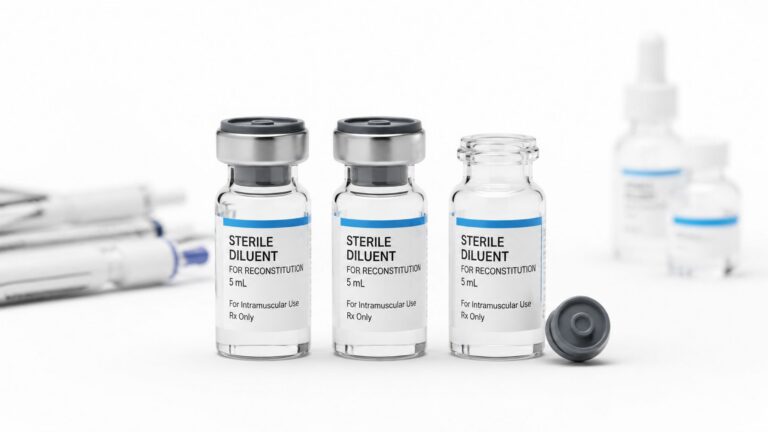
This visual helps frame the kind of lab and supply context where correct diluent selection matters.

Diluent comparison at a glance
| Characteristic | Bacteriostatic Water | Sterile Water for Injection | Normal Saline (0.9% NaCl) |
|---|---|---|---|
| Preservative | Contains 0.9% benzyl alcohol | No preservative | Salt solution, not a preservative format |
| Typical use pattern | Multi-dose handling when repeated withdrawals are expected | Single-use style handling | Used when isotonicity matters from the start |
| Best fit | Reconstitution and dilution where the vial may be accessed repeatedly | One-time preparation where preservative isn't desired | Situations where sodium chloride content is required |
| Main trade-off | Preservative present, so it isn't appropriate for every situation | Less suited to repeated vial access | Not interchangeable with water-based diluents |
| Research concern | Better aligned with repeat-access workflows | Higher handling burden if multiple preparations are needed | Changes solution composition immediately |
For buyers comparing options, water for injection product categories are easier to evaluate when the choice is tied to the intended workflow rather than to vague preference.
How to choose without guessing
A practical decision framework is simpler than many users expect.
Choose bacteriostatic water when the job involves reconstitution or dilution and the same vial will likely be punctured multiple times over a short, controlled period. That is the case in many peptide workflows, small-batch preparation routines, and repeated lab withdrawals.
Choose sterile water for injection when the preparation is intended for one-time use or when a preservative shouldn't be part of the formulation. That choice reduces preservative exposure but increases the burden of opening and managing fresh diluent more often.
Choose normal saline when isotonicity is required from the outset. Saline is not just "another sterile liquid." It changes the composition of the final preparation because it contains sodium chloride.
Trade-offs that actually matter in use
Users often compare these products on convenience first. The better approach is to compare them on fit for method.
- Repeated withdrawals: Bacteriostatic water is the practical fit.
- Single-event preparation: Sterile water is often the cleaner choice.
- Composition-sensitive systems: Saline may be necessary, but only when the formulation calls for it.
One more point matters clinically and operationally. Benzyl alcohol isn't appropriate for every population. When buyers distribute preserved diluents, they need to communicate that the presence of benzyl alcohol is not a trivial labeling detail. It determines suitability.
Key Applications in Research and Peptide Reconstitution
The clearest answer to what is bacteriostatic water used for appears in day-to-day preparation work. It is used where a dry or concentrated material must be brought into solution and that prepared material won't be consumed in a single access event. Research peptides are the obvious example, but not the only one.
Where bacteriostatic water fits best
The primary operational use of bacteriostatic water is reconstituting lyophilized drugs, and the preservative allows a single vial to support repeated withdrawals over a 28-day in-use window, reducing vial waste and handling events compared with single-use sterile water, as explained by Empower Pharmacy's review of bacteriostatic water in compounding.
That matters in research because repeat access is where inconsistency starts. A lyophilized peptide may be stable as a dry cake, but once reconstituted, every withdrawal becomes a handling event with a contamination risk and a concentration control risk. A preserved sterile diluent helps manage the first problem. The operator still has to manage the second.
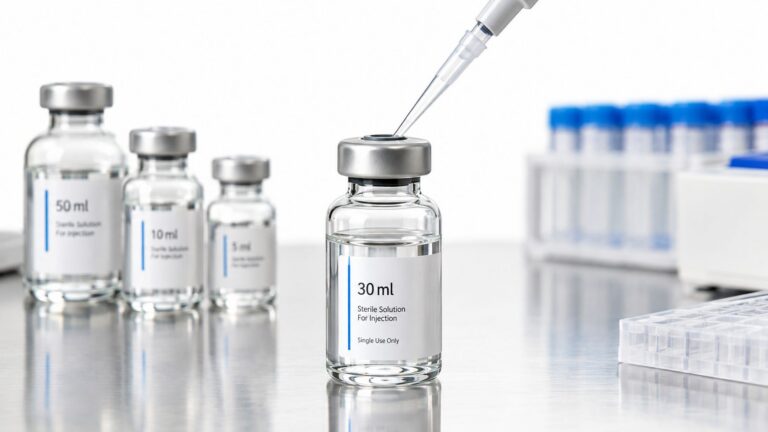
This infographic shows the basic flow used in professional reconstitution practice.

Typical research-facing uses include:
- Lyophilized peptide reconstitution: Useful when a powder must be dissolved for repeated measured withdrawals.
- Concentrated injectable dilution: Relevant when a stock solution needs a sterile diluent before use.
- Compounded multi-dose protocols: Appropriate when the same support vial is part of a short-term repeat-access routine.
- Low-burden lab preparation: Helpful in workflows where minimizing repeated opening of fresh single-use diluent is operationally valuable.
A detailed peptide mixing reference such as how to mix peptides with bacteriostatic water is useful when buyers or resellers need a practical example of how this plays out step by step.
A practical reconstitution workflow
The workflow is simple on paper, but the details separate reproducible preparation from careless prep.
Start with a clean workspace, the powder vial, the bacteriostatic water vial, sterile syringe hardware, and alcohol swabs. Inspect both stoppers and both vials before doing anything else. If packaging integrity or solution clarity is questionable, that vial shouldn't enter the workflow.
Then swab both stoppers and let them dry. Draw the required volume of bacteriostatic water with a sterile syringe. Inject the liquid slowly into the lyophilized vial, ideally down the side of the glass rather than blasting directly into the powder cake. That reduces foaming and mechanical stress on delicate materials.
A demonstration can help teams standardize the motion and sequence used in preparation.
Once the liquid is in the vial, mix gently. Swirl. Don't shake aggressively. The goal is to dissolve the material fully without introducing unnecessary turbulence.
Workflow note: Good reconstitution protects both sterility and concentration accuracy. A clear final solution doesn't prove the process was clean, but poor technique often shows up later as drift, waste, or unexplained variability.
What works and what fails
What works is boring. The same supplies, the same aseptic sequence, the same labeling habit, and the same storage decision every time. That is exactly why it supports reproducibility.
What fails is usually a shortcut:
- Reusing access tools: This adds contamination risk immediately.
- Skipping stopper disinfection: This turns each puncture into an uncontrolled variable.
- Over-handling the vial: Repeated unnecessary manipulation adds avoidable exposure.
- Using the wrong diluent by habit: This causes method drift before the experiment starts.
For product sourcing, one example in this category is Herbilabs Bacteriostatic Water / Reconstitution Solution in glass vials for research workflows, which aligns with the kind of repeat-access preparation described here.
Safe Handling Storage and Shelf Life
A vial can stay clear, sealed, and still be unusable for any workflow that has to stand up to review. That is the point many teams miss. Bacteriostatic water supports repeat access because it contains benzyl alcohol as a preservative, but that does not protect a poor process, missing dates, or uncertain storage history.
For research work, handling discipline is tied directly to reproducibility. If one technician dates the vial, swabs the stopper every time, and discards on schedule while another does not, the diluent stops being a controlled input and becomes another source of variation.
Required handling protocols
As noted earlier, product labeling sets the baseline conditions for use and storage. In practical terms, unopened vials belong at controlled room temperature, and opened vials need a clear discard date based on first puncture. Multi-dose use only works when each access follows the same aseptic routine.

Use the same handling sequence every time:
- Disinfect the stopper before each puncture: The surface has to be cleaned at every access point, not just when the vial is first opened.
- Use a new sterile needle and syringe for each withdrawal: Multi-dose refers to the vial, not to the access hardware.
- Write the first puncture date on the vial immediately: If no one can verify when it was opened, no one can defend keeping it in use.
- Check the vial before drawing from it: Discoloration, particles, cloudiness, or closure damage are discard triggers.
- Limit unnecessary handling: Every extra puncture and every avoidable contact increases exposure risk.
Small lapses create large downstream problems. A contaminated or poorly documented diluent can shift concentration confidence, force reruns, and weaken the chain of custody around sample preparation.
Storage discipline and discard decisions
The hardest rule for many labs is not storage temperature. It is discarding an opened vial on time even when volume remains and the solution still looks normal. Appearance is a weak quality check. It does not confirm sterility, preservative performance, or handling quality across repeated access.
That is why the 28-day in-use limit matters operationally. It gives researchers, prep staff, and distributors a defined handling window that can be applied consistently across teams. Once that window is exceeded, the vial no longer supports a preparation record with the same level of confidence.
A clear vial is not automatically a usable vial.
Discard decisions should be immediate if the cap or stopper has been compromised, if foreign material is visible, or if storage conditions cannot be verified. In a controlled workflow, uncertainty is enough reason to remove the vial from use.
For wholesalers and research suppliers, this is also a documentation issue. Storage instructions, puncture dating, and in-use limits should be taught as part of the product standard, especially for buyers operating under research use only requirements. That training helps preserve consistency across receiving, storage, resale, and final preparation.
Regulatory Considerations and Practical FAQs
Bacteriostatic water often sits in a gray area for buyers because the product is simple but the use context isn't. In research supply channels, that means compliance language has to stay precise. A sterile diluent sold for laboratory workflows isn't automatically a general-use clinical product just because the chemistry is familiar.
Research use only in practical terms
For research suppliers, Research Use Only means the product is supplied for laboratory and investigational workflows, not for direct human therapeutic or diagnostic use. That distinction protects both the seller and the buyer from sliding into unsupported claims or unsupported applications. A plain-language reference on that point is Herbilabs' explanation of the research use only definition.
For wholesalers and resellers, RUO status affects how the product is described, who it is sold to, and what usage guidance can be provided. The safest commercial practice is to stay close to the product's actual role: a sterile preserved diluent used in controlled preparation workflows.
Common questions that affect liability and use
Is bacteriostatic water compatible with all peptides?
No blanket answer is safe. Compatibility depends on the material being reconstituted and the instructions attached to that material. The correct approach is to verify the reconstitution guidance for the specific product, not to assume all lyophilized compounds behave the same way.
What are the risks of using it past the labeled in-use period?
The main issue is loss of a defensible contamination-control window. Once a vial goes past its intended opened-life, the user no longer has a reliable basis for treating it as a controlled multi-dose diluent.
Can a lab make its own bacteriostatic water?
That is a bad idea for any workflow that depends on traceable quality and reproducibility. Sterility, preservative concentration, packaging integrity, and labeling control all matter. Improvised preparation undermines all four.
What if benzyl alcohol isn't appropriate for the use case?
Then a different diluent should be selected. The presence of benzyl alcohol is the central feature of bacteriostatic water, so if that preservative is unsuitable, the answer isn't to work around it. The answer is to use the correct alternative.
Is it ever the right choice as a standalone injection?
No. Its role is as a solvent or diluent, not as a medication by itself.
A supplier that answers these questions clearly does more than move product. It helps protect method integrity, reduce misuse, and support customers who need repeatable preparation rather than trial-and-error handling.
Researchers and distributors who need a sterile diluent for controlled repeat-access workflows can review Herbilabs as one laboratory supply option for RUO bacteriostatic water, reconstitution solutions, and related labware used in peptide and reconstitution settings.