Private Label, White Label, Wholesale partnerships available - EU, USA and UK - Free shipping from €75
Sterile Water for Irrigation: A Guide for Labs & Resellers
A surprising number of failed lab runs start with a basic handling choice, not a complex assay problem. The peptide was weighed correctly. The vial looked fine. The protocol was followed closely. Then the result drifts, the sample clouds, or the data won't reproduce. Very often, the issue sits upstream in the diluent.
That matters because sterile water for irrigation isn't just “clean water.” It's a specific sterile product with a defined purpose, defined limits, and a very different risk profile depending on whether the context is clinical irrigation or research reconstitution. For wholesalers, that distinction affects product positioning, labeling, and downstream compliance. For peptide researchers, it affects stability decisions, workflow discipline, and whether a single-use sterile product is being used in a way that matches the experiment.
The practical problem is that buyers often group sterile water, bacteriostatic water, saline, and distilled water into one mental bucket. They're not interchangeable. A lab that treats them as interchangeable usually creates preventable variability. A reseller that markets them loosely creates preventable regulatory exposure.
Table of Contents
- Why a Simple Liquid Is a Critical Research Variable
- Defining Sterile Water for Irrigation
- Understanding Key Purity Standards and Specifications
- Comparing Sterile Water to Saline and Other Diluents
- Clinical Use Cases Versus Research Applications
- Best Practices for Handling and Storage
- Selection Criteria for Wholesalers and Researchers
Why a Simple Liquid Is a Critical Research Variable
A diluent choice can subtly alter an otherwise careful workflow. When a lyophilized peptide doesn't dissolve as expected, or a prepared solution behaves differently from one batch to the next, many teams first suspect peptide quality, storage conditions, or pipetting error. The liquid used for reconstitution often gets checked last, even though it should be checked first.
That's because the diluent controls more than convenience. It affects how the material enters solution, how long the prepared sample can realistically be handled, and whether the process stays aligned with the intended use of the product. In research settings, especially peptide work, these aren't minor details. They shape reproducibility.
Why “water is water” fails in practice
Sterile water for irrigation looks deceptively simple. It contains no added preservative, no antimicrobial agent, and no added buffer. That simplicity is useful in some workflows and a liability in others. A researcher who needs a single, immediate preparation may value a sterile, solute-free liquid. A researcher planning repeated vial access usually needs to stop and reassess the choice.
A wholesaler faces a parallel issue. Product names that sound similar can invite misuse if the catalog copy is vague. If a buyer looking for a reconstitution solution receives a product intended and labeled for irrigation, the compliance problem starts long before the bottle is opened.
Practical rule: If the success of the protocol depends on storage after opening, repeated withdrawals, or casual room-temperature handling, the wrong question is often being asked. The first question should be whether sterile water for irrigation matches the workflow at all.
The variable that affects both results and compliance
For peptide researchers, the distinction is operational. For resellers, it is also legal and reputational. Research Use Only positioning has to be unambiguous, and product descriptions can't blur into therapeutic or human-use language.
This is why sterile water for irrigation deserves more attention than it usually gets. It sits at the intersection of sterility, handling discipline, documentation, and labeling. Used with the right expectations, it can be a clean, purpose-built tool. Used casually, it becomes a source of experimental noise or a compliance mistake.
Defining Sterile Water for Irrigation
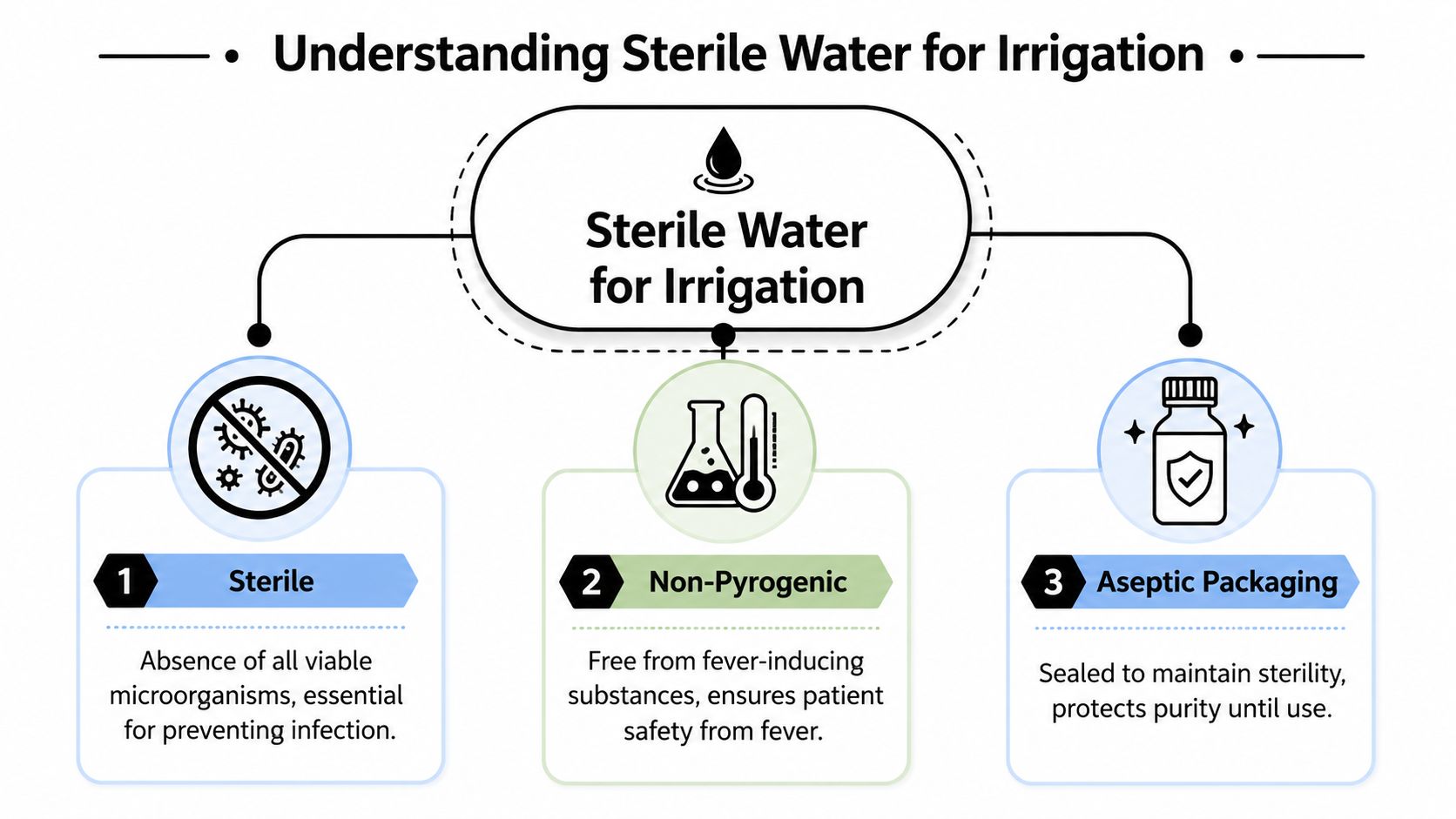
Sterile water for irrigation is a sterile, water-only product designed for irrigation use, not a general-purpose substitute for every sterile diluent in a lab. The most important starting point is regulatory identity. The FDA labeling states that it is “for irrigation only” and “not for injection or infusion by usual parenteral routes” because it is hypotonic with an osmolarity of 0 mOsmol/L, and the same labeling warns that clinically relevant absorption can cause hyponatremia, hypoosmolality, and fluid overload, with outcomes that may include fatality or permanent morbidity. The label also gives a pH of 5.5 (5.0 to 7.0) and notes that no antimicrobial agent is added, as shown in the FDA-approved labeling for sterile water for irrigation.
What the product actually is
At the practical level, the product is simple but highly constrained. It is sterile packaged water intended to rinse, wash, or mechanically flush during a procedure. Its value comes from sterility and purity, not from any buffering capacity, preservative effect, or physiological balance.
Three characteristics define the user's understanding of it:
- Sterile packaging matters: the container is part of the product's function, because sterility depends on an intact seal.
- No antimicrobial support exists: once opened, the liquid doesn't have built-in protection against contamination.
- No solute system is present: the product isn't formulated to mimic body fluids or stabilize repeated handling.
Why the label is restrictive
The term hypotonic gets mentioned often, but many buyers don't connect it to real consequences. A hypotonic water-only solution doesn't behave like saline. If absorbed systemically in meaningful amounts, it can shift water into cells and dilute electrolytes. In a clinical context, that's why the labeling is restrictive. In a research context, it's a reminder that the product's chemistry is intentionally minimal and not broadly forgiving.
Sterile water for irrigation is not “safer water.” It is a narrower product with a narrower allowed role.
That distinction also helps separate clinical and RUO thinking. Clinical irrigation products are labeled for mechanical cleansing in procedural settings. Research users may choose sterile water products for certain preparation steps, but they shouldn't erase the original product identity in the process. Calling an irrigation product “injectable-grade water” or implying therapeutic suitability creates confusion that the labeling specifically avoids.
Understanding Key Purity Standards and Specifications
When experienced buyers review sterile water for irrigation, they don't stop at the product name. They look at the specification language because the specification tells them how the product is expected to behave once it reaches the bench.
Pfizer's labeling describes sterile water for irrigation as sterile, distilled, nonpyrogenic, solute-free water used only for irrigation, washing, rinsing, or dilution. It also states that the product contains no bacteriostat, antimicrobial agent, or added buffer, with a labeled pH of 5.5 and range of 5.0 to 7.0, as shown in the Pfizer sterile water for irrigation labeling.
What the specifications mean in practice
Distilled matters because buyers are not selecting tap water cleaned up after the fact. They're selecting a controlled water source prepared to a pharmaceutical standard.
Nonpyrogenic matters because sterility alone doesn't answer every quality question. A sterile liquid can still be unsuitable if fever-inducing contaminants are present. For labs, that point is less about clinical effect and more about process discipline. It signals that the manufacturing target is tighter than “free of visible contamination.”
Solute-free is often where research users make the wrong assumption. Solute-free doesn't mean universally ideal. It means no electrolytes, no preservatives, and no buffering help. That can be useful when a protocol requires a minimal background matrix. It can also create instability if the preparation needs protection from repeated exposure or needs a more controlled chemical environment.
What buyers should verify on documentation
A quality-focused buyer should expect the paperwork to match the label language, not merely resemble it. Documentation review should answer practical questions:
- Identity match: Does the product description clearly say irrigation rather than imply injection or infusion suitability?
- Composition clarity: Are the absence of preservatives, antimicrobials, and buffers stated plainly?
- pH disclosure: Does the supplier identify the expected pH range instead of leaving the water chemically undefined?
- Single-use logic: Does the packaging and handling guidance reflect the fact that the product is built for short procedural use rather than repeated access?
For research teams that specifically need a different sterile water standard, it helps to compare irrigation products with water for injection options used in controlled preparation workflows. The names sound close. The use logic is not.
| Specification | Why it matters operationally |
|---|---|
| Sterile | Reduces contamination risk at the point of opening |
| Distilled | Supports consistency of the water source |
| Nonpyrogenic | Reflects tighter quality control than basic sterility alone |
| Solute-free | Minimizes added variables, but offers no buffering or preservative support |
| pH 5.0 to 7.0 | Indicates a defined product, not an unspecified bulk water source |
Comparing Sterile Water to Saline and Other Diluents
The fastest way to create avoidable confusion is to compare products only by whether they're clear and sterile. Clear liquids can have very different use cases. In practice, buyers usually need to separate sterile water for irrigation, normal saline, bacteriostatic water, and plain distilled water by function, not appearance.
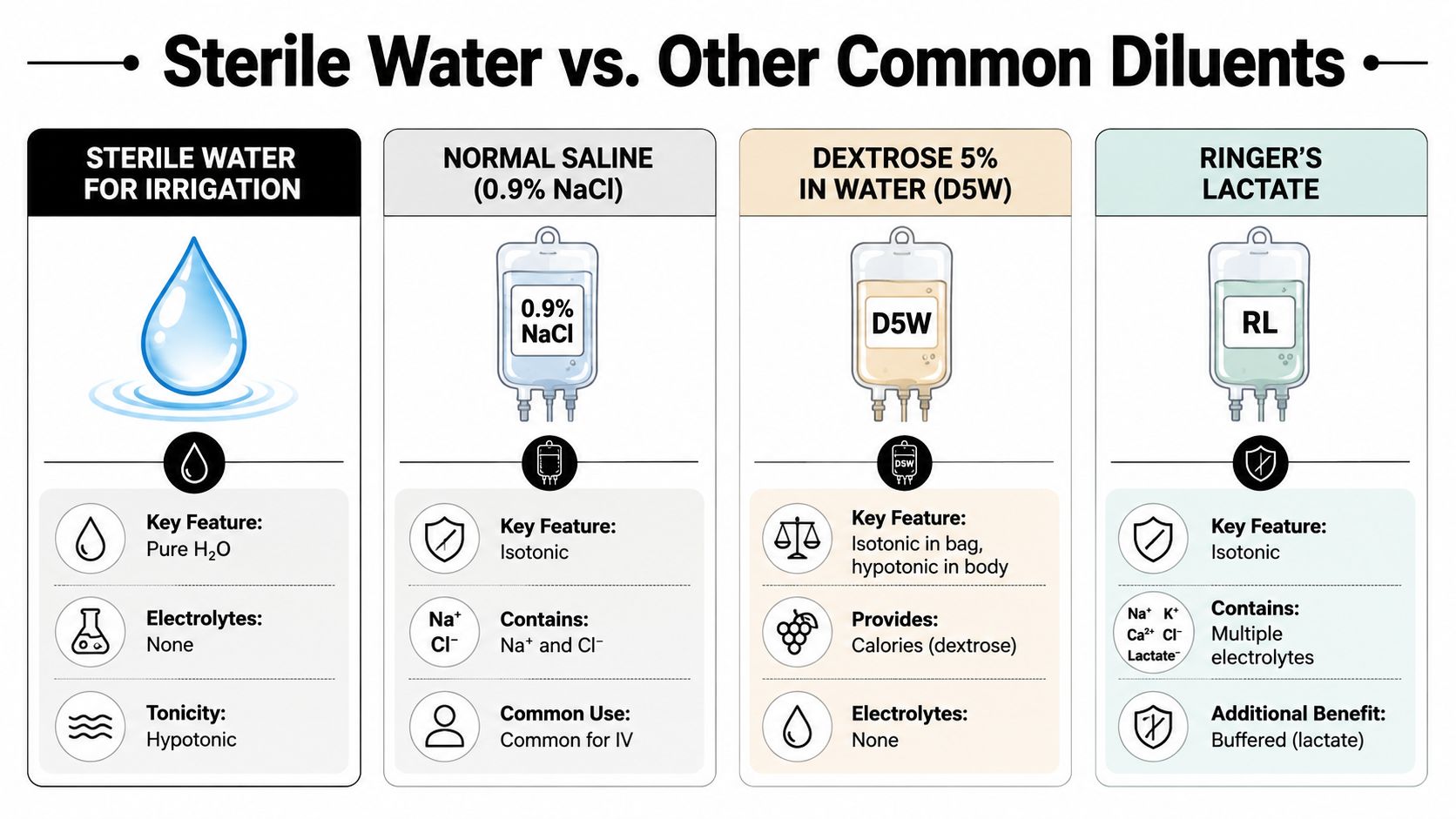
Fresenius Kabi's prescribing information makes the key distinction clear. Sterile water for irrigation is hypotonic and can cause rapid cell lysis and electrolyte dilution if absorbed systemically in meaningful amounts. The labeling therefore limits it to general irrigation and short-procedure use, where its function is mechanical cleansing rather than therapeutic delivery, according to the Fresenius Kabi product information for sterile water for irrigation.
Where confusion causes problems
Researchers commonly mix up these products for three reasons. First, catalog language is often sloppy. Second, the words “sterile water” receive more attention than the words “for irrigation.” Third, some users focus only on whether they can dissolve a powder, not on whether the resulting workflow still makes sense after opening.
This is also where wholesalers get into trouble. Product pages that collapse irrigation, injection, and bacteriostatic use into one sales narrative invite misuse. A better approach is to describe each category with hard boundaries and let the buyer choose accordingly. More on that distinction appears in this overview of the critical role of sterile diluents in research.
A short visual explainer can help frame the differences before procurement or bench use:
Side by side comparison
| Diluent | Composition | Osmolarity | Preservative | Primary Use Case |
|---|---|---|---|---|
| Sterile water for irrigation | Water only | Hypotonic | None | Irrigation, rinsing, short single-use procedural handling |
| Normal saline | Water with sodium chloride | Isotonic | None stated here | Situations where an isotonic fluid is needed |
| Bacteriostatic water | Sterile water with preservative | Not specified here | Yes | Multi-use handling where preservative presence is intentional |
| Distilled water | Water processed by distillation | Not specified here | None | General non-sterile or non-clinical uses unless specifically sterilized and packaged |
A few practical distinctions matter more than the rest:
- Sterile water for irrigation: Choose it when the value lies in sterile, solute-free mechanical use and immediate handling.
- Saline: Choose it when isotonic behavior matters more than absolute absence of solutes.
- Bacteriostatic water: Choose it only when preservative presence is acceptable for the protocol.
- Distilled water: Don't assume that distilled means sterile, packaged for procedural use, or suitable for sensitive work.
If a buyer says the products are “basically the same,” the buyer hasn't defined the use case tightly enough yet.
Clinical Use Cases Versus Research Applications
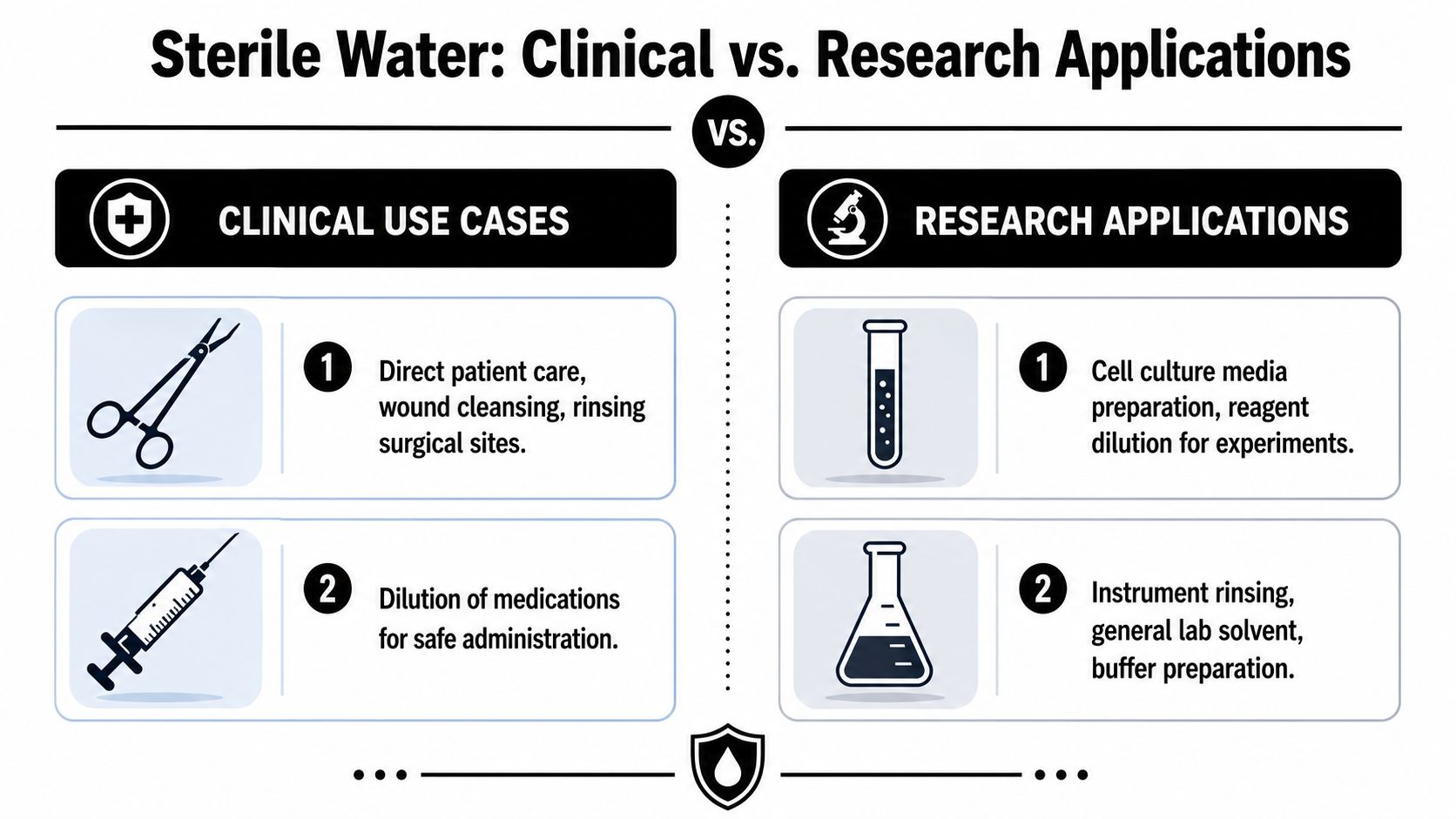
The same bottle can sit in two very different conversations. In a clinical environment, sterile water for irrigation is an irrigant with a narrow procedural role. In a research environment, users may look at the same sterile, solute-free liquid and treat it as a preparation aid. The mistake is assuming those two contexts carry the same compliance language.
Clinical irrigation is mechanical cleansing
Clinically, the product's role is straightforward. It is used for irrigation, washing, and rinsing where the aim is mechanical cleansing. That means flushing a site, clearing debris, or rinsing during a short procedure. The product is not there to deliver therapy. It is there to clean.
That narrow role is useful because it creates a clean operational boundary. Staff can align training, storage, and disposal around a product intended for immediate procedural handling rather than repeated use over time.
Research use demands stricter labeling discipline
Research labs sometimes use sterile water products in reconstitution or dilution workflows, especially where a minimal, additive-free liquid is preferred for immediate bench work. That can be reasonable within a tightly controlled protocol. It becomes risky when the product is casually reclassified in marketing copy or downstream resale.
For peptide researchers, the central question isn't “Can this dissolve the material?” It's “Does this product fit the entire workflow from opening to disposal?” If the protocol involves delayed reuse, repeated puncture, uncertain storage after opening, or any implication of human administration, the fit is already poor.
For wholesalers and peptide resellers, the compliance burden is heavier. Under an RUO framework, listings, labels, support messages, and customer service language must stay inside research boundaries. That means:
- No therapeutic framing: Product text shouldn't imply treatment, administration, or patient use.
- No clinical substitution claims: An irrigation product shouldn't be presented as a stand-in for injectable or therapeutic water products.
- No vague cross-category wording: “For research and other applications” is the kind of phrase that creates avoidable ambiguity.
- No mixed sales signals: A strict RUO policy loses value if support staff casually suggest human-use handling in private messages.
A reseller doesn't create compliance by adding “RUO” in one line. Compliance comes from consistent language across the entire sales process.
Used carefully, sterile water for irrigation can support specific research handling steps. Marketed carelessly, it creates exactly the kind of confusion that regulators and serious buyers notice first.
Best Practices for Handling and Storage
The biggest handling mistake with sterile water for irrigation is treating it like a durable bench staple. It isn't. Once opened, the product loses the protection that came from its sealed sterile packaging, and because it contains no antimicrobial agent, sloppy handling shows up fast as contamination risk.
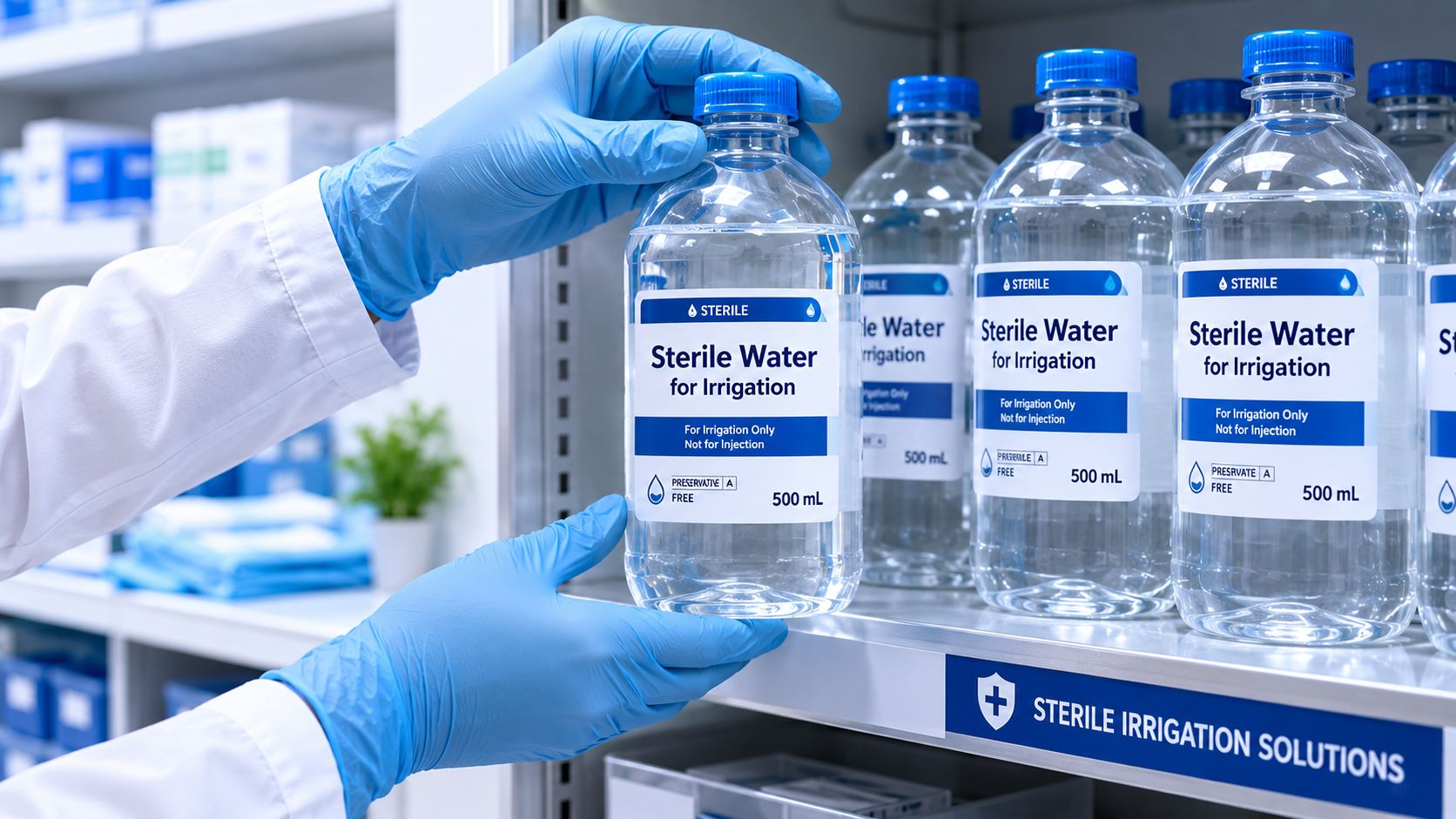
Labs that keep cleaner workflows usually treat sterile diluents as controlled inventory, not convenience stock. That means separating unopened product from opened containers, documenting receipt condition, and storing units in a way that protects label visibility and package integrity. A practical framework appears in this guide to flawless sterile laboratory storage.
Handling rules that protect sterility
Aseptic technique matters most at the moment of first access. That is where a sterile product becomes an exposed product.
- Inspect before release: Reject containers with broken seals, visible damage, or unclear labeling.
- Open only when needed: Don't pre-open units for convenience during setup.
- Use clean technique at the bench: Minimize open-air exposure and unnecessary contact with the opening.
- Match volume to task: Large containers used for tiny one-off procedures often create unnecessary waste and temptation to reuse.
Storage and disposal habits that prevent avoidable failures
An unopened sterile product should be stored under controlled conditions according to supplier instructions. The more important practical rule is what happens after opening. Because there is no preservative system, opened product should be treated as single-use and any unused portion discarded rather than saved for later bench work.
That point matters for both quality and compliance. A researcher who saves the remainder for the next day is no longer working with the same controlled product state. A reseller who encourages reuse is teaching the wrong behavior.
A simple receiving and use checklist helps:
- Confirm packaging integrity on arrival
- Log lot details with the rest of sterile stock
- Stage unopened units away from routine splash zones
- Open immediately before use
- Discard remainder after the procedure or preparation step
Keep the product sterile by shortening the time between opening and use. Most contamination problems come from unnecessary time, unnecessary handling, or both.
Selection Criteria for Wholesalers and Researchers
Selection starts with honesty about use case. Buyers shouldn't ask whether sterile water for irrigation is “good quality” in the abstract. They should ask whether its specification, packaging, and labeling match the actual workflow.
The category is also commercially significant. One market source estimates the global sterile water for irrigation market at USD 1.5 billion in 2024 and projects USD 2.5 billion by 2033, implying a 6.5% CAGR from 2026 to 2033. The same market page also presents a second forecast, valuing the market at USD 1,450.75 million in 2025 and projecting USD 2,700.40 million by 2033 at a 7.72% CAGR, with demand concentrated in North America, Europe, and Asia Pacific, according to Verified Market Reports on the sterile water for irrigation market. Growth creates opportunity, but it also raises the cost of poor product positioning.
What researchers should prioritize
Researchers should screen products with a short list:
- Fit to protocol: Is a single-use, additive-free, short-handling liquid what the method needs?
- Documentation quality: Does the supplier provide clear identity and specification information?
- Packaging logic: Does the container size make sense for immediate use rather than leftover stock?
- Category discipline: Is the product described clearly enough that there's no confusion about irrigation versus other sterile water types?
What wholesalers and resellers should demand from suppliers
For wholesalers and peptide resellers, supplier selection is partly about quality and partly about risk control.
A strong supply partner should provide clear batch documentation, consistent product naming, stable fulfillment, and packaging that supports sterile handling. Just as important, the supplier should avoid blurred marketing language. If the upstream manufacturer or distributor markets one product as if it fits every sterile-water scenario, downstream sellers inherit that confusion.
The best commercial posture is conservative and precise. Sell products into the use case they are built for. Keep RUO messaging consistent. Refuse language that drifts toward therapeutic implication. That approach may feel narrower, but it produces fewer returns, fewer customer misunderstandings, and fewer compliance problems.
Herbilabs supports researchers, wholesalers, and distribution partners with RUO-focused sterile diluents, clear documentation, reliable fulfillment, and consistent product handling standards across the EU, UK, and USA. For teams that need a dependable sourcing partner with transparent specifications and a strict research-use approach, Herbilabs is built for that workflow.