Private Label, White Label, Wholesale partnerships available - EU, USA and UK - Free shipping from €75
Inside a Peptide Research Lab: A 2026 Buyer’s Guide
You can have the sequence, the vial, and the protocol on paper, and still lose the project in the first hour if the lab behind it isn't built for the work. A new peptide arrives in a lyophilized vial, the team needs to confirm what's inside, decide how to reconstitute it, and plan the next assay without contaminating the sample or guessing at identity. That's where the peptide research lab starts, not at a single bench, but in a chain of synthesis, analytics, storage, and sourcing decisions that all have to hold together.
Table of Contents
- The Moment a Peptide Project Comes to Life
- What a Peptide Research Lab Actually Does
- Inside the Synthesis to Storage Workflow
- Why Orthogonal Analytics Define a Serious Lab
- The Role of Sterile Diluents in Reproducible Research
- Choosing the Right Supply Partner for Your Lab
- Regulatory and RUO Considerations for Research Buyers
- Putting It All Together for a Reliable Peptide Program
The Moment a Peptide Project Comes to Life
A researcher opens a shipment and finds a white film at the bottom of a vial. The label says the sequence is correct, the sample is for research use only, and the next step is reconstitution, but none of that tells the team whether the material is fit for the assay they planned. If the peptide is hydrophobic, oxidation-prone, or destined for repeated withdrawals, the reconstitution choice matters as much as the sequence itself.
That's the point where a peptide project stops being abstract. Someone has to verify identity, check the paperwork, pick the right diluent, preserve sterility, and decide whether the next readout is a binding assay, a cell study, or another purification pass. A weak link at any step can turn a promising peptide into an ambiguous result that nobody trusts.
Practical rule: a peptide vial is only useful if the lab can trace it from synthesis to storage and back to the bench without losing identity, purity, or documentation.
The rest of the work follows that logic. A peptide research lab is not one room with a freezer and a hood. It's a coordinated system that connects chemistry, instrumentation, cold storage, and supply partners so that each vial entering a project has a defensible origin and a predictable handling path.
For wholesalers and distributors, that matters just as much as it does for the scientist. If the supply chain can't answer basic questions about synthesis route, purification, batch testing, and diluent compatibility, the project starts with avoidable risk. The lab manager often becomes the person who has to catch those gaps before the experiment does.
What a Peptide Research Lab Actually Does
A peptide research lab designs, makes, purifies, analyzes, and stores peptide sequences for experimental work. That sounds simple until the handoffs are broken down, because each stage answers a different question. Synthesis asks whether the right sequence can be built, purification asks whether the desired molecule can be isolated, analytics asks whether the vial really contains what the label says, and storage asks whether the material will still behave the same way when it gets to the bench.
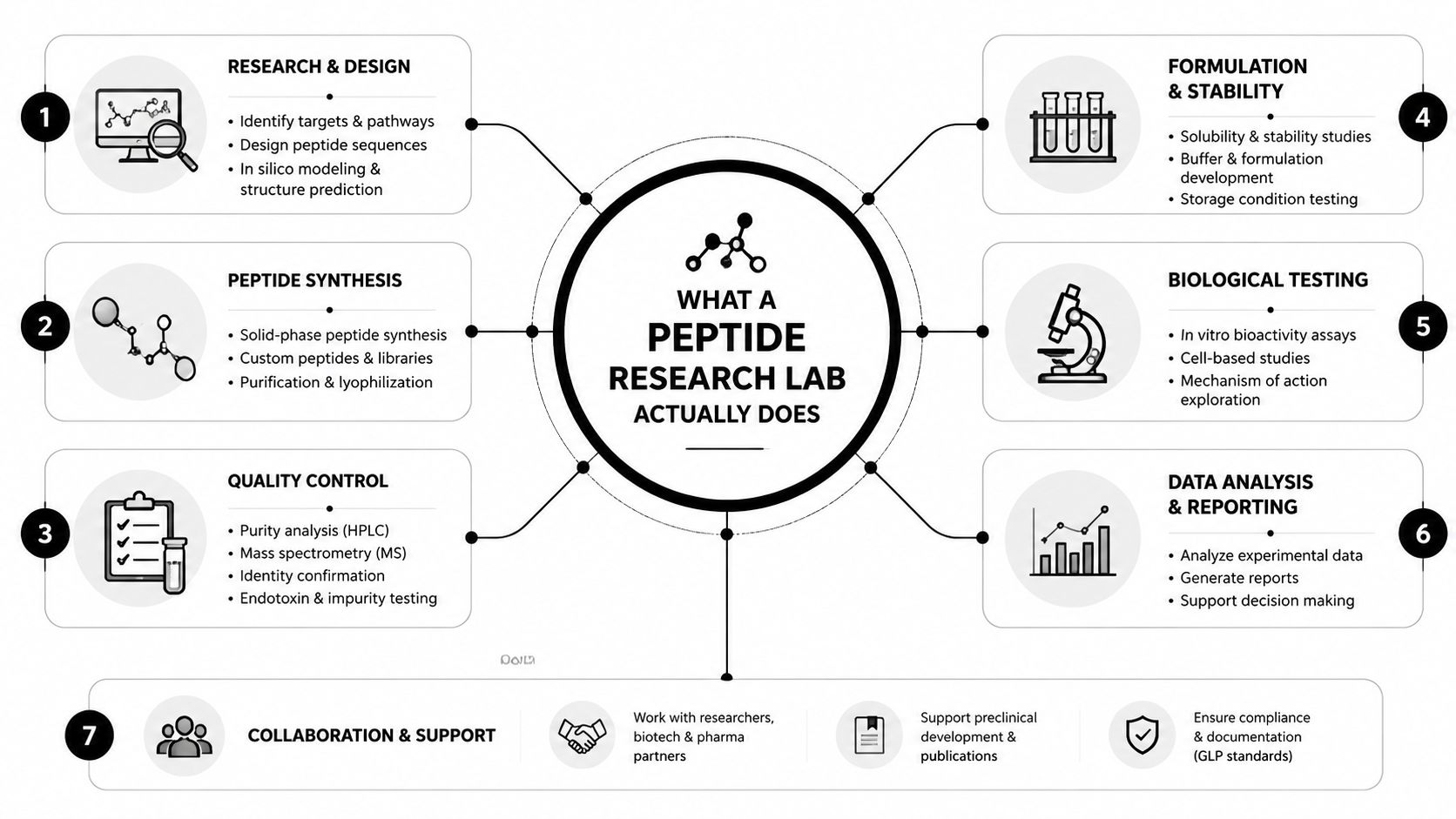
The modern version of this field begins with solid-phase peptide synthesis, SPPS, introduced by Bruce Merrifield in 1963. The key change was practical reproducibility, because stepwise amino acid assembly became workable at scale instead of being trapped in slower, artisanal synthesis. Historical milestones matter here too, insulin entered clinical use in 1922, and the first chemically synthesized peptide hormones, oxytocin and vasopressin, were reported in 1953 to 1954, with du Vigneaud receiving the 1955 Nobel Prize in Chemistry for that work (Trends in peptide drug discovery).
Different lab models serve different goals
An academic core facility often supports many projects at once, so flexibility matters more than polished packaging. A contract research organization usually focuses on delivery, documentation, and fit-for-purpose outputs. An in-house industry lab sits somewhere else again, because it may prioritize continuity, scale, and tighter integration with downstream development.
The market context explains why that structure matters. One review reports more than 80 peptide drugs worldwide have been approved since insulin's introduction in 1921, and peptide publications in PubMed have risen by more than 300% over the past two decades (review summary). The field is no longer niche. It's a broad workflow ecosystem, and the lab that succeeds is usually the one that treats every stage as part of one controlled process.
Inside the Synthesis to Storage Workflow
A good peptide workflow starts before the first amino acid is coupled. The sequence has to be designed for the biology, but also for the chemistry. Hydrophobic stretches, aggregation-prone motifs, and difficult protecting-group choices all shape whether the project belongs on a standard synthesizer, a microwave-assisted platform, or a more specialized route.
From sequence design to finished vial
On modern systems, SPPS-enabled automation lets teams run parallelized arrays of up to 192 sequences, which changes how discovery groups think about screening and iteration (automation review). Microwave-assisted synthesis shortens coupling and deprotection cycles and helps with difficult sequences by improving reaction kinetics. That doesn't remove judgment from the process, it just makes the chemistry less dependent on manual timing and more dependent on method control.
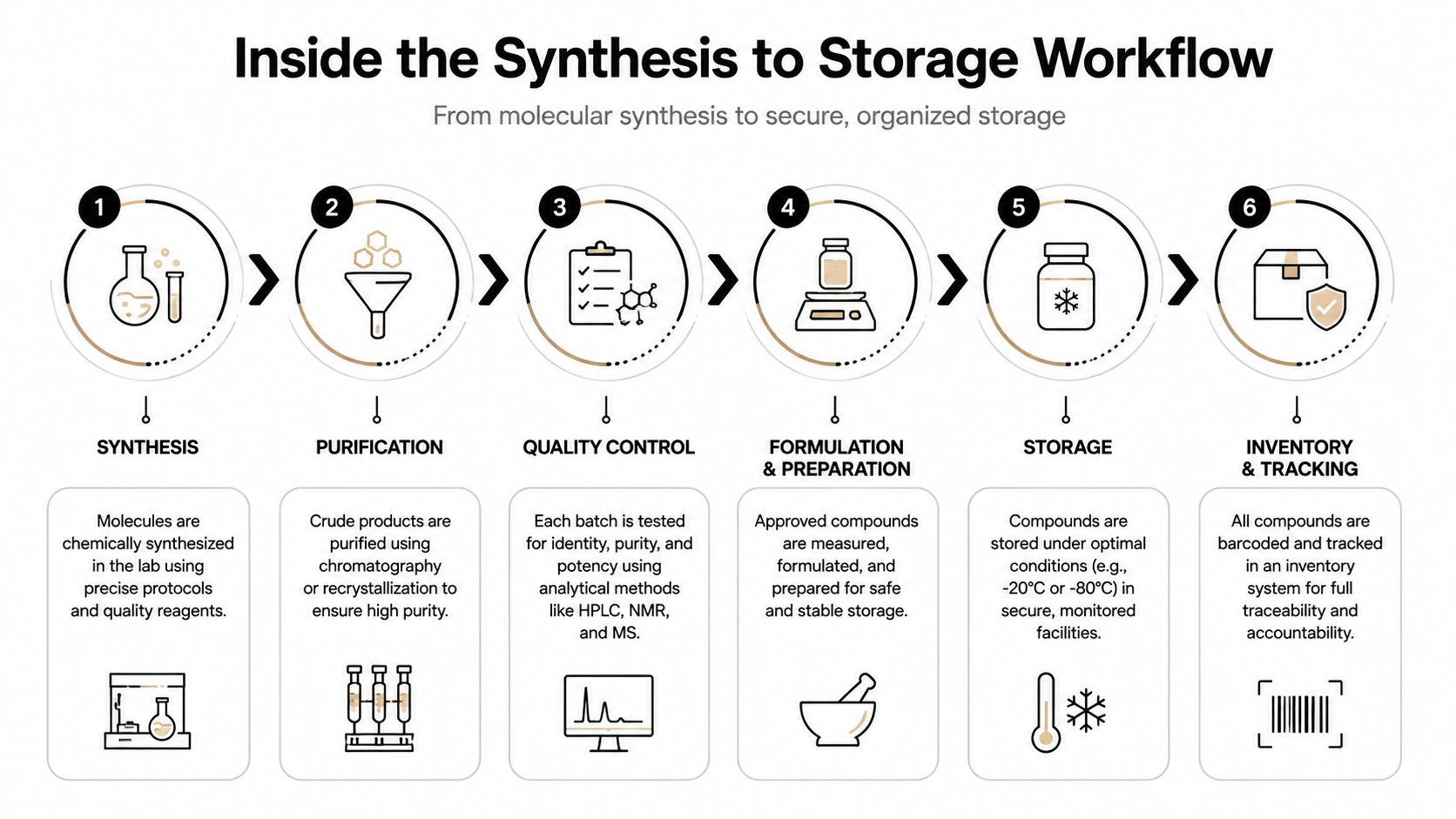
After synthesis, the crude peptide is cleaved, precipitated, and dried, usually by lyophilization. From there, purification begins. Crude material goes onto HPLC, fractions are collected, and only the correct pools move forward. Any mismatch between synthesis and purification, for example, poor solubility, incomplete cleavage, or excessive side products, becomes visible here instead of later in a biological assay.
The final handoff is storage. Finished vials need temperature control, clear labeling, and enough documentation that a future user can trace the batch back to its origin. That sounds administrative until a project restarts months later and someone has to know whether a vial was opened, reconstituted, or exposed to avoidable temperature swings.
A manager also has to choose the right handling guide for reconstituted material, because storage and reconstitution are connected. A practical reference like Herbilabs' guide on storing reconstituted peptides becomes useful when the same peptide has to survive multiple transfers without compromising the next assay.
The workflow is easier to audit when each station has one job.
- Design: choose a sequence that fits both the target and the synthesis route.
- Assembly: run automated or microwave-assisted SPPS with attention to difficult motifs.
- Cleanup: cleave, precipitate, and dry the crude product before analysis.
- Purification: use chromatography to isolate the intended fraction.
- Release: confirm identity and document the batch.
- Storage: keep the finished vial under controlled conditions until use.
When one station underperforms, the whole chain slows down. A synthesizer problem can look like an analytical problem, and a storage problem can look like a biology problem. That's why peptide teams need technicians, analysts, and procurement staff to work from the same playbook instead of handing the sample off and hoping the next step fixes the last one.
Why Orthogonal Analytics Define a Serious Lab
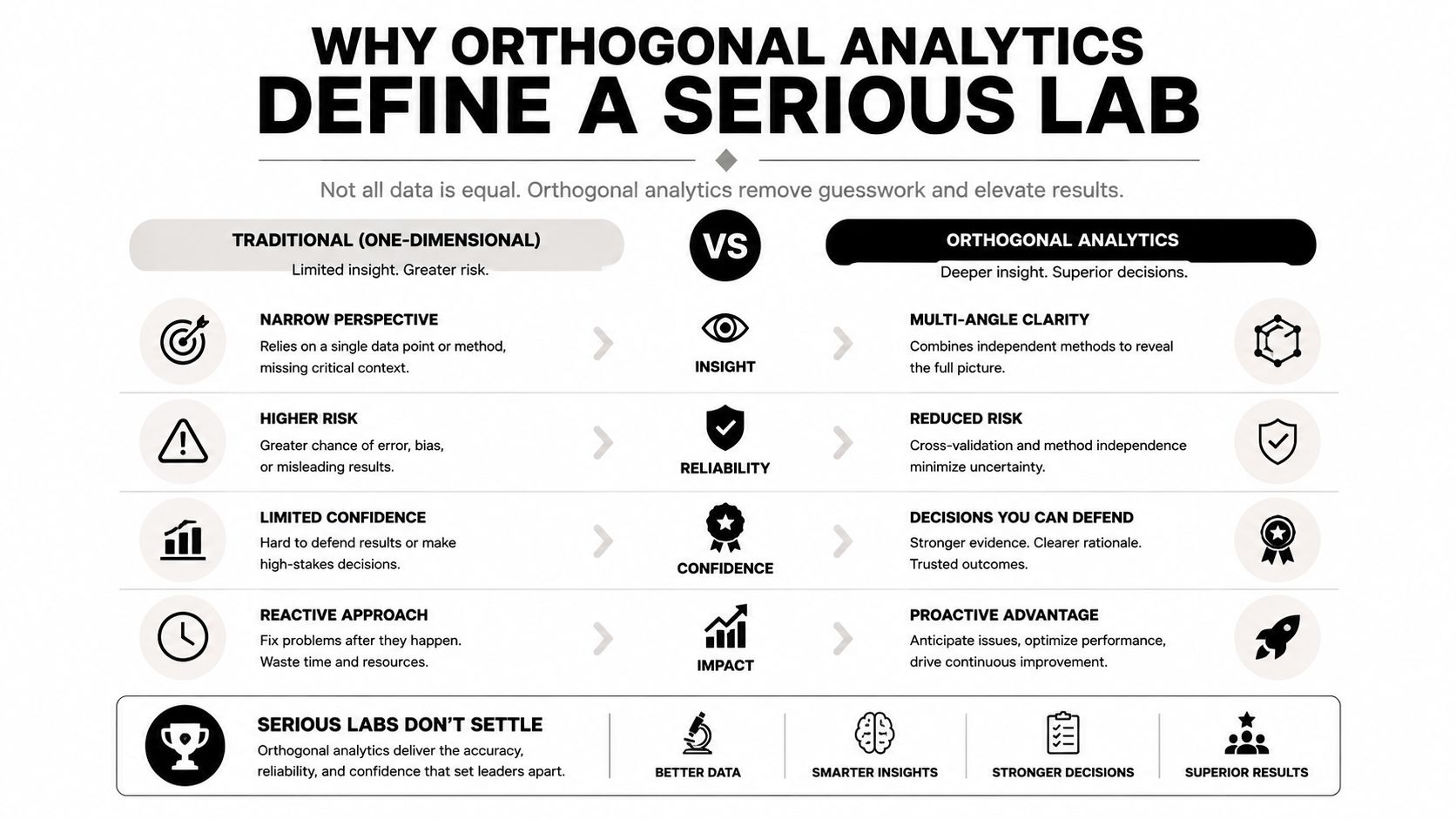
A single purity number is not enough to trust a peptide. The reason is simple, peptides can look clean on one assay and still carry truncations, oxidation variants, counterion issues, or other closely related impurities that matter in real experiments. A serious lab uses orthogonal methods because each method sees a different part of the problem.
UHPLC and HRAM MS answer different questions
UHPLC is the workhorse for separation and quantitation. It tells the team how many components are present, how sharp the peaks are, and whether the sample behaves like one expected molecule or a mixture. High-resolution accurate-mass mass spectrometry, HRAM MS, answers the identity question, because it can confirm whether the measured mass matches the intended structure and help flag close variants that chromatography alone might not resolve (analysis review).
That's the difference between a photograph and a fingerprint. A photograph shows what's visible, but a fingerprint can separate one person from another even when the picture looks convincing. In peptide work, that distinction matters because biological activity can shift when a peptide is shortened by one residue, oxidized at a sensitive site, or contaminated by a related byproduct.
A lab that relies on one assay alone is taking an unnecessary shortcut. A certificate that says “pure” without a layered analytical story leaves too many questions open for anyone planning structure-activity work or downstream candidate selection. If the material is meant to support decision-making, not just labeling, the analytics have to be built to catch the mistakes that one method misses.
A reliable analytical pipeline should make it hard for a wrong peptide to pass as a right one.
For buyers, the right question isn't “Do you test purity?” It's “What combination of methods do you use, and what kinds of defects can each one detect?” That question forces the vendor to describe the workflow instead of hiding behind a single percentage or a generic COA. It also gives wholesalers and distributors a clear screening tool before they commit to a supply relationship.
The Role of Sterile Diluents in Reproducible Research
A peptide can be analytically sound and still fail in practice if the reconstitution step is sloppy. The diluent choice changes solubility, sterility, and how confidently the sample can be used again. That's why sterile water, bacteriostatic water, and other reconstitution solutions belong in the same conversation as chromatography and storage.
Match the diluent to the use pattern
Sterile water for injection fits single-use applications where the sample will be prepared and consumed once. Bacteriostatic water is different, because it contains 0.9% benzyl alcohol, which helps suppress bacterial growth during repeated withdrawals and makes it the standard choice for multi-dose vials. The chemistry is straightforward, but the habit is not, because teams often choose based on convenience instead of use pattern.
The sealed-jar analogy works well here. Once the lid comes off, the contents need protection from the environment, and the protection has to match how often the vial will be opened. A single-use workflow can tolerate one kind of diluent strategy, while repeated sampling calls for another.
Researchers also need to think about compatibility with the peptide itself. Some sequences tolerate aqueous reconstitution cleanly, while others need careful solvent planning and tighter handling. A supplier that packages diluents in premium glass vials with clear labels reduces confusion at the bench, because the vial itself helps prevent guesswork before the first draw.
The practical rule is simple.
- Single-use sample: choose sterile water when no repeated withdrawal is planned.
- Multi-dose workflow: choose bacteriostatic water when the vial will be accessed more than once.
- Sequence-sensitive project: check the peptide's handling notes before deciding on any reconstitution solvent.
For a supplier-backed reference, the internal guide on sterile water for reconstitution is useful because it frames diluent selection around handling reality, not just product naming. That matters in research, because reproducibility often depends on the small steps that teams treat as routine.
Choosing the Right Supply Partner for Your Lab
A supplier shapes research outcomes the way a well-designed protocol does, consistently and often unnoticed until something goes wrong. If the batch varies, the documentation is thin, or the logistics break down, the lab absorbs the problem even when the assay design is sound. Wholesalers and distributors should review peptide partners with the same discipline they apply to their own quality systems.
What to ask before committing
Start with manufacturing control. A partner that owns its production facility has more direct oversight than one that relies heavily on third-party sourcing, so the buyer can trace problems back to a clearer point in the process. Ask how every batch is tested, because contaminant screening is part of whether the material can be trusted for repeatable research.
Temperature control matters too. Peptides and related reagents do not benefit from rough handling in transit, and same-day dispatch can make a real difference when a project is waiting on a time-sensitive assay. Transparent certificates of analysis matter just as much, because a clean-looking product page means little if the buyer cannot see batch-level information.
Herbilabs is one example of a vertically integrated supplier in this space. The company states that it has operated its own production facility since 2018, that every batch is tested for contaminants, and that it serves over 100,000 clients across universities, research organizations, and independent investigators, with a stated 99%+ purity benchmark (Herbilabs). For distributors, those are the kinds of claims worth checking against the documentation trail rather than treating them as marketing language.
Buyers should audit the evidence, not the slogan. If the COA, batch number, logistics process, and labeling do not line up, the supply chain is not ready for serious peptide work.
The qualification process should be formal, especially for buyers serving the EU, UK, and USA. The internal guide on Herbilabs' supplier qualification criteria shows the kind of evidence wholesalers should ask for before they place a standing order. That includes how claims are documented, how dispatch is handled, and whether the supplier can support a longer-term commercial relationship without improvising every shipment.
Regulatory and RUO Considerations for Research Buyers
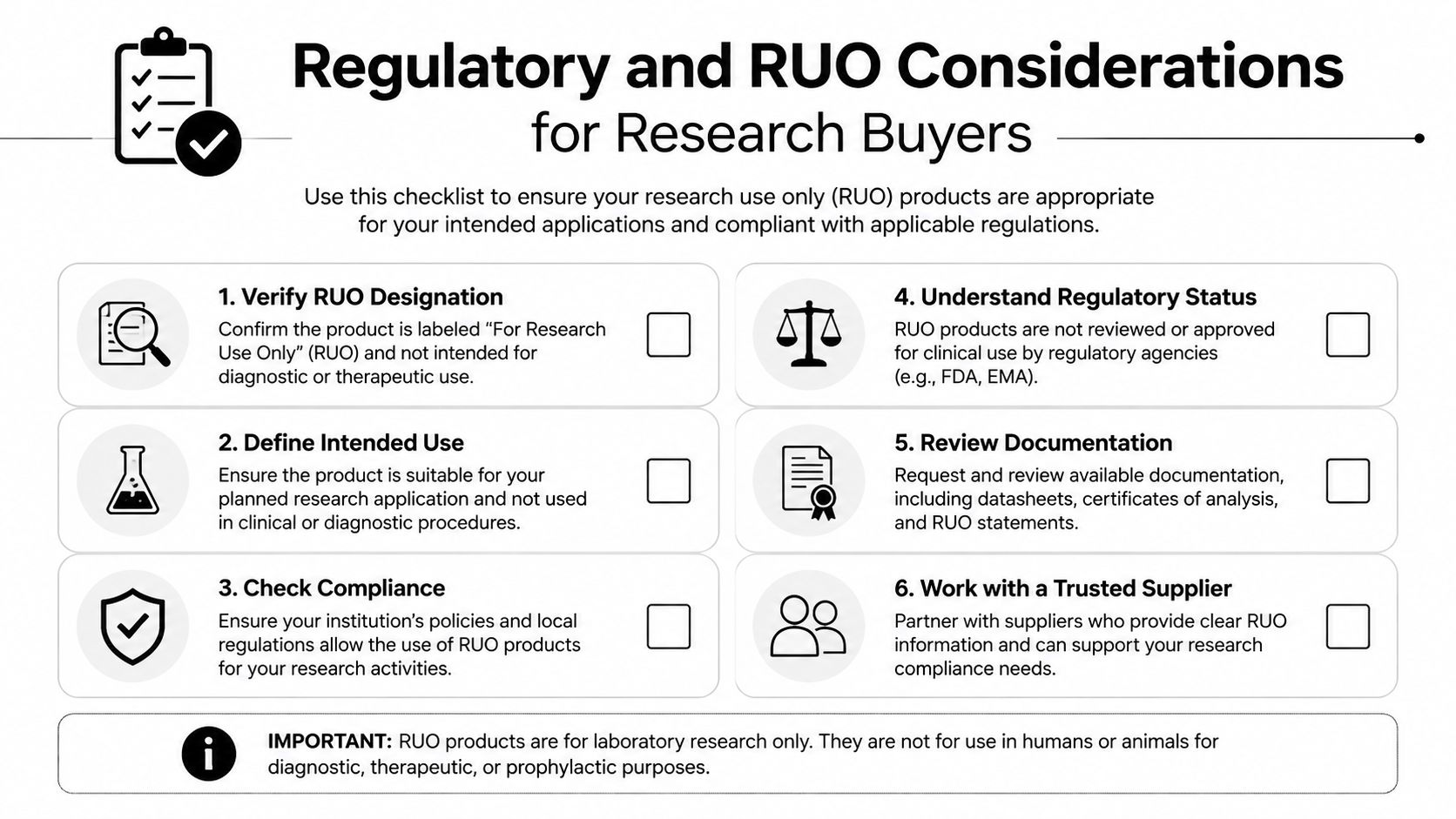
Research Use Only, RUO, means the material is intended for non-clinical research, not human therapeutic use. That distinction needs to survive every stage of the product life cycle, from warehouse labeling to reseller copy to customer communication. If a wholesaler blurs that line, the compliance problem follows the product downstream.
Documentation is part of the product
A reputable supplier should provide batch numbers, clear COAs, expiration dating, and safety data sheets. Those documents let the buyer verify what was shipped and keep the audit trail intact if questions arise later. They also protect resellers, because marketing language needs to preserve the RUO designation across all channels in the EU, UK, and USA.
Cold chain handling belongs in that same conversation. A useful outside reference on cold chain transport best practices helps logistics teams think through why temperature control isn't a background detail, it's part of the product's usable condition when it arrives.
Buyers can run a quick document check before the first order.
- RUO label present: confirm the material is marketed for research only.
- COA included: verify batch-level identity and release information.
- Batch traceability: match the vial to the paperwork.
- Safety data: confirm SDS access before receipt.
- Storage instructions: make sure transport and handling align with the product type.
The reputational risk is real. If a lab, reseller, or wholesaler communicates the product incorrectly, the scientific value of the material gets overshadowed by avoidable regulatory confusion. The safest suppliers keep the language consistent because consistency protects both the buyer and the research record.
Putting It All Together for a Reliable Peptide Program
A peptide program only works when the handoffs between synthesis, analytics, reconstitution chemistry, and supplier control are clean. If any one of those steps slips, the whole chain weakens, and the result is not just a storage problem or a paperwork problem. It becomes a question of whether the material in the vial still matches the material the lab thought it ordered.
For wholesalers, distributors, and lab managers, the useful check is not a vague promise of quality. It is a simple three-point audit of the supply chain. First, the synthesis record should show that the batch was made and released under defined conditions. Second, the analytics should confirm identity and purity in a way the buyer can trace back to that batch. Third, the sourcing and fill process for sterile diluents should fit the intended research use, with labeling and handling that match the material type. If those three handoffs are weak, the program will keep absorbing avoidable doubt, no matter how carefully the vial is stored after arrival.
A lab manager can compare this to a relay team. Each runner may be strong, but the baton exchange decides whether the race holds together. In peptide work, the baton passes from synthesis to analysis, then from analysis to formulation and shipment, and then from shipment to the bench. Buyers who vet partners like Herbilabs should ask where those transfers are controlled, who signs off on them, and what documents travel with the batch at each stage. That is the practical way to judge whether a supplier is supporting reproducible research or only filling orders.
The most reliable programs are built by partners who keep the scientific record, the shipping record, and the labeling record aligned. That alignment matters because researchers do not use a peptide in isolation. They use a supply chain, and every weak link shows up later as confusion at the bench, uncertainty in the result, or a failed audit trail. When wholesalers and distributors review a partner, they should look for clean batch traceability, clear release documentation, and handling that matches the product's stated research-only use. Those are the points that protect the program after the first order has already left the dock.
Herbilabs supplies research-use peptide reagents, sterile diluents, and documented batches for labs that need controlled handling and clear traceability. For wholesalers, distributors, and research teams comparing supply partners, Herbilabs is worth reviewing for its batch testing, RUO documentation, and fulfillment model.


