Private Label, White Label, Wholesale partnerships available - EU, USA and UK - Free shipping from €75

How to Store Reconstituted Peptides for Optimal Stability
A researcher has just reconstituted a peptide, watched the powder disappear, and set the vial on the bench for a moment while preparing the next step. That moment is where good handling either protects the work or starts to undermine it. Once a peptide is in solution, storage stops being a housekeeping detail and becomes part of the experiment.
Anyone looking up how to store reconstituted peptides is usually in one of two situations. Either a fresh vial is ready and there's a need for a clean protocol right now, or something has already gone wrong and there's a need to decide whether the sample is still usable. In both cases, the answer isn't just a temperature. It's a workflow that starts at the bench, continues through aliquoting and freezer choice, and includes transport, documentation, and troubleshooting.
Table of Contents
- Protecting Your Peptide Investment After Reconstitution
- Pre-Storage Essentials Sterile Technique and Labeling
- The Critical Step Aliquoting to Prevent Freeze-Thaw Damage
- Optimal Storage Conditions Temperature and Duration Guide
- Recognizing Signs of Peptide Degradation
- Troubleshooting Common Peptide Storage Problems
- Putting It All Together for Reproducible Research
Protecting Your Peptide Investment After Reconstitution
A peptide arrives on time, the assay window is tight, and the vial finally goes into solution. That is the point where many losses begin. Few storage mistakes destroy a sample in one obvious step. More often, they shave off potency, introduce variability, or contaminate material that still looks fine in the tube.
A reconstituted peptide carries more than its purchase price. It carries synthesis cost, shipping, analyst time, assay setup, animal or cell work, and the credibility of the data that follow. If storage is handled casually, the first thing lost is usually consistency. The expensive part comes later, when results fail to reproduce and the lab starts troubleshooting biology instead of handling.
Once a peptide is in solution, every handling decision matters. Temperature swings, oxygen exposure, light, pH stress, adsorption to tube surfaces, and repeated opening all increase the chance of drift in concentration or activity. Some failures are visible. Many are not. A clear solution can still be a compromised one.
Peptides with residues such as Asn, Gln, Met, Cys, or Trp often need tighter control in solution because those side chains are more prone to chemical change. In practice, the safe workflow is straightforward. Prepare the sample cleanly, limit bench time, split it into planned-use portions, freeze under stable conditions, and avoid reopening the same tube over and over.
What good storage means in practice
Researchers often reduce peptide storage to a temperature choice. That misses the core problem. Good storage is a workflow that starts the moment solvent touches the powder and continues through retrieval, transport, and troubleshooting after the sample leaves the freezer.
A reliable process includes:
- Controlled handling at reconstitution: contamination and pH mistakes introduced here remain with the sample for the rest of its life. Good cross-contamination prevention practices protect both the peptide and the experiment built around it.
- Appropriate containers: one shared working vial that is opened repeatedly invites evaporation, adsorption, and handling error.
- Aliquots sized for actual use: each tube should match a single experiment or a single day's demand.
- Stable storage conditions: a nominal freezer temperature means little if the sample sits in a high-traffic rack with frequent warming.
- Clear records: identity, solvent, concentration, preparation date, and freeze-thaw history must be obvious at a glance.
Labs that get reproducible peptide performance do not rely on memory. They use a handling system that protects the sample from the bench to the freezer and back again.
Pre-Storage Essentials Sterile Technique and Labeling
Before a peptide ever enters a freezer box, the bench setup has to be right. Storage failures often begin long before storage. They begin with contaminated pipette tips, vague labels, reused tubes, or a rushed reconstitution done in a cluttered space.
Start with a controlled setup
A peptide solution should be prepared in a clean work area using sterile consumables and a solvent appropriate for the sequence and intended use. The exact solvent choice is sequence-dependent, but the handling principle is universal: use sterile reagents, minimize exposure time, and avoid improvising halfway through the task.
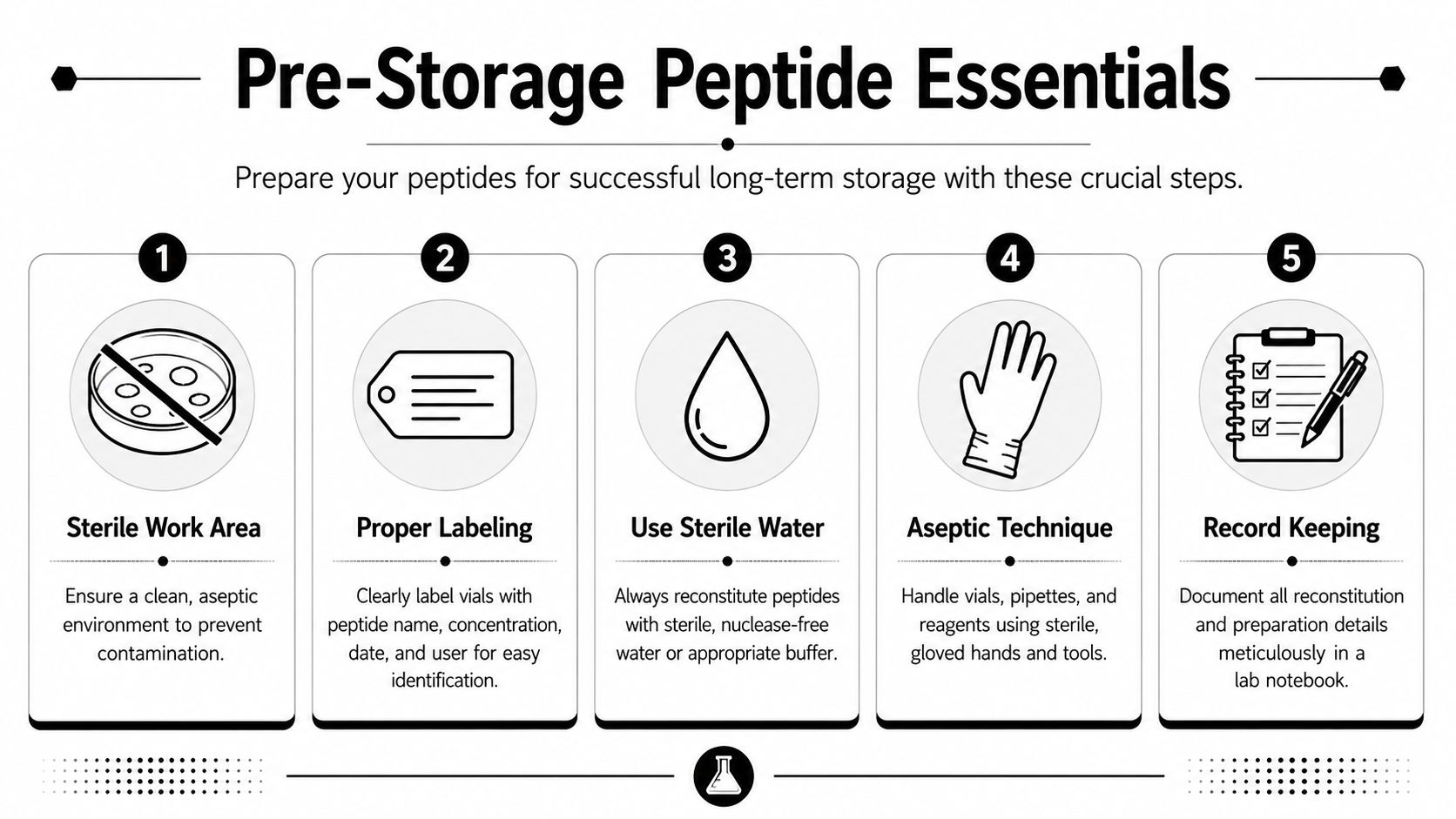
A strong pre-storage routine usually includes:
- Sterile vials and tubes: use clean, compatible containers for both the stock solution and aliquots.
- Fresh pipette tips: don't move between stock and aliquots with anything that's already touched another surface.
- Gloves and wiped surfaces: contamination often comes from ordinary bench traffic, not obvious mistakes.
- A written plan before opening the vial: decide the final concentration, aliquot count, tube layout, and labels in advance.
Teams that need a refresher on contamination control can use this practical guide on preventing cross-contamination in research workflows.
Label before freezing, not later
A tube without a full label is a future mix-up. Writing on frosted plastic after freezing wastes time and creates ambiguity. Label every aliquot before dispensing.
Each label should identify the essentials:
- Peptide name: use the exact lab naming convention, not a shortcut that only one person understands.
- Concentration: include units clearly.
- Solvent or buffer: especially important when multiple solvent systems are used in the same project.
- Date of reconstitution: this anchors every later storage decision.
- Operator or study ID: this preserves traceability when several people handle similar materials.
A peptide tube should be readable by someone who didn't prepare it.
That standard sounds basic, but it prevents the most common storage-room errors: duplicate labels, wrong concentrations, and samples that become unusable because nobody can verify what they contain.
Choose containers for the workflow, not just the volume
A common mistake is using whatever tube is nearest. That creates unnecessary headspace, repeated handling, and poor organization in the freezer. Small aliquots belong in small, well-sealed sterile tubes. The goal is simple: one tube, one thaw, one use.
Container choice also affects transport inside the facility. If a peptide will move from prep bench to cold room to assay space, the container has to stay sealed, legible, and easy to organize in racks or freezer boxes. Good storage begins with physical control, not just chemical stability.
The Critical Step Aliquoting to Prevent Freeze-Thaw Damage
Aliquoting is the point where careful labs separate themselves from wasteful ones. It is not an optional refinement. It is the main defense against a predictable form of damage.
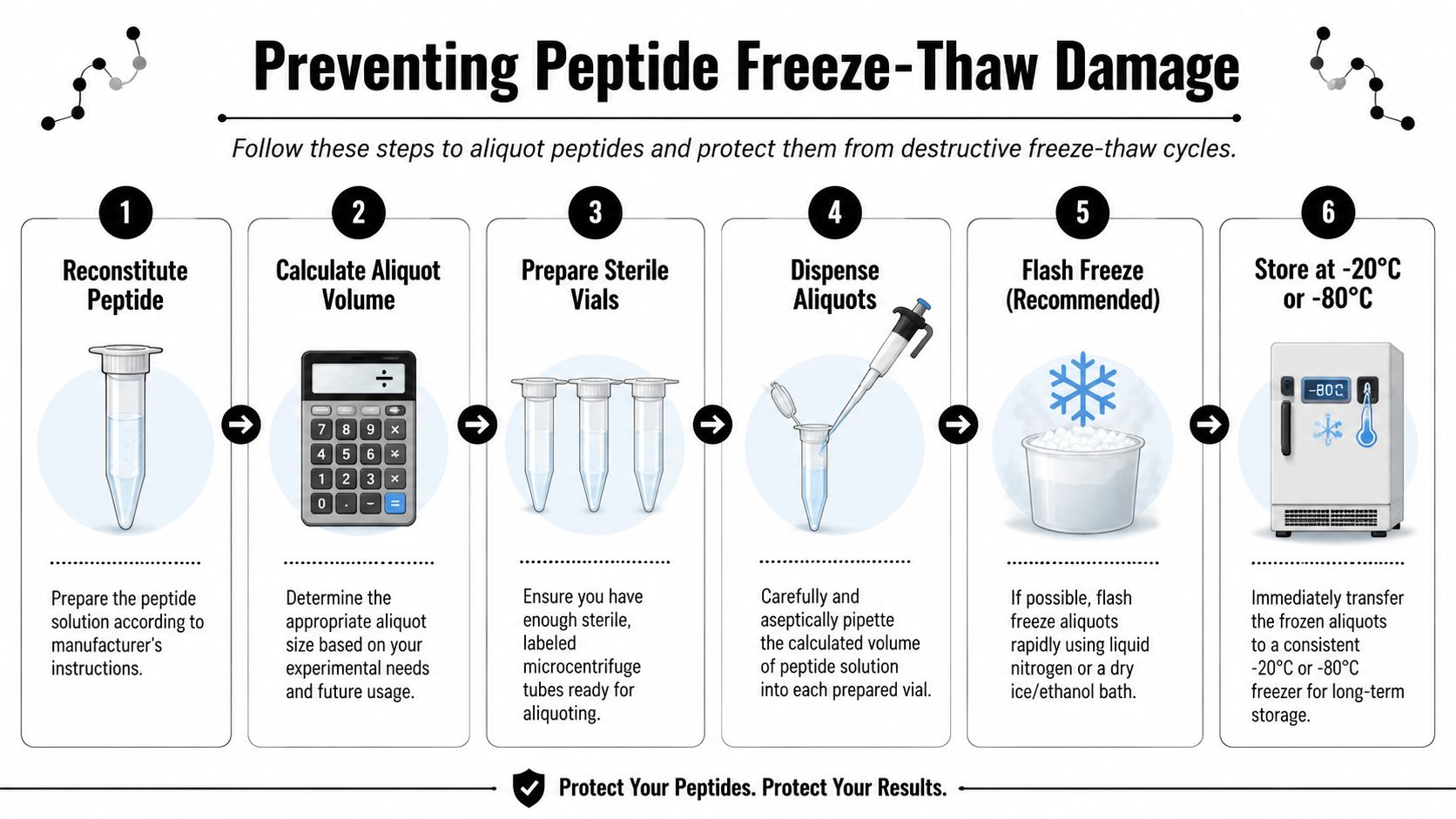
JPT's technical guidance is direct: the most defensible workflow is to dissolve the peptide, immediately split the solution into small aliquots, and freeze them at ≤ -20°C. For longer storage, −80°C is preferred. The reason is cumulative freeze-thaw damage, which increases degradation, especially for peptides containing unstable residues such as Asn, Gln, Cys, Met, or Trp (JPT peptide storage recommendations).
A visual summary helps when training new staff on the sequence of steps:
Why a single working vial fails
Every time the same tube is thawed, opened, sampled, and returned to the freezer, the peptide experiences another cycle of thermal and chemical stress. Ice formation and melting can promote structural change and aggregation. Repeated handling also increases oxygen exposure and contamination risk.
That's why the “master vial in the freezer door” approach performs so poorly in real lab settings. It's convenient for a week and costly for the rest of the study.
For teams planning aliquot size, this reference on matching vial volume to a research application is useful when setting up a practical single-use format.
How to set aliquot volume intelligently
The right aliquot size depends on the actual assay workflow. A tube should cover one planned use, or one very short run of tightly related use, without requiring refreezing. If a protocol usually consumes a small amount per experiment, the aliquot should be built around that amount rather than around convenience at the pipette.
A practical aliquoting setup looks like this:
- Calculate real usage first. Base aliquots on the amount typically needed per experiment, not on the total amount in the vial.
- Prepare all tubes in advance. Label and arrange them before reconstitution so the peptide spends less time exposed on the bench.
- Dispense aseptically and consistently. Use clean tips and steady pipetting to avoid contamination and volume drift.
- Freeze promptly. Once aliquots are filled, move them into controlled cold storage without delay.
Later in the workflow, staff often benefit from a quick visual reminder before routine handling:
The trade-off researchers should actually care about
Aliquoting does create more prep work upfront. It uses more tubes, more labels, and a little more time on day one. But that small effort buys control over the variables that most often erode peptide integrity in solution.
One careful aliquoting session is cheaper than repeating a compromised experiment with uncertain reagent quality.
That's the right lens for how to store reconstituted peptides. It isn't about convenience at the freezer. It's about protecting the interpretability of the data.
Optimal Storage Conditions Temperature and Duration Guide
A peptide can be perfectly dissolved, cleanly aliquoted, and still lose value if the storage temperature does not match the intended use window. That mistake shows up later as drift in assay performance, unexpected variability between runs, or the expensive suspicion that the reagent, not the biology, caused the result. Temperature choice is part of the storage workflow, not an isolated freezer setting.
NIBSC notes that peptide solution shelf life is limited, especially for sequences containing C, M, N, Q, and W, and recommends storing peptide solutions at −20°C or colder whenever possible while avoiding repeated freeze-thaw cycles (NIBSC peptide storage guidance). That is a useful baseline, but it still has to be applied with judgment. A stable, frequently used working aliquot and a long-hold reference stock should not be managed the same way.
What Each Temperature Range Is For
Room temperature is handling space only. Use it during reconstitution, transfer, or immediate assay setup, then get the material back under control. Time on the bench increases exposure to light, airborne contamination, and adsorption losses at the tube surface. In a busy lab, a vial left out during one interruption can turn a short handling window into an uncontrolled hold.
4°C is a short-term option for near-term use. It can be reasonable when the peptide will be used within days and the workflow would suffer from repeated thawing of frozen material. It is a weak choice for routine storage of reconstituted peptides because degradation in solution is sequence-dependent and often faster than new staff expect.
−20°C is the standard working freezer condition for many reconstituted peptide aliquots. For most labs, this is the practical minimum for preserving dissolved material beyond short refrigerated use. It reduces chemical and physical instability, but only if freezer performance is consistent and aliquots are sized so one tube supports one use or a tightly limited number of uses.
−80°C is the better choice for sensitive sequences, longer storage periods, archived reference aliquots, and studies where repeatability matters enough that reagent uncertainty is unacceptable. It offers more protection, but only within a disciplined workflow. A poorly labeled tube thawed on the bench three times is still a compromised sample, even if it lives in an ultra-low freezer the rest of the week.
Storage discipline should also include the solvent and diluent side of the workflow. Labs that prepare and hold peptide solutions alongside aqueous reagents should align freezer, refrigerator, and handling practices with storage practices for bacteriostatic water so the whole cold chain is set up consistently.
Peptide Storage Conditions at a Glance
| Temperature | Typical Duration | Best For | Key Consideration |
|---|---|---|---|
| Room temperature | Brief handling periods only | Reconstitution, transfer, immediate assay setup | Do not treat bench time as storage time |
| 4°C | Short-term use | Peptides scheduled for prompt use over the next few days | Stability in solution can drop quickly for some sequences |
| −20°C | Medium-term aliquot storage | Standard working aliquots in routine lab use | Freezer cycling and repeat access still cause damage |
| −80°C | Longer-term storage | Sensitive peptides, archive aliquots, high-value study material | Best used with strict labeling and one-use aliquots |
Decision Criteria
Choose the temperature based on how the sample will be used, not on a generic chart alone.
Ask four questions before the vial goes into storage:
- How soon is this aliquot scheduled for use?
- Will the tube be reopened, or can it remain single-use?
- Does the sequence include residues that are more prone to instability in solution?
- Is the freezer reliable enough to hold a steady temperature without frequent warming events?
Those answers determine whether a peptide belongs in a refrigerator for short scheduled use, a −20°C working freezer, or a −80°C archive condition. The trade-off is simple. Colder storage adds handling demands and freezer dependence, but it protects both the reagent investment and the credibility of downstream data. Calendar-based expiry estimates help, but condition control usually decides whether a reconstituted peptide remains fit for research use.
Recognizing Signs of Peptide Degradation
A degraded peptide doesn't always announce itself. Many failed stocks still look acceptable at first glance, which is why visual inspection should be treated as one checkpoint, not the only one. Still, some warning signs are easy to spot if staff know what to look for before loading an assay.
What the vial may show
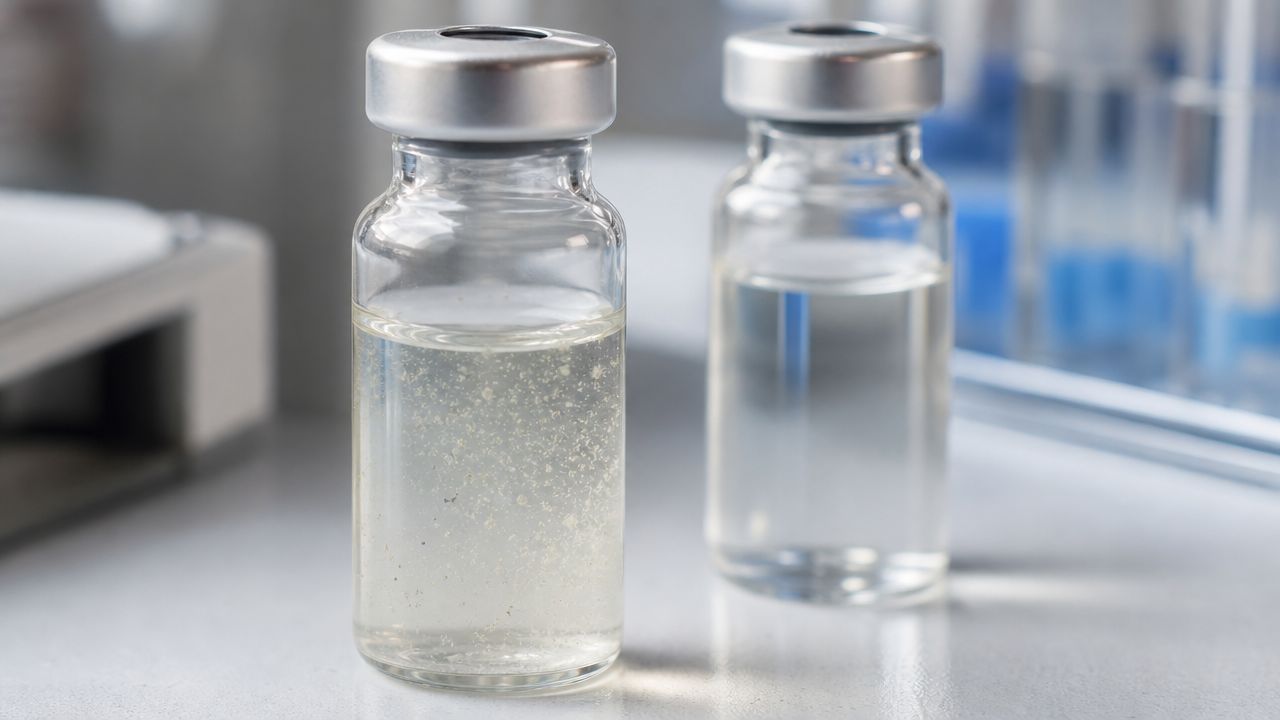
A fresh peptide solution is often expected to be clear and uniform. If the tube becomes cloudy, develops visible particles, or shows material collecting at the bottom after thawing, the sample should be treated cautiously. That appearance can point to aggregation, incomplete redissolution, contamination, or chemical instability.
Discoloration also matters. A solution that shifts away from its expected appearance may have experienced oxidation or another storage-related change. That doesn't automatically identify the mechanism, but it does mean the sample should not be assumed reliable.
Use this simple visual screen before every use:
- Cloudiness: suggests the solution is no longer uniform.
- Precipitation or particulates: indicates material has come out of solution or contamination is present.
- Unexpected color change: may signal oxidation or light-related damage.
- Cap or seal residue: can indicate evaporation, leakage, or repeated warming and cooling.
What the experiment may show
Performance changes are often the first practical clue. A peptide that previously gave clean and expected results may start behaving inconsistently across runs, between operators, or across aliquots. If assay conditions are unchanged and controls are sound, storage history should move high on the troubleshooting list.
When peptide performance drops suddenly, the storage log is often more revealing than the assay notes.
That's especially true when one aliquot behaves normally and another from the same batch does not. Uneven handling after reconstitution, rather than synthesis quality, is frequently the differentiator in that situation.
How to respond
Don't try to “use it up anyway” if the vial looks wrong or behaves unpredictably. Quarantine the suspect aliquot, review the storage record, and compare it with another aliquot from the same preparation if one is available. A questionable peptide sample can distort an entire result set long before anyone notices the reagent was the issue.
Troubleshooting Common Peptide Storage Problems
Most peptide storage problems are recoverable only if the lab responds quickly and documents what happened. The wrong response is guesswork. The right response is to assess exposure, identify what changed, and decide whether the aliquot is still defensible for research use.
Bachem specifically warns against frost-free freezers because automatic defrost cycles create temperature swings that accelerate potency loss. The same guidance highlights oxygen exposure and bright light as major failure modes, especially for peptides with free cysteine residues, which oxidize rapidly at higher pH (Bachem peptide handling and storage guidelines).
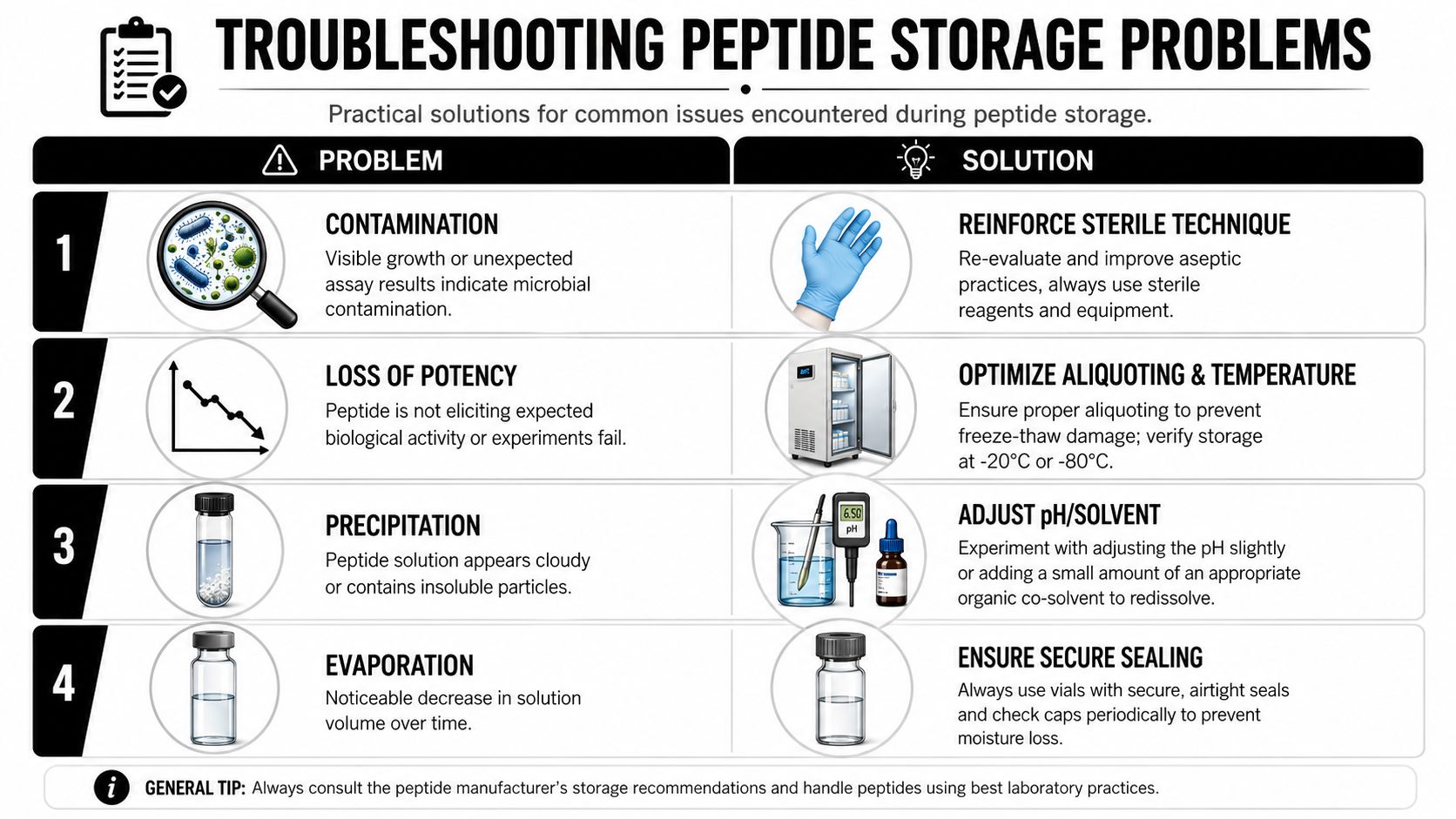
Common situations and the practical response
An aliquot was left at room temperature.
First, determine how long it was out and whether it remained sealed and protected from light. If exposure was brief, the main concern is potency loss, not appearance. Mark the event in the sample record and avoid returning that tube to long-term storage as if nothing happened.The freezer failed overnight.
Check whether the aliquots remained partially frozen, fully thawed, or warmed repeatedly during the failure window. A single uninterrupted warming event is different from cycling. Segregate exposed tubes from unaffected stock and make a conservative use-or-discard decision based on the project's tolerance for uncertainty.The peptide precipitated after thawing.
Don't shake the tube aggressively. Let it equilibrate under controlled conditions and assess whether the solvent system or pH may be contributing. Some peptides need a more sequence-appropriate buffer environment to remain in solution.The vial has been stored in a frost-free freezer.
Treat the sample history as compromised until proven otherwise. The issue isn't one dramatic event. It's repeated temperature fluctuation over time.
What not to do under pressure
A rushed lab tends to make peptide problems worse. These are the common bad fixes:
- Repeatedly refreezing the same vial: this compounds the original error.
- Pooling questionable aliquots with clean stock: this destroys traceability.
- Ignoring light exposure for sensitive samples: clear tubes on a bright bench can deteriorate subtly.
- Leaving pH uncontrolled: some sequences, especially those with free cysteine, are more vulnerable under alkaline conditions.
Stable cold storage only works when the temperature is actually stable.
The larger lesson is that troubleshooting isn't separate from storage practice. It reveals whether the original workflow was built for control or for convenience.
Putting It All Together for Reproducible Research
Good peptide storage is a chain of decisions. If one link is weak, the rest of the workflow has to absorb the damage. A clean reconstitution followed by poor labeling still creates risk. A carefully labeled tube that gets thawed five times still creates risk. A well-aliquoted batch stored in a cycling freezer still creates risk.
The strongest approach is disciplined and boring in the best way. Prepare the solution under clean conditions. Use a solvent and buffer strategy appropriate for the sequence. Label every tube completely. Aliquot immediately. Freeze at −20°C or lower as the working standard, and use −80°C when the peptide or project demands tighter control. Keep light, oxygen, pH stress, and repeated thawing to a minimum.
Researchers who want reproducible data should treat peptide storage as a critical control point, not a back-room task. The Certificate of Analysis and any sequence-specific handling notes should stay attached to the workflow, not buried in email. Storage records should be easy to review. Deviations should be documented when they happen, not reconstructed later from memory.
That is the practical answer to how to store reconstituted peptides. Protect the sample, and the sample is far more likely to protect the data.
Researchers who need sterile diluents, glass vials, and dependable RUO labware can review the range available from Herbilabs. The company supports peptide handling workflows with research-focused supplies, clear documentation, and fulfillment designed for labs that need consistency rather than guesswork.