Private Label, White Label, Wholesale partnerships available - EU, USA and UK - Free shipping from €75

Hospira Bacteriostatic Water: A Guide for Lab Professionals
A purchasing lead signs off on a box of vials. A reseller adds a familiar product name to a catalog. A researcher reaches for a diluent before reconstituting a peptide. All three may be handling the same product, yet each is worried about something different.
The wholesaler wants documentation and traceability. The reseller wants to avoid mislabeling, storage mistakes, and customer complaints. The end-user wants a solution that behaves predictably at the bench. That's why Hospira Bacteriostatic Water raises more questions than plain sterile water. It isn't just water in a vial. It's a specific formulation with a specific use case, and the details matter.
Confusion usually starts with language. People hear “bacteriostatic,” “multi-dose,” “benzyl alcohol,” “RUO,” or “COA” and treat them as separate topics. In practice, they're tied together. The preservative affects how the vial is used. The intended use affects storage and handling. The supply chain affects confidence in what arrives at the lab. A product that looks simple on paper can become a control point for quality, compliance, and safety once it enters real workflows.
Table of Contents
- Introduction Why Specificity in Lab Diluents Matters
- The Composition of Hospira Bacteriostatic Water
- Common Applications in Research and Clinical Settings
- Safety Compatibility and Handling Protocols
- Evaluating Quality and Navigating Regulations
- Purchasing Options and Best Storage Practices
- Frequently Asked Questions for Professionals
Introduction Why Specificity in Lab Diluents Matters
A common mistake in labs and distribution chains is treating all aqueous diluents as interchangeable. They aren't. The label determines how the vial is supposed to be used, how often it may be accessed, and what risks come with that access.
Hospira Bacteriostatic Water tends to draw attention because the name signals a known pharmaceutical manufacturer, but brand recognition alone doesn't answer the practical questions. A buyer still needs to know whether the vial is intended for repeated withdrawals, whether it contains a preservative, and whether its documentation matches the intended market and use.
That matters most when the vial sits between multiple handoffs. A distributor may receive inventory in good condition, a reseller may list it correctly, and an end-user may still compromise the product through poor handling after the first puncture. The reverse also happens. A careful end-user can't fix vague lot records or weak supplier documentation upstream.
Practical rule: If a vial will be punctured more than once, everyone handling it should understand why that's allowed, what preserves that allowance, and what documentation supports the claim.
For peptide work, the distinction becomes very concrete. A lyophilized material needs a solvent or diluent that supports careful reconstitution without adding avoidable uncertainty. For inventory teams, the same distinction appears in another form. They need to know whether they're stocking a commodity bottle of water or a regulated multiple-dose diluent with labeling that has to be read closely.
Specificity is what keeps a small purchasing choice from turning into a bench error, a customer dispute, or a compliance problem.
The Composition of Hospira Bacteriostatic Water
What the product actually is
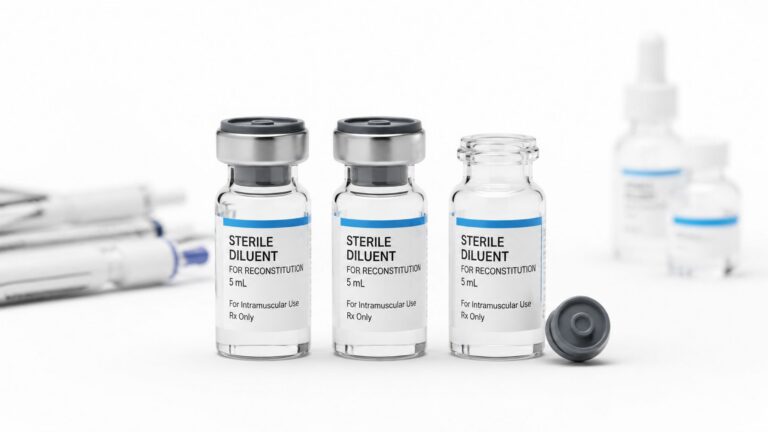
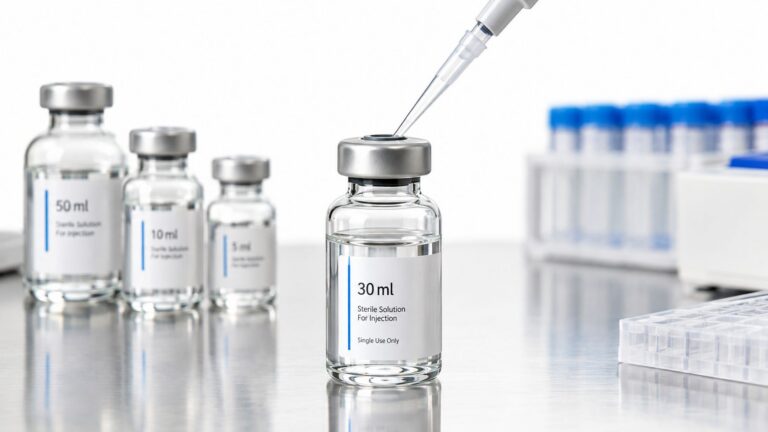
Hospira's product is not merely sterile water packaged under a known label. Pfizer labeling describes Hospira bacteriostatic water for injection, USP as a multiple-dose sterile, nonpyrogenic diluent that contains 0.9% (9 mg/mL) benzyl alcohol, with some presentations containing 1.1% (11 mg/mL), such as a 20 mL fill in 30 mL glass fliptop vials for drug dilution or dissolution, as shown in the Pfizer product labeling.

Two words in that description carry most of the practical meaning. Multiple-dose means the product is formulated and labeled for repeated aseptic withdrawals. Diluent means its role is to dissolve or dilute another substance. It is not presented as a stand-alone therapeutic product for casual substitution in every context where “water for injection” appears on a protocol.
For new lab staff, the easiest way to think about it is this. Sterile water is the solvent base. Benzyl alcohol changes the use pattern of that base.
Why benzyl alcohol changes how the vial is used
“Bacteriostatic” often gets misunderstood as “sterilizing.” That isn't what the label is telling the user. In practice, the preservative helps inhibit bacterial growth after the vial has entered repeated use. It supports multi-dose handling, but it doesn't excuse sloppy aseptic technique.
A useful analogy is a secured door. The rubber stopper is the door. Each puncture opens it briefly. Benzyl alcohol acts more like a security guard than a cleaning crew. It helps control what happens after entry, but it does not undo contamination introduced by poor technique.
That distinction matters for the whole supply chain:
- For wholesalers: product identity depends on the exact labeled formulation, not just the brand name.
- For resellers: listing “sterile water” and “bacteriostatic water” as if they are the same product creates downstream risk.
- For end-users: repeated withdrawals only make sense when the preservative is present and the vial is handled aseptically every time.
A preservative extends practical usability for multi-dose workflows. It does not turn a mishandled vial into a safe one.
One more detail is easy to overlook. DailyMed states that this formulation is stored at 20 to 25°C (68 to 77°F) and identifies it as a sterile, nonpyrogenic multiple-dose diluent, with 0.9% (9 mg/mL) or 1.1% (11 mg/mL) benzyl alcohol depending on the presentation, and names Hospira as distributor in Lake Forest, Illinois, USA, in the DailyMed labeling record. That storage language signals controlled room temperature handling rather than routine refrigeration.
Common Applications in Research and Clinical Settings
The most familiar bench use for Hospira Bacteriostatic Water is reconstituting lyophilized material for repeated small withdrawals. That's one reason peptide users ask for it by name.

A typical workflow starts with inspection, not mixing. The user checks that the vial is clear, intact, and correctly labeled for the intended task. Then the stopper is disinfected, a sterile syringe is prepared, and the diluent is introduced gently into the receiving vial so the powder hydrates without unnecessary agitation. In peptide work, the goal is usually controlled dissolution, not forceful mixing.
How peptide reconstitution usually works
A careful sequence reduces avoidable problems:
- Confirm compatibility first. The compound, protocol, and supplier instructions must agree on the correct diluent.
- Use aseptic technique from the start. Every puncture matters once a vial becomes multi-use.
- Add the liquid slowly. Directing the stream against the vial wall can be gentler than blasting the powder directly.
- Let the material dissolve. Swirling may be appropriate in some workflows. Vigorous shaking often isn't.
- Label the reconstituted product clearly. Date, identity, concentration, and handler initials help prevent bench confusion.
For a practical walkthrough focused on peptide handling, this guide on mixing peptides with bacteriostatic water is a useful operational reference.
Many problems blamed on the diluent are technique problems. Foam, incomplete dissolution, or inconsistent concentration often trace back to rough handling, poor labeling, or repeated non-sterile access.
Other settings where the formulation makes sense
Outside peptide work, the formulation is useful anywhere a sterile multiple-dose diluent is needed for repeated small-volume preparation under appropriate protocols. Clinical and research settings value that pattern because one vial can support several aseptic withdrawals instead of a single one-time use.
That doesn't mean it belongs in every preparation. Some compounds or patient contexts require preservative-free diluents. The right question isn't “Can bacteriostatic water be used?” It's “Does the protocol call for a preserved multiple-dose diluent?”
This visual demo helps clarify how careful vial access and draw technique typically look in practice.
Safety Compatibility and Handling Protocols
Why pH and storage temperature matter
A vial can be sterile and still be a poor fit for a sensitive workflow if compatibility is ignored. DailyMed lists the formulation's pH as 5.7, with an allowed range of 4.5 to 7.0, and specifies storage at 20 to 25°C (68 to 77°F) in the DailyMed FDA labeling file. For bench work, those aren't trivial background numbers. They affect how the diluent may interact with the material being reconstituted.
Some compounds tolerate a broad range of conditions. Others don't. A researcher working with a sensitive peptide, biologically active reagent, or unstable dissolved material should treat pH and temperature as part of the method, not as storage trivia on the carton.
If a vial has been exposed to heat, cold, or poor handling, confidence drops even before visible changes appear. A supply team may not see a dramatic defect, yet the end-user may face reproducibility issues that are hard to trace later.
Controlled storage protects more than the vial. It protects the meaning of the results that come after it.
Handling rules that protect the vial and the workflow
Strict handling isn't bureaucracy. It's contamination control.
A few habits make the biggest difference:
- Disinfect the stopper every time. Multi-dose access only works when each entry is treated as a contamination event waiting to happen.
- Use fresh sterile tools. Reusing syringes or needles defeats the point of a preserved diluent.
- Keep a simple access log. Open date, lot, and user tracking help when several people share stock.
- Separate clean and active bench areas. Vial handling should happen away from clutter, spills, and aerosol-generating steps.
Teams that train around cross-contamination usually get fewer “mystery” failures later. This practical article on preventing cross contamination in lab workflows fits that mindset well.
One safety point also deserves plain wording. Because this product contains benzyl alcohol, users must match the formulation to the intended application and population. A preserved multi-dose diluent solves one problem, but it can create another if used where a preservative-free option is required.
Evaluating Quality and Navigating Regulations
A buyer assessing Hospira Bacteriostatic Water should think like an investigator, not a shopper. The vial label matters, but the paperwork around it matters just as much.
What a buyer should verify before stock moves
For wholesalers and resellers, COA review is part of product qualification. A Certificate of Analysis won't replace label reading, but it helps establish whether the lot documentation is complete, traceable, and consistent with what is being sold. At minimum, a buyer should expect clear lot identification, manufacturer details, and records that align with the product presentation.
Documentation review should also be paired with physical inspection. Check that packaging is intact, seals are undisturbed, and the product identity matches the listing exactly. A mismatch between vial presentation and paperwork is a supply-chain problem, not a cosmetic issue.

A vendor comparing options may also need a baseline reference for how preserved diluents differ from other injectable water products. This overview of water for injection categories and use considerations is helpful when training sales or support staff who need to explain those distinctions accurately.
Why the 2013 recall still matters
In 2013, the FDA reported that Hospira, then a Pfizer company, issued a voluntary nationwide recall of one lot, W20308, of 30 mL multi-dose vials because of a potential lack of sterility and an inability to confirm sterilization for some vials, as detailed in the FDA recall notice. The FDA warned of severe possible outcomes including invasive bacterial infection, bacterial meningitis, septicemia, fever, chills, malaise, and cutaneous abscess, while also noting that no adverse events had been reported at the time of the notice.
That event remains instructive because it shows what quality review is really for. Not reputation. Verification.
A known manufacturer reduces uncertainty. It does not remove the need for lot-level scrutiny.
When a sterile injectable product is under question, every handoff matters. The manufacturer's quality system matters. The distributor's lot control matters. The reseller's recordkeeping matters. The user's handling matters.
Where RUO fits for resellers and research supply partners
RUO, or Research Use Only, is often misunderstood as a casual disclaimer. It isn't. It defines the commercial and operational context in which a product may be marketed and supplied.
For resellers, that means product descriptions, customer support language, and listing categories should match the labeled and permitted use. For buyers, it means confirming that internal sales processes don't drift into unsupported claims. For labs, it means procurement staff should know whether a product is entering a research workflow or a different regulatory pathway.
The cleanest operations are the ones that align label, paperwork, catalog copy, and actual use without improvisation.
Purchasing Options and Best Storage Practices
A vial can leave the supplier in good condition and still become a problem before anyone draws the first milliliter. That is why purchasing and storage need to be treated as one control point, not two separate chores. For wholesalers, this affects traceability and complaint handling. For resellers, it affects whether the product reaches customers with the right paperwork and use-positioning. For end users, it affects whether the diluent still behaves like a trustworthy sterile reagent at the bench.
What to check when ordering
Start with the workflow, because container choice affects how often the stopper is entered and how long the vial stays in active use. A multi-dose format works like a shared lab notebook. It is useful only if each entry is controlled and documented. If a team plans repeated small withdrawals for peptide reconstitution or similar research tasks, that format may fit. If the vial will be opened once and used up promptly, the safer purchasing question is often whether repeated access can be avoided altogether.
The receiving step deserves the same attention as the purchase order. A clean invoice does not confirm a clean shipment.
A practical intake check usually includes:
- Match the product to the order. Confirm the exact name, presentation, lot number, and labeling details before stock is accepted into inventory.
- Inspect the physical unit. Check for cracks, damaged seals, leakage, discoloration, or visible particles. Sterile water should not require interpretation.
- Confirm the paperwork trail. The COA, invoice, shipping record, and internal item record should all point to the same lot and presentation.
- Segregate stock quickly. Place the product into its designated storage condition instead of leaving it on a dock, cart, or packing bench.
- Record who received it. A name, date, and lot entry make later investigations much easier if a customer complaint or internal deviation appears.
One commercial option in this category is Herbilabs, which supplies bacteriostatic water and related reconstitution solutions for research workflows. The useful question for buyers is not whether the name is familiar. The useful question is whether the supplier can provide lot documentation, consistent RUO positioning where applicable, and handling information that stays aligned from catalog listing to delivered unit.

How to store and monitor opened stock
Storage is really contamination control in slow motion. Controlled room temperature matters, but daily handling matters just as much. An opened vial that is passed around carelessly can fail in practice long before the label limit becomes the main issue.
The simplest storage systems are often the strongest because they leave less room for improvisation:
- Store the vial upright in a clean, designated area. This reduces mix-ups and helps staff spot leaks or damage quickly.
- Mark the open date clearly. Use the vial label or a controlled log so every user sees the same timeline.
- Check clarity before each withdrawal. Cloudiness, particles, or any change in appearance should end use immediately.
- Restrict access to trained personnel. Repeated stopper entries only stay low-risk when technique is consistent.
- Quarantine questionable units without debate. If a vial's history or condition is uncertain, remove it from use first and investigate after.
For supply-chain teams, good storage also protects the business record. If a reseller receives a quality question from a peptide customer, the answer should not depend on memory. It should come from documented receipt, storage, and lot history. For bench users, the same rule applies in smaller form. The label, the log, and the vial condition should all tell the same story.
Frequently Asked Questions for Professionals
The hardest questions usually come after the basics are already understood. They tend to involve edge cases, customer explanations, and procurement judgment.
| Question | Answer |
|---|---|
| What makes Hospira Bacteriostatic Water different from plain sterile water for injection? | The key operational difference is the preserved multiple-dose design covered earlier. Plain sterile water and preserved bacteriostatic water shouldn't be treated as interchangeable names for the same thing. |
| Can a wholesaler rely on brand recognition alone when sourcing stock? | No. A recognized brand helps with product identification, but lot records, labeling consistency, packaging integrity, and supplier documentation still need review. The recall history discussed above is the clearest reason why. |
| What should a reseller explain to peptide customers first? | Start with the intended use pattern. Customers need to understand that the product is chosen because it supports repeated aseptic withdrawals, not because it is a generic “better water.” Then explain that technique still determines whether the vial remains trustworthy in use. |
| Is a COA enough to approve a shipment? | No. A COA is one part of qualification. It should match the lot, product presentation, and supplier record, but buyers also need intact packaging, traceability, and internal receiving controls. |
| How should a support team answer questions about RUO products? | Carefully and consistently. The language used in listings, invoices, and customer service should align with the product's permitted context. Support staff should avoid drifting into claims that the label and commercial framework do not support. |
| What's the best way to explain value to a skeptical buyer? | Focus on risk control. A well-documented preserved diluent can reduce confusion around use pattern, handling expectations, and product identity. That's often more persuasive than talking only about brand familiarity. |
| When should a lab discard a vial even if it still looks acceptable? | If handling history is uncertain, labeling is incomplete, packaging was compromised, or aseptic access can't be trusted, the vial shouldn't remain in active use. Visual clarity alone doesn't prove suitability. |
| What usually causes confusion in multi-person labs? | Shared vials with weak labeling. If no one knows who opened the vial, when it was accessed, or how often it has been punctured, confidence drops quickly. |
| Should a buyer compare presentations as well as labels? | Yes. Fill volume, vial format, and exact labeling language affect how the product fits the workflow. Small presentation differences can matter operationally. |
| What's the clearest message for new staff? | A preserved multi-dose diluent supports repeated use only when the label, storage, documentation, and handling all stay aligned. If one part breaks, the whole workflow becomes harder to defend. |
For professionals across the supply chain, that last point is the main takeaway. Hospira Bacteriostatic Water sits at the intersection of formulation science, sterile handling, purchasing discipline, and regulatory clarity. People often focus on only one of those. Reliable operations require all of them.
For labs, resellers, and distribution partners that need bacteriostatic water and related reconstitution supplies within a clear research-use framework, Herbilabs offers product information, supply options, and documentation details that can be reviewed before purchase.