Private Label, White Label, Wholesale partnerships available - EU, USA and UK - Free shipping from €75

Hospira BAC Water: A Researcher’s Explainer Guide
A researcher has a vial of lyophilized compound on the bench, a protocol that assumes clean reconstitution, and very little room for error. At that moment, the diluent can look like the least important item in the setup. It isn't. A poor choice there can introduce contamination risk, shift handling practices, or make it harder to reproduce the same preparation next week.
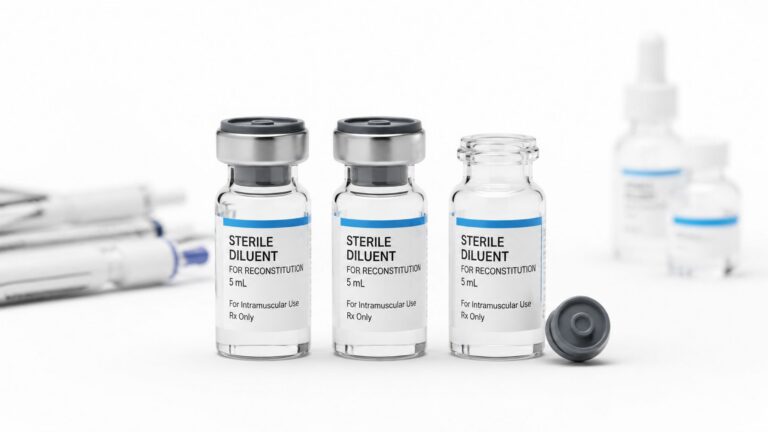
That's why Hospira BAC water keeps coming up in research discussions. It sits at the intersection of sterility, preservative chemistry, and practical sourcing. For new researchers, the confusion usually starts with a simple question: is all bacteriostatic water basically the same? The short answer is no. The label, intended use, packaging, and supporting documentation all matter.
The practical decision often isn't just between one brand and another. It's between pharmaceutical-grade products such as Hospira Bacteriostatic Water for Injection, USP and Research Use Only alternatives sold for laboratory workflows. Those categories overlap in purpose, but they don't mean the same thing, and they shouldn't be treated as interchangeable without checking what the work requires.
Table of Contents
- Why Your Choice of Diluent Matters in Research
- Deconstructing Bacteriostatic Water Composition
- Common Applications in a Research Setting
- Best Practices for Safe Handling and Storage
- Navigating RUO versus Pharmaceutical Grade Supply
- What to Look for When Buying BAC Water
- Frequently Asked Questions About BAC Water
- Is Hospira BAC water the same as any other bac water product
- Does bacteriostatic mean sterile forever after opening
- Can BAC water be used like plain sterile water in every protocol
- Why does RUO documentation matter so much
- What should happen if a vial looks clear but its history is uncertain
- Is it safe to make bacteriostatic water independently
Why Your Choice of Diluent Matters in Research
A diluent isn't passive. It becomes part of the handling environment for the compound being prepared. If a lab is working with a sensitive peptide, a research hormone standard, or any material that will be withdrawn more than once from the same preparation path, the diluent affects how that workflow behaves in practice.
Hospira BAC water is relevant because it represents a well-known pharmaceutical-grade version of a product category many researchers rely on. The category itself is large enough to show how central it has become in modern workflows. In 2024, the global bacteriostatic water for injection market was valued at US$ 1.2 billion, with a projected 7.9% CAGR through 2034, and North America held 41.7% of the market according to Market.us reporting on bacteriostatic water for injection.
That market scale matters for a simple reason. Products used this widely end up in very different settings, from tightly controlled pharmaceutical environments to general research purchasing channels. A new researcher can easily assume that any vial labeled “bac water” serves the same purpose under the same standards. That assumption creates trouble.
The bench-level impact
A reconstitution step usually happens quickly. A vial is opened, the stopper is pierced, liquid is drawn, and a powder is dissolved. But several control points sit inside that sequence:
- Container type: The vial material and closure affect handling and contamination control.
- Preservative system: Multi-use access changes what matters after the first puncture.
- Documentation: Researchers need to know what was tested, by whom, and for which intended use.
- Protocol fit: A diluent that works for one application may be wrong for another.
Practical rule: If the protocol depends on repeatability, the diluent should be treated as a controlled input, not a convenience item.
Researchers who want a broader foundation on why sterile diluents deserve more scrutiny can review the critical role of sterile diluents in research. The key point is straightforward. Reproducibility starts before the compound is ever fully dissolved.
Where researchers often get confused
The most common confusion is mixing up availability with suitability. A product may be easy to buy, widely discussed, or familiar by brand name, but that doesn't answer the questions that matter at the bench:
| Question | Why it matters |
|---|---|
| Is it pharmaceutical grade or RUO? | Intended application changes how the product should be evaluated |
| Is it a multi-dose container? | Repeated access raises handling and contamination concerns |
| Is there batch documentation? | Without it, quality review gets weaker |
| Does the formulation match the protocol? | “Water” alone isn't enough detail |
Researchers don't need more vague assurances. They need enough detail to choose deliberately.
Deconstructing Bacteriostatic Water Composition
Bacteriostatic water sounds more complicated than it is. At its core, it is sterile water plus a preservative. What matters is understanding what that preservative does, and what it does not do.
Pfizer's labeling states that Hospira Bacteriostatic Water for Injection, USP is a sterile, nonpyrogenic diluent containing 0.9% benzyl alcohol (9 mg/mL) as a bacteriostatic preservative, supplied in multiple-dose containers intended for repeated withdrawals. The same labeling also lists a variant with 11 mg/mL benzyl alcohol in a 20 mL fill. That information appears in Pfizer's product labeling for Bacteriostatic Water for Injection, USP.

What bacteriostatic actually means
The word bacteriostatic does not mean “sterilizing.” It means the formulation is designed to inhibit bacterial growth. That distinction matters because many people hear the term and assume the vial can somehow correct poor technique. It can't.
A useful mental model is this: benzyl alcohol acts like a bouncer at the door. It helps stop trouble from building inside a multi-dose setting, but it doesn't turn careless handling into safe handling. If contamination is introduced during repeated vial access, the preservative isn't a license to ignore aseptic practice.
The two parts that matter most
The formulation is easier to understand when split into its functional pieces:
- Sterile water for injection: This is the base solvent. Its job is dilution or dissolution.
- Benzyl alcohol: This is the preservative that supports repeated withdrawals from a multi-dose container.
That combination is why bacteriostatic water is commonly chosen when repeated access is expected. For a chemistry-focused explanation of the preservative role, researchers can review how benzyl alcohol safeguards research integrity.
The preservative helps control growth risk during repeated access. It does not convert the vial into a standalone therapeutic product, and it does not replace sterile technique.
What Hospira BAC water is not
Many new researchers often make a category error. Hospira BAC water is a diluent, not the active material being studied. Its function is to support reconstitution or dilution of another product according to the relevant instructions.
That means several practical boundaries apply:
- It shouldn't be treated as interchangeable with plain sterile water in every protocol.
- It isn't the same as saline.
- It should not be treated as a direct substitute for any product that requires a preservative-free environment.
A researcher who understands those boundaries will make better decisions before the vial is ever punctured. That's where most avoidable mistakes begin.
Common Applications in a Research Setting
In research settings, bacteriostatic water most often appears at the moment a dry material needs to become a usable solution. The classic example is a lyophilized powder. A vial arrives sealed, the active material is freeze-dried, and the protocol calls for careful reconstitution before aliquoting or repeated use.

A peptide lab provides a familiar scenario. A researcher receives multiple vials from the same lot, plans a series of assays across several days, and wants one prepared solution to remain usable over repeated withdrawals within the allowed handling window. In that workflow, bacteriostatic water is often selected because the preservative system better fits multi-use access than plain sterile water.
Typical bench workflows
The practical uses tend to cluster around a few recurring patterns:
- Peptide reconstitution: A dry peptide is dissolved for aliquoting, storage planning, or controlled experimental use.
- Research hormone preparation: A small-volume vial is reconstituted for repeated measured withdrawals in a laboratory context.
- Method development: A lab may compare stability, handling, or dissolution behavior across diluents while documenting protocol effects.
What matters in each case is that the water is serving as a vehicle. It is there to prepare another material, not to stand alone as the object of use.
Why researchers choose it over plain sterile water
Plain sterile water has no preservative. That makes it appropriate in some contexts, but less forgiving for repeated entry into the same vial or repeated use after preparation. Bacteriostatic water is often preferred when a multi-dose handling pattern is expected and the protocol allows it.
That doesn't mean it's automatically the right choice. A preservative can be helpful in one workflow and inappropriate in another. The protocol should drive the choice, not habit.
A good lab habit is to ask one question before selecting the diluent: will this preparation be accessed once, or repeatedly?
Common mix-ups on the bench
New researchers often confuse bacteriostatic water with two other liquids:
| Product | Main difference |
|---|---|
| Sterile water | No preservative, usually approached as single-use once opened |
| Saline | Contains salt, so it isn't a neutral substitute for every reconstitution step |
| Bacteriostatic water | Contains preservative and is built for multi-dose container use |
Another frequent misunderstanding is assuming the phrase “for injection” means the vial is meant to be used by itself. In practical laboratory terms, the safer understanding is narrower. It is a diluent used in preparation workflows.
A simple example
A lab receives a freeze-dried reference compound intended to be dissolved and sampled several times over the course of a short project. Using a multi-dose diluent with a preservative system may make the workflow more manageable. Using plain sterile water may force stricter one-time-use handling or earlier discard of the prepared material path.
That decision affects convenience, but it also affects documentation. A reproducible lab records not only what active compound was used, but also what diluent was used, from which supplier, in which vial type, and under what storage conditions.
Best Practices for Safe Handling and Storage
Clean handling matters more than brand familiarity. A premium label won't rescue a vial that's been punctured carelessly, stored poorly, or passed around without documentation. For bacteriostatic water, safe use depends on routine discipline.
A practical visual checklist helps keep that discipline consistent across staff and shifts.

Before the first puncture
Start with the basics. Inspect the vial, confirm the label, and check the expiration date. If the closure looks damaged, the liquid appears abnormal, or the label information doesn't match the protocol, the vial shouldn't enter use.
Storage should follow the product instructions. The infographic above includes controlled room temperature (15 to 30°C) as a handling reference in its checklist, but researchers should still verify the exact product labeling and site procedures before setting storage rules for a given supply.
During routine use
Each puncture is a contamination opportunity. That sounds severe, but it's the right mindset.
- Swab the stopper: Alcohol wiping before access lowers transfer risk from the surface.
- Use a new sterile syringe and needle: Reusing access hardware undermines the whole point of controlled vial handling.
- Record the opening date: Multi-use containers need a visible lifecycle.
- Limit unnecessary handling: The less time the vial spends in active circulation, the better.
For teams training junior staff, this short demonstration can help reinforce the handling sequence:
Why discard timing matters
Once a multi-dose vial has been entered, the clock changes. Repeated access, environmental exposure, and surface contact all add cumulative risk. Even if the liquid still looks clear, visual inspection alone doesn't prove continued suitability.
That's why good labs label the vial at first puncture and follow a defined discard practice rather than relying on memory. The habit is as important as the chemistry. It keeps one technician from assuming another technician “just opened it yesterday.”
Handling standard: Date the vial on first use, store it as directed, and treat every later access as a fresh aseptic event.
Signs a vial should be removed from use
A vial should be set aside and evaluated for disposal if any of the following appear:
- Visible particles: Anything floating or settled is enough to stop use.
- Cloudiness or discoloration: The solution should remain visually clean.
- Compromised closure: A damaged stopper or loose seal undermines sterility assumptions.
- Documentation gaps: If no one can confirm when it was opened, it shouldn't stay in circulation.
The strongest handling systems are boring on purpose. They make the correct action obvious every time.
Navigating RUO versus Pharmaceutical Grade Supply
Most purchasing mistakes arise when a buyer sees “bacteriostatic water,” compares vial size and price, and assumes the products differ mainly by branding. They don't. The key distinction is intended use, regulatory framework, and documentation depth.
Pharmaceutical-grade products such as Hospira Bacteriostatic Water for Injection, USP are labeled and distributed within a regulated medical product framework. RUO products are sold for laboratory use and should be evaluated under that context. Neither label should be ignored, and neither category should be stretched beyond its intended role.

What pharmaceutical grade signals
With a product like Hospira BAC water, the buyer is looking at a labeled pharmaceutical item. That means the product identity, formulation, and packaging are presented inside a medical manufacturing and distribution system. For some buyers, that's exactly what the application requires.
But pharmaceutical status should never be mistaken for immunity from quality events. In October 2024, Hospira, Inc. issued a voluntary nationwide recall for one lot of Bacteriostatic Water for Injection, USP, specifically lot W20308, due to a potential lack of sterility assurance. The FDA notice states that Hospira could not confirm the sterilization process for some vials in that lot, creating risk of severe adverse events including bacterial meningitis, septicemia, and sepsis, though no adverse events had been reported at the time of the recall announcement according to the FDA recall notice for Hospira Bacteriostatic Water for Injection, USP.
That recall is a useful reminder. Brand recognition is not a substitute for lot-level vigilance.
What RUO buyers should examine
Research Use Only supply belongs in a different decision tree. The product isn't being purchased under the same intended-use assumptions as a pharmaceutical-grade item. The question becomes: what evidence supports the quality of the material for laboratory work?
A strong RUO review usually starts with the Certificate of Analysis.
- Batch specificity: The COA should relate to the exact batch in hand.
- Identity and basic quality markers: The document should clearly match the labeled product.
- Supplier transparency: Buyers should be able to see what was tested and how the lot is tracked.
- Use limitation clarity: The product should be plainly designated for research use only.
For teams that need a concise framing of those boundaries, this explanation of Research Use Only meaning is a useful reference.
A practical purchasing comparison
| Buying question | Pharmaceutical grade | RUO |
|---|---|---|
| Intended application | Labeled medical product context | Laboratory research context |
| Documentation focus | Product labeling and regulated distribution | Batch-specific testing and supplier transparency |
| Buyer mistake to avoid | Assuming no lot-level review is needed | Assuming “sterile” language alone is enough |
| Key review habit | Check recalls and lot status | Check COA and intended-use statement |
One RUO option in this category is Herbilabs, which supplies bacteriostatic water and reconstitution solutions in premium glass vials with batch testing and COA-based documentation for research workflows. That doesn't make it interchangeable with pharmaceutical-grade Hospira product. It means the buyer should match the supply type to the application, then judge the supplier by documentation and clarity.
The right comparison isn't “Which is better?” It's “Which product category fits the actual work, and what proof supports that choice?”
What to Look for When Buying BAC Water
A careful buyer doesn't stop at the front label. The right purchasing habit is to review the vial as a package of risks and controls. If any of the basics are vague, the product deserves more scrutiny before it reaches the bench.
Start with intended use and labeling
The first question is simple. Is the product clearly marked for pharmaceutical use or Research Use Only? Ambiguous labeling is a warning sign because it leaves the buyer guessing about the framework that should govern handling and procurement.
The second question is whether the label clearly identifies the formulation and container type in a usable way. A good product listing should make it easy to confirm what is being purchased, not force the buyer to infer key details from marketing language.
Then review the supporting documents
For RUO purchasing, documentation is the backbone of trust. A buyer should expect enough information to tie the vial in hand to a traceable batch and a defined test record.
A strong checklist looks like this:
- Batch-specific COA: Not a generic template. The document should correspond to the lot being sold.
- Clear product identity: The COA, label, and invoice should describe the same item.
- Container material disclosure: Glass and plastic don't behave the same in all workflows, so the packaging should be known.
- Supplier contact transparency: Buyers should be able to reach a real company for clarifications and records.
Look at the vial, not just the certificate
Some buyers over-focus on paperwork and ignore packaging quality. That's a mistake. The closure integrity, vial material, and general presentation all affect handling consistency. Many researchers prefer chemically inert glass containers for certain workflows because they reduce one layer of uncertainty in storage and compatibility decisions.
A BAC water purchase should survive three checks: the label makes sense, the documents match the batch, and the container looks fit for controlled lab use.
Questions worth asking before purchase
Instead of asking “Is this good?”, a buyer gets better answers with narrower questions:
- Is the product pharmaceutical grade or RUO?
- Is there a batch-specific COA available before or at purchase?
- What preservative system is used, and is it stated clearly?
- What container material is used?
- Is the supplier explicit about what the product is for, and what it is not for?
A supplier that answers those questions clearly is easier to work with in a reproducible lab environment. A supplier that avoids them usually creates work later.
Frequently Asked Questions About BAC Water
Is Hospira BAC water the same as any other bac water product
No. Products in the same category can differ in labeling, intended use, packaging, documentation, and distribution framework. A buyer should compare those features before treating them as substitutes.
Does bacteriostatic mean sterile forever after opening
No. The preservative helps inhibit bacterial growth in a multi-dose context, but it doesn't cancel contamination risk from repeated punctures or poor technique.
Can BAC water be used like plain sterile water in every protocol
No. Some protocols call for preservative-free conditions, and some don't. The formulation has to match the application.
Why does RUO documentation matter so much
Because RUO purchasing depends heavily on supplier transparency. If the batch can't be tied to a usable COA and a clear intended-use statement, the buyer has less control over research quality.
What should happen if a vial looks clear but its history is uncertain
It should be removed from use. A clear appearance doesn't prove proper handling, correct storage, or acceptable time in circulation.
Is it safe to make bacteriostatic water independently
That isn't an appropriate lab shortcut. Preservative concentration, sterility assurance, container quality, and documentation all matter. Those controls are exactly why researchers buy prepared products rather than improvising them.
Herbilabs provides bacteriostatic water and related laboratory diluents for Research Use Only workflows, with batch documentation and wholesale availability for labs, resellers, and distribution partners that need a documented sourcing option alongside pharmaceutical-grade products such as Hospira BAC water.